
When rent is due Friday, the car needs a $600 repair, or a medical bill lands early, waiting a week for payday isn’t an option. That’s when apps like Nova Cash Advance start showing up in searches, app store recommendations, or right next to your credit card issuer’s fee warning. But before you connect a card and tap “approve,” you deserve straight answers on cost, credit impact, and repayment.
A Nova Cash Advance is a short-term loan. It goes to your linked checking account and is paid back automatically through ACH debit. Instead of borrowing directly from your card, it uses your available credit to decide if you qualify.
Below, we break down eligibility, real dollar costs, the repayment mechanism, credit score effects, and the red flags to watch before you accept a single dollar.
Key Takeaways
This guide explains how a Nova cash advance is calculated, funded, and repaid, including eligibility requirements, fee and APR ranges, repayment timing, and how a missed payment can affect your credit report.
Core Facts:
- A Nova cash advance is a separate short-term loan funded through your bank account, not a direct charge added to your credit card balance.
- Nova calculates your advance amount by applying a risk-based percentage, typically 10% to 30%, to your card’s available credit.
- The final approved amount is capped at whichever is lower: the calculated limit or the amount you requested in the app.
- Nova charges an upfront fee in a single-digit percentage range plus an ongoing APR typically between the high teens and low thirties.
- Repayment happens through an automatic ACH debit from your linked checking account on a scheduled date, with a backup card used if the debit fails.
- A missed payment can trigger a failure fee, a higher APR on the remaining balance, and, in extended cases, collections or credit report reporting.
Best for:
- Credit card holders considering a Nova cash advance who want to understand the real cost before applying.
- Readers trying to estimate their likely approval amount based on their current credit utilization.
- Anyone wanting to understand how missed Nova payments could affect their credit report before they authorize the loan.
What a Nova Cash Advance Actually Is
A Nova Cash Advance is not the same thing as pressing “cash advance” on your credit card at an ATM. It’s a separate short-term loan provided by a third-party app. The money doesn’t come off your credit line and doesn’t post as a purchase or cash-advance transaction on your card. Instead, the funds are deposited straight into the checking account you link during signup, and the app later pulls the repayment from that same account by ACH debit.
So why does the app ask for your credit card at all? Nova uses your card’s available credit, payment history, and account age as a risk signal to decide how much to lend and at what price.
Your card is essentially a soft data source and, in some cases, a backup payment method if the checking account debit fails. The actual loan sits with Nova (or its lending partner), not your card issuer.
That distinction matters for three reasons. To start, your credit card statement won’t show a “cash advance” line item. This means you can avoid the issuer’s cash-advance fee, which is usually 3%–5%.
Additionally, you won’t face the steep cash-advance APR that starts accruing immediately. Second, because the money lands in checking, you can use it for anything a debit card or bank transfer can pay, including rent, utilities, or a landlord who won’t take plastic. Third, repayment is controlled by Nova’s schedule, not your card’s billing cycle.
How This Differs From a Traditional Credit Card Cash Advance
A traditional credit card cash advance pulls money against your card’s credit limit at an ATM, a bank counter, or through a convenience check. It carries a cash-advance APR that’s typically 5 to 8 points higher than your purchase APR, and interest starts on day one with no grace period.
According to Bankrate’s tracking, the average credit card APR is around 20%, but cash-advance rates often run close to 30%. On top of that, your issuer usually charges a 3%–5% transaction fee.
A Nova-style advance sidesteps most of that structure. It’s a fresh short-term loan, not a draw on your credit line, so it doesn’t raise your card’s reported balance or utilization ratio (more on that below). But it has its own fees, APR, and repayment date. This date is usually linked to your next payday, not your monthly credit card statement.
Eligibility Requirements: What You Need to Qualify
To qualify for a Nova Cash Advance, most applicants need to meet a small set of baseline checks. To qualify, you must be at least 18 years old. You need to be a U.S. resident with a Social Security number or ITIN. Also, have a linked checking account that shows regular deposits for the last 60 to 90 days. The app also wants an open credit card, in good standing, and not maxed out.
Nova doesn’t do a hard credit pull. Instead, it checks your card’s snapshot. This includes your current balance, credit limit, on-time history, and when the account was opened.
New cards under 3 to 6 months old are often rejected because there isn’t enough history to score. A checking account with frequent overdrafts or negative balances is also a common reason for a lower cap or a flat decline.
You’ll need a valid government ID for identity verification. Also, have a working phone number for two-factor authentication. If the name on your ID doesn’t match the name on your checking account or credit card, expect a delay while support reviews the mismatch.
Common Reasons for Denial or a Lower Approval Than Expected
Even if you meet the baseline rules, the amount offered can be smaller than you hoped, or the app can decline outright. The most common reasons include:
- High credit utilization on the linked card. If your card is already 70% or more utilized, Nova reads that as elevated risk and either declines or offers a much smaller advance.
- Recent large purchases or a cash advance on the same card in the past 30 days. These signal short-term stress and often trigger a cap.
- Irregular deposits into checking. If direct deposits are inconsistent or the account often dips near zero, the app may worry the ACH debit will bounce.
- A recent late payment on any tradeline. A 30-day late in the past six months is a frequent auto-decline.
- Duplicate accounts or a device flagged for prior chargebacks. If someone previously used your device or IP to run a Nova account with an unpaid balance, the new application is blocked.
If declined, most cash-advance apps let you reapply after 14 to 30 days once the flagged factor changes.
How Nova Calculates Your Advance Amount
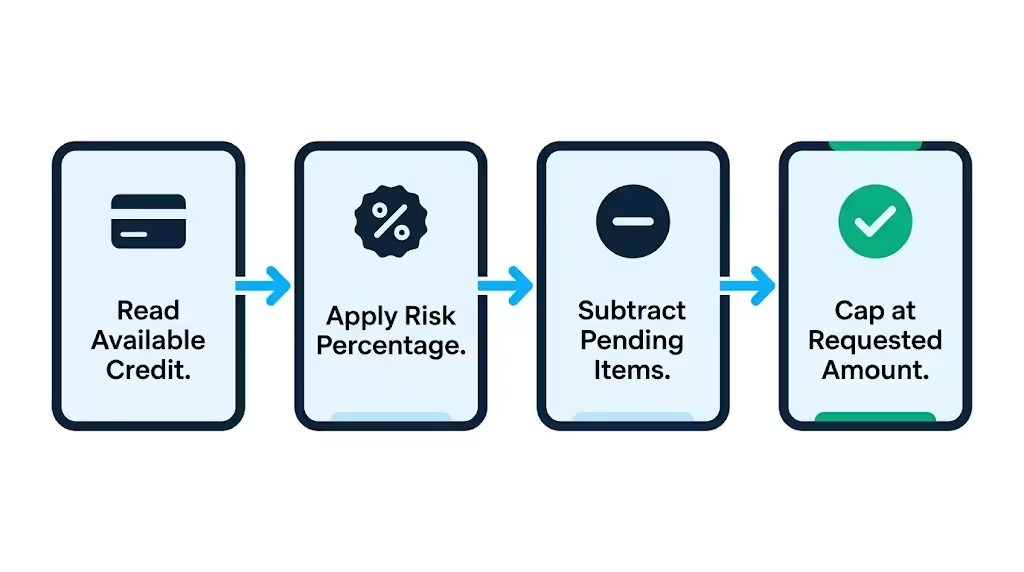
Nova’s underwriting logic works in two layers. First, it looks at your available credit on the linked card, which is your credit limit minus your current statement balance and pending charges. That number sets the ceiling. Second, it applies a risk-based percentage to that ceiling, adjusted for your card’s age, utilization pattern, payment history, and your checking account’s deposit stability.
Most first-time users get 10% to 25% of their available credit. This amount is capped at the app’s maximum, which is usually between $200 and $500 for new users. So if you have $2,000 in available credit and a solid history, an offer near $300 to $500 is realistic. With $2,000 available credit but a card that’s 65% utilized, the same applicant might see $150 to $250 instead.
Repeat users who repay on time typically see their cap grow with each successful cycle. A pattern of 3 to 6 clean repayments often unlocks the app’s higher tier, sometimes double the initial offer. Missed or late repayments do the opposite: the cap drops or resets to the entry-level tier.
Estimate Your Likely Approval Range Before You Apply
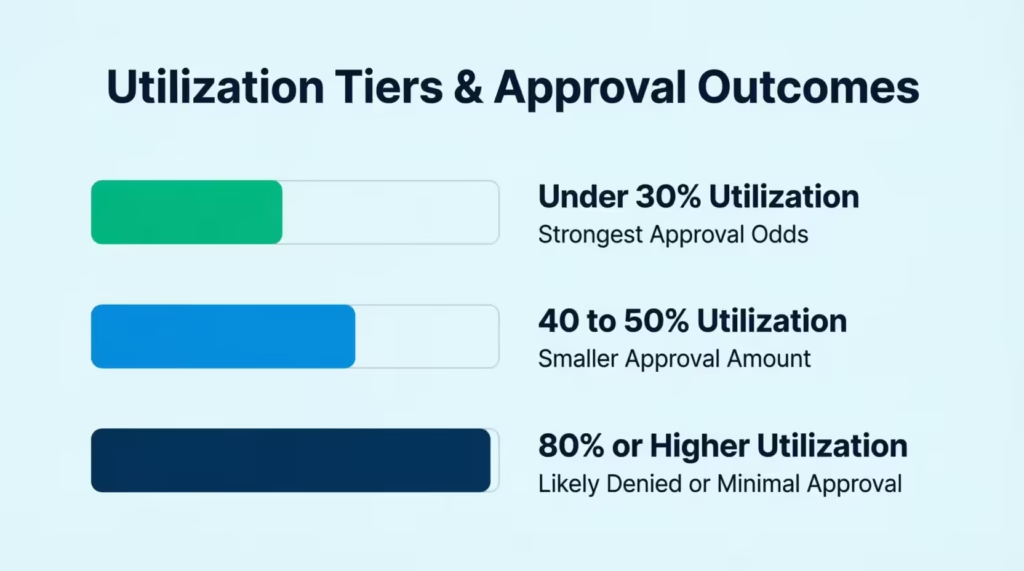
You can get a rough estimate before you apply by running this quick self-check on your linked card:
- Utilization under 30% and account older than 12 months: Expect an offer in the higher band, roughly 20%–25% of available credit, up to the product cap.
- Utilization 30%–60% or account 6–12 months old: Expect a mid-band offer, roughly 10%–15% of available credit.
- Utilization over 60% or account under 6 months: Expect a low-band offer or a soft decline, often under 10% of available credit or no offer at all.
Add or subtract based on your checking account. Steady biweekly deposits of $1,500+ push the offer up. Frequent low balances or overdrafts push it down.
💡 Pro Tip: If you’re close to a utilization tier break (say, 32%), pay your card down by even $50 before applying. Nova pulls a fresh snapshot each time, and dropping just under 30% utilization can meaningfully improve your offer.
The Application Process, Step by Step
The Nova cash advance application takes most people 5 to 10 minutes end to end. Here’s what to expect and prepare.
Step 1: Download the app and create an account. Nova is available on the Apple App Store and Google Play. Sign up with your email or phone number, then set a strong password and enable two-factor authentication when prompted.
Step 2: Complete identity verification (KYC). Federal Know Your Customer rules require the app to confirm you’re a real person. You’ll enter your legal name, date of birth, address, and either your Social Security number or ITIN. You’ll also upload a photo of a government-issued ID (driver’s license, state ID, or passport) and take a live selfie. Blurry photos are the top reason KYC gets rejected, so use good lighting.
Step 3: Link your checking account. Most apps use Plaid or a similar aggregator, which asks you to log in with your bank’s online banking credentials. The connection is read-only. Nova sees deposits, balances, and transaction history but can’t move money without a separate authorization.
Step 4: Link your credit card. Enter the card number, expiration, and CVV. Some cards require a small verification charge (usually $0.50 to $1.00) that’s refunded within 3 to 5 business days. This confirms the card is active and matches your name on file.
Step 5: Review the offer and terms. Once approved, you’ll see the exact advance amount, the flat fee (if any), the APR, the repayment date, and the account that will be debited. Read this screen carefully. Once you tap accept, the ACH pull is scheduled and hard to reverse.
Step 6: Choose funding speed. You’ll usually have two options: standard ACH (free, next business day) or instant funding (fee of $1.99 to $8.99, minutes to a few hours). The instant option uses debit rails, so your linked checking must accept push-to-debit.
⚠️ Mistake to Avoid: Accepting an offer without checking the exact repayment date. Many users assume repayment falls on their next payday, but the app may schedule it 14 days out regardless of when you get paid. If your paycheck lands after the debit, you’re set up for an overdraft.
When You’ll Actually Get the Money
Funding time depends on which speed you choose and when you submit the request.
Standard ACH funding is free but slower. Requests submitted before the day’s ACH cutoff typically land in your checking account the next business day. Requests submitted after cutoff, on weekends, or on federal holidays roll to the next business day. NACHA data shows Same Day ACH now processes over 1.4 billion payments annually, with three daily processing windows, but not every bank supports the fastest window on the receiving side.
Instant funding uses debit card rails (often called Visa Direct or Mastercard Send). Money usually arrives within minutes, though banks can take up to a few hours to post it as available balance. The fee for instant funding typically runs $1.99 to $8.99, and it applies even if the transfer is delayed.
A few real-world timing rules to know:
- Weekend requests: A Friday-evening or Saturday request on standard ACH usually posts Monday morning.
- Holidays: Federal holidays add a full business day to standard funding.
- First-time users: Your first advance may take longer because the app runs extra fraud checks and a micro-deposit verification on your bank link.
- Small banks and credit unions: Some smaller institutions don’t post ACH credits until end of day, even when the transfer settles earlier.
If speed matters and you can’t wait, instant funding is worth the fee. If you can wait one business day, standard ACH saves money.
What a Nova Cash Advance Actually Costs
Cash advance apps aren’t free, even when they say “no interest.” The real cost often includes a flat borrowing fee. You may also face an instant funding fee if you need money quickly. In some cases, there’s a monthly subscription to access advances. Add in an optional “tip” and you can end up paying an effective APR that dwarfs a credit card.
CFPB analysis of the paycheck advance market found the average APR for a typical earned wage cash advance is around 109.5% once expedited fees and tips are counted as finance charges. The same CFPB analysis puts expedited-funding fees at $1 to $5.99, averaging $3.18.
Here’s how the pricing pieces typically stack for a Nova-style advance:
- Flat advance fee: Sometimes zero, sometimes 1%–5% of the advance amount, disclosed on the offer screen.
- Instant funding fee: $1.99 to $8.99 per advance if you skip the free next-day option.
- Subscription fee: Some apps charge $1 to $15 per month for membership, whether or not you take an advance that month.
- Optional tip: Framed as voluntary, but on many apps the default tip is preselected. The CFPB treats these as finance charges.
- Late or failed-debit fee: $10 to $35 if the ACH pull bounces, depending on the app.
- Bank overdraft fee: Not paid to Nova, but if the debit hits when your account is short, your bank can charge $25 to $35 on top of the failed-debit fee.
The APR on a cash advance app looks low as a flat number because the repayment term is short. A $5 fee on a $100 advance repaid in 14 days is roughly a 130% APR when annualized.
Worked Example: What a $300 Advance Actually Costs You
Take a common scenario. Jennifer, an operations coordinator at a Denver logistics firm, needs $300 to cover a car repair five days before payday. She takes a Nova advance with these terms:
- Advance amount: $300
- Flat fee: $6 (2%)
- Instant funding fee: $5.99
- Subscription: $3/month (already paid this month)
- Optional tip: $3 (default suggestion, she leaves it on)
- Repayment date: 14 days out
Her out-of-pocket cost is $6 + $5.99 + $3 = $14.99 in direct fees, plus the $3 subscription she’s already paying. She gets $300 and pays back $300. But fees come from her checking account. They can be upfront or included in the repayment, depending on the app.
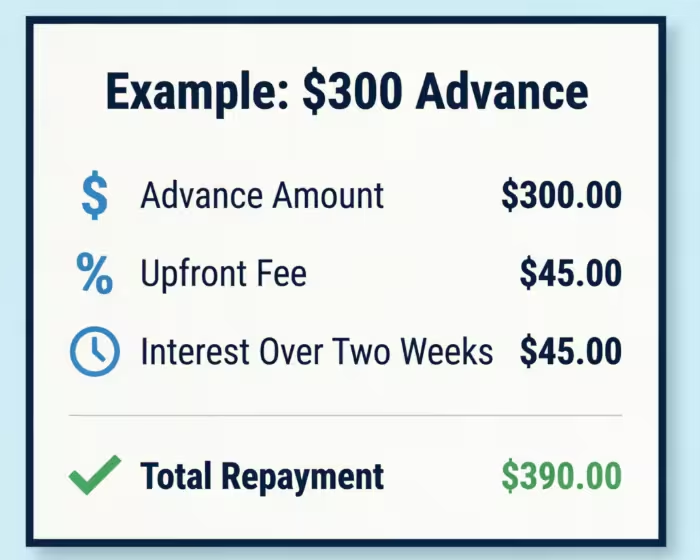
Annualized, $14.99 in fees on a $300 advance held for 14 days works out to roughly a 130% APR. If she skipped the tip and used free standard funding, the cost would drop to about $6, or roughly a 52% APR. For comparison, her credit card’s cash-advance APR is 29.99% with a $10 (3%) transaction fee, a total of $10 plus a few days of interest, or about $12 for the same period.
The lesson: cash advance apps can be competitive with credit card cash advances on very short holds, but only if you skip instant funding and tips. Add both, and the app costs more.
How Repayment Works
Nova repayment is almost always fully automated. When you accept the advance, you authorize an ACH debit from your linked checking account on a specific repayment date, usually 7 to 30 days later. On that date, the app pulls the full amount owed (advance principal plus any bundled fees) in a single transaction.
On your bank statement, the debit typically shows as something like “NOVA CASH ADV” or the name of Nova’s payment processor. It counts as an ACH withdrawal, not a card charge, which means it won’t show up on your credit card statement.
A few repayment mechanics worth knowing:
- The debit hits the morning of the repayment date. Funds need to be available at the start of the business day, not the end. If your paycheck lands the same day, timing can be tight.
- You can usually repay early. Most apps let you tap “pay now” to trigger an earlier debit, which can unlock a new advance sooner or lift your future cap.
- You can sometimes reschedule once. Many apps offer a one-time repayment extension of 3 to 7 days, either free or for a small fee. Use it before the original date, not after.
- A backup payment method may be pulled if the primary fails. If you linked a debit card or your credit card as backup during signup, the app can attempt a charge there if the ACH debit bounces. That fallback debit-card charge would post on your card statement.
📌 Did You Know: Automatic ACH debits from cash-advance apps are one of the top triggers for consumer overdraft fees. Setting a same-day calendar alert one day before repayment gives you time to move money into checking if needed.
What Happens If You Miss or Delay a Payment
Missing a Nova repayment doesn’t work like missing a credit card payment. There’s no 30-day grace period before something bad happens. The consequences start within hours of the failed debit and escalate over weeks.
Immediately after a failed ACH pull, the app typically retries the debit within 1 to 3 business days. Each failed retry might cause a late payment fee from the app, usually $10 to $35. It can also lead to a non-sufficient funds or overdraft fee from your bank, typically $25 to $35. Two failed retries can easily add $60 to $70 in fees on top of the original balance.
If retries keep failing, the app pauses your account so you can’t take new advances. After 30 to 60 days of nonpayment, the balance is often sent to a third-party collections agency. The collector can report the debt to credit bureaus. This may add a collections tradeline to your credit report, which can stay for up to seven years.
Mild vs. Severe Consequences: What to Prioritize
Not every missed-payment consequence is equal. Sort them by severity to decide where to focus if money is short.
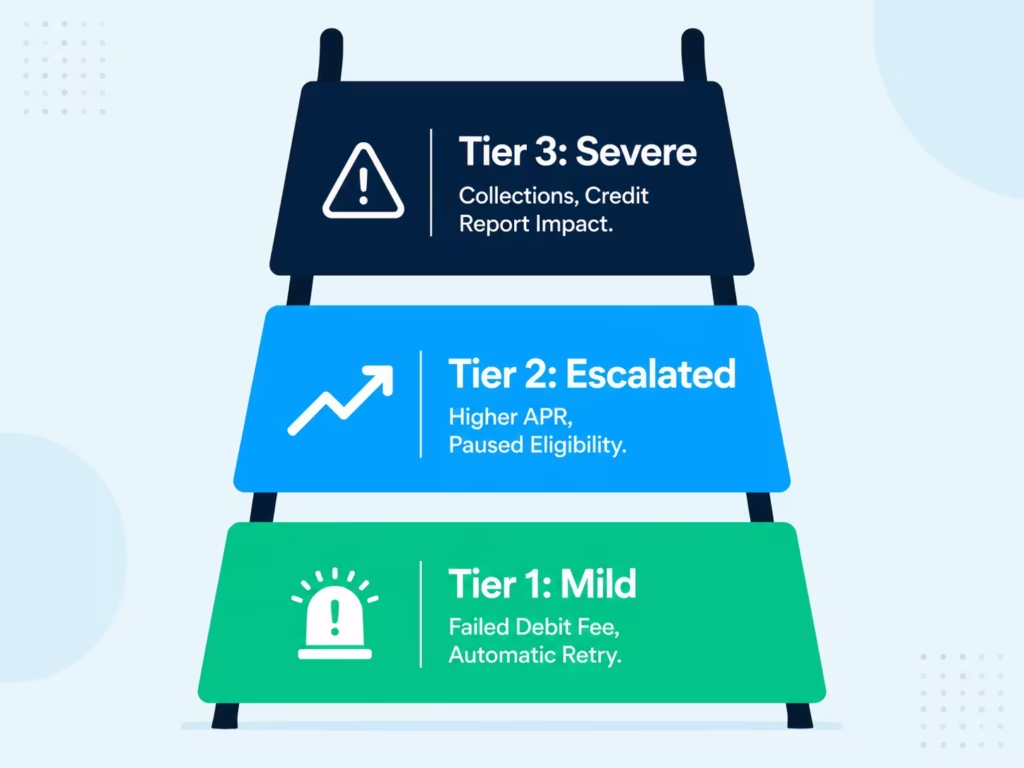
Mild (fix within days):
- App-level late fee ($10–$35)
- Bank overdraft or NSF fee ($25–$35 per bounce)
- Account frozen from new advances
Moderate (fix within 2–4 weeks):
- Repeated failed retries pulling your bank account further into overdraft
- Loss of eligibility for the app’s higher advance tier
- Cascading fees from other bills bouncing because of the negative balance
Severe (fix before 30–60 days):
- Transfer of the balance to a third-party collections agency
- Credit bureau reporting of the collections account, which can drop a FICO Score by 50 to 100+ points and stay on file for seven years
- Potential small-claims lawsuit for the unpaid amount plus fees
Priority is clear: if you can only fix one thing, fix the debt before it hits 30 days delinquent. The app-level fees hurt, but a collections tradeline hurts far more and far longer.
Does a Nova Cash Advance Affect Your Credit Score?
For most users, a Nova Cash Advance itself doesn’t directly show up on a credit report. The app doesn’t do a hard inquiry. It also doesn’t open a tradeline with the bureaus. Furthermore, it doesn’t report on-time repayments to Experian, Equifax, or TransUnion. That means a paid-on-time Nova advance is invisible to FICO scoring.
But there are three indirect ways your credit can still take a hit.
First, your credit utilization ratio. Because Nova uses your credit card only as a data signal, the advance itself doesn’t add to your card balance. Utilization stays the same unless you use the cash from the advance to pay your card.
Then, if you recharge the card or use it as backup, it will count as a card charge. Utilization drives about 30% of your FICO Score. According to Experian’s 2025 consumer credit review, average U.S. credit card utilization sits at 29.1%, and keeping utilization below 10% is best for score building.
Second, missed repayments that go to collections. A Nova balance sent to a collections agency can hurt your score a lot. It can stay on your record for seven years, according to the Fair Credit Reporting Act.
Third, backup payment cascades. If your ACH debit fails and Nova pulls from a backup credit card, that charge shows on your card statement as a purchase. If your card balance goes over 30% utilization, your FICO Score might drop. This usually happens when the card reports to the bureaus, often the day after your statement closes.
Bottom line: a used-and-repaid-on-time Nova advance is essentially neutral to your credit report impact. A missed and collected advance can materially damage your score. The single most important thing you can do to protect your credit is to make sure the checking account has enough money on the repayment date.
How Nova Protects Your Bank and Personal Data
Any app that asks for your Social Security number, bank details, or credit card info needs strong data protection. A reliable cash-advance app must meet security standards. It should protect cardholder data when storing and sending it. Additionally, it needs modern authentication to stop account hijacking.
Look for these specific protections before you connect anything:
- Encryption in transit and at rest. Sensitive data (SSN, bank credentials, card numbers) should travel over TLS 1.2 or higher and be stored with AES-256 encryption. Encryption at rest means even if a database is breached, the raw values are unreadable.
- Tokenization of card numbers. Instead of storing your full 16-digit card number, the app should replace it with a token that maps back to the real number only inside a locked “vault.” Tokenization is now expected under the current PCI DSS 4.0.1 standard, which became mandatory on March 31, 2025.
- PCI DSS compliance. Any company handling credit card data must comply with the Payment Card Industry Data Security Standard. Reputable apps disclose their PCI DSS level on their security or trust page.
- Bank credentials via a trusted aggregator. Reputable apps use Plaid, MX, or Finicity to link your checking account, so your bank password is entered on the aggregator’s page, not stored by Nova.
- Two-factor authentication and biometrics. Requiring a code via SMS or an authenticator app plus a Face ID or fingerprint check makes account takeover far harder.
- Clear data-sharing disclosures. The privacy policy should say what data is shared with lending partners, credit bureaus, and marketing partners, and how to opt out.
Before installing, check the app’s most recent privacy policy and security page. A reputable app updates both at least once a year and lists a specific security contact for reporting vulnerabilities.
Red Flags to Watch For Before You Accept an Advance
Before you tap accept on any cash-advance offer, run through this checklist. Any single red flag isn’t automatic disqualification, but two or more should push you to pause and reconsider.
Cost and fee red flags:
- The total cost (fee + instant funding + tip + subscription) isn’t shown as one number before you confirm. If you have to add it up yourself from four screens, that’s a warning.
- The “APR” or effective rate isn’t disclosed anywhere in the app, even though CFPB guidance treats expedited fees and tips as finance charges.
- The default tip is preselected at 10% or higher and can only be lowered through a hidden menu.
- Subscription fees continue to bill even when you don’t take an advance and there’s no easy in-app cancellation.
Repayment and account red flags:
- The repayment date isn’t confirmed on the acceptance screen or is set to a date before your next paycheck lands.
- A pending hold on your checking account can lower your available balance. This can happen due to another debit, a deposit that hasn’t cleared yet, or an existing autopay.
- The app requires a credit card as a mandatory backup payment method with no opt-out. This is where overdraft risk meets card-utilization risk.
- Auto-renewal or “auto-advance next payday” is turned on by default and buried in settings.
Trust and legitimacy red flags:
- No physical address, no state lender license disclosures, and no CFPB complaint route on the app’s website.
- Recent app-store reviews (last 30 days) mention unauthorized debits, surprise fees, or blocked cancellation.
- The privacy policy allows the app to sell your data to third-party lenders or lead generators.
- The app pressures you to accept quickly with a countdown timer or a “limited-time” rate.
Hidden-fee red flags:
- Hidden fees buried under “processing,” “verification,” “expedite,” or “convenience” labels that aren’t in the main price disclosure.
- Different repayment amount on the debit than the amount shown at acceptance, with no clear reason.
If you see a cost red flag with any trust red flag, it’s best to close the app. You can then consider cheaper options. Consider a cash advance from your credit card, a small personal loan from a credit union, or a small overdraft line of credit from your bank.
Frequently Asked Questions (FAQs)
Is Nova cash advance a loan or a credit card cash advance?
It’s a separate short-term loan funded through your bank account, not a charge added directly to your credit card. Nova only uses your card’s available credit to calculate how much you qualify for.
Does a Nova cash advance affect my credit score?
Since the advance itself isn’t added to your card balance, it typically doesn’t raise your card’s utilization ratio. Your credit report is more likely affected if a payment goes unresolved and reaches collections.
How much can I get from a Nova cash advance?
Nova typically approves 10% to 30% of your available credit, depending on your utilization and repayment history. The final amount is capped at whichever is lower: the calculated limit or the amount you requested.
How fast does Nova deposit the money?
Requests made before the early afternoon ACH cutoff often arrive within minutes to a few hours. Later requests, weekends, or holidays usually push the deposit to the next business day.
What happens if I miss a Nova repayment?
A single missed debit typically triggers a retry and a flat failure fee. Repeated non-payment can raise your APR, pause future eligibility, and eventually lead to collections or credit reporting.
Can I get denied for a Nova cash advance?
Yes, especially with utilization above 80% to 90%, a recent large purchase, or an existing unpaid advance. Some declined applicants are still approved for a very small amount instead of a full denial.
Wrapping Up
We’ve covered what a Nova Cash Advance is, who can qualify, and how the app determines your amount. We also discussed the actual costs, how repayment works, what happens if you miss a payment, and the credit score risks involved.
In short, most readers should follow this rule. Only take an advance if you can skip the tip. Avoid instant funding. Also, make sure the repayment date is after your paycheck clears. That single decision often turns a triple-digit effective APR into a reasonable short-term cost.
If you know someone weighing a fast cash advance to bridge rent or a medical bill, share this guide. It could save them from a $35 overdraft fee, a collections tradeline, or a seven-year hit to their credit.