
When your paycheck is still five days away, and rent is due tomorrow, we know that sinking feeling of needing cash fast. Many people turn to an Elastic line of credit because banks and credit cards said no, but then a big question hits: how does an Elastic cash advance work, and what will really land in your account? The confusion around fees, timing, and repayment stops many folks from moving forward.
An Elastic cash advance is a draw against your approved personal line of credit, minus a 10% Cash Advance Fee, deposited directly into your bank account.
Below, you’ll get a full walkthrough with real dollar examples, timing rules, billing cycle tips, and the honest cost picture so you can decide with confidence.
Key Takeaways
This guide explains how an Elastic cash advance works, including the 10% Cash Advance Fee, next-business-day funding timelines, billing cycle setup based on pay frequency, and the Carried Balance Fees charged on unpaid balances.
Core Facts:
- An Elastic cash advance deposits 90% of the requested amount after a 10% Cash Advance Fee is deducted upfront on every draw, not just at account opening.
- Approved credit limits typically range from $500 to $4,500, with a possible increase to $6,000 for long-time customers through the credit line increase program.
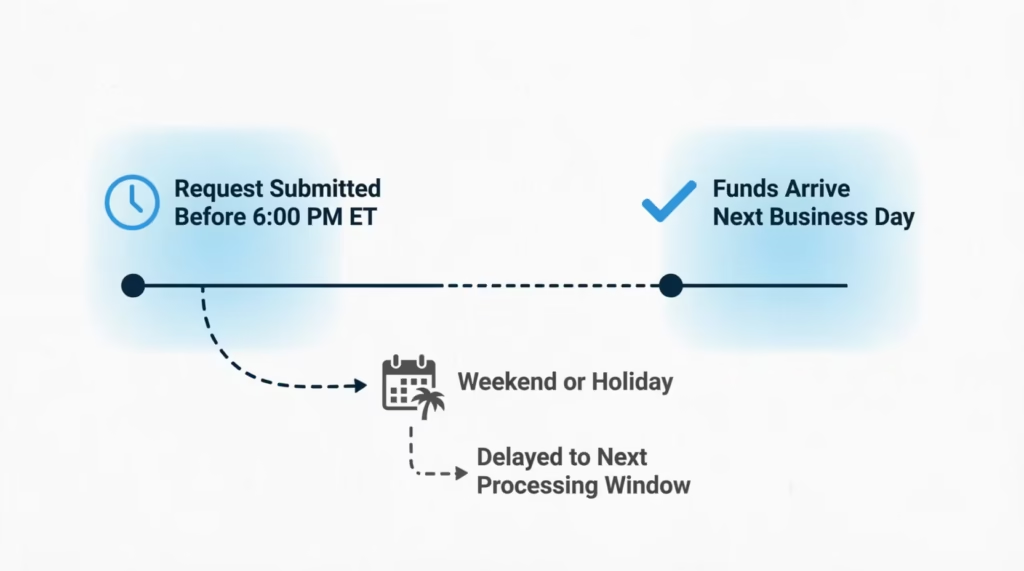
- Requests submitted before 6:00 p.m. ET on a business day are usually funded by direct deposit the next business day.
- The minimum Required Payment is the greater of $50 or 5% of the balance for biweekly or semi-monthly schedules, and the greater of $100 or 10% of the balance for monthly schedules.
- Carried Balance Fees range from $5 to $410 on balances over $10 for any cycle not paid in full, with fees up to $550 on the extended credit line.
- Republic Bank & Trust runs one hard credit inquiry at initial application, but individual cash advance requests do not trigger additional hard pulls.
Best for:
- Readers deciding whether to take an Elastic cash advance and wanting to know the exact deposit amount after fees.
- Existing Elastic customers trying to understand their billing cycle, Required Payment, or Carried Balance Fee charges.
- Anyone comparing Elastic’s cost structure against a payday loan or credit card cash advance before borrowing.
What an Elastic Cash Advance Actually Is
An Elastic cash advance is not a payday loan, a title loan, or a business merchant advance. It’s a draw against a personal line of credit that has already been approved in your name. The line itself is issued by Republic Bank & Trust Company, a Kentucky-based FDIC-insured bank, and Elastic is the servicing brand that runs the online account.
Think of it like this. Your line of credit is a pool of money the bank has set aside for you. A cash advance is the action of pulling some of that money out of the pool and sending it to your checking account. You don’t fill out a new loan application each time. You just request an amount, and the funds move.
The product is a revolving line of credit, which works a lot like a credit card in structure. As you pay the balance down, that credit opens back up so you can draw again later. It’s not a one-time installment loan with a fixed payoff date.
Approved credit limits typically fall between $500 and $4,500. Long-time customers in good standing may qualify for a bump up to $6,000 through the credit line increase program. Your exact limit is based on the info from your original application and your ongoing account behavior.
📌 Did You Know: Elastic is designed for non-prime borrowers, but it is not a payday loan. It has no fixed interest rate. Instead, it uses flat fees, which changes how you should think about the true cost.
How to Request a Cash Advance, Step by Step
Once your line is open, pulling cash is a short online process. You do not need to reapply or resubmit documents each time.
Here is the flow most users follow:
- Log in to your account at the Elastic customer portal.
- Click “Schedule Advance” on your dashboard.
- Enter the cash advance amount you want, up to your available credit.
- Choose your delivery method. Direct deposit to your checking account is the fastest and most common choice. A paper check by mail is also offered, but it takes longer.
- Review the fee summary. You’ll see the 10% Cash Advance Fee and the net amount that will hit your bank.
- Confirm the request.
Timing is where many first-time users trip up. Requests submitted before 6:00 p.m. ET on a business day are usually funded the next business day by direct deposit. Requests made after that cutoff, on weekends, or on federal holidays get pushed to the next processing window.
After you confirm, you can track the status of your advance right inside your Elastic dashboard. You’ll typically see “Scheduled” first, then “Funded” once the money is sent.
💡 Pro Tip: Submit your request in the morning of a business day. This gives you the widest buffer against system delays, bank cutoff times, and ACH processing gaps that can push funding by an extra day.
Why You Receive Less Than You Request
This is the single biggest source of confusion for new Elastic users. You ask for $1,000, but only $900 shows up. Nothing was stolen. Nothing broke. The Cash Advance Fee is deducted before the money is sent.
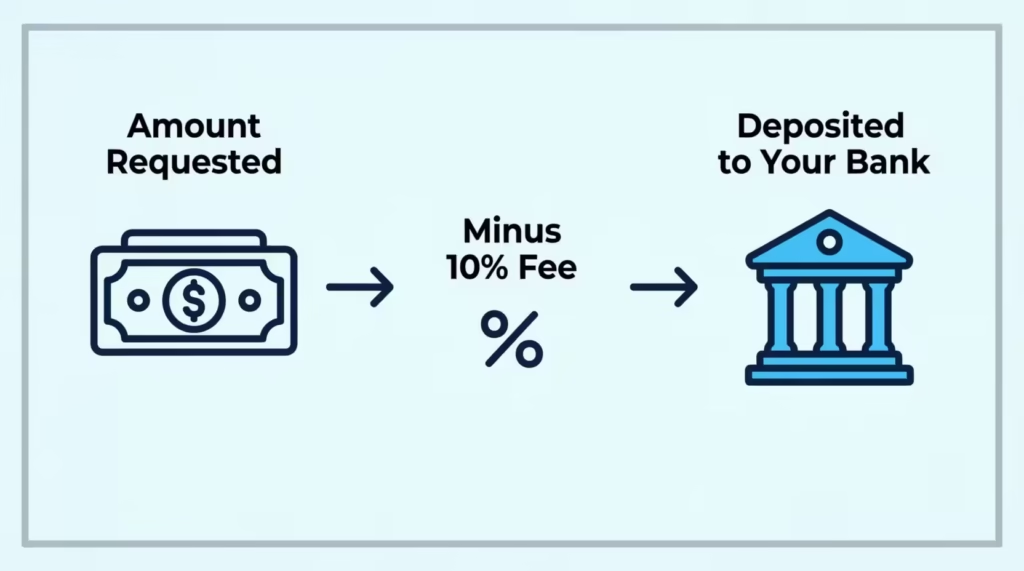
Republic Bank & Trust charges a 10% Cash Advance Fee on every draw. This is not a one-time fee at account opening. It applies every single time you request an advance, no matter how many you take. The fee is not paid separately later. It is subtracted from the advance amount up front, so the deposit you receive is already net of the fee.
The Elastic Cash amount you get in your bank account is always 90% of what you requested. The other 10% is added to your balance as the fee and shows on your statement.
Real Dollar Example of a Cash Advance Request
Let’s walk through a clean example so the math is crystal clear.
| Item | Amount |
|---|---|
| Cash advance requested | $1,000 |
| 10% Cash Advance Fee | $100 |
| Amount deposited to your bank | $900 |
| Total balance owed to Elastic | $1,000 |
Now scale it up and down so you can plan around your own needs:
| You Request | 10% Fee | You Receive | You Owe |
|---|---|---|---|
| $300 | $30 | $270 | $300 |
| $500 | $50 | $450 | $500 |
| $1,500 | $150 | $1,350 | $1,500 |
| $2,500 | $250 | $2,250 | $2,500 |
Here’s the practical takeaway. If you truly need $1,000 in your account to cover a bill, you must request more, roughly $1,112, so that after the fee your deposit lands close to $1,000. Requesting the exact number you need almost always leaves you short.
How Fast the Money Arrives
Speed matters when you’re staring at a due date. Elastic uses standard ACH direct deposit, so it moves at bank speed, not instant.
For most customers, funds arrive by the next business day after the request is approved, as long as the request beats the 6:00 p.m. ET cutoff. That means a Monday morning request usually funds by Tuesday. A Friday afternoon request often funds the following Monday.
Delivery method changes the timing a lot:
- Direct deposit to a checking account: next business day in most cases.
- Check by mail: several business days, plus postal delivery time. This is rarely the fastest choice.
Bank holidays add delay because ACH transfers don’t run on federal holidays. If you request an advance the day before a holiday, funding shifts to the next open banking day. Weather-related bank closures can create similar gaps.
Your own bank also matters. Some banks post ACH deposits early in the morning. Others hold them until the end of business. If you don’t see the deposit by lunchtime on the expected day, check your bank’s ACH posting policy before assuming something went wrong.
⚠️ Mistake to Avoid: Don’t count on same-day funds. Elastic does not offer instant transfers. If your bill is due today and you request an advance today, the money will not arrive in time.
How Billing Cycles and Payment Due Dates Work
Elastic doesn’t run on a standard calendar month like most credit cards. Your billing cycle is built around how often you get paid, which is one of the more unusual features of the product. That alignment is meant to help you pay from active income instead of savings.
When you set up your account, you tell Elastic your pay date and pay frequency. From that info, the system builds your billing cycles and sets your Payment Due Date to land shortly after you get paid.
How Your Pay Date Determines Your Due Date
The pay frequency you choose during setup drives everything downstream:
- Weekly pay: billing cycles are shorter, and required payments come more often, usually every week.
- Biweekly pay (every two weeks): the most common setup, with payments due every two weeks after each payday.
- Semi-monthly pay (twice a month, like the 1st and 15th): two payments per month tied to those specific pay dates.
- Monthly pay: one Required Payment each month.
If your paydays change (say you switch jobs), you need to update your pay schedule inside your account so future due dates match your new reality. A due date that lands the day before payday, not after, is a common cause of missed payments.
What You’re Required to Pay Each Cycle
Your Required Payment each cycle is the minimum you must pay by the due date to keep the account current. It’s not just interest, and it’s not a fixed dollar amount for everyone. It’s a formula-based number that changes with your balance.
Every Required Payment includes three parts:
- A portion of your outstanding balance (principal reduction).
- Any Carried Balance Fee for the cycle.
- Any past due amounts from a prior cycle you did not fully cover.
If you pay only the Required Payment and nothing extra, you’ll clear the balance eventually, but it will cost you more in Carried Balance Fees along the way. Paying above the required amount, or paying the full balance in a single cycle, cuts total cost sharply.
Minimum Required Payment Explained
The minimum formula depends on your pay frequency:
| Pay Frequency | Minimum Required Payment |
|---|---|
| Biweekly or semi-monthly | The greater of $50 or 5% of the balance |
| Monthly | The greater of $100 or 10% of the balance |
So if you’re paid biweekly and owe $800, your minimum for that cycle is 5% of $800 = $40, but the floor of $50 kicks in, so you pay $50. If you owe $2,000 biweekly, 5% = $100, and that’s what you’ll owe.
Carried Balance Fees If You Don’t Pay in Full
Here’s the piece most borrowers miss. If you don’t pay the entire balance off within a billing cycle, Elastic adds a Carried Balance Fee on top. This fee ranges from $5 to $410 on balances over $10, and it’s calculated based on how large your balance is at the start of the cycle. Customers on the extended credit line can see fees as high as $550.
Because the fee applies to any balance you carry, holding a large balance across many cycles adds up quickly. Elastic itself notes that if you make only the Required Payment, it can take as long as 20 months to fully repay an advance, and the fees stack for every one of those cycles.
The lesson is simple. This product works best when you pay it off in one or two cycles, not when you drag it out.
How Re-Borrowing Works on a Revolving Line
A revolving line of credit means the money “refills” as you pay it back. You don’t have to close out the account and reapply to get more cash.
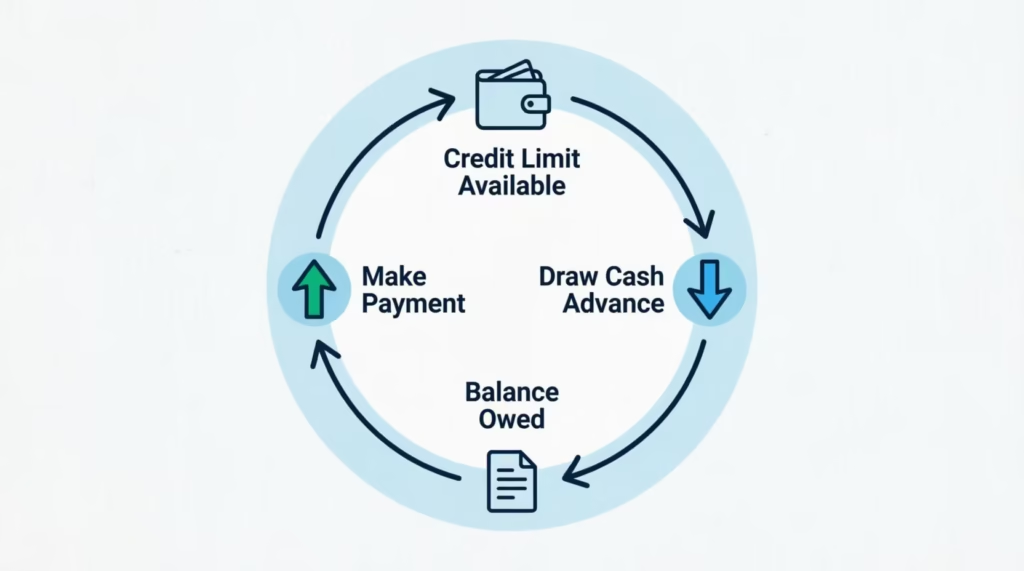
Say you have a $2,000 credit limit. You take a $1,000 advance. Your available credit drops to $1,000 (you can only draw up to your limit, and your $1,000 balance is already using half the line). As you make payments and lower the balance, your available credit climbs back up.
You do not need to fully repay one advance before taking another. If you have room under your credit limit, you can request a second draw whenever you need it. That said, remember that each new draw carries its own 10% Cash Advance Fee.
Two $500 draws cost $50 in fees each ($100 total), just like one $1,000 draw ($100 fee). But taking six small draws in quick succession stacks six separate fees, and that’s where costs spiral for some borrowers.
Re-borrowing is a feature, not a strategy. Use it when a real, unplanned expense hits, not as a rolling income supplement.
How Your Credit Limit Is Determined
Your credit limit is set by Republic Bank & Trust when you’re first approved and can change over time based on how you use the account.
Starting limits typically range from $500 to $4,500. The exact number is based on:
- The information you provided on your application (income, housing, employment).
- Data pulled from your credit file at the time of application.
- Your state of residence, since Elastic isn’t available everywhere and some states cap terms.
Once you’ve been a customer for a while and shown a track record of on-time payments, you may become eligible for the credit line increase program, which can push your limit to as much as $6,000. Elastic reviews accounts for this eligibility over time. You don’t apply for it separately.
If your limit feels tight, the fastest path to a higher one is a clean history of on-time Required Payments and full payoff cycles when possible.
Does Requesting a Cash Advance Affect Your Credit Score
Short answer: taking an individual advance does not trigger a new credit pull. The confusion here matters, so it deserves a careful breakdown.
When you first apply for the line of credit, Republic Bank & Trust performs a hard credit inquiry, generally through TransUnion. That single hard pull can shave a few points off your score temporarily, similar to any credit application. According to TransUnion, hard inquiries usually stay on your credit report for two years but only affect your score for about one year.
After that initial pull, individual cash advance requests do not cause new hard inquiries. Elastic does not re-pull your credit each time you click “Schedule Advance.” Your credit file only sees the account itself, not the individual draws.
That said, your Elastic account can still affect your score in other ways:
- On-time payments are typically reported and can help your credit.
- Missed payments get reported too and can lower your score.
- Carrying a high balance relative to your limit may not affect your utilization ratio the same way a credit card would (since revolving lines like this are treated differently by scoring models), but it can still be a signal on your report.
So the anxiety about “will this one advance drop my score” is misplaced. The bigger credit impact comes from how you repay, not from clicking the request button.
What an Elastic Cash Advance Really Costs
Elastic markets itself as a payday loan alternative, and its fees are structured differently, but the true cost still depends heavily on how quickly you repay.
Combine the two fees to see the picture:
- 10% Cash Advance Fee on every draw (charged once per draw).
- Carried Balance Fee of $5 to $410 for any cycle you don’t fully clear.
Here’s a rough cost comparison for a $1,000 advance under different repayment speeds:
| Repayment Timeline | Est. Total Fees | Est. Cost of $1,000 |
|---|---|---|
| Paid off in first cycle | ~$100 | $1,100 |
| Paid off in 3 cycles | ~$200–$300 | $1,200–$1,300 |
| Paid off over 12+ cycles | $500+ | $1,500+ |
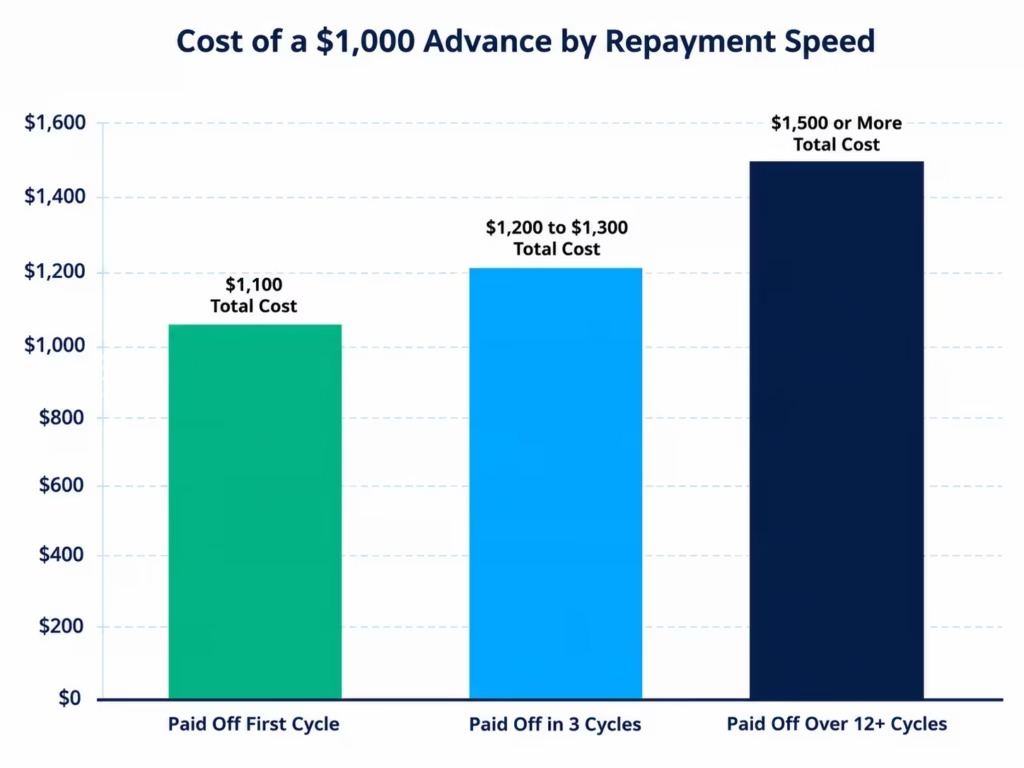
Expressed as an effective APR, Elastic can look expensive when the balance stretches over many months, sometimes triple digits, which is common for non-prime revolving credit products in this category
It compares favorably to a two-week payday loan, which the Consumer Financial Protection Bureau reports typically carries fees that translate to APRs of around 400%. But it can be more expensive than a credit card cash advance if you can qualify for one.
Bottom line: Elastic is designed as a short-term cash-flow tool. Use it that way, and the cost is manageable. Stretch it into a long-term debt, and the fees add up fast.
What Happens If You Miss a Payment
Missing a Required Payment triggers a chain of consequences you’ll want to avoid.
First, the amount you didn’t pay becomes a Past Due Amount and gets added to your next Required Payment. So if you owed $50 this cycle and paid nothing, your next cycle’s minimum becomes the new required payment plus that $50 (plus any new Carried Balance Fee for the cycle).
Second, missed payments are typically reported to credit bureaus once they hit 30 days past due. A single 30-day late notation can drop your credit score noticeably, especially if your score is already fragile.
Third, if the account keeps rolling with missed payments, the bank may take further collection action, including sending the account to collections, which creates additional negative marks on your credit file.
If you know you’ll miss a payment, contact Elastic customer service before the due date. Options for hardship or a shifted schedule may exist, but they’re only available if you reach out early. Waiting until after a missed payment posts limits what can be done.
Frequently Asked Questions (FAQs)
How long does it take to get a cash advance from Elastic?
Most advances fund by the next business day if you request before 6:00 p.m. ET on a business day. Requests made after that cutoff, on weekends, or on federal holidays get pushed to the next processing window.
Does Elastic do a hard pull on your credit?
Republic Bank & Trust runs one hard credit inquiry when you first apply for the line, typically through TransUnion. After that, individual cash advance requests don’t trigger new hard pulls.
Can you get multiple cash advances at once?
Yes, as long as you have available credit under your limit, you can request another draw without fully repaying the first. Each new draw carries its own 10% Cash Advance Fee, so several small draws cost more in fees than one larger draw.
What happens if you don’t pay back an Elastic cash advance?
Unpaid amounts become a Past Due Amount added to your next Required Payment, and Carried Balance Fees keep accruing on the remaining balance. Missed payments are typically reported to credit bureaus after 30 days and can lead to collections.
How does an Elastic loan actually work?
It’s not a loan but a revolving personal line of credit issued by Republic Bank & Trust Company. You draw cash against your approved limit, pay a 10% fee on each draw, and your available credit refills as you repay the balance.
How much can you borrow from Elastic?
Starting credit limits typically range from $500 to $4,500 based on your application info, credit file, and state of residence. Long-time customers with a good payment history may qualify for a bump up to $6,000.
Is Elastic considered a payday loan?
No, Elastic is a revolving line of credit with flat fees instead of the short-term, lump-sum structure of a payday loan. It compares favorably to payday loans, which the CFPB reports can carry fees translating to roughly 400% APR.
What are the requirements to get a cash advance with Elastic?
You need an already-approved Elastic line of credit and available room under your credit limit to request a draw. Once approved, you don’t reapply each time; you simply log in and schedule the advance.
Does Elastic approve people with bad credit?
Elastic is designed for non-prime borrowers, meaning it targets people who may not qualify for traditional bank loans or credit cards. Your exact limit still depends on your application details and credit file at the time you applied.
What’s the minimum payment required each billing cycle?
For biweekly or semi-monthly pay schedules, it’s the greater of $50 or 5% of your balance. For monthly pay schedules, it’s the greater of $100 or 10% of your balance.
Wrapping Up
An Elastic cash advance is a fast draw from a revolving personal line of credit, but the way fees, billing cycles, and repayment interact is what really shapes the cost. A $1,000 request gets you a $900 deposit, and how long the balance sits determines whether you pay $100 or several times that.
Based on the fee math in this guide, the most effective approach is to treat Elastic as a one-cycle tool: request only what you need, pay in full at the next Required Payment, and avoid rolling balances forward.
If you know someone weighing a payday loan or scrambling to cover a short-term gap, share this guide with them. A ten-minute read here could save them hundreds in stacked fees.