
You need money before payday, and you’ve heard the Albert app can front you cash fast. But the details feel murky. Does an Albert cash advance really require a paid plan? How much will you actually get approved for? And what happens if the cash isn’t there when repayment comes due? Those unknowns matter a lot when rent is due this week.
The short answer: Albert advances between $25 and $1,000 with no credit check, no interest, and no late fees, and repayment is due six days after you draw.
Keep reading for the full mechanics, including eligibility, fees, delivery speed, state limits, bank compatibility, and the exact in-app steps.
Key Takeaways
This guide explains how Albert cash advances work, including real approval limits, eligibility factors, repayment timing, fees, and what happens if you can’t repay on time.
Core Facts:
- Albert advances range from $25 to $1,000 with no credit check, no interest, and no late fees, though few customers qualify for the full $1,000.
- No paid subscription is required to access Instant Advances; Albert’s Terms of Use state a subscription is not needed for Instant.
- Repayment is due six days after drawing funds, and users can request a one-time extension of up to 7 days before the due date.
- Funds sent to an Albert Cash account arrive instantly at no charge, while sending directly to an outside bank costs a transfer fee or takes 2 to 3 business days via standard ACH.
- Missing repayment does not trigger debt collection, third-party sale, or credit reporting, but does suspend access to new advances for periods ranging from a few days up to 90 or more.
- Eligibility depends on linked bank account activity, transaction history, and consumer reporting data rather than a traditional credit score.
Best for:
- Readers who want to confirm whether Albert cash advances require a paid plan before signing up.
- People deciding between a cash advance and a payday loan who want to compare costs and repayment risk.
- Users planning to link a bank account early to build the transaction history needed for a higher limit later.
What Albert Instant Actually Is
Before looking at limits or fees, it helps to know which product you’re really signing up for. This is where most people get confused, and the confusion is not their fault. Albert uses similar names for three different things.
Albert Instant is an umbrella feature. Under that one name sit advances, loans, and lines of credit. They work in very different ways. They also carry very different risks.
Most people searching for how Albert Instant cash advance works are looking for the first one on this list.
| Product | What it is | Limits | Cost | Credit reporting |
|---|---|---|---|---|
| Instant Advance | A non-recourse cash advance offered at Albert’s discretion | $25 to $1,000 | No interest, no late fees | Not reported |
| Instant LOC | An unsecured line of credit issued by FinWise Bank | $25 to $1,000 | Draw fee, and a late fee if it applies | Governed by the credit agreement |
| Albert Loans | A personal loan paid out in full upfront | $1,000 to $10,000 | Interest on the whole balance | Payments may be reported |
The word “non-recourse” matters here. With an Instant Advance, Albert states in its own terms that it has no legal or contractual claim against you if you don’t repay. A loan is the opposite. A loan is a debt you owe, and a credit pull may be needed to apply for one.
The line of credit version is issued by FinWise Bank, a Utah-chartered commercial bank and Member FDIC. Albert itself is not a bank. It works with banking partners. Money held in an Albert Cash account sits in a pooled account at Sutton Bank and Stride Bank, N.A.
So when a blog post says “Albert loan,” check which product it means. A draw fee on a line of credit is not the same as a fee-free advance. And a $5,000 personal loan with interest is a completely different decision.
Eligibility Requirements for Albert Instant
Albert doesn’t decide based on a credit score. It decides by looking at your bank data. That’s good news if your credit is rough. It’s less predictable, though, because you can’t see the score you’re being judged on.
Albert lists these factors for setting your limit:
- Account activity. You need an active bank account linked to Albert.
- Transaction history. Albert wants an account with a long transaction history. A brand new account with two weeks of activity gives it almost nothing to read.
- Consumer reporting. Albert does obtain information from consumer reporting agencies. This is not the same as a credit report pull, but it does mean outside data is part of the call.
Two more requirements catch people off guard. First, an Albert Cash account is required to access Instant Advances. Second, Smart money must be set to the “Automatic” schedule. Smart money is Albert’s automatic transfer feature, and it’s also how repayment gets collected. If you turn Smart money off, you lose access to Instant.
Setting up the line of credit adds one more step. A linked debit card is required. Albert runs a small test charge of less than $0.40 on that card and then cancels it. If your balance is under $1, Albert delays that check so you don’t overdraft.
Notice what is not on this list. There’s no minimum credit score. There’s no employer verification step. But a regular income pattern flowing into your linked account still helps, because that pattern is exactly what the model is reading.
Albert also states plainly that not all customers will qualify. State restrictions apply too, which is covered further down.
📌 Did You Know: Albert doesn’t pull your credit report for Instant, but it does pull other data from consumer reporting agencies. So “no credit check” doesn’t mean “no data check.”
How Much You Can Borrow From Albert
The advertised range is $25 to $1,000. That top number does a lot of marketing work. It is not what most people get.
Albert says it directly: eligibility varies based on your ongoing account history and activity, not all customers will qualify, and few qualify for $1,000. Read that last part twice before you plan around a big number.
Here’s why the low starting amounts happen. Your first advance amount is a risk decision made with very little data. Albert has just met you. It has seen your linked account for a short time. So it starts small and watches what you do.
Think about a realistic example. Jasmine, a dental office receptionist, needs $450 for a transmission repair. She downloads Albert on a Tuesday, links her credit union checking account, and gets approved for $50. Nothing went wrong. Her account was only linked that morning, so the history Albert reads was almost empty.
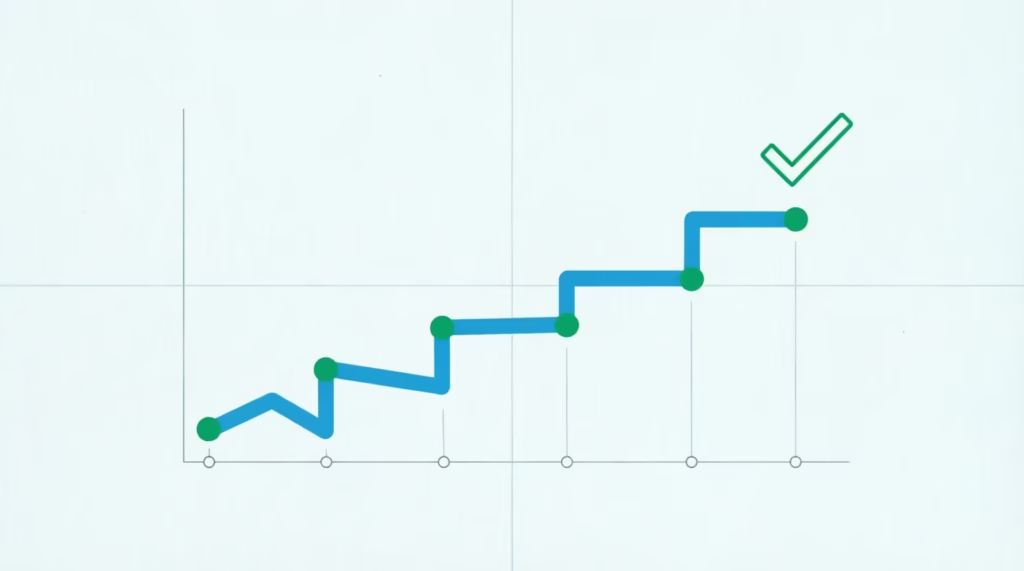
Limits can move up over time. Repaying on schedule, keeping your linked account active, and letting real deposit history build all feed the same model that set your first limit. Users on cash advance forums often describe climbing in steps, from $50 to $150 to $250, over several months of clean repayment.
Two practical takeaways:
- Don’t count on Albert to cover a large, fixed bill on day one.
- If you think you’ll need a bigger cushion later, link your main account now and let the history build before you need it.
Also worth knowing: you can advance up to 6 times within 30 days, up to your limit. So a $250 limit doesn’t mean one draw per month.
Does Albert Cash Advance Require a Genius Subscription?
No. A paid plan is not required.
This is the single most misreported fact about the product, so it’s worth quoting the source. Albert’s own terms state: “You do not need to maintain an Albert subscription to access Albert Instant.”
That language sits in Albert’s Terms of Use, alongside the confirmation that there is no credit check, no late fee, and no interest on an Instant Advance. Albert’s help center repeats the same point for both advances and loans, and its Genius page adds that a subscription has no impact on Instant Loan eligibility.
So what do the paid tiers actually do? Albert’s subscription plans run roughly $19.99 to $39.99 per month by the company’s own disclosures. Those plans gate other features, such as certain savings and advisory perks. They do not unlock the advance, and they do not raise your advance limit.
Why do so many articles claim otherwise? Two reasons. Older versions of the app bundled things differently, and some third-party posts still describe that setup. Others simply copy each other. Reviews on consumer forums also describe users being funneled toward a paid plan during signup, which feels like a requirement even when it isn’t one.
What this means for you in the app: read each signup screen. If a screen offers a plan, look for the option to skip or continue without it. If you already got charged for a plan you didn’t want, contact support to cancel it.
⚠️ Mistake to Avoid: Don’t subscribe to a paid tier because you think it unlocks a bigger advance. It doesn’t, and a $19.99 monthly charge can cost more over a year than the advance itself.
How to Request an Albert Cash Advance (Step-by-Step)
The process is short once setup is done. Setup is the part that takes the longest, so do it before an emergency, not during one.
Step 1: Install the app. Albert is free to download on the Apple App Store and on Google Play. Look for the listing published by Albert.
Step 2: Link your bank account. Albert connects accounts through Plaid. Search for your bank by name or website address. Link the checking account where your pay actually lands, not a rarely used side account. That history is what your limit is built on.
Step 3: Set up Instant. From the home screen, tap “Instant” and follow the prompts. A linked debit card is required, and Albert will run that small verification charge under $0.40.
Step 4: Request your amount. On the home screen, select “Borrow,” then tap “Instant,” then choose an amount up to your limit.
Step 5: Pick where the money goes. Funds sent to your Albert Cash account arrive instantly. Sending money to an outside bank account instead triggers a fee and a different timeline.
Step 6: Confirm and check the fee screen. Any fee is shown to you before you finish the transfer. Read that screen. It’s the last point where you can change your delivery choice.
One planning tip: if you already know you’ll want the cash in your outside bank, move it from Albert Cash yourself only if you can wait. Standard bank-to-bank withdrawals from Albert Cash take 2 to 3 business days.
Delivery Speed and Transfer Fees
Speed and cost are linked. Choose the wrong option and you either pay more than you needed to or you wait longer than you can afford.
| Where the money goes | Speed | Cost |
|---|---|---|
| Albert Cash account | Instantly after you advance | No charge for an Instant Advance |
| External linked account, instant | Typically within minutes | Instant Advance Transfer Fee applies |
| External linked account, standard ACH | 2 to 3 business days | Free |
The free instant option only exists inside Albert’s own ecosystem. Money into your Albert Cash account lands right away at no charge. That’s the cheapest fast route, and it’s why the Cash account is required for advances.
Sending funds straight to an outside bank within minutes costs money. Albert calls this the Instant Advance Transfer Fee, and the exact amount depends on your transfer. The cost is disclosed before you confirm, so nothing should surprise you if you read the screen.
Note one extra detail about the line of credit version. A draw fee may apply each time you advance on the Instant LOC, based on the amount you borrow. That’s separate from any transfer fee.
Business days matter for the free route. ACH transfers don’t move on weekends or federal holidays. A standard transfer started Friday afternoon can land in the middle of the next week. Transactions started after 4 pm PT count as received the next business day.
Repayment Terms for Albert Instant
Repayment is automatic, and the clock is short.
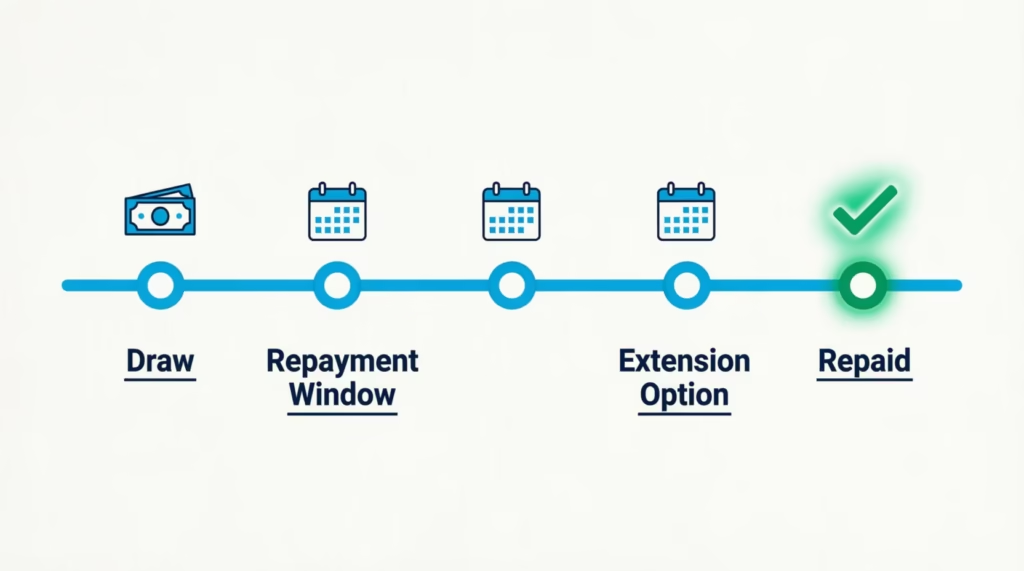
Your advance is due six days from when you initially advance. That’s it. It isn’t a monthly bill, and it isn’t tied to a 30-day cycle. Albert’s terms call this window the Repayment Period.
Two things cover the balance:
- Smart money deposits. These automatic transfers pull from your linked account and can clear your balance without you doing anything. If a deposit is larger than what you owe, the extra goes into your other Albert accounts.
- A manual payment. You can pay early or top off a shortfall yourself. In the app, select “Instant Advance,” open Settings, then choose “Make a manual payment” under the Advance section.
Albert also reserves the right to set off balances from your other Albert accounts to cover what you owe. So money sitting in your Albert Cash or savings can be used for repayment.
The cost side is genuinely simple. There is no interest, and there are no late fees on an Instant Advance. You repay what you drew, plus any transfer fee you agreed to at the start.
One more useful feature: you can request an extension of up to 7 days on your due date in the app. Ask before the due date passes, not after.
What Happens If You Can’t Repay on Time
Your paycheck gets delayed. The math doesn’t line up. This is the fear that stops people from tapping the feature at all, so here’s exactly what Albert says happens.
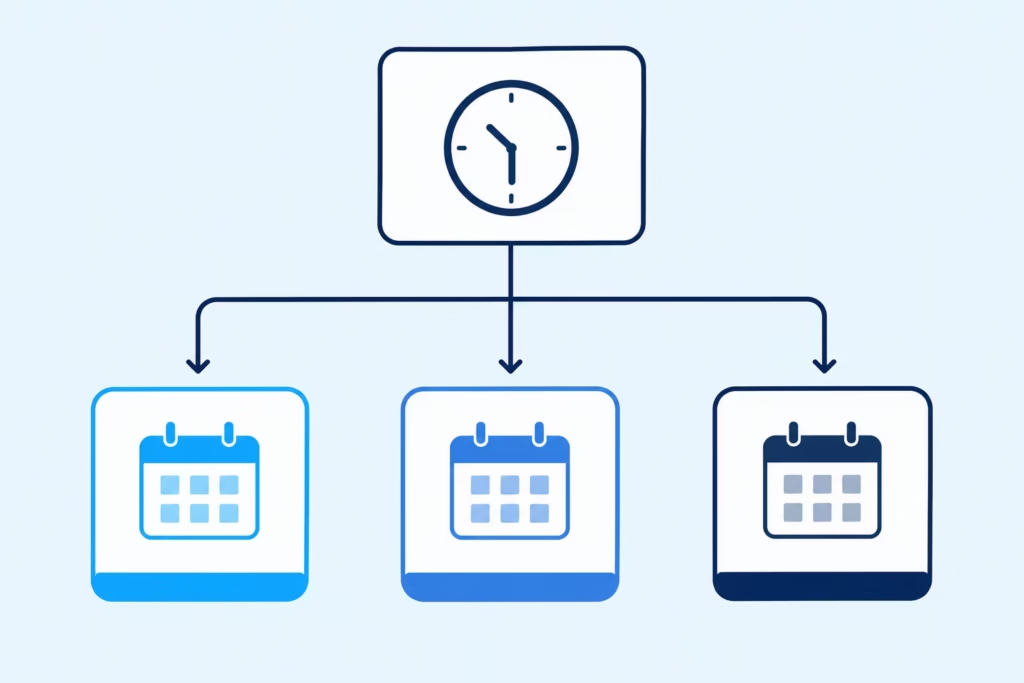
You may be suspended from taking new advances. The length depends on how late the repayment lands:
- Repaid within 15 days after the due date: the suspension may lift once your covering deposits complete.
- Repaid more than 15 days late: access may be suspended for 30 days or more from when repayment completes.
- Repaid more than 30 days late: access may be suspended for 90 days or more from the day repayment completes.
What does not happen is just as important. For an Instant Advance, Albert states it has no legal or contractual claim or remedy against you for failing to repay. Albert also says it will not pursue debt collection, will not place or sell the amount to a third party, and will not report the amount to a consumer reporting agency.
So the real penalty is losing access, not a lawsuit or a credit hit. Missed repayment also feeds the history behind future limit decisions, which can slow down any increase.
If timing looks risky, take action early. Request the 7-day extension in the app before the due date. Make a partial manual payment if you can. And check that your linked account won’t get hit for the full amount on a day your balance is near zero, since your own bank can still charge you an overdraft fee even though Albert won’t.
Does Albert Run a Credit Check?
No traditional credit check is involved. Albert’s help center answers it directly: Albert does not pull your credit report to use Instant.
But the fuller answer has two halves, and both matter.
What Albert does look at instead is behavior. Active linked bank accounts. Length and depth of transaction history. Income and spending patterns flowing through the account you connected. Albert also obtains information from consumer reporting agencies, even without a credit report pull. Data brokers that track bank account activity are a common source for this kind of check, so a history of unpaid overdrafts elsewhere can still work against you.
Whether an advance affects your credit score is the other half. For an Instant Advance, no. Albert says it doesn’t report the advanced amount to consumer reporting agencies, and it doesn’t report missed repayment either. That means an advance can’t help your score, and it can’t hurt it.
The loan products behave differently. With Albert Loans, a credit pull may be required to check eligibility, and information about your loan payments may be reported to consumer reporting agencies. So the “no credit impact” rule applies to advances, not to every product with the Instant name attached.
Practical read: someone rebuilding credit can use an advance without adding a new tradeline to their file. Someone hoping this will build credit should look elsewhere, because it won’t.
State Availability for Albert Cash Advance
Availability depends on where you live, and Albert is explicit about that.
The Instant Line of Credit issued by FinWise Bank is subject to eligibility requirements that include geographic restrictions. Lending licenses are granted state by state, so a line of credit can be offered in one state and not the one next door. Albert keeps its licensing information in a linked list inside its Terms of Use rather than publishing a fixed state list in its help articles.
Albert also spells out what happens if you relocate. Move to a state where the Instant line of credit is not offered, and you won’t be able to take additional draws from that account while you live there. You may still be able to access other Instant products.
Because these license lists change, treat any state list you read on a third-party blog as a guess. Verify in two places instead: the licensing link inside Albert’s current Terms of Use, and the app itself after you enter your address. The app is the only place that reflects today’s rules for your exact location.
Does Albert Cash Advance Work in CT
Connecticut residents should confirm availability in the app before planning around a draw. Albert does not publish a plain-language state list in its help center, and it does apply geographic restrictions to the FinWise-issued line of credit.
The fastest way to get a real answer takes about two minutes. Download the app, enter your address during signup, and open the Instant section. If the line of credit isn’t offered where you live, the app will not present it, and other Instant products may still appear. Checking the licensing link inside Albert’s Terms of Use before you sign up gives you the same answer without creating an account.
Does Albert Cash Advance Work in Maryland
The same rule applies in Maryland. Availability comes down to current licensing, and only Albert’s live disclosures can confirm it for your address.
Do not rely on a comparison article for this. Lending licenses get added and withdrawn, and an article written last year can be wrong today. Check the state licensing link inside Albert’s Terms of Use, then confirm inside the app once your address is entered. If Instant isn’t available to you, the app won’t show the option to draw.
Bank and App Compatibility for Albert Cash Advance
Two account requirements sit at the center of this. First, you need a linked bank account with real transaction history, because that history sets your limit. Second, an Albert Cash account is required for Instant Advances, and that’s where free instant funding lands.
Albert connects outside accounts through Plaid. Albert notes it aims to support all U.S. financial institutions, but some, especially smaller regional banks and credit unions, aren’t currently supported by that partner. If your bank doesn’t appear in the search, you can add the account manually after you’ve successfully linked at least one other institution.
Two details decide most compatibility questions. Can the account be linked and read? And does it carry the deposit history Albert wants to see? An account you barely use will link fine and still produce a tiny limit.
Does Albert Cash Advance Work With Chime
Chime is a widely supported institution in bank-linking networks, and many cash advance users do connect it. Comparison coverage from lenders such as MoneyLion lists Albert among the apps compatible with Chime.
Still, treat linking and qualifying as two separate questions. Linking Chime tells Albert who you bank with. Qualifying depends on whether that Chime account holds a long, active history with regular deposits. A Chime account you opened last month will link and still return a very low limit, or none.
Keep the funding path in mind too. Instant Advance money arrives free and instantly in your Albert Cash account. Moving it from there into Chime is a separate transfer, and doing that within minutes triggers the Instant Advance Transfer Fee. The free ACH route takes 2 to 3 business days.
Does Albert Cash Advance Work With Cash App
Albert doesn’t publish a list of approved or blocked fintech apps, so the honest answer is to test it in the app rather than trust a blog. Search for the provider during account linking and see what appears.
Cash App balances tend to be weaker as the primary linked account for a different reason. Albert reads transaction history and deposit patterns to set limits. A peer-to-peer payment balance used mostly for splitting bills and sending money to friends gives the model far less to work with than a checking account that receives payroll deposits.
The workable approach: link the account where your pay actually arrives as your primary connection. If a provider isn’t searchable, Albert’s manual add option becomes available once you’ve linked one supported institution. Then use your Albert Cash account for the advance itself.
Albert Instant vs. Payday Loans
Cost is where these two options separate, and the gap is enormous.
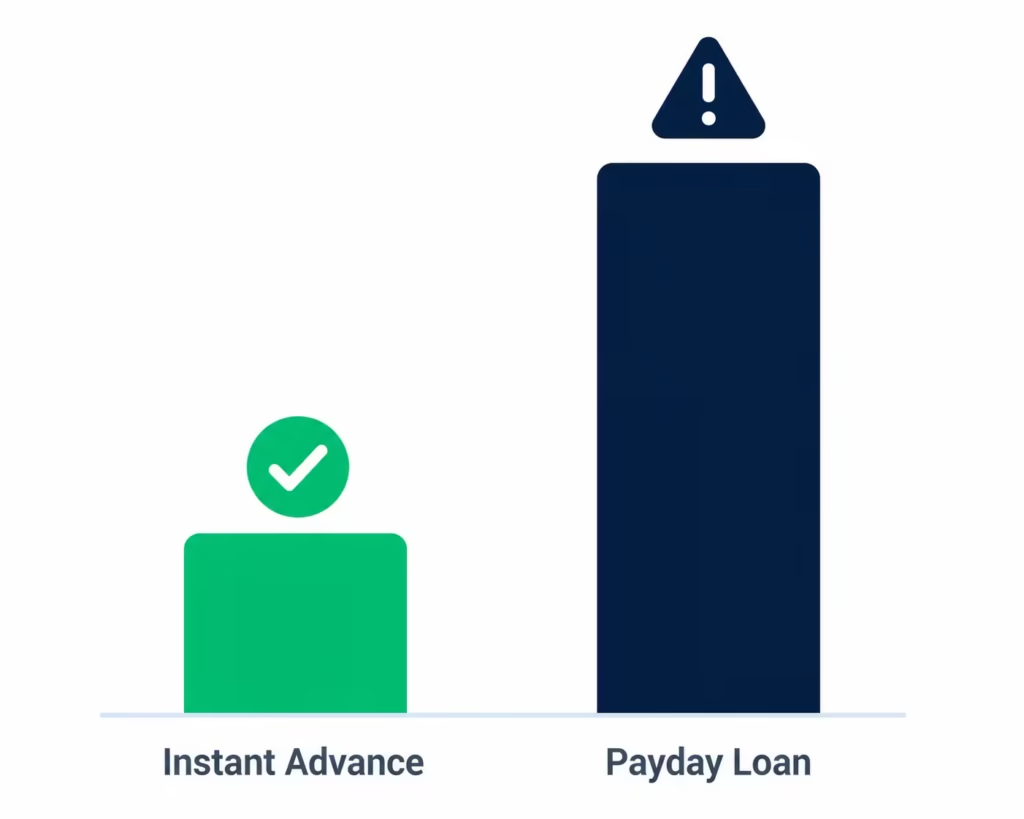
Payday loans are usually small, short, and expensive. Many state laws allow fees of $10 to $30 for every $100 borrowed.
A typical two-week payday loan with a $15 fee per $100 works out to an annual percentage rate of almost 400 percent, CFPB guidance explains. Some state laws also let lenders roll a loan over, so you pay the fee again and the due date moves.
| Feature | Albert Instant Advance | Typical payday loan |
|---|---|---|
| Interest | None | Fee equal to roughly 400% APR on a two-week term |
| Late fees | None | Common, plus rollover fees in some states |
| Repayment window | 6 days, extendable by up to 7 days | Usually 2 to 4 weeks |
| If you don’t repay | Access suspended, no collections | Lender can cash your check or debit your account |
| Credit reporting | Not reported | May be sent to collections |
The structural difference matters as much as the price. Albert says it won’t pursue collection activity, sell the balance to a third party, or report an unpaid Instant Advance to a consumer reporting agency. A payday lender generally holds a post-dated check or an authorization to debit your account, and can use it.
That said, an advance is still borrowed money. It comes out of next week’s budget. Draw $200 today, and you have $200 less to work with in six days. Using an advance to cover the hole left by the last advance is the pattern to watch for, because six-day cycles come around fast even without interest.
The unsecured line of credit version deserves one extra note. It carries a draw fee, and a late fee can apply. That’s still far below payday pricing, but it isn’t free the way the advance is.
Compared with short-term borrowing at 400 percent, a fee-free advance repaid on time is clearly the cheaper tool. Compared with asking a biller for a due-date change or a payment plan, it may not be.
Frequently Asked Questions (FAQs)
How much does Albert let you borrow the first time?
Most first-time users get approved for a small amount, often around $50, since Albert has little transaction history to judge you on yet. Your limit grows over time as you repay on schedule and build deposit history.
Does Albert really loan you $1000?
The $1,000 figure is the top of Albert’s advertised range, but few customers actually qualify for it. Your real limit depends on your account activity and transaction history, and most people start much lower.
Is it hard to get approved for an Albert loan?
Albert doesn’t run a traditional credit check, but it does evaluate your linked bank account’s transaction history and consumer reporting data. A new account with little activity often gets approved for a low limit or denied outright.
What is the maximum cash advance for Albert?
The maximum Instant Advance is $1,000, though Albert states plainly that not all customers will qualify and few reach that top amount.
Does Albert pay you instantly?
Yes, funds sent to your Albert Cash account arrive instantly with no charge. Sending money straight to an outside bank account instead triggers a fee, or takes 2 to 3 business days for the free ACH option.
How to borrow $500 immediately?
Albert can advance up to $1,000, but reaching $500 usually requires an established history of on-time repayment and active account use. New users typically start with much smaller amounts and build up over several months.
Which is better, Albert or Chime?
They’re different products. Albert offers cash advances, and Chime is widely supported as a linkable bank account for those advances, but qualifying still depends on how much deposit history your Chime account carries.
Why won’t Albert give me a cash advance?
Common reasons include a newly linked bank account with little transaction history, Smart Money not set to “Automatic,” or living in a state where the product isn’t licensed. Albert also states that not every customer qualifies.
Do I have to pay Albert back?
Yes, repayment is due six days after you draw, typically pulled automatically through Smart Money deposits. There’s no interest or late fee, but missing the deadline can suspend your access to future advances.
Can I transfer money from Albert to my bank account?
Yes, you can send funds to an outside linked account either instantly for a fee or through standard ACH transfer, which is free but takes 2 to 3 business days.
Wrapping Up
Getting an Albert cash advance comes down to a handful of concrete facts. Limits run from $25 to $1,000, few people reach the top, and no paid plan is required. Funding is free and instant into an Albert Cash account, while sending money straight to an outside bank costs a fee. Repayment lands six days out with no interest and no late fees, and missing it costs you access rather than your credit score.
Based on that fee structure, the most effective approach is to link your main checking account early, keep draws small, and let your limit grow before an emergency hits.
If you know someone comparing cash advance apps and worrying about hidden fees, share this with them. It could stop them from paying for a subscription they never needed.