
You’re staring at a bill that can’t wait. Maybe it’s a car repair, a utility shutoff notice, or a rent shortfall, and payday is still a week away. You’ve heard NetPay Advance can put cash in your account fast, but you also know short-term loans can get expensive quickly. Before you tap “apply,” you want to know exactly how NetPay Advance works, what it truly costs, and whether it will fix your problem or stretch it thinner.
NetPay Advance is a licensed lender. They provide small, short-term loans like payday loans, installment loans, or lines of credit. You can get your funds in minutes, sent directly to your debit card. Repayment happens automatically on your next payday from your bank.
Below, you will get a complete guide on costs, state rules, repayment, missed payments, and cheaper alternatives.
Key Takeaways
This guide explains how NetPay Advance loans work, including the application-to-funding process, real cost examples by loan amount, how automatic ACH repayment functions, and cheaper alternatives to consider first.
Core Facts:
- NetPay Advance offers three loan types: single-payment payday loans, installment loans repaid over up to 180 days, and lines of credit, with amounts generally between $100 and $3,000.
- APRs on NetPay Advance products typically range from about 199% to 939%, and a $200 loan repaid in 14 days can total around $246, an approximate 600% APR.
- Repayment is automatically withdrawn from the borrower’s checking account via ACH on the due date, which typically falls 8 to 31 days after funding for payday loans.
- A failed ACH payment can trigger a failed-ACH fee ($15 to $30), a bank NSF fee ($25 to $35), a possible overdraft fee, and a late fee, potentially adding $60 to $100 in combined costs.
- The application uses a soft credit check that does not affect a FICO score, but unpaid debt sent to collections can be reported to credit bureaus and remain for up to seven years.
- NetPay Advance is state-licensed and only operates in select states such as California, Kansas, Louisiana, Missouri, South Carolina, Tennessee, Texas, Utah, and Wisconsin, with terms varying significantly by state.
Best for:
- Readers facing an urgent, short-term cash gap who want to understand the full cost before applying rather than after signing.
- Borrowers deciding between NetPay Advance and lower-cost alternatives like a Payday Alternative Loan, a 0% APR credit card, or an employer earned wage access program.
- Anyone who wants to understand ACH repayment mechanics and the fee consequences of a missed payment before committing to a short-term loan.
What “NetPay Cash Advance” Actually Means
The phrase “cash advance” gets used loosely, so it helps to be precise. When NetPay Advance says “cash advance,” they don’t mean a credit card cash advance, and they don’t mean an app that floats you a few dollars from your paycheck. They mean a small-dollar loan against your future income, deposited into your bank account, and paid back on a set date.
Depending on your state and financial profile, you may be offered one of three products:
- Single-payment payday loan (deferred presentment transaction): You borrow a small amount, typically $100 to a few hundred dollars, and repay the full balance plus fees on your next payday.
- Installment loan: You borrow a larger amount and repay it in scheduled payments across several weeks or months, usually up to about 180 days.
- Line of credit: You get an approved credit limit, draw from it as needed, and repay based on what you’ve used, similar to a small revolving account.
Loan amounts generally sit between $100 and $3,000, though what you can actually qualify for depends heavily on your state’s laws and your income.
You don’t pick the product from a menu. The type you get depends on where you live. It also depends on what the lender sees in your bank activity, income, and current obligations.
Step-by-Step: What Happens After You Apply
The application itself is designed to be quick. Most people finish it in under 5 to 10 minutes on a phone or laptop. You’ll enter your basic personal info, employment and income details, and connect a checking account.
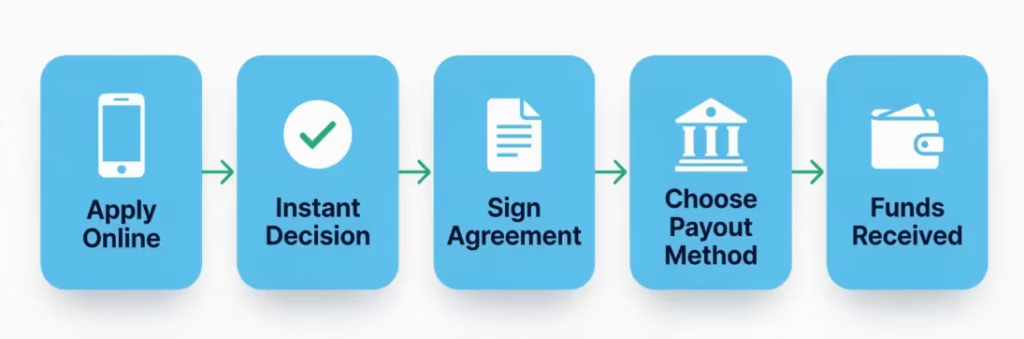
Once you submit, the process usually flows like this:
- Instant decision. The system reviews your application in real time and tells you whether you’re approved and for how much, within seconds to a couple of minutes.
- Review the loan agreement. You’ll see the exact loan amount, fee, APR, due date, and payment method in writing. Read every line, especially the total repayment amount.
- Electronically sign the agreement. Nothing is final until you sign. Signing authorizes the lender to send funds and later pull repayment via ACH.
- Choose your disbursement method. Instant funding to an eligible debit card, or standard ACH transfer to your checking account (usually next business day).
- Receive funds. Confirmed, deposited, ready to use.
Marketing pages love the phrase “cash in minutes.” That’s true only in specific cases. If your debit card isn’t eligible for instant transfer, or you apply after the daily cutoff, you’ll wait until the next business day. Weekends and federal holidays also push funding out.
How Approval Is Decided
NetPay Advance doesn’t run a traditional hard credit inquiry, so applying won’t ding your FICO score. Instead, approval leans on:
- A soft credit check through alternative credit data sources (bank behavior, prior loan history with similar lenders).
- Income verification to confirm you have consistent money coming in.
- Bank account history, usually pulled through a secure bank-connection tool, to check for overdrafts, existing loan payments, and average balance.
You’ll also need to meet the basics: be at least 18, hold an active checking account in your name, and have a verifiable source of income. Meeting the minimums doesn’t guarantee approval. The underwriting model can still say no if your bank activity signals you’d struggle to repay.
How Fast Funds Actually Arrive
Speed depends entirely on how you get the money.
- Instant transfer to an eligible debit card: Funds can land in minutes, sometimes under 30 minutes. Your card has to be enrolled in a real-time payment network (Visa Direct or Mastercard Send).
- Standard ACH to your bank: If your card isn’t eligible, or you prefer bank deposit, expect the money by the next business day.
- Cutoff times matter. Apply late in the evening or on a Friday night and the ACH won’t process until the next business day.
If you need cash today, confirm your debit card qualifies before you sign.
Where NetPay Advance Is Available
NetPay Advance is not available in every state. Small-dollar lending is regulated by each state. Every state sets its own rules, like maximum loan size, allowable fees, and license requirements. The lender operates only where it holds the proper license.
As of now, NetPay Advance offers loans in various states. These states include California, Kansas, Louisiana, Missouri, South Carolina, Tennessee, Texas, Utah, and Wisconsin, among others. The exact list changes as licensing evolves, and terms differ significantly by state.
Why the patchwork? A state like California caps payday loan principal at $255, while Texas uses a Credit Access Business (CAB) model that allows different fee structures and higher borrowing limits. Some states don’t permit this type of lending at all.
Before you apply, check the Rates & Terms page for your specific state on the lender’s site. That page shows the exact loan amount, fee schedule, and APR you’ll actually be offered.
How Much It Actually Costs
This is the part most borrowers underestimate, so slow down here.
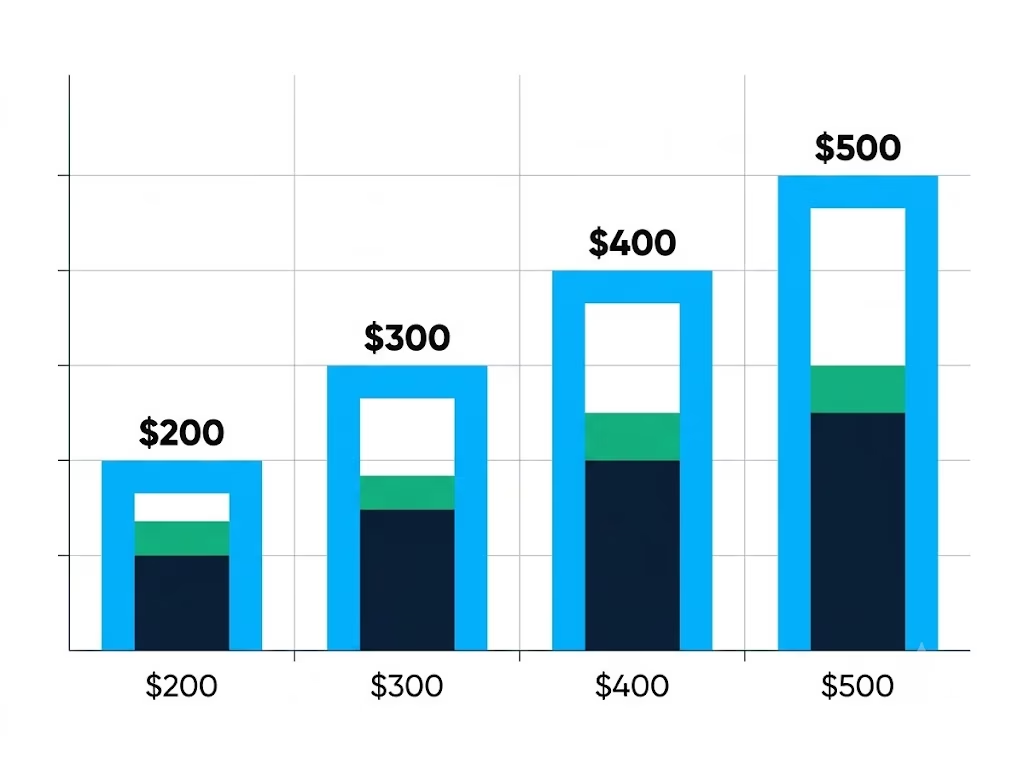
APRs on NetPay Advance products vary enormously depending on your state and loan type. Across the board, they typically fall between roughly 199% and 939% APR. That’s not a typo. Short-term small-dollar loans carry very high annualized rates because the fee is fixed against a short repayment window.
For context, a typical two-week payday loan with a $15 fee per $100 borrowed works out to an APR of nearly 400 percent, according to the Consumer Financial Protection Bureau. NetPay Advance’s rates sit inside that range, and sometimes above it, depending on the state.
Here’s a realistic cost example for a 14-day loan term:
| Amount Borrowed | Fee (approx.) | Total Repayment | Approx. APR |
|---|---|---|---|
| $200 | $46 | $246 | ~600% |
| $300 | $69 | $369 | ~600% |
| $400 | $92 | $492 | ~600% |
| $500 (installment, 30 days) | ~$115 | $615 | ~280% |
Numbers vary by state. California caps loans at $255. Texas allows larger amounts but layers in a CAB fee. Always read your specific loan agreement, because the “up to 939% representative APR” language you see in ads is a range, not your quote.
Two cost structures show up depending on the product:
- Flat prepaid finance charge: A one-time fee calculated on your original principal. Paying early doesn’t reduce it.
- Daily accruing interest: Interest builds each day you carry the balance. Pay early, and you save.
Ask which one applies before signing.
⚠️ Mistake to Avoid: Comparing loans by fee dollar amount instead of total repayment. A “$46 fee” sounds small until you realize you’re paying it every two weeks. Always look at the total repayment number and the APR.
How the Fee/Finance Charge Is Calculated
The finance charge on a single-payment payday loan is usually a flat prepaid fee tied to how much you borrow. Borrow $300 at $23 per $100, and your fee is $69, regardless of whether you repay on day 3 or day 14. That fee is already baked in.
Installment loans and lines of credit typically work differently. Interest accrues daily on the outstanding principal, so paying down the balance sooner reduces total cost.
In Texas, a CAB fee (Credit Access Business fee) is charged in addition to the base interest because NetPay Advance operates as a credit access business there, not a direct lender. That fee sits on top of the lender’s interest, which is why Texas totals can look higher than in other states.
The takeaway: total cost depends not just on the APR, but on how the fee is structured and how quickly you repay.
How Repayment Actually Works
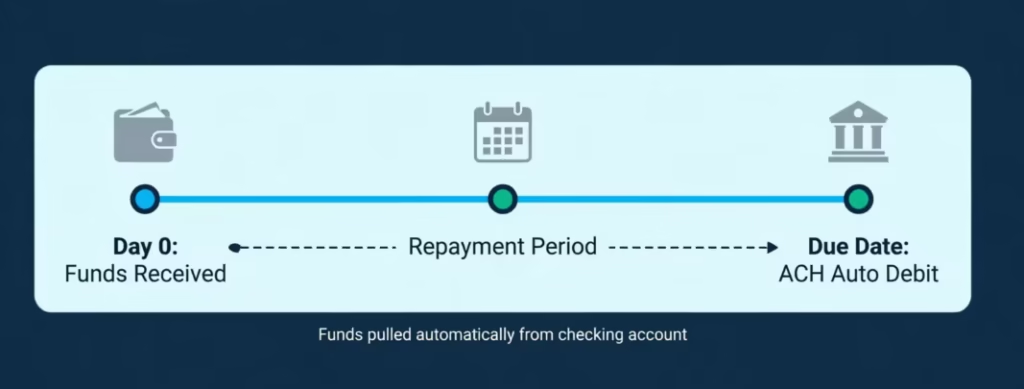
Repayment isn’t a bill you pay manually. When you sign the loan agreement, you authorize the lender to pull the amount owed directly from your checking account via ACH auto-debit on the due date.
The due date is typically tied to your next payday. For a payday loan, that usually falls 8 to 31 days after funding, depending on state law and your pay cycle. Installment loans spread repayment across multiple scheduled ACH pulls.
Two things you must confirm:
- Your due date and pull amount should be listed clearly in your loan agreement. Screenshot it.
- Your account balance on that date needs to cover the full amount. Not “close to” it. Full.
If you want to pay early, most lenders let you. On daily-interest products, early payoff can save real money. On flat-fee payday loans, early payoff doesn’t reduce the fee, but it clears the debt and removes the risk of a failed ACH.
You don’t need to do anything on the due date if you have the money in your account. The lender pulls it automatically. You will need to contact customer support ahead of time if you want to change the repayment date or method.
What Happens If You Can’t Repay On Time
This is where costs can spiral, so understand the mechanics before you’re in trouble.
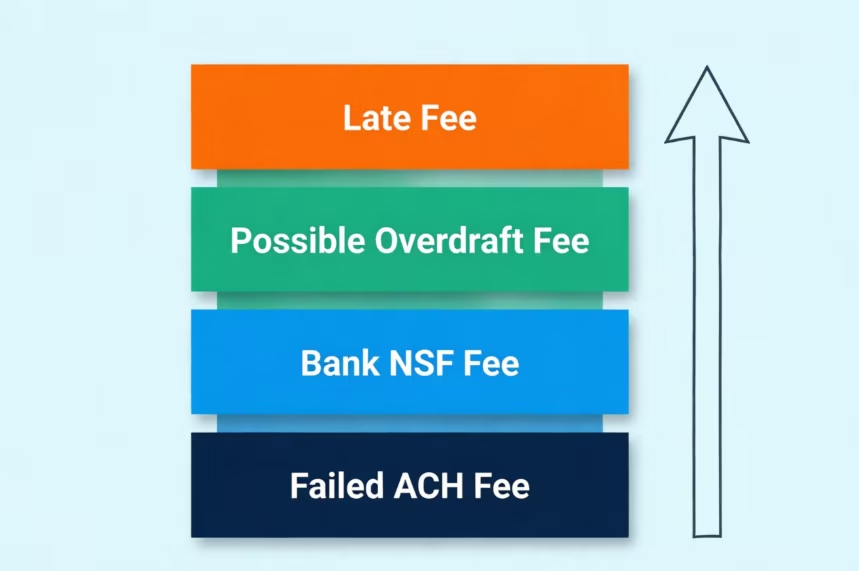
If the ACH pull fails because your account balance is too low, several things happen at once:
- A failed ACH fee from the lender, typically $15 to $30, depending on your state’s rules.
- A returned-item or NSF fee from your own bank, often $25 to $35 per failed transaction.
- A possible overdraft fee if the pull partially clears and pushes your account negative.
- A late fee, often around 5% of the unpaid installment or a flat amount, whichever is less.
Stacked together, a single missed payment can add $60 to $100 in fees on top of what you already owe. If the lender re-attempts the ACH pull, each failed attempt can trigger a fresh round of fees from your bank.
If the loan stays unpaid, the account can eventually be sent to collections. That’s when a hard mark on your credit report can happen. Collection accounts and charge-offs are reported to the credit bureaus.
The single best move is to contact customer support before the due date if you know you can’t pay. Options open before default; they narrow fast afterward.
Can You Extend Your Due Date
Yes, in some states. Extension rules vary because they’re set by state law, not the lender.
- Some states allow a short extension, often up to 3 days, sometimes longer, if you request it before the due date.
- Extensions don’t erase fees already earned. You’ll still owe the original finance charge, plus any interest that continues to accrue.
- Repeated extensions can trigger a different repayment plan in states with rollover protections, which is a separate process with its own terms.
Call or message support before the due date. Waiting until after the ACH fails narrows your options and locks in the failed-payment fee stack described above.
Does It Affect Your Credit Score
The application itself won’t hurt your score. NetPay Advance uses a soft credit check during underwriting, which is not visible to other lenders and doesn’t lower your FICO.
Where the credit picture changes is in how you handle repayment.
- On-time repayment: Most short-term lenders don’t report positive payment history to the three major bureaus (Equifax, Experian, TransUnion). Paying on time typically doesn’t build credit.
- Missed payment sent to collections: If the debt goes unpaid long enough to be sold or assigned to a collection agency, that collection account often is reported to the bureaus, and it can stay on your report for up to seven years.
- Legal judgment: If unpaid debt escalates to a lawsuit, a judgment against you can also appear on public records tied to your credit profile.
So “no credit check to apply” is not the same as “no credit risk.” The upside is limited (no score boost). The downside, if you default, is real.
💡 Pro Tip: If your only goal is to build credit while covering a small emergency, a Payday Alternative Loan (PAL) from a federal credit union is a better fit. PAL lenders typically do report to the bureaus, so on-time payments actually strengthen your credit file.
Is NetPay Advance a Legitimate, Licensed Lender
Yes, in the states where it operates. NetPay Advance has state lending licenses in all areas where it gives loans. In Texas, it is also a registered Credit Access Business.
You don’t have to take the company’s word for it. You can verify a lender’s license yourself:
- California: Search the Department of Financial Protection and Innovation (DFPI) license database.
- Texas: Check the Office of Consumer Credit Commissioner (OCCC) registry.
- Other states: Search the state’s financial regulator or the NMLS Consumer Access portal for the lender’s license number.
Beyond licensing, look for outside reputation signals: Better Business Bureau accreditation and rating, Trustpilot reviews, and how the company handles complaints filed with state regulators or the CFPB. One good review isn’t proof of legitimacy. A pattern of resolved complaints and a real license is.
Red Flags When Comparing Similar Cash Advance Offers
Not every “cash advance” site is a licensed lender. When shopping around, walk away from any offer that shows these signs:
- “Guaranteed approval” with no verification. Real lenders always verify income and bank activity. Guaranteed approval is a marketing lure.
- Upfront fees before funds are disbursed. Legitimate lenders deduct fees from your loan or bill them at repayment. If someone wants you to pay a fee to receive the loan, it’s a scam.
- No state license disclosure or vague company registration. A real lender lists its licensing information in the footer, on rate pages, and in the loan agreement.
- Pressure to sign immediately or refusal to give you the loan agreement in writing to review.
- Contact only through a WhatsApp number or Gmail address, with no verifiable business address.
Cheaper Alternatives to Consider First
Before you commit to any short-term high-APR product, check whether you qualify for one of these lower-cost options. On a $400 emergency, the savings can be dramatic.
Payday Alternative Loan (PAL) from a federal credit union
PALs are designed as a direct substitute for payday loans. Under National Credit Union Administration rules, PAL I loans go up to $1,000 with terms up to 6 months, and PAL II loans go up to $2,000 with terms up to 12 months. Interest is capped at 28%, plus an application fee of up to $20. You’ll need to be a credit union member (often just a $5 share account), and PAL I typically requires 30 days of membership before applying.
0% APR promotional credit card
If you have a credit card with a 0% purchase APR, use it for the expense. Just pay it off before the promo ends, and you won’t pay any interest. Skip this option if you can’t realistically clear the balance before the promo period ends, because the go-to APR is often 20% or higher.
Employer paycheck-advance program
Many employers now offer earned wage access (EWA) through payroll partners. You can pull a portion of already-earned wages before payday, typically for a flat fee of $0 to $5 per advance, sometimes free entirely. Ask HR or check your payroll app.
Quick side-by-side, using a $400 loan borrowed for two weeks as the baseline:
| Option | Approx. Cost for $400 (2 weeks) | Speed | Credit Impact |
|---|---|---|---|
| NetPay Advance (typical payday loan) | ~$92 fee | Minutes to next business day | No score building; risk if missed |
| Federal credit union PAL | ~$4–$8 interest + up to $20 fee | 1–3 business days | Positive payment reporting |
| 0% APR promo credit card | $0 (if paid before promo ends) | Instant, if you have the card | Neutral, if paid on time |
| Employer EWA program | $0–$5 | Same day, if enrolled | None |
The math is stark. If any of the alternatives above are available to you, they’ll cost far less than a triple-digit-APR loan. Only fall back to a short-term cash advance if none of them fit your timeline or eligibility.
📌 Did You Know: Active-duty service members and their dependents are protected by the Military Lending Act, which caps the APR on most consumer loans, including payday and small-dollar loans, at 36%. If that applies to you, high-APR products like standard payday loans can’t legally be offered to you at those rates.
Frequently Asked Questions (FAQs)
Is Net Pay Advance a legitimate company?
Yes, Net Pay Advance is a state-licensed direct lender with BBB accreditation, though it should still be verified through your state’s regulator site before applying.
How much does a Net Pay Advance loan actually cost?
APRs typically range from about 199% to over 900% depending on your state and loan type, so a $200–$400 advance can carry $70–$140 or more in fees.
Does Net Pay Advance affect my credit score?
The application itself uses a soft credit check that won’t affect your score, but missed payments could still lead to fees or collections activity.
What states does Net Pay Advance operate in?
Availability is limited to a specific list of states (such as California, Kansas, Texas, and a handful of others), so you should confirm your state is served before applying.
What happens if I miss a payment?
You’ll likely face a late fee and, if the ACH withdrawal fails, an additional failed-payment fee on top of whatever your own bank charges.
Can I extend my due date if I can’t pay on time?
Some states allow a short extension (a few days), but this doesn’t remove fees already accrued, so it’s best to contact support before the due date.
Wrapping Up
Cutting through the marketing, a NetPay cash advance is a small, fast, state-regulated loan that can bridge a real gap, but at a real cost. You’ve seen how the app works. You know how funds come in and how repayment pulls automatically. You also understand what happens if it fails and what it may cost across states.
Many readers should first look at a Payday Alternative Loan or an employer-earned wage program. Both options provide quick access to funds and have a much lower APR. Use a high-cost cash advance only when it’s the last option, and you know you can repay on the due date.
If you know someone facing a paycheck gap this month, share this so they can compare the real cost side by side before signing anything. It could save them hundreds in fees.