
I still remember staring at my first auto loan offer, squinting at two numbers that looked almost the same but weren’t. One said “interest rate 5.9%,” and the other said “APR 6.4%.” I had no idea which one was the real cost, and the dealer wasn’t slowing down to explain.
If you’re sitting in front of a credit card application, a personal loan quote, or a car financing offer, you might feel stuck. Figuring out what APR actually means can feel like the difference between making a smart decision and ending up with an expensive one.
Here’s the short answer: APR is the yearly cost of borrowing money, shown as a percentage, that includes both interest and most required fees.
Below, we’ll walk through every piece of it, with real dollar examples, simple math, and the traps lenders hope you miss.
Key Takeaways
This guide explains what APR (Annual Percentage Rate) means, how it differs from a simple interest rate, what fees are included, how it works on credit cards versus installment loans, and how to compare offers and lower the rate you pay.
Core Facts:
- APR is the total yearly cost of borrowing, required by law under the Truth in Lending Act, and always includes interest plus most required fees — making it higher than the interest rate alone.
- The daily periodic rate on credit cards equals APR divided by 365; a 21% APR applies approximately 0.0575% interest to your balance every single day.
- Carrying even a small balance into the next billing cycle eliminates the grace period, causing interest to accrue retroactively on all new purchases from the day they post.
- “Same as cash” and “no interest if paid in full” promotions typically signal deferred interest — missing the payoff deadline triggers back-charged interest on the full original purchase amount.
- Credit score tier determines APR tier: a super-prime borrower may receive a 5-6% auto loan APR while a subprime borrower receives 16-19%, costing roughly $10,900 more in interest on a $30,000 loan.
- Approximately 76% of cardholders who called and requested a lower APR received one, with an average reduction of around 6 percentage points, according to LendingTree research.
Best for:
- Anyone comparing loan or credit card offers who wants to identify which option costs less in total dollars paid.
- Borrowers considering a 0% promotional offer who need to understand whether interest is waived or deferred before signing.
- People looking to lower their current APR through credit score improvement, direct negotiation, balance transfers, or refinancing.
What APR Means
APR stands for Annual Percentage Rate. It’s the yearly cost of borrowing money, shown as a percentage. It rolls together the interest a lender charges, plus most of the required fees that come with the loan. That’s why it gives you a fuller picture than the interest rate alone.
Think of it this way. The interest rate is the rent you pay on the money you borrow. The annual percentage rate is the rent plus the move-in fees, spread across the year. It tells you the true yearly cost in one clean number.
This number isn’t just a marketing tool. It’s required by law. Under the federal Truth in Lending Act (TILA), lenders must show you the APR before you sign.
The rule, enforced by the Consumer Financial Protection Bureau, exists so you can compare offers on the same footing. Without this TILA disclosure, one lender could hide fees inside a low rate, and another could be upfront, and you’d have no fair way to compare.
So the APR definition comes down to this. It’s a standard yearly cost, set by law, that includes the finance charge (interest plus required fees) so you can shop loans side by side. When two lenders quote different APRs, the higher one almost always costs you more, even if their headline interest rates look similar.
APR vs. APY
People mix these up all the time, but they live in two different worlds.
- APR applies when you borrow money. Lower is better. It shows what you pay.
- APY (Annual Percentage Yield) applies when you save money. Higher is better. It shows what you earn.
APY also includes the effect of compounding, while APR usually doesn’t. So if your savings account says 4.5% APY and your credit card says 22% APR, those numbers aren’t comparable. One is money flowing toward you. The other is money flowing away from you.
APR vs. Interest Rate
This is the single biggest source of confusion for new borrowers, so let’s clear it up with real numbers.
The interest rate is just the cost of the money itself. The APR is the cost of the money plus the required fees, expressed as a yearly percentage.
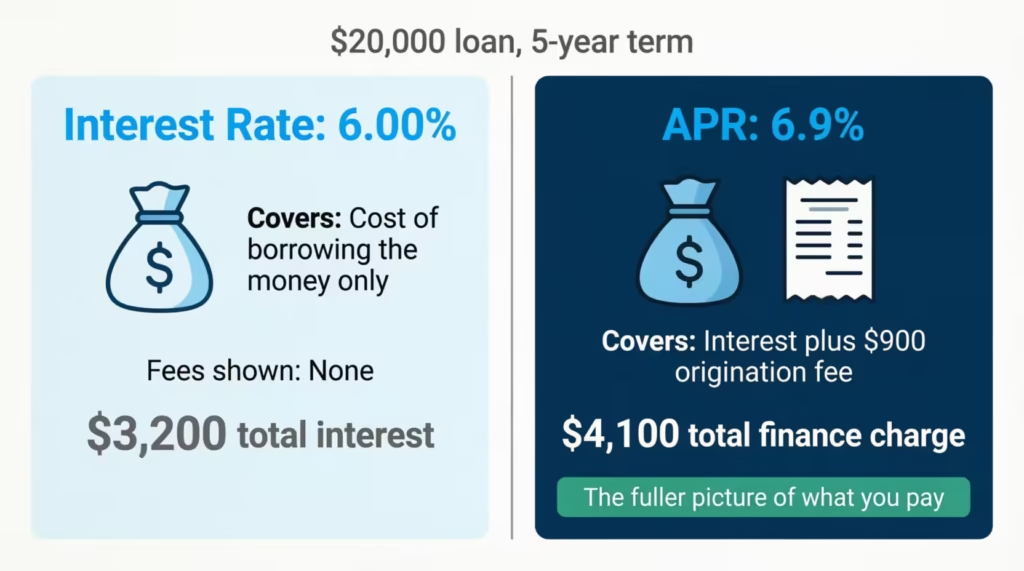
Say you’re taking out a $20,000 personal loan with a 5-year loan term.
- The lender quotes a 6.00% interest rate.
- There’s a $900 origination fee rolled into the loan.
The interest alone would cost you about $3,200 over five years. But that $900 fee is also part of what you’re paying to borrow. When you fold the fee into the math and spread it across the loan, the APR comes out to roughly 6.9%. Same loan. Same payment. But the APR shows the fee, and the interest rate hides it.
That’s why APR is almost always higher than the interest rate. If you ever see an APR that’s lower than the interest rate, ask questions, because something is off.
Here’s a quick side-by-side:
| Number | What It Shows | Includes Fees? |
|---|---|---|
| Interest Rate | Cost of borrowing the money itself | No |
| APR | Total yearly cost, including most required fees | Yes |
When you’re shopping, compare APR to APR, not interest rate to APR. Otherwise, you’re comparing a clean number to a dirty one.
💡 Pro Tip: If a lender pushes the interest rate and dodges the APR question, that’s a sign the fees are doing real damage to the total cost. Ask for the APR in writing before you keep talking.
What’s Included in APR (and What Isn’t)
The finance charge is the legal term for everything the lender charges you to borrow. Not every fee is part of the APR, though, and knowing the difference helps you avoid surprises at closing.
Typically included in APR:
- Interest on the loan
- Origination fees
- Discount points (on mortgages)
- Mortgage broker fees
- Most lender-required insurance
- Underwriting and processing fees
Typically excluded from APR:
- Late payment fees
- Over-limit fees
- Appraisal fees (in many cases)
- Title insurance
- Credit report fees
- Notary and recording fees
The rules for what must be included come from Regulation Z, which is the rulebook that puts the Truth in Lending Act into practice. It’s the reason two different lenders can’t pick and choose which fees to bury.
One thing to watch for: mortgage closing costs are a mix. Some get rolled into the APR (like origination), and others don’t (like title insurance). So even two mortgage APRs can hide different totals. Always ask for an itemized Loan Estimate so you can see every fee, not just the ones the APR captures.
How APR Is Calculated
The exact math gets messy, but the simple version looks like this:
APR = [(Interest + Fees) ÷ Loan Amount ÷ Days in Loan Term] × 365 × 100
Walk through it with our $20,000 loan from earlier:
- Interest over 5 years: about $3,200
- Origination fee: $900
- Total finance charge: $4,100
- Loan term: 1,825 days (5 years)
Plug it in: ($4,100 ÷ $20,000 ÷ 1,825) × 365 × 100 ≈ 4.1% simple cost per year on the original principal, which the law then adjusts for the way the loan actually amortizes, landing near 6.9% APR.
You don’t need to do this math yourself. The lender has to do it and disclose it. But knowing the formula helps you spot when something doesn’t add up.
Fixed APR vs. Variable APR
This one matters because it decides whether your payment can change after you sign.
A fixed APR stays the same for the life of the loan. The rate you sign is the rate you keep. Most auto loans, personal loans, and traditional mortgages use a fixed APR. Your monthly payment doesn’t move.
A variable APR can rise or fall over time. It’s built from two parts:
- An index, usually the prime rate
- A margin, which is a fixed number that the lender adds on top
The formula looks like: Variable APR = Prime Rate + Margin
Most credit cards, home equity lines of credit, and adjustable-rate mortgages use variable APRs. The prime rate is set by big banks based on decisions from the Federal Reserve. When the Fed raises its target rate, prime usually follows, and your variable APR climbs with it.
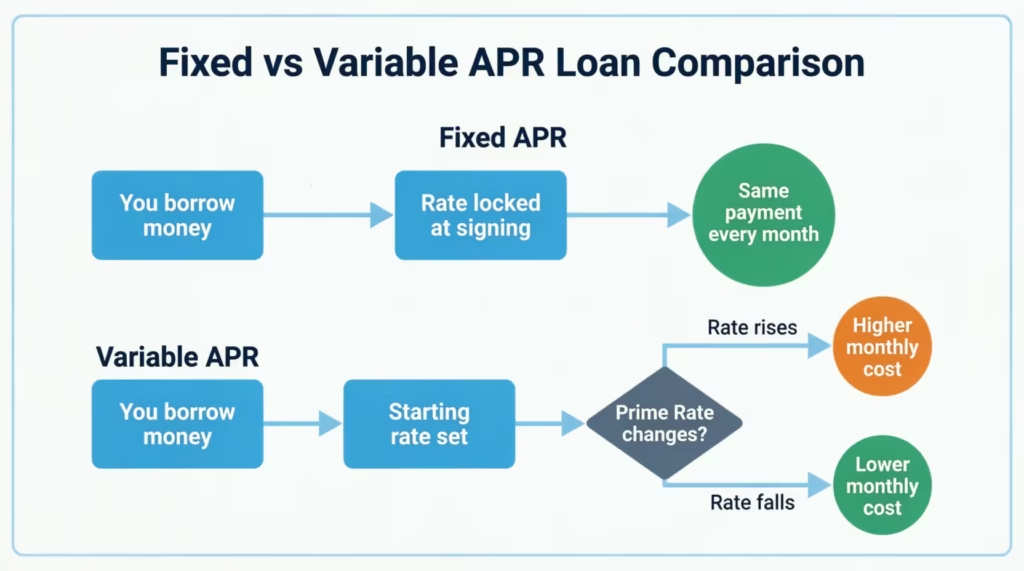
Let’s run a real scenario. Say your credit card has a variable APR of prime + 14.25%. Today, the U.S. prime rate sits at 6.75%, Federal Reserve H.15. That means your APR right now is 21.00%. If the Fed raises rates and prime moves up to 7.25%, your APR jumps to 21.50%, and you didn’t sign anything new. The increase just shows up on your next statement.
That’s the trade-off. Fixed gives you certainty. Variable gives you a lower starting rate sometimes, but it can move against you.
How APR Works on Credit Cards
Credit cards work differently from loans, and this is where most people get caught off guard. The APR on a card isn’t applied once a year. It’s broken into a tiny daily rate and applied every single day to your balance.
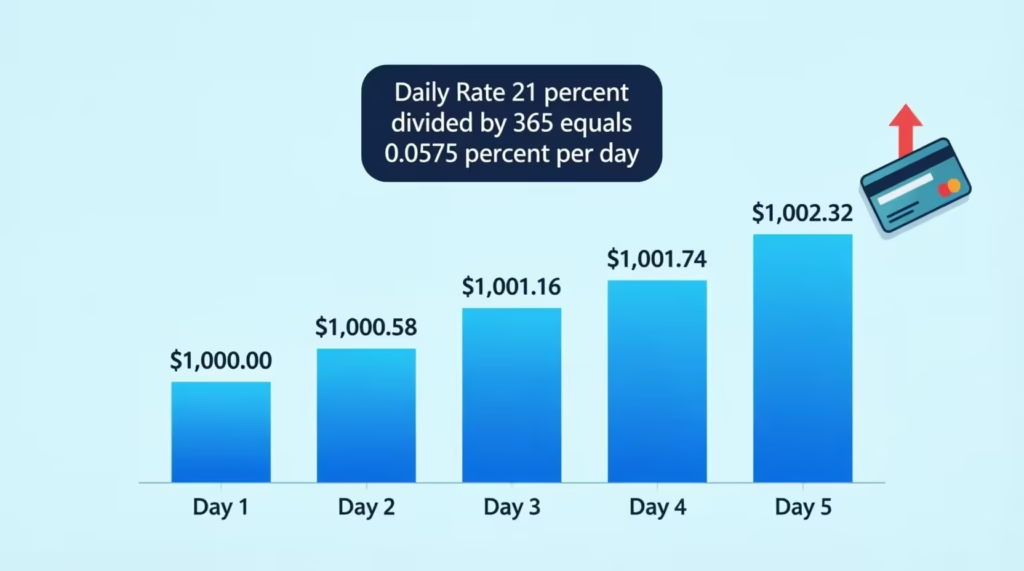
Here’s the math. The daily periodic rate is your APR divided by 365.
21% APR ÷ 365 = 0.0575% charged each day on your balance
Now picture this. You owe $1,000 on your card. Each day, the issuer adds about $0.58 in interest to your balance. The next day, you’re charged interest on $1,000.58. The day after that, on a slightly bigger number. That’s daily compounding, and it’s why credit card debt grows faster than it feels like it should.
The issuer also uses your average daily balance during the billing cycle (usually about 30 days) to figure out the finance charge. If your balance bounced around during the month, they average it before applying interest.
But here’s the saving grace: the grace period.
If you pay your statement balance in full by the due date, you usually pay zero interest on new purchases. That grace period only works if you pay 100% of the statement balance. Carry even $20 into the next cycle, and the grace period collapses. Interest starts accruing from the day each new purchase posts, retroactively.
⚠️ Mistake to Avoid: Paying the minimum on time isn’t the same as paying in full. The minimum keeps you in good standing with the bank, but you lose the grace period and start paying interest on every new transaction from day one.
Types of Credit Card APR
A single card can carry several different APRs, all on the same account. Read your cardholder agreement, and you’ll usually see:
- Purchase APR — Applies to regular shopping when you carry a balance.
- Cash Advance APR — Higher than the purchase APR, and there’s no grace period. Interest starts the moment you take the cash.
- Balance Transfer APR — A special rate (sometimes 0%) for moving debt from another card. It often comes with a 3% to 5% transfer fee.
- Penalty APR — A punishment rate (often 29.99%) triggered if you miss payments. It can stick around for six months or more.
- Intro APR — A promotional rate, often 0%, for a limited window like 12 to 21 months.
Each rate applies to a different bucket of your balance. So you might be paying 21% on purchases, 0% on a balance transfer, and 29.99% on a recent late payment, all at the same time.
How APR Works on Installment Loans (Auto, Personal, Mortgage)
Installment loans behave more predictably than credit cards. You borrow a set amount, you pay a fixed monthly payment, and the loan ends on a known date. The annual percentage rate is built into that payment from day one.
What’s not obvious is how each payment gets split. This is called amortization, and it matters more than most borrowers realize.
In the early months of the loan term, most of your payment goes to interest, not principal. As time passes, the split slowly flips, and more of each payment chips away at the balance.
Take a $25,000 auto loan at 7.5% APR over 60 months. The monthly payment lands near $501. But in month one:
- About $156 is interest
- Only about $345 reduces your loan balance
By month 50, the split has swung the other way. Most of your payment is going to the principal. This is why paying extra in the first year of a loan saves you far more interest than paying extra in the last year.
The finance charge also covers any rolled-in fees, like an auto loan documentation fee or a mortgage origination fee. Those fees show up inside the APR, which is why a 7.0% interest rate on a car loan might show as 7.5% APR once the dealer fees are baked in.
What “0% APR” Really Means (and the Deferred Interest Trap)
A 0% APR offer can be a genuine money-saver or a costly trap, depending on the fine print. The difference comes down to two words: waived versus deferred.
Waived interest is the real deal. Many balance transfer offers and introductory APR credit card promotions work this way. If the intro period is 18 months at 0%, you owe no interest for those 18 months. Period. After month 18, you start paying interest only on whatever balance is left going forward. Nothing snaps back at you.
Deferred interest is a different animal, and it’s where people get hurt. You’ll see this most often on store credit cards and “same as cash” furniture, jewelry, or medical financing offers. Here’s how it works:
You buy a $3,000 couch with a “0% APR for 12 months” deal. The catch hidden in the contract: if you don’t pay the entire $3,000 off within 12 months, the lender charges you every penny of interest that would have built up over the whole year, all at once, on the original $3,000.
So let’s say you’ve paid down the couch to $200 by month 12. You miss the deadline by one payment. The lender then back-charges interest at, say, 28.99% APR on the full original $3,000 from the day you bought it. That’s roughly $870 added to your balance overnight, on a $200 leftover debt.
📌 Did You Know: “Same as cash” and “no interest if paid in full” are the warning phrases that almost always signal deferred interest, not waived interest. The Consumer Financial Protection Bureau flags this practice as one of the most common borrower surprises in retail financing.
To stay safe, read the offer’s fine print and look for the exact word “deferred.” If you see it, set a calendar reminder for 30 days before the promo ends, and pay the balance to zero.
What Is a Good APR?
There’s no single “good” number, because a good APR depends on the product you’re buying and the credit score you bring to the table. Here are realistic benchmark ranges for the current market.
| Product | Strong APR | Average APR | Weak APR |
|---|---|---|---|
| Credit Cards | Below 18% | 21% to 24% | Above 28% |
| New Auto Loans (60 mo.) | Below 6% | 7% to 9% | Above 12% |
| Personal Loans | Below 11% | 12% to 18% | Above 24% |
| 30-Year Mortgages | Below market average | At market average | Above market average + 1% |
For context, the Federal Reserve’s most recent G.19 release puts the average APR on credit cards accruing interest at 21.52% in Q1 2026, and the average 60-month new auto loan at about 7.52% Federal Reserve G.19. If your offer beats these numbers, you’re doing well. If it doesn’t, there’s room to negotiate or shop around.
A “good” APR is also relative to your credit score. Someone with a 780 score who got a 7% auto loan APR got a bad deal. Someone with a 620 score who gets the same 7% APR got a great one. Benchmark against your credit tier, not the national average.
How Your Credit Score Determines Your APR
Lenders price loans based on risk. The higher the risk that you won’t pay them back, the higher the APR they charge. Your credit score is the shortcut they use to measure that risk.
Here’s roughly how the tiers break down for a typical 60-month new auto loan:
| Credit Tier | FICO Score | Typical Auto APR |
|---|---|---|
| Super Prime | 781 to 850 | 5% to 6% |
| Prime | 661 to 780 | 7% to 9% |
| Near Prime | 601 to 660 | 11% to 13% |
| Subprime | 501 to 600 | 16% to 19% |
| Deep Subprime | 300 to 500 | 19% to 22% |
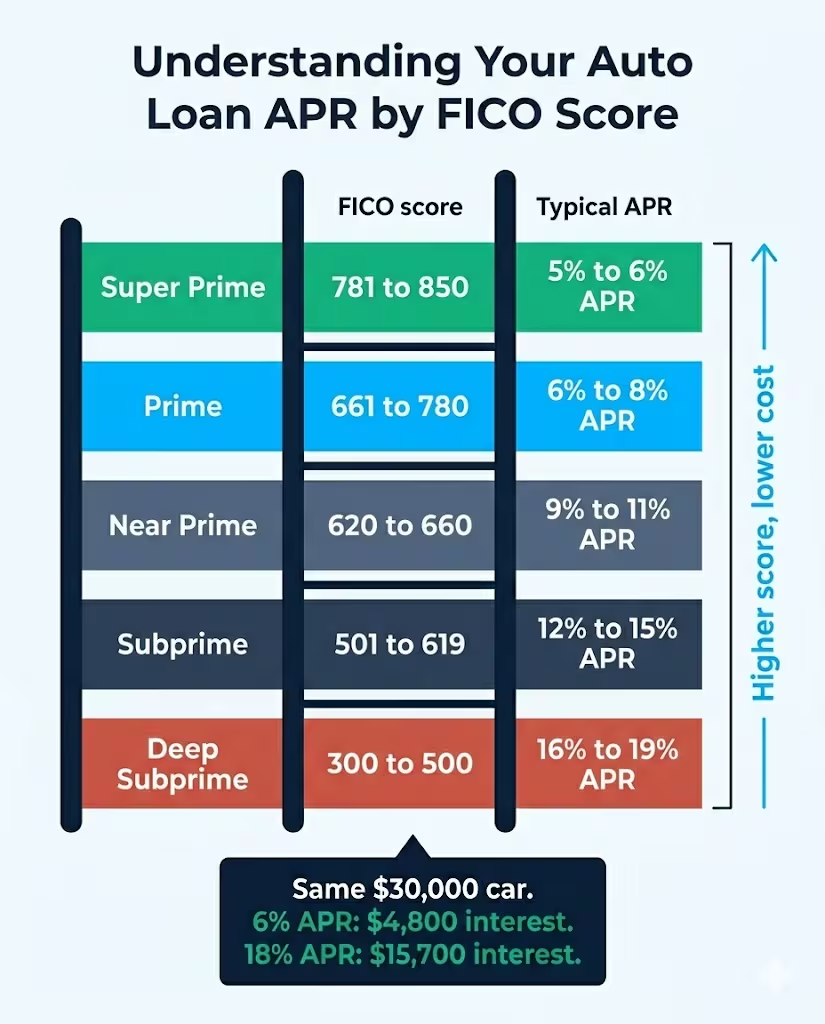
The dollar difference is brutal. Take a $30,000 auto loan over 60 months.
- At 6% APR, you pay about $4,800 in total interest.
- At 18% APR, you pay about $15,700 in total interest.
Same car. Same loan term. An extra $10,900 paid, just because of the credit score on file when you applied.
This is also why “as low as” advertising is so misleading. When you see “Auto loans as low as 4.99% APR,” that rate is reserved for super prime borrowers, usually under 5% of applicants. The rate you’ll actually be offered depends on your credit profile, your income, your debt-to-income ratio, and the lender’s pricing model that week.
To know what you’ll really get, ask for a pre-qualification that uses a soft credit pull. This shows you a real rate offer without damaging your score.
How to Translate APR Into the Dollars You’ll Actually Pay
A percentage on paper means nothing until you turn it into dollars. Here’s how to do that in two minutes for the most common borrowing scenarios.
Example 1: Credit Card Balance
Say you carry a $3,000 balance on a card with a 22% APR and pay only the minimum each month (about 2% of the balance, or $60 to start).
- Daily periodic rate: 22% ÷ 365 = 0.0603%
- First month’s interest: about $55
- Of your $60 payment, only $5 reduces the actual balance.
At that pace, paying just the minimum, that $3,000 balance takes more than 17 years to pay off, and you end up paying close to $4,200 in interest on top of the original $3,000. The smallest payment trap is real because compound interest keeps stacking up faster than the small payments can knock it down.
Example 2: Auto Loan
A $25,000 auto loan at 7.5% APR over 60 months:
- Monthly payment: about $501
- Total paid over 5 years: about $30,060
- Total interest paid: about $5,060
Bump the APR to 12% (subprime territory), and the same loan costs:
- Monthly payment: about $556
- Total paid: about $33,360
- Total interest: $8,360
That 4.5 percentage point difference costs you $3,300 in extra interest.
Don’t try to do this math in your head. Use a free amortization calculator from a trusted source like Bankrate or the Consumer Financial Protection Bureau. Plug in the loan amount, the APR, and the term, and you’ll see your monthly payment and total interest in seconds.
How to Compare Two Offers Using APR
If you’re holding two loan offers, here’s a clean 3-step framework to figure out which one actually costs less.
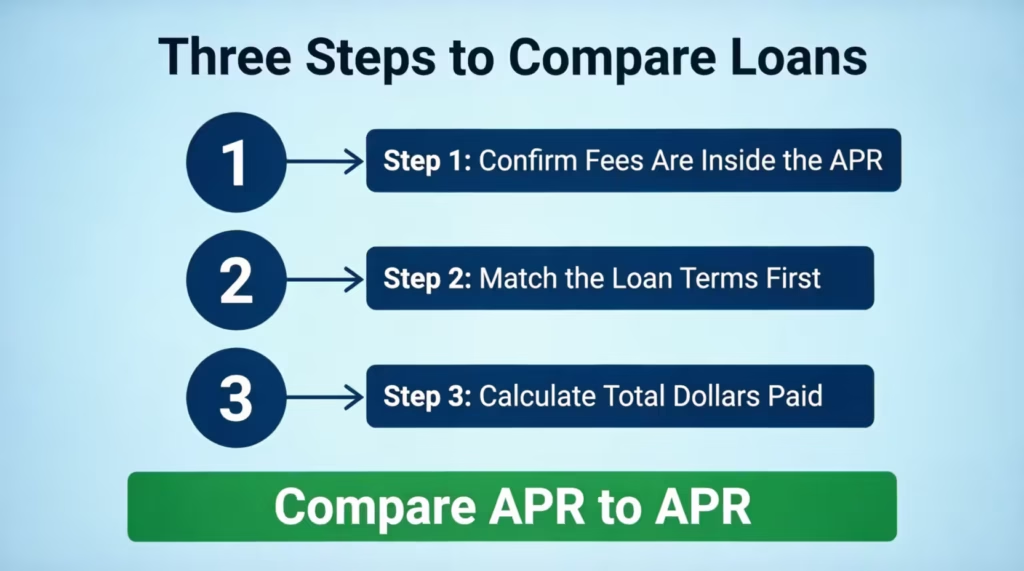
Step 1: Confirm both quotes include the same fees inside the APR.
Not every lender includes every fee. Ask each lender directly: “Does the APR you’re quoting include the origination fee, points, and any required insurance?” If one APR includes a $500 origination fee and the other one doesn’t, you’re comparing two different things. Ask the second lender to give you the APR with all fees rolled in.
Step 2: Confirm both loans have the same term.
A 4.5% APR over 7 years can cost more than a 5.5% APR over 4 years. Why? Because the longer you borrow, the more total interest you pay, even at a lower rate. Always match terms first. Compare a 60-month loan to a 60-month loan, not a 60-month loan to an 84-month one.
Step 3: Calculate the total dollars you’ll pay over the life of each loan.
This is the only number that truly matters. Take your monthly payment and multiply it by the number of payments. The lower total wins.
Quick worked example:
| Lender A | Lender B | |
|---|---|---|
| Loan Amount | $20,000 | $20,000 |
| Term | 60 months | 60 months |
| APR | 6.9% | 7.4% |
| Monthly Payment | $395 | $400 |
| Total Paid | $23,700 | $24,000 |
Lender A wins by $300. The 0.5 percentage point gap on the APR vs interest rate chart turns into real, measurable dollars in your pocket.
How to Lower the APR You’re Offered (or Currently Paying)
You have more leverage than you think. Here are the moves that actually work.
1. Improve your credit score before you apply.
Even a 30-point jump in your credit score can shift you into a better pricing tier. The fastest wins:
- Pay down credit card balances below 30% of your limits, then below 10%.
- Don’t close old credit cards. Length of history helps.
- Dispute any errors on your credit reports. You can pull them free at AnnualCreditReport.com, the only federally authorized source.
2. Shop in a tight window.
For auto loans, mortgages, and student loans, FICO treats multiple inquiries within a 14 to 45-day window as a single inquiry. That means you can pull rate quotes from five or six lenders in two weeks without taking five or six hits to your score. Use this. The rate you’re first offered is rarely the best one available.
3. Negotiate directly.
Call your credit card issuer and ask, in plain words: “I’ve been a customer for X years. I’d like to lower my APR. What can you offer?” It works more often than people expect. A study from LendingTree found that about 76% of people who asked for a lower credit card APR got one, with an average reduction of around 6 percentage points LendingTree. The call takes ten minutes. The savings can run into the hundreds per year.
4. Use a balance transfer strategically.
A balance transfer APR of 0% for 18 to 21 months can wipe out interest while you pay off the principal. Two rules: pay the transfer fee (usually 3% to 5%) out of pocket if possible, and aim to clear the balance before the promo ends. Otherwise, the new APR can be higher than what you had before.
5. Refinance an existing loan.
If rates have dropped since you took out your loan, or your credit has improved, refinancing your auto loan or mortgage can shave one or two percentage points off the APR. Just make sure the closing costs don’t eat the savings.
The fastest single move for most borrowers is asking. Lenders compete for good customers, and a polite, direct request often gets you a better rate without changing a single other thing.
Frequently Asked Questions (FAQs)
What does a 24% APR mean?
A 24% APR means borrowing costs 24% per year before things like late fees or other extra charges. On a credit card, that cost is applied daily, so a carried balance grows faster than many people expect.
How much is 26.99 APR on $3,000?
A $3,000 balance at 26.99% APR costs about $809.70 in simple yearly interest, or about $67.48 per month before compounding. On a credit card, the exact charge changes with your daily balance and payments.
Is 29.99% APR bad?
Yes, 29.99% APR is a very high credit card rate and usually signals penalty pricing. Compared with the article’s weak card APR range above 28%, this rate is expensive.
Is 34.9% APR bad?
Yes, 34.9% APR is extremely expensive and well above the article’s weak card APR range above 28%. A balance at that rate can grow fast even when you make payments.
What is a good APR for a 700 credit score?
A 700 score often falls in the prime range for a 60-month new auto loan, where the article shows typical APRs around 7% to 9%. For other products, the exact offer still depends on the lender and fees.
Is 20% APR too high?
For a credit card, 20% APR is close to the article’s average and is not a bargain. For a personal loan or auto loan, 20% would usually be considered expensive.
Does your APR go down if you pay off early?
Yes, paying off an installment loan early can reduce the total interest you pay because less balance remains for the lender to charge. On credit cards, paying the statement balance in full also stops new purchase interest in most cases.
Do I pay APR if I pay on time?
If you pay your credit card statement balance in full by the due date, you usually do not pay interest on new purchases. Paying only the minimum still counts as on time, but it usually ends the grace period and starts interest.
How can I lower my APR?
Improve your credit score, compare offers from multiple lenders, negotiate with your card issuer, or refinance if better rates are available.
What is the difference between APR and an interest rate?
The interest rate reflects the cost of borrowing money, while APR includes both interest and most required loan fees, giving a more complete picture of total borrowing costs.
Conclusion
We’ve explained what APR means, how it’s different from a simple interest rate, what is included in the annual percentage rate, and what isn’t. We also looked at how the same number acts differently on a credit card compared to an installment loan. We also walked through the deferred interest trap, the credit-score-to-APR ladder, and a clean 3-step way to compare two offers in dollars, not percentages.
For most readers, the most effective approach is this: always compare APR to APR (never APR to interest rate), match the loan terms before you compare, and ask any lender for a lower rate before you sign. Those three moves alone can save you thousands.
If you know someone shopping for a car, applying for a credit card, or staring at a mortgage offer this month, share this guide with them. One clear understanding of APR could save them five figures over the life of a loan.