
You’re on the casino floor. Your wallet is thinner than you expected. The tables are hot, or maybe you just want to grab dinner without breaking your slot budget. You reach for your debit card and pause. Which machine do you use? Will your bank block it? How much will this really cost? A cash advance at a casino with a debit card is usually your fastest, cheapest way to pull money from your checking account on-site.
In this guide, I’ll walk you through both methods, real fee math, PIN rules, and how to avoid a decline before it happens.
Key Takeaways
This guide explains how to get a cash advance at a casino with a debit card, covering floor ATM withdrawals versus cage advances, real fee ranges, withdrawal limits, PIN rules, and how to avoid a decline.
Core Facts:
- A cash advance at a casino with a debit card can happen at a floor ATM or at the cashier cage, and both pull funds directly from checking with no interest charged.
- Floor ATMs typically cap withdrawals at $300 to $500 per transaction, while cage advances commonly allow $1,500 to $5,000 per transaction depending on the casino.
- A $300 floor ATM withdrawal typically costs $4.50 to $19.50 total in combined ATM surcharge, out-of-network fee, and any casino convenience fee.
- Cage advances usually charge a flat percentage of 3% to 5.99% plus a fixed service charge of $3 to $6 per transaction.
- Both floor ATM and cage debit transactions require PIN entry, and a debit transaction never affects a credit score since it pulls from checking, not a credit line.
- Common decline causes include bank fraud flags, reaching a daily debit limit, merchant category code blocks on gambling transactions, and selecting the wrong account type.
Best for:
- Casino visitors deciding between a floor ATM and a cashier cage for withdrawing cash on-site.
- Travelers who want to understand and compare the real fees before pulling cash at a casino.
- Anyone trying to prevent a debit card decline at a casino by preparing with their bank in advance.
Debit ATM Withdrawal vs. Cage Debit Card Advance: The Two Ways to Get Cash
There are two very different ways to pull cash inside a casino using your debit card, and mixing them up is the number-one reason people overpay or get declined.
The debit ATM withdrawal works exactly like a normal ATM run at a gas station. You insert your debit card, punch in your PIN, and the machine pulls money directly from your checking account. The catch is that casino ATMs are almost always out-of-network, which means you pay a surcharge from the ATM operator plus a foreign-ATM fee from your own bank. It’s still a straight debit transaction, not a loan, and nothing gets billed to a credit line.
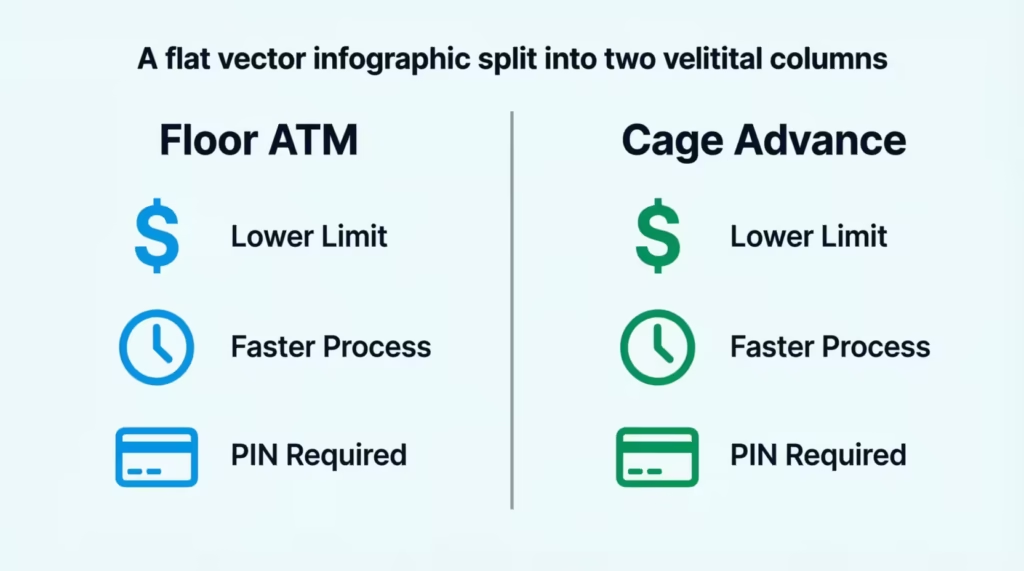
The cage debit card advance happens at the cashier window (also called the “cage”). A cage clerk swipes your Visa or Mastercard debit card through a payment terminal run by a specialty provider like Global Cash Access or Pavilion Payments. You enter your PIN, show ID, and the clerk hands you cash across the counter. This route usually offers higher single-transaction limits than the floor ATM, which matters if you want $1,500 in one pull instead of three $500 trips.
Both are debit transactions. Both pull from your checking account in real time. Neither is a loan. The differences that actually matter are the fee structure, the withdrawal cap, and whether you’re comfortable talking to a human cashier.
What Is a Cash Advance at a Casino ATM
The phrase “cash advance” causes real confusion here, so it’s worth clearing up. In everyday banking, a “cash advance” means borrowing against your credit card’s line of credit, which comes with an APR that starts accruing immediately.
When people say cash advance at a casino ATM using a debit card, they don’t mean borrowing. They mean pulling their own money out of their own checking account through a casino-floor ATM. There’s no interest, no line of credit, and no separate “cash advance APR.” You’re just accessing your own funds through a more expensive machine.
The casino industry, and some card issuers, still label these transactions as “quasi-cash” or “cash-equivalent.” That label can matter for reward points and bonus categories, but for a straight debit withdrawal, it doesn’t cost you extra beyond the ATM fees you’d see anywhere.
How to Get Cash From a Credit Card at a Casino
Some readers land here wondering if they should use a credit card instead. The short answer: usually not, unless you truly have no debit option.
Pulling cash from a credit card at a casino is a true cash advance, and it’s expensive on three fronts. First, most issuers charge a cash-advance fee of 3% to 5% of the amount, with a $10 minimum, per Experian. Second, the cash-advance APR is typically higher than your purchase APR, and it starts charging interest the moment the cash hits your hand. There is no grace period. Third, the casino ATM or cage still adds its own surcharge on top.
The Consumer Financial Protection Bureau has flagged that credit card cash-advance activity, and the fees tied to it, spike noticeably in states after sports betting is legalized. That research is a strong reminder to think twice before using credit at a cage window.
If you have money in checking, use your debit card. Save the credit card cash advance for emergencies where nothing else works.
Can You Get a Cash Advance at a Casino Without a PIN?
For a debit card, the answer is almost always no. A debit transaction, whether at a floor ATM or a cage terminal, is authorized through the PIN debit network. No PIN means no transaction.
There are a few narrow exceptions. Some casino cages can process a signature-based debit transaction, which runs the card more like a purchase and doesn’t need a PIN. But this is not universal, and the cashier will often push you toward PIN entry because it clears faster and costs the casino less.
For a credit card cash advance, most issuers now require a PIN as well. Many cardholders don’t even know their card has one. If you plan to use credit as a backup, call your card issuer at least a week before your trip and request a cash-advance PIN by mail. It usually takes 7 to 10 business days to arrive.
💡 Pro Tip: Set your debit PIN to something you can recall under pressure, but never something obvious like a birth year. Casino ATMs will lock the card after three wrong tries, and getting unlocked from the floor takes a phone call and a lot of patience.
Casino ATM Withdrawal Limit: What to Expect
Withdrawal caps at casino ATMs are set by two parties: the ATM operator and your own bank. The lower of the two limits is the one that actually stops you at the machine.
Typical numbers on the floor:
- Per transaction: $300 to $500 at most casino floor ATMs.
- Per day (ATM operator): $1,000 to $2,000 for one card at one machine.
- Per day (your bank): Often $500 to $1,000, unless you’ve raised it in advance.
The cage terminal is more generous. Cage debit card advances commonly allow $1,500 to $5,000 per transaction, depending on the casino and the funds in your account. The cage still runs the card against your bank’s daily debit limit, so if your bank caps you at $1,000 per day, that ceiling follows you to the cage window.
📌 Did You Know: Your bank’s debit limit resets on a rolling 24-hour window from your last transaction at many banks, not at midnight. Two $500 withdrawals five hours apart may look identical to the network, but the second one can still fail if it’s within that rolling window.
Step-by-Step: Getting Cash From a Casino ATM With Your Debit Card
Follow these steps at the floor machine:
- Find a casino-branded ATM on the gaming floor. They’re usually near the cage, the sportsbook, or major slot banks. Skip any freestanding machine that looks off-brand or is tucked into a hallway.
- Insert your debit card and choose “Checking” as the account type. Selecting “Savings” by mistake is a common decline trigger.
- Enter your PIN. You get three tries before the card locks.
- Select the amount. Round numbers like $200 or $300 process faster. Machines often preload buttons for $60, $100, $200, and “Other.”
- Review the fee screen carefully. The ATM must show the surcharge before you commit. This is your last chance to cancel with zero cost.
- Confirm and wait. The cash drops in 10 to 20 seconds. Take your receipt. The receipt is your proof if the transaction is disputed later.
- Move away from the machine before you count the cash. That habit alone deters most opportunistic theft.
If the machine offers dynamic currency conversion (mostly for international cards), always decline. The built-in exchange rate is worse than what your bank would charge.
Getting Cash Fast: What ‘Instant’ Really Means
“Instant” describes when the cash reaches your hand, which is 20 seconds. It does not describe when your bank actually settles the debit. Most banks post debit ATM transactions in real time as a pending hold, but the final settlement can take 1 to 3 business days.
Two practical effects. First, your available balance drops immediately, so don’t count on the money still being there for a mortgage payment that pulls the same night. Second, if the ATM fails to dispense but still shows an approval, the hold can take up to 10 business days to reverse. Casinos are good about this, but always keep your receipt and note the machine ID.
Step-by-Step: Getting a Debit Card Advance at the Casino Cage
The cashier window is your move when the floor ATM caps out or when you want a single larger pull. The process:
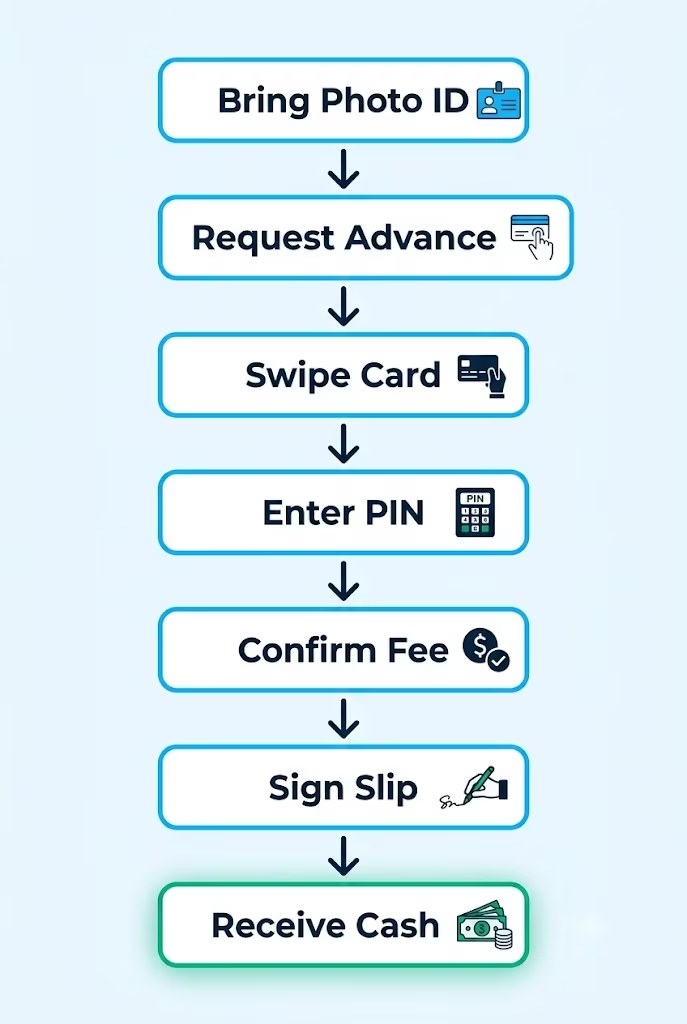
- Bring a government-issued photo ID. Driver’s license, passport, or state ID. Expired IDs are refused every time.
- Walk up to the cage and tell the cashier you want a debit card cash advance. The clerk hands you a terminal, similar to the pinpad at a grocery store.
- Swipe or insert your debit card on the terminal. On newer terminals, tap-to-pay is disabled for cash advances by design.
- Enter your PIN. No PIN means no transaction here. The cashier cannot override this.
- Confirm the amount and the total fee on the terminal screen. The full disclosure, including the cage’s markup and your bank’s out-of-network fee (which is often estimated, not exact), appears before you approve.
- Sign the printed slip the cashier hands you. You get a copy for your records.
- Receive the cash in the denominations you request. Cages will usually break it into $100s and $20s. Ask for a mix if you’re headed to lower-limit tables.
Cage transactions are logged and reported to federal regulators once the daily total for one person crosses $10,000, per FinCEN. That filing is routine and doesn’t mean you did anything wrong, but it does mean the casino permanently records your ID and the transaction.
What Fees You’ll Actually Pay
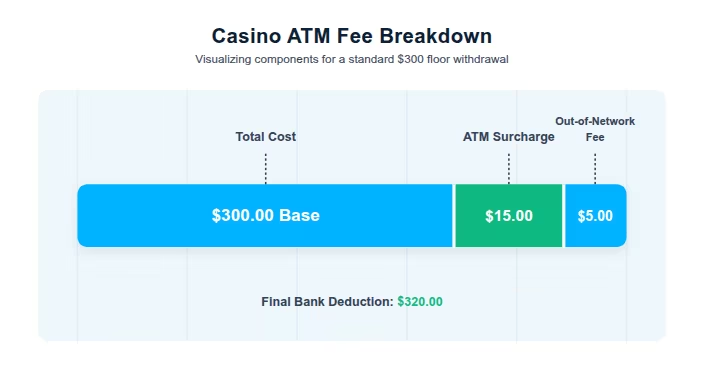
The fee stack is where people get burned, because no single receipt shows the whole picture. Here’s a worked example for a $300 debit withdrawal at a casino floor ATM.
| Fee | Typical Amount | Who Charges It |
|---|---|---|
| ATM surcharge | $3.00 to $6.00 | Casino ATM operator |
| Out-of-network fee | $1.50 to $3.50 | Your own bank |
| Casino “convenience” fee | $5.00 to $10.00 | Some cage terminals only |
| Total on $300 withdrawal | $4.50 to $19.50 | Combined |
For context, the 2025 Bankrate Checking Account and ATM Fee Study puts the average total out-of-network ATM cost at $4.86 nationwide, which is the most recent published figure. Casino ATMs run well above that average because they know you have limited alternatives once you’re inside.
At the cage, the fee is usually a flat percentage of the withdrawal, commonly 3% to 5.99%, plus a fixed service charge of $3 to $6. A $500 cage advance at 5% plus a $5 flat fee costs you $30 out the door. That’s often more than a floor ATM, but you get the higher single-transaction limit.
Jennifer, a marketing director on a weekend trip to a regional casino, learned this the direct way. She pulled $400 from a floor ATM three separate times over two days. The surcharge was $5.99 each pull, and her bank tacked on $3 out-of-network each time.
Her total in fees came to $26.97, on top of what she actually spent gambling. One $1,200 cage advance at 4% plus a $5 charge would have cost her $53, so the ATM was cheaper in her case. Do the math for your amount before you pick a lane.
⚠️ Mistake to Avoid: Don’t accept the on-screen “conversion” or “rate” offer at casino ATMs. Say no to any prompt that offers to charge you in your home currency or lock in a rate. The default network rate is almost always better.
Why Your Debit Card Might Get Declined at a Casino
Declines at casinos are common and rarely mean anything is wrong with your card. The usual reasons:
- Location-based fraud flag. Your bank’s fraud system sees a large debit withdrawal in Las Vegas, Atlantic City, or a tribal casino zip code and freezes the card until you confirm the charge.
- Daily debit limit reached. Even if you have $10,000 in checking, most banks cap ATM withdrawals at $500 to $1,000 per day by default.
- Merchant category code (MCC) block. Some banks and credit unions actively block MCC 7995 (gambling transactions) on debit cards. This is common at conservative regional banks.
- Wrong account selected. Choosing “Savings” when your PIN is tied to “Checking” trips a decline every time.
- Chip read failure. Casino ATMs get heavy use. A dirty chip reader can force a fallback to magstripe, which some banks now reject.
Prevention is straightforward. Call your bank two days before your trip. Tell them the specific casino name, the city, and the dates. Ask them to note the account. Most banks now let you do this in the mobile app under “travel notifications” in under a minute.
How to Raise Your Daily Limit Before You Go
Every major bank lets you raise the daily debit and ATM limit temporarily. The exact numbers vary, but the process is similar:
- Chase, Bank of America, Wells Fargo: Call the number on the back of the card and request a temporary daily ATM limit increase. Chase will often lift you from $500 to $3,000 for up to seven days.
- Capital One 360, Ally, and other online banks: Use the in-app chat. These lift more conservatively, often to $1,500 max.
- Credit unions: Almost always require a phone call to a member service rep. Do this at least 48 hours in advance.
Be ready to answer security questions. The bank may also ask why you need the higher limit. “Travel” is a fine answer. You don’t have to mention gambling if you’re uncomfortable, but confirming the destination city helps the fraud team clear future charges faster.
Does a Casino Debit Transaction Affect Your Credit Score?
No. A debit card withdrawal, whether from a casino ATM or a cage, pulls from your checking account and never touches your credit report.
There is no credit inquiry, no reported balance, no utilization change, and no impact to any of the three major credit bureaus. Your FICO and VantageScore are not affected by debit activity. This is one of the most persistent myths about casino cash, and it’s flatly wrong for debit transactions.
The picture is different for credit card cash advances. Those add to your card’s balance, which raises your reported utilization ratio, which can lower your score temporarily. The cash-advance APR also means interest starts accruing the same day, so the balance can grow between statements. Credit card cash advances are treated as a separate borrowing category and often carry harsher terms than purchases.
One nuance worth naming: some banks flag heavy casino debit activity for internal risk review, not credit scoring. If you regularly pull $2,000 at a casino cage twice a month, your bank may quietly lower your overdraft limit or ask questions if you apply for a new product with them. It’s not on your credit report, but it can affect your relationship with that specific bank.
How to Get Cash at a Casino Without a Debit Card
Options if you left the card at home, lost it, or want to avoid the fee stack:
- Cash a personal check at the cage. Most casinos will cash a personal check up to a set limit, often $500 to $2,500, once you’re enrolled in their check-cashing program. Enrollment is free but requires a driver’s license, a bank routing number, and a few minutes for the cage to run a Certegy or TeleCheck verification.
- Apply for a casino line of credit. This is a marker, essentially a short-term interest-free loan from the casino. Approval takes anywhere from 24 hours to a week, so this is a pre-trip move. Approvals are based on your average bank balance, not your credit score, and the marker must be repaid in 30 to 45 days.
- Wire funds to the cage. Casinos accept incoming wires from your bank, usually with a $10 to $25 receiving fee. Slow (same-day if you wire before noon, next-day otherwise) but useful for larger amounts.
- Use a prepaid card or a peer-to-peer app. Venmo, Cash App, and Zelle can move money to a friend on-site, who can then hand you cash. This bypasses cage fees entirely, but you and your friend need to agree on the terms in advance.
Casino Cash Advance Check
The casino cash advance check is a hybrid option that many players don’t know exists. It’s a check drawn on your own bank account, processed by a third-party vendor like Global Cash Access, and cashed on the spot at the cage.
The process: you fill out a personal check made out to the casino for the amount you want. The cashier runs the check through an electronic verification system tied to your bank. If your account has the funds, the check clears in real time, and you walk away with cash. Fees usually run 2% to 4% of the check amount, with a $5 to $10 minimum. Limits are often higher than debit card cash advances, sometimes up to $5,000 or more per check.
This route makes sense when your debit daily limit is capped, but your checking balance is large, and when you want to avoid the merchant category code issue tied to debit transactions at gambling venues. You do need a physical checkbook, which is the modern obstacle.
Staying Safe at Casino ATMs and Cages
Casino floors are heavily surveilled, but that doesn’t make you invisible to skimmers, shoulder-surfers, or opportunists. A short security checklist to work through every time:
- Use ATMs that are physically inside the casino cage’s line of sight. Free-standing machines in dim hallways or near back exits are higher risk for skimming devices.
- Wiggle the card reader before inserting your card. Skimmer overlays are usually glued on and will move slightly. If the reader shifts, walk away and report it to security.
- Cover the PIN pad with your other hand as you enter your PIN. Hidden cameras above the machine are the second half of most skimming setups.
- Watch for shoulder-surfers. If someone is standing closer than they need to be, cancel the transaction and move to a different machine.
- Keep the cash concealed as you walk to the tables or the room safe. Never count large bills on the floor.
- Save every receipt for at least 60 days. If a transaction is later disputed, the receipt with the ATM ID and timestamp is your fastest path to a refund.
- Enable real-time transaction alerts in your bank app before you leave home. A push notification hits your phone within 5 seconds of every debit, which is often faster than you’d notice a fraudulent charge yourself.
If your card is ever swallowed by a casino ATM, do not walk away. Call the number posted on the machine and file a report with the casino’s security office right then. Recovery is often possible within an hour if you act immediately.
Frequently Asked Questions (FAQs)
Can you get a cash advance at a casino with a debit card?
Yes, through a floor ATM withdrawal or a cage debit card advance at the cashier window. Both pull cash directly from your checking account with no interest, since neither is an actual loan.
Can you get a cash advance at a casino without a PIN?
Almost always no, since both floor ATMs and cage terminals require PIN debit network authorization. Some cages allow signature-based debit as a rare exception, but cashiers usually push PIN entry because it clears faster.
Can you use a credit card to take money out at a casino?
Yes, but it counts as a true cash advance with a 3% to 5% fee (minimum $10) plus a higher APR that starts accruing immediately with no grace period. The casino ATM or cage adds its own surcharge on top of that.
How much is a cash advance fee for $1,000?
A credit card cash advance typically charges 3% to 5%, so $1,000 would cost $30 to $50 in issuer fees alone, per Experian’s stated range. A cage debit advance runs a similar 3% to 5.99% plus a $3 to $6 flat charge.
How do I get a cash advance without a PIN on a credit card?
Most issuers now require a PIN for credit card cash advances, so you’ll need to request one by mail from your card issuer before your trip. This typically takes 7 to 10 business days to arrive.
What is the casino ATM withdrawal limit?
Floor ATMs usually cap transactions at $300 to $500, with daily limits of $1,000 to $2,000 from the machine operator. Your own bank’s daily debit limit, often $500 to $1,000, is the ceiling that actually applies first.
Does a casino debit transaction affect your credit score?
No, a debit withdrawal at a casino ATM or cage pulls from checking and never touches your credit report. There’s no inquiry, no reported balance, and no utilization change from debit activity.
Why does my debit card get declined at a casino?
Common causes include a fraud flag from your bank noticing a large withdrawal in a casino ZIP code, hitting your daily debit limit, or your bank blocking gambling merchant codes (MCC 7995). Calling your bank two days ahead with your destination usually prevents this.
How do you raise your daily debit limit before a casino trip?
Call the number on your card or use your bank’s app to request a temporary increase; Chase, for example, can lift you from $500 to $3,000 for up to seven days. Online banks like Capital One 360 typically raise limits more conservatively, often to $1,500 max.
How can I withdraw cash from my debit card at a casino without a card?
Cash a personal check at the cage, apply for a casino line of credit called a marker, or wire funds to the cage in advance. Peer-to-peer apps like Venmo or Zelle also work if a friend on-site hands you cash.
Wrapping Up
Getting cash at a casino with a debit card is genuinely simple once you understand the two lanes. Floor ATMs are quick, capped lower, and best for small amounts. The cage window is slower, allows bigger single pulls, and often costs more per transaction.
For many readers, the cheapest option for amounts under $500 is the floor ATM. Just raise your bank’s daily limit first. This way, total fees usually stay under $10. For amounts above $1,000, the cage will save you multiple transaction fees. Whichever lane you pick, call your bank first, keep every receipt, and cover that PIN pad.
If a friend is planning a Vegas weekend or a cruise stop with a casino, share this guide with them. It could easily save them $30 in fees and one very frustrating declined transaction.