
I know how stressful it feels to stare at a credit report full of negative marks and not know who to trust. Late payments, collections, or a repossession can block you from a mortgage or car loan, and the credit repair industry is full of scammy players who prey on that panic. Choosing the best credit repair companies is not just about price. It’s about safety, real results, and legal protection.
The safest choice is a company that follows federal law, charges only after work is done, and has a clean complaint record.
Below, you’ll find step-by-step help, an easy-to-understand legal guide, cost averages, and a list tailored to your specific credit issue.
Key Takeaways
This guide explains how to choose among the best credit repair companies, covering typical costs, CROA legal protections, a step-by-step vetting checklist, and provider picks by specific credit situation.
Core Facts:
- Monthly fees for legitimate credit repair companies typically range from $79 to $149, plus a separate first work fee of $89 to $199.
- Under the Credit Repair Organizations Act, companies cannot charge any fee until work is completed, and consumers get a 72-business-hour right to cancel with no penalty.
- No company can legally remove accurate negative information; correct records like missed payments can remain on a credit report for up to seven years.
- A February 2026 GAO report confirmed the CFPB is undergoing significant downsizing, which increases the need for consumers to self-vet companies before signing.
- A fair vetting process includes checking BBB accreditation, searching the CFPB complaint database, and verifying state registration where required.
- Goodwill letters requesting removal of a one-time late payment succeed roughly 20 to 30 percent of the time, according to the article.
Best for:
- Readers comparing multiple credit repair providers who want to understand real cost ranges before signing a contract.
- Consumers with several negative items, identity theft cases, or a tight lending deadline who are deciding whether professional help is worth it.
- Readers who want a specific vetting checklist and legal rights overview to avoid a bad-actor company.
Is It Worth Hiring a Credit Repair Company?
Credit repair companies exist to challenge negative items on your credit report with the three bureaus (Equifax, Experian, and TransUnion) and, in some cases, with the original creditor. They send dispute letters, follow up on responses, and push for removal of items that are inaccurate, outdated, or unverifiable.
You don’t always need to pay for this. If you have just one or two clear errors, like a paid collection still showing as unpaid, you can dispute it yourself in about 30 minutes using the free online forms at each bureau. The Fair Credit Reporting Act gives you the right to do this at no cost.
Hiring help starts to make sense when the situation is messy. Think of Michael, a 42-year-old operations manager who found seven inaccurate entries after a stolen wallet led to identity theft. He worked 55 hours a week and had no time to track dispute deadlines across three bureaus. A professional service handled the paperwork while he kept his job on track.
Professional help also adds value when you face:
- Multiple negative items across different bureaus
- Identity theft with mixed files
- Old collections that keep re-appearing after removal
- A tight deadline, like a mortgage application in 60 days
Here’s the honest limit. No company, good or bad, can legally remove accurate negative information. If you truly missed a payment and the record is correct, it stays on your report for up to 7 years. Anyone who promises otherwise is breaking federal law.
💡 Pro Tip: Pull your free reports from all three bureaus at AnnualCreditReport.com before you hire anyone. If you count fewer than three disputable items and have the paperwork, DIY often wins.
How Much Does Credit Repair Usually Cost?
Real pricing in 2026 sits in a narrow range. Most legitimate providers charge a monthly subscription fee between $79 and $149, based on the plan tier. Basic plans handle standard bureau disputes. Premium plans add creditor interventions, cease-and-desist letters, and identity theft support. Experian data shows that credit repair services generally run from $50 to $150 per month, depending on the plan.
A first work fee (sometimes called a setup or “first work” charge) usually runs $89 to $199. This one-time fee covers the initial credit report pull and audit. Under federal law, this can only be billed after the first round of work is completed, never before.
Some companies market a “pay-per-deletion” model, charging $50 to $75 per item removed. This model is heavily restricted by the Credit Repair Organizations Act because payment is tied to results the company cannot guarantee. Genuine pay-per-deletion plans are rare, and any provider pushing this hard should raise a flag.
Here’s what should be included in a fair monthly fee:
- Dispute letters to all three bureaus
- Direct creditor challenges
- Progress reports every 30 to 60 days
- Access to a case advisor
Add-ons often billed separately:
- Credit monitoring ($15 to $25 per month)
- Score tracking dashboards
- Identity theft insurance
- Debt validation letters
A fair money-back guarantee usually spans 90 days. If no items are removed in that window, you get a refund. Read the fine print. Some guarantees only refund the last month’s fee, not the full amount paid.
Your Legal Rights Under CROA
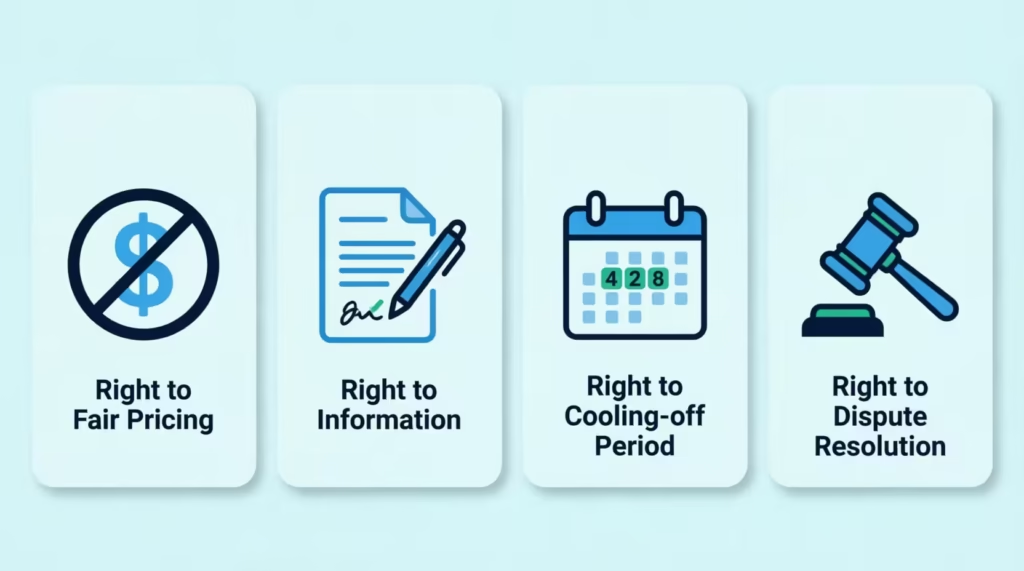
The Credit Repair Organizations Act (CROA) is your shield. It’s a federal law passed in 1996 that governs every for-profit credit repair company operating in the U.S. Every reader signing a contract today has four core protections.
No upfront fees. A company cannot charge you a single dollar until it has completed the work it promised. The FTC confirms that CROA bars credit repair companies from demanding advance payment for their services. If a sales rep asks for a credit card charge on day one before any letter is sent, walk away.
Written contract with full disclosures. Every legitimate provider must give you a written contract that lists total price, payment terms, services performed, expected timeline, and the company’s legal name and address. Verbal promises don’t count.
Three-business-day right to cancel. You have 72 business hours after signing to cancel with no penalty and no fee. This right must be printed clearly in your contract. Weekends and federal holidays don’t count in that window.
Right to sue for violations. If a company breaks CROA, you can sue for actual damages, punitive damages, and attorney’s fees. Class actions are also allowed. This gives real teeth to consumer complaints.
⚠️ Mistake to Avoid: Don’t sign anything the same day you first speak to a company. Take the contract home, read it slowly, and check that every promise made on the phone appears in writing.
The State of CFPB Enforcement in 2026 (and Why Vetting Matters More Now)
The Consumer Financial Protection Bureau (CFPB) has been the primary federal cop on credit repair scams for over a decade. That’s shifting in 2026. A February 2026 GAO report confirmed that CFPB is undergoing a deliberate and significant downsizing and restructuring effort, with reduced staffing and litigation capacity.
What does that mean in practice? Enforcement of bad actors will likely be slower. New investigations may take longer to open. Restitution funds paid out to harmed consumers could shrink. The complaint database is still live, but the agency behind it has fewer people to act on filings.
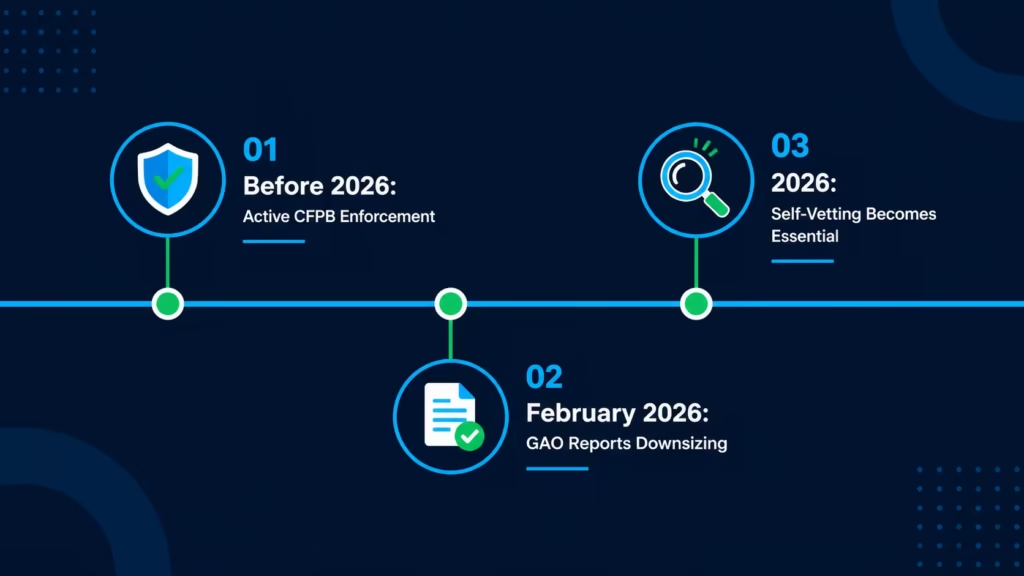
This does not mean the law changed. CROA is still in force. The FTC and state attorneys general still have full authority. But the burden of self-vetting has grown for you as a consumer.
Three practical shifts to make right now:
- Check the Better Business Bureau (BBB) profile before you sign, not after
- Search the CFPB complaint database at consumerfinance.gov for the company’s name and read the last 12 months of complaints
- Look up the company on your state attorney general’s consumer protection page
If a provider has more than 20 unresolved complaints in the last year, that’s a warning sign no matter how polished their website looks.
How to Vet a Credit Repair Company Before You Sign
Use this checklist as your screening tool. Any company that fails two or more items should be crossed off your list.
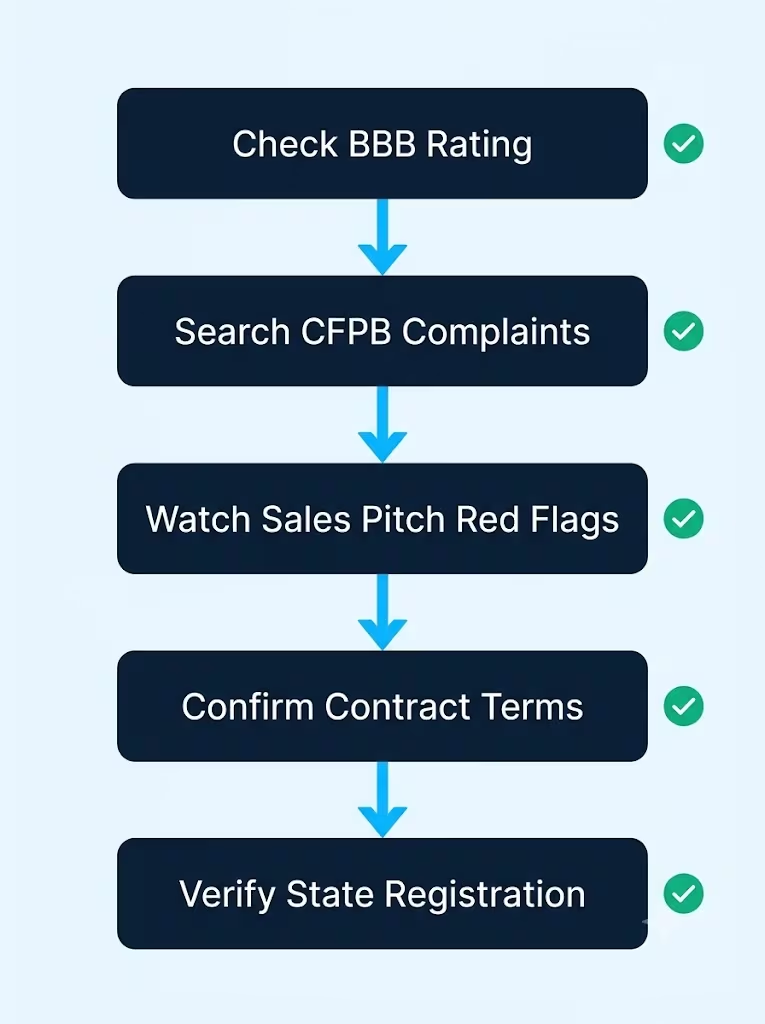
Step 1: Check BBB accreditation and rating. Visit BBB.org and search the exact business name. Look for an A- or higher rating, at least three years in operation, and fewer than 25 complaints in the last 12 months. Read three complaints in full to see how the company responded.
Step 2: Search the CFPB complaint database. Type the company name into consumerfinance.gov/complaint. Note the pattern. A few complaints are normal for any company with thousands of customers. Repeated complaints about the same issue (billing fraud, no results, refusal to cancel) are a red flag.
Step 3: Watch for red flags in the sales pitch.
- Guaranteed score increases (“we’ll raise your score 100 points”)
- Pressure to pay before any work is done
- Vague or missing written contract
- Claims they can remove accurate negative items
- Refusal to share the address or legal business name
Step 4: Confirm written contract terms. Read every page. Look for the cancellation clause, refund policy, service scope, and total price. If a promise made on the call isn’t in the contract, it doesn’t exist.
Step 5: Verify state registration. Some states require credit repair companies to register and post a surety bond. Your state attorney general’s site will list registered providers.
Does State Matter When Choosing a Company?
Most reputable national providers, like Lexington Law, Credit Saint, and Sky Blue, operate in all 50 states. So living in Texas, California, Georgia, or Florida rarely blocks you from a national brand.
That said, state laws sometimes add extra protection on top of CROA. Texas and California require credit repair companies to register with the state and post a surety bond. Georgia has strict rules on advance fees. Florida has a specific credit repair statute with its own contract disclosures.
Before you sign, visit your state attorney general’s website. There, you can find a list of registered credit repair organizations and any recent complaints. If the company you’re considering isn’t registered in a state that requires it, that’s a hard no.
Best Credit Repair Companies for Bad Credit
If your score sits under 580 and you have five or more negative items, you need a provider built for heavy caseloads. Look for these traits:
- Unlimited disputes per month, not a monthly cap
- Coverage across all three bureaus in every dispute round
- Direct creditor challenges (goodwill letters, validation demands, cease-and-desist)
- Case advisor access, not just email support
- A realistic timeline (6 to 12 months for full cleanup)
Top picks in this category are:
- Credit Saint’s Clean Slate plan
- The Credit People’s Premium tier
- Lexington Law’s Premier Plus service
All three handle high-volume dispute workloads and challenge original creditors, not just the bureaus.
Set your expectations right. Bad credit repair is a marathon. The first two months usually show one or two removals. Real progress usually appears between month four and month eight. This happens when second-round disputes make the bureaus check items they couldn’t confirm before.
Most Aggressive Credit Repair Companies
“Aggressive” means dispute volume, escalation tactics, and follow-through. A truly aggressive company will:
- File disputes with all three bureaus in the same round
- Send creditor intervention letters directly to original lenders and collectors
- Use debt validation demands under the Fair Debt Collection Practices Act
- Escalate to method-of-verification requests when bureaus verify items too quickly
- File complaints with regulators when creditors ignore FCRA obligations
The Credit Pros and Credit Saint are known for this level of intensity. Their case managers push multiple angles at once, not just standard bureau letters.
There’s a legal line, though. Some companies cross into “jamming,” which means flooding the bureaus with dozens of duplicate or frivolous disputes to force removal by overwhelm. This is illegal, and the bureaus can flag your file as “frivolous,” which stops all future disputes cold. Bureaus can and do reject repeat disputes without new evidence.
Before you sign, ask two direct questions:
- “How many disputes do you file per bureau per month, and are they duplicates?”
- “Do you send new evidence or new grounds for each round?”
A legitimate aggressive company will explain their round-by-round strategy. A jammer will dodge the question.
Best Credit Repair Companies for Collections
Collection accounts follow different rules than late payments or credit inquiries. When a collector reports a debt, the law gives you the right to demand written proof that they actually own it and that the amount is accurate. This is called a validation letter.
The best providers for collections do three things well:
- Send debt validation letters within 30 days of the collector’s first contact
- Negotiate pay-for-delete arrangements when validation succeeds
- Track statute of limitations by state (which controls whether a debt is legally collectible)
Look for CreditFirm.net, Ovation Credit Services, and Credit Saint for collections work. All three train case managers specifically on FDCPA and collection dispute tactics.
Realistic outcomes fall into three buckets. First, full removal when the collector cannot validate. Second, a pay-for-delete agreement where you pay a reduced amount in exchange for full deletion. Third, an updated status showing “paid” instead of “unpaid,” which helps your score but leaves the item on your report.
Never pay a collector directly without a written pay-for-delete agreement first. Once you pay, your leverage disappears.
Best Credit Repair Companies for Late Payments
Late payments are the hardest negative item to remove because they’re often accurate. If you truly paid 30 days late, the bureau has no reason to delete the record. So the strategy shifts.
The main tool here is a goodwill letter. This is a written request to the original creditor asking them to remove the late mark as a one-time courtesy, especially if you’ve been a long-time customer with an otherwise clean payment history. Goodwill letters work best with:
- Credit unions and community banks
- Store cards with strong customer service
- Auto lenders where you’ve paid off the loan
Formal disputes still play a role. If the reported late payment has any error, like the wrong date, the wrong amount, or a payment that was actually on time, that opens a valid dispute path.
The Credit People and Sky Blue Credit are known for goodwill letter work. They coach clients on personalized wording and follow up on responses.
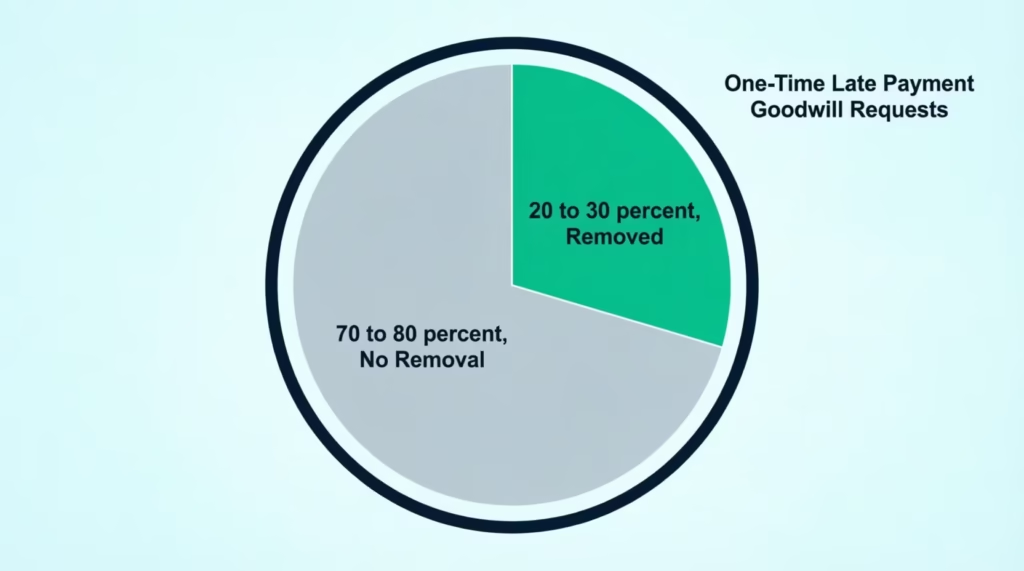
Set expectations. Goodwill removal is entirely at the creditor’s discretion. Success rates hover around 20 to 30 percent for one-time late payments. Multiple lates on the same account are much harder to remove.
Best Credit Repair Companies for Couples
Joint credit repair matters most when you and a partner are planning a shared financial goal, like buying a home or refinancing. Both credit reports need work at the same time, on the same timeline.
Two pricing models exist:
- Per-person pricing. Each partner pays the full monthly fee. This is the most common model.
- Household or couples plans. One combined fee covers both credit files. Typically 25 to 40 percent cheaper than paying twice.
Providers offering true couples plans include The Credit Pros, Lexington Law, and Credit Saint. Ask these specific questions before enrolling:
- Is the couples discount tied to a longer contract?
- Are both partners’ cases handled by the same advisor?
- Do progress reports come combined or separate?
- Can one partner cancel without ending the other’s service?
Joint goals need joint timelines. If you’re 90 days from a mortgage application, both scores need to be lender-ready. A provider that gives you a single case advisor coordinating both files is worth more than a small discount from a provider with siloed teams.
Best Credit Repair Companies (BBB Accredited)
BBB accreditation means a company has applied to the Better Business Bureau, agreed to their standards, and pays an annual fee. Accreditation verifies:
- Business identity and legal registration
- A minimum number of years in operation
- Agreement to respond to consumer complaints
- A rating based on complaint volume and resolution
Here’s what accreditation does not verify. It doesn’t guarantee results. It doesn’t audit financial health. It doesn’t confirm the company follows CROA in every case.
That’s why accreditation should be one check, not the only check. Combine it with the CFPB complaint database, state AG records, and a careful reading of the contract.
Credit Saint, Sky Blue Credit, and Ovation Credit Services all hold BBB accreditation with A or A+ ratings as of mid-2026. Verify current status yourself before signing, since ratings shift as complaint patterns change.
Top 10 Credit Repair Companies Compared
Use this table alongside the vetting checklist above. Verify each provider’s current pricing and BBB rating on their official site before you enroll.
| Company | Monthly Fee | First Work Fee | Money-Back Guarantee | Best For |
|---|---|---|---|---|
| Credit Saint | $79.99 – $119.99 | $99 – $195 | 90 days | Bad credit, complex cases |
| Lexington Law | $89.85 – $139.95 | $89.85 | None | Couples, high-volume |
| The Credit Pros | $69 – $149 | $119 | 90 days | Identity theft, collections |
| Sky Blue Credit | $79 per person | $79 | 90 days | Couples, simple cases |
| Ovation Credit Services | $79 – $109 | $89 | Case-by-case | Collections, BBB priority |
| The Credit People | $79 flat / $419 flat | $19 | Money-back on flat plan | Bad credit, budget-friendly |
| CreditFirm.net | $49.99 | $14.99 | Refund on no results | Low cost, collections |
| Pyramid Credit Repair | $99 | $99 | 90 days | Couples |
| Credit Glory | $99 | $199 | Case-by-case | Bad credit |
| MyCreditGroup | $79 – $129 | $99 | 60 days | Aggressive disputes |
📌 Did You Know: Companies with no money-back guarantee aren’t automatically bad. Sometimes their pricing model already reflects the risk. But a written 90-day refund policy is the safer bet for first-time buyers.
Use this table to pick your top 3 candidates. Then run each through the vetting steps above before you sign anything.
Frequently Asked Questions (FAQs)
How much does credit repair usually cost?
Most legitimate providers charge $79 to $149 per month, plus a first work fee of $89 to $199. This fee only covers the setup and audit, and cannot legally be billed before any work is completed.
Is it worth going to a credit repair company?
It’s worth it when you face multiple negative items, identity theft, or a tight deadline like a mortgage application. For one or two clear errors, disputing them yourself through the bureaus is free and takes about 30 minutes.
Are there legitimate credit repair companies?
Yes, legitimate companies follow the Credit Repair Organizations Act, charge no upfront fees, and provide a written contract with full disclosures. Credit Saint, Lexington Law, and Sky Blue Credit are examples that operate under these federal rules.
Can a credit repair company erase a poor credit history?
No company can legally remove accurate negative information. If a late payment or collection is correct, it stays on your report for up to seven years regardless of who you hire.
How long should you stay with a credit repair company?
Full cleanup for bad credit typically takes 6 to 12 months, with real progress usually appearing between month four and month eight. A fair money-back guarantee usually spans 90 days if no items are removed.
Is Lexington Law Credit Repair worth it?
Lexington Law charges $89.85 to $139.95 monthly with an $89.85 first work fee and is best known for handling couples’ cases and high-volume disputes. It offers no money-back guarantee, so weigh that against its dispute capacity.
How do you fix badly damaged credit?
Providers built for heavy caseloads offer unlimited disputes, coverage across all three bureaus, and direct creditor challenges like goodwill and validation letters. Expect a realistic timeline of 6 to 12 months rather than a quick fix.
How can I fix my credit myself?
You can dispute inaccurate items directly with Equifax, Experian, and TransUnion using their free online forms under the Fair Credit Reporting Act. This works well if you have just one or two clear errors and the supporting paperwork.
What happens if a credit repair company breaks the law?
You can sue for actual damages, punitive damages, and attorney’s fees under CROA, and class actions are allowed. You also have a 72-business-hour right to cancel any contract with no penalty.
Wrapping Up
Picking a credit repair company in 2026 comes down to legal compliance, complaint history, and matching the provider to your actual problem. We covered cost benchmarks, your CROA rights, and the changing CFPB landscape.
We also looked at a hands-on vetting checklist and specialty providers for bad credit, collections, late payments, couples, and BBB-accredited options.
Shortlist three companies using the vetting checklist and pricing benchmarks in this article. Then, check each one with the CFPB and BBB. If something feels off, use your three-day cancellation right.
If you know someone stuck with negative marks blocking a mortgage or car loan, share this guide. It could save them from a bad-actor scam and thousands in wasted fees.