
I’ve stared at that TransUnion number on my banking app, then seen a totally different score when a lender ran my credit, and wondered which one is real. If you’re checking your TransUnion credit score accuracy because the number doesn’t match what your bank quoted or what Credit Karma shows, you’re not imagining things. Different scores from the same name feel confusing, and you need to know which one to trust before you sign anything.
The short answer: the TransUnion score you see is a real, correctly calculated score, but it may use a different model than the one your lender pulls.
Below, we’ll walk through why scores differ, when to trust the TransUnion number, when to get the lender’s version, and how to spot a real error versus normal variance.
Key Takeaways
This guide explains whether a TransUnion credit score is accurate, covering why scores differ by model (VantageScore vs FICO), by bureau, and by reporting timing, plus how to identify a genuine credit report error.
Core Facts:
- TransUnion’s displayed score is a real, correctly calculated score, but free services typically show VantageScore 3.0 while 90% of top U.S. lenders use a FICO version instead.
- A 20 to 40 point gap between VantageScore and FICO Score built from the same TransUnion data is common and not an error.
- Bureau-to-bureau score differences of 10 to 30 points using the same scoring model are typical, since not every lender reports to all three bureaus.
- Mortgage lenders typically pull FICO or VantageScore 4.0 from all three bureaus and use the middle score, or the lower of two scores for co-borrowers.
- A hard inquiry can lower a score by 3 to 8 points temporarily, while soft inquiries from checking your own score cause no score impact at all.
- Under the FCRA, TransUnion generally must investigate a dispute within 30 days, extendable to 45 days if new information is submitted.
Best for:
- Readers confused by seeing different TransUnion, Equifax, or Experian scores on the same day.
- Anyone preparing for a mortgage, auto loan, or credit card application who wants to know which score model the lender will actually use.
- People trying to determine whether a score gap signals a real credit report error versus normal model or timing variance.
Is the TransUnion Credit Score Itself Accurate
Yes, the score TransUnion shows you is a real score. It’s not a fake number or a marketing gimmick. It’s produced by a genuine scoring formula run against the data TransUnion has on file for you.
Here’s the key idea. TransUnion is a credit bureau. Its job is to collect and store your credit data. The three-digit number you see is not made by TransUnion itself. Instead, a scoring model (like VantageScore 3.0 or a FICO Score) reads that data and produces the score. So the math is sound. The formula is real. The result is accurate for the data that went in.
But “accurate” and “matches what your lender sees” are two different things. Your lender might use a different model, or pull data from a different bureau, or check on a different day. Any of those things can produce a different number, even though both scores are technically correct.
So when you ask about TransUnion credit score accuracy, the honest answer is this: the calculation is trustworthy. What it means for a specific loan decision depends on which score the lender actually uses. We’ll cover that next.
📌 Did You Know: The score you see on TransUnion’s free site is a VantageScore 3.0, not a FICO Score. Both are real, but lenders often use a different FICO version, which is why the numbers can differ.
TransUnion Score vs. FICO Score: Why They Differ
Two scoring companies dominate the market: FICO (made by Fair Isaac Corporation) and VantageScore. Both build formulas that turn your credit report into a three-digit number. They just use different math.
FICO and VantageScore weigh things a bit differently. They also handle thin credit files, medical debt, and rent payments in their own ways. So even when both scores read the exact same TransUnion data, they can spit out different numbers. That’s normal, not an error.
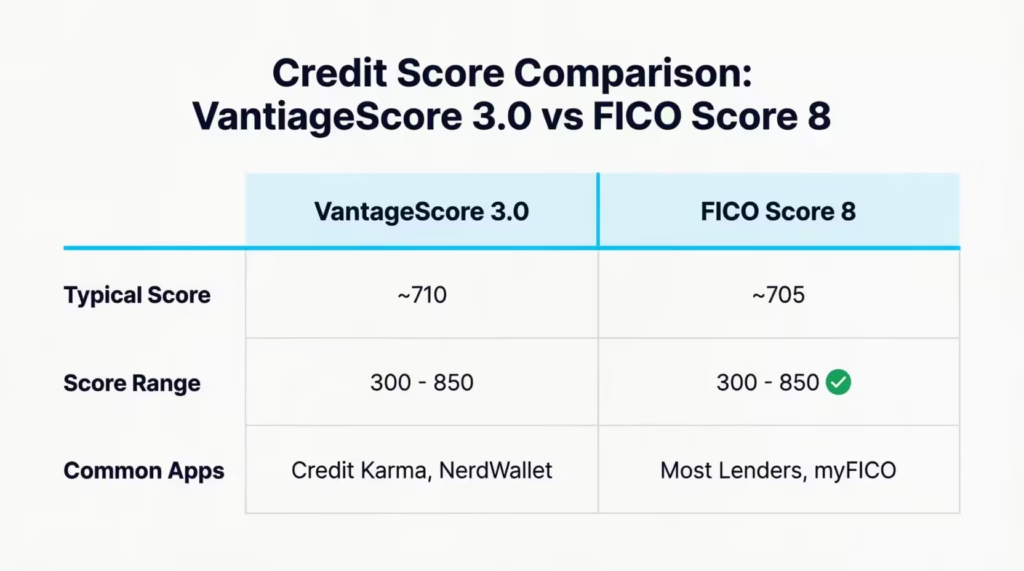
The confusion often starts with the label. When your bank app or a free service says “TransUnion Score,” it usually means “the VantageScore 3.0 calculated from your TransUnion data.” It rarely means a FICO Score, unless the app clearly says “FICO.” Meanwhile, FICO Scores are used by 90% of top U.S. lenders, so the number your lender pulls is often a FICO version.
To tell which model you’re looking at, check the fine print near the score. Look for “VantageScore” or “FICO” plus a version number, like “FICO Score 8” or “VantageScore 3.0.” If the app doesn’t label it, it’s almost always VantageScore.
VantageScore vs. FICO Under the TransUnion Label
Seeing two different numbers with “TransUnion” attached to both is a very common source of frustration. Here’s how to sort it out.
First, identify the model. Free services like TransUnion’s own free site, Credit Karma, and many bank apps show VantageScore. Paid credit monitoring, myFICO.com, and some premium bank features show a FICO version. The data source (TransUnion) can be the same. The formula on top of it is not.
Second, understand why free apps favor VantageScore. VantageScore was co-created by all three major bureaus, so it’s easier and cheaper for apps to license. FICO charges more, and myFICO usually requires a subscription to see multiple FICO versions.
Third, know that seeing a 20 to 50 point gap between a VantageScore and a FICO Score built from the same TransUnion file is common. That gap alone is not a sign anything is wrong with your credit.
TransUnion Score vs. Equifax and Experian: Why They Differ
If your Equifax or Experian score is different from your TransUnion score, that doesn’t mean one bureau is wrong. It usually means each bureau has slightly different data.
Lenders don’t always report to all three bureaus. Some report to just one or two. So your TransUnion file might show a credit card that isn’t yet on Equifax, or vice versa. That alone can move your score.
Reporting timing also matters. A lender might send updates to TransUnion on the 5th of the month and to Experian on the 20th. If you paid down a balance in between, TransUnion will show the change first. Your score on each bureau reflects a snapshot in time, not a live feed.

No single credit bureau is more accurate than another. All three follow the same federal rules under the Fair Credit Reporting Act (FCRA) and use the same data furnishing process. Their scores differ because their raw data can differ. The scoring model then does its job on whatever data is there.
If you want to compare fairly, pull all three reports on the same day and use the same scoring model across them. That’s the only apples-to-apples check.
Which Score Do Lenders Actually Use
This is the question most people really care about. The answer depends on the type of loan.
For credit cards and personal loans, most lenders use a FICO version, often FICO Score 8. Some card issuers now also consider VantageScore, but FICO still leads.
For auto loans, lenders often use the FICO Auto Score, an industry-specific version tuned for auto lending risk. It can differ from your basic FICO 8 by 10 to 30 points either way.
For mortgages, the rules are stricter. Under current requirements, Fannie Mae and Freddie Mac accept Classic FICO or VantageScore 4.0 via a tri-merge credit report. Mortgage lenders typically pull all three bureaus’ scores and use the middle one (or the lower of two, if you have a co-borrower). So a mortgage lender may see three different numbers for you and pick just one.
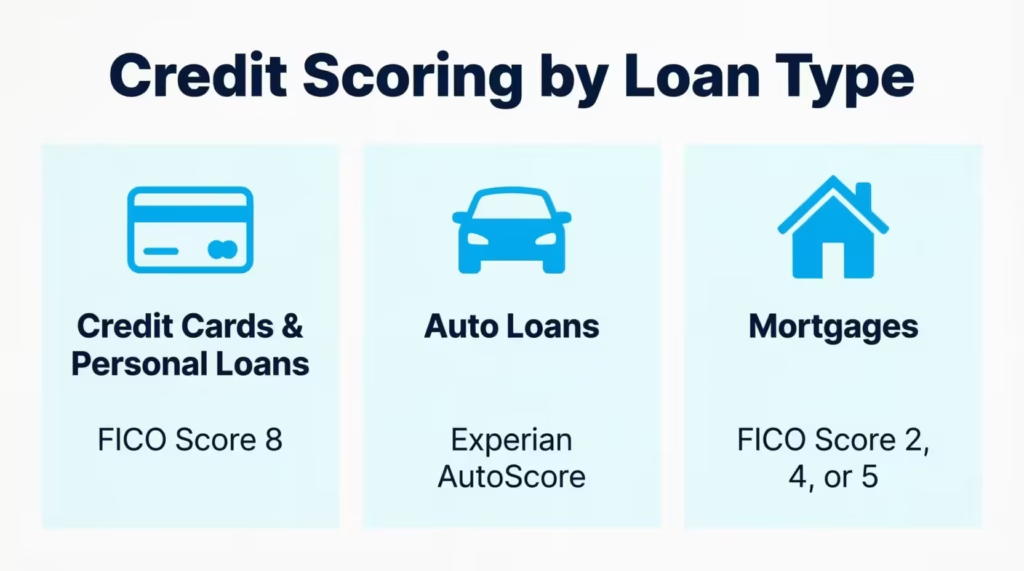
The practical takeaway: the “lender-pulled score” is rarely the same as your free TransUnion score. It’s a different model, sometimes an industry-tuned version, and it may be from a different bureau.
Before a big application, just ask the lender directly: “Which credit score model and which bureau will you use for my application?” Most loan officers will tell you. Then you can check that specific score in advance.
When to Trust the TransUnion Number vs. When to Get the Lender’s Version
Here’s a simple decision rule for the moment you’re in right now.
Trust your free TransUnion score for these situations:
- Tracking whether your score is going up or down over months
- Watching for sudden drops that might signal fraud
- Getting a rough sense of what tier you’re in (fair, good, very good, excellent)
- Deciding when you’re ready to start shopping for a loan
Get the lender-specific score for these situations:
- You’re within 60 days of applying for a mortgage
- You’re about to apply for an auto loan and rate matters
- You want to qualify for a specific card, and you’re near a score cutoff
- Your free score sits close to a lender’s minimum, and small gaps could change approval
To get a FICO version, you can pay for myFICO, use a bank or card issuer that offers free FICO Scores (Discover, Citi, Bank of America, and others include this), or ask the lender to run a soft pull before formal application. A soft pull won’t hurt your score.
💡 Pro Tip: Before a mortgage application, buy one month of myFICO’s 3-bureau plan. You’ll see all three mortgage-relevant FICO versions in one place, which is exactly what your lender will pull.
Why Your TransUnion Score Changed Suddenly
Seeing your score jump 15 points overnight, or drop 25 without warning, feels alarming. But most sudden changes have simple, non-scary reasons.
First, monthly reporting cycles. Your credit card issuer reports your balance to TransUnion roughly once a month, usually right after your statement closes. If your reported balance jumps from $200 to $2,400 because you booked a vacation, your utilization ratio spikes, and your score can drop 20 to 40 points until the next report cycle shows a lower balance.
Second, new account activity. A new credit card adds a hard inquiry (small drop), a new account (drops your average age of accounts), and a new credit line (may lower your utilization if you don’t use it). The net effect can be positive or negative.
Third, hard inquiries. Each new hard inquiry can shave 3 to 8 points off your score. Multiple inquiries in a short period hit harder.
Fourth, aged accounts falling off. When an old paid-off installment loan drops off after 10 years, your credit mix and average age can shift, moving the score.
None of this means the score is broken. It means your credit report data just refreshed. This is exactly how scoring is supposed to work.
Reporting Lag and Timing Differences
Score changes are often just a matter of when data arrives, not what the data says.
Lenders report on different monthly schedules. One card might report on the 3rd, another on the 17th. If you check your score on the 10th, some of your recent activity is baked in, and some isn’t. Check again on the 20th, and the picture can shift.
Because of this, checking your TransUnion score just a few days apart can produce different numbers, even under the same scoring model. That’s normal reporting lag, not inaccuracy.
Dispute updates also take time to show up. If TransUnion agreed to remove a late payment on the 8th, your score may not reflect the change until the next monthly refresh cycle runs. Give it up to 30 to 45 days before assuming the correction didn’t stick.
How to Tell If a Score Gap Is Normal or a Red Flag
Not every score gap is a problem. Most are just model or timing differences. But some gaps signal a real data issue you should chase down.
Typical variance ranges for the same person on the same day look like this. Between VantageScore and FICO on the same bureau, expect roughly 20 to 40 points of difference. Sometimes more if you have a thin file.
Research from the Urban Institute found that VantageScore 4.0 runs on average about 14 points higher than Classic FICO across a large sample. Between the three bureaus using the same model, expect 10 to 30 points of variance.
A gap becomes a red flag when:
- One bureau shows an account you don’t recognize
- Your reported balance is far off what you actually owe
- A closed account still shows as open, or open shows as closed
- A payment you made on time is listed as late
- One bureau’s score is 60+ points lower, and you can’t find a normal reason (new inquiry, higher utilization, missed payment)
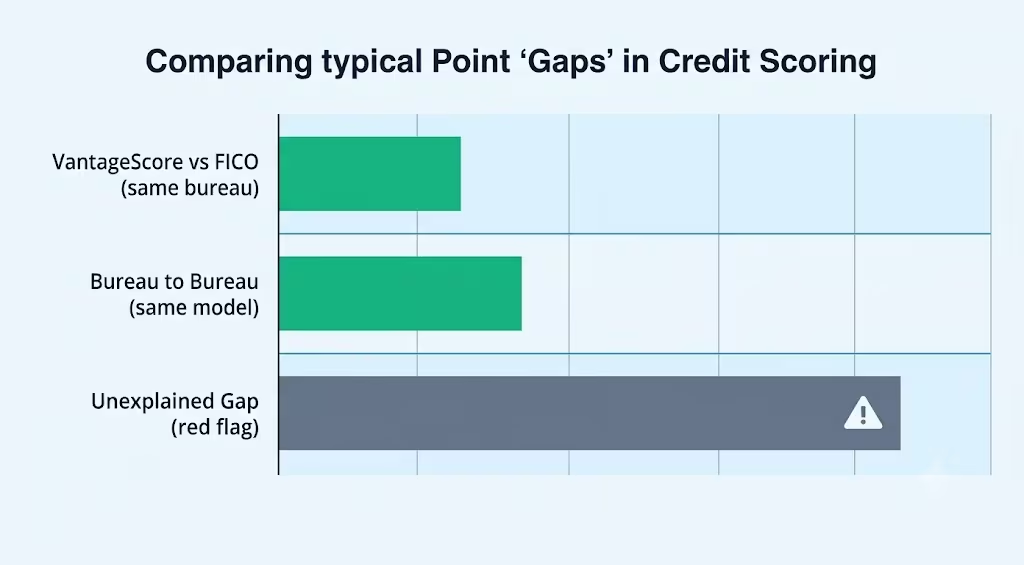
Use this quick self-check:
- Pull all three reports on the same day at AnnualCreditReport.com
- Compare account lists across bureaus
- Compare balances, credit limits, and payment histories
- Flag anything that doesn’t match your own records
If everything matches your records, the gap is normal. If something doesn’t match, you may have a real error worth disputing.
⚠️ Mistake to Avoid: Assuming a low score on one bureau means that bureau is “wrong.” It usually just means one of your lenders doesn’t report there, so a positive account is missing from your file.
Example: Comparing Score Gaps Across Models and Bureaus
Consider a made-up but realistic case. Michael, a 34-year-old marketing manager, checks his credit before applying for an auto loan. Here’s what he sees on the same day:
| Source | Model | Score |
|---|---|---|
| Credit Karma (TransUnion) | VantageScore 3.0 | 742 |
| Credit Karma (Equifax) | VantageScore 3.0 | 738 |
| myFICO (TransUnion) | FICO Score 8 | 715 |
| myFICO (Experian) | FICO Score 8 | 719 |
| Auto lender (Experian) | FICO Auto Score 8 | 708 |
Michael’s VantageScore is about 25 points higher than his FICO Score 8. His FICO Auto Score is another 7 to 11 points lower than his base FICO 8. His bureau-to-bureau differences are 4 to 6 points. All of these gaps are within normal ranges.
If instead Michael saw a TransUnion score of 742 and an Experian score of 615 on the same model on the same day, that 127-point gap would be a strong signal to pull his reports and look for missing accounts, mixed files, or fraud.
What Determines the Accuracy of the Data Behind Your Score
Here’s the part most people miss. Your score is only as accurate as the credit report feeding it. If the underlying data is wrong, the score will be wrong, even if the math is perfect.
Common causes of report inaccuracy include:
- Balances reported at the wrong time or amount
- Late payments that weren’t actually late
- Accounts that don’t belong to you (fraud or mixed files where two people’s data got merged)
- Closed accounts still showing as open
- Old debts that should have aged off but haven’t
- Duplicate accounts (the same debt listed twice)
Errors are more common than most people think. According to Consumer Reports, CFPB complaints about incorrect credit report information hit 443,321 in 2023, more than 2.5 times the level in 2021. Not every complaint is a confirmed error, but the trend shows how often people find something wrong when they actually check.
That’s why checking the report, not just the score, is the real accuracy test. A score is a summary. The report is the source. If you want to fix your score, you fix the data.
How to Verify Your TransUnion Report Is Correct
Follow these steps to check your TransUnion credit report data carefully.
- Pull your free report at AnnualCreditReport.com. This is the official government-authorized site. You can pull all three bureau reports free every week.
- Log in to TransUnion.com for a second look. TransUnion also offers a free view of your own report.
- Go through each account. Check the balance, credit limit, open date, and status (open, closed, paid, current).
- Compare to your own records: card statements, loan documents, and bank data.
- Check payment history month by month for the last 24 months. Look for any month marked late that you actually paid on time.
- Review the personal info section. Old addresses are fine, but names that aren’t yours or Social Security numbers that don’t match may signal a mixed file.
- Note the inquiries section. Any hard inquiry you don’t recognize could be fraud.
If everything matches your records, your data is clean. Any variance in your score is model or timing, not error.
What to Do If You Find a Genuine Error
If you find something wrong, take these steps.
First, confirm it’s an actual error and not just model variance. A different score on VantageScore vs. FICO is not a data error. A wrong balance or a fake account is.
Second, file a dispute directly with TransUnion. You can do it online at the TransUnion dispute center, by phone, or by mail. Include a clear description of the error and any supporting documents (statements, letters, receipts).
Third, know the timeline. Under the FCRA, TransUnion generally must investigate and respond within 30 days, as the CFPB explains. If you send new information during the investigation, they can extend it to 45 days.
Fourth, watch for the corrected score. If the disputed item is removed or fixed, your score usually updates within one to two monthly refresh cycles. If nothing changes and you still believe the item is wrong, you can add a 100-word statement to your file or escalate to the CFPB.
Does Checking Your TransUnion Score Affect Its Accuracy or Value
No. Checking your own score does not lower it. This is one of the most common myths in credit.
When you check your own credit through TransUnion, Credit Karma, your bank, or myFICO, it counts as a soft inquiry. Soft inquiries are visible only to you and don’t affect any scoring model.
Hard inquiries are different. Those happen when a lender pulls your credit for a new application (credit card, auto loan, mortgage, apartment). Each hard inquiry can knock 3 to 8 points off your score temporarily. The effect fades within a few months and drops off entirely after two years.
So checking your TransUnion score once a week, or even daily, causes zero harm. In fact, regular checking helps protect your credit’s accuracy. You spot errors faster, catch fraud sooner, and see how your score responds to real behavior (paying down a card, opening a new account, letting a hard inquiry age).
Regular self-monitoring is one of the simplest ways to keep your credit accurate. It costs nothing and lowers your risk of walking into a lender with a surprise on your report.
Frequently Asked Questions (FAQs)
Is TransUnion credit score accurate?
Yes, TransUnion’s score uses a real scoring formula run against your actual credit data, so the math is sound. It may still differ from a lender’s score because lenders often use a different model, such as FICO rather than VantageScore.
Can I trust my TransUnion credit score?
You can trust it for tracking trends, spotting fraud, and getting a general sense of your credit tier. For a major application like a mortgage or auto loan, check the lender-specific FICO version instead, since that’s usually what gets pulled.
Why is my TransUnion score higher than my Equifax score?
Each bureau often holds slightly different data, since not every lender reports to all three. A 10- to 30-point gap between bureaus using the same scoring model is common and doesn’t mean either score is wrong.
Is TransUnion better or more accurate than Experian?
Neither bureau is more accurate than the other. All three follow the same federal rules under the Fair Credit Reporting Act, and score differences come from variations in the data each bureau has on file, not from one being more reliable.
Is a TransUnion score of 600 good?
A 600 typically falls in the fair range rather than good, though exact tier cutoffs depend on the scoring model used. What matters more for approval odds is the specific score version and cutoff a given lender requires.
Is TransUnion always the lowest score?
No, there’s no rule that TransUnion runs lower than the other bureaus. Which bureau shows the highest or lowest score depends on which lenders report to that bureau and when they last updated your data.
Do banks look at TransUnion or Equifax?
Banks and lenders may pull from any of the three bureaus, and mortgage lenders often pull all three and use the middle score. Which bureau a specific lender uses depends on that lender’s own policy, so asking directly is the only sure way to know.
Is it safe to give my Social Security number to TransUnion?
TransUnion is one of the three major credit bureaus and a federally regulated entity that already holds your credit data. Providing your SSN through TransUnion’s official site or AnnualCreditReport.com is standard practice for identity verification when pulling your report.
Which credit score matters more, TransUnion or FICO?
FICO is a scoring model while TransUnion is a bureau, so they aren’t directly comparable. What matters most is which specific model and bureau combination your lender pulls, since FICO Scores are used by 90% of top U.S. lenders.
What causes the biggest drops in a credit score?
Missing a payment, running up high credit card balances relative to your limit, and adding multiple new hard inquiries in a short period all cause the steepest score drops. A missed payment reported late can be one of the most damaging single events on a credit file.
Wrapping Up
Your TransUnion score is real, but it’s not always the same score your lender will use. The gap between what you see and what a bank pulls comes down to the model (VantageScore vs. FICO), the bureau (TransUnion vs. Equifax vs. Experian), and the timing of the data.
To track trends, trust your TransUnion score. Before any major application, pull the lender-specific FICO score. Then check the full report, not just the number, at least twice a year.
If you know someone who is stressed about a score mismatch before a loan, share this with them. It will help them walk into the lender’s office knowing exactly which number matters.