
You’re standing at checkout, staring at that Affirm “Pay Over Time” button, and one worry keeps nagging at you: will this little loan show up on my credit report? Maybe you’ve already used Affirm, and now you’re second-guessing a late payment.
Or maybe you’re wondering if using Affirm to buy a mattress could actually help your credit. That uncertainty is real, and getting the answer wrong can cost you real points on your score. That’s why understanding whether Affirm reports to credit bureaus matters right now.
Yes, Affirm now reports most pay-over-time plans to Experian and TransUnion under its expanded 2025 policy.
We’ll guide you on the timing, the involved bureaus, what happens if you pay late, and how to check your file. This way, you can use Affirm confidently.
Key Takeaways
This guide explains whether Affirm reports pay-over-time loans to credit bureaus, including which bureaus are covered, the 30-day late payment trigger, reporting differences by loan type, and how to check your credit report.
Core Facts:
- Affirm reports most pay-over-time plans, including Pay in 4 and installment loans, to Experian starting April 1, 2025, and to TransUnion starting May 1, 2025.
- Affirm does not report to Equifax, so lenders who pull only that bureau will not see Affirm loan history, positive or negative.
- Pay Now purchases, where the full amount is paid at checkout, are never reported since no credit is extended.
- A payment is reported as late or past due once it reaches 30 days past the due date, which is the standard trigger for a delinquency mark.
- Affirm sends monthly account updates to Experian and TransUnion showing current balance, latest payment, and account status for open installment loans.
- Loans opened before April 1, 2025 generally followed older, more limited reporting rules compared to loans opened on or after that date.
Best for:
- Shoppers deciding whether to use Affirm and wanting to know if payments will affect their credit score.
- Current Affirm users who missed a payment and want to understand the reporting timeline before it worsens.
- Readers trying to determine which credit bureau report to check for their Affirm loan history.
Does Affirm Report to Credit Bureaus?
Yes. As of the current policy, Affirm reports most pay-over-time plans to the credit bureaus. That includes Pay in 4, monthly installment loans, and longer-term financing plans. This is a big shift from the older, quieter reporting rules that only touched certain long loans.
The change kicked in on April 1, 2025, when Affirm expanded reporting to Experian. TransUnion followed on May 1, 2025. Any Affirm pay-over-time loan you take out on or after those dates can appear on your credit file, whether you pay on time, pay late, or miss a payment.
Not everything gets reported, though. A few things sit outside this policy:
- Pay Now purchases (paying the full price at checkout) never touch your credit file.
- Account creation alone is not reported.
- Prequalification checks at checkout are soft and stay off your report.
So the short version: if money is being spread over time through Affirm, it counts. If it isn’t, it doesn’t.
Before vs. After the April 2025 Policy Change
The rules split cleanly around spring 2025, and knowing which side your loan falls on tells you what applies.
Before April 2025: Affirm only reported a slim group of longer-term installment loans. Short plans like Pay in 4 and many mid-length plans stayed off the bureaus. Many shoppers used Affirm for years without a single loan hitting their file.
After April 1, 2025 (Experian) and May 1, 2025 (TransUnion): All pay-over-time products can now be reported. That covers Pay in 4, six-month plans, twelve-month plans, and beyond.
Practical tip: check the origination date on your Affirm loan inside the app. If it was opened before April 1, 2025, the old rules likely apply. If it was opened on or after that date, treat it as a fully reportable loan and manage payments like any credit account.
Which Credit Bureaus Does Affirm Report To?
Affirm reports to two of the three major credit bureaus, and this gap matters more than most people realize.
Experian started receiving Affirm data on April 1, 2025. The Experian announcement confirmed the plan covers all pay-over-time products issued from that date forward.
TransUnion followed on May 1, 2025. All Affirm pay-over-time loans issued on or after that date can appear on TransUnion files.
Equifax is not part of the current arrangement. Affirm does not send data to Equifax at this time.
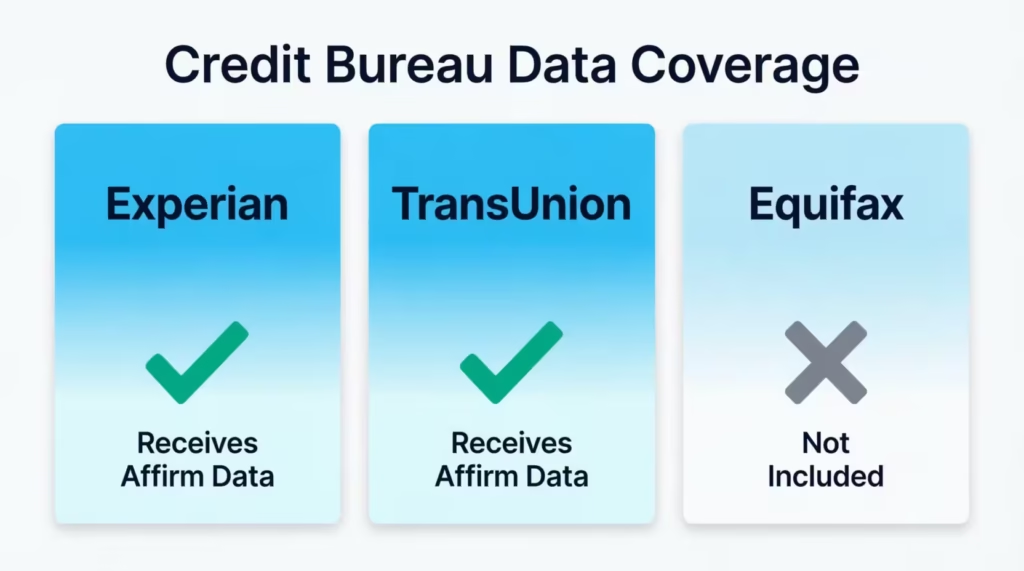
This matters because lenders don’t all pull the same bureau. A car dealer might pull only Equifax. A landlord might rely on Experian. If a lender checks a bureau that Affirm doesn’t feed, your Affirm history simply won’t show up in that decision. That works both ways. It can hide a strong payment record you were counting on. It can also hide a rough patch you’d rather forget.
📌 Did You Know: A single Affirm loan can produce three very different “credit stories” depending on which bureau a lender pulls. Your Experian and TransUnion files can show the loan clearly, while your Equifax file may look like Affirm never happened.
Do All Affirm Loan Types Report the Same Way?
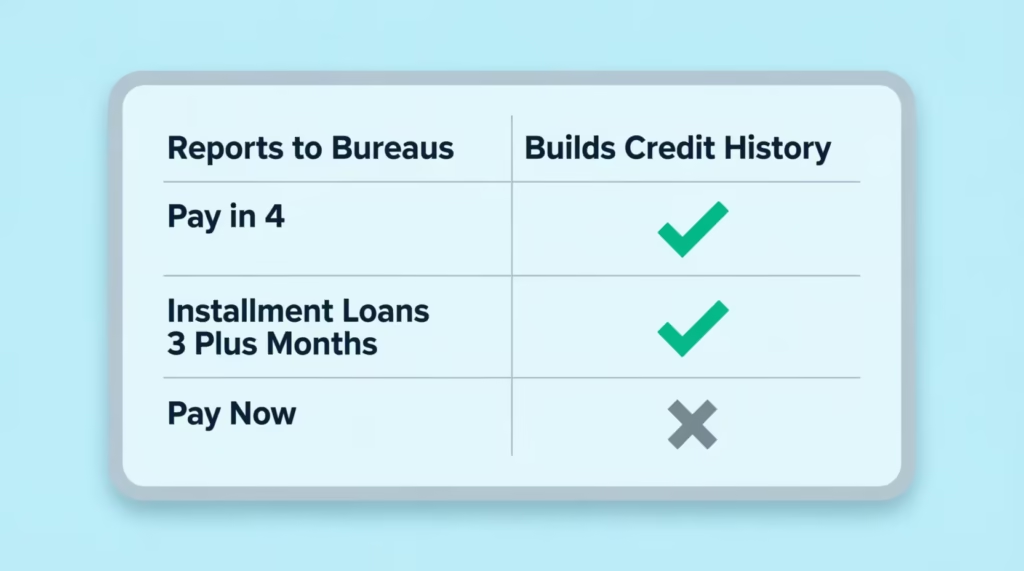
Not quite. Reporting depends on the type of plan you pick, and Affirm sells a few different products under one brand. The main split is between short-term plans like Pay in 4 and longer installment loans. The expanded policy covers both now, but they still look different on your credit file.
Pay in 4 Plans
Pay in 4 is Affirm’s most popular product. You split a purchase into four equal payments over about six weeks, and there’s no interest.
Under the expanded 2025 policy, Pay in 4 plans are reportable. Both on-time payments and late payments can show up on your Experian and TransUnion files if the plan started on or after the April/May 2025 dates. Before that change, most Pay in 4 loans did not report at all.
The catch: Pay in 4 loans are short. They close quickly, which means they don’t build much history. A single Pay in 4 loan won’t dramatically move your score. String together many of them, though, and the pattern starts to matter, especially if any payments run late.
Longer-Term Installment Loans (3+ Months)
Longer installment loans last three, six, twelve, or even twenty-four months. They appear on your credit file as a standard installment loan tradeline. That’s the same category as an auto loan or a personal loan.
Each month, the tradeline shows your balance, payment status, and whether you paid on time. Because these loans stay open longer, they carry more weight in scoring models. A clean payment history on a twelve-month Affirm loan can help build a positive record. A missed payment on that same loan can drag your score down for years.
The “Pay Now” Option
Pay Now is not a loan. When you choose Pay Now at checkout, you pay the full amount right away using a debit card, bank transfer, or similar method. No financing is happening.
Because there’s no credit being extended, there’s nothing to report. Pay Now doesn’t show up on Experian, TransUnion, or anywhere else. It has zero impact on your score, good or bad. If you want to shop through Affirm without any credit reporting at all, Pay Now is the option that stays off your file.
Does Affirm Report to Credit Bureaus If You Don’t Pay?
Yes. Under the current policy, missed payments are reported, and the entry can hurt your score meaningfully.
Here’s what “missed” really means. A payment isn’t instantly flagged the moment you skip a due date. Affirm’s late payments help page explains that a payment is reported as late or “past due” once it goes 30 days or more past the due date. Before that, you may get reminders, but the bureaus haven’t been told yet.
Once the 30-day mark passes, the entry can appear on your Experian and TransUnion files as a delinquency. It typically shows:
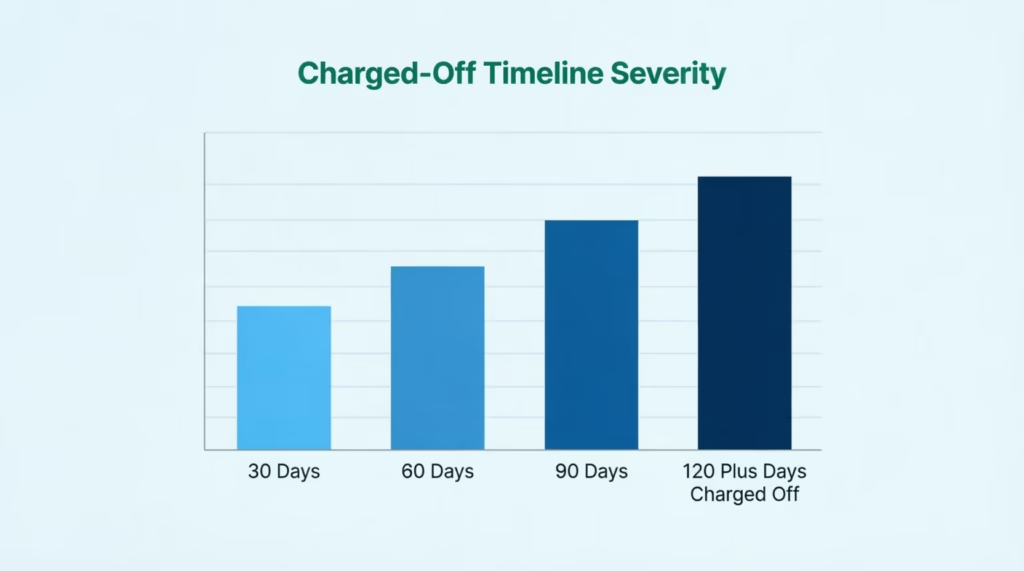
- The days late (30, 60, 90, and so on)
- The account status (past due, in collections, charged off)
- The balance owed at the time of reporting
The score hit depends on your starting point. A shopper with a strong 780 score often sees a bigger drop than someone at 620, because there’s more score to lose.
Late marks can sit on your credit file for up to seven years, even after you pay the balance off. That’s why treating an Affirm loan like any other credit account matters, no matter how small the purchase seemed at checkout.
⚠️ Mistake to Avoid: Treating a small Affirm balance like a low-priority bill. A $180 mattress plan that’s 30 days late can hurt your credit like a $1,800 credit card mistake. The credit bureaus don’t care about the amount; they focus on whether you’re behind on payments.
After How Many Days Does Affirm Report to Credit Bureaus?
The clock is one of the most important things to understand. Affirm follows the standard industry timeline for delinquency reporting, and it moves in stages.
Days 1 to 10 (grace window): You get automatic reminders through the app and email. No credit report yet. A late fee may apply on some interest-bearing loans, though Pay in 4 typically doesn’t carry one.
Days 11 to 29: More reminders. Affirm may reach out through additional channels. Still no bureau report, but your loan is now clearly flagged inside your Affirm account as past due.
Day 30 (the reporting trigger): Once your payment is 30 full days past due, Affirm can furnish the delinquency to Experian and TransUnion. This is the point most credit damage begins.
Days 60, 90, 120+: Progressive delinquency marks stack up. Each new 30-day window that passes without payment gets its own line, and the damage grows. After 120 to 180 days, the account may be charged off or sent to collections, which is one of the worst marks a credit file can carry.
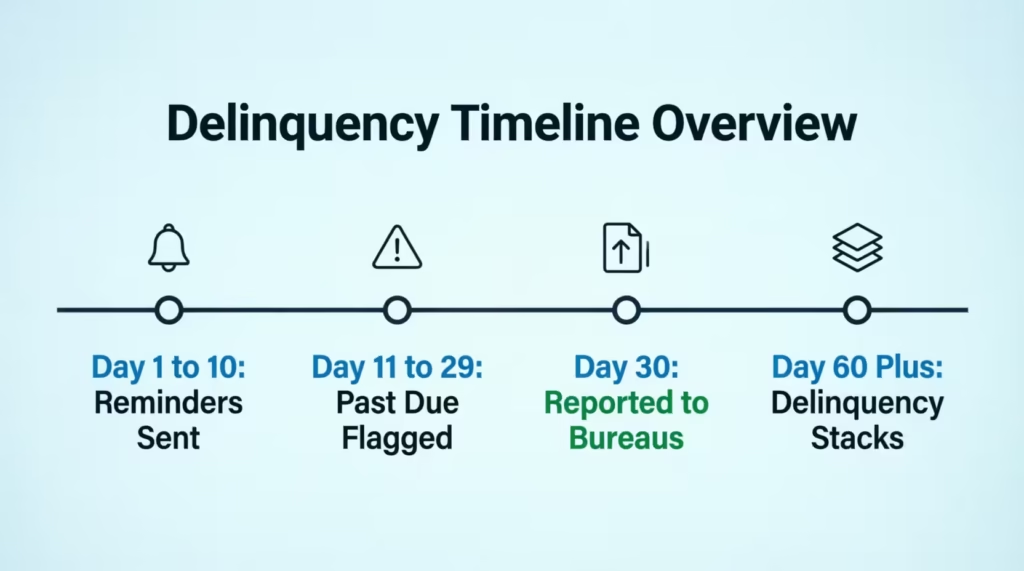
The takeaway: the difference between day 29 and day 30 is huge. Paying even a few days before the 30-day line, when possible, keeps the delinquency off the bureaus entirely.
Does Affirm Report to Credit Bureaus After 30 Days?
Yes. 30 days past due is the standard trigger for Affirm to report a late payment to the credit bureaus. This matches how most lenders, including credit card issuers and auto lenders, handle delinquency reporting.
At the 30-day point, the entry on your file usually looks like this:
- Payment status: 30 days late
- Account status: past due
- Balance and last payment date included
That single 30-day mark can drop a healthy score by roughly 50 to 100 points, depending on your baseline. Paying the balance after the fact doesn’t erase the mark, though it does stop things from getting worse.
Does Affirm Report to Credit Bureaus Monthly?
Yes, but we need to separate two things: ongoing updates to an existing account and new alerts for a missed payment.
Affirm sends monthly account updates to Experian and TransUnion, which is the standard cadence lenders follow. Each month, your open installment loan updates on your credit file. It shows the current balance, the latest payment, and the account status. This is the normal “monthly furnishing cycle.”
That monthly rhythm is different from delinquency reporting. A monthly update simply refreshes the picture of an account that’s already there. A delinquency report, by contrast, adds a new negative mark when a payment crosses the 30-day past-due line.
So if you have an active Affirm installment loan and you pay on time, your credit file quietly updates each month with the good news. Miss a payment badly enough, and a separate delinquency mark gets added on top of the routine update.
Do On-Time Affirm Payments Get Reported and Can They Help Your Score?
Yes, on-time Affirm payments can be reported, and this is one of the biggest myths worth clearing up.
For years, shoppers assumed BNPL lenders only told the bureaus about late payments. That was mostly true before 2025. Under the expanded policy, though, Affirm reports the full picture: on-time, late, and missed. Your good behavior counts too, not just your slip-ups.
That said, expectations should stay realistic. Payment history is the biggest single factor in most credit scoring models, often around 35% of a FICO score. On paper, that suggests on-time Affirm payments should give a nice boost. In practice, the boost is usually modest because:
- Short Pay in 4 loans close fast, giving little time to build history.
- Affirm doesn’t report to Equifax, so any lender pulling that bureau won’t see your positive history.
- Some scoring models are still adjusting to how BNPL data should be weighted.
You’re most likely to see a real benefit from a longer installment loan (six months or more) that you pay on time every single month. That builds a clean installment tradeline, and clean tradelines gently support your score over time. Just don’t expect a jump from 680 to 780 because you paid off a $200 Pay in 4 plan.
Does Applying for Affirm Trigger a Hard or Soft Credit Inquiry?
Applying for Affirm usually starts with a soft pull, not a hard one. That’s an important distinction because inquiries and payment reporting are two very different things.
Here’s the split:
Soft pull at prequalification and checkout: When you see what Affirm offers or during most checkout processes, Affirm does a soft credit check. Soft pulls don’t affect your credit score, and other lenders can’t see them on your file.
Hard inquiry for larger loans: For bigger amounts or longer terms, Affirm may do a hard inquiry before approving your loan. A hard pull can shave a few points off your score, usually five points or fewer, and it stays visible on your credit report for two years. Affirm will typically tell you before this happens.
The safest habit: read the disclosure Affirm shows you before you tap “Confirm.” If the screen mentions a hard credit check, know that the inquiry itself may nudge your score. If it only mentions a prequalification or soft check, your score stays untouched at the application stage. Either way, once the loan is approved and active, the reporting rules from the earlier sections take over.
Can Using Affirm Help You Build Credit?
Honestly, Affirm can help you build credit, but only in a modest way, and only under the right conditions.
Under the expanded 2025 policy, an installment loan you pay on time creates a positive tradeline on Experian and TransUnion. That’s real, measurable credit history. For someone with a thin file, adding any well-managed tradeline can nudge a score in the right direction.
But there are real ceilings on how much this helps:
- Equifax exclusion: Any lender pulling only Equifax won’t see your good Affirm history. That cuts the impact roughly by a third.
- Loan size and length: A six-week Pay in 4 loan for $80 does very little. A twelve-month loan for $1,200 you pay perfectly does much more.
- Product mix: Credit scores reward a healthy mix (revolving accounts like credit cards plus installment loans). Stacking many small BNPL loans doesn’t recreate that mix.
If your main goal is credit building, dedicated tools tend to work better and faster. A secured credit card, a credit-builder loan from a credit union, or being added as an authorized user on a reliable account often provides better, more consistent results. Affirm can help if you’re already using it, but it’s not the first choice for getting a stronger score.
💡 Pro Tip: If you’re using Affirm mainly to build credit, choose one longer installment loan and pay it perfectly, rather than opening several small Pay in 4 plans. One clean twelve-month tradeline usually helps your file more than five tiny closed accounts.
How to Check If Affirm Is on Your Credit Report
You don’t have to guess whether your Affirm loan is showing up. You can check for free, from home, in under ten minutes.
Step 1: Pull your free credit reports. Every U.S. consumer can access free weekly reports from all three bureaus at AnnualCreditReport.com, the site authorized by federal law. Pull your Experian and TransUnion reports, since those are the two bureaus Affirm feeds. Skip Equifax for this check, since Affirm doesn’t report there.
Step 2: Find the installment loans section. On both reports, scroll to the section labeled “installment loans,” “loans,” or “accounts.” Affirm installment loans typically list the creditor name as “Affirm Inc.” or “Affirm Loan Services.” Pay in 4 plans may appear under a similar name once they’re reported.
Step 3: Read the account details. Look for:
- Account status: open, closed, paid, past due
- Date opened: should match your loan origination date
- Payment history grid: shows each month’s status
- Balance and last payment date
Step 4: Cross-check with your Affirm app. Open Affirm, tap the loan, and compare what you see there against what your credit report shows. Any mismatch (wrong balance, missing payment, incorrect late mark) is something you can dispute directly with Affirm or with the bureau under the credit reporting disputes process.
Wait for one full reporting cycle, usually 30 to 45 days, if nothing shows up. This applies if your loan started after April 1, 2025. Don’t assume there’s a problem just yet.
What to Do If You Already Missed an Affirm Payment
Missing a payment is stressful, but the situation isn’t out of your hands. Acting quickly makes a real difference.
Pay the balance as fast as you can. If you’re still inside the 30-day window, paying now can stop the delinquency from ever reaching the bureaus. If you’re already past 30 days, paying still matters, because it stops the next 30-day mark (at day 60) from stacking on top.
Contact Affirm support directly. Reach out through the Affirm app or through Affirm’s help center to ask about hardship options. Affirm sometimes offers short payment extensions or restructured schedules if you explain your situation early. This is more effective by phone or chat than by simply waiting.
Monitor your reports going forward. Set a reminder to pull your Experian and TransUnion reports every month or two for the next six months. Watch for the exact way the late payment is listed, the balance, and the status. If anything is wrong (say, a mark is showing past due when you actually paid), file a dispute right away. Correcting an error is much easier when you catch it early.
Frequently Asked Questions (FAQs)
Does my credit score go down if I use Affirm?
Using Affirm doesn’t automatically lower your score. A hard inquiry on larger loans may cost a few points, and only a missed payment past 30 days causes real damage.
Is Affirm a hard or soft credit pull?
Most prequalification and checkout checks are soft pulls that don’t affect your score. Larger or longer-term loans may trigger a hard inquiry, which can cost up to five points and stays visible for two years.
Is using Affirm a good way to build credit?
Affirm can help build credit modestly if you pay a longer installment loan on time every month. A secured credit card or credit-builder loan usually works faster since Affirm doesn’t report to Equifax.
What is the downside of using Affirm?
Missed payments get reported as delinquencies after 30 days and can drag your score down for years. Affirm also doesn’t report to Equifax, so any positive history stays invisible to lenders who pull that bureau.
Will my credit score go up if I pay off Affirm?
On-time payments on a longer installment loan can build a positive tradeline on Experian and TransUnion. The boost is usually modest, especially for short Pay in 4 plans that close too quickly to build much history.
How long can I go without paying Affirm?
You have about a 29-day grace window before a missed payment gets reported to the bureaus. Once you hit 30 days past due, the delinquency can appear on your Experian and TransUnion files.
Does Affirm look bad on a credit report?
A missed payment can look bad, appearing as past due with days late and balance owed, and can stay on your file for up to seven years. An on-time, paid-as-agreed loan shows up as a normal, positive installment tradeline.
Is it hard to get approved by Affirm?
The article doesn’t cover Affirm’s approval requirements or credit score thresholds. Check Affirm’s own eligibility details directly for approval criteria.
What should I do if I already missed an Affirm payment?
Pay the balance as soon as possible, since paying within the 30-day window can stop the delinquency from ever being reported. Contact Affirm support about hardship options and monitor your Experian and TransUnion reports for the next several months.
Does Affirm report Pay in 4 plans the same way as longer loans?
Pay in 4 plans are reportable under the 2025 policy, covering both on-time and late payments. They close in about six weeks, though, so a single plan won’t move your score much compared to a longer installment loan.
The Bottom Line
Affirm now sits inside the credit reporting system in a real way. Loans issued from April 1, 2025 to Experian and May 1, 2025, to TransUnion can show up on your file. Missed payments hit at the 30-day mark, on-time payments finally count, and Equifax remains outside the loop.
Treat each Affirm plan like a small credit card. Pay early, keep an eye on the due date, and check your report twice a year.
If you have a friend who uses Affirm for purchases and hasn’t heard about the 2025 changes, share this guide. Missing just one 30-day mark could harm their credit for years.