

I know the feeling. You open the mailbox, or your credit app pings, and there it is: a medical bill or a strange collection account you didn’t expect. Your stomach drops. You start wondering if your credit score is already in trouble, or if you still have time to fix things before medical bills affect your credit score.
Here’s the short answer: most medical bills won’t hurt your credit right away, and many won’t hurt it at all.
Below, I’ll walk you through the exact rules for 2026, how much a medical collection can really drop your score, and the step-by-step way to check if your bill is actually at risk.
Key Takeaways
This guide explains whether medical bills hurt your credit score, covering the 365-day grace period, the $500 reporting threshold, state-level protections, and the 2025 court ruling that vacated the federal CFPB medical debt rule.
Core Facts:
- Medical bills only affect your credit score if they go unpaid, are sent to a collection agency, and are reported to the credit bureaus, since providers themselves do not report to Equifax, Experian, or TransUnion.
- The three major credit bureaus will not report a medical collection until it is at least 365 days past due, a rule in effect since July 2022.
- Medical collections with an initial reported balance under $500 will not appear on a credit report under a rule that took effect April 11, 2023.
- Paid medical collections must be removed from credit reports entirely under the current bureau agreement, making payment a strong option for score recovery.
- A federal judge in the Eastern District of Texas vacated the CFPB’s rule banning medical debt from credit reports on July 11, 2025, so that federal ban is not in effect.
- Around 15 states have their own laws blocking medical debt from appearing on credit reports, though legal challenges to these state laws are ongoing.
Best for:
- Readers who received a surprise medical bill or collection notice and want to know their actual credit risk timeline.
- People deciding whether to pay, dispute, or negotiate a medical collection before it can be reported.
- Anyone confused by outdated news about a federal medical debt credit reporting ban.
Do Medical Bills Automatically Hurt Your Credit Score?
No. A medical bill by itself does not hurt your credit score. Doctors, hospitals, and clinics don’t report to the three big credit bureaus the way a credit card company does. So getting a bill, even a large one, does not create a mark on your credit report.
The damage only starts if the bill goes unpaid long enough that the provider sends it to a collection agency. And even then, several rules must line up before it can show up on your report at all.
Think of it as a chain of events, not one single moment. You get a bill. You don’t pay. The provider tries to collect. If that fails, they may sell or hand off the account to a collections company. Only that collections company reports to Equifax, Experian, and TransUnion. And only when the debt meets certain rules.
So if you just got a scary bill today, take a breath. Your score is fine right now. What you do in the next few weeks and months is what really matters.
Why Medical Debt Is Treated Differently Than Other Debt
Medical debt isn’t like credit card debt or an auto loan. You didn’t shop around and sign up for it. You got sick or hurt, went to a provider, and only found out the cost later, often long after the care.
Regulators and the credit industry have said the same thing over the years: medical debt is a poor predictor of whether someone will pay back future loans. A person with a $4,000 ER bill after a car crash is not the same risk as someone who maxed out three credit cards on vacations.
Because of that, the credit bureaus and scoring companies have built in special treatment for medical debt. This includes a waiting period, a dollar threshold, and softer scoring rules in newer models. Regular consumer debt gets none of these breaks. That’s the key reason a medical bill hurts your score much less, and much later, than most other debts.
The 365-Day Grace Period Before a Medical Bill Can Be Reported
You have a full year. Since July 2022, the three major credit bureaus have agreed not to add a medical collection to your credit report until it’s at least 365 days past due, as confirmed by TransUnion in their joint industry announcement.
That’s a big deal. Before this change, a medical bill could hit your report after just six months. Now you get a full 12 months from the date the debt first went to collections. Not from the date of service, and not from the date you got the first bill. The clock starts the day the account is officially in collections.
Use that year. Here’s what to do inside the grace window:
- Call the provider’s billing office and ask for an itemized bill.
- Compare it against your Explanation of Benefits (EOB) from insurance.
- Ask about financial assistance or charity care, which most hospitals must offer.
- Request a payment plan or a lump-sum settlement discount.
- Dispute any charge that looks wrong, duplicated, or should have been covered.
The 365-day grace period exists so people can sort out billing errors and insurance mix-ups before their credit gets hit. That’s exactly what you should use it for.
💡 Pro Tip: Set a calendar reminder for day 300 after a bill first goes to collections. That gives you two full months to negotiate or dispute before the reporting window opens.
The $500 Threshold and What the Credit Bureaus Voluntarily Removed
Small medical debts don’t count. If a medical collection has an initial reported balance under $500, the three major bureaus will not put it on your credit report, even if it stays unpaid.
This rule went into effect on April 11, 2023, according to the Consumer Financial Protection Bureau. Equifax, Experian, and TransUnion agreed to it as a voluntary industry move, not a law.
Here’s what that means in plain terms:
- A $199 urgent care bill? Not on your report.
- A $450 lab bill? Not on your report.
- A $501 imaging bill? Can be reported, but only after the 365-day grace period.
The threshold is based on the initial reported balance, not the current balance. So you can’t pay a $600 bill down to $400 to dodge the rule. The number that matters is what the account was worth when it first went to collections.
Also, the bureaus agreed to remove paid medical collections from credit reports entirely. If you pay off a medical collection, it should be removed from your report. That’s a permanent change, and it’s one of the strongest reasons to pay a valid medical collection if you can afford it.
Paid-on-Time Bills Have Never Been the Issue: Confirming What Still Counts
A medical bill you pay on time never touches your credit report. Not before the rule changes, not now. Providers don’t report on-time payments to the credit bureaus at all.
So paying your co-pay, your deductible, or your out-of-pocket bill by the due date does nothing for your credit score, good or bad. It just keeps you out of the collections pipeline.
What still counts against your credit:
- Medical collection accounts over $500 that remain unpaid for more than 365 days.
- Medical debt you put on a credit card and then fail to pay (that’s now credit card debt, which is fully reported).
- Medical debt financed through a medical credit card like CareCredit, which reports like any other credit card.
That last point trips a lot of people up. The moment you move a medical bill onto a credit card or a medical financing plan, it stops being “medical debt” for credit reporting. It’s regular consumer debt now, with no grace period and no threshold protection.
⚠️ Mistake to Avoid: Putting a large hospital bill on a high-interest credit card to “protect your credit.” You just traded a 365-day protected debt for a fully reportable one that starts hurting your score after 30 days late.
Is the CFPB Medical Debt Rule Still in Effect? (No, Here’s What Changed)
No. The CFPB medical debt rule is not in effect. A federal court struck it down in July 2025, and it never took force.
Quick background. In January 2025, the Consumer Financial Protection Bureau finalized a rule. This rule banned all medical debt from consumer credit reports. It also stopped lenders from using medical info in credit decisions. It was set to take effect in March 2025.
Then came the lawsuit. The Cornerstone Credit Union League and other industry groups sued the CFPB. On July 11, 2025, a federal judge in the Eastern District of Texas vacated the rule in full. The court found the rule went beyond what the Fair Credit Reporting Act (FCRA) allows.
What that means for you in 2026:
- The federal ban on medical debt in credit reports is dead.
- The rules that DO still apply are the ones the credit bureaus set on their own: the 365-day grace period, the $500 threshold, and the removal of paid medical collections.
- Older FICO models and VantageScore rules on medical debt weighting are still in play.
So if you saw a headline in early 2025 saying medical debt was banned from credit reports, that news is now out of date. The industry protections are still real. The federal rule is not.
Does Your State Offer Extra Protection Against Medical Debt on Credit Reports?
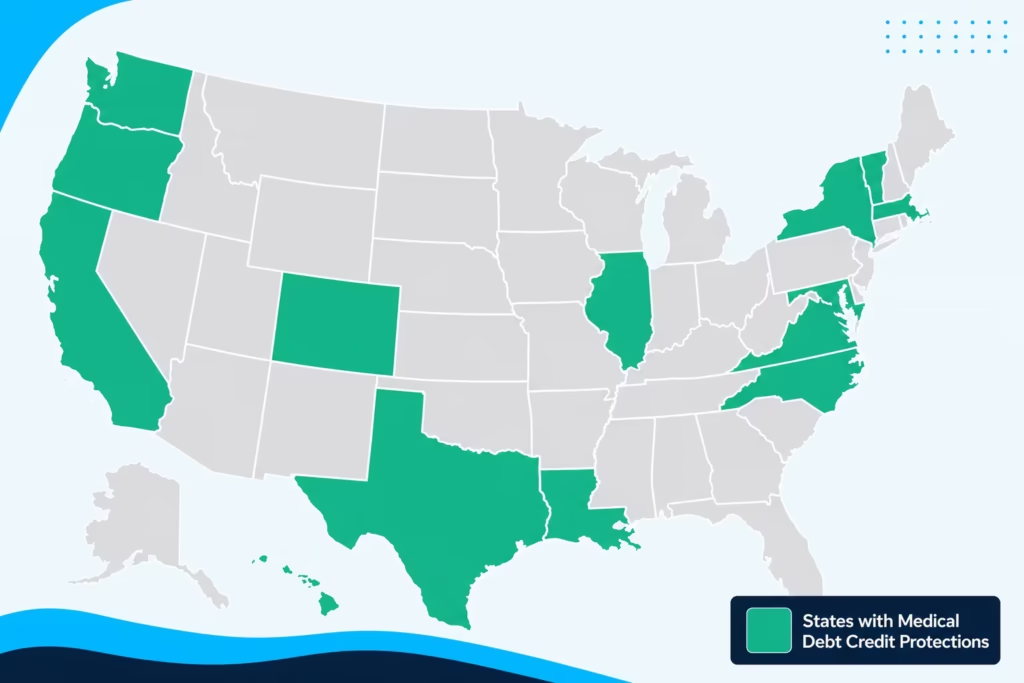
Maybe. Around 15 states have passed their own laws that block medical debt from appearing on residents’ credit reports, according to a 2025 Investopedia analysis.
The states with the strongest medical debt credit report protections include:
- California
- Colorado
- Connecticut
- Delaware
- Illinois
- Maine
- Maryland
- Minnesota
- New Jersey
- New York
- Oregon
- Rhode Island
- Vermont
- Virginia
- Washington
If you live in these states, your medical debt probably can’t be reported to Equifax, Experian, or TransUnion. This is true no matter how much you owe or how long it’s overdue. Colorado’s law, for example, blocks debt collectors from reporting any medical debt to consumer reporting agencies for state residents.
Note: The legal picture here is still shifting. A federal court in the 2025 Cornerstone ruling suggested the FCRA may preempt some of these state laws, and challenges to state protections are ongoing. If you live in one of these states, check with your state attorney general’s office or a local consumer protection nonprofit for the current status.
If you don’t live in one of these states, you fall back on the national rules: the 365-day grace period, the $500 threshold, and the removal of paid collections. That’s still meaningful protection, just not as strong.
How Many Points Can a Medical Collection Cost You?
A medical collection can lower your score by a few points or even over 100. It all depends on the scoring model your lender uses and your credit health before the collection.
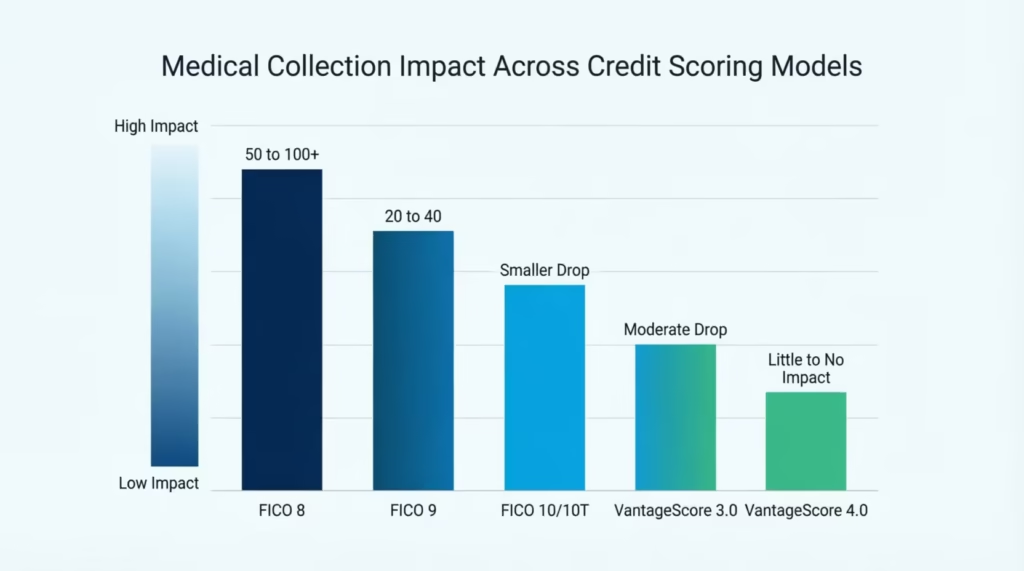
Here’s the important part: not all scoring models treat medical debt the same way. FICO and VantageScore offer multiple versions. The one your lender uses affects how much a medical collection impacts you.
| Scoring Model | Treatment of Medical Collections | Typical Impact |
|---|---|---|
| FICO 8 (older, still widely used) | Medical collections treated like any other collection | 50–100+ point drop possible |
| FICO 9 | Ignores paid collections. Unpaid medical collections weighted less than other collections | Smaller drop, often 20–40 points |
| FICO 10 / FICO 10 T | Similar to FICO 9. Unpaid medical collections over $500 count, but less than other collections | Smaller drop |
| VantageScore 3.0 | Medical collections weighted less than other collections | Moderate drop |
| VantageScore 4.0 | Ignores paid medical collections entirely. Excludes unpaid medical collections in the latest updates | Little to no impact |
FICO’s own analysis confirms that unpaid medical collections over $500 have less impact on FICO 9 and the FICO 10 Suite than on older models. VantageScore has gone further, removing medical collection records from its latest scoring models entirely, with the company estimating some consumers may see scores rise by up to 20 points as a result.
Here’s the catch. Mortgage lenders still often use older FICO models (FICO 2, 4, and 5). So if you’re applying for a home loan, a medical collection can hurt more than if you’re applying for a credit card that uses a newer model.
Two people with the same medical collection can see very different score changes. Someone starting at 780 with a clean file may drop 100 points. Someone starting at 620 with other issues might only drop 30. Higher scores fall further because they have more to lose.
What Happens When an Unpaid Medical Bill Goes to Collections
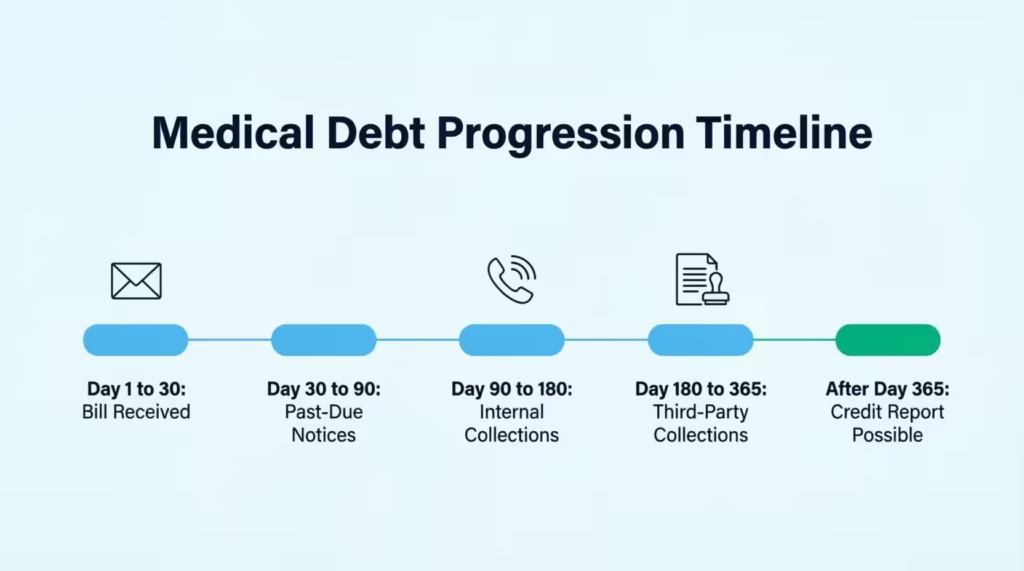
The path from bill to collection to credit report follows a fairly clear timeline. Knowing it helps you spot where you are and what you can still do.
Day 1 to Day 30: You get the bill from the provider. It’s overdue but not yet late. No credit impact.
Day 30 to Day 90: The provider’s billing office sends reminders and past-due notices. They may call. Still no credit impact.
Day 90 to Day 180: The provider may hand the debt to an internal collections department or an early-stage collection agency. Still not on your credit report.
Day 180 to Day 365: The debt is now with a third-party collection agency. It’s officially “in collections.” But even now, it cannot appear on your credit report yet.
After Day 365: If the debt is over $500 and still unpaid, the collection agency can now report it to Equifax, Experian, and TransUnion. Your score will likely drop.
Once reported, a medical collection can stay on your credit report for up to seven years from the date of the original delinquency, per the Fair Credit Reporting Act. Paying it should trigger removal under the current bureau rules, but you may need to push for that.
When a Billing Error or Insurance Delay Gets Mistaken for Real Debt
A lot of “medical debt” isn’t real debt at all. It’s a billing error, a coding mistake, or an insurance claim that was never processed properly.
Common examples:
- The provider billed the wrong insurance.
- The claim was denied for a fixable reason like a missing referral or prior authorization.
- Two providers billed you for the same service.
- You were charged the uninsured rate when you had coverage.
- The bill was sent to an old address, and you never saw it before it went to collections.
Take the case of Michael, a 42-year-old project manager whose son needed an ER visit. Six months later, a $2,100 collection account showed up on his Experian report. When he called, he learned the hospital had billed his old employer’s insurance, which had ended two months before the visit. His current insurance had never been billed at all. He filed a dispute, the hospital rebilled the correct insurance, and the collection was removed within 45 days.
If a medical bill or collection surprises you, treat it as possibly wrong until proven right. Ask for an itemized bill, compare it to your EOB, and contact your insurance company before you pay a cent.
How to Check If a Medical Bill Is Already on Your Credit Report
You get free credit reports every week from all three bureaus. Go to AnnualCreditReport.com, the only federally authorized site for free credit reports.
Steps to check for medical collections:
- Visit AnnualCreditReport.com.
- Fill in your name, address, Social Security number, and date of birth.
- Choose all three bureaus: Equifax, Experian, and TransUnion.
- Answer the identity verification questions. These often ask about old addresses or loan amounts.
- Download or view each report.
- Scroll to the “Collections” or “Negative Accounts” section.
- Look for any account listed with a medical provider, hospital, or a collection agency name you don’t recognize.
Not all medical collections say “medical” on the label. Many are listed under the collection agency’s name, like “ARS National Services” or “Med-1 Solutions.” If you see a collection you don’t recognize, search the company name online. If it’s a medical debt collector, that’s your clue.
You can also check your score for free through your bank, credit card issuer, or a free service like Credit Karma or Experian’s free app. But your score alone won’t tell you exactly what’s on your report. For that, you need the actual report from all three bureaus.
Check all three. A medical collection can be on one bureau’s report but not the others. Fixing it on Equifax doesn’t fix it on Experian.
How to Dispute or Remove a Medical Collection From Your Report
If a medical collection is on your report, you have real options to get it removed. The right steps depend on whether the debt is valid, wrong, or paid.
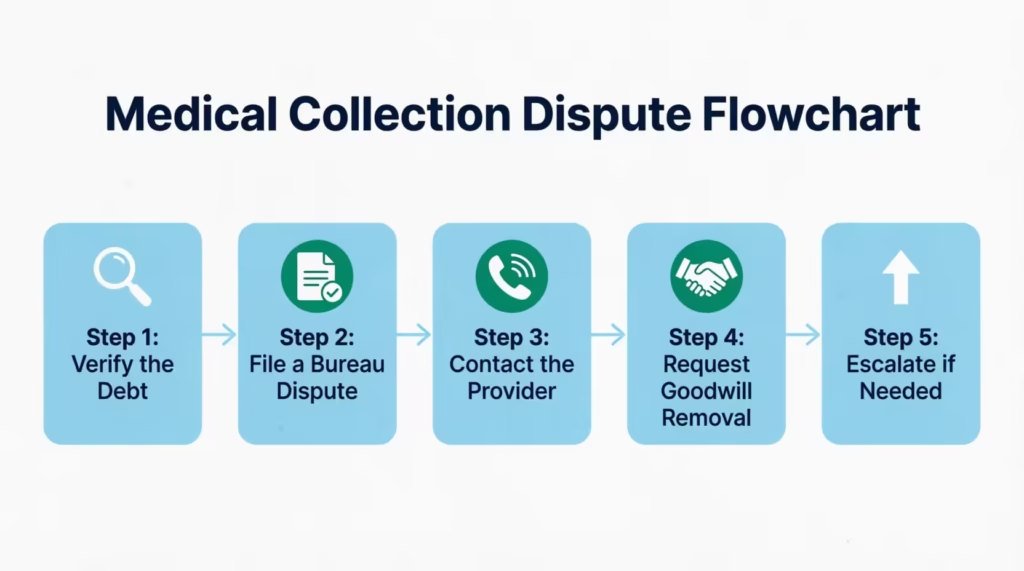
Step 1: Verify the debt. Send the collection agency a written debt validation letter within 30 days of first contact. They must send you proof the debt is yours, and the amount is correct. If they can’t verify it, the collection must come off your report.
Step 2: File a dispute with each bureau. If the debt is wrong, dispute it directly with each credit bureau that shows it:
The bureau has 30 days to investigate. If the collection agency can’t verify the debt within that window, it comes off.
Step 3: Dispute with the provider or collector directly. If it’s a billing error, contact the original provider. Ask them to withdraw the account from collections and correct the bill. Get everything in writing.
Step 4: Ask about goodwill removal. If the debt was valid and you’ve now paid it, write to the collection agency and ask for a goodwill deletion. Explain the situation. This works more often than people expect, especially with medical collections.
Step 5: Escalate if needed. If disputes fail and you believe the debt is invalid, file a complaint with the Consumer Financial Protection Bureau and your state attorney general.
Keep records of every phone call, letter, and email. Include dates, names, and what was said. Paper trails win disputes.
Getting a Paid Medical Collection Removed
Under the current deal with Equifax, Experian, and TransUnion, paid medical collections will be removed from your credit report. If you’ve paid a medical collection and it’s still showing up, here’s what to do:
- Get proof of payment. A receipt, a bank statement, or a letter from the collection agency confirming zero balance.
- Contact the collection agency and ask them to update the account status to “paid” and request deletion.
- Send the proof of payment along with a dispute to each of the three bureaus. State that this is a paid medical collection and should be removed under the industry agreement effective July 2022.
- Give it 30 days. If it’s not removed, escalate to the CFPB.
This usually works. Most collection agencies know the rules and will process the removal without a fight. If they push back, the bureaus themselves will often remove it once you provide proof of payment.
📌 Did You Know: The industry agreement to remove paid medical collections isn’t a law, but the three major bureaus have committed to it publicly. That gives you real leverage in disputes, because the bureaus are motivated to honor their own stated policy.
Is Your Specific Medical Bill at Risk? A Quick Way to Check
Use this checklist to know exactly where your bill stands. Answer each question in order.
1. Is the bill currently in collections?
- No: Your credit is not at risk yet. You have time to negotiate, dispute, or set up a payment plan directly with the provider.
- Yes: Continue to question 2.
2. Has the bill been in collections for less than 365 days?
- Yes: Not on your credit report yet. Use this time to dispute errors, apply for financial assistance, or negotiate a settlement.
- No: Continue to question 3.
3. Is the initial reported balance under $500?
- Yes: The three major bureaus will not report it. Your credit is safe from this specific bill.
- No: Continue to question 4.
4. Do you live in a state that blocks medical debt from credit reports?
- Yes (California, Colorado, Connecticut, Delaware, Illinois, Maine, Maryland, Minnesota, New Jersey, New York, Oregon, Rhode Island, Vermont, Virginia, or Washington): Your state law likely protects you, though the legal landscape is shifting.
- No: Continue to question 5.
5. Is the bill accurate, and did insurance process it correctly?
- No: File a dispute with the provider and your insurance. This is the fastest way to make the debt go away.
- Yes: You’re at real risk. Focus on payment, settlement, or payment plans to avoid a credit report hit.
If you got to question 5 with a “yes,” act now. Contact the collection agency to negotiate a settlement or a payment plan. Ask if paying will trigger removal from your credit report. Get any agreement in writing before you send money.
For most bills that hit question 1, 2, or 3, there’s no urgent credit crisis. You have time and options. That’s the whole point of the current rules.
Frequently Asked Questions (FAQs)
Can medical bills hurt your credit score?
A medical bill alone does not hurt your credit score since providers do not report to the bureaus. Damage only starts if the bill goes unpaid, gets sent to collections, stays unpaid past 365 days, and exceeds 500 dollars.
What happens if a $200 medical bill goes to collections?
A $200 medical collection will not appear on your credit report at all. The three major bureaus only report medical collections with an initial balance over 500 dollars.
How long does it take for unpaid medical bills to fall off a credit report?
A reported medical collection can stay on your credit report for up to seven years from the original delinquency date. Paying it off should trigger removal under the current bureau rules.
How much will my credit score drop if a medical bill goes to collections?
The drop ranges from a few points to over 100, depending on the scoring model. Older FICO 8 models can cut 50 to 100-plus points, while FICO 9 and VantageScore 4.0 cause a much smaller or no impact.
How do I get medical bills removed from my credit report?
Send a written debt validation letter, then dispute the account with each bureau if it’s wrong. If it’s valid and paid, request removal since paid medical collections must come off under the 2022 bureau agreement.
Is it worth it to pay off medical debt?
Yes, paying it off is worth it because paid medical collections are removed from your credit report entirely under the current bureau policy. This makes payment one of the strongest ways to repair your score after a collection hits.
Did Trump reverse medical bills on credit reports?
No presidential reversal was involved. A federal judge in the Eastern District of Texas vacated the CFPB’s medical debt rule on July 11, 2025, ruling it exceeded what the Fair Credit Reporting Act allows.
Is it illegal to send medical bills to collections?
No, sending an unpaid medical bill to collections is legal. Collectors must still follow the 365-day grace period and the 500 dollar threshold before reporting the debt to any credit bureau.
Does medical debt in collections ever go away?
Yes, a medical collection falls off your report after seven years from the original delinquency date, even if unpaid. Paying it can get it removed much sooner under current bureau rules.
What is a 609 letter to remove collections?
A 609 letter is a written request citing Section 609 of the Fair Credit Reporting Act, asking the bureau to verify a collection account is accurate. If the bureau or collector cannot verify it, the account must be removed.
Wrapping Up
Medical bills don’t have to wreck your credit. The 365-day grace period, the $500 threshold, and the removal of paid medical collections give you real breathing room, even after the July 2025 court decision to vacate the CFPB medical debt rule. State laws add another layer of protection in about 15 states. And newer scoring models like FICO 9 and VantageScore 4.0 treat medical collections much more gently than older models.
Based on the current rules, the smartest move is to use the grace period actively. Verify the bill, dispute errors, and negotiate before day 365. That single step protects most readers from any credit damage at all.
If you know someone facing an unexpected hospital bill or an EOB they don’t understand, share this guide with them. It could save their credit score before a single collection ever gets reported.