
Your credit score dropped, and no one is telling you exactly why. Maybe I checked mine last week and saw a 40-point dip with no clear reason on the app. That sinking feeling gets worse when a mortgage, car loan, or apartment application is around the corner. Knowing what hurts your credit score is the fastest way to stop the bleeding and rebuild trust with lenders.
The short answer: late payments, high card balances, new credit applications, closed old accounts, collections, charge-offs, and bankruptcy do the most damage, in roughly that order of severity.
Below, I’ll walk you through every action that drags your number down, how many points each one can cost, how long the damage sticks, and what to do next.
Key Takeaways
This guide explains what hurts your credit score, including late payments, high credit utilization, hard inquiries, closed accounts, collections, charge-offs, and bankruptcy, with typical point drops and recovery timelines for each.
Core Facts:
- Payment history makes up 35% of your FICO Score, and a 30-day late payment can drop a high score by 60 to 110 points.
- Credit utilization above 30% starts hurting your score, while the best scores usually stay under 10% utilization.
- A single hard inquiry typically costs 3 to 5 points and stays on a credit report for two years, though its score impact fades after about 6 to 12 months.
- Closing an old credit card can drop a score 15 to 40 points by shrinking total credit limit and raising utilization, even with no new spending.
- Collections and charge-offs are major derogatory marks that can drop a high score by 100 points or more and stay on a report for up to 7 years.
- Bankruptcy is the most damaging single event, capable of dropping even a top-tier score by 200 points or more, with Chapter 7 staying on a report up to 10 years and Chapter 13 up to 7 years.
Best for:
- Readers who noticed an unexplained credit score drop and want to identify the likely cause.
- People preparing for a mortgage, car loan, or apartment application who want to avoid actions that could hurt their score beforehand.
- Anyone deciding whether to close an old card, cosign a loan, or pay off an installment loan early and wants to understand the score impact first.
How Late and Missed Payments Hurt Your Score
Payment history is the biggest single factor in your credit score. Data from myFICO shows payment history makes up 35% of your FICO Score, which is more than any other category. That’s why one slip can sting so much.
A payment is not officially “late” on your credit report until it is at least 30 days past the due date. Pay it on day 15 or day 25, and your lender may charge a fee, but the credit bureaus never see it. Cross the 30-day line, and the mark can stay for up to seven years.
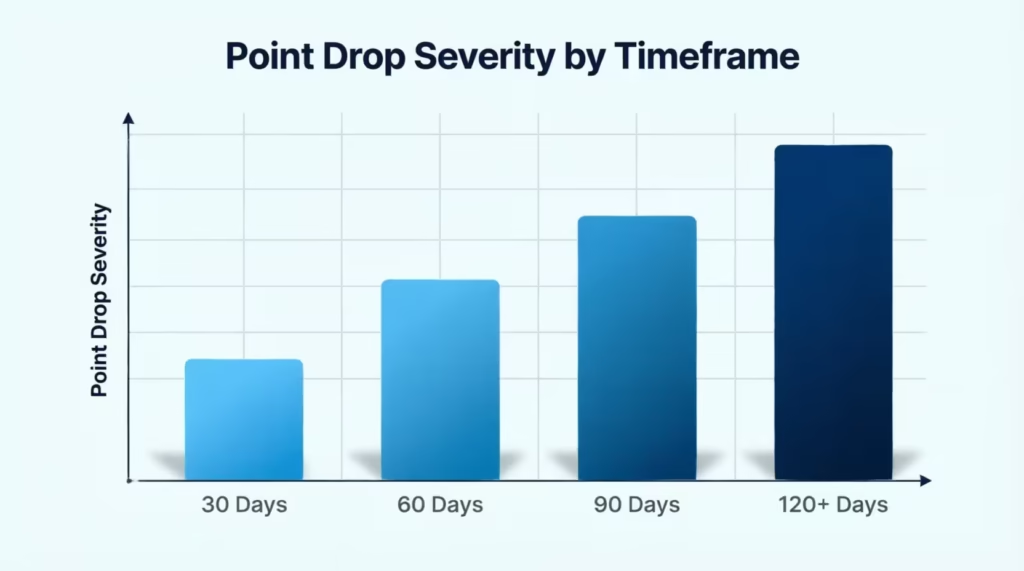
The damage scales with how late you are:
- 30 days late: first true “ding.” Common drop of 60 to 110 points on a high score.
- 60 days late: the account looks riskier. Extra 20 to 40-point hit on top of the first.
- 90 days late: now called a “serious delinquency.” Lenders view you as a real default risk.
- 120+ days late: the account is on track to become a charge-off or head to collections.
A single late payment is called a “derogatory mark.” Two or three in a short window turn into a pattern, and patterns hurt worse than one-off mistakes. Set up autopay for at least the minimum on every card and loan. That one habit protects the 35% of your score that matters most.
⚠️ Mistake to Avoid: Paying only the annual fee or a partial amount and thinking you’re safe. If the statement balance isn’t paid or you don’t hit the minimum by the due date, the clock to a 30-day late still starts ticking.
Why a Single Late Payment Can Drop Your Score Sharply
The higher your score, the more a first late payment can cost you. A person with a 780 score has “no negative history” baked into that number. One 30-day late tells the model that assumption was wrong, so the score falls hard and fast.
Someone with a 620 score already has some risk priced in. A new late still hurts, but the drop tends to be smaller, often 30 to 60 points. This is why “clean” credit files are the most fragile.
Take Sarah, a 29-year-old marketing coordinator with a 795 score. She missed one $42 payment on a store card while switching bank accounts. Her score fell to 705 in one cycle. It took her about 14 months of perfect payments to climb back to 770.
The mark itself sits on your report for seven years from the original delinquency date. The score impact fades much faster than that. Most of the damage is gone within 24 months if you pay on time from then on.
How High Credit Utilization Hurts Your Score
Credit utilization is the second biggest factor in your score, right after payment history. It measures how much of your available revolving credit you are using at any moment. Lenders read a high number as “this person may be stretched thin.”
The math is simple. Add up your credit card balances. Add up your credit limits. Divide the first by the second, then multiply by 100.
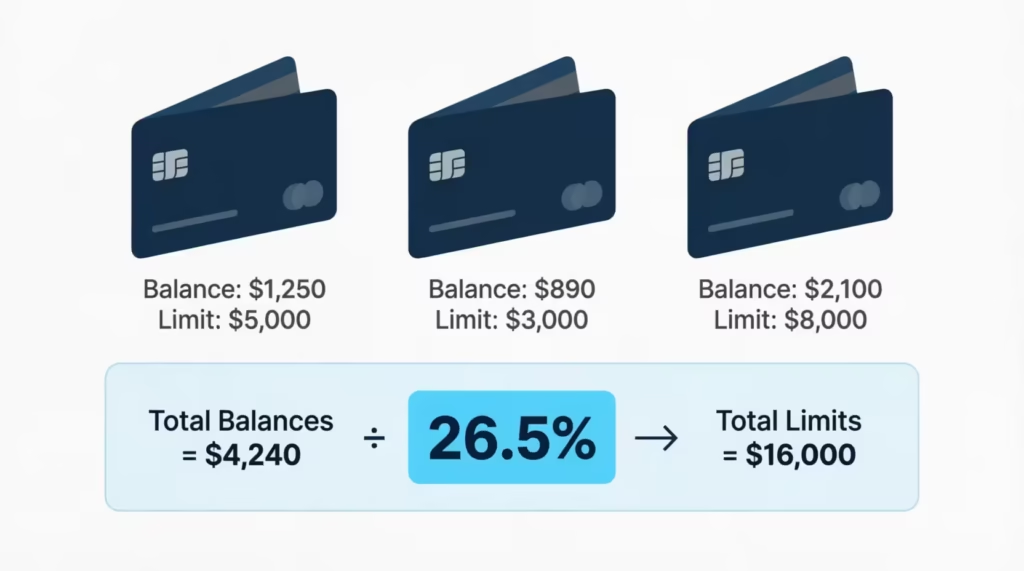
Worked example:
- Card A balance $1,200, limit $3,000
- Card B balance $800, limit $2,000
- Card C balance $0, limit $5,000
- Total balances: $2,000. Total limits: $10,000.
- Utilization ratio: $2,000 ÷ $10,000 = 20%.
That 20% score is healthy. Cross 30%, and the model starts to worry. The best scores usually sit under 10%. Utilization is calculated per card and across all cards, so a single maxed-out card can hurt even if your overall ratio looks fine.
Here is where timing gets tricky. Your score uses the balance your card issuer reports to the bureaus, usually on your statement closing date, not your due date. You can pay in full every month and still show high utilization if you charge a lot right before the statement closes. To keep this ratio low, pay the balance down a few days before the statement date, not just before the due date.
💡 Pro Tip: Ask your card issuer for a credit limit increase every 6 to 12 months. If they say yes and you keep your spending the same, your utilization ratio drops overnight, which usually nudges your score up within one billing cycle.
Maxing Out a Card: Why It’s Worse Than It Looks
Maxing out one card can drop your score 30 to 60 points on its own, even if your other cards are at zero. Scoring models look at your highest single-card utilization, not just the total. So a $4,800 balance on a $5,000-limit card (96% used) can outweigh three empty cards next to it.
There is a second, uglier risk. Card issuers watch balances too. If you carry a near-max balance for several months, the bank may cut your credit limit. That is called a “credit limit decrease.” When your limit drops, your utilization jumps overnight, even though you never charged another dime. A cut from $5,000 to $2,500 on a $2,400 balance takes your utilization on that card from 48% to 96%. Your score can fall 20 to 40 points from a change you didn’t make.
How Hard Inquiries Hurt Your Score
A hard inquiry (also called a “hard pull”) happens when you apply for new credit and a lender checks your credit report to decide. One hard inquiry usually costs 3 to 5 points. That is small compared to a late payment, but the effect adds up when you apply for a lot of credit in a short window.
Hard inquiries stay on your credit report for two years. They only affect your score for the first 12 months, and most of that impact fades after 6 months. So they are annoying, not disastrous.
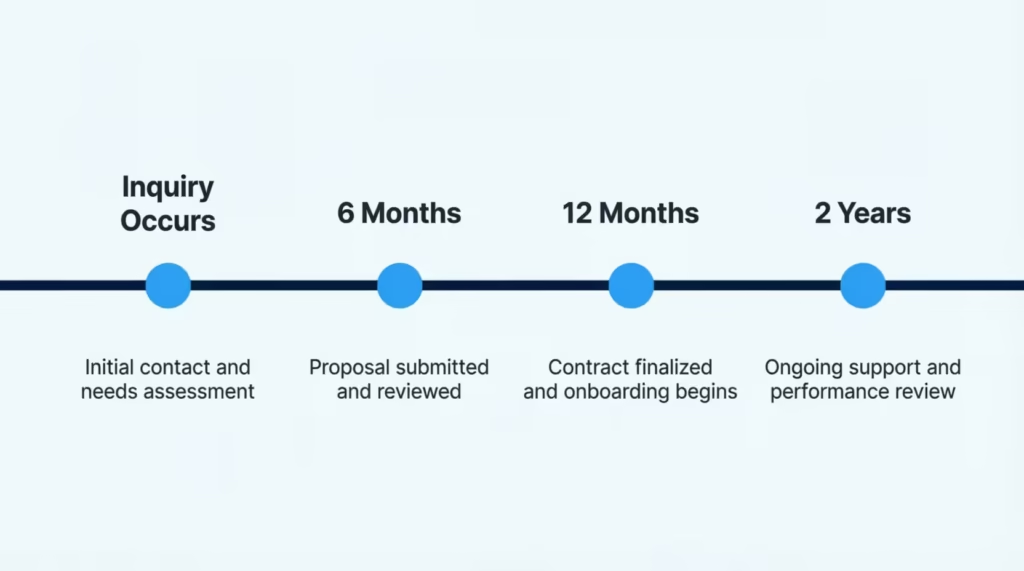
There is one big carve-out. If you are shopping for a mortgage, auto loan, or student loan, all the hard pulls from lenders during your rate-shopping window count as one inquiry.
The Consumer Financial Protection Bureau confirms mortgage lenders’ credit checks are grouped as a single inquiry inside a 45-day window. So compare 5 mortgage lenders in three weeks, and your score treats it like one application, not five. Credit card and personal loan applications do not get this discount. Each one is its own separate inquiry.
Soft inquiries do not hurt your score at all. Checking your own credit report, prequalifying for a card, and getting a credit-monitoring update are all soft pulls. You can look at your own score every day if you want, and it will not move a point.
Opening Too Many New Accounts at Once
Multiple new accounts in a short window hurt in two ways at the same time.
First, each application adds a hard inquiry, so the small 3 to 5 point hits stack. Second, new accounts lower your average account age. If your existing accounts average 8 years old and you open a brand-new card, your average could drop to 4 years overnight, which the model doesn’t like.
There is also a behavior signal. A person who opens 4 cards in 60 days looks either desperate for credit or planning to take on a lot of debt. Both patterns raise the model’s default risk estimate. Space new applications at least 3 to 6 months apart, and try to avoid any new applications in the 6 months before a big loan like a mortgage.
Why Closing an Old Credit Card Can Hurt Your Score
Closing a card feels like tidying up. On your credit score, it can do the opposite. Two hidden effects hit at once.
Effect 1: Your average account age drops. Length of credit history is about 15% of your FICO Score. If your oldest card is 12 years old and you close it, the average age of your remaining accounts falls. Fair warning: the closed account’s history stays on your report for about 10 years, so the age drop is usually delayed, not instant. But once it falls off, your average age can drop sharply.
Effect 2: Your total credit limit shrinks, so utilization spikes.
Here is a before-and-after using real numbers:
Before closing the card:
- Card A (the one you plan to close): $0 balance, $5,000 limit
- Card B: $2,000 balance, $5,000 limit
- Card C: $500 balance, $5,000 limit
- Total balance: $2,500. Total limit: $15,000.
- Utilization: 16.7%. Healthy.
After closing Card A:
- Card B: $2,000 balance, $5,000 limit
- Card C: $500 balance, $5,000 limit
- Total balance: $2,500. Total limit: $10,000.
- Utilization: 25%. Getting close to the 30% danger zone.
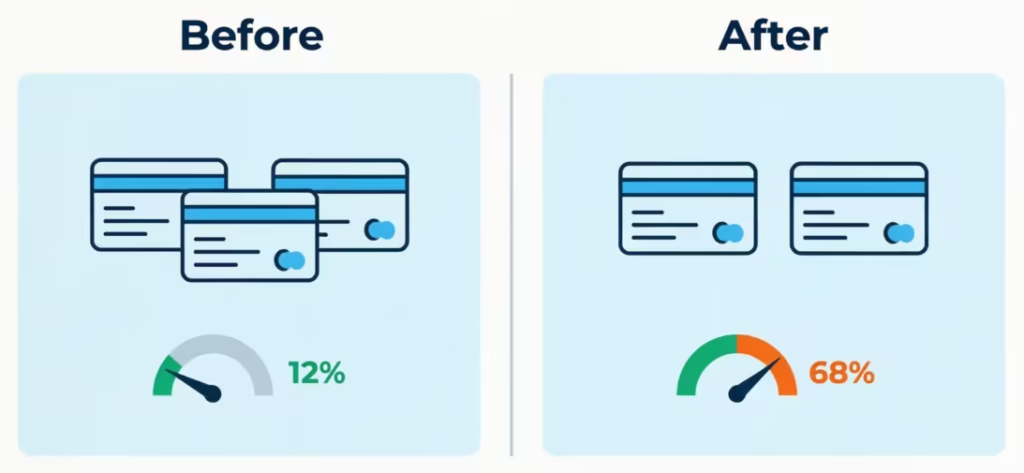
Same debt. Same spending habits. But the score can fall 15 to 40 points, purely because the math shifted. If a card has no annual fee, keeping it open (even with a small monthly charge on autopay) is almost always better for your score than closing it.
If the card has a fee you no longer want to pay, ask the issuer for a “product change” to a no-fee version instead. Your account history and credit limit usually stay intact.
How Collections and Charge-Offs Hurt Your Score
Collections and charge-offs are among the most damaging entries you can have on a credit report. A single one can drop a high score 100 points or more. They belong to a group called “major derogatory marks.”
A collection happens when a debt is so overdue that the original lender either sells it to or hires a debt collection agency. Common triggers include unpaid medical bills, old cell phone contracts, gym memberships, and defaulted credit cards.
Two timelines matter here, and people mix them up:
- How long it stays visible on your report: Up to 7 years from the date of the original missed payment that led to the collection, not the date the collection was filed.
- How long it actively drags your score down: The heaviest damage happens in the first 24 months. After that, the impact fades even though the mark is still visible.
Paying a collection is still worth it. Newer scoring models (FICO 9, FICO 10, VantageScore 3.0 and 4.0) ignore paid collections. Older models still count them, but a “paid” status looks better to a human underwriter reading your report for a mortgage. Ask for a “pay for delete” letter in writing before you pay. Some collectors will remove the mark entirely in exchange for payment. Not all will, but it’s worth asking.
📌 Did You Know: Medical debt under $500 is no longer supposed to appear on your credit reports at all, and paid medical collections of any size are removed. If you see a small medical bill on your report, you can dispute it directly with the credit bureau.
Charge-Offs Explained
A charge-off is what happens before or alongside a collection. When you stop paying a credit card or loan, the lender is required by accounting rules to write off the debt as a loss, usually after 180 days of missed payments. This is called a “charge-off.”
A charge-off does not mean the debt is forgiven. You still owe the money. The lender either keeps trying to collect it themselves or sells the account to a collections agency. That is how one bad debt can show up twice on your credit report: once as a charge-off from the original lender, and once as a collection from the buyer.
For scoring purposes, treat a charge-off with the same seriousness as a collection. Both are severe derogatory marks, and both stay on your report for up to 7 years.
How Bankruptcy Hurts Your Score
Bankruptcy is the most damaging single event a personal credit report can carry. A fresh bankruptcy filing can drop even a top-tier score by 200 points or more. A score in the 500s can fall into the low 400s.
How long the mark sticks depends on which type of bankruptcy you file:
- Chapter 7 (liquidation bankruptcy): stays on your credit report for up to 10 years from the filing date.
- Chapter 13 (repayment plan bankruptcy): stays on your credit report for up to 7 years from the filing date.
Chapter 7 stays longer because it wipes out most of the debt, while Chapter 13 requires you to pay back at least some of it over 3 to 5 years. Credit models treat the repayment version as slightly less risky, so it gets a shorter penalty window.
The score damage does not last the full 7 or 10 years. Most people see meaningful recovery start around the 18 to 24 month mark, as long as they are paying every new account on time. Many rebuild into the 650 to 700 range within 3 to 4 years by using a secured card, keeping utilization under 10%, and never missing a due date. Bankruptcy hurts a lot, but it is not a permanent sentence.
How Cosigning and Authorized User Status Can Hurt Your Score
You do not need to be the borrower to get hurt. Being tied to someone else’s account can quietly damage your credit in ways most people never see coming.
When you cosign a loan, you take on full legal responsibility for the debt. The account appears on your credit report the same way as if you had borrowed the money yourself. Every payment, on time or late, hits your score.
If your friend, sibling, or child misses payments on a car loan you cosigned, the late payment sits on your credit report for up to 7 years and can drop your score by 60 to 110 points, just as if you had missed the payment yourself.
The added debt also raises your “debt-to-income ratio,” which can block you from getting your own mortgage or car loan even when you’re paying nothing on the cosigned account.
Michael, a 34-year-old operations manager, cosigned a $22,000 car loan for his younger brother. His brother missed two payments over 6 months. Michael’s score dropped from 758 to 651, and his own mortgage application was denied that quarter.
Before you cosign anything, ask yourself if you would be comfortable paying the full loan yourself if the primary borrower stopped paying. If the answer is no, don’t sign.
Being an Authorized User on a Poorly Managed Account
Being an authorized user is different from cosigning. You are not legally responsible for the debt. You just get a card with your name on it, tied to someone else’s account.
But the account still shows up on your credit report and still affects your score. If the primary cardholder maxes out the card or pays late, your utilization and payment history can get dragged down with theirs. This is often called “piggybacking gone wrong.”
If a parent adds you to a card with a long history and low balances, being an authorized user can help. If they add you to a card they routinely max out or pay late, ask to be removed. Removal from the account usually removes the entry from your credit report within one or two billing cycles.
Why Paying Off an Installment Loan Early Can Temporarily Lower Your Score
This one surprises most people. You pay off a car loan or student loan early, do a small victory dance, then watch your score fall 10 to 20 points the next month. What gives?
Two things happen when you close an installment loan:
- Your credit mix loses a category if it was your only installment loan. A mix of revolving credit (like cards) and installment credit (like loans) is worth about 10% of your FICO Score.
- Your account activity looks a little “quieter.” Active, on-time installment loans send positive signals every month. A closed loan sends none, even though the past payment history stays on the report.
The dip is small and temporary. Most people bounce back within 2 to 6 months as long as they keep paying other accounts on time. Don’t pay a loan longer than needed just to protect your score. If you can save real interest by paying it off early, do it. A 10-point dip is nothing compared to paying an extra $2,400 in interest.
How Credit Mix Affects Your Score
Credit mix is the smallest scoring category, but it still matters. Scoring models like to see that you can handle different types of borrowing responsibly. The main split is:
- Revolving credit: credit cards, retail cards, home equity lines of credit. The balance and available limit change every month.
- Installment credit: mortgages, auto loans, personal loans, student loans. Fixed monthly payment for a fixed number of months.
If you only have credit cards, adding one installment loan can boost your score over time. Most people should not open a loan just to fix credit mix. It costs interest and adds a hard inquiry. A better path is to let your credit mix grow naturally as you take on real-life loans: a car, a home, or a student loan.
Which of These Actions Hurts Your Score the Most
Not every negative action is equal. Here is a ranked view of what actually costs the most points, based on typical impact for a person starting with a 750 score:
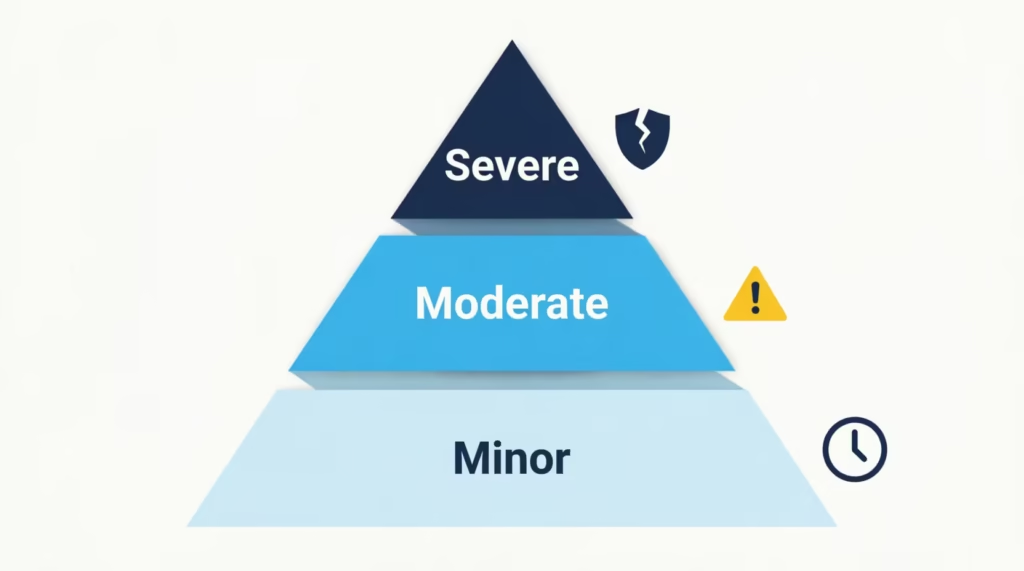
Severe damage (100+ point drops, 7 to 10 year impact):
- Bankruptcy (Chapter 7 or 13). The single most damaging event.
- Foreclosure or repossession.
- Collections and charge-offs.
Moderate damage (30 to 110 point drops, 1 to 5 year impact):
- 30, 60, or 90 day late payments.
- High credit utilization (over 30%, and much worse over 70%).
- Maxing out a single card.
- Cosigned loan going into default.
Minor damage (3 to 40 point drops, under 12-month impact):
- One or two hard inquiries.
- Opening a new account (from the age-of-accounts hit).
- Closing an old credit card (mostly from utilization spike).
- Paying off an installment loan early.
A useful way to think about what hurts your credit score most is to sort by two questions: how many points does it cost right now, and how long does it stick? A single late payment can rival a small collection in point damage but fades faster. A bankruptcy is the only event that hits both dimensions hard at once.
| Action | Typical Point Drop | How Long It Stays on Report | Recovery Time |
|---|---|---|---|
| Bankruptcy | 130 to 240+ | 7 to 10 years | 3 to 5 years |
| Collection or charge-off | 60 to 150 | 7 years | 2 to 4 years |
| 30-day late payment | 60 to 110 | 7 years | 12 to 24 months |
| Maxing out one card | 30 to 60 | Until balance drops | 1 to 2 months |
| Closing an old card | 15 to 40 | 10 years (as closed) | 1 to 6 months |
| Hard inquiry | 3 to 5 each | 2 years | 6 to 12 months |
| Paying off installment loan | 10 to 20 | Reports permanently | 2 to 6 months |
Frequently Asked Questions (FAQs)
What is the biggest killer of credit scores?
Bankruptcy is the single most damaging event, capable of dropping even a top-tier score by 200 points or more. Late payments, high utilization, and collections follow close behind as major score killers.
What brings a credit score down the most?
Late payments (35% of your score), high credit utilization, and major derogatory marks like collections, charge-offs, and bankruptcy cause the deepest drops. A 30-day late payment alone can cost 60 to 110 points on a high score.
What makes your credit score go down 100 points?
Major derogatory marks cause 100+ point drops: bankruptcy, foreclosure, repossession, collections, and charge-offs. A single collection or charge-off can drop a high score by 100 points or more on its own.
Why is my credit score going down if I pay everything on time?
Your utilization ratio may be spiking due to a credit limit decrease, a closed old card shrinking your total limit, or high balances reported on your statement closing date. Closing a card alone can push utilization from a healthy 16.7% to a risky 25% with zero change in spending.
How many credit cards is too many?
There’s no fixed number, but opening several cards within a short window hurts more than the total count. Opening 4 cards in 60 days stacks hard inquiries and lowers your average account age, both of which raise your risk profile to lenders.
What are 5 factors that affect your credit score?
The five main factors are payment history (35%), credit utilization (second-biggest factor), length of credit history (about 15%), credit mix (about 10%), and new credit inquiries. Payment history and utilization together make up roughly 65% of your score.
How to raise credit score fast?
Pay down credit card balances before your statement closing date, not just the due date, since that’s the balance reported to bureaus. Setting up autopay for at least the minimum payment protects the 35% of your score tied to payment history.
What is credit mix and why does it matter?
Credit mix is the smallest scoring factor at about 10% of your FICO Score, and it rewards handling both revolving credit (cards) and installment credit (loans) responsibly. Paying off your only installment loan early can cause a temporary 10 to 20 point dip since you lose that mix category.
Wrapping Up
Your credit score is really just a summary of the last few years of financial habits, and every action on this list either builds it or breaks it. Late payments, high utilization, collections, and bankruptcy do the deepest damage. Hard inquiries, closed old cards, and early loan payoffs sting a little but fade fast.
To boost your score, focus on protecting your payment history and utilization first. These two factors account for almost 65% of your score.
If you know someone about to apply for a mortgage, car loan, or first apartment, share this guide with them. One well-timed heads-up could save their score before a lender ever sees it.