
Debt has a way of sitting on your chest. You open the statements, see the balances, and feel stuck. Maybe the credit card minimums keep rising, or a personal loan is eating your paycheck. If you’re asking how to get out of debt quickly, you’re not looking for a lecture. You want a real plan.
The fastest way out is to list every debt, cut a clear budget, and attack one balance at a time using either the snowball or avalanche method.
Below, we walk you through each step, with math, timelines, and options for low income or bad credit. Read on and start today.
Key Takeaways
This guide explains how to get out of debt quickly, covering debt inventory, debt-to-income ratio calculation, zero-based budgeting, the snowball and avalanche payoff methods, and realistic timelines based on monthly payment amount.
Core Facts:
- A debt-to-income ratio above 43% is treated by the Consumer Financial Protection Bureau as the point where debt becomes hard to manage without outside help.
- The snowball method pays off debts from smallest balance to largest, while the avalanche method targets the highest APR balance first to minimize total interest.
- On a $20,000 balance at 22% APR, paying $400 a month takes about 8 years and costs roughly $18,900 in interest, while $1,500 a month takes about 1 year 4 months and costs about $2,700.
- Balance transfer cards typically offer 0% intro APR for 12 to 21 months but charge a transfer fee of 3% to 5%.
- Nonprofit debt management plans usually cut credit card APRs to around 8% to 10% and typically finish in three to five years.
- Chapter 7 bankruptcy can discharge most unsecured debt in about 4 to 6 months but stays on a credit report for 10 years, while Chapter 13 involves a 3 to 5 year repayment plan and stays on a report for 7 years.
Best for:
- Readers with $10,000 to $30,000 in consumer debt looking for a realistic 18 to 48 month payoff plan.
- People with low income or bad credit who need alternatives to 0% cards, such as hardship programs or credit union loans.
- Anyone deciding between DIY payoff methods versus credit counseling, settlement, or bankruptcy based on how severe their debt load is.
Take Inventory of Everything You Owe
You can’t fix what you can’t see. Before choosing any payoff method, you need one clear picture of your full debt inventory. Guessing at balances or ignoring old bills is the main reason people stall for months.
Open a spreadsheet or a plain sheet of paper. Log in to each account or pull your free credit reports from AnnualCreditReport.com. Every debt gets one row. Do not skip small ones. Do not skip old ones you hope will vanish. They will not.
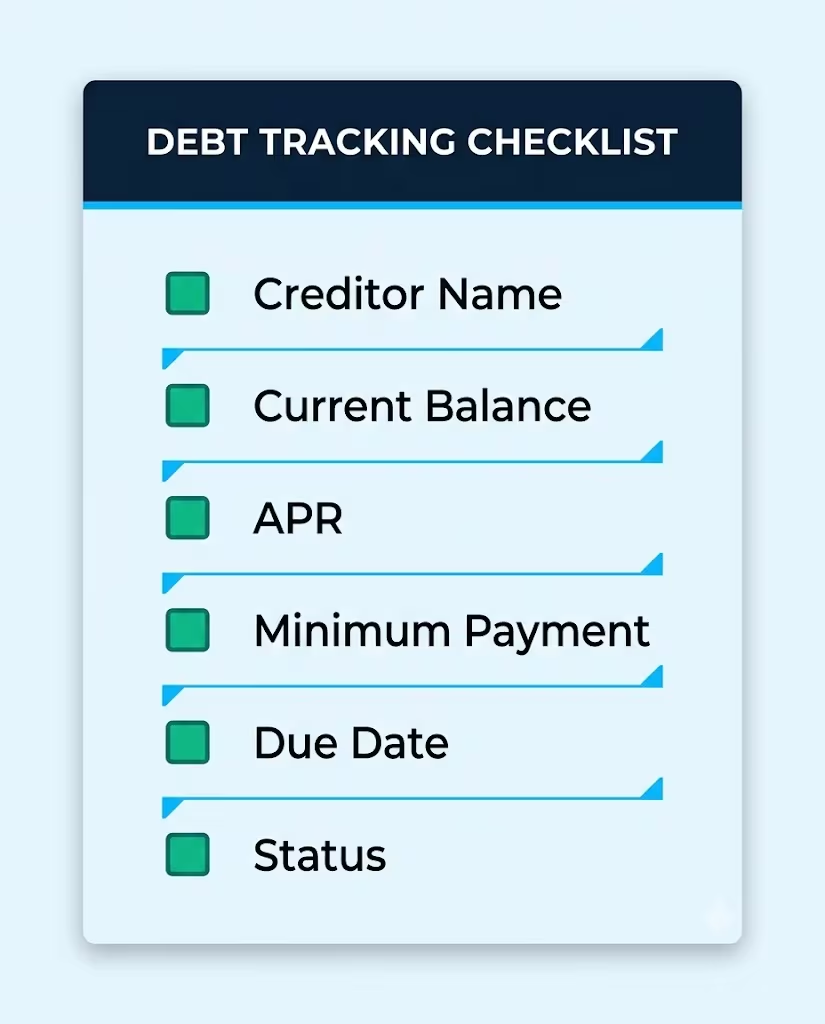
For each debt, write down these six items:
- Creditor name (the company you actually pay)
- Current balance (what you owe today, not last month)
- APR (the interest rate)
- Minimum payment (the smallest amount due each month)
- Due date (the day the payment must arrive)
- Status (current, past-due, in collections, or charged-off)
Include everything: credit cards, store cards, buy-now-pay-later plans, personal loans, medical bills, payday loans, auto loans, student loans, tax debt, and money owed to family. Even a $180 old cable bill in collections accounts belongs on the list.
Once the table is done, add the balances. Add the minimum payments. Those two numbers are your true starting line. Most people find the total is smaller and less scary than they feared, or bigger but finally knowable. Either way, you now have something to work with.
📌 Did You Know: A charged-off debt is not a forgiven debt. The original creditor writes it off their books for accounting, but you still owe it, and collectors can still sue for it in most states.
Figure Out How Bad It Really Is
Before you pick a strategy, run a quick severity check. This step decides whether you need a payoff plan or professional help.
The main number to run is your debt-to-income ratio, or DTI. It compares your monthly debt payments to your monthly gross income (income before taxes).
The math is simple:
DTI = (total monthly debt payments ÷ gross monthly income) × 100
Include rent or mortgage, minimum credit card payments, auto loans, student loans, and any other required monthly debt. Do not include groceries, utilities, or gas.
Here is how to read the result:
| DTI Range | What it means | What to do |
|---|---|---|
| Under 20% | Healthy | Build a payoff plan on your own |
| 20% – 35% | Manageable | Snowball or avalanche will work |
| 36% – 42% | Tight | Consider a strict budget or balance transfer |
| 43% – 49% | Warning zone | Look at credit counseling |
| 50% and up | Crisis level | Consider debt management, settlement, or bankruptcy |
The 43% mark is not random. The Consumer Financial Protection Bureau has long treated a DTI above 43% as the point where debt becomes hard to service without help. If you land there, do not feel shame. It just means the DIY path may not be enough on its own.
Also look at cash flow. If your minimum payments, rent, food, and utilities exceed your take-home pay, no method will help you pay off debt. You need to either increase your income or seek help from creditors.
Build a Budget That Actually Frees Up Money
A budget is not a punishment. It is a tool that finds the dollars hiding in your month. The fastest path forward is zero-based budgeting, where every dollar of income gets a job before the month starts.
Start with your monthly take-home pay. Then list expenses in this order:
- Survival first: rent or mortgage, utilities, groceries, transport to work, basic insurance.
- Minimum payments: every debt on your list gets its minimum. Miss one and the whole plan slips.
- Small buffer: $500 to $1,000 in a starter emergency fund. Without it, one flat tire puts you back on a credit card.
- Debt attack fund: every extra dollar goes here. This is the money that speeds up debt payoff.
- Wants: streaming, dining out, hobbies. What is left after the four steps above.
If income minus survival minus minimums leaves nothing for step four, you need to adjust your budget. Cut two or three real costs, not just coffee. Pause subscriptions, drop one insurance add-on, switch phone plans, cook one more meal at home each day. Small daily wins add up faster than one big cut.
Track spending for the first 30 days. Most people find $150 to $400 a month they did not know they were spending. That money is your fuel.
💡 Pro Tip: Use a separate checking account just for bills and minimum payments. Move that money on payday and leave the rest in your main account. It stops accidental overspending without any willpower.
Choose Your Payoff Method: Snowball vs. Avalanche
Once you have extra money each month, point it at one debt at a time. Two methods dominate, and both work. The choice is about what keeps you going.
The debt snowball method works like this:
- List debts from smallest balance to largest.
- Pay minimums on all of them.
- Throw every extra dollar at the smallest balance.
- When it clears, roll that payment into the next smallest.
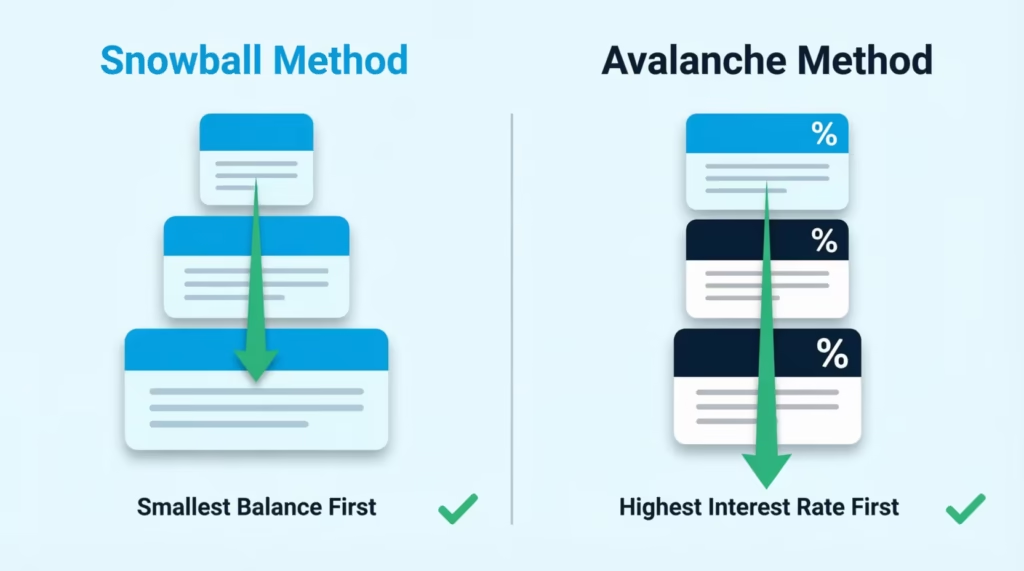
The debt avalanche method looks similar but ranks by rate:
- List debts from highest APR to lowest.
- Pay minimums on all of them.
- Throw every extra dollar at the highest-APR balance.
- When it clears, move to the next highest rate.
Here is a quick side-by-side:
| Feature | Snowball | Avalanche |
|---|---|---|
| Order | Smallest balance first | Highest APR first |
| Best for | Motivation, quick wins | Interest savings, math-driven readers |
| First payoff | Fastest | Slower |
| Total cost | Slightly higher | Lowest |
| Time to debt-free | Similar or slightly longer | Usually a bit shorter |
Which is better? The one you will finish. A Harvard Business Review study found that people who paid off small balances first stayed on plan longer, even though avalanche saved more on paper. If you are numbers-driven, use avalanche. If you need a win in month one to stay in the fight, use snowball.
When to Prioritize by Consequence, Not Just Method
Interest rate is not always the top risk. Some debts can hurt you faster than a high APR ever will.
Move these to the front of the line, no matter which method you picked:
- Past-due accounts headed to collections: bringing them current stops fees and legal risk.
- Auto loans or secured debt at risk of repossession: losing the car often costs the job.
- Tax debt: the IRS can garnish wages and levy bank accounts.
- Child support or court-ordered debt: nonpayment can mean license suspension or jail.
- Rent or mortgage arrears: shelter first, always.
Once these are stable, return to your snowball or avalanche order.
Get Out of Debt on a Low Income or With No Extra Money
If your budget shows zero left after survival costs, you still have moves. This section is for readers who feel that no plan works because there is nothing to work with.
First, protect the essentials. Follow the survival-first order every month:
- Food for the household
- Housing (rent or mortgage)
- Utilities you cannot live without
- Transport to work
- Minimum payments on debts
If a debt payment forces you to skip one of the top four, that debt is not your top priority this month. Missing a credit card payment hurts your credit; missing rent can end your housing.
Next, try these low-income levers:
- Call every creditor and ask for hardship programs. Many lenders will lower APR, waive fees, or pause payments for 3 to 12 months.
- Apply for utility and food assistance. Programs like LIHEAP and SNAP free up cash for debt.
- Make micro-payments weekly, not monthly. Sending $15 every Friday feels doable and cuts interest faster than one lump.
- Sell items you do not use. Even $60 from a sold gadget goes to one balance.
- Use tax refunds and stimulus checks in full. A $2,000 refund can wipe a smaller card in one shot.
If income is truly fixed and low, the honest answer is that debt payoff may take longer. That is fine. Progress beats panic.
Get Out of Debt Fast When You Have Bad Credit
Bad credit blocks the shiny tools like 0% cards and low-rate personal loans. But options remain, and some are actually better for your situation.
Start by knowing your score. Free access is available through your credit card app or MyFICO. If your FICO Score is under 620, most balance transfer offers will be denied or capped.
Here are the paths that work with weak credit:
- Direct negotiation with each creditor. Ask for a lower rate, a hardship plan, or a temporary interest freeze. Success rates are higher than most people expect, especially on accounts you have held for over a year.
- Nonprofit credit counseling. A credit counseling agency can set up a debt management plan, which usually cuts APRs to around 8% to 10%, even for poor credit. More on this below.
- Secured debt consolidation loan. If you have a car or savings, a secured loan may qualify where an unsecured one will not. Weigh the risk of losing the asset.
- Credit union personal loans. Local credit unions often approve members with credit scores that big banks reject.
Avoid these traps:
- Payday loans and title loans (APRs of 300% or more)
- “Debt relief” companies that promise to erase debt for pennies on the dollar
- Any lender asking for money upfront before a loan is approved
Use Balance Transfers and Consolidation the Right Way
When credit is decent, transfer and consolidation tools can slash the interest bleed. Used wrong, they trap you in more debt than before.
A balance transfer card moves high-APR credit card debt onto a new card with a 0% intro APR, usually for 12 to 21 months. During that window, every dollar you pay wipes principal, not interest.
Rules that make it work:
- The transfer fee is usually 3% to 5%. Do the math and confirm the savings still beat the fee.
- Only transfer what you can realistically pay off before the promo ends.
- Do not use the new card for any new purchases.
- Set a calendar reminder for one month before the intro rate ends.
A debt consolidation loan rolls several debts into one fixed payment, ideally at a lower rate than your credit cards. According to Federal Reserve data, the average credit card APR in the U.S. sits above 20%, while personal loan rates for borrowers with good credit often run 8% to 15%. That gap is the whole point.
Use consolidation when:
- Your credit score qualifies you for a lower rate than your current mix
- The monthly payment fits your budget
- You will not run the cleared cards back up
The biggest failure with these tools is the “re-spending trap.” You clear the cards, feel relief, and start swiping again. Six months later, you owe on the old cards and the new loan. Cut the cards, freeze the credit line, or hide them in a drawer. Whatever it takes.
⚠️ Mistake to Avoid: Never miss a payment on a 0% balance transfer card. One late payment often ends the promo rate on the spot and can retroactively charge interest back to day one.
Find Extra Money to Speed Up Payoff
Cutting spending has a floor. Earning more does not. If you want to shrink your timeline by months or years, add income.
Real side hustle options that pay this month, not next year:
- Rideshare or delivery: Uber, DoorDash, Instacart, Amazon Flex. Cash within a week.
- Freelance skills: writing, design, bookkeeping, video edits on Upwork or Fiverr.
- Local services: pet sitting on Rover, house cleaning, lawn work, tutoring.
- Weekend retail or hospitality: many places pay weekly.
- Sell unused items: Facebook Marketplace, eBay, Poshmark.
Michael, a warehouse supervisor with $14,200 in credit card debt, started delivering for DoorDash three nights a week. He earned about $340 a month after gas. Every dollar went to his highest-APR card. In 11 months, that card was gone, six months faster than his original plan.
Also use every extra income windfall in full:
- Tax refund
- Work bonus
- Stimulus or rebate
- Cash gifts
- Sold items
The rule is simple. Windfalls go 100% to debt, not “half to fun.” One large payment is worth more than three months of small ones because it kills more interest.
Get Help From Credit Counseling and Creditors Directly
You do not need to fight alone. Nonprofit help exists and is often free or low cost.
A credit counseling agency offers a free budget review and can enroll you in a debt management plan, or DMP. In a DMP, the agency negotiates lower rates with your creditors and consolidates your payments into one monthly transfer. Most DMPs finish in three to five years.
To find a legitimate agency, use the National Foundation for Credit Counseling agency finder. NFCC members are nonprofit, accredited, and bound by strict standards.
Signs of a scam to avoid:
- Charges high upfront fees
- Promises to “erase” or “settle” debt for pennies
- Cold-calls or texts you
- Refuses to send anything in writing
How to Negotiate With Creditors Yourself
If you prefer DIY, call each creditor. Have your debt inventory in front of you and a calm script ready.
Ask three specific things:
- A lower APR. “I’ve been a customer for X years. Can you lower my rate to help me pay this down?”
- A hardship program. “I’m facing a financial hardship. What temporary programs do you offer?”
- A fee waiver or reage account. For late or past-due accounts, ask if fees can be waived or the account brought current after a few on-time payments.
Get any agreement in writing before you send a dime. A quick email confirmation is enough. If the first agent says no, thank them, hang up, and try again later. A different rep often gives a different answer.
What a Realistic Payoff Timeline Looks Like
Guessing at “how long will this take” keeps you stuck. Real math keeps you moving.
Here is a realistic view of a payoff timeline for how I can get out of $20,000 debt fast at 22% APR, based on how much you can throw at it each month above minimums:
| Monthly Payment | Time to Debt-Free | Total Interest Paid |
|---|---|---|
| $400 | About 8 years | ~$18,900 |
| $600 | About 4 years | ~$8,600 |
| $800 | About 2 years 10 months | ~$5,800 |
| $1,000 | About 2 years 2 months | ~$4,400 |
| $1,500 | About 1 year 4 months | ~$2,700 |
Two lessons jump out. First, minimum payments alone can trap you for a decade. Second, doubling the payment more than halves the total interest.
Run your own numbers with a free tool like the CreditCardWind debt payoff calculator. Enter your balance, APR, and monthly payment to see the exact payoff date.
A realistic plan for most readers with $10,000 to $30,000 in consumer debt lands between 18 and 48 months. Faster is possible with extra income. Slower is fine if life throws curveballs.
Stay Out of Debt Once You’ve Paid It Off
Getting to zero is only half the win. Staying debt-free is the other half. Most people who pay off debt slide back within two years because they never build a buffer.
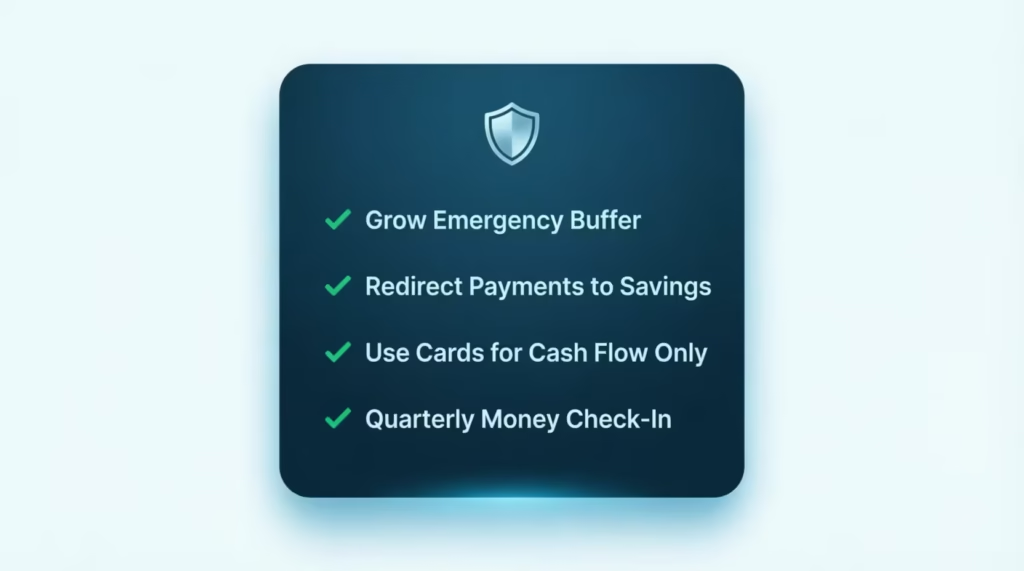
Do these four things the month your last card hits zero:
- Grow your emergency buffer to 3 to 6 months of expenses. This is the single biggest predictor of staying debt-free. Without it, the next surprise goes right back on a card.
- Redirect debt payments to savings and investing. If you were paying $700 a month toward debt, send $500 to a high-yield savings account and $200 to retirement. Do not absorb it into lifestyle spending.
- Use credit cards for cash flow only. Charge only what you can pay in full each month. Set autopay to the statement balance.
- Do a quarterly money check-in. Fifteen minutes every three months to review balances, savings, and goals. Small course corrections beat big cleanups.
Jennifer, a school administrator who paid off $23,400 in credit cards over three years, kept the same “debt payment” auto-transfer running. Only now, it goes to a brokerage account. Two years later, she has over $18,000 in savings and has not carried a card balance once.
When DIY Isn’t Enough: Settlement and Bankruptcy
Some situations are beyond budgets and side hustles. If your DTI is above 50%, your income cannot cover minimums, or you are facing lawsuits and wage garnishment, it is time to look at bigger tools.
Debt settlement is when a creditor agrees to accept less than the full balance, usually 40% to 60%, to close the account. It can shave years off payoff, but it comes with real costs:
- Late payments and account closures drag your credit down for up to 7 years
- Forgiven debt over $600 is usually taxed as income
- Third-party settlement companies charge 15% to 25% of enrolled debt
- Nothing stops a creditor from suing during negotiations
Settlement makes sense when you have lump sums available (savings, family loan, tax refund) and your credit is already damaged.
Chapter 7 bankruptcy wipes out most unsecured debt in about 4 to 6 months. To qualify, your income must fall below your state’s median or pass a means test. Some assets may be sold, though most filers keep everyday items. It stays on your credit report for 10 years but often gives the fastest true fresh start.
Chapter 13 bankruptcy sets up a 3 to 5 year court-supervised repayment plan. You keep your assets, including your home and car, if you stay on the plan. It stays on your credit report for 7 years.
Bankruptcy tanks your FICO Score in the short term, often by 130 to 240 points. But the score also starts climbing again quickly once filing is complete, because the underlying debt is gone.
Talk to a bankruptcy attorney before filing. Most offer free first consultations. Also complete the required pre-filing credit counseling from an approved provider on the U.S. Trustee list.
Frequently Asked Questions (FAQs)
How to pay off $10,000 in credit card debt?
At 22% APR, paying $400 a month clears roughly $10,000 in about 3 years with heavy interest costs, while $800 a month cuts that to under 18 months. Doubling your payment more than halves total interest paid.
Is $20,000 in credit card debt a lot?
Yes, at 22% APR, a $20,000 balance takes about 8 years to clear, paying only $400 a month, costing nearly $18,900 in interest. Pushing payments to $1,000 a month drops the payoff to about 2 years 2 months.
How to pay off $30,000 in debt in 3 years?
Clearing $30,000 in 3 years means finding roughly $900 to $1,000 monthly above minimums, which the avalanche or snowball method can direct toward one balance at a time. Adding a side income stream, like delivery driving, speeds this up further.
How do I pay off debt if I live paycheck to paycheck?
Follow the survival-first order: cover food, housing, utilities, transport, and minimum payments before anything else. Call creditors for hardship programs, apply for assistance like SNAP or LIHEAP, and send micro-payments weekly instead of waiting for a lump sum.
How to aggressively pay off debt?
Build a zero-based budget so every dollar has a job, then throw all extra cash at one debt using the avalanche method (highest APR first) or snowball method (smallest balance first). Add income through side work and put 100% of windfalls like tax refunds toward the balance.
Can I repair my credit score in 3 months?
Only debt payoff strategies and their effect on financial stability. Paying down high balances can help utilization over time, but a full recovery for damaged credit usually takes longer than 3 months.
What’s the difference between debt settlement and bankruptcy?
Debt settlement negotiates paying 40% to 60% of what you owe to close an account, often costing 15% to 25% in fees to a settlement company. Chapter 7 bankruptcy wipes out most unsecured debt in 4 to 6 months but stays on your credit report for 10 years.
What percent of people who make $100,000 live paycheck to paycheck?
It’s worth checking current data from sources like LendingClub or PYMNTS if this number matters to your situation.
How does a balance transfer card help pay off debt faster?
A balance transfer card moves high-APR credit card debt onto a card with 0% intro APR for 12 to 21 months, so every payment goes toward principal instead of interest. Transfer fees run 3% to 5%, so only transfer what you can repay before the promo ends.
Should I use the snowball or avalanche method to pay off debt?
The avalanche method targets your highest-APR balance first and saves the most money overall, while the snowball method clears your smallest balance first for a faster motivational win. A Harvard Business Review study found snowball users tend to stick with their plan longer despite paying slightly more interest.
Wrapping Up
Paying off debt fast comes down to five moves: know exactly what you owe, run your DTI, build a budget that frees up real cash, pick snowball or avalanche and stick with it, and add income wherever you can. Bad credit, low income, or a $20,000 balance do not close the door. They just shift which lever works first.
The best way for most readers is to use a strict zero-based budget, the avalanche method, and a steady side income. If you know someone quietly drowning in credit card statements, share this guide with them. It could be the plan that changes their year.