
Losing your home is stressful enough. But then comes the second wave: watching your credit score slide and wondering how bad it will really get. Most people search for answers and only find vague warnings like “your credit will take a hit,” which doesn’t help when you need real numbers. If you’re staring down a foreclosure, or already got through one, you deserve straight facts about how much a foreclosure affects credit score health, how long the damage lasts, and what your next moves look like.
The short answer: A foreclosure can lower your FICO score by 85 to 160 points. It stays on your credit report for seven years. Also, it can delay a new mortgage by two to seven years, depending on the loan type.
We’ll discuss score ranges from starting points. We’ll also look at common pre-foreclosure damage that people often miss. Next, we’ll explain how the seven-year clock works. Finally, we’ll share quick ways to rebuild.
Key Takeaways
This guide explains how much foreclosure affects credit score, including exact point drops by starting score, the seven-year reporting timeline, recovery pace, and mortgage waiting periods by loan type.
Core Facts:
- A completed foreclosure typically drops a FICO score by 85 to 160 points, with higher starting scores losing more points than lower ones.
- The foreclosure stays on your credit report for seven years starting from the first missed mortgage payment, not the sale date.
- Payment history makes up roughly 35% of a FICO score, which is why stacked late payments before foreclosure cause much of the total damage.
- Most score recovery happens within the first three years, even though the foreclosure entry remains visible on the report for seven years.
- Mortgage waiting periods after foreclosure range from 2 years for VA loans to 7 years for conventional loans, with shorter waits possible for extenuating circumstances.
- Non-QM loans have no standard waiting period and can finance a buyer as soon as one day after foreclosure completion.
Best for:
- Homeowners currently facing foreclosure who want to understand the real credit score impact before it happens.
- People who already went through foreclosure and want a realistic recovery and rebuild timeline.
- Buyers planning their next mortgage application and needing exact waiting periods by loan type.
How Many Points Does a Foreclosure Drop Your Credit Score
A completed foreclosure can knock 85 to 160 points off a FICO score, and sometimes more. The exact hit depends on where your score sat before things went wrong. This is the number readers came here for, so let’s put it plainly.
Most articles quote a flat “100+ points” figure. That’s not wrong, but it hides an important truth: the higher your starting score, the harder you fall. FICO’s model penalizes fresh negative marks more when your file was previously clean, because those marks are a bigger signal of new risk.
Here is a score-tiered breakdown of the typical drop after a completed foreclosure sale:
| Starting FICO Score | Estimated Point Drop | Score After Foreclosure |
|---|---|---|
| 780 (Excellent) | 140 to 160 points | Around 620 to 640 |
| 720 (Very Good) | 115 to 140 points | Around 580 to 605 |
| 680 (Good) | 85 to 105 points | Around 575 to 595 |
| 620 (Fair) | 60 to 85 points | Around 535 to 560 |
These numbers come from FICO’s own analysis of consumer credit files, first published in a widely referenced study and confirmed by lender data since. As The Mortgage Reports notes, a homeowner starting at 780 typically sees a 140-160 point foreclosure drop, while a 680 starting score drops 85-105 points.
The ranges hold across common FICO scoring models. VantageScore reacts in a similar way but can lag by a few weeks depending on when lenders report.
📌 Did You Know: A single foreclosure event is often the largest one-time hit most consumers ever take, second only to a Chapter 7 bankruptcy filing.
Why Higher Starting Scores Lose More Points
It feels unfair. Someone with a 780 loses 150 points, while their neighbor at 620 loses 70. But it’s not arbitrary. It’s math.
FICO’s scoring curve treats a first serious black mark as a huge new risk signal. A clean file suddenly showing a foreclosure looks very different from a file that already had late payments, collections, or a maxed-out card. The scoring model has more distance to fall from a high score, and it uses that distance.
Someone with a lower starting score has already been “priced in” for risk. Their file was already showing signs of stress, so a foreclosure adds less new information to the model. The system isn’t punishing responsible borrowers on purpose. It’s simply reacting more strongly when past behavior didn’t predict the loss.
The good news: higher scorers also tend to rebound faster, because the rest of their credit profile is usually still solid.
Credit Score Damage Before the Foreclosure Is Even Final
Here’s what most people miss. The foreclosure is not one big event that hits your credit on one day. The damage starts months earlier, with the first missed mortgage payment, and it stacks.
By the time the sheriff’s sale or trustee’s sale happens, your score has usually already dropped 100 points or more from late payments alone. The final foreclosure entry adds more damage on top of that.
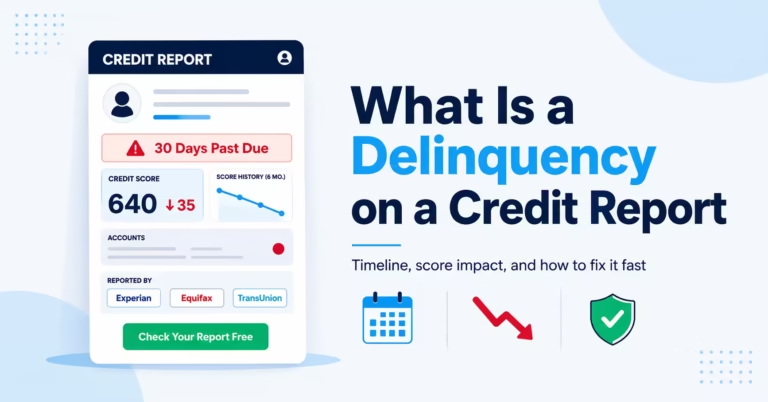
Here’s the typical delinquency timeline lenders follow before starting foreclosure:
| Days Past Due | What Gets Reported | Typical Score Impact |
|---|---|---|
| 30 days late | First late payment reported to bureaus | 50 to 100 point drop |
| 60 days late | Second late payment reported | Additional 20 to 40 point drop |
| 90 days late | Third late payment; account often flagged as “seriously delinquent” | Additional 20 to 40 point drop |
| 120 days late | Loan sent to foreclosure department; Notice of Default filed | Additional 10 to 30 point drop |
| Foreclosure completion | Public record entry added | Additional 30 to 80 point drop |
Most U.S. mortgage servicers can’t legally start the foreclosure process until you’re 120 days behind, based on rules under the CFPB. So there’s a roughly four-month window where your score gets battered by separate late-payment reports before the foreclosure entry ever appears. As Amerisave data shows, a 30-day late payment alone can drop an excellent score by 63 to 83 points.
If your score has already tanked before foreclosure completes, you’re not imagining it. That’s the stacking effect at work.
How Payment History Weighs Into the Drop
Payment history is the single biggest slice of your FICO score. It counts for roughly 35% of the total, according to myFICO. No other factor comes close.
That’s why every stage of delinquency hits so hard. Each 30-day, 60-day, 90-day, and 120-day late mark is reported to Equifax, Experian, and TransUnion as a separate negative event. Then the foreclosure itself gets added as a public record.
So the “foreclosure hit” isn’t really one hit. It’s five or six smaller hits stacked on top of each other, all landing in the same category that matters most. That’s why the total drop can feel so brutal even before the home is officially gone.
⚠️ Mistake to Avoid: Assuming your score is safe until foreclosure is final. By the time the sale happens, most of the damage is already done. Talking to your servicer about loss mitigation options at 30 or 60 days late saves far more points than waiting.
How Long a Foreclosure Stays on Your Credit Report
A foreclosure stays on your credit report for seven years. That’s the hard rule under the federal Fair Credit Reporting Act (FCRA), and no bureau can legally keep it longer if the entry is accurate.
Here’s the part most sources get wrong: the seven-year clock does not start on the day your home is sold at auction. It starts from the date of the first missed mortgage payment that led to the foreclosure. Experian confirms that a foreclosure stays on your credit report for seven years after the first missed mortgage payment that started the foreclosure process.
If you missed your first payment in March 2025 and the foreclosure finished in December 2025, the entry will drop off around March 2032, not December 2032. In some cases, that saves you nearly a year of visible damage.
You can’t remove an accurate foreclosure entry early. Credit repair companies that promise otherwise are selling a service they can’t deliver. The only way an entry comes off before seven years is if it’s inaccurate or unverifiable when you dispute it.
Does the Score Impact Last the Full 7 Years?
No, and this is huge. Most readers assume “seven years on the report” means “seven years of a crushed score.” That’s not how it works.
The scoring impact fades much faster than the report entry does. Recovery usually looks like this:
- Year 1: Score impact is heaviest. This is your low point.
- Years 2 to 3: Most of the recovery happens here if you’re paying other bills on time. Many people gain back 60 to 100 points in this window.
- Years 4 to 7: The foreclosure entry still shows, but scoring models weigh it less each year. Your score can climb near or even past its pre-foreclosure level well before year seven.
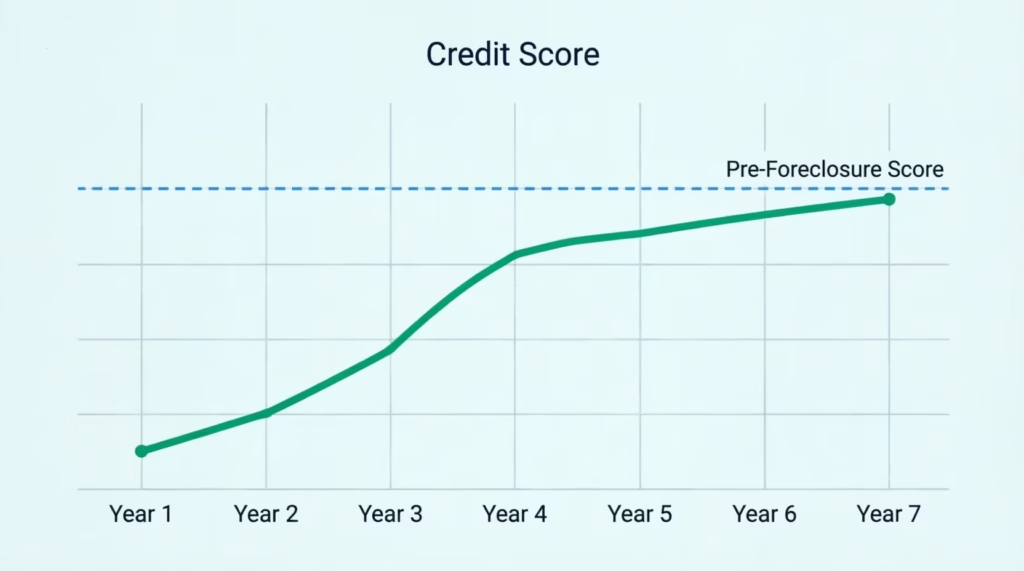
The foreclosure line stays visible to any lender pulling your report until year seven. But the actual point drag lightens up steadily. So if you rebuild responsibly, your score at year four could look very different from your score at year one, even though the entry is still there.
Foreclosure vs. Bankruptcy: Which Hurts Credit More
Between foreclosure and bankruptcy, bankruptcy generally hurts credit more, both in points lost and in how long it stays on your report.
Here’s a direct comparison:
| Event | Typical Point Drop | Time on Credit Report |
|---|---|---|
| Foreclosure | 100 to 160+ points | 7 years |
| Chapter 13 Bankruptcy | 130 to 200 points | 7 years |
| Chapter 7 Bankruptcy | 130 to 240 points | 10 years |
Bankruptcy typically knocks off more points because it’s usually filed against multiple accounts, not just one. It signals to lenders that a borrower has walked away from a broader set of obligations. Foreclosure, by contrast, is tied to a single asset and a single loan.
Experian data shows that a bankruptcy can lower your credit score by up to 200 points. The exact drop depends on your starting score.
That said, foreclosure is still considered one of the most severe events a credit file can carry. It ranks just above bankruptcy in lender risk models. This leads to longer mortgage waiting periods than most other negative events.
Foreclosure vs. Short Sale vs. Deed-in-Lieu: Credit Impact Comparison
If you’re weighing options before things become final, this section matters most. The three main alternatives to foreclosure look similar to credit bureaus, but they’re not identical.
| Event | Typical Point Drop | Time on Credit Report | Notes |
|---|---|---|---|
| Foreclosure | 100 to 160+ points | 7 years | Most severe; longest mortgage waits |
| Short Sale | 85 to 160 points | 7 years | Impact can be smaller if payments were current before sale |
| Deed-in-Lieu | 85 to 150 points | 7 years | Slightly less damage; requires lender agreement |
A short sale happens when your lender agrees to accept less than the full mortgage balance from a buyer. If you kept up with payments until the sale, the credit impact can be less severe than a full foreclosure. This is because there might not be a long history of missed payments. If you were already many months behind, the damage looks a lot like a foreclosure.
A deed-in-lieu of foreclosure is when you voluntarily hand the property back to the lender. It avoids the court process and may look better to future lenders than a completed foreclosure. However, the point drop is often similar. Some conventional lenders offer shorter mortgage waiting periods after a deed-in-lieu than after a full foreclosure.
None of these three options is a magic escape. All of them show up on your report for seven years. But if you have the choice, a short sale done while current tends to cause the least long-term damage.
How a Loan Modification Affects Credit Differently
A loan modification is a different animal. Instead of losing your home, your lender agrees to change the loan terms, like extending the term, lowering the rate, or reducing the principal, so you can afford to keep it.
Here’s why the credit impact is different:
- If reported as “paid as agreed” after the modification, ongoing damage is minimal.
- Any late payments before the modification still stay on your report for seven years.
- Once you’ve made 6 to 12 months of on-time modified payments, most scores start climbing back.
- Some lenders code modifications specifically, and that code can sit on your file, but it’s not treated like a foreclosure.
The tricky part: the delinquencies that pushed you toward modification in the first place don’t disappear. So if you were 90 or 120 days late before your servicer approved the modification, those late marks still count against you. The upside is that you keep the home and stop adding new damage.
Compared to foreclosure, a modification is almost always better for your credit if you can qualify. The catch is that not everyone gets approved, and lenders usually want to see you can actually afford the modified terms.
How Long Until You Can Get a New Mortgage After Foreclosure
Buying again is possible, and it’s often sooner than you think. Waiting periods change depending on the loan type. They usually start from the foreclosure completion date on your credit report, not from when you first missed a payment or moved out.
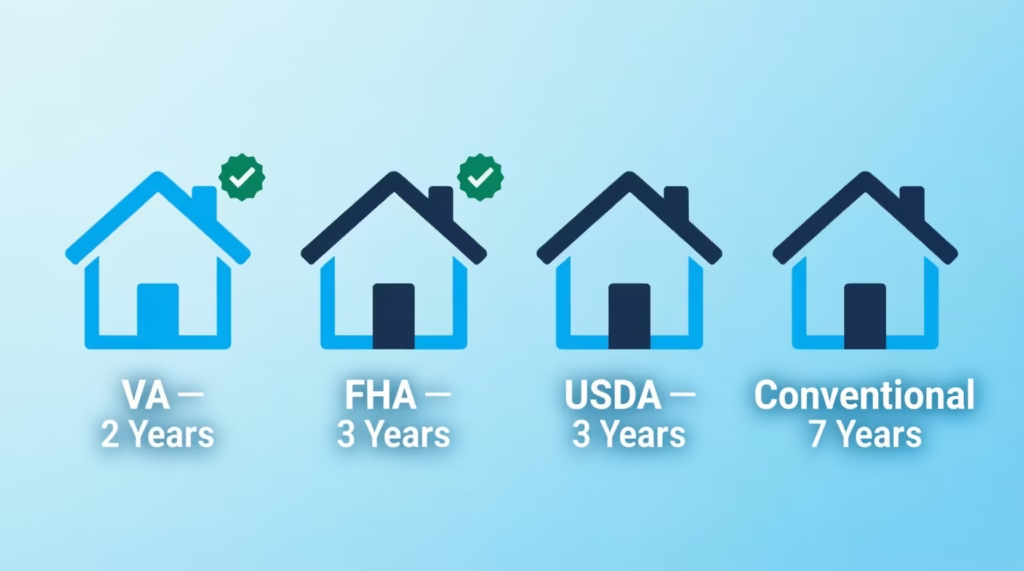
Here’s the quick-reference table for 2026:
| Loan Type | Standard Waiting Period | With Extenuating Circumstances |
|---|---|---|
| Conventional (Fannie Mae) | 7 years | 3 years (with 90% LTV cap) |
| FHA | 3 years | Case by case, no strict floor |
| VA | 2 years | Case by case |
| USDA | 3 years | Case by case |
| Non-QM | None | Not applicable |
Below is what each program actually requires. The clock starts at the foreclosure completion date reported by the bureaus.
Conventional Loan Waiting Period
Conventional loans have the longest wait. The standard waiting period is 7 years from the foreclosure completion date, according to the Fannie Mae Selling Guide.
If you can show extenuating circumstances, the wait can drop to 3 years. However, there’s a strict condition: the loan is capped at 90% loan-to-value for a primary residence purchase. That means you’ll need at least 10% down. You’ll also need to show re-established credit and no new derogatory marks since the foreclosure.
Freddie Mac follows similar rules, so most conventional loans backed by the two big agencies work the same way.
FHA Loan Waiting Period
FHA loans are one of the most common paths for buyers rebuilding after foreclosure. The standard FHA waiting period is 3 years from the foreclosure completion date.
Basic requirements at year three:
- Minimum credit score around 580 with a 3.5% down payment
- Scores between 500 and 579 require 10% down
- No new late payments or negative marks during the waiting period
Extenuating circumstances can shorten the wait, but HUD doesn’t publish a strict minimum. Approval depends on the underwriter and documentation.
VA Loan Waiting Period
If you’re a veteran or active-duty service member, you have the shortest wait among major loan types. The VA waiting period after foreclosure is typically 2 years from the completion date.
A few things to know:
- If your foreclosed loan was a VA loan, your entitlement may be reduced by the amount the VA had to pay to cover the loss.
- Remaining entitlement can still be used for another VA purchase, sometimes with a down payment to cover the shortfall.
- Credit re-establishment during those two years is expected.
For most veterans, the two-year mark is the earliest realistic point to buy again.
USDA Loan Waiting Period
USDA loans are for rural and some suburban areas. They have a 3-year waiting period after foreclosure completion. Documented mitigating circumstances can provide flexibility. However, approvals are done on a case-by-case basis through USDA’s automated underwriting system.
USDA loans require no down payment and have low mortgage insurance costs. This makes them appealing for eligible buyers who are rebuilding after foreclosure.
Extenuating Circumstances That Can Shorten the Wait
“Extenuating circumstances” is a specific term with a strict meaning across all major loan programs. It refers to a one-time event outside the borrower’s control that caused sudden and prolonged income loss or expense.
Qualifying examples typically include:
- Job loss due to layoff or company shutdown
- Serious illness or medical emergency
- Death of the primary wage earner
- Divorce with major financial fallout (in some programs)
To qualify for the shortened wait, you’ll need:
- Third-party documentation of the event (termination letter, medical records, death certificate)
- Evidence that the event caused the default
- Proof that you have re-established credit and stable income since
What doesn’t count: general career changes, business downturns you chose to weather, or bad investment decisions. Lenders draw a hard line here.
Non-QM Loans as a No-Waiting-Period Option
For borrowers who need to buy sooner, Non-QM loans are the alternative. These mortgages don’t follow the standard “qualified mortgage” rules set by the CFPB. So, they can provide more flexibility than agency and government loans.
Typical Non-QM features after foreclosure:
- No standard waiting period; some lenders will finance one day out of foreclosure
- Down payment usually 10% to 20% or more
- Credit scores as low as 500 accepted by some lenders
- Interest rates usually 1% to 3% higher than conventional
- Bank-statement income documentation often available for self-employed buyers
Non-QM isn’t the cheapest path, but it exists for people who can’t or don’t want to wait years. If you have solid income and reserves but a recent foreclosure, this may be your fastest route back to homeownership.
Steps to Rebuild Your Credit Score After Foreclosure
Recovery is not automatic, but it’s very possible. Most people who follow these steps see meaningful score gains within 12 to 18 months, and full recovery within 3 to 5 years.
Here’s what actually moves the needle:
- Pay every other bill on time, every time. Payment history is 35% of your FICO score. One more late mark after foreclosure can undo months of progress.
- Keep credit card balances under 30% of limits, ideally under 10%. Credit utilization is the second-biggest factor in your score.
- Don’t close old accounts. Older accounts help your average account age. Even if you’re not using a card, keeping it open (with occasional small purchases) helps.
- Check your credit reports at least once a year. Use AnnualCreditReport.com, the only federally authorized free source. Dispute any errors, especially anything reporting the foreclosure incorrectly.
- Avoid new hard inquiries you don’t need. Every hard pull dings your score temporarily and signals risk when stacked.
- Add a small installment loan if you don’t have one. A mix of credit types (revolving and installment) helps your score once payments are consistent.
💡 Pro Tip: Set every recurring bill to autopay for at least the minimum. One missed payment during your rebuilding phase can undo 6 months of gains. Autopay is your safety net while you focus on bigger financial moves.
Secured Credit Cards and Rebuilding Tools
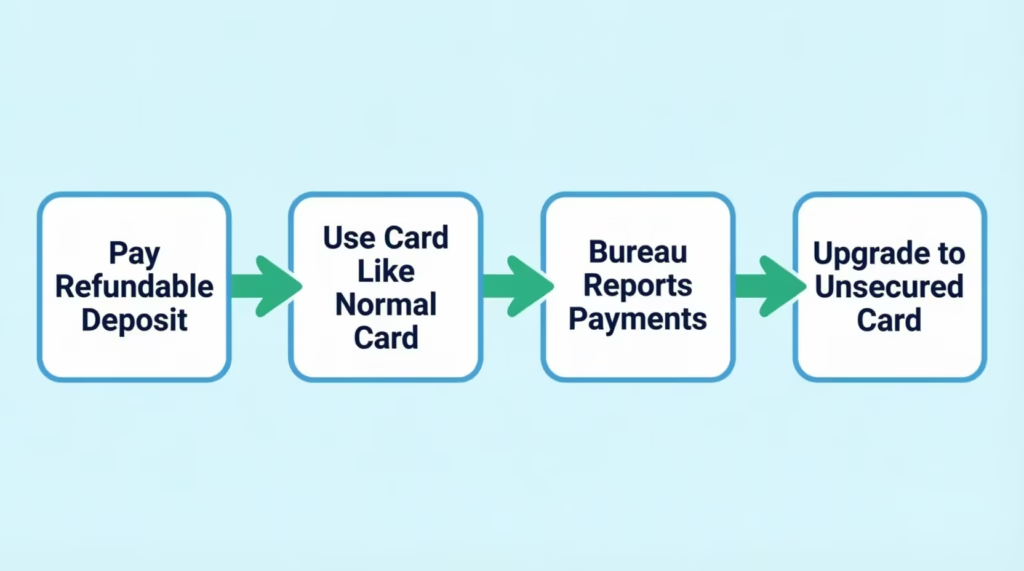
A secured credit card is one of the fastest ways to start rebuilding after foreclosure. Here’s how it works:
- You put down a refundable cash deposit (usually $200 to $500).
- The deposit becomes your credit limit.
- You use the card like any other credit card, and payments get reported to all three bureaus.
- After 6 to 12 months of on-time payments, many issuers upgrade you to an unsecured card and return your deposit.
Look for a secured card that:
- Reports to all three major bureaus (Equifax, Experian, TransUnion)
- Has no annual fee if possible
- Offers a clear upgrade path to an unsecured product
Other useful tools include credit-builder loans, offered by many credit unions and fintech apps. These small installment loans hold your “borrowed” money in savings while you make payments. When the loan finishes, you get the cash and a track record of on-time payments.
Consider starting with one secured card and one credit-builder loan. That gives you both types of credit reporting activity without overextending yourself.
Common Mistakes That Slow Down Recovery
A few common missteps can stretch your recovery from 3 years to 6 or more. Watch out for these:
- Paying for “credit repair” that promises fast fixes. No legitimate company can remove accurate negative items from your report. Any promise otherwise is either misleading or illegal under the Credit Repair Organizations Act.
- Taking on new debt too soon. Store cards, personal loans, and buy-now-pay-later plans all trigger hard inquiries and add balances. Wait until your score has stabilized before stacking new credit.
- Applying for a mortgage before you’re truly ready. Each rejected mortgage application means another hard inquiry, and often another year of waiting to reapply. Get pre-qualification counseling first, ideally from a HUD-approved counselor.
- Ignoring your credit reports. Errors on foreclosure entries are common, especially around dates, balances, and reporting status. If the entry is inaccurate, dispute it. If it’s correct, at least know exactly what future lenders will see.
- Closing all your old credit cards in frustration. Length of credit history matters. Keep at least one or two old accounts active with tiny recurring charges.
Recovery is a marathon, not a sprint. The people who bounce back fastest treat the first two years as a rebuilding runway, not a punishment.
Frequently Asked Questions (FAQs)
How many points will a foreclosure drop your credit score?
A foreclosure typically drops a FICO score by 85 to 160 points. The exact hit depends on your starting score, with higher scores losing more points than lower ones.
How long is your credit ruined after a foreclosure?
The foreclosure stays on your credit report for seven years from the first missed payment. However, most of the score damage recovers within 3 years if you pay other bills on time.
What is the 120-day rule for foreclosure?
Most U.S. mortgage servicers cannot legally start foreclosure until a borrower is 120 days behind on payments. By that point, your score has usually already dropped significantly from separate late-payment reports.
Can I fix my credit after a foreclosure?
Yes, most people see meaningful score gains within 12 to 18 months and full recovery within 3 to 5 years. Paying bills on time and keeping credit utilization low are the biggest drivers of recovery.
Do repossessions fall off after 7 years?
A foreclosure falls off your credit report seven years after the first missed mortgage payment, not seven years after the sale date. This can mean the entry disappears nearly a year earlier than expected.
How can your credit score drop 100 points in a month?
A single 30-day late mortgage payment can drop an excellent score by 63 to 83 points on its own. Combined with a second late payment, the total drop can exceed 100 points within a month or two.
How many years do you have to wait to buy a house after foreclosure?
Waiting periods range from 2 to 7 years depending on the loan type. VA loans require 2 years, FHA and USDA loans require 3 years, and conventional loans require 7 years unless you qualify for extenuating circumstances.
Can you buy a house with a foreclosure on your credit report?
Yes, Non-QM loans have no standard waiting period, and some lenders will finance a buyer one day out of foreclosure. These loans typically require 10-20% down and charge interest rates 1-3% higher than conventional loans.
How serious is a foreclosure?
Foreclosure ranks among the most severe events a credit file can carry, just above bankruptcy in lender risk models. It causes longer mortgage waiting periods than most other negative credit events.
What is the biggest killer of credit scores?
Payment history is the single biggest factor in your FICO score, making up roughly 35% of the total. This is why the stacked late payments before a foreclosure cause so much of the total damage.
Wrapping Up
A foreclosure is one of the harshest events a credit file can absorb, but it’s not permanent damage. Expect a drop of 85 to 160 points, based on your starting score. This will stay on your report for seven years after your first missed payment. Also, mortgage waits range from 2 to 7 years, depending on the loan type.
Most score recovery happens in the first 3 years. You can help by protecting your payment history, keeping your utilization low, and avoiding new derogatory marks.
The best way to move forward is to treat the first two years after foreclosure as a time to rebuild.
If you know someone quietly worried about their home or credit right now, share this guide with them. The specifics here could save them years of confusion and thousands in future borrowing costs.