
I know the feeling. You opened your credit app, saw the word “delinquent” next to an account, and your stomach dropped. Maybe a lender just denied your application, or you’re checking your report before a mortgage. Either way, you’re not sure how bad this really is, whether it can be removed, or what a delinquency on a credit report actually means for your score.
A delinquency is a credit account that has a late payment. When it’s 30 days late, it gets reported to the credit bureaus. This can damage your credit score.
Keep reading. You’ll get the exact timeline, how much your score can drop, whether you can remove the mark, and the step-by-step action to take right now.
Key Takeaways
This guide explains what a delinquency on a credit report is, including the 30-day reporting threshold, the 30/60/90/180-day damage timeline, score impact ranges, and how to fix or dispute it.
Core Facts:
- A delinquency is any missed payment, but most creditors only report it to the credit bureaus once it reaches 30 days past due.
- A single 30-day late payment can drop a credit score anywhere from about 20 to 100+ points, depending on your starting score and credit history.
- The same 30-day late payment can drop a fair credit score by 17 to 37 points, compared to 63 or more points for a very good or excellent score.
- Payment history makes up 35% of a FICO Score, more than any other single factor, according to myFICO.
- Under the Fair Credit Reporting Act, most delinquencies stay on a credit report for up to 7 years from the original delinquency date, and paying the account off does not reset this clock.
- Accurate delinquencies cannot be legally removed early, but inaccurate ones can be disputed with the credit bureau, which generally has 30 to 45 days to investigate.
Best for:
- Readers who just noticed a “delinquent” status on their credit report and need to know what it means and how urgent it is.
- People deciding whether to bring an account current, send a goodwill letter, or file a formal dispute.
- Anyone trying to understand how long a late payment will affect their score and credit report.
What Counts as a Delinquency on a Credit Report
A delinquent account is any credit account with a payment that hasn’t been made by its due date. The moment you miss the due date, even by one day, the lender considers the account delinquent in their internal system. That’s the technical starting point.
But here’s the part most people don’t realize. Being delinquent inside the lender’s records isn’t the same as being reported as delinquent to the credit bureaus. Those two things happen at different times, and the gap between them is where you still have room to act.
A delinquency can appear on any type of credit account. That includes credit cards, auto loans, personal loans, mortgages, and student loans. Once it’s reported, it becomes a derogatory mark on your credit file, which is the industry term for any negative item that pulls your score down. The account will usually show a status like “30 days past due,” “60 days past due,” and so on, depending on how long the past-due balance has been unpaid.
So if you just spotted the word “delinquent,” start by checking two things. First, how many days past due is the account? Second, has it actually been reported to a bureau yet, or is it still just marked late by the lender? Those two answers change everything about what you should do next.
Delinquent vs. Late Payment vs. Default vs. Charge-Off
These four words get mixed up all the time, and the difference matters because each one signals a different level of trouble.
A late payment is the informal term. It just means you paid after the due date. It can be one day late or one hundred days late.
Delinquent is the formal, reported status a lender uses once your payment is officially past due. Once the delinquency is reported to the bureaus (typically at 30 days), it becomes a derogatory mark on your file.
Default happens when the lender decides you’re not likely to repay under the original terms of the loan. The exact point varies by loan type. For federal student loans, default kicks in after 270 days of nonpayment. For credit cards, most issuers treat the account as in default well before that, often around 180 days.
Charge-off is the final stage. The lender writes off the debt as a loss on their books, usually after 180 days of nonpayment. You still owe the money, and the debt is often sold to a collection agency after this point.
The sequence usually flows as follows: late, then delinquent at 30 days, followed by deeper delinquency at 60, 90, and 120 days. This leads to charge-off or default around 180 days, followed by collections. Each step causes more damage and gives you fewer options.
How Delinquency Reporting Actually Works
Missing a payment by three days feels scary, but it usually doesn’t hit your credit report. Lenders follow a specific reporting window, and understanding it can save your score.
When a Missed Payment Becomes a Reported Delinquency
Most creditors follow a 30-day reporting threshold. This means a payment must be at least 30 days past its due date before the lender sends it to Experian, Equifax, or TransUnion as a delinquency. If you’re 1 to 29 days late, the account is technically delinquent on the lender’s books, but it usually isn’t on your credit report yet.
This is why a payment that’s five days late doesn’t tank your score. The bureaus never see it. You may still get hit with a late fee from the lender, and in some cases your card’s interest rate can jump to a penalty APR, but your credit report stays clean.
The 30-day rule is the standard used by nearly every major creditor, though a few may report slightly sooner or later. When in doubt, treat 30 days as your hard deadline.
Your Grace Period and Window to Fix It Before It’s Reported
A grace period is a short window some lenders give you between your due date and when a late fee or delinquency status kicks in. Grace periods vary a lot. Mortgages often include a 15-day grace period before a late fee applies. Many credit cards, on the other hand, don’t offer a grace period on missed minimum payments at all, so a late fee can hit the day after you miss the due date.
Here’s the good news: Most creditors don’t report a delinquency until day 30. So, you often have a few weeks to fix the account before it affects your credit file. If you catch a missed payment on day 10 or day 20, pay at least the minimum right away. In most cases, you’ll avoid the credit report hit entirely.
💡 Pro Tip: If you catch a missed payment, call the lender the same day you pay. Ask them to confirm the account is now current and that no report was sent to the bureaus. A five-minute call can prevent months of score damage.
Which Types of Accounts Can Become Delinquent
Not every unpaid bill lands on your credit report. Knowing the difference helps you focus your worry on the accounts that actually matter for your score.
Accounts that report to the credit bureaus include:
- Credit cards (all major issuers report monthly)
- Auto loans
- Mortgages
- Personal loans
- Student loans (both federal and private)
- Home equity lines of credit
These accounts report your payment status every month, so a missed payment on any of them can become a reported delinquency after 30 days.
Accounts that usually don’t report unless something goes wrong include:
- Utility bills (electricity, gas, water)
- Cell phone bills
- Medical bills
- Most rent payments
- Cable and internet
These types of accounts don’t send monthly payment history to the bureaus. If the bill remains unpaid, the company may send it to a collection agency. Then, the collection account can appear on your credit report and harm your credit score.
Medical debt is a special case. Under updated credit reporting rules, paid medical collections no longer appear on credit reports, and unpaid medical collections under $500 are also excluded. Larger unpaid medical bills can hurt your score if sent to collections. However, this only happens after a one-year waiting period from when the bill went to collections.
The Delinquency Timeline: What Happens at 30, 60, 90, 120, and 180 Days
This is the map most people wish they had. Find where your account sits, and you’ll see exactly what’s coming next.
| Days Past Due | What Happens | Score Impact |
|---|---|---|
| 1–29 days | Late fee applied, possible penalty APR, but not yet reported to bureaus | None yet |
| 30 days | Reported as delinquent to credit bureaus; first score drop hits | Moderate to severe |
| 60 days | Second delinquency reported; collection calls intensify; higher fees | Additional damage |
| 90 days | Account flagged as seriously delinquent; risk of being sent to collections rises | Major damage |
| 120 days | Lender preparing to charge off the account; internal collections may begin | Continued damage |
| 150–180 days | Charge-off typically occurs; debt often sold to a collection agency | Severe long-term damage |
At 30 days, the delinquency lands on your credit report for the first time. This is the biggest single jump in damage. The account will show a “30 days past due” status.
At 60 days, another late payment gets reported. The lender’s collection department usually starts calling more aggressively, and fees can stack up.
At 90 days, most lenders flag the account as seriously delinquent. Some accounts may already be handed to an in-house or third-party collector.
At 120 days, the lender is often preparing to close and charge off the account.
At 150 to 180 days, the account is typically charged off, meaning the lender books it as a loss. The debt is often sold to a collection agency for very little money. Then, a new collection account can show up on your report, adding to the original delinquency.
⚠️ Mistake to Avoid: Waiting until day 60 or 90 to act, thinking “it’s already bad.” The biggest score damage happens at 30 days, but each additional 30-day mark adds fresh damage. Paying at day 45 is far better than paying at day 75.
How Much a Delinquency Can Lower Your Credit Score
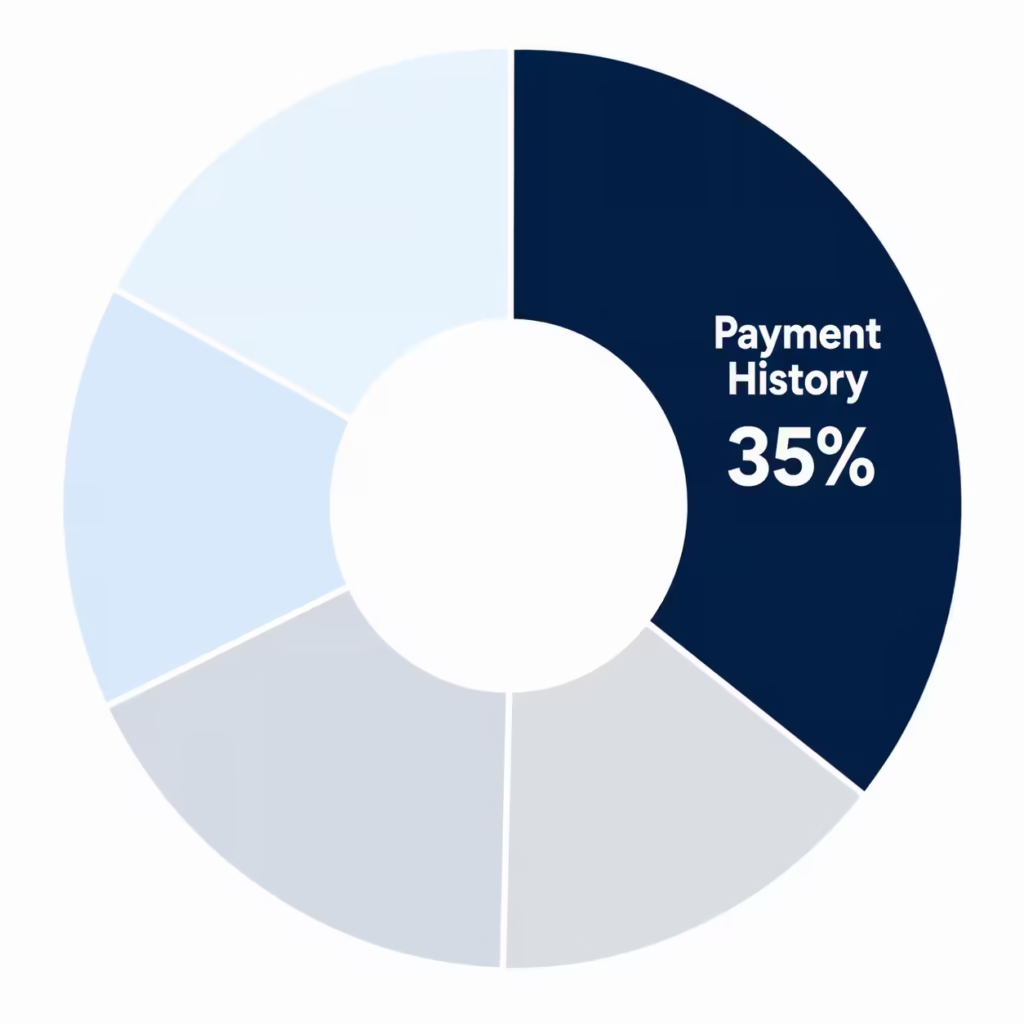
Payment history is the single largest factor in your credit score, making up 35% of your FICO Score, more than any other category, according to myFICO. That’s why a single missed payment can move your score so sharply.
The score drop from a single 30-day late payment depends on a few factors. It matters where your score started. It also depends on how many other negative marks are on your file and how many positive accounts you have. A general range looks like this:
- A single 30-day late payment can drop a score anywhere from about 20 to 100+ points
- A 60-day late payment typically causes a larger drop than the 30-day mark
- A 90-day late payment causes even more damage
- A charge-off at 180 days is one of the most severe negative marks possible
The damage compounds. A person with one 30-day late payment loses less ground than someone with a 30, 60, and 90-day late payment all on the same account.
Why the Same Delinquency Hurts High Scores More Than Low Scores
If two people have the exact same 30-day late payment, the one with the higher score usually loses more points. This surprises a lot of people, but it makes sense once you see the logic.
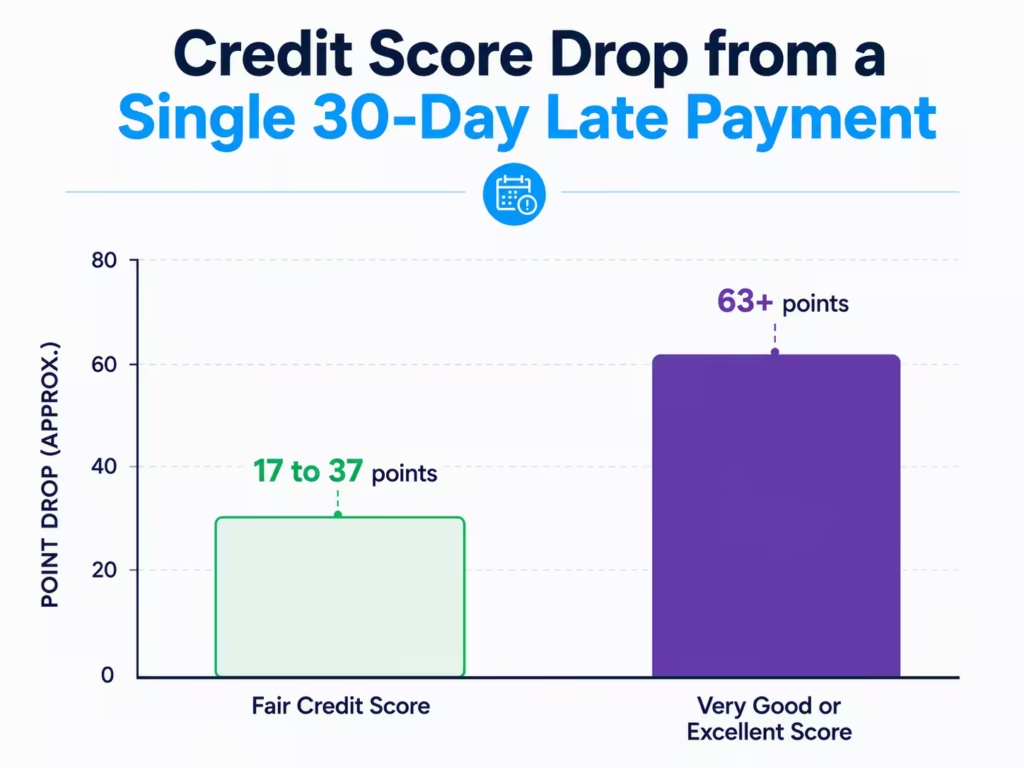
A 30-day missed payment can cause a fair credit score to drop around 17 to 37 points, while a very good or excellent score can drop 63 points or more from the same event.
The reason is how scoring models view risk. A high score signals a low-risk borrower with a clean history. When that borrower suddenly misses a payment, the model treats it as a bigger warning sign because it breaks a strong pattern. A lower score already reflects some risk, so the model has less “room” to move the number down. Neither situation is great. If you have strong credit and just got your first late payment, expect a bigger drop than someone with a damaged report.
How Long a Delinquency Stays on Your Credit Report
Under the Fair Credit Reporting Act (FCRA), most negative marks, including delinquencies, can stay on your credit report for up to 7 years. The clock is measured from the original delinquency date, which is the date the account first became 30 days past due and was never brought current again.
This detail is important because it means paying off the delinquent account does not reset the 7-year clock. The account can be updated to “paid” or “closed,” but the negative history stays visible for the full period from that original delinquency date.
Here’s a simple example. If you first went 30 days late in March 2026 and never caught up, the delinquency should fall off your report around March 2033. Paying it off in 2027 doesn’t shorten or lengthen that timeline.
A few specific items follow different rules. Chapter 7 bankruptcies can stay for up to 10 years, while positive accounts remain much longer and actually help your score.
Does the Impact on Your Score Fade Before the 7 Years Are Up
Yes. Even though the delinquency stays visible for 7 years, its impact on your score generally weakens over time. Scoring models place more weight on recent behavior than older events. A late payment from 6 months ago will drag your score down far more than the same late payment from 4 years ago.
People who miss a payment but then pay on time for 12 to 24 months often see a big score recovery. This happens even though the delinquency is still on their report. The fresh, positive payment history starts to outweigh the older negative mark, especially as more months pass.
Is the Delinquency Accurate, or Could It Be a Reporting Error
Before doing anything else, confirm the delinquency is actually yours. Credit report errors are more common than most people expect, and disputing a mistake is far easier than fixing a real delinquency.
Pull your reports from all three bureaus. You can get free weekly reports at AnnualCreditReport.com, the only site authorized by federal law for free reports from Experian, Equifax, and TransUnion. Check the account name, account number, dates, balance, and payment status.
Common reasons a delinquency may be inaccurate include:
- The payment was made on time but posted late by the lender
- Identity theft or a fraudulent account opened in your name
- A mix-up with someone who has a similar name
- An account already paid off that’s still showing as past due
- Incorrect dates that make the delinquency look more recent than it is
- A dispute you already won that reappeared on the report
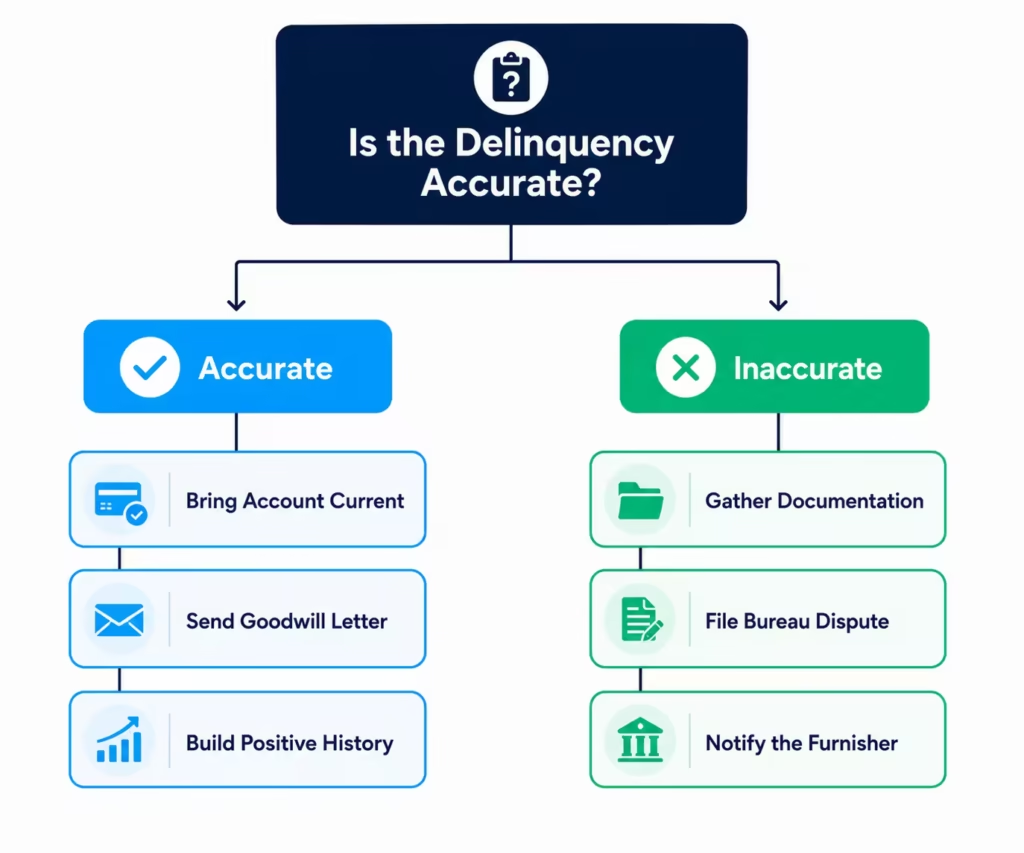
Why this step matters: the right next move depends entirely on this answer. If the mark is accurate, your path is to bring the account current and consider a goodwill letter. If it’s inaccurate, your path is a formal credit dispute with the bureau. Doing the wrong one wastes time.
What to Do If the Delinquency Is Accurate
If you genuinely missed the payment, you can’t legally force the mark off your report before 7 years. But you can stop the damage from getting worse and start rebuilding right away.
Step 1: Bring the account current immediately. Pay at least the minimum owed to move the account out of “past due” status. This stops any new 30-day late marks from being added and prevents the account from sliding toward charge-off. If you can’t pay in full, call the lender and ask about a hardship program or a payment plan. Many lenders will work with you if you contact them before the account hits 90 or 120 days late.
Step 2: Send a goodwill letter. A goodwill letter is a polite written request asking the creditor to remove the late payment as a courtesy. This works best if you have a clean history with that lender. The delinquency should be a one-time event. Also, you need a valid reason, like job loss, a medical emergency, or a banking error. There’s no guarantee, but a well-written goodwill letter costs nothing to send.
Step 3: Focus on building fresh positive history. Every on-time payment you make from this point adds positive data that dilutes the impact of the delinquency over time. Automate your payments so you never miss another one, keep your credit card balances low, and don’t close old accounts.
Can You Get an Accurate Delinquency Removed Early
There’s no legal right to have an accurate delinquency removed before the 7-year period ends. The Fair Credit Reporting Act (FCRA) allows accurate negative information to stay on your report for the full period.
That said, there are two real (but limited) options.
Goodwill adjustments are completely discretionary. The creditor is under no obligation to remove an accurate late payment, and many won’t. However, some do, especially for long-term customers with a single slip-up. It’s worth trying, but don’t count on it.
“Pay for delete” is a red flag. Watch out for companies that claim they can negotiate with lenders to erase correct delinquencies for a fee. Most big creditors don’t allow this. If a company “guarantees” the removal of accurate items, it’s likely a scam. Credit repair companies cannot legally remove accurate information from your credit report.
What to Do If the Delinquency Is Inaccurate
You can dispute a delinquency if it shouldn’t be there. You have a legal right to do this. Disputes often get resolved in your favor, especially if you have supporting documents.
Step 1: Gather your documentation. Collect any proof that supports your case.
You can use several types of documents to prove the mark is wrong. These include:
- Bank statements showing on-time payments
- Payment confirmation emails
- A paid-off letter from the lender
- A police report for identity theft
- Any other relevant records
Step 2: File a dispute with the credit bureau. You can file directly online with each bureau: Experian, Equifax, and TransUnion. You’ll need to file separately with each bureau that shows the error. The Consumer Financial Protection Bureau states that you generally must dispute directly with the credit reporting company first.
Step 3: Also notify the furnisher (the original lender). Sending a dispute to the lender who reported the delinquency, in addition to the bureau, strengthens your case.
Step 4: Wait for the resolution. Credit bureaus generally have 30 days to investigate a dispute (extended to 45 days in some cases). If the information can’t be verified, it must be removed or corrected. You’ll receive the results in writing.
If the dispute doesn’t go your way and you still feel you’re right, you can:
- Add a 100-word statement to your credit report explaining your side.
- Escalate the issue to the CFPB.
- Consult a consumer attorney.
What Happens If You Ignore a Delinquent Account
Doing nothing is the most expensive path. A delinquent account doesn’t quietly sit still; it actively gets worse.
Your score keeps dropping. New 30-day-late marks are typically added every month the account stays unpaid, at 60, 90, 120, and beyond. Each new report adds fresh damage.
The account gets charged off. After roughly 180 days of nonpayment, the lender writes the debt off as a loss. A charge-off is very damaging on a credit report. It shows future lenders that a past creditor has stopped trying to collect from you.
The debt goes to collections. Once charged off, the debt is often sold to a collection agency for a fraction of the balance. That collection account shows up as a separate negative item on your report. This means one unpaid account can lead to two derogatory marks.
Borrowing gets more expensive. Every future loan or credit card becomes harder to qualify for, and when you do qualify, you’ll pay significantly higher interest rates. On a 30-year mortgage, this difference can add tens of thousands of dollars in interest over the life of the loan.
Legal action is possible. Depending on the amount and your state’s statute of limitations, a creditor or collection agency can sue you for the debt. A court judgment can lead to wage garnishment or a bank levy in some states.
Acting on day 20 is much better than on day 60. Also, acting at day 60 is better than at day 150. Every step you delay narrows your options and multiplies the cost.
Frequently Asked Questions (FAQs)
Can I get a delinquency removed from my credit report?
You can only remove an accurate delinquency early with a goodwill letter. This is a special request that some lenders may grant. It’s usually for customers who have a clean history and a good reason, like job loss. There’s no legal right to early removal, and any company guaranteeing removal for a fee is likely running a scam.
How long until a delinquency is removed from my credit report?
A delinquency stays on your report for up to 7 years from the original delinquency date, which is when the account first went 30 days past due and was never brought current again. Paying off the account does not reset or shorten this 7-year clock.
Will my credit score go up if I pay off a delinquent account?
Paying off the account makes it current and stops new late marks. However, it won’t remove the existing delinquency. That stays visible for 7 years. Your score can recover quickly. Scoring models focus on recent payment history. So, if you make on-time payments for 12 to 24 months, you’ll see real improvement.
How many days until an account is considered delinquent?
An account becomes delinquent the moment you miss the due date, even by one day, but most lenders don’t report it to the credit bureaus until it reaches 30 days past due. If you catch and pay a missed payment before day 30, you’ll often avoid the credit report hit entirely.
Should I pay off a delinquent account?
Yes, paying off or bringing a delinquent account current immediately is the first step, since it stops any new 30-day late marks from being added and prevents the account from sliding toward charge-off. If you can’t pay in full, call the lender and ask about a hardship program or payment plan.
Can delinquency be reversed?
An accurate delinquency can’t be legally forced off your report, but a goodwill letter can sometimes get a creditor to remove a one-time late payment as a courtesy. An inaccurate delinquency can be reversed by filing a formal dispute with the credit bureau, which must investigate within 30 to 45 days.
What is the biggest factor that hurts a credit score?
Payment history is the single largest factor in your credit score, making up 35% of your FICO Score according to myFICO. This is why even one 30-day late payment can drop a score anywhere from about 20 to over 100 points.
How bad is a delinquency on a credit report?
A single 30-day late payment can drop a score by 20 to 100+ points or more, and the damage compounds with each additional 30, 60, or 90-day mark on the same account. A charge-off at 180 days is one of the most severe negative marks possible.
What’s the difference between a delinquency and a charge-off?
A delinquency is when a payment is reported as late after 30 days. A charge-off occurs later, around 180 days, when the lender considers the debt a loss. The debt is still owed after a charge-off and is often sold to a collection agency.
How do I know if a delinquency on my report is a mistake?
Common errors include a payment posted late by the lender, identity theft, a mix-up with a similar name, or an already-paid account still showing as past due. Pull your reports at AnnualCreditReport.com and compare the account name, dates, and balance against your own records to check for these mistakes.
Wrapping Up
Spotting a delinquency on your credit report is stressful, but it isn’t the end of your credit story.
Key points to remember:
- A delinquency officially reports at 30 days past due.
- Payment history makes up 35% of your FICO Score.
- Most delinquencies stay on your report for 7 years from the original date.
- Your next step depends on whether the mark is accurate or an error.
To improve your score, act quickly. Bring any late accounts up to date. Dispute inaccuracies right away. Then, aim to build 12 to 24 months of on-time payments for faster recovery.
If you know someone worried about a “delinquent” mark on their report, share this guide. It might help them avoid a score drop and a costly mistake.