
You checked your credit score and saw the label “FICO Score 8” next to a number. Maybe it was on your credit card app or a bank statement. Now you’re wondering what it means, and whether it’s the score a lender will actually use. That confusion is normal, because “FICO 8” is just one version of the FICO score, and the number you see on free apps is often something else entirely.
FICO Score 8 is the most widely used version of the FICO credit scoring model, and it rates your credit risk on a scale of 300 to 850.
Below, you’ll learn exactly what this score measures, how it’s calculated, how it compares to other scores, and where to check your real number for free.
Key Takeaways
This guide explains what FICO Score 8 is, including how its five weighted factors are calculated, how it compares to FICO 9 and FICO 10, and which lenders actually use it for credit decisions in 2026.
Core Facts:
- FICO Score 8, released by Fair Isaac Corporation in 2009, is the most widely used version of the FICO credit scoring model and ranges from 300 to 850.
- The score weighs five factors: payment history (35%), amounts owed/credit utilization (30%), length of credit history (15%), credit mix (10%), and new credit (10%).
- Score tiers are Poor (300-579), Fair (580-669), Good (670-739), Very Good (740-799), and Exceptional (800-850); the U.S. average was 713 as of September 2025.
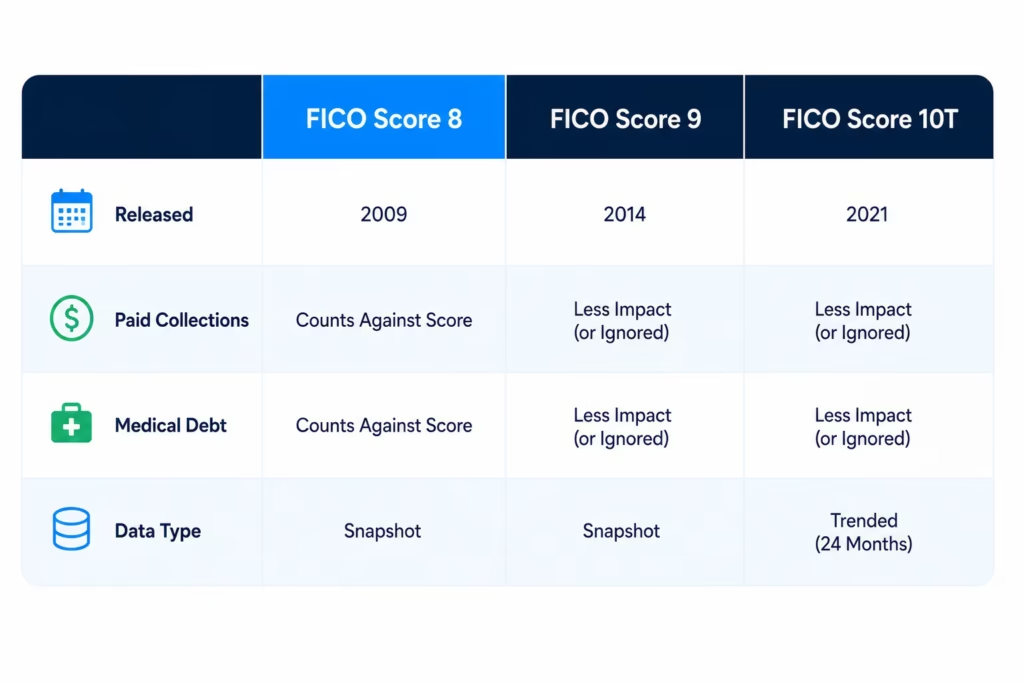
- FICO Score 8 counts paid and unpaid collection accounts equally against a score, while FICO Score 9 no longer penalizes paid third-party collections.
- FICO Score 8 introduced a 45-day deduplication window that counts multiple mortgage, auto, or student loan inquiries as a single inquiry.
- Mortgage lenders generally do not use FICO Score 8, relying instead on FICO Score 2 (Experian), Score 5 (Equifax), and Score 4 (TransUnion).
Best for:
- Readers trying to understand a “FICO Score 8” label seen on a credit card app, bank statement, or credit monitoring service.
- People comparing scores across apps (such as Credit Karma) who want to know why the numbers differ.
- Anyone preparing to apply for a credit card, auto loan, or personal loan who wants to know which score version the lender will pull.
What FICO Score 8 Is
FICO Score 8 is a specific version of the credit scoring model built by the Fair Isaac Corporation. The “8” is a version number, not a score value. It works like software. Just as your phone runs a certain version of its operating system, lenders run a certain version of the FICO formula when they pull your credit.
Fair Isaac Corporation is an independent analytics company. It doesn’t lend money, and it doesn’t collect your credit data. Instead, it sells its scoring algorithm to lenders, and the three major credit bureaus (Equifax, Experian, and TransUnion) supply the credit report data that feeds into it.
The reason this version matters is simple: it’s the most widely used FICO score among lenders today. As Experian notes, FICO Score 8 is currently the most widely used version of the FICO Score, even though newer versions exist.
Who Created FICO Score 8 and When
Fair Isaac Corporation released FICO Score 8 in 2009. The company has built credit scores for lenders since 1989. Each new version updates the formula based on real consumer credit use. Version 8 was built on decades of those earlier models, with tweaks designed to predict risk more accurately.
The FICO Score 8 Range
The base FICO Score 8 range runs from 300 to 850. A higher number means lower risk to the lender. One thing that trips people up: industry-specific versions, like FICO Bankcard Score 8, use a wider range of 250 to 900. So if you ever see a score above 850, you’re likely looking at an industry-specific version, not the base model.
How FICO Score 8 Is Calculated
This credit scoring model weighs five categories of data from your credit report. Each category carries a different level of importance:
- Payment history: 35%
- Amounts owed (credit utilization): 30%
- Length of credit history: 15%
- Credit mix: 10%
- New credit: 10%
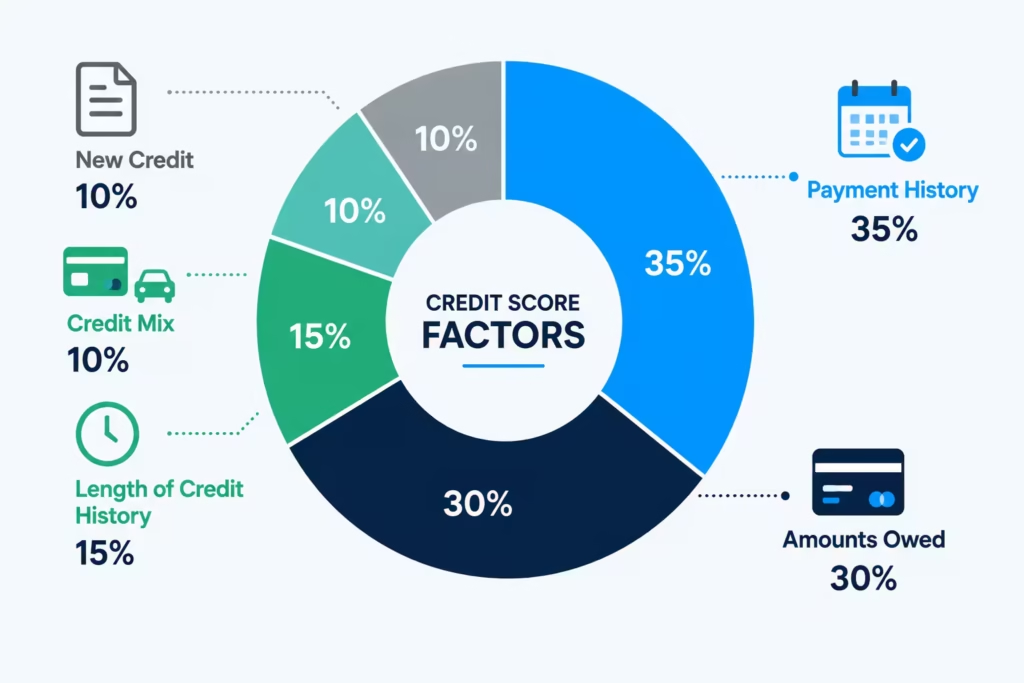
This same five-factor structure underlies most FICO versions, not just this one. What changes between versions is how the formula fine-tunes the details inside each category.
Payment History (35%)
Payment history is the single largest factor, and it tracks one core question: do you pay your bills on time? The model looks at on-time payments, late or missed payments, defaults, and delinquencies across your accounts.
It carries the most weight because past payment behavior is the strongest signal of future payment behavior. A lender’s biggest fear is not getting repaid, so this category does the heaviest lifting in the score.
Amounts Owed / Credit Utilization (30%)
The second-biggest factor is how much of your available credit you’re using. This is called your credit utilization ratio.
Here’s a quick example. Say you have one credit card with a $5,000 limit and a $1,500 balance. Your utilization on that card is 30%. The model checks utilization on each card and across all your cards combined.
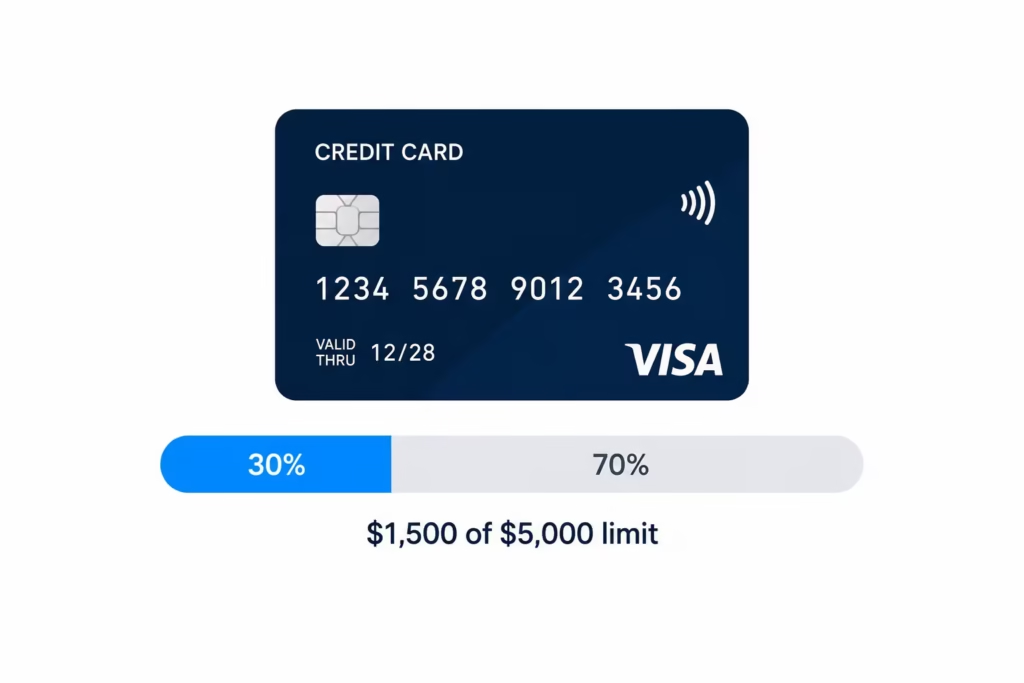
High utilization can hurt your score, even if you pay in full later. This is because the score shows the balance reported that month. Keeping usage low, both per card and overall, is one of the fastest ways to protect your number.
💡 Pro Tip: Your utilization is usually measured on your statement closing date, not your due date. Paying down a big balance before the statement closes can keep a high balance from ever being reported.
Length of Credit History (15%)
This factor measures time. The model considers the age of your oldest account, the age of your newest account, and the average age of all your accounts. Longer histories give the formula more data to work with, which is why closing your oldest credit card can sometimes lower a score.
Credit Mix (10%)
Credit mix looks at the variety of accounts on your report.
There are two main types of credit:
- Revolving credit: This includes credit cards. You borrow and repay continuously.
- Installment credit: This covers loans like auto loans or mortgages. You pay a set amount on a schedule.
Having some of each helps, but only a little. Nobody should open a loan just to improve this 10% slice.
New Credit (10%)
The final factor tracks recent applications. When you apply for credit, the lender runs a hard inquiry on your report, and each hard inquiry can shave a few points off your score for a short time. A cluster of applications looks risky, because it can signal money trouble. One key exception is that rate shopping for some loans gets special treatment. This is explained in detail later in the article.
What Counts as a Good FICO Score 8
The 300 to 850 scale breaks into standard tiers:
| Tier | Score Range | What It Means in Practice |
|---|---|---|
| Poor | 300–579 | Approval is difficult; expect denials or secured products only |
| Fair | 580–669 | Approval possible, but with higher interest rates |
| Good | 670–739 | Most lenders view you as a dependable borrower |
| Very Good | 740–799 | Strong approval odds and better rates |
| Exceptional | 800–850 | Access to the best rates and terms offered |
For context, data from Experian puts the average FICO Score in the U.S. at 713 as of September 2025, which sits in the Good tier. That means a score in the low 700s is already at or above the national norm.
A simple way to understand your score:
- Good usually gets you approvals.
- Very Good opens the door to better rates.
- Exceptional gives you the best rates lenders offer.
What Makes FICO Score 8 Different From Earlier FICO Models
FICO updates its formula periodically, the same way software gets new releases. Each update adjusts how the scoring model reads consumer behavior. When version 8 launched in 2009, it introduced three notable changes that still matter to borrowers today.
Leniency on a Single Late Payment
Earlier models could punish one slip almost as harshly as a pattern of missed payments. FICO Score 8 is more forgiving of an isolated late payment when the rest of the credit report looks clean. Chronic lateness, meaning repeated missed payments across accounts, still causes serious damage. But one mistake followed by years of on-time payments won’t define your score forever.
The 45-Day Rate-Shopping Window
This version introduced a generous deduplication window for certain loans. Multiple hard inquiries for a mortgage, auto loan, or student loan made within 45 days count as a single inquiry.
Here’s how that plays out. Say Michael, a project manager at a manufacturing company, applies with five auto lenders over two weeks to find the best rate. Under FICO Score 8, those five pulls count as one inquiry. The model understands he’s shopping for one car, not five.
⚠️ Mistake to Avoid: The rate-shopping window applies to mortgages, auto loans, and student loans. It does not apply to credit card applications. Five credit card applications in two weeks means five separate inquiries.
Safeguards Against Tradeline Renting
Before 2009, people used a shady method called tradeline renting, or “piggybacking for pay.” This let them pay to become authorized users on a stranger’s credit card to inherit its clean history. Companies sold this as a service. FICO Score 8 was designed to spot and reduce the impact of authorized-user accounts that lacked a real connection. This change closed the loophole and made it tougher to manipulate scores.
FICO Score 8 vs. FICO Score 9
The core difference between these two versions comes down to collections and medical debt. FICO Score 9, released in 2014, softened how those items affect a score. Version 8 did not. This is important. Many lenders still use version 8. So, if you pay off a collection, it might not change your score. It all depends on which model the lender uses.
How Each Version Treats Paid Collection Accounts
Under FICO Score 8, a collection account hurts your score whether it’s paid or unpaid. The formula makes no distinction between the two. Paying a $600 collection is smart. It prevents more damage and improves manual reviews. However, don’t expect an instant score boost.
FICO Score 9 changed this. Paid third-party collections no longer count against you under that model, as explained on the official FICO score versions page. This gap explains a common frustration: someone pays off an old collection, checks their score, and sees no change. If their lender (or their score provider) uses version 8, that paid collection is still dragging.
How Each Version Treats Medical Debt
FICO Score 8 treats medical collections like any other collection. An unpaid medical bill in collections weighs just as heavily as an unpaid credit card balance.
FICO Score 9 lessens the effect of unpaid medical collections. It acknowledges that medical debt usually comes from emergencies and billing disputes, not from reckless borrowing. If medical debt is the main blemish on your report, the version being used can make a real difference in the number a lender sees.
FICO Score 8 vs. FICO Score 10 and 10T
FICO Score 10 and 10T are the newest models in the lineup. The big innovation is in 10T, which uses trended data. Older scores, including version 8, look at your most recently reported balance, like a snapshot. Trended data looks at roughly 24 months of balance history, like a video. It shows if your balances are going up, down, or staying the same. Two people with the same balance today can still have different scores based on that trend.
Despite the newer tech, adoption moves slowly in lending. Each lender decides if and when to upgrade, and many stick with what they trust. FICO Score 8 is still the main score used in credit decisions. So, in 2026, this is the score that matters most.
FICO Score 8 vs. VantageScore
FICO and VantageScore are two different companies with two different formulas. VantageScore was created jointly by Equifax, Experian, and TransUnion, and it weighs and reads credit data its own way.
This is why your numbers can differ even when both scores pull from the same credit report. They’re different algorithms answering the same question. A 40-point gap between the two is common and usually meaningless.
The classic real-world case: Credit Karma shows VantageScore 3.0, not FICO Score 8. So when your card app says 745 and Credit Karma says 710, neither one is “wrong.” They’re just different models. What matters is knowing which type your lender pulls, and in most lending decisions, that’s a FICO score.
Which Lenders and Products Actually Use FICO Score 8
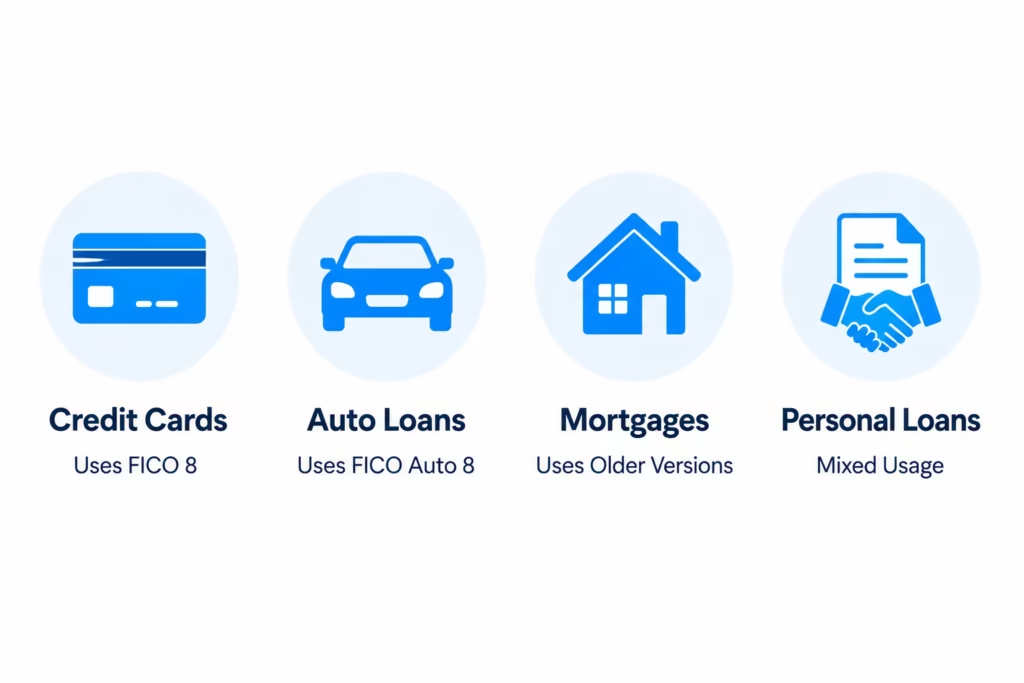
Whether this score matters for you depends on what you’re applying for. Usage varies by product, so here’s the breakdown.
Credit Cards
This is FICO Score 8’s home turf. Most credit card issuers use the base version 8 or its sibling, FICO Bankcard Score 8, when reviewing applications. If you’re about to apply for a card, this is very likely the family of scores involved.
Auto Loans
Auto lenders lean on FICO Auto Score 8, an industry-specific version tuned to predict auto loan risk. It remains the dominant choice in auto financing, though some lenders have moved to Auto Score 9. Either way, the score your bank app shows you is a close cousin, not the exact number the dealer’s lender will pull.
Mortgages
Here’s the big exception, and it surprises most people. Mortgage lenders generally do not use FICO Score 8. Because of longstanding requirements from Fannie Mae and Freddie Mac, mortgage underwriting relies on much older versions: FICO Score 2 from Experian, FICO Score 5 from Equifax, and FICO Score 4 from TransUnion. Lenders typically pull all three and use the middle score.
Change is underway, with FICO 10T and VantageScore 4.0 approved for eventual use in mortgage lending. But rollouts in this space take years, so home buyers in 2026 should still expect the classic trio.
Personal Loans
Personal loans are a mixed bag. Banks and traditional lenders usually rely on FICO Score 8. In contrast, many online and fintech lenders prefer FICO Score 9, VantageScore, or their own models. With personal loans, the only way to know is to ask the lender directly.
FICO Bankcard Score 8 and Other Industry-Specific Versions
Sometimes a score comes with a label like “FICO Bankcard Score 8” or “FICO Auto Score 8.” These are industry-specific FICO scores. They share the same foundation as the base model but are fine-tuned for one type of credit. Bankcard versions emphasize how you handle credit cards. Auto versions emphasize how you’ve handled car loans.
The other key difference is the scale. While the base score runs from 300 to 850, industry-specific versions run from 250 to 900. So a 780 base score and a 780 Bankcard score aren’t directly interchangeable. If you see one of these labels, read it within its own range, and know it’s the version built for that specific lending decision.
How to Check Your Actual FICO Score 8
Many free apps show VantageScore, not a FICO score. To see your real FICO Score 8, use one of these legitimate sources:
- Your credit card issuer or bank. More than 200 financial institutions give customers free FICO scores through the FICO Score Open Access program. Check your card issuer’s app or online dashboard. The score is often listed right on your account page or monthly statement.
- myFICO. The score sold directly at myFICO.com comes from the company that created it. Free and paid tiers are available, and paid plans show industry-specific versions too.
- Experian. Experian’s free membership shows your FICO Score 8 based on your Experian credit report.
While you’re at it, review the credit reports feeding the score. You can pull free weekly reports from all three bureaus at AnnualCreditReport.com, the only site federally authorized for this. A great score starts with accurate data underneath it.
Frequently Asked Questions (FAQs)
Is FICO 8 a real credit score?
Yes, FICO Score 8 is a real, widely used credit scoring model built by Fair Isaac Corporation. Released in 2009, it scores consumers on a 300 to 850 scale based on data from your credit report.
Is FICO 8 or FICO 9 better?
Neither is universally better; they simply treat certain debts differently. FICO 9 ignores paid collection accounts and reduces the impact of medical debt, while FICO 8 counts both against you regardless of payment status.
Is there a FICO Score 10?
Yes, FICO Score 10 and 10T are the newest versions in the lineup. FICO 10T adds trended data, looking at roughly 24 months of balance history instead of just a single snapshot.
Do any mortgage lenders use FICO 8?
Generally no. Mortgage underwriting relies on older versions instead, specifically FICO Score 2 from Experian, FICO Score 5 from Equifax, and FICO Score 4 from TransUnion, with lenders pulling all three and using the middle score.
What is a good FICO 8 score to buy a house?
A score of 670 or higher falls in the Good tier and gives most lenders confidence in your reliability. Scores of 740 and above unlock even better rates, though mortgage lenders will actually pull older FICO versions, not FICO 8, to make the decision.
Is FICO 8 better than Credit Karma’s score?
They’re not directly comparable since they come from different companies. Credit Karma displays VantageScore 3.0, while FICO 8 is a separate model, and a 40-point gap between the two on the same credit report is common and usually meaningless.
What is the biggest killer of credit scores?
Missed or late payments do the most damage since payment history makes up 35% of your FICO Score 8. High credit utilization is the second-biggest factor, carrying 30% of the weight.
What brings your credit score up the fastest?
Paying down credit card balances before your statement closing date is one of the fastest ways to boost your score. This lowers your reported utilization, which accounts for 30% of your FICO Score 8.
What is a perfect FICO 8 score?
A perfect FICO Score 8 is 850, the top of the base 300 to 850 range. Industry-specific versions like FICO Bankcard Score 8 use a wider 250 to 900 scale, so a perfect score there would be 900.
Does paying off a collection account raise my FICO 8 score?
Not necessarily. Under FICO Score 8, a collection account hurts your score whether it’s paid or unpaid, so paying it off may not produce an immediate score increase, though it can improve manual loan reviews.
The Bottom Line
FICO Score 8 is the top credit scoring model used in lending today. It ranges from 300 to 850 and is based on five key factors. Payment history and credit utilization are the most important ones.
It mainly differs from FICO 9 in how it handles collections and medical debt. This version is used for most credit card decisions, but mortgages still rely on older models.
For most readers, the best next step is to check your real number on your card issuer’s FICO Open Access dashboard. Then, confirm which version a lender uses before you apply.
If you know someone puzzled by different scores on two apps, share this article. It can ease their worries before the next application.