
I get why you’re worried. You open the Navy Federal app, glance at your Mission: Credit Confidence Dashboard, and see a number. But you’re not sure if that’s the same score your lender will pull. That doubt hits hardest right before you apply for a car loan, credit card, or mortgage. Nobody wants a shock like a denial or a higher rate, and the question of whether your Navy Federal credit score is accurate is a fair one.
Here’s the short answer: The dashboard shows a real, accurate score, but it’s a VantageScore 3.0 from TransUnion, not the FICO score most lenders use.
Stick with me. Below, you’ll get the exact model, the size of the gap to expect, product-by-product guidance, and a simple pre-application checklist.
Key Takeaways
This guide explains whether the Navy Federal credit score dashboard is accurate, including the exact scoring model used, why lender scores differ by bureau and model, typical point gaps, and how to check the score a lender will actually use.
Core Facts:
- Navy Federal’s Mission Credit Confidence Dashboard shows a VantageScore 3.0 pulled from TransUnion data, not the FICO score most lenders use for approval decisions.
- Most members see a gap of 20 to 50 points between their dashboard VantageScore and a lender’s FICO score, though gaps can range from 10 to 100 points.
- VantageScore 4.0 can score a file with 1 month of credit history, while FICO Score 8 requires at least 6 months of history to generate a score.
- VantageScore 3.0 and 4.0 exclude medical collections from scoring, while some FICO models still include them, which can create divergent results.
- Rate shopping windows differ: VantageScore groups inquiries within about 14 days, while FICO uses about 45 days for auto, mortgage, and student loan inquiries.
- Navy Federal mortgages historically use older Classic FICO models (2, 4, and 5), and VA loans commonly require a minimum representative score of 620 per Fannie Mae guidance.
Best for:
- Navy Federal members preparing to apply for a credit card, auto loan, or mortgage who want to understand their real approval odds.
- Readers confused about why their dashboard score differs from a score a lender or loan officer quoted them.
- Anyone wanting a pre-application checklist to check their actual FICO score before applying.
What Credit Score Model Navy Federal’s Dashboard Actually Shows You
The number in your Navy Federal app is a legitimate credit score. It’s not a made-up figure. It’s not a marketing gimmick. But you should know exactly what you’re looking at.
Navy Federal states plainly on its own site that the score in the dashboard is a VantageScore 3.0 pulled from your TransUnion credit report. As Navy Federal Credit Union notes on its member education page, “The credit score and report you will receive through Mission Credit Confidence Dashboard is a TransUnion credit report with a TransUnion Vantage 3 Score.”
So when you check the app, you’re getting a real score built by a real scoring company. VantageScore Solutions is a joint venture of the three big credit bureaus. The score uses the same 300 to 850 range you already know. It reflects your actual credit file at TransUnion. So the tool itself is not fake.
But here’s the catch. When a lender decides on your loan, most of them don’t look at VantageScore 3.0. They look at a FICO score, which is built by a different company called Fair Isaac Corporation. Same person, same credit history, different math. That’s why the label “accurate” needs a small tweak. The score you see is accurate for what it is. It just isn’t always the score a bank uses to price your loan.
Think of the dashboard number as a health tracker for your credit. It’s real. It’s useful. It moves in the right direction when you do the right things. It just isn’t the same tool your lender uses to price a loan.
📌 Did You Know: VantageScore and FICO both use the 300 to 850 range, but they’re built by two different companies. That means the same credit file can produce two different scores on the same day, and both can still be “correct.”
Which Bureau Supplies the Data
The data behind your dashboard score comes only from TransUnion. That’s one of the three main credit bureaus. The other two are Equifax and Experian.
Why does this matter? Because not every creditor reports to all three bureaus. Some report to just one or two. So your TransUnion file may show a slightly different picture than your Equifax or Experian file.
For example, a small store card you opened last year might be on your TransUnion report but missing from your Experian report. If a lender pulls Experian, they’ll see a different account list than what you see in the Navy Federal dashboard.
This is one big reason your dashboard number can differ from the score a lender sees. Same person, different bureau, different data on file.
Why Your Navy Federal Score Can Differ From the Score a Lender Pulls
If you’ve ever thought, “Why is my Navy Federal credit score different from what the lender saw?” the answer is not that one is wrong. It’s that they’re measuring slightly different things. Four main reasons drive the gap.
1. Different scoring models weight things differently. VantageScore 3.0 and FICO Score 8 look at the same basic facts (payment history, balances, credit age, new accounts, credit mix). But each one gives those facts different weight. So the same credit file can produce two different numbers.
2. Different bureaus mean different data. Your dashboard pulls only from TransUnion. A lender might pull from Experian or Equifax instead. If a creditor reports to one bureau but not the others, that account only shows up in some places. This creates a real scoring discrepancy even when nothing about you has changed.
3. Timing and reporting lag. Creditors don’t report to the bureaus in real time. Most report once a month, on their own cycle. So a payment you made yesterday might not show up on your credit file for another two or three weeks. Your dashboard score and a lender’s fresh pull can catch you at different points in that cycle.
4. Recent activity that isn’t reflected yet. Did you just open a new card? Pay off a big balance? Miss a payment? Any of these can change your score, but only after the creditor sends the update to the bureau. Until then, your dashboard is showing the “old you.”
So the answer to “why is my Navy Federal credit score different” is rarely that one number is fake. It’s that scoring is a snapshot, and different snapshots can look a little different.
How Big a Gap Is Normal
Most people see a gap somewhere between 20 and 50 points when they compare VantageScore 3.0 to FICO Score 8 on the same day. In some cases the gap is smaller, close to 10 points. In other cases it can stretch to 60 or even 100 points, especially if your credit file has quirks like recent inquiries, a mix of open and closed accounts, or a thin file with few tradelines.
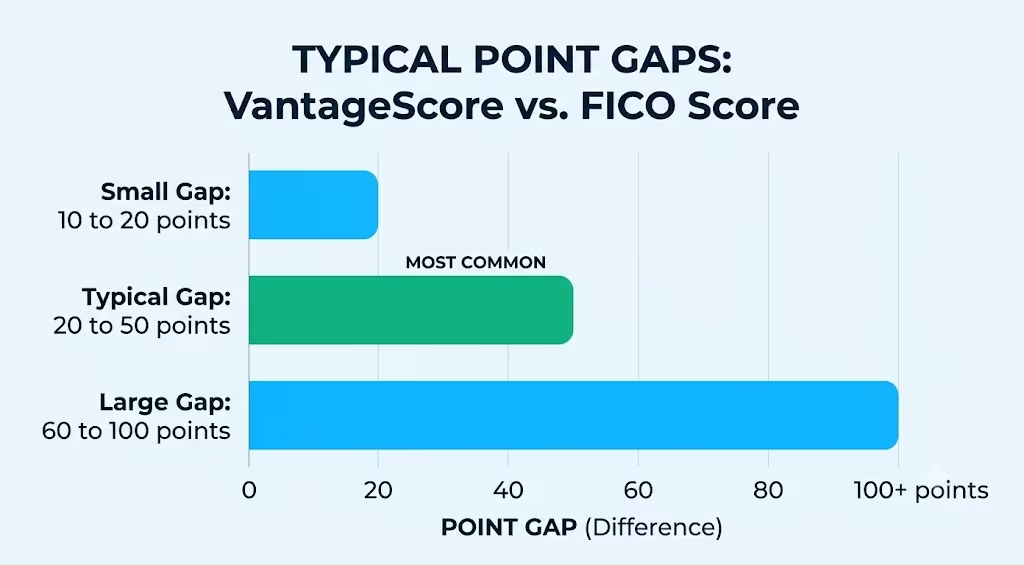
Data from Experian shows that VantageScore can build a score for someone with just one month of credit history and one recent update on file. FICO needs at least six months of history and a recently reported account. That difference alone can move a score by dozens of points.
If your dashboard shows 720 and a lender pulls 690, that’s normal. If it shows 720 and the lender pulls 550, something else is going on (usually a missing report, an error, or a very recent negative event that didn’t reach your TransUnion file yet).
VantageScore vs. FICO: The Core Differences That Cause the Gap
Now let’s get under the hood. If you understand these differences, the gap stops feeling like a bug and starts feeling like basic math.
Scoring model rules. VantageScore 4.0 can score you with as little as one month of credit history and one account reported in the last 24 months. FICO Score 8 needs six months of history and a recently reported account. If you’re new to credit or you took a break, VantageScore may give you a number when FICO can’t score you at all.
Same range, different math. Both VantageScore 4.0 and FICO Score 8 use the 300 to 850 range. But they don’t weight the five factors the same way. FICO leans heavily on payment history and amounts owed. VantageScore uses a slightly different mix that puts more weight on total credit usage and less on the exact type of accounts you have.
Medical debt treatment. VantageScore 3.0 and 4.0 do not use medical collections at all. VantageScore announced this change in 2022. So if you have an old medical bill in collections, your VantageScore may ignore it, while some older FICO models still count it. That alone can move your two scores in very different directions.
Hard inquiry rules. When you rate-shop for a loan, both models group multiple inquiries together so you’re not punished for smart shopping. But the window is different. VantageScore uses a rolling 14-day window for all types of loans. FICO uses a 45-day window for most auto, mortgage, and student loans. So a shopping spree that looks fine to FICO might ding your VantageScore a bit more.
A quick side-by-side:
| Feature | VantageScore 3.0 / 4.0 | FICO Score 8 |
|---|---|---|
| Range | 300 to 850 | 300 to 850 |
| Minimum credit history | 1 month | 6 months |
| Medical collections | Excluded (in 3.0 and 4.0) | Included in FICO 8 |
| Rate-shop window | ~14 days | ~45 days for auto/mortgage/student |
| Built by | VantageScore Solutions | Fair Isaac Corporation |
These are the “aha” differences. They explain almost every case where a member says, “Why did my Navy Federal score say 710 but the lender saw 680?”
Does Navy Federal Use This Same Score to Approve Your Application
Short answer: usually no. The dashboard score and the score Navy Federal uses to underwrite your application are almost never the exact same number.
Here’s why. The dashboard is a credit monitoring tool. It runs on a soft pull, which means Navy Federal (through TransUnion) checks your file for informational purposes only. A soft pull does not affect your score, and it doesn’t share your file the way a real loan application does.
When you actually apply for a Navy Federal credit card, auto loan, or mortgage, Navy Federal runs a hard inquiry. A hard inquiry is a formal request for your credit file for a lending decision. It can shave a few points off your score, and it pulls a lender-facing score built for underwriting, not for consumer monitoring. That lender-facing score is usually a FICO product, and it may come from a different bureau than TransUnion.
Also, your score is only one piece of the decision. Navy Federal also looks at:
- Your income and how stable it is
- Your debt-to-income (DTI) ratio
- Your existing relationship with Navy Federal (deposits, other loans, how long you’ve been a member)
- The specific product you’re applying for and its own rules
- The size of the loan and the down payment or collateral
So even a member with a 780 dashboard score can be denied a huge loan if their income doesn’t support it. And a member with a 660 dashboard can still get approved if the rest of their file looks strong. The dashboard number is a good clue, not a guarantee.
⚠️ Mistake to Avoid: Don’t treat your dashboard score as a “pre-approval.” It’s a monitoring number. Applying triggers a hard pull and a different scoring model, so build in a cushion of 20 to 40 points before assuming you’ll qualify.
Which Score Actually Matters for Different Navy Federal Products
Not every Navy Federal product uses the same score. The scoring model that matters depends on what you’re applying for. Here’s how to think about it product by product.
The general rule: Navy Federal (like most lenders) tends to use FICO-family scores for lending decisions, but the exact version and bureau can vary by product. When possible, use Navy Federal’s pre-qualification or pre-approval tools before you formally apply. Those tools give you a much better read than the dashboard alone, because they use lender-side data.
Credit Cards
For Navy Federal credit cards, expect the decision to lean on a FICO Score 8 or a similar bankcard-focused score. Bankcard scores use the standard 300 to 850 range but are tuned to predict credit card default risk, not car loan or mortgage risk.
If your dashboard shows 700, your credit card application score is probably in a similar range, give or take 20 to 40 points. Navy Federal also considers your existing card relationship with them, your income, and your recent applications. If you’ve opened several new cards in the last six months, expect a small drag on your score.
Practical tip: Before applying, use the pre-qualification tool on the Navy Federal credit cards page if it’s available. Pre-qualification is a soft pull and won’t hurt your score.
Auto Loans
Auto lenders often use a FICO Auto Score, which is a version of FICO tuned for car loans. Auto scores use a wider 250 to 900 range and weight your auto loan history more heavily. So even if your regular FICO Score 8 is 700, your FICO Auto Score could be a bit higher or lower depending on your history with car loans.
Two more auto-loan specifics to know:
- Rate shopping window. Multiple auto loan inquiries within about 14 to 45 days count as one inquiry for scoring purposes. So you can shop several lenders without stacking up score damage.
- Loan-to-value and down payment matter a lot. A strong down payment and a modest loan-to-value can offset a middling score.
If your dashboard shows a comfortable score for the car you want, still expect the actual auto-loan score to differ by a handful of points either way.
Mortgages
Mortgages are the strictest case. Historically, most Navy Federal mortgages (and virtually all conventional loans sold to Fannie Mae or Freddie Mac) have used the older Classic FICO models: FICO Score 2, 4, and 5. These are older than FICO 8 and can behave differently from your dashboard number.
The industry is shifting. The Federal Housing Finance Agency confirmed on its Credit Scores policy page that lenders will move to use FICO Score 10T and VantageScore 4.0 for loans sold to Fannie Mae and Freddie Mac. Fannie Mae’s own Credit Score Models and Reports Initiative page shows the historical data was published on July 1, 2026, to help lenders prepare.
What does this mean for you today?
- If you apply for a Navy Federal conventional mortgage, expect the underwriter to pull scores from all three bureaus and often use the middle score across bureaus (or the lower of two if only two scores exist).
- Your VantageScore 3.0 dashboard number can easily differ from the mortgage-side Classic FICO by 20 to 60 points.
- For VA loans, which are common for Navy Federal members, the minimum representative score requirement per Fannie Mae’s Selling Guide is 620 for government-backed programs. Navy Federal may set its own overlay above that.
Bottom line for mortgages: the dashboard is a starting point only. Ask your Navy Federal loan officer for a tri-merge credit pull once you’re ready. That’s the number the underwriter will actually use.
How Often the Navy Federal Score Updates and Why That Creates Lag
Your dashboard score does not update in real time. It refreshes on a set cycle. Most Navy Federal members see their score update about once a month, tied to when TransUnion pushes fresh data into the dashboard.
This lag causes a lot of the confusion. Say you pay off a $4,000 credit card balance today. Here’s what actually happens:
- Your credit card issuer waits until your statement closes (up to 30 days).
- Then the issuer reports the new balance to TransUnion (a few more days).
- Then Navy Federal’s dashboard picks up that update on its next refresh cycle.
You could be looking at three to six weeks between the action and the score change. That’s normal. It’s not a bug in the app.
Two more things to know about the update cycle:
- The score simulator inside Mission: Credit Confidence can show you a rough estimate of what your score might look like after a hypothetical action (like paying off a card or opening a new one). It’s a guide, not a promise. Use it to plan, not to predict exact numbers.
- Refresh cycles are not the same as bureau reporting cycles. Even after TransUnion has your new data, Navy Federal’s dashboard may only sync once per month. So there can be a lag on top of a lag.
If you need a fresher read (say, right before a mortgage application), don’t rely on the dashboard alone. Pull a fresh credit report yourself (more on that below).
Common Reasons for a Sudden or Unexplained Score Change
Sometimes your score jumps or drops with no clear reason. Here’s what usually causes it:
- A statement balance posted higher or lower than usual. Even if you pay in full, a high statement balance can lift your utilization and drop your score for a few weeks.
- A new account or hard inquiry hit the bureau. New accounts lower your average age of credit and can shave a few points.
- An old account closed. A closed account changes your utilization math and your account age. Both can move your score.
- A collection, late payment, or public record was added or removed. These are the biggest single-event movers.
- A credit limit change. A higher limit can improve utilization and boost your score. A lower limit can do the opposite.
If the change is small (under 15 points), it’s usually normal cycle noise. If it’s a big drop (30 points or more) and you can’t explain it, pull your full TransUnion credit report from AnnualCreditReport.com and look line by line for something new or wrong.
Is the Navy Federal Score Still Worth Trusting and Using
Yes. The Navy Federal credit score is a trustworthy credit monitoring tool. It just isn’t a loan-approval crystal ball, and it was never meant to be.
Here’s what it does well:
- Tracks your trend. If your score is climbing month over month, your credit habits are working. If it’s dropping, something needs attention.
- Alerts you to changes. A sudden drop is a signal to check your report for errors, fraud, or missed payments.
- Helps you plan. The built-in score simulator lets you test decisions before you make them.
- Costs you nothing. It’s free to Navy Federal members, and checking it is a soft pull, so it never damages your score.
What it doesn’t do:
- Predict the exact score a lender will pull.
- Guarantee approval or a specific interest rate.
- Replace a full three-bureau credit report.
So use the dashboard the way a smart driver uses a dashboard gauge. Watch the direction of change. If the needle moves the wrong way, dig deeper. But don’t confuse the gauge with the engine. The engine (your actual credit file across all three bureaus) is what a lender looks at when the money is on the table.
💡 Pro Tip: Check your Mission: Credit Confidence Dashboard once a month. Log the number in your phone’s notes. Trends matter far more than any single reading, and a monthly log helps you spot problems fast.
How to Check the Score a Lender Will Actually Use Before You Apply
Now for the payoff. If you want to know the score your lender will really see, take these steps before you apply. They’re free (or nearly so) and take less than an hour.
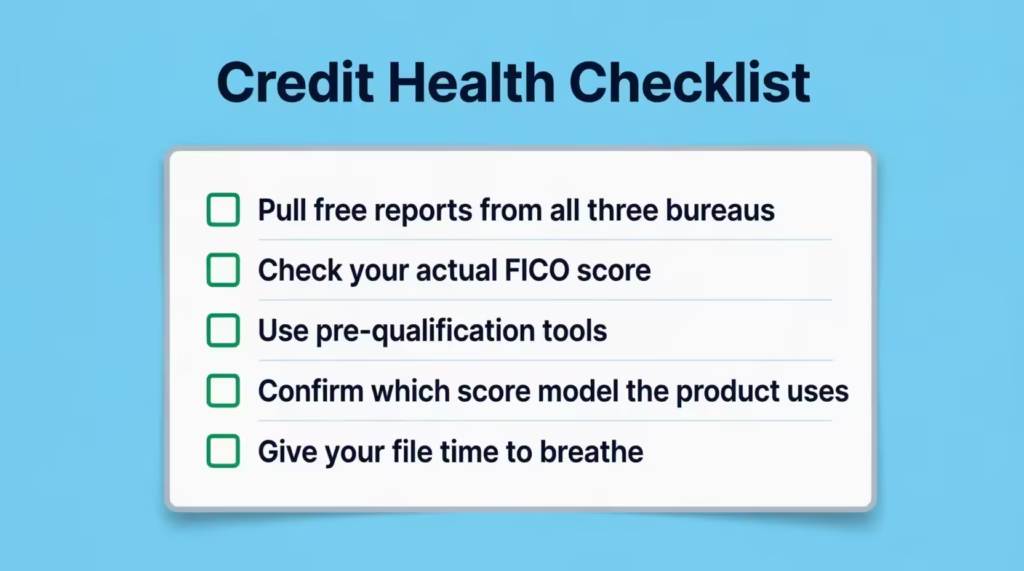
1. Pull your free credit reports from all three bureaus. Go to AnnualCreditReport.com. This is the only site authorized by federal law to give you free reports from Equifax, Experian, and TransUnion. Since 2023, the three bureaus have made weekly free reports permanent. Grab all three. Compare them side by side. If an account is on one and not another, that alone can explain a score gap.
2. Check your actual FICO score. Many credit card issuers (including some Navy Federal cards) show you a free FICO Score inside your monthly statement or app. If you have a Discover, Bank of America, Chase, or Capital One card, check for a FICO Score section in the app. If you want to see the exact FICO version a mortgage lender might use, myFICO.com offers paid access to multiple FICO versions, including the mortgage-specific ones (FICO 2, 4, and 5) and FICO Auto Score.
3. Use pre-qualification tools before applying. Most Navy Federal products have a pre-qualification or pre-approval tool. These use a soft pull, so they don’t hurt your score, and they give you a much better read than the dashboard. For auto loans, get pre-approved before you visit the dealer. For credit cards, use the “See if you’re pre-qualified” option when it’s offered.
4. Confirm which score model the specific product uses. Ask your Navy Federal loan officer directly. A simple question works: “For this product, which credit score model and which bureau will you use?” A good loan officer will tell you (for example, “FICO Auto Score 8 from TransUnion” or “the middle Classic FICO from a tri-merge”). Now you know exactly what to compare against.
5. Give your file time to breathe. If you’re planning a big application in the next 90 days:
- Don’t open new accounts.
- Don’t close old accounts.
- Pay balances down at least 10 days before your statement closes so a lower balance gets reported.
- Dispute any errors you spot in step 1.
Do this checklist, and you’ll walk into your application knowing roughly what score the lender will see. No more surprises.
What To Do If the Numbers Still Don’t Match
Sometimes even after doing everything right, the lender’s score comes in lower than expected. Here’s what to do next.
Ask for the exact score and version the lender used. Under the Fair Credit Reporting Act, if you’re denied credit or offered worse terms because of your credit, the lender must give you a “risk-based pricing notice” or an adverse action notice that includes the score used, the model, and the bureau. Get that in writing.
Pull that specific bureau’s report and compare. If the lender used Equifax and your dashboard uses TransUnion, look at the Equifax file line by line. Find the account that’s dragging your score. Is it a real problem or an error?
Dispute errors right away. If you see something wrong (a paid account still marked open, a late payment you never made, an account that isn’t yours), file a dispute directly with the bureau online. Bureaus have 30 days to investigate.
Wait 30 to 60 days and reapply, or ask for a re-review. If you fixed the issue or paid down a big balance, the score can move fast. Some lenders will do a “rapid rescore” for mortgages, where updated info is pushed to the bureaus in days instead of weeks. Ask your Navy Federal mortgage officer if that’s an option.
Focus on the trend, not the moment. One low score doesn’t mean you’re stuck. A steady climb over three to six months is what actually gets you the best rates.
Frequently Asked Questions (FAQs)
Does Navy Federal show your real credit score?
Yes, the dashboard shows a real VantageScore 3.0 pulled from your TransUnion credit report. It reflects your actual credit file, but it’s not the same score most lenders pull for a loan decision.
What FICO score does NFCU use?
Navy Federal typically uses FICO Score 8 or a similar bankcard score for credit cards, FICO Auto Score for auto loans, and older Classic FICO models (2, 4, and 5) for mortgages. The exact version and bureau can vary by product, so ask your loan officer directly.
What is a good Navy Federal credit score?
A dashboard score of 700 or higher is generally considered good and suggests a similar range on the FICO side, though expect a gap of 20 to 40 points either way. Higher scores also help offset weaker income or debt-to-income ratios during underwriting.
Is Navy Federal hard to get a loan from?
Approval depends on more than your score. Navy Federal also weighs your income, debt-to-income ratio, membership history, and the specific loan product, so a lower score can still get approved if the rest of your file is strong.
Will Navy Federal give me a loan with a 550 credit score?
It’s unlikely for most products, since a 550 falls well below typical approval ranges. VA loans have a common minimum representative score of 620 per Fannie Mae’s guide, and Navy Federal may set its own requirements above that.
Which FICO score is most accurate?
There isn’t one universally “accurate” FICO score since different products use different versions, like FICO 8 for cards and FICO Auto Score for car loans. The most useful one is whichever version and bureau your specific lender confirms they’ll pull.
How rare is an 824 or 830 credit score?
Scores in the 820s are uncommon and sit near the top of the 300 to 850 range used by both VantageScore and FICO. Reaching that range typically requires years of on-time payments, low utilization, and a long credit history.
What credit score do I need to buy a $400,000 house?
Score requirements vary by loan type rather than home price, with VA loans commonly requiring at least a 620 representative score. Mortgage underwriters usually pull scores from all three bureaus and use the middle or lower score, not your dashboard number.
Can I raise my credit score 100 points in 30 days?
A jump that large in 30 days is rare and usually only happens after fixing a major reporting error or removing a large negative item. Normal score changes from paying down balances or improving habits typically take a full billing cycle or more to show up.
Wrapping Up
At the end of the day, the Mission: Credit Confidence Dashboard gives you a real, trustworthy VantageScore 3.0 from TransUnion, but it isn’t always the score a lender will use to approve your loan or set your rate. Different models, different bureaus, and reporting lag are the three biggest reasons your Navy Federal credit score may differ from a lender’s number, and gaps of 20 to 50 points are completely normal.
Based on how the models actually work, the most effective approach is to use the dashboard for monthly trend tracking, then pull a fresh three-bureau report and a real FICO score before any major application.
Found this useful? Share it with a fellow service member or Navy Federal member who’s about to apply for a car loan or mortgage. It could save them from an unwelcome surprise at the finance desk.