
You need cash today. Maybe your car broke down, a utility shut-off notice arrived, or payday is still a week away. You’ve seen the bright yellow PLS signs around town, or you’ve landed on pls247.com, and now you’re wondering how a PLS cash advance actually works before you commit. The fear of hidden fees, confusing paperwork, or being turned away at the counter is real.
Here’s the short answer: a PLS cash advance is a short-term loan or check-cashing service that gives you money the same day, once you provide an ID, proof of income, and bank details.
Below, I’ll walk you through every step, the true cost, the paperwork, and what happens if things go sideways, so you can decide with full confidence.
Key Takeaways
This guide explains how a PLS cash advance actually works, including eligibility requirements, required documents, in-store and online application steps, real costs with a worked example, and what happens if repayment is missed.
Core Facts:
- A PLS cash advance is either a short-term loan (payday or installment) or a check-cashing service, and product availability depends entirely on the state where the borrower lives.
- Basic eligibility requires being at least 18 (21 in some states), having provable regular income, an active checking account, and a valid government-issued photo ID.
- In a worked example, a $300 loan with a $15-per-$100 fee carries a $45 finance charge, making the total repayment $345 in 14 days, an APR of roughly 391%.
- PLS typically checks alternative credit databases rather than the three major credit bureaus, so a standard approval does not affect a FICO or VantageScore.
- Repayment is most commonly pulled through an automatic ACH debit on the due date, though in-store cash payment or a post-dated check may be available depending on the state.
- Missing a payment can trigger a returned-payment fee of $15 to $30 plus bank overdraft charges, and many states require lenders to offer an Extended Payment Plan before default.
Best for:
- Readers deciding whether to visit a PLS store or apply online before committing to a loan or check-cashing transaction.
- Borrowers who want to understand the real dollar cost of a payday loan before signing an agreement.
- Anyone concerned about repayment risk who wants to know their options if they can’t pay on time.
What “PLS Cash Advance” Actually Means
Many people hear “cash advance” and picture pulling money off a credit card at an ATM. A PLS cash advance is not that. PLS Financial Services is a storefront and online provider of small-dollar money services. It runs hundreds of neighborhood shops under the PLS 24/7 brand and an online portal at pls247.com. It is not a bank, and it does not issue a traditional credit card that you can swipe for a cash advance.
When people search for “PLS cash advance,” they usually mean one of two things. The first is a short-term loan, often a payday loan or a small installment loan, in which PLS lends you money, and you repay it on your next payday or over a few months. The second is check cashing, where you hand over a paycheck or government check and walk out with cash right away, minus a fee.
Which one you actually get depends on the state you live in. PLS is licensed differently in each state, so the product menu inside a Chicago store looks different from one in Phoenix or Los Angeles. That is why the first step is always to check what PLS offers where you live before you plan anything.
📌 Did You Know: PLS stands for “People’s Loan Source.” Even though the name includes “loan,” the company sells many non-loan services too, like money orders, prepaid debit cards, and bill payment.
PLS’s Product Lineup and Where Cash Advance Fits
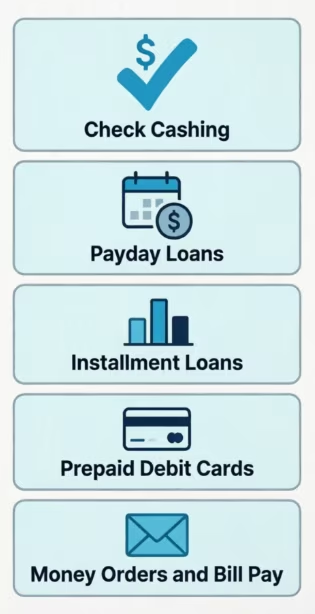
To understand where a cash advance fits in, it helps to see the full menu. PLS 24/7 offers a mix of money services under one roof, and only a few of them put actual cash in your hand the same day.
The main products include:
- Check cashing. You bring in a paycheck, government check, tax refund check, or insurance check. PLS gives you cash on the spot after taking a small percentage as a fee.
- Payday loans. A small, short-term loan tied to your next paycheck. You borrow a few hundred dollars now and pay it back in full on your next payday, plus a fee.
- Installment loans. A slightly larger loan paid back in fixed chunks over several weeks or months. This is common in states where payday lending is capped or banned.
- Prepaid debit cards. The Xpectations! Plus card, where you can load cash or set up direct deposit.
- Money orders, bill pay, wire transfers, and tax prep. These are add-on services that do not give you a loan.
When someone says “PLS cash advance,” they most often mean either a payday loan, an installment loan, or immediate check cashing. All three deliver fast money, but the rules, costs, and repayment paths are very different.
Check Cashing vs. Short-Term Loans at PLS
The key difference is simple. Check cashing is not borrowing. You already own the money on that check. PLS just turns it into cash today instead of making you wait days for a bank hold to clear. There is nothing to repay later. The only cost is the cashing fee, usually a small percent of the check.
A short-term loan is borrowing. PLS gives you money that is not yours yet, and you agree to pay it back with a finance charge on a set date. If you miss that date, more fees can stack up.
If you already have a check in hand, cashing it is almost always cheaper and safer than taking a loan. If you don’t have a check yet but you need cash before payday, a loan may be your only option through PLS.
Who Qualifies for a PLS Cash Advance
Eligibility is one of the biggest worries people have before walking into a store or filling out an online form. The good news is that PLS’s rules are lighter than a bank’s. You do not need great credit, and you do not need years of pay stubs. You do need to meet a few basic requirements.
To qualify, you generally must:
- Be at least 18 years old (21 in some states).
- Live in a state where PLS is licensed to offer the product you want.
- Have a steady source of income you can prove, whether that is a job, Social Security, disability, unemployment, or a regular government benefit.
- Have an active checking account in your name (for most loans, though some check-cashing services don’t need this).
- Show a valid, government-issued photo ID.
If you meet these five points, you clear the first hurdle. Approval for a specific loan amount then depends on your income level, your state’s loan cap, and PLS’s own underwriting checks.
Age, Residency, and Income Requirements
You must be a legal adult in your state to take a loan. PLS also needs to see that you actually live in the state where the store is located, so a current utility bill, lease, or ID with your address works.
Income is where many people get tripped up. PLS does not require a “traditional” 9-to-5 job. Self-employment income, gig work, Social Security, VA benefits, child support, and pension checks can all count. What matters is that the income is regular and provable. A one-time deposit from a friend or a cash tip you can’t document usually does not qualify.
Situations That May Disqualify You
Even if you tick the basic boxes, a few things can stop your application:
- You already have an open payday loan with PLS or another lender in your state. Many states legally block a second loan until the first is paid off.
- You are in the mandatory cooling-off period between loans (more on this later).
- Your bank account is closed, frozen, or shows a history of returned payments.
- You are on active military duty. Federal law caps loans to service members at 36% APR, and many payday products don’t qualify under this rule.
- You cannot verify your identity or address.
If any of these apply, PLS will most likely turn down the request. It’s better to know before you drive to the store.
Documents and Information You’ll Need
Walking in prepared saves you a second trip. Whether you apply in a store or online, PLS asks for the same core items to verify who you are, prove you earn income, and know where to send or pull money.
Bring these documents:
- A government-issued photo ID. A driver’s license, state ID card, U.S. passport, or military ID all work. It must be current, not expired.
- Proof of income. Your most recent pay stub is ideal. If you’re paid by direct deposit, a bank statement showing that deposit works. For benefits, bring your award letter or benefit statement.
- Proof of address. A utility bill, lease, or piece of mail dated within the last 30 to 60 days.
- An active checking account. Bring a voided check or your bank routing and account numbers. This is how PLS deposits your loan and later pulls the repayment.
- A working phone number and email. They will call or text to confirm details and send reminders.
- Social Security number. Needed for identity verification and to comply with federal lending rules.
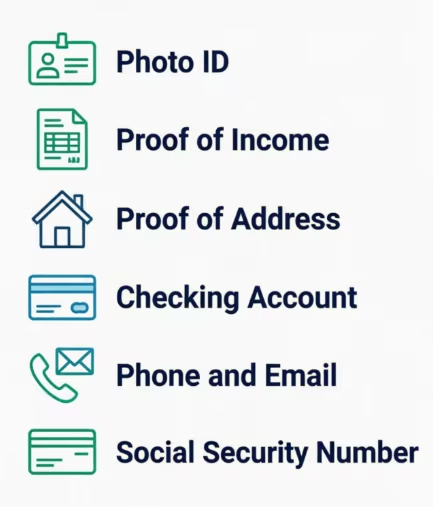
If you’re cashing a check rather than borrowing, you mainly need the check itself plus your ID. Loans need the full stack.
💡 Pro Tip: Take clear photos of every document on your phone before you go. If a store computer can’t read your printed pay stub, staff can often accept a clean phone image.
How the In-Store Application Process Works
Walking into a PLS 24/7 location is designed to be fast. Most stores are open long hours, and many are open 24 hours a day, which is where the “24/7” name comes from.
Here is what happens, step by step:
- Arrive at the store. You’ll see a teller counter behind bulletproof glass. Tell the teller you’d like to apply for a cash advance or payday loan.
- Hand over your documents. The teller checks your ID, scans your pay stub, and confirms your address.
- Fill out a short application. This asks for your job details, income, bank information, and Social Security number. It usually takes 5 to 10 minutes.
- Wait for the decision. PLS runs an internal check and often a soft check with alternative credit databases, not the main credit bureaus. This part usually takes 15 to 30 minutes.
- Review your loan agreement. If approved, the teller prints your contract. It shows the loan amount, the fee, the APR, the due date, and how repayment will be pulled.
- Sign and get your cash. Once you sign, the teller hands you the cash or loads it onto a prepaid card. You leave with money in hand.
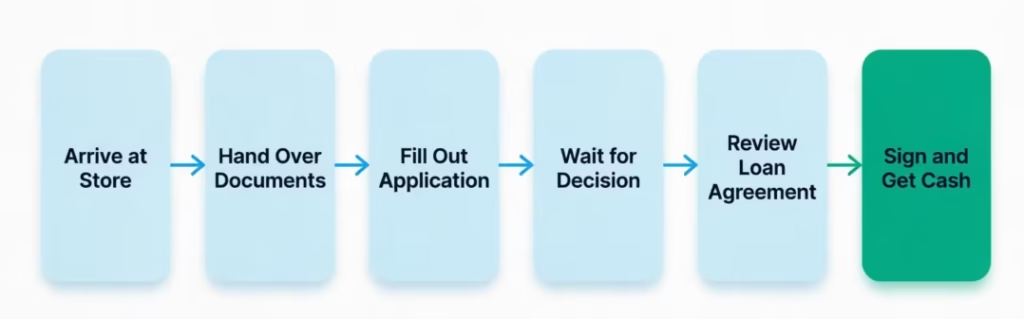
The whole visit often takes under an hour. Bring patience for busy times, especially on Fridays and the first of the month.
How the Online Application Process Works
If you’d rather skip the trip, PLS 24/7 lets you apply online through pls247.com in states where online loans are allowed. The steps mirror the in-store flow, just done from your couch.
- Go to pls247.com and pick your state from the drop-down menu. This is important because the site only shows you products legal where you live.
- Choose “Apply for a Loan” or the equivalent link for cash advance in your state.
- Create an account. You’ll enter your name, email, phone number, and set a password.
- Complete the application form. Fill in your address, employment details, income, and bank routing and account numbers.
- Upload your documents. You’ll be asked to snap photos of your ID, most recent pay stub, and possibly a utility bill.
- Submit and wait. The system runs its checks in the background.
Most online applications get an initial answer in a few minutes, though final approval can take a few hours if a real person needs to review the file.
What Happens After You Submit Online
After you hit submit, one of three things happens. You may be approved instantly, meaning your loan agreement pops up on the screen for e-signature. You may be pending review, which usually means a staff member is checking your income or bank details manually. Or you may be declined, in which case the site or an email will tell you why in general terms.
Once you e-sign, the money moves. If it’s early in the business day and your bank supports fast ACH, you may see the deposit within a few hours. Later in the day, expect it the next business morning. Some states also let you finish the process at a nearby store, where you can pick up cash the same day.
How Fast You Actually Get Your Money
Speed is the whole reason people choose PLS over a bank. The exact timing depends on which channel you use.
- In-store loans. You almost always leave with cash the same visit, usually within 30 to 60 minutes of walking in.
- In-store check cashing. Cash is handed to you in minutes, often less than 10.
- Online loans with bank deposit. Same day if you apply and get approved before the mid-morning ACH cutoff, usually next business day if you apply later.
- Online loans with cash pickup at a store. Same-day pickup once you’re approved and the store confirms your file.
- Weekends and holidays. Banks don’t run ACH transfers on weekends or federal holidays. A Saturday online approval usually funds Monday morning.
If you truly need money in the next hour, going in person beats applying online. If you can wait until the next morning, online is easier.
What a PLS Cash Advance Really Costs
This is where most surprises happen. Small-dollar loans look cheap in dollar terms and expensive in percentage terms, and both numbers matter.
For check cashing, the fee is usually a percent of the check face value. It commonly falls between about 1% and 5%, depending on the check type. Government and payroll checks tend to be cheapest. Personal checks cost more because they carry more risk of bouncing.
For payday and installment loans, you pay a finance charge plus, in some products, ongoing interest. On a two-week payday loan, a $15 fee per $100 borrowed is common in states that allow it. That single fee equals an APR of about 391% when annualized, which is why the Consumer Financial Protection Bureau warns borrowers to treat these loans as short-term emergency tools, not repeat credit.
Federal law under the Truth in Lending Act requires PLS to disclose the finance charge and APR in writing before you sign. Read the box on the contract that shows “Finance Charge” and “Annual Percentage Rate.” Those numbers, not the marketing on the wall, tell you the real price.
Worked Example: Borrowing $300
Say Sarah, a 34-year-old warehouse shift lead in Phoenix, borrows $300 from PLS to cover a car repair. Her state allows a $15-per-$100 payday fee, so her finance charge is $45. Her loan term is 14 days, ending on her next payday.
Here is what her deal looks like:
| Item | Amount |
|---|---|
| Amount borrowed | $300.00 |
| Finance charge (fee) | $45.00 |
| Total to repay in 14 days | $345.00 |
| APR (annualized) | ~391% |
On payday, PLS pulls $345 from Sarah’s checking account. If she doesn’t have $345 available that morning, her bank may charge a $35 overdraft fee, and PLS may add a returned-payment fee of $15 to $30. A $300 problem can quickly turn into a $410 problem.
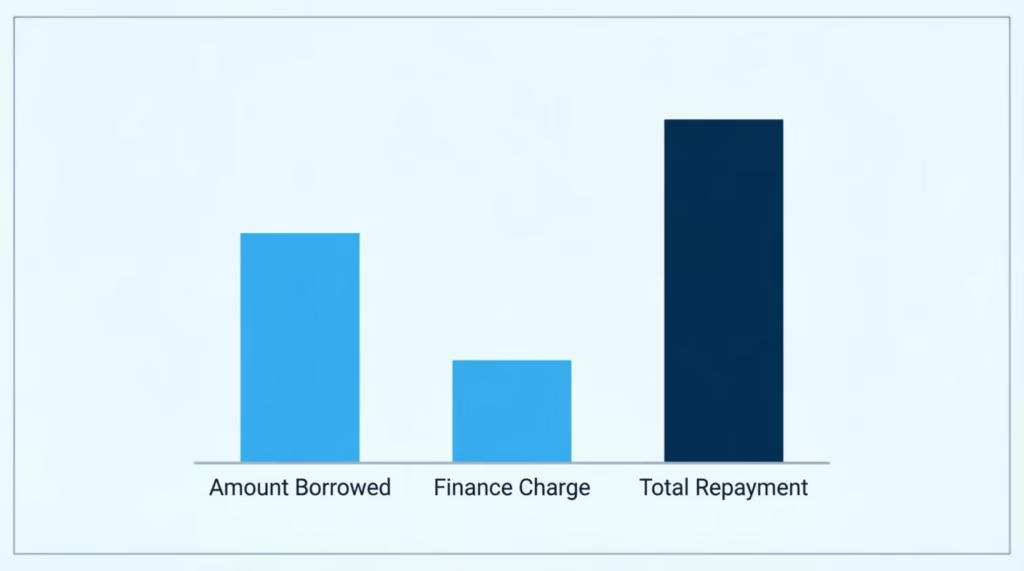
That is the risk. The loan itself is easy. Repayment is the part you must plan for.
⚠️ Mistake to Avoid: Don’t borrow the maximum just because it’s offered. Borrow only what you can repay in full on the due date. Every extra $100 borrowed adds another $15 to $20 in fees.
How State Laws Change What’s Available to You
PLS’s product menu is not the same nationwide. Each state sets its own rules on interest rate caps, loan sizes, loan terms, and whether payday loans are even legal. That is why the same PLS sign in one city offers a two-week payday loan, while another only offers a 6-month installment loan.
Some states cap small-dollar loan APRs at 36% or lower, which effectively bans traditional payday lending. Others allow triple-digit APRs with limits on rollover activity. A few states have no payday statute at all, which usually means PLS does not lend there.
Before you plan on a specific product, pick your state on pls247.com. The site adjusts to show only what is legally offered where you live. If the “loans” option is missing on your state page, PLS likely only offers check cashing, money orders, and card services there.
States Where Payday Loans Aren’t Offered
Illinois is the clearest example. The state passed the Predatory Loan Prevention Act, which caps most consumer loan APRs at 36%. Under that cap, the classic payday loan model no longer works, so PLS and other lenders shifted to small installment loans or stopped lending in the state. A report from NPR Illinois found that far fewer Illinois residents used payday lenders after the cap took effect.
Other states with strict caps or outright bans include New York, New Jersey, Massachusetts, Connecticut, Pennsylvania, Vermont, West Virginia, Maryland, Georgia, Arkansas, North Carolina, and the District of Columbia. In these places, PLS either does not operate or only offers non-loan services like check cashing and prepaid cards. Always confirm on the pls247.com state page before you plan on a specific product.
Does PLS Check Your Credit
Credit worry is one of the top reasons people hesitate to apply. The honest answer is: PLS usually does check something, but it’s not the same check a bank runs for a car loan or mortgage.
For most PLS loans, the company pulls a soft inquiry or uses an alternative credit bureau such as Clarity Services, DataX, or FactorTrust. These databases track small-dollar lending activity but do not affect your FICO or VantageScore. A soft check does not lower your score, and it usually does not appear on your standard credit report.
Traditional credit bureaus (Experian, Equifax, and TransUnion) come into play in two situations. First, if PLS or one of its lending partners chooses to run a hard pull for a larger installment loan, that will show on your report and can nudge your score down a few points for a short time. Second, if you default and the debt gets sent to collections, that collection account can land on your main credit reports and hurt your score for years.
The upside is that on-time repayment of a standard PLS payday loan usually does not help your credit score either, because PLS often does not report positive payment history to the main bureaus. If building credit is one of your goals, a small-dollar loan from a credit union or a credit-builder product is a better tool.
How Repayment Works
Repayment is set the moment you sign the loan agreement. There are no surprises about when or how the money leaves your account, as long as you read the contract.
The three most common repayment methods are:
- Automatic ACH debit. PLS pulls the full amount from your checking account on the due date. This is the default for most online loans. Make sure the money is in the account the night before, not the morning of.
- In-store cash payment. You walk into any PLS 24/7 store on or before the due date and hand over cash. Get a printed receipt every time.
- Post-dated check. In some states, you write PLS a check dated for your payday. On that date, PLS deposits it. If the check bounces, both your bank and PLS may charge fees.
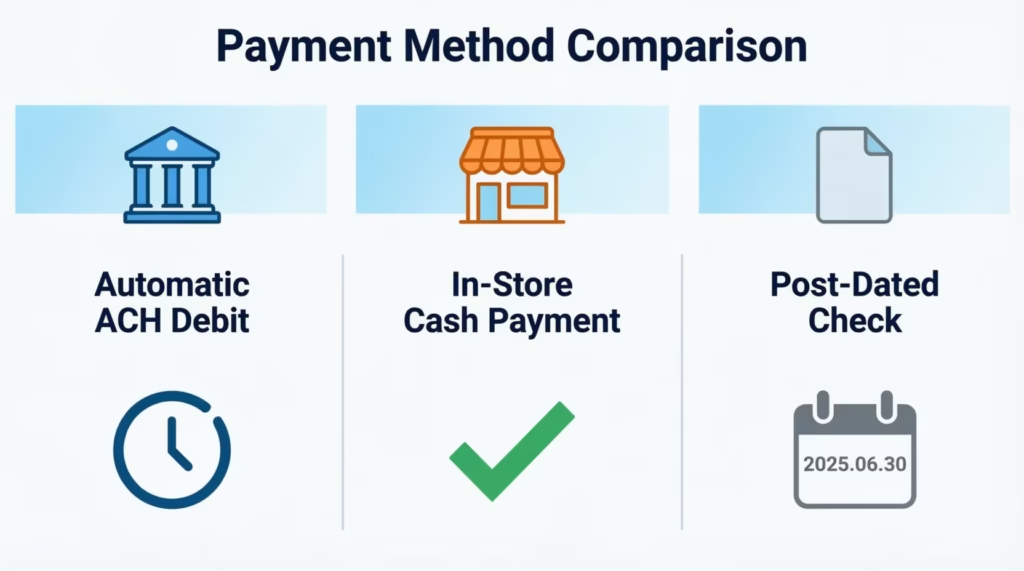
Installment loans work a little differently. Instead of one lump sum, you pay a fixed amount every week, two weeks, or month, until the balance is cleared. Each payment covers part principal and part finance charge. You can usually pay early with no penalty, which lowers your total cost.
Set a phone reminder for two days before the due date. That gives you time to move money, cancel a scheduled expense, or ask PLS about a payment plan if you’re short.
What Happens If You Can’t Repay on Time
Missing a due date is stressful, but it is not the end of the world. What matters is what you do in the next 48 hours.
If your ACH payment bounces, PLS usually tries again once or twice, so you may see repeated overdraft fees from your bank. PLS itself will add a returned-payment fee, often $15 to $30, plus a late fee that varies by state. Interest keeps accruing on installment loans until the balance is paid.
After a missed payment, PLS will start contacting you by phone, text, and mail. If several weeks pass with no contact from you, the account may be sent to a third-party collector, and the debt could be reported to a credit bureau at that point.
The single most important step is to call PLS or visit a store before you miss the payment. Most state laws require lenders to offer some form of Extended Payment Plan (EPP) that lets you break the balance into smaller installments at no extra cost, but you often must request it before the loan defaults.
Rollovers, Extensions, and Cooling-Off Rules
A rollover means paying only the fee on the due date and starting the loan over for another cycle. It sounds convenient, and it is a debt trap. Every rollover adds another full fee without reducing what you owe.
Many states now ban or tightly limit rollovers on payday loans. States often require a mandatory cooling-off period between loans, usually 24 hours to 7 days, and cap how many payday loans one borrower can have in a year. This is why PLS may say no when you try to take a second loan right after paying off the first.
An extension is different from a rollover. An extension usually means PLS agrees to move your due date, sometimes for a small fee, without restarting the loan. An Extended Payment Plan, offered in many states, is the best option: it splits the amount into 3 to 4 no-fee installments so you can catch up without piling on more charges.
If you’re stuck, reach out early. Contacting PLS is far cheaper than letting the account default.
Frequently Asked Questions (FAQs)
Does PLS let you borrow money?
Yes, PLS offers payday loans and installment loans in states where it’s licensed to lend. Approval depends on your income, state loan caps, and PLS’s internal underwriting checks.
What can get you denied for a payday loan at PLS?
You’ll likely get denied if you already have an open payday loan, are in a mandatory cooling-off period, have a frozen or closed bank account, or can’t verify your identity. Active military duty can also disqualify you due to the federal 36% APR cap on service members.
What credit score do I need for a payday loan?
PLS typically doesn’t require a specific credit score for payday loans, since it usually checks alternative databases like Clarity Services or FactorTrust instead of your FICO score. A soft check like this won’t lower your credit score or appear on your standard credit report.
How much would a $500 payday loan cost?
At a common rate of $15 per $100 borrowed, a $500 payday loan would carry a $75 finance charge, making your total repayment $575. That fee structure annualizes to roughly 391% APR.
Does PLS check your credit?
PLS usually runs a soft inquiry through an alternative credit bureau rather than pulling your Experian, Equifax, or TransUnion report. A hard pull only happens for larger installment loans, and defaulted debt sent to collections can eventually hit your main credit report.
Is PLS considered a bank?
No, PLS Financial Services is not a bank. It’s a storefront and online provider of small-dollar money services, operating under the PLS 24/7 brand and the pls247.com website.
What does PLS stand for in finance?
PLS stands for “People’s Loan Source.” Despite the name, the company sells many non-loan services too, including money orders, prepaid debit cards, and bill payment.
Can PLS take money off your card?
PLS repayment is typically pulled through an automatic ACH debit from your checking account on the due date, not directly off a card. Some states allow a post-dated check instead, but a prepaid card isn’t the standard repayment method described in PLS loan agreements.
How hard is it to get approved for a payday loan at PLS?
Approval is generally easier than a bank loan since PLS accepts non-traditional income like gig work, Social Security, or disability, and skips traditional credit checks. You mainly need proof of steady income, a checking account, and a valid photo ID.
What happens if you can’t repay a PLS loan on time?
A missed ACH payment can trigger bank overdraft fees plus a PLS returned-payment fee, often $15 to $30, along with a state-varying late fee. Most states require PLS to offer an Extended Payment Plan if you request it before the loan defaults.
Wrapping Up
A PLS cash advance can be a fast fix when you need money before payday, as long as you go in with clear eyes. To save money, cash a check if you have one.
Borrow only what you can repay fully by the due date. Also, check your state’s laws before applying. Bring the right documents, read the APR box, and set a reminder for repayment.
If a friend or coworker is weighing a payday loan without knowing the true cost, share this guide with them. A five-minute read could save them hundreds in fees and a much bigger headache down the road.