
You’re staring at a real decision right now. Maybe it’s a card balance that’s gotten uncomfortable, or a big expense you can’t cover from savings. Either way, you’re trying to figure out whether a personal loan or a credit card is the smarter way to borrow. Pick wrong, and the mistake can cost you thousands in extra interest.
A personal loan is usually the cheaper choice for larger amounts you need more than a few months to repay, while a credit card wins for smaller spending you can pay off fast.
What you’ll find below:
- The real rate gap between the two options.
- Cost examples at three balance levels.
- A clear explanation of how each choice impacts your credit score.
- A straightforward framework to help you decide based on your numbers.
At a Glance
This guide compares personal loan vs credit card borrowing costs, covering real interest rate data, worked payoff examples at three balance levels, credit score impact, and a decision framework based on timeline, amount, and credit profile.
Core Facts:
- The average credit card rate on accounts assessed interest was 22.15% in Q2 2026, compared to an average 24-month personal loan rate of 11.86%, a gap of roughly 10 percentage points.
- Personal loans are installment loans with a fixed lump sum, fixed rate, and fixed monthly payment, typically repaid over 24 to 60 months, sometimes up to 84 months.
- Credit cards are revolving credit with a reusable limit; paying the full statement balance by the due date avoids interest entirely through the grace period.
- Only revolving balances count toward credit utilization, so paying off a card with a personal loan can lower utilization while total debt stays the same, which can raise a credit score.
- Personal loan origination fees typically range from 1% to 10% of the loan amount and are often deducted from the loan proceeds before disbursement.
- A TransUnion study cited in the article found consolidators saw median card utilization drop from 59% to 14% immediately after consolidation, though it rose to 42% within 18 months for some borrowers.
Best for:
- Readers comparing a specific balance or expense who want real cost data instead of general “loans are cheaper” advice.
- Anyone considering consolidating credit card debt with a personal loan and wanting to understand the credit score impact first.
- Readers weighing a 0% intro APR credit card against a personal loan and wanting to understand the risk if the balance isn’t paid off in time.
Personal Loan vs. Credit Card: Core Structural Differences
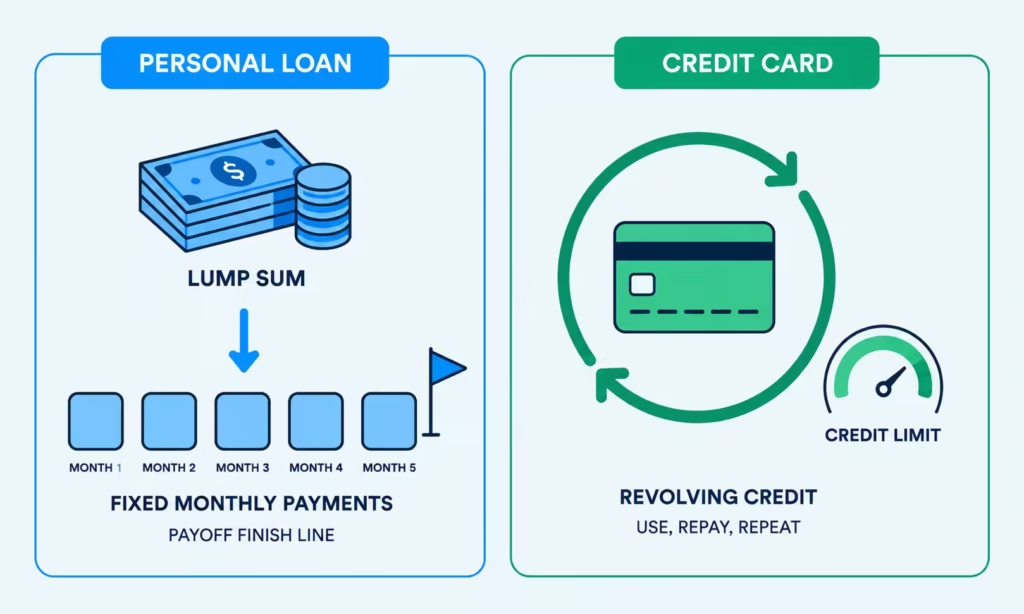
A personal loan gives you a lump sum to repay in fixed monthly payments. In contrast, a credit card offers a reusable credit line. You can use it, pay it back, and use it again.
That one structural difference explains almost everything else in this article. It’s why the two products carry different rates, hit your credit score differently, and demand different levels of discipline. A personal loan is an installment loan with a built-in finish line. A credit card is revolving credit with no finish line at all unless you create one. Keep that in mind as we get into the numbers.
How a Personal Loan Works
A personal loan works like this: you apply once, get approved for a set amount, and receive the full lump sum in your bank account. Most personal loans are unsecured, meaning you don’t put up your car or home as collateral.
From there, the terms stay locked in:
- You get a fixed interest rate, so your rate doesn’t drift up over time.
- You make the same monthly payment every month until the balance hits zero.
- Loan terms typically run 24 to 60 months, though some lenders stretch to 84 months.
- When you make the last payment, the debt is done. There’s no balance to fall back into.
Common uses include debt consolidation, medical bills, home repairs, and other large one-time expenses. The fixed structure is the whole point. You trade flexibility for a guaranteed payoff date.
This structure makes budgeting much easier. You know exactly how much you need to pay each month and when you will finally be debt-free. You do not have to worry about rising interest rates or lingering balances. It gives you a clear plan to reach your goal. Once you make that final payment, the account closes automatically.
How a Credit Card Works
A credit card gives you a credit limit, say $8,000, and lets you borrow against it whenever you want. As you pay the balance down, that credit becomes available again. That’s the “revolving” part of revolving credit.
Two mechanics matter most here. First, the minimum payment. Card issuers typically set it as a small slice of your balance, often around 1% of the balance plus that month’s interest. Paying only the minimum barely dents the principal, which is why balances can linger for years.
Second, the grace period. If you pay your full statement balance by the due date, you owe zero interest on purchases. A card used this way costs nothing at all. The catch: card APRs are variable, and interest only kicks in when you carry a balance. That’s when a card gets expensive, fast.
Interest Rate Comparison: What Each Option Actually Costs
Here’s where the rate gap gets real. The Federal Reserve’s G.19 consumer credit data for the second quarter of 2026 puts the average rate on credit card accounts that were actually assessed interest at 22.15%. Across all card accounts, including ones paid in full, the average was 20.94%.
Personal loans sit far lower. That same Fed release shows the average finance rate on a 24-month personal loan from a commercial bank at 11.86%. Bankrate’s weekly rate survey found a similar picture in early September 2026, with a national average personal loan rate of 12.21% and rates as low as 6.20% for borrowers with excellent credit.
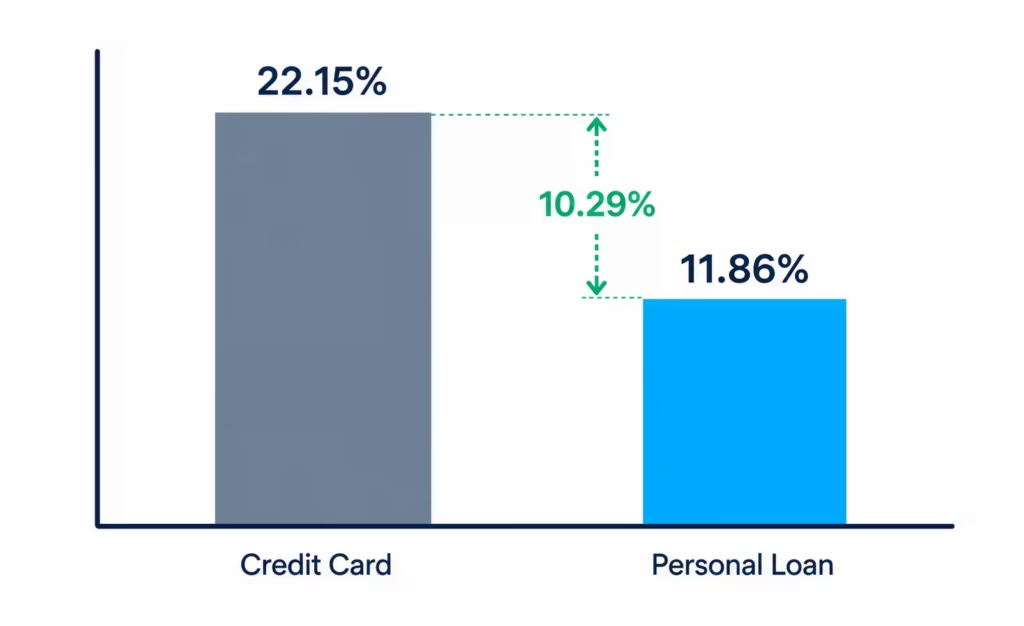
So the typical gap runs about 10 percentage points. Why the difference? Both products are usually unsecured, but lenders price them on structure. A card balance can grow anytime, so issuers charge for that open-ended risk. A personal loan has a fixed balance that only shrinks, which makes it safer to lend against.
Two caveats before you use these numbers. First, rates move. Check current averages before you decide anything. Second, 0% intro APR cards are a major exception to this gap, and they get their own section below.
These specialized cards allow you to borrow money without paying any interest for a set amount of time. Stores and bank issuers offer these deals to attract new customers.
You must typically pay off the entire balance before the promotional period ends. If you fail to do so, the remaining amount will start to accrue interest at a much higher standard rate. Always read the fine print to understand the specific terms and deadlines involved.
Monthly Payment and Total Interest Cost, by Balance and Term
General statements like “loans are cheaper” don’t help much. You need to know by how much, for your balance. Let’s run the math at three levels.
Assumptions: The card has a 22% APR. Minimum payments are interest plus 1% of the balance. This is a common formula. The personal loan has a 12% APR, which is near the national average. Rounded to the nearest dollar.
| Balance | Card: minimum payments only | Loan: fixed payments | Interest saved with the loan |
|---|---|---|---|
| $5,000 | First payment ~$142; about 19 years to pay off; ~$8,100 interest | $166/mo for 36 months; ~$979 interest | ~$7,121 |
| $10,000 | First payment ~$283; about 25 years; ~$17,266 interest | $332/mo for 36 months; ~$1,957 interest | ~$15,309 |
| $20,000 | First payment ~$567; about 31 years; ~$35,600 interest | $527/mo for 48 months; ~$5,280 interest | ~$30,319 |
Look at the $10,000 row. Minimum payments cost more in interest than the original debt. That’s not a rounding error. It’s how revolving credit is designed to work.
Maybe you’re thinking you’d never pay just the minimum. Fair. Paying the fixed amount on the card won’t help much. The 22% APR still hurts. If you pay $332 a month on a $10,000 balance, it takes about 45 months. You’ll end up paying around $4,679 in interest. In contrast, the loan costs only $1,957 in interest. The loan still saves about $2,700.
The break-even logic is simple. A loan saves money when the rate gap, multiplied by your balance and your repayment time, beats any loan fees. Bigger balance, longer timeline, wider rate gap: the more the loan wins. Tiny balance paid off in a month or two: the card costs little or nothing, and a loan just adds fees and a hard inquiry.
How to Run This Calculation With Your Own Numbers
You can replicate this in about ten minutes. Gather three things:
- Your current card APR and balance. Both are on your statement.
- A real loan quote, not an advertised teaser. Use prequalification tools (more on those below) to get an actual rate estimate.
- A loan term you’re considering. Shorter terms mean higher payments but less total interest.
Then plug the numbers into a personal loan calculator and a credit card payoff calculator. Compare the two on total cost (all payments plus all fees), not on monthly payment alone. A lower monthly payment over a longer stretch often costs more overall. And remember to add any origination fee to the loan side before you compare.
Fees That Change the Real Cost
Interest isn’t the whole price tag. These fees can quietly flip which option is cheaper:
- Origination fees (personal loans). Many lenders charge 1% to 10% of the loan amount, often deducted from your proceeds before you get the money. A 5% fee on a $10,000 loan means $9,500 lands in your account. Need the full $10,000? You’d have to borrow about $10,526 and pay interest on the fee too.
- Prepayment penalties (some personal loans). Some lenders charge you for paying off early. Not all do, so check the loan agreement before signing. If there’s a penalty, early payoff flexibility disappears.
- Annual fees (some credit cards). Plenty of solid cards charge nothing, but annual fees on rewards cards can run $95 to several hundred dollars. If you’re carrying a balance, the rewards rarely justify the fee anyway.
- Balance transfer fees. Moving card debt to a 0% intro APR card typically costs 3% to 5% of the transferred amount, added to your new balance.
- Late fees (both). Miss a payment on either product, and you’ll pay a fee, plus possible credit score damage once the payment is 30 days past due.
The fix is easy: fold every fee into the total-cost comparison from the last section. A 12% loan with a 6% origination fee isn’t really a 12% loan.
Calculate the actual annual percentage rate, or APR, to see the true cost. This number combines the interest rate with all mandatory fees. Always ask the lender for the APR before you commit. It is the best tool for comparing two different loan offers. If you only look at the base interest rate, you might miss hidden expenses that make a loan more expensive than it looks.
How Each Option Affects Your Credit Score
This is the most misunderstood part of the whole comparison, so let’s slow down.
Your credit utilization ratio is the share of your revolving credit limits that you’re currently using. If you have $10,000 in total card limits and owe $6,000, your utilization is 60%.
The “amounts owed” category, which includes utilization, drives about 30% of your FICO Score, making it one of the biggest scoring factors. Experian notes that scores tend to benefit when utilization stays under 30%, with single digits being even better.
Here’s the key mechanism: only revolving balances count toward utilization. Installment loans don’t. So when you pay off a $6,000 card balance with a $6,000 personal loan, your total debt hasn’t changed, but your utilization drops from 60% to roughly 0%. That shift alone can lift a score.
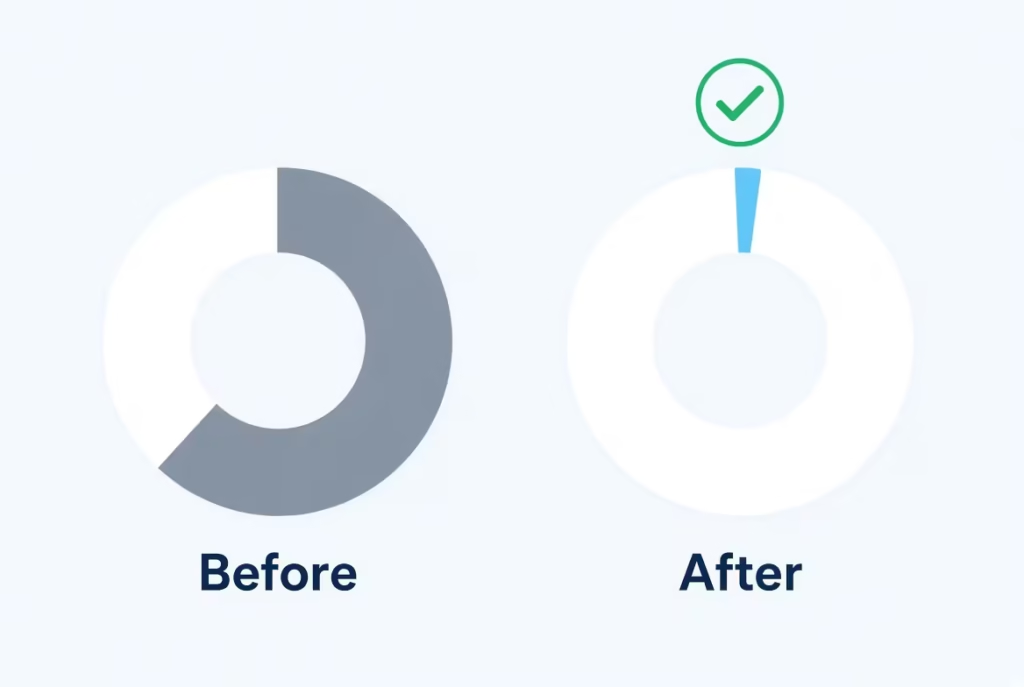
One critical warning: this only works if the card stays open and you don’t run it back up. Close the card, and you lose its credit limit, which pushes your utilization right back up. Run it back up, and you’ve got both problems at once. (The consolidation section below digs into that risk.)
Other Credit Score Factors: Account Mix, Inquiries, and Account Age
A few secondary effects round out the picture:
- Hard inquiries. Applying for a personal loan or a new credit card triggers a hard inquiry, which can trim a few points off your score for a short period. Applying for both at once compounds it.
- Credit mix. Scoring models like to see you handle different credit types. Adding an installment loan to a file that’s all revolving credit can help modestly.
- Account age. Closing your oldest card after paying it off shortens your average account history and shrinks your available credit. Both can nudge your score down.
Expect a pattern of short-term dip, longer-term gain. The inquiry and new account might lower your score a bit at first. But lower utilization and on-time payments will help rebuild it over the next few months. The exact size of any change varies by person, since scoring models weigh your full credit file.
What Credit Score You Need, and What Rate to Expect
Advertised rates are marketing. Your rate is personal. Here’s a realistic tier map:
| Credit tier (FICO) | Personal loan APR, typical range | Credit card outlook |
|---|---|---|
| Excellent (760+) | Roughly 6% to 12%; access to the best advertised rates | Easy approvals; best 0% intro APR and balance transfer offers |
| Good (700–759) | Roughly 12% to 18% | Approved for most cards; APRs near the national average |
| Fair (640–699) | Roughly 18% to 28%+ | Approvals possible; higher APRs, smaller limits, few 0% offers |
These ranges shift with the market, so treat them as ballparks, not promises.
Score isn’t the only hurdle, either. Lenders look at your income, job stability, and debt-to-income ratio (DTI). DTI shows how your monthly debt payments stack up against your monthly income. A strong score with a stretched DTI can still mean a worse offer or a denial.
Why does the “as low as 6%” teaser rarely apply? Because it describes the best-case borrower. If your score sits in the fair range, expect an offer far above the headline number.
💡 Pro Tip: Many personal loan lenders and card issuers offer prequalification with a soft credit pull, which doesn’t affect your score. Prequalify with two or three lenders first, then compare real offers instead of guessing from advertised rates.
When a Personal Loan Is the Better Choice
A personal loan tends to win when one or more of these describe you:
- The expense is large, and the payoff will take more than a few months. At a 10-point rate gap, every extra month of carrying a card balance costs you real money, as the tables above showed.
- You’re consolidating high-APR card debt. Moving a 22% revolving balance to a 12% installment loan cuts interest and drops your utilization at the same time.
- You want a fixed finish line. The same payment every month, ending on a known date, removes the willpower variable entirely.
- Revolving credit tempts you. If an open credit limit feels like spendable money, the loan’s closed structure protects you from yourself.
- You can qualify for a rate meaningfully below your card APR. “Meaningfully” means enough to beat the fees. A 2-point gap on a $3,000 balance barely matters. A 10-point gap on $15,000 matters a lot.
If three or more of these fit, the loan is probably your answer. Run your own numbers to confirm.
When a Credit Card Is the Better Choice
Cards aren’t the villain they’re made out to be. A card wins clearly in these cases:
- Small purchases you can pay off within one to a few billing cycles. A $2,000 expense paid off over two months at 22% APR costs roughly $75 in interest. A loan for the same amount adds an origination fee, a hard inquiry, and a multi-year contract. That’s overkill.
- You can pay in full every month. This is the free-credit case. Pay the full statement balance by the due date, and the grace period means you owe zero interest. No loan can beat free.
- You’re building or maintaining credit history. Regular, small purchases paid in full keep your accounts active and your file healthy at no cost.
- You need ongoing access to funds. Freelancers with lumpy income, for example, may need to borrow, repay, and borrow again. A lump sum loan can’t do that.
- Rewards actually pencil out. Cash back or points have real value, but only when you pay in full. Carry a balance at 22%, and the interest wipes out the rewards many times over.
The pattern: cards reward speed and discipline. If either is missing, the math flips toward the loan.
0% Intro APR Credit Cards: A Middle-Ground Option (With a Catch)
A 0% intro APR card means you pay no interest on purchases or balance transfers. This deal usually lasts 12 to 21 months with major issuers. For the right borrower, this beats both regular cards and personal loans.
The math can be striking. Say you transfer an $8,000 balance to a card with 0% for 18 months and a 3% transfer fee. Your total cost is $240, and paying about $445 a month clears the debt before interest starts. The same $8,000 as an 18-month personal loan at 12% costs about $781 in interest. The card saves you over $500 if you finish on time.
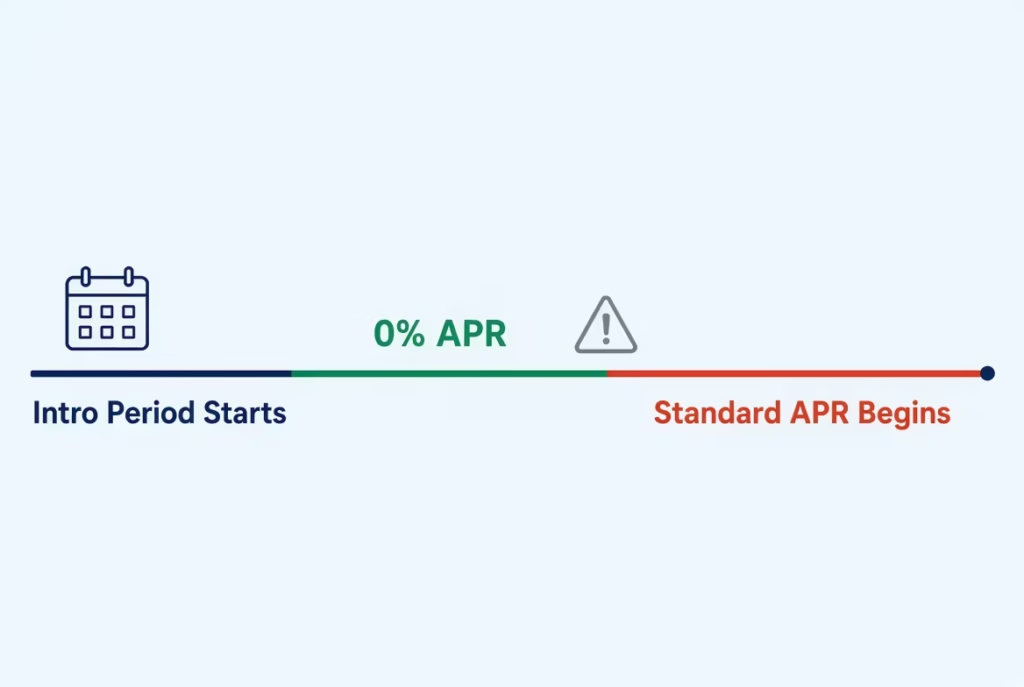
That “if” carries real weight. When the intro period ends, any leftover balance starts accruing the card’s standard APR, often 20% or more. And some retail “deferred interest” promotions are worse: miss the deadline and interest gets charged retroactively back to day one. Bank-issued 0% intro APR offers usually aren’t structured that way, but read the terms so you know which type you hold.
Only use this route if all of these are true:
- You can pay off the full balance during the intro period. Just divide the balance by the number of months. Then, check if that payment fits your budget.
- You won’t add new charges to the card while paying it down
- You’ve accounted for the balance transfer fee (typically 3% to 5%)
- You know exactly what APR kicks in afterward and when
Fail any one of these, and a fixed-rate loan is the safer bet.
Using a Personal Loan to Pay Off Credit Card Debt
This is the most common real-world use of a personal loan, and the mechanics are simple. You take out the loan and use it to pay off your credit cards. Some lenders may pay the cards directly. Then, you just make one fixed monthly loan payment instead of managing multiple card bills.
Done right, consolidation attacks two problems at once. First, cost: swapping a 22% APR for a 12% APR cut total interest by roughly 80% in our $10,000 example. Second, your credit score: the card balances drop to zero, so your utilization craters while your total debt stays the same.
Data from a TransUnion study found that consumers who consolidated card debt with a personal loan saw their median card utilization fall from 59% to 14% immediately, along with an average credit score increase of 18 points.
Keep at least one paid-off card open afterward. Its unused limit keeps your utilization low, and its age supports your credit history. Closing it feels tidy but works against you.
The Consolidation Trap: Avoiding New Debt on the Same Cards
Here’s the pattern that quietly undoes everything. The loan pays off the cards. The cards sit there with fresh, empty limits. Spending slowly creeps back. Eighteen months later, there’s a loan payment plus new card balances.
The TransUnion study showed that median card utilization for consolidators rose to 42% in 18 months. This happened even though consolidation helped those who controlled their spending.
Three concrete safeguards:
- Remove the temptation. Freeze the card (literally, in ice, or via the issuer’s app lock) or ask the issuer to lower the credit limit. Keep the account open, just hard to use.
- Fix the budget before you consolidate. Consolidation reshuffles debt; it doesn’t reduce it. If the spending that built the balance continues, no loan will save you.
- Automate and track. Set the loan to autopay so you never miss it, and track your total debt across both products monthly so a creeping card balance can’t hide.
How to Decide: A Framework Based on Amount, Timeline, and Credit Profile
Most articles tell you “big expense equals loan, small expense equals card.” That’s half the picture. The real deciding factor is repayment timeline, with amount and credit profile as the other two legs.
Work through it in this order:
- Timeline first. Can you pay this off within one to three billing cycles? Use a card and pay in full or near-full; interest will be zero or trivial. Will it take longer than about six months? A loan’s lower rate almost always wins on cost.
- Then amount. Under roughly $1,000, loan fees and hassle outweigh any rate savings. Over roughly $5,000 with a multi-year payoff, the rate gap compounds into thousands of dollars, as the tables above showed.
- Then credit profile. Check your score against the tier table. Excellent credit unlocks 0% intro APR offers that can beat even a loan. Fair credit flips the script: loan APRs in the 20s may barely beat your card, and the fees could make the loan the worse deal.
- Finally, be honest about behavior. If open credit limits have burned you before, weight the loan’s fixed structure heavily, even at a slightly higher cost.
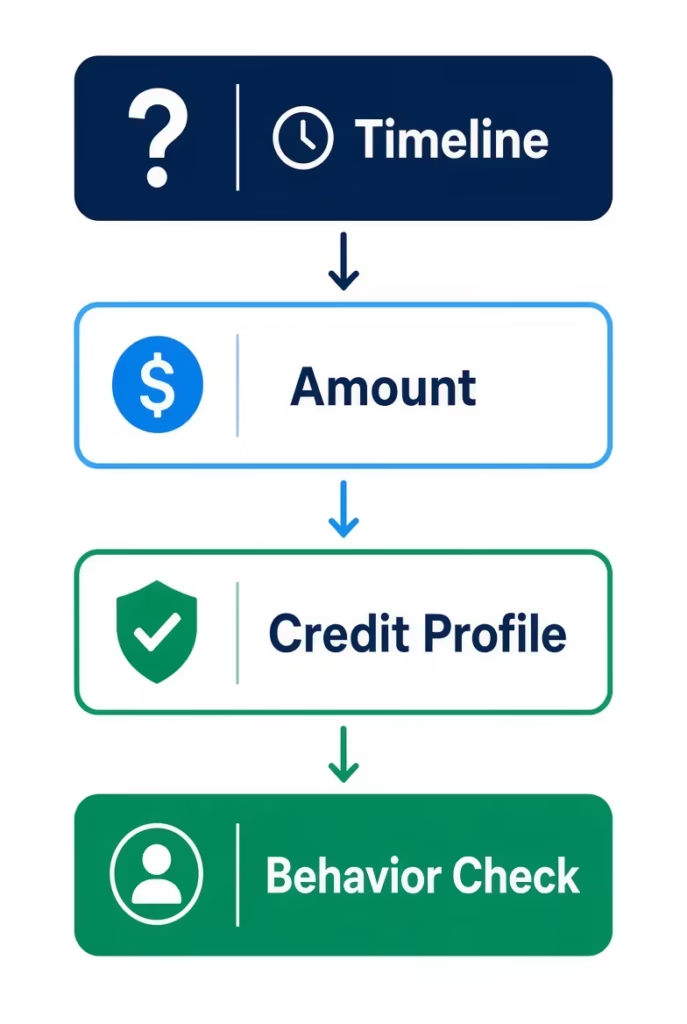
No single factor decides alone. Timeline sets the direction, amount sets the stakes, and your credit profile sets the actual prices you’re choosing between.
Can You Use Both at the Same Time?
Yes, and millions of people do. Nothing about holding a personal loan stops you from using a credit card, or vice versa.
One thing to know: when you apply for either product, the lender counts your existing obligations from the other. A personal loan payment raises your monthly debt load, which feeds into your DTI when a card issuer reviews your application, and card balances do the same when a loan lender underwrites you.
The combo that often works best after consolidation: the loan carries the old debt on a fixed schedule, while one card handles everyday spending, paid in full each month. You get the loan’s structure and the card’s flexibility without the interest.
Speed, Application Process, and Practical Logistics
When you need money fast, the two products behave very differently:
- Existing credit card: instant. The credit is already there; you just swipe. Nothing beats an open credit line for speed.
- New credit card: approval can be instant online, but the physical card typically takes a week or so to arrive (some issuers offer instant virtual numbers).
- Personal loan: many online lenders fund the same day or the next business day after approval. Some banks and credit unions take a few business days.
Paperwork differs too. A personal loan application usually asks for proof of income (pay stubs or tax returns), employment details, ID, and permission to pull your credit. A card application is lighter, typically asking only for income and housing costs, since the issuer underwrites a smaller exposure.
Also check use restrictions. Some personal loan lenders bar using proceeds for things like tuition, investments, or business expenses. Credit cards rarely restrict what you buy.
The practical takeaway: if you need funds today and already have a card with available credit, the card is your only instant option. If you have a few days, get loan quotes and compare properly. And a card you don’t yet have helps neither emergency.
Common Mistakes to Avoid When Choosing Between the Two
A quick sweep of the errors that cost people the most:
- Comparing advertised rates instead of your rate. The “as low as” number is for top-tier borrowers. Prequalify first, then compare real offers.
- Ignoring fees. An origination fee, balance transfer fee, or annual fee can erase a rate advantage. Compare total cost, always.
- Consolidating without changing the spending. The TransUnion data above shows how often balances creep back. Fix the budget first, then consolidate.
- Taking a loan for a small, short-term expense. A purchase you could clear in a month or two costs nothing on a card paid in full. A loan adds fees and a hard inquiry for no benefit.
- Missing the end of a 0% intro period. Set a calendar reminder two months before expiration. Any leftover balance jumps to the standard APR.
- Closing the paid-off card right after consolidating. You lose the credit limit and the account age, and your utilization spikes. Keep it open and out of reach instead.
Frequently Asked Questions (FAQs)
What’s better, a personal loan or a credit card?
A personal loan is cheaper for larger balances that take months to repay. But a credit card is better for smaller purchases you can pay off in one or two billing cycles. The right answer depends on your repayment timeline, the amount, and your credit profile.
Are personal loans a good idea?
Personal loans are a good option when you’re consolidating high-APR credit card debt or financing a large expense with a fixed payoff date. The average personal loan rate sits near 12%, roughly 10 points below the 22% average credit card rate, which can save thousands on larger balances.
Do personal loans affect credit score?
Yes, both positively and negatively. Applying triggers a hard inquiry, which might lower your score a bit at first. However, using the loan to pay off card debt reduces your credit utilization ratio. This can boost your score in a few months.
How much would a $10,000 personal loan cost per month?
At a 12% APR over a common 36-month term, a $10,000 personal loan costs roughly $332 a month and about $1,957 in total interest. The same balance on a credit card at 22% APR with minimum payments costs far more over time.
Can I pay off a personal loan early?
It depends on the lender. Some personal loans have a prepayment penalty for early payoff. Check your loan agreement before signing if you want flexibility.
What are 5 disadvantages of credit cards?
Credit cards have variable APRs that can rise suddenly. They often require minimum payments that hardly lower your principal. Rewards cards may charge annual fees, and missed payments can lead to late fees. Plus, their revolving nature can encourage you to carry debt for a long time.
Is it better to use a loan or credit card for a small purchase?
For a small purchase you can repay within one to a few billing cycles, a credit card is usually better. A $2,000 expense paid off in two months at 22% APR costs about $75 in interest. That’s much less than a personal loan’s origination fee and hard inquiry for the same amount.
What’s a good credit utilization ratio to aim for?
Keep your credit utilization under 30% of your total available limits; single digits are even better for your score. Utilization makes up about 30% of your FICO Score, making it one of the most impactful factors you control.
Is a 0% intro APR credit card always better than a personal loan?
Not always. A 0% intro APR card can outshine a personal loan. You need to pay off the full balance within the promo period, usually 12 to 21 months. If you don’t, the leftover balance will switch to a standard APR, often 20% or higher, once the period ends.
Wrapping Up
The personal loan versus credit card question doesn’t have a universal winner. Loans are cheaper for larger balances and longer payoffs. Credit cards are better for small purchases that you pay off quickly. Also, 0% intro offers can beat both options if the timing is right. Your credit profile sets the prices you’re actually choosing between.
A practical approach: first, set your repayment timeline. Then, get rate quotes with soft-pull prequalification.
Finally, compare total costs, including fees. And if this decision affects someone you know, share this article with them. It could save them thousands.