

I know how stressful it feels when you spot a new hard inquiry on your credit report, or when you’re about to apply for a loan and worry your score might drop. That small line item can look scary, especially when you don’t know what triggered it or how long it will stick around.
The good news? A single inquiry usually drops your score by fewer than 5 points and fades from scoring within a year.
In this guide, we’ll walk you through exactly what happens, how much it hurts, and what to do next.
Key Takeaways
This guide explains what a hard inquiry is and how it affects your credit score, including the point drop range, the 24-month report timeline versus the 12-month scoring window, rate shopping rules, and how to dispute unauthorized pulls.
Core Facts:
- A hard inquiry is a lender’s request to pull your full credit report, made only with your consent for a real credit decision like a card, auto loan, or mortgage application.
- A single hard inquiry typically lowers your score by fewer than 5 points, falling under the “new credit” category that makes up about 10% of your FICO score.
- A hard inquiry stays visible on your credit report for 24 months, but it only affects your FICO score for 12 months before the scoring model stops counting it.
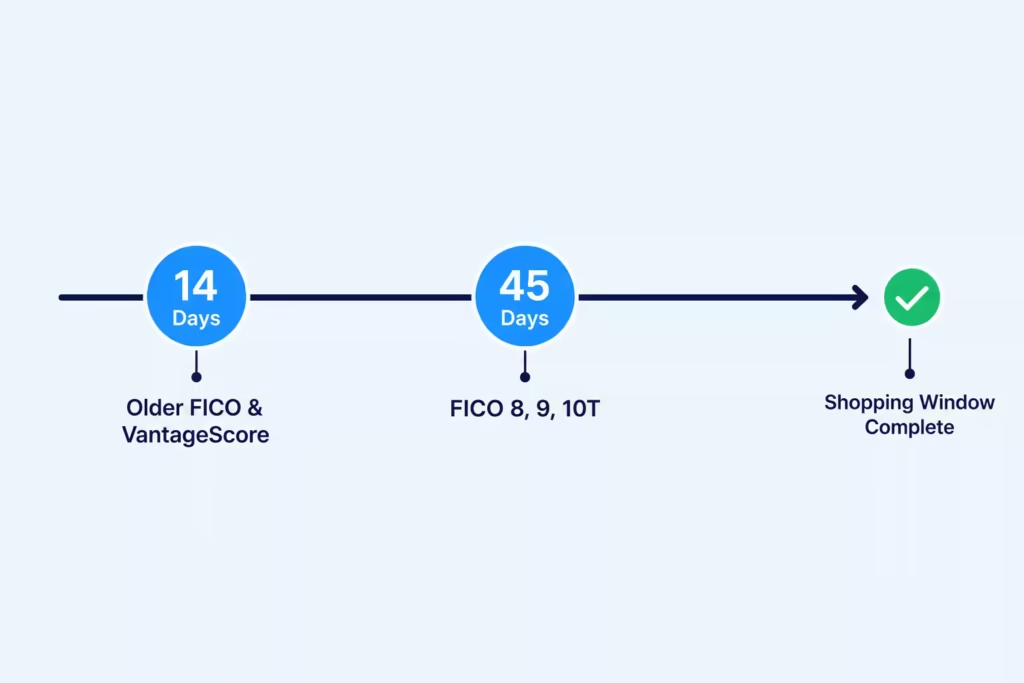
- Rate shopping for auto loans, mortgages, and student loans lets multiple inquiries count as one: FICO 8, 9, and 10T allow a 45-day window, while older FICO models and VantageScore use a 14-day window.
- Credit card and personal loan applications do not get rate shopping grouping, so each application counts as a separate hard inquiry with its own score impact.
- Only unauthorized inquiries can be removed from your report; legitimate inquiries you consented to must remain for the full 24 months, and the credit bureau must investigate a dispute within 30 days.
Best for:
- Readers who noticed a new hard inquiry on their credit report and want to know how much it will affect their score.
- Anyone preparing to apply for a mortgage, auto loan, or credit card and wanting to time or group their applications to minimize score impact.
- People who spotted an unfamiliar inquiry and need to know the dispute process for unauthorized pulls.
What Is a Hard Inquiry?
A hard inquiry is a request a lender makes to pull your full credit report when you apply for new credit. It’s also called a “hard pull.” The lender wants a complete picture of your credit history before deciding to approve you, reject you, or offer a specific rate.
Because this pull happens only when you agree to a real credit application, it counts as a signal that you’re seeking new debt. That’s why it shows up on your report and can nudge your score down a bit.
Under the Fair Credit Reporting Act, a lender must have a “permissible purpose” to pull your full file. That means they can’t just check your credit for fun. They need your consent, and they must be reviewing you for a real credit decision.
Common examples include a credit card application, an auto loan, or a mortgage. Each of the three major credit bureaus, Equifax, Experian, and TransUnion, logs the pull on your file so future lenders can see it too.
How a Hard Inquiry Happens
The trigger is simple: you fill out a real credit application and give the lender permission to check your file. That could be a paper form at a car dealership, an online credit card application, or a mortgage pre-approval that requires full underwriting.
Once you hit “submit” and check the consent box, the lender sends a request to one or more credit bureaus. The bureau then hands over your full report, and the request itself gets recorded as a hard pull.
You should know that not every “credit check” is a hard one. Getting pre-qualified for a card, checking your own score, or letting an insurance company peek at your file usually counts as a soft pull. The dividing line is whether you’re actively asking for new credit and whether the lender is making a real approval decision.
Hard Inquiry vs. Soft Inquiry
The biggest difference is impact. A hard pull can lower your score by a few points and is visible to other lenders. A soft pull does not affect your score at all and is only visible to you.
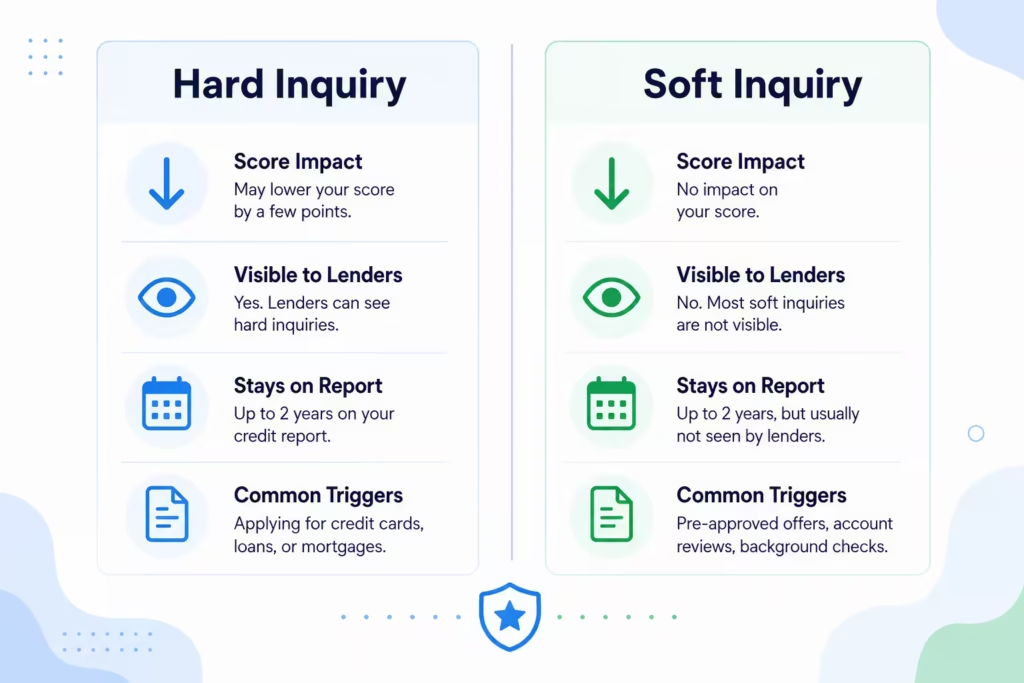
Lenders use hard pulls when they need to make a real lending decision. Soft pulls happen when someone is just peeking at your file for a lower-stakes reason, like a pre-qualified offer, a background check, or your own credit monitoring app.
Here’s a quick side-by-side view to make it clear:
| Feature | Hard Inquiry | Soft Inquiry |
|---|---|---|
| Score impact | Small drop, usually under 5 points | No impact |
| Visible to lenders | Yes | No |
| Stays on report | 24 months | Varies, usually not shared |
| Common triggers | Card, loan, or mortgage applications | Pre-qualified offers, self-checks, employer checks |
| Requires your consent | Yes | Sometimes, but not always |
Pre-qualified offers you get in the mail are soft pulls. So are the “check my rate” tools that many card issuers now offer. Those are safe to use because they don’t hurt your score, even if you end up not applying.
Does Checking Your Own Credit Count as a Hard Inquiry?
No. Checking your own credit is always a soft pull. It never lowers your score, no matter how often you look. This is one of the most common credit myths, and it stops many people from watching their own report as often as they should.
You can pull your report for free every week from all three bureaus at AnnualCreditReport.com, the only site backed by federal law for free reports. Free apps and card issuer dashboards also use soft pulls to show you your score. The Consumer Financial Protection Bureau confirms that self-checks have zero impact on your score. So check away.
How Much Does a Hard Inquiry Lower Your Credit Score?
For most people with a healthy credit file, one hard pull drops the score by fewer than 5 points. FICO reports that many consumers see no meaningful change at all. Inquiries fall under the “new credit” category, which makes up about 10% of your FICO score. That’s the smallest slice of the pie, which is why the sting is usually mild.
The exact drop depends on the rest of your credit picture. Someone with a long, clean history and lots of accounts may barely notice. Someone with only one or two accounts and a short history may lose closer to 10 points.
Multiple hard pulls in a short period, especially across different types of credit, can add up and cause a bigger dip. But a single card application is rarely worth losing sleep over.
💡 Pro Tip: If you’re planning a big purchase like a home in the next 6 months, avoid opening any new credit cards. Even a small 5-point drop can push you into a higher mortgage rate tier and cost you thousands over the life of the loan.
Why the Impact Varies by Credit Profile
Two things drive the size of the drop: how thick your file is and how many recent inquiries you already have. A “thin file” means you have few accounts or a short credit history. In that case, one new inquiry stands out more, and the drop tends to be bigger. A “thick file” means many open accounts and years of payment history. New inquiries barely move the needle here.
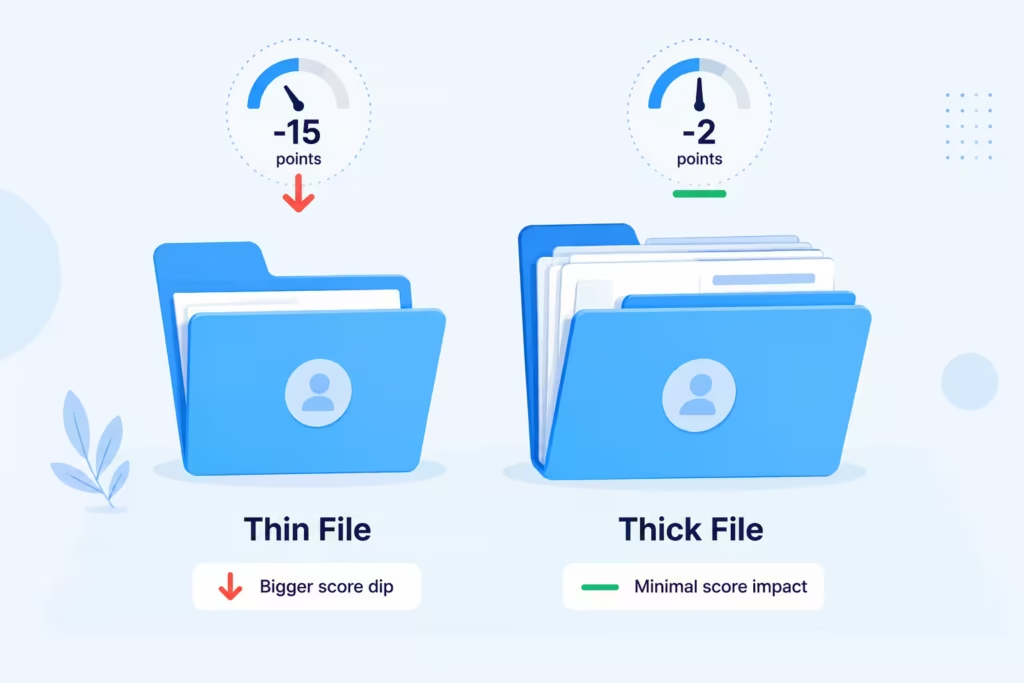
The number of recent pulls matters too. One hard inquiry alone is a blip. Six hard inquiries in six months tells a very different story. Scoring models read that pattern as “credit hungry,” which signals higher risk. If you already have a few recent pulls, adding one more will hurt more than the first one did.
How Long Does a Hard Inquiry Stay on Your Credit Report?
A hard inquiry stays visible on your credit report for 24 months, or two full years, from the date it happens. All three bureaus follow the same rule. After 24 months, the entry drops off your report and no one, including you, can see it anymore.
Being visible is not the same as being counted in your score. Even while the inquiry is still on your file, its effect on your score fades much sooner. Lenders reviewing your report by hand may still see and consider it during that two-year window, especially for big loans like mortgages. But the automated scoring impact ends well before the record itself disappears.
How Long Does a Hard Inquiry Affect Your Credit Score?
Even though a hard pull is visible for two years, it only affects your FICO score for 12 months. After one year, the scoring model ignores it, even though it’s still listed on your report. VantageScore works in a similar way and often stops counting inquiries even sooner.
Here’s the key point: “on your report” and “affecting your score” are two different clocks. Many people mix these up and worry for the full 24 months when the score impact is already gone. If you had one hard pull last spring and it’s been over a year, your score has already fully recovered from that pull. The line item is just paperwork at that point.
📌 Did You Know: Hard inquiries affect your FICO score for only 12 months, but they stay listed on your credit report for a full 24 months. That means the second year is purely cosmetic on your score.
Rate Shopping: How Hard Inquiries Work for Auto Loans, Mortgages, and Student Loans
Rate shopping is where the rules bend in your favor. When you shop for a big loan like a car, home, or student loan, credit scoring models group multiple inquiries into one. That way, you can compare offers from several lenders without getting punished for each pull. This is built right into FICO and VantageScore to encourage smart shopping.
So if you visit five lenders in one week to compare mortgage rates, and each one pulls your credit, most scoring models will count that as a single inquiry. This protects you from the score drop that would otherwise come from stacking five separate pulls. It only applies to auto loans, mortgages, and student loans, though. Credit cards and personal loans do not qualify for this grouping.
Rate Shopping Windows by Scoring Model
The window you have to shop depends on the model your lender uses. Older FICO models give you a 14-day window. Newer FICO models (FICO 8, FICO 9, FICO 10T) give you a 45-day window. VantageScore uses a 14-day window across all versions.
To stay safe no matter which model is used, try to keep all your loan shopping inside 14 days.
There’s also a “buffer” period. Most FICO models ignore any auto, mortgage, or student loan inquiries from the last 30 days when calculating your current score. That means a fresh mortgage pull won’t ding you right away, giving you extra breathing room to finish shopping and lock in a rate.
Why Credit Cards Don’t Get This Treatment
Credit card applications are always counted one by one, no matter how close together they happen. If you apply for three cards in one week, that’s three separate hard inquiries and three separate score hits.
Scoring models treat cards differently because getting five cards is very different from getting five mortgage quotes. You can only have one mortgage, but you can carry many cards, so each new card application is a real new risk.
The same rule applies to personal loans and store financing. There’s no shopping window for these, so each pull counts on its own. If you’re comparing card offers, use pre-qualification tools first. Those are soft pulls and let you compare terms without any score damage.
Common Situations That Trigger a Hard Inquiry
Any real credit application can trigger a hard pull. The most common triggers include:
- Credit card applications, including store cards and business cards
- Auto loan applications, whether from a dealer or a bank
- Mortgage applications and refinance requests
- Student loan applications, both federal and private
- Personal loan applications, including online lenders
- Requests for a credit limit increase on an existing card (some issuers)
- Apartment rental applications where the landlord runs full credit
- Utility service setups in some cases, especially with a big deposit waiver
- Cell phone contracts that offer financed devices
Not every situation ends in a hard pull, though. Some card issuers do a soft pull for a credit limit increase. Some landlords use tenant screening reports that don’t count as hard inquiries. If you’re not sure, ask the company directly before you sign or apply. A simple “Will this be a hard or soft pull?” is a fair question.
What to Do If You See a Hard Inquiry You Don’t Recognize
Spotting an inquiry you don’t remember can feel alarming. It might be a mistake, or it might be a sign of identity theft. Either way, act quickly. Follow these four steps:
- Verify first. Think back over the past few months. Did you apply for anything, even a store card at checkout or a “check my rate” tool that turned into a real application? Sometimes the name on the report is a parent company you don’t recognize. Search the name online before you panic.
- Contact the lender. If the name still looks unfamiliar, call the company that pulled your credit. Ask when the pull happened and what account it was for. Legitimate lenders will confirm details or help you spot fraud.
- Dispute with the bureau. If the lender confirms you never applied, file a dispute with each bureau that shows the inquiry. Equifax, Experian, and TransUnion all offer online dispute forms. The bureau has 30 days to investigate under federal law.
- Freeze your credit. If you suspect identity theft, place a security freeze with all three bureaus right away. A freeze is free, blocks new credit pulls, and can be lifted in minutes when you need it. Also file a report at IdentityTheft.gov, the official Federal Trade Commission resource for recovery.
⚠️ Mistake to Avoid: Don’t ignore an unfamiliar hard inquiry just because your score didn’t drop much. It could be the first sign of identity theft, and thieves often open new accounts within weeks. Investigate every pull you don’t recognize.
Can You Remove a Hard Inquiry From Your Credit Report?
You can only remove a hard inquiry if it was made without your permission. Legitimate inquiries, ones you agreed to when you applied for credit, have to stay on your report for the full 24 months. No dispute, phone call, or “credit repair” service can erase a valid pull. Anyone who promises to do so is likely running a scam.
Unauthorized inquiries are different. Under the Fair Credit Reporting Act, you have the right to dispute any inquiry you did not authorize. File the dispute in writing with the credit bureau that shows the inquiry. Include a copy of your ID, a short letter explaining that you never applied, and any proof you have.
The bureau must investigate within 30 days and remove the inquiry if it can’t be verified. Take Sarah, a marketing manager in Ohio, who spotted a car dealership inquiry from a state she’d never visited. She filed disputes with all three bureaus, and within three weeks, all three pulls were removed, and her score bounced back 12 points.
How to Minimize the Impact of Hard Inquiries When You Apply for Credit
A little planning goes a long way. Follow these steps to keep your score strong when you need new credit:
- Space out your applications. Aim to leave at least 6 months between new credit card applications so pulls don’t stack up.
- Use pre-qualification tools. Most major card issuers offer a “check if you’re approved” tool that uses a soft pull. Use these before you apply for real.
- Cluster your loan shopping. For auto, mortgage, and student loans, do all your rate shopping within a 14-day window to make sure every model groups the pulls.
- Pull your own report first. Check your credit before you apply. You can see what lenders will see and fix any errors ahead of time.
- Avoid new credit before big purchases. Skip new applications for at least 6 months before a mortgage or car loan. This gives your score time to fully recover from any recent pulls.
- Ask before you apply. Ask the lender if the check is hard or soft. Some credit limit increases and apartment checks are soft pulls, but not all.
Michael, a 29-year-old teacher, opened three store cards during holiday shopping to grab discounts. His score dropped 22 points from the stacked pulls. When he applied for a car loan two months later, he ended up with a higher rate that added $1,800 to his total loan cost. Spacing out those applications, or using pre-qualification, could have saved him the extra money.
Frequently Asked Questions (FAQs)
What is a hard inquiry?
A hard inquiry is a lender’s request to pull your full credit report when you apply for new credit, like a credit card, auto loan, or mortgage. It requires your consent and can lower your score slightly because it signals you’re seeking new debt.
Is it worth disputing a hard inquiry?
Disputing is worth it only if you didn’t authorize the inquiry. Sarah, a marketing manager in Ohio, disputed an unauthorized car dealership pull and saw her score bounce back 12 points within three weeks.
Do lenders care about hard inquiries?
Lenders reviewing your file by hand, especially for mortgages, may notice inquiries during the full 24-month window they’re visible. Automated scoring models stop factoring them in after 12 months, so the impact on your actual score fades faster than lenders’ visibility into it.
How much does a hard inquiry drop your credit score?
A single hard inquiry typically drops your score by fewer than 5 points. People with a thin credit file or short history may lose closer to 10 points, while those with a long, established file often barely notice.
How much do 3 hard inquiries affect your credit score?
Three hard inquiries in a short window add up more than one alone, since scoring models read multiple pulls as a sign you’re “credit hungry.” Michael, a 29-year-old teacher, opened three store cards during holiday shopping and saw his score drop 22 points.
Can I remove a hard inquiry from my credit report?
You can only remove a hard inquiry if it was made without your permission. Legitimate inquiries you authorized must stay for the full 24 months, and any service promising to erase a valid pull is likely a scam.
How long until hard inquiries fall off your credit report?
A hard inquiry stays visible on your report for 24 months from the date it happened. All three bureaus, Equifax, Experian, and TransUnion, follow this same timeline.
Will my credit score go up when hard inquiries fall off?
Your score already recovers from a hard inquiry after 12 months, since that’s when scoring models stop counting it. The extra 12 months on your report before it disappears is cosmetic and doesn’t affect your score further.
Why did my credit score drop after a hard inquiry?
A single hard inquiry alone rarely causes a big drop, typically under 5 points. A larger drop usually means several pulls happened close together, which scoring models interpret as a higher-risk pattern of seeking new credit.
Does a hard inquiry affect rate shopping for a mortgage or auto loan?
No, multiple inquiries for the same type of loan within a set window count as just one pull. FICO 8, 9, and 10T give you 45 days to rate shop, while older FICO models and VantageScore use a 14-day window.
The Bottom Line
Most single hard inquiries are small bumps. They fade within a year, but the record stays for 24 months.
The best way to manage your credit is to check it often. This is just a soft pull. Also, use pre-qualification tools before applying for loans.
Finally, try to cluster your loan shopping into a 14-day window. Watch every inquiry you don’t recognize, and dispute any that weren’t authorized.
If you know someone about to apply for a mortgage or car loan, share this guide so they can protect their score before they sign.