
You opened a free credit app and saw a number labeled “VantageScore 3.0.” Now you are asking yourself: what is VantageScore, and can you trust it? It is not the FICO score you have heard about for years. That can feel confusing, especially if you plan to apply for a card, a loan, or an apartment soon.
VantageScore is a real credit scoring model created by the three major credit bureaus, and thousands of lenders use it to judge credit risk.
Below, you will learn how the score works, why it often differs from FICO, which lenders actually use it, and where to check yours for free, step by step.
Key Takeaways
This guide explains what VantageScore is, how it differs from FICO, what factors determine the score, and which lenders now accept it for mortgages as of 2026.
Core Facts:
- VantageScore is a credit scoring model created in 2006 by the three major credit bureaus, Experian, Equifax, and TransUnion, and it ranges from 300 to 850.
- More than 3,700 institutions, including 9 of the top 10 banks, used VantageScore in 2024, totaling about 42 billion scores that year.
- Payment history is the largest factor in VantageScore 4.0 at 41 percent, followed by depth of credit and credit utilization at 20 percent each.
- Both VantageScore 3.0 and 4.0 drop paid collection accounts from the score entirely, while some older FICO versions still count them.
- All hard inquiries for the same loan type within a 14-day window count as a single inquiry rather than multiple separate inquiries.
- The Federal Housing Finance Agency validated VantageScore 4.0 for loans sold to Fannie Mae and Freddie Mac, and Freddie Mac began accepting the model.
Best for:
- Readers confused about why their free credit app score differs from a score shown by their bank or lender.
- People with thin or new credit files who want to know if they can be scored despite limited history.
- Homebuyers or loan applicants who want to know which scoring model a lender might use before applying.
What Is VantageScore?
VantageScore is a company that builds credit scoring models. It is not one single score. A scoring model is the math formula that turns the information in your credit report into a three-digit number.
The company was founded in 2006 as a joint venture by the three major credit bureaus: Experian, Equifax, and TransUnion. These bureaus collect your credit data. The model then reads that data and predicts how likely you are to repay borrowed money on time. That prediction is your score, and it runs from 300 to 850.
Lenders, card issuers, landlords, and utility companies use this number to judge creditworthiness. In plain terms, it helps them decide two things: whether to approve you, and what interest rate or deposit to charge you.
Is VantageScore a Legitimate Credit Score?
Yes. This is not a marketing trick from a free app. The model was built and is owned by the same bureaus that hold your credit reports.
The scale of use is large. Figures from VantageScore show that more than 3,700 institutions, including 9 of the top 10 banks, used its scores in 2024. About 42 billion scores were used that year alone.
One small point helps clear up confusion. “VantageScore” the company is the model maker. “Your VantageScore” is the number that model produces from your report. When people ask if the score is real, they usually mean the number. It is real, and it is built from your actual credit history.
VantageScore 3.0 vs 4.0 vs 4plus: What’s the Difference?
The company has released several versions of its model. Each one updates the math, but all of them use the same 300 to 850 range.
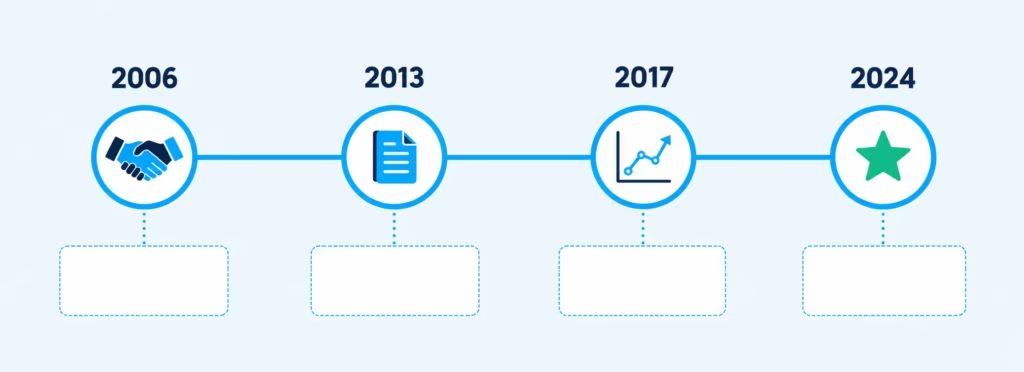
VantageScore 3.0 came out in 2013. It set the 300 to 850 scale and made it possible to score people with very little credit history. This is still the version most free consumer apps display, including Credit Karma.
VantageScore 4.0 launched in 2017. Its big change was trended credit data, which looks at your behavior over time instead of one moment. It also ignores paid collection accounts.
VantageScore 4plus is a refreshed version of 4.0, released in 2024. It keeps the same structure but sharpens accuracy with updated analytics.
If the number on your app says “3.0,” you are seeing the older, widely used version. If a lender quotes a score today, it may come from 4.0. That is one more reason two scores for the same person can differ.
What Is Trended Credit Data?
Trended credit data means the model studies how your balances changed over time, often across 24 months, instead of looking at a single snapshot.
Think of two people with the same $2,000 card balance today. David had a $2,000 balance last month too, and he pays it off in full every cycle. Michael had $5,000 six months ago and has only made minimum payments. A snapshot model sees them as identical. A trended model sees that David’s habit is safer, and it rewards him with a stronger score.
This cuts both ways. If your balances are creeping up over time, version 4.0 can be stricter than 3.0. If you are steadily paying debt down, it can be more forgiving.
How Is VantageScore Calculated?
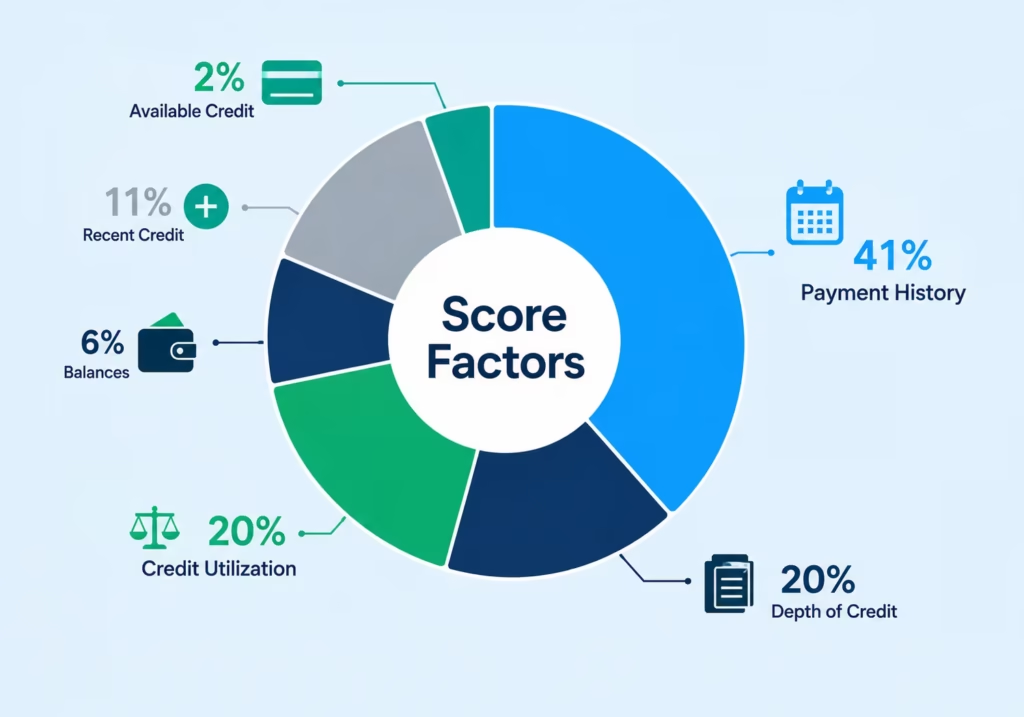
The model reads your credit report and weighs six factors. The table below shows the commonly cited weights for versions 3.0 and 4.0. Exact numbers can shift slightly by version.
| Factor | VantageScore 3.0 | VantageScore 4.0 |
|---|---|---|
| Payment history | 40% | 41% |
| Depth of credit (age and mix) | 21% | 20% |
| Credit utilization | 20% | 20% |
| Balances | 11% | 6% |
| Recent credit | 5% | 11% |
| Available credit | 3% | 2% |
Payment history is the biggest piece by far. It simply tracks whether you pay on time. One late payment can do real damage, and a long streak of on-time payments builds the score.
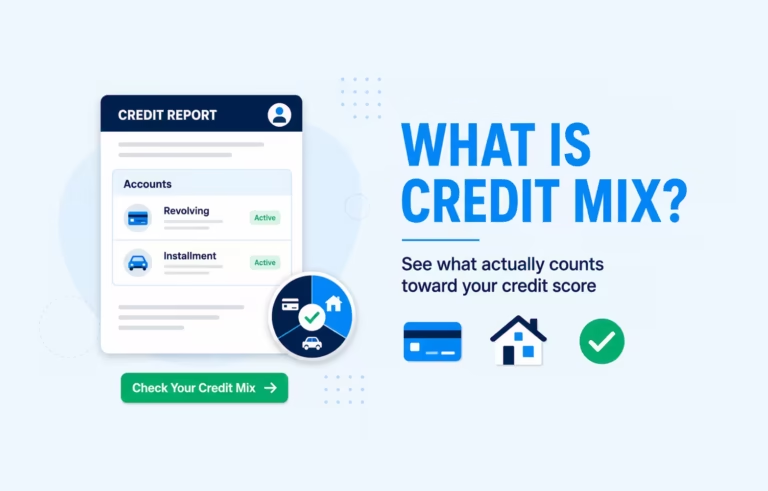
Depth of credit means the age of your accounts and your mix of credit types, such as cards and loans. Older accounts and a healthy mix help.
Credit utilization ratio is the share of your card limits you are using. If your limits total $10,000 and you owe $3,000, your utilization is 30%. Lower is better.
Balances is the total you owe. Recent credit covers new accounts and hard inquiries. Available credit is the unused limit you could still borrow against.
How VantageScore Counts Hard Inquiries
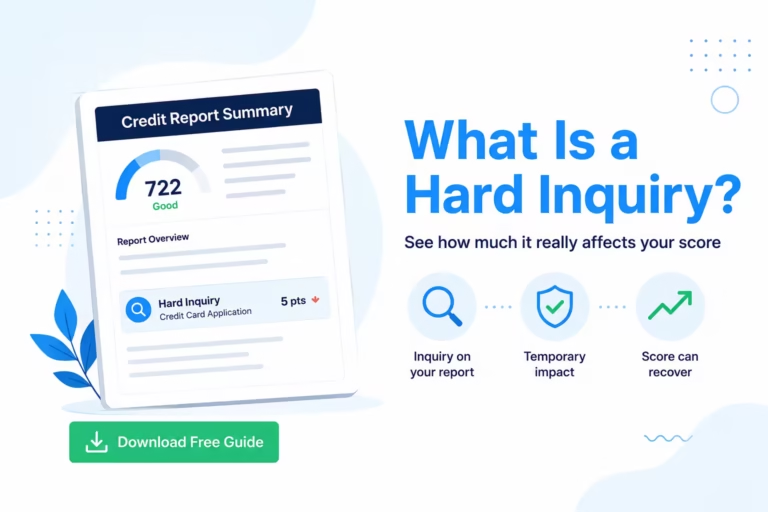
A hard inquiry happens when a lender checks your credit for an application. Too many in a short time can pull a score down, because it can signal money stress.
But rate shopping gets a break. All hard inquiries for the same type of loan within a 14-day window count as just one inquiry. So if you apply with five auto lenders in two weeks to find the best rate, the model treats it as a single smart move, not five red flags. Inquiries stay on your report for two years, but their effect fades fast.
How Collection Accounts Affect Your VantageScore
Here is a rule many people find surprising. Once you pay a collection account, VantageScore ignores it. Both 3.0 and 4.0 drop paid collections from the math entirely.
That is not true everywhere. Some older FICO versions still count a paid collection against you. So clearing an old collection can lift this score even when another model barely moves. If a paid collection is the main stain on your report, paying it off is one of the fastest ways to see a change here.
VantageScore vs. FICO: Why Your Scores Don’t Match
Both models use the same 300 to 850 scale and read the same credit reports. They just weigh the factors differently. Data published by myFICO breaks the FICO formula down this way, next to the VantageScore 4.0 weights:
| Factor | FICO | VantageScore 4.0 | |
|---|---|---|---|
| Payment history | 35% | 41% | |
| Amounts owed / utilization | 30% | 20% (plus 6% balances) | |
| Length / depth of credit | 15% | 20% | |
| Credit mix | 10% | part of depth | |
| New credit | 10% | 11% |
The practical effect is simple. Someone carrying high card balances may see a wider gap between the two numbers, because each model treats that debt with different weight.
Consider Jennifer, a marketing coordinator at a software firm. Her Credit Karma app showed 712. Two days later, her bank’s dashboard showed 691 from a FICO model. She assumed one was broken. Neither was. The same report produced both numbers, and 21 points apart is a normal spread.
⚠️ Mistake to Avoid: Never assume the score on your free app is the exact number a lender will pull. Ask the lender which model and version they use before you apply, especially for big loans.
What’s a Good VantageScore? Score Ranges and Tiers
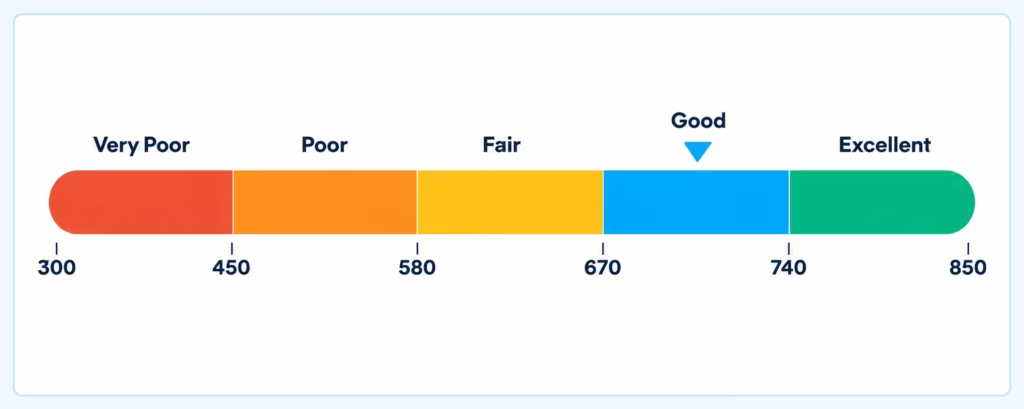
The score range runs from 300 to 850, divided into five credit tiers:
| Tier | Score Range | What It Means in Practice |
|---|---|---|
| Very Poor | 300–499 | Approval is unlikely without a deposit or co-signer |
| Poor | 500–600 | Some approvals, often with high rates or fees |
| Fair | 601–660 | Near prime; approval possible, terms may be costly |
| Good | 661–780 | Most lenders approve; competitive rates |
| Excellent | 781–850 | Best rates and terms widely available |
A score of 661 or above is generally considered a good VantageScore. That is the line where prime lending terms start to open up. Subprime borrowers, those below 661, can still get credit, but they usually pay more for it.
What to Do If Your VantageScore Is Low
A low number is a snapshot of your current report data, not a permanent verdict on you. Scores move every month as new information lands on your report.
Two levers do most of the work: pay every bill on time, and keep card balances low relative to their limits. Those two habits feed the heaviest factors in the model. A full step-by-step improvement plan is covered in a dedicated guide, so this section stays a quick orientation rather than a deep dive.
The main point is this. A low score today tells you where you stand. It does not tell you where you will be in six months.
Do Lenders Actually Use VantageScore?
Yes, and in specific situations you can map to your own life:
Credit card pre-qualification and pre-approval. Many issuers use this model for the soft-pull checks behind “you’re pre-approved” offers. It lets them screen you without touching your score.
Auto and personal loans. Thousands of banks, credit unions, and fintech lenders use it for real lending decisions, not just marketing.
Tenant and apartment screening. Landlords and property managers often pull it to judge whether an applicant is likely to pay rent on time.
There is also a reason free apps show this particular score. The bureaus supply it directly to apps like Credit Karma and CreditWise. It is cheap for the apps to license and easy for you to access, so it became the default “free score” most Americans see.
VantageScore and Mortgages: What Changed in 2026
Mortgages were the last stronghold of the old FICO-only system. That wall has now come down.
The Federal Housing Finance Agency validated VantageScore 4.0 for loans sold to Fannie Mae and Freddie Mac, and Freddie Mac began accepting the model. Fannie Mae and Freddie Mac back the majority of residential mortgages in the United States, so this change touches most home loans.
One caution: this does not mean every mortgage lender has switched yet. The market is still mixed, and some lenders continue to use older FICO versions. If you are shopping for a home loan, ask each lender which scoring model they pull. The answer can change what rate you expect.
Can You Get a VantageScore With No Credit History?
Very likely, yes. The model can generate a score with as little as one month of history on an account, as long as that account was reported to a bureau within the past 24 months.
FICO is stricter. It generally needs an account that is at least six months old before it can produce a score at all.
This gap matters for people who are new to credit. Take Maria, a recent graduate who opened a secured card with a $500 limit. One month after her first statement, a VantageScore appeared on her banking app. A FICO score did not exist for her until months later. Recent immigrants and young adults often follow the same path: this model scores them first.
📌 Did You Know: Millions of Americans who are “unscorable” under traditional models still receive a VantageScore, because it needs far less history to work.
Where to Check Your VantageScore for Free
You can see your number today without paying anything:
- Credit Karma shows VantageScore 3.0 from your Equifax and TransUnion reports, free.
- Capital One CreditWise shows VantageScore 3.0 from TransUnion, and you do not need to be a Capital One customer.
- Many bank and card dashboards display it monthly. Chase Credit Journey is one common example.
Checking through any of these sources is a soft inquiry. It has zero effect on your score, no matter how often you look.
💡 Pro Tip: The number is only half the story. Pull the actual reports behind it free at AnnualCreditReport.com and check for errors, since a mistake on the report feeds every score built from it.
Frequently Asked Questions (FAQs)
Is VantageScore a real credit score?
Yes, VantageScore is a legitimate model built by Experian, Equifax, and TransUnion. More than 3,700 institutions, including 9 of the top 10 banks, used its scores in 2024.
What is the difference between a VantageScore and FICO score?
Both use a 300 to 850 scale but weigh factors differently. VantageScore 4.0 puts 41% on payment history versus FICO’s 35%, and 20% on credit mix versus FICO’s 10%.
Why is my VantageScore higher than my FICO score?
The two models weigh the same credit report differently, so gaps of 20 points or more are normal. VantageScore also drops paid collection accounts entirely, while some older FICO versions still count them against you.
Do banks use FICO or VantageScore?
Both, depending on the lender and purpose. Many card issuers use VantageScore for pre-approval offers, while other lenders, especially for large loans, still rely on FICO.
Which mortgage lenders use VantageScore?
Freddie Mac began accepting VantageScore 4.0 after the Federal Housing Finance Agency validated it for loans sold to Fannie Mae and Freddie Mac in 2026. Not every mortgage lender has switched yet, so it’s worth asking which model a specific lender pulls.
What is a good score for VantageScore?
A score of 661 or above is considered good, since that’s where most lenders start offering competitive rates. Scores of 781 to 850 fall in the excellent tier, with the best rates and terms widely available.
Can you get a VantageScore with no credit history?
Yes, VantageScore can generate a score with as little as one month of history on an account reported to a bureau in the past 24 months. FICO typically requires an account to be at least six months old before it can produce a score.
How does VantageScore handle rate shopping and hard inquiries?
All hard inquiries for the same loan type within a 14-day window count as just one inquiry. This means applying to five auto lenders in two weeks to compare rates only dings your score once, not five times.
The Bottom Line
VantageScore is a legitimate, bureau-built scoring model used by thousands of banks, card issuers, landlords, and now mortgage giants like Fannie Mae and Freddie Mac. It weighs payment history most heavily, can score people with thin credit files, and ignores paid collections. If your number differs from a FICO score elsewhere, that gap is normal, not an error.
For most readers, the most effective approach is to track the free score monthly, keep utilization low, and ask lenders which model they use before applying.
If you know someone confused by a strange score on their credit app, share this guide with them. It could save them from distrusting a tool that is actually working in their favor.