

When I first sat down to apply for a mortgage, the loan officer asked about my debt-to-income ratio before anything else, and I honestly had no idea what number to give her. Maybe you’re in that same spot right now, staring at a loan application and wondering if lenders will approve you before you even hit submit.
Your debt-to-income ratio is the percentage of your gross monthly income that goes toward paying your monthly debts.
In this guide, we’ll cover the formula, real examples, and DTI targets for major loan types. You’ll also find simple steps to lower your ratio before applying.
Key Takeaways
This guide explains what debt-to-income ratio means, including the exact formula, what counts as debt, target ranges for major loan types, and specific steps to lower a high ratio before applying.
Core Facts:
- Debt-to-income ratio equals total monthly debt payments divided by gross monthly income, then multiplied by 100 to express it as a percentage.
- Only fixed recurring debts count toward DTI, including rent or mortgage, minimum credit card payments, auto loans, student loans, and co-signed loan payments.
- Groceries, utilities, insurance premiums, subscriptions, and retirement contributions are not included in the DTI calculation.
- A DTI below 20% is considered excellent, 20% to 35% is healthy, 36% to 43% is manageable, and 50% or higher is difficult for most lenders to approve.
- FHA loans use standard benchmarks of 31% front-end and 43% back-end DTI, while conventional loans typically cap back-end DTI around 45%.
- A high DTI can sometimes be offset by compensating factors such as large cash reserves, a credit score above 740, or a larger down payment.
Best for:
- Readers preparing to apply for a mortgage, personal loan, or credit card who want to calculate their own DTI before applying.
- Borrowers with a DTI above their loan program’s standard limit who want specific steps to lower it before applying.
- Anyone confused about the difference between debt-to-income ratio and credit score and how lenders use each one.
DTI Formula and How to Calculate It
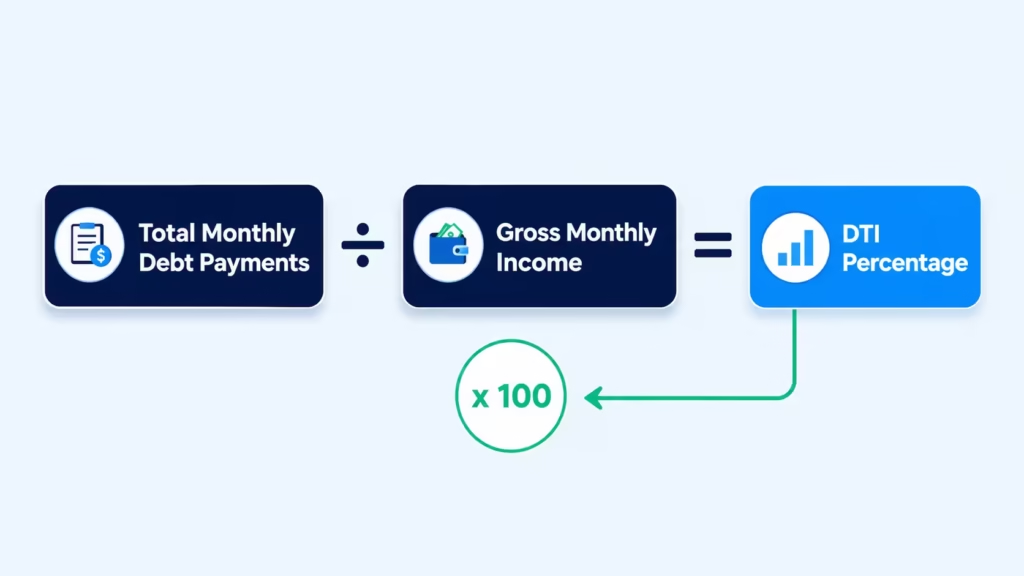
The formula is short, and the math is easier than most people expect. You divide your total monthly debt payments by your gross monthly income, then multiply the result by 100 to get a percentage.
Here it is written out:
DTI = (Total Monthly Debt Payments ÷ Gross Monthly Income) × 100
Say your monthly debts add up to $2,000 and you earn $6,000 per month before taxes. Your ratio would be ($2,000 ÷ $6,000) × 100, which comes out to 33%. That means one third of your paycheck already goes to debt before you spend a dollar on food, gas, or savings.
The Consumer Financial Protection Bureau says that lenders use this number to see how much room you have in your budget for a new loan payment. A lower number tells them you have more breathing room. A higher number tells them you might struggle to take on more debt without missing payments.
To calculate yours, gather three things: your most recent pay stubs, a list of your fixed monthly debt payments, and a calculator. Add up every debt payment first. Then divide by your pre-tax monthly earnings. That’s it.
What Counts as Debt (and What Doesn’t)
This is where most people trip up. Not every bill you pay each month counts as debt in the eyes of a lender. Only fixed, recurring obligations on your credit report or listed on the loan application count.
Here is a simple checklist.
Counts as debt:
- Rent or mortgage payment (including property taxes and homeowners insurance if escrowed)
- Minimum monthly credit card payments (not the full balance)
- Auto loan payments
- Student loan payments
- Personal loan payments
- Child support and alimony you pay
- Co-signed loan payments, even if someone else pays them
Does not count as debt:
- Groceries
- Utility bills (electric, water, gas, internet, phone)
- Health insurance and car insurance premiums
- Streaming and subscription services
- Gym memberships
- Gas and transportation costs
- Taxes withheld from your paycheck
- Savings and retirement contributions
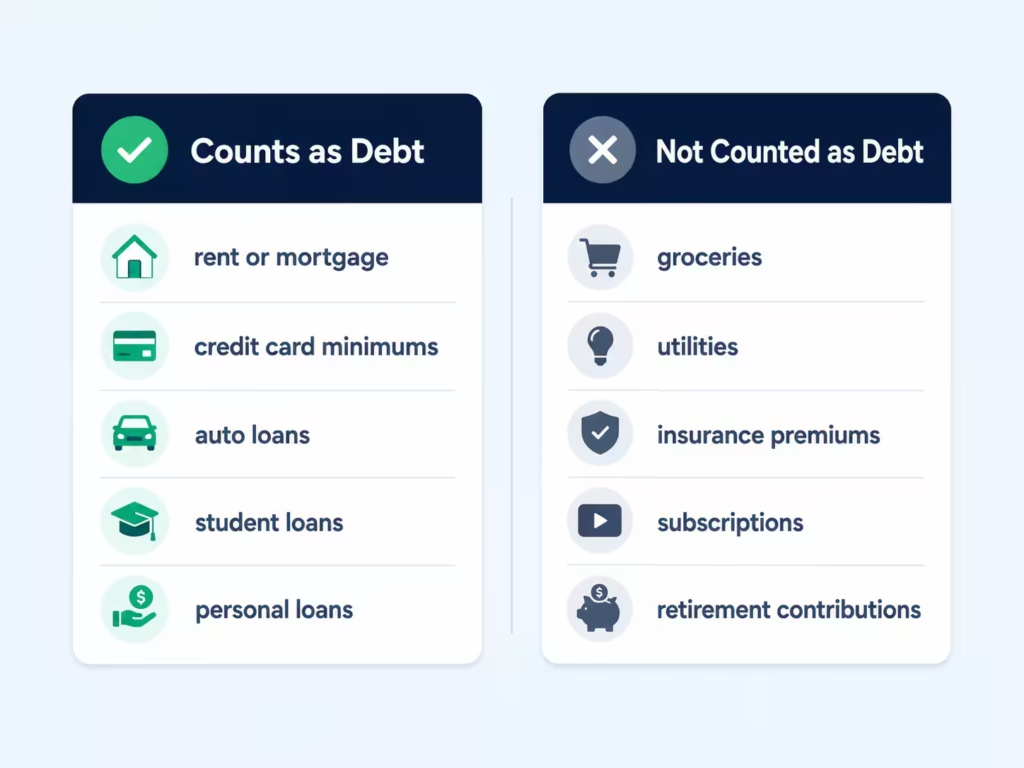
So if your credit card statement shows a $5,000 balance with a $100 minimum payment, only the $100 counts. Lenders care about the required payment, not the full balance.
Gross Income vs. Net Income
Your DTI uses gross income, not the amount that lands in your bank account. Gross income is what you earn before taxes, health insurance, retirement contributions, and other deductions come out. Net income is your take-home pay.
Picture this: Sarah, a marketing manager at a Chicago tech firm, earns $84,000 per year. Her gross monthly income is $7,000. But after taxes and her 401(k) contribution, she only sees about $5,200 land in her checking account. If she used $5,200 by mistake, her ratio would look much worse than lenders will actually see. Using $7,000 gives her the accurate number banks will use.
For salaried workers, divide your annual salary by 12. For hourly workers, multiply your hourly rate by your average weekly hours, then multiply by 52, and divide by 12. If you’re self-employed or earn commissions, lenders usually average your last two years of tax returns.
Worked Example
Numbers make this clearer than any definition. Let’s walk through a full example with Michael, a 34-year-old operations manager who wants to buy his first home.
Michael earns $90,000 per year. His gross monthly income is $7,500.
His monthly debt payments look like this:
- Current rent: $1,800
- Car loan: $425
- Student loan: $310
- Credit card minimums: $85
- Personal loan for a home repair: $180
His total monthly debt = $1,800 + $425 + $310 + $85 + $180 = $2,800
Now the math: $2,800 ÷ $7,500 = 0.373
Multiply by 100 to get 37.3%.
Michael’s current DTI is about 37%. That’s on the higher side, but still workable for many loan programs. If he pays off the personal loan and the credit card balance before applying, his debt drops to $2,535. That would move his ratio down to about 34%, which puts him in a stronger spot.
Here’s another quick view:
| Situation | Monthly Debt | Gross Income | DTI |
|---|---|---|---|
| Before paying off loans | $2,800 | $7,500 | 37.3% |
| After paying credit cards | $2,715 | $7,500 | 36.2% |
| After paying credit + personal loan | $2,535 | $7,500 | 33.8% |
Small changes to your debts can move your ratio noticeably. That’s why even a few weeks of focused payoff before applying can matter.
Front-End vs. Back-End DTI
Mortgage lenders actually look at two ratios, not one. Both matter, and each measures something different.
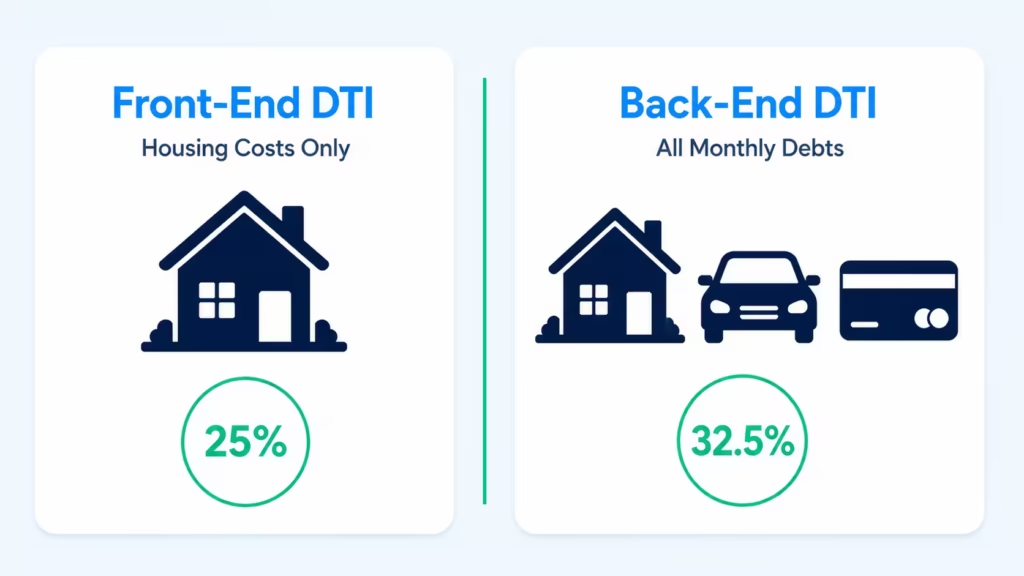
Front-end DTI looks only at your future housing costs. That includes your projected mortgage payment, property taxes, homeowners insurance, and HOA fees if any. Divide that housing total by your gross monthly income.
Back-end DTI is the one most people mean when they say “DTI.” It adds your future housing payment to all your other monthly debts (car, student loans, credit cards, etc.), then divides by gross income.
Let’s plug in numbers. Jennifer earns $8,000 per month. Her expected new mortgage payment including taxes and insurance is $2,000. Her other monthly debts total $600.
- Front-end DTI: $2,000 ÷ $8,000 = 25%
- Back-end DTI: ($2,000 + $600) ÷ $8,000 = 32.5%
Both numbers are healthy. But if Jennifer’s other debts were $1,200 instead, her back-end ratio would jump to 40%, and lenders might get nervous even though her front-end still looks fine.
You’ll mostly hear about back-end DTI outside of mortgages. Auto lenders and credit card issuers usually skip the front-end split entirely because housing isn’t the point of the loan.
What Is a Good Debt-to-Income Ratio?
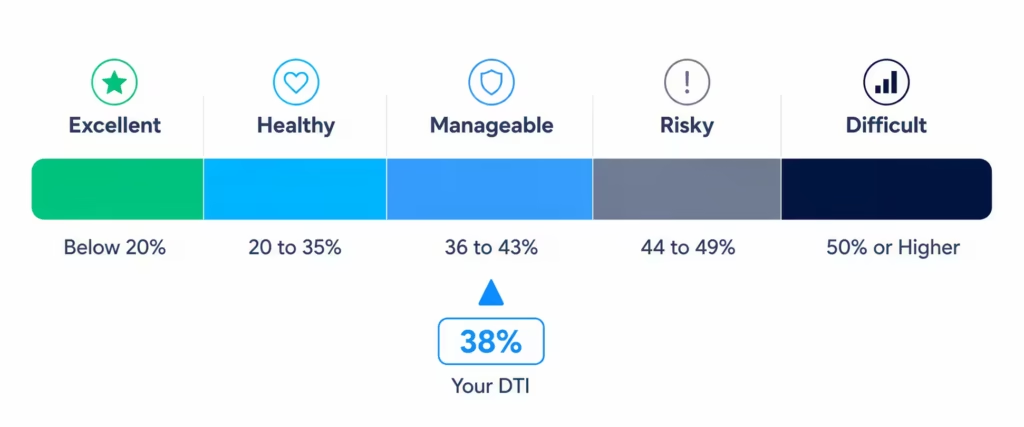
Lenders don’t all use the same cutoff, but the general ranges below are widely accepted.
| DTI Range | What It Means |
|---|---|
| Below 20% | Excellent. Very strong borrowing position. |
| 20% to 35% | Healthy. Most loans available at good rates. |
| 36% to 43% | Manageable. Approval possible, but rates may rise. |
| 44% to 49% | Risky. Fewer lenders will approve you. |
| 50% or higher | Difficult. Most loans will be denied. |
The 43% mark is the number to remember. Fannie Mae and Freddie Mac generally set 43% as the ceiling for Qualified Mortgages, though exceptions exist.
📌 Did You Know: A DTI just 2 or 3 points below the lender’s limit can save you thousands over the life of a loan through better interest rates. Even small debt payoffs before applying can shift you into a lower rate bracket.
Below 36% is where most financial planners suggest you aim. It gives you room to handle a car repair, a medical bill, or a stretch of lower income without falling behind on payments.
DTI Requirements by Loan and Credit Type
Every loan program has its own targets. Knowing them before you apply saves you from a surprise denial.
FHA Loans
FHA loans come from the Federal Housing Administration. They help buyers who have smaller down payments or lower credit scores. The standard limits are 31% front-end and 43% back-end. With strong compensating factors like solid savings or a high credit score, some lenders will approve DTIs as high as 50% HUD Handbook 4000.1.
Conventional Loans
Conventional loans follow Fannie Mae and Freddie Mac guidelines. The usual back-end cap is 45%. However, automated underwriting systems can raise it to 50% for borrowers with great credit and solid reserves. If you’re aiming for the best rates, keep your ratio under 36%.
VA Loans
VA loans, available to eligible veterans and active-duty service members, use 41% as a guideline rather than a hard cap. VA underwriters also weigh a separate figure called residual income, which is how much cash you have left each month after all bills. High residual income can offset a higher DTI.
USDA Loans
USDA loans support home buyers in eligible rural and suburban areas. Standard ratios are 29% front-end and 41% back-end. Higher ratios are possible with a credit score above 680 and documented compensating factors.
Personal Loans and Credit Cards
Personal loan lenders and credit card issuers usually want a back-end DTI below 40%. Some online lenders will go up to 50%, but expect higher interest rates. For credit cards, issuers rely more heavily on your credit score, but a high DTI can still shrink the credit limit they offer.
Here’s a quick side-by-side view:
| Loan Type | Front-End DTI | Back-End DTI |
|---|---|---|
| FHA | 31% | 43% (up to 50% with factors) |
| Conventional | 28% (preferred) | 45% (up to 50%) |
| VA | Not required | 41% guideline |
| USDA | 29% | 41% |
| Personal Loan | N/A | 35% to 40% |
| Credit Card | N/A | 40% (informal) |
DTI vs. Credit Score: What’s the Difference?
These two numbers get mixed up all the time, but they measure very different things.
Your credit score shows how reliably you’ve paid back money in the past. It looks at payment history, credit utilization, length of credit history, credit mix, and new credit applications. Scores run from 300 to 850.
Your debt-to-income ratio shows how much room your current income has for new debt. It ignores your payment history entirely. Two people can have the same 750 credit score. But one earns $4,000 a month and has $2,000 in debt payments.
The other makes $8,000 a month with the same $2,000 in debt. Their debt-to-income (DTI) ratios are different: 50% for the first person and 25% for the second. The lender will see them as very different risks.
| Feature | Credit Score | DTI |
|---|---|---|
| What it measures | Past payment behavior | Current debt burden vs. income |
| Range | 300 to 850 | 0% to over 100% |
| Where to find it | Credit bureaus, banking apps | You calculate it yourself |
| Impact on approval | Rate and approval | Approval and loan size |
| How to improve fast | Slow (months to years) | Fast (pay off debts, boost income) |
Lenders use both together. A great score with a bad ratio can still lead to denial, because the lender worries you’ll stretch too thin. A moderate score with a healthy ratio often gets approved because the numbers say you can handle the payment.
⚠️ Mistake to Avoid: Don’t assume a high credit score cancels out a high DTI. Mortgage underwriters routinely deny applicants with 780+ scores because their DTI crosses the program limit. Both numbers must clear the bar.
Why Lenders Use DTI to Evaluate Borrowers
Lenders care about one core question: can you actually afford this new payment on top of everything else you owe? Your DTI answers that in a single number.
Credit scores tell them you’ve paid on time in the past. Income tells them what you earn. But DTI is the only number that shows what’s actually left over each month after existing obligations. That’s the number that decides whether a new payment will fit or break your budget.
There’s also a regulatory piece. After the 2008 housing crisis, the Consumer Financial Protection Bureau created the Qualified Mortgage rule, which uses a 43% back-end DTI as one of the safe-harbor thresholds. Lenders who stay within that limit get certain legal protections, so they lean hard on the ratio when making decisions.
For non-mortgage lending, the reasoning is the same in plain terms. If your paycheck is already spoken for, adding another bill sets you up to miss a payment. That costs the lender money and hurts your credit.
How to Lower a High Debt-to-Income Ratio
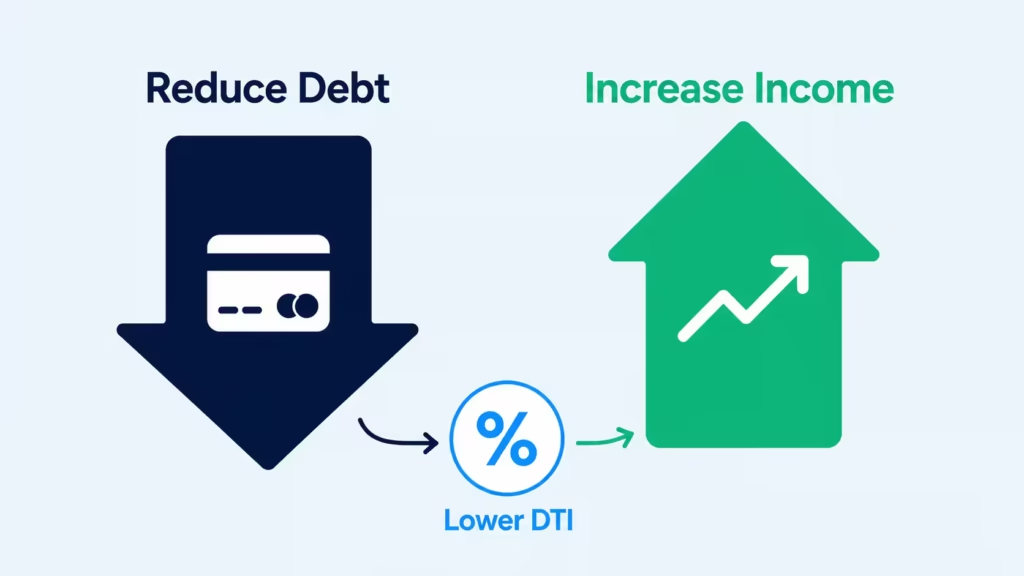
Since DTI is a fraction, you can improve it two ways: shrink the top number (debt) or grow the bottom number (income). Doing both at once works fastest.
💡 Pro Tip: Before applying for any major loan, pull your credit report and list every monthly debt payment. Focus on paying off small balances first, since eliminating a $30 minimum payment lowers your DTI faster than knocking $30 off a larger loan.
Reduce Monthly Debt Payments
The fastest wins come from small revolving debts. Paying off a credit card with a $50 minimum removes that $50 from your monthly debt total forever. That single move can shift your ratio down by 1 to 2 percentage points if you’re near the middle of the range.
Try these steps in order:
- Pay off small credit cards first. A $400 balance eliminated is one less minimum payment on your ratio.
- Avoid taking on new debt. No new car, no store credit cards, no financed furniture in the 6 months before applying.
- Refinance high-interest debt. Rolling a $12,000 credit card balance into a lower-rate personal loan can drop your monthly payment by $80 or more.
- Ask about longer loan terms. Stretching an auto loan lowers the monthly payment (though you’ll pay more interest overall).
- Pay down balances that are close to zero. Finishing off a nearly-paid loan removes it from your debt list entirely.
David, a project manager in Denver, went from a 44% DTI to 38% in three months by paying off two small credit cards using his tax refund. That change alone qualified him for a conventional mortgage he’d been denied for earlier.
Increase Gross Income
Growing your income is slower, but it also lasts. Lenders want documented, stable income, so a one-time bonus won’t help much. What does help:
- A documented raise from your current employer with an updated pay stub or offer letter
- A second job you’ve held for 12 months or longer (some lenders require 24 months)
- A side business with two years of tax returns showing consistent profit
- Rental income from a property you already own, documented on your tax return
- Overtime or commission if you can show a two-year history
If you switched jobs recently for higher pay, ask your new employer for a formal offer letter listing your base salary. Many lenders will use that letter to document income after a short waiting period.
Compensating Factors That Can Offset a High DTI
Sometimes lenders bend the rules if the rest of your file looks strong. These are called compensating factors, and they can push through a loan that DTI alone would block.
Common compensating factors include:
- Large cash reserves. Six or more months of mortgage payments in a savings account shows you can handle a bad month.
- Excellent credit score. A score above 740 signals low default risk.
- Larger down payment. Putting 20% or more down reduces the lender’s risk and often loosens DTI limits.
- Long, stable job history. Five or more years with the same employer or in the same field carries weight.
- Minimal payment shock. If your new mortgage payment is close to your current rent, lenders see less risk in your ability to adjust.
- Documented residual income. Especially important for VA loans, this shows cash left over after all bills.
Jennifer, a nurse in Boston, had a 47% back-end DTI, which is above the standard limit. But she had $45,000 in savings, a 780 credit score, and had worked at the same hospital for eight years. Her lender approved her FHA loan by documenting those compensating factors in the underwriting file.
Common Mistakes When Calculating Your DTI
Small mistakes lead to big surprises at the loan office. These are the ones people make most often.
Using net income instead of gross
Take-home pay is what feels real, but lenders use pre-tax income. Always start with the top of your pay stub.
Including groceries, utilities, or subscriptions
These aren’t debts. Adding them makes your ratio look worse than it actually is.
Using credit card balances instead of minimum payments
A $5,000 balance is not a $5,000 monthly obligation. Only the minimum due each month counts.
Forgetting co-signed loans
If you co-signed for someone’s car or student loan, the payment counts against you, even if they’ve never missed one.
Skipping the new payment
For a mortgage, you have to include the projected new payment, not just current housing costs. Ask your loan officer for the estimated PITI (principal, interest, taxes, insurance).
Confusing DTI with credit utilization
Credit utilization is the percent of your credit card limits you’re using. DTI is monthly debt payments compared to income. They’re totally separate numbers.
Forgetting about spousal debts on joint applications
If you apply jointly, both partners’ debts and incomes get combined.
Taking five extra minutes to double-check each item on your list can be the difference between an approval and a denial letter.
Frequently Asked Questions (FAQs)
What is a good debt-to-income ratio?
A DTI below 36% is considered healthy by most lenders, with anything under 20% viewed as excellent. Ratios between 36% and 43% are still manageable for many loan programs, but rates may be higher.
What is the 28/36 rule?
The 28/36 rule suggests spending no more than 28% of gross income on housing costs and no more than 36% on total debt payments combined. It’s a conservative benchmark many financial planners use, tighter than the 43% ceiling most lenders allow.
Is a 40% DTI too high?
A 40% DTI falls in the “manageable” range for most lenders but isn’t ideal. Conventional loans often approve up to 45%, and FHA loans allow up to 43% standard, so 40% typically still qualifies, just not at the best rates.
Is 50% DTI too high for approval?
A 50% DTI is difficult for most loan programs and gets denied by many lenders outright. Some FHA and conventional loans allow up to 50% only with strong compensating factors like large cash reserves or a credit score above 740.
Can I calculate my own debt-to-income ratio?
Yes, add up all your fixed monthly debt payments and divide by your gross monthly income before taxes, then multiply by 100. You only need recent pay stubs and a list of your debt payments to do this yourself in a few minutes.
What expenses are not included in the debt-to-income ratio?
Groceries, utilities, insurance premiums, subscriptions, gas, and retirement contributions don’t count toward DTI. Only fixed debts like mortgage or rent, auto loans, student loans, and minimum credit card payments are included.
Can I get a loan if my DTI is too high?
Yes, some lenders approve borrowers above standard DTI limits if they have compensating factors like six months of cash reserves, a 740+ credit score, or a large down payment. FHA loans specifically can go up to 50% with documented compensating factors.
Does a high DTI hurt my credit score?
No, your debt-to-income ratio isn’t a factor in your credit score calculation at all. DTI and credit score are separate metrics that lenders check independently, though missing payments due to a high DTI could eventually hurt your score.
Does paying off my mortgage lower my DTI?
Paying off your mortgage entirely removes your largest monthly debt payment, which can significantly lower your DTI. For most borrowers still paying a mortgage, reducing the balance won’t help until the monthly payment itself changes, such as through refinancing.
The Bottom Line
Your debt-to-income ratio is one of the clearest signals lenders use to decide whether to say yes. Once you know the formula, what counts as debt, and the target ranges for your specific loan type, you can walk into any application with confidence.
Calculate your number today. Pay off the smallest revolving debts first. Also, avoid new loans in the months before you apply. Even a few percentage points of improvement can unlock better rates.
If you know someone getting ready to buy a home or apply for a big loan, share this guide with them so they can prepare the same way.