
Ever swiped a card and wondered why the ad promised “money back” but nothing showed up on your bill? That mix of hope and confusion is normal, especially when you keep seeing cash back on a credit card in every card pitch, review site, or friend’s advice. You want to know if it’s real savings or just marketing fluff.
Cash back is a small percentage of your purchase that your card issuer returns to you as a reward for spending.
In this guide, we’ll walk through how it’s earned, when it lands in your account, what spending doesn’t count, and whether a rewards card actually pays off for your lifestyle. You’ll leave knowing exactly what to expect.
Key Takeaways
This guide explains what cash back on a credit card is, including how it is calculated, when it gets paid out, what purchases are excluded, whether it is taxable, and how to judge if a cash back card is worth it.
Core Facts:
- Cash back is a percentage of eligible spending returned to the cardholder, calculated by multiplying the purchase amount by the card’s rewards rate.
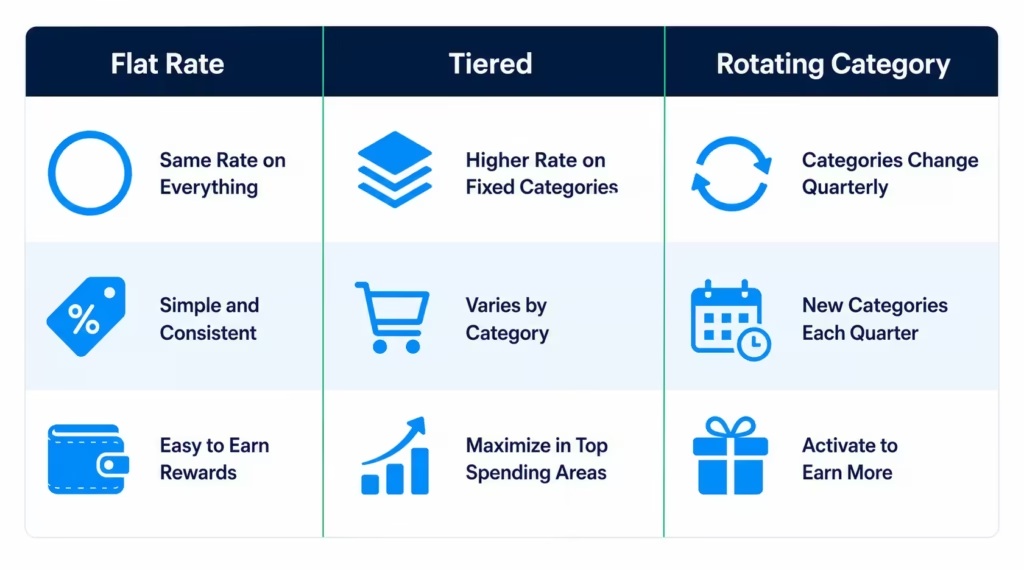
- Cards use three main structures: flat rate (same percentage on all purchases), tiered (fixed higher rates in set categories), and rotating category (bonus categories that change quarterly and require activation).
- Rewards typically post after a transaction clears and the billing cycle closes, and returns or fraud reversals remove any rewards already earned on that transaction.
- Redemption options include statement credit, direct deposit, paper check, and gift cards, and some cards require a minimum balance, such as $25, before redemption is allowed.
- Common exclusions from cash back include balance transfers, cash advances, fees, interest charges, and money orders or wire transfers.
- The IRS generally treats cash back earned through spending as a rebate rather than taxable income, though bonuses received without a spending requirement can be taxable.
Best for:
- Readers who are new to credit cards and want to understand how cash back works before applying for or using a rewards card.
- Anyone comparing a cash back offer against their spending habits to decide if the rewards outweigh any annual fee or interest risk.
- Cardholders confused about redemption rules, tax treatment, or the difference between cash back and a cash advance.
What Cash Back Actually Means
Cash back is a reward. When you use a credit card that offers it, the issuer gives you a small slice of every purchase back. Think of it like a mini refund on your spending. If your card offers 1.5% cash back and you spend $100 on groceries, you earn $1.50 back.
The key word is “reward.” You’re not getting a discount at the store. You still pay the full price at checkout. The reward shows up later, tied to your card account.
This reward is delivered as a cash equivalent, not a coupon or gift certificate. That means it can turn into a statement credit, a direct deposit into your bank, or a check in the mail. You choose the form that works best for you when it’s time to redeem.
Cash back is different from points or miles. Points might get you flights, hotels, or gift cards. Cash back keeps things simple. It’s just money, valued at a dollar for a dollar. There’s no math about “how many points equal a flight” or “which transfer partner is best.”
The rewards meaning here is straightforward. You spend, the card tracks it, and a percentage returns to you. That’s it. No hidden formulas. No confusing charts. Just a plain rebate on eligible spending.
How Cash Back Is Calculated
The math behind cash back is simple. The formula is:
Purchase amount × Rewards rate = Cash back earned
Let’s walk through a real example. Say you have a card with a flat 2% rewards rate. In one month, you use it for:
- Groceries: $400
- Gas: $150
- Dining out: $200
- Online shopping: $250
- Utility bills: $200
Your total spend is $1,200. Multiply that by 2% (or 0.02), and you earn $24 in cash back for the month.
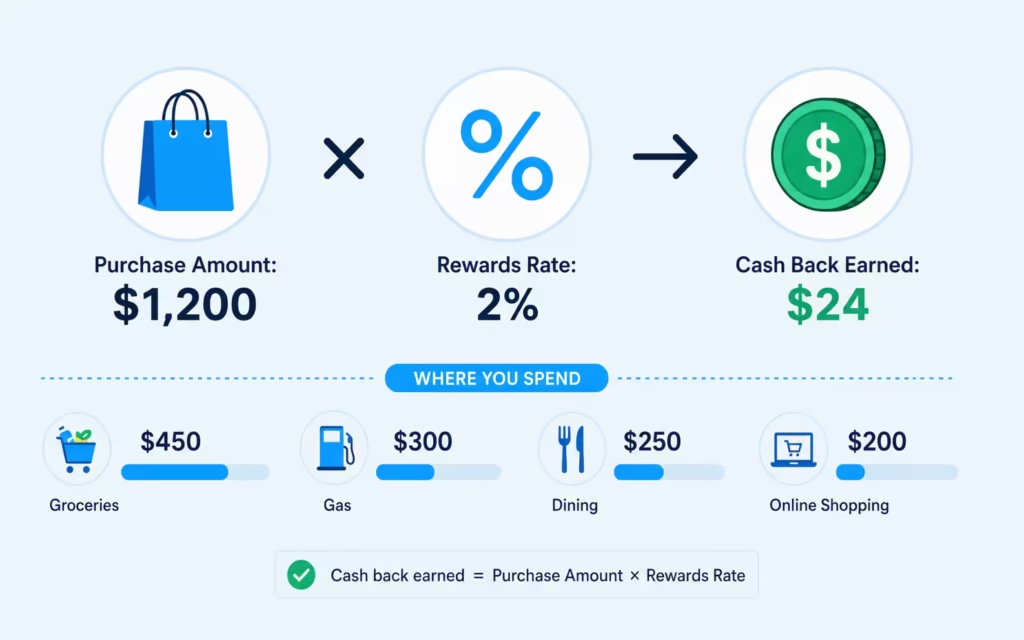
Each transaction gets calculated on its own. So the $400 grocery run earns $8. The $150 gas purchase earns $3. The card adds up every eligible swipe, then totals your monthly reward.
Some cards use different rates for different categories. If your card gives 3% on dining and 1% on everything else, that same $1,200 month looks like this:
- Dining ($200 × 3%) = $6
- All other spending ($1,000 × 1%) = $10
- Total earned: $16
The rewards rate always applies to the net purchase amount. That means if you return the $250 online order, the card removes the $2.50 you earned on it. Returns reverse rewards.
Understanding how does cash back work on a credit card boils down to this: know your rate, know your spending, and you can predict your rewards each month.
💡 Pro Tip: Track your top three spending categories for one month. Then match a card whose highest rates align with those categories. A dining-heavy spender earns more with a 3% dining card than with a flat 2% card.
Types of Cash Back Structures
Not all cash back cards work the same way. Card issuers use three main structures. Each one fits a different type of spender.
Flat-Rate Cash Back
A flat-rate card gives the same percentage on every purchase. No categories. No caps. No activation needed.
For example, the Wells Fargo Active Cash offers 2% on everything. Whether you buy a $5 coffee or a $500 flight, you earn 2% back on all of it.
This structure is predictable and simple. You never wonder if a purchase counts or which category it falls under. If you prefer not to manage rewards or track categories, a flat-rate card is an ideal choice.
The tradeoff? You might earn less than someone using a category card for their biggest spending areas. But the simplicity often wins for busy people.
Tiered Cash Back
Tiered cards offer higher rates in fixed categories. These categories don’t change. Common tiers include:
- 3% on groceries
- 3% on gas
- 2% on dining
- 1% on everything else
The tiered rewards rate rewards specific habits. If you spend $600 a month on groceries, a 3% grocery tier earns $18. A flat 1.5% card would earn only $9. That’s double the reward for the same spending.
The catch: some tiered cards cap the higher rate. You might earn 3% on the first $6,000 in grocery spending each year. After that, the rate drops to 1%. Check the fine print before applying.
Rotating Category Cash Back
Rotating category cards change their bonus areas every quarter. One quarter might feature 5% on gas stations. The next might switch to 5% on restaurants and streaming services.
The Chase Freedom Flex and Discover it are the best-known examples. Both offer 5% cash back on rotating bonus categories each quarter, up to a spending cap (usually $1,500 per quarter).
Two rules make these cards work:
- You must activate the categories each quarter. Miss the activation, and you earn the base rate instead.
- Spending caps apply. Once you hit the cap, extra spending in that category drops to 1%.
Rotating cards can pay off big if you plan around the categories. But they take effort. If you forget to activate or ignore the calendar, you leave money on the table.
How and When Cash Back Accrues
Cash back doesn’t hit your account the moment you swipe. It follows a specific timeline.
Here’s how it works. When you make a purchase, the transaction sits as “pending” for a day or two. Once the payment clears, the card posts the transaction as final. Only then does the cash back get added to your rewards balance.
Your billing cycle ties to the rewards. Most cards calculate and post rewards after the statement closes each month. So a purchase made on the first of the month usually shows up as earned rewards after the cycle ends, about 30 days later.
Returns work in reverse. If you buy $200 in shoes and earn $4 in rewards, then return the shoes, the card takes back the $4. This reversal happens automatically. You don’t need to do anything.
Fraud reversals work the same way. If someone uses your card and the charge gets refunded, any rewards earned on that fraudulent transaction get removed too.
This timing matters for one big reason. You can’t spend rewards you haven’t earned yet. Even after the cash back posts, most cards require it to sit in your rewards balance for another billing cycle before you can redeem it.
How Cash Back Gets Paid Out
Once rewards land in your account, you get to choose how to receive them. Most cards offer several payout options.
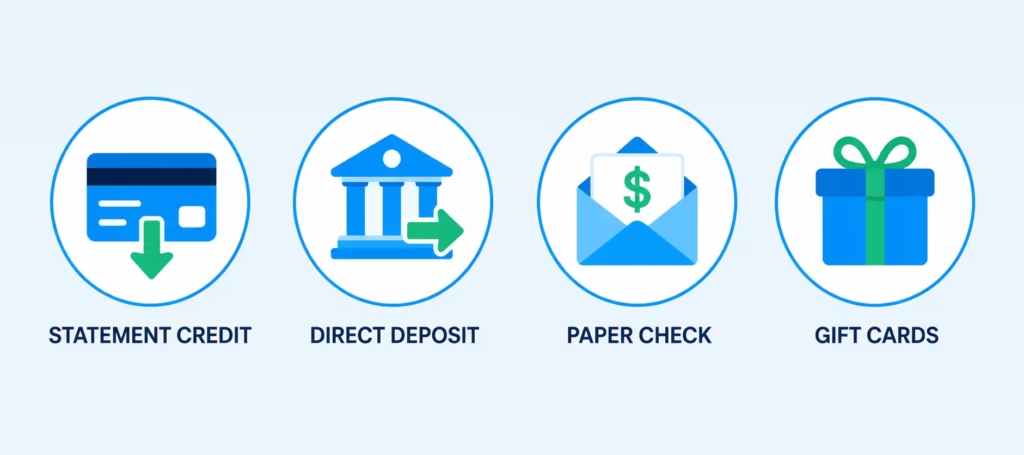
Statement credit is the most common option. Your rewards get subtracted from your card balance. If you have a $500 bill and $25 in cash back, applying a statement credit drops your bill to $475. It’s easy and automatic. But it doesn’t put actual cash in your pocket.
Direct deposit sends your rewards straight to your linked checking or savings account. This gives you real cash to spend or save however you want. Most issuers process direct deposits within a few business days.
Paper check works for people who don’t want to link a bank account. The issuer mails a check to your address. It’s slower, usually taking one to two weeks.
Some cards also let you use rewards for:
- Gift cards (sometimes at a bonus rate)
- Amazon or PayPal purchases at checkout
- Charitable donations
- Travel bookings through the card’s portal
Payouts can be manual or automatic. Manual means you log in and request the redemption. Automatic means you set a rule, like “send $25 as statement credit every month once earned,” and the card handles it for you.
Choose the option that matches your habits. If you always carry a balance, statement credit reduces what you owe. If you pay off cards in full, direct deposit gives you real money to enjoy.
Redemption Minimums and Expiration
Some cards let you redeem rewards anytime, in any amount. Others make you wait until you hit a minimum balance.
Minimum redemption thresholds vary by issuer. Common minimums include:
- $25 minimum for statement credits or checks
- $20 minimum for gift cards
- No minimum for some flat-rate cards
If your card has a $25 minimum and you’ve earned $18, you’ll need to keep earning until you cross the threshold. Only then can you redeem.
Expiration rules are just as important. Some cards keep rewards active forever, as long as your account is open and in good standing. Others expire rewards after a set time, often 12 to 60 months of inactivity.
Rewards can also disappear if you:
- Close the account
- Miss payments for a certain period
- Fall into serious delinquency
Check your card’s rewards terms carefully. The fine print will spell out both the minimum and any expiration timeline.
To stay safe, redeem your rewards on a schedule. Cashing out every three to six months keeps your balance moving and reduces the risk of losing anything.
⚠️ Mistake to Avoid: Don’t let rewards sit unclaimed for years. Even cards that say “rewards never expire” often void balances when accounts close. Cash out at least once a year to protect what you’ve earned.
Cash Back vs. Cash Advance
These two terms sound similar. They are very different. Mixing them up can cost you hundreds of dollars.
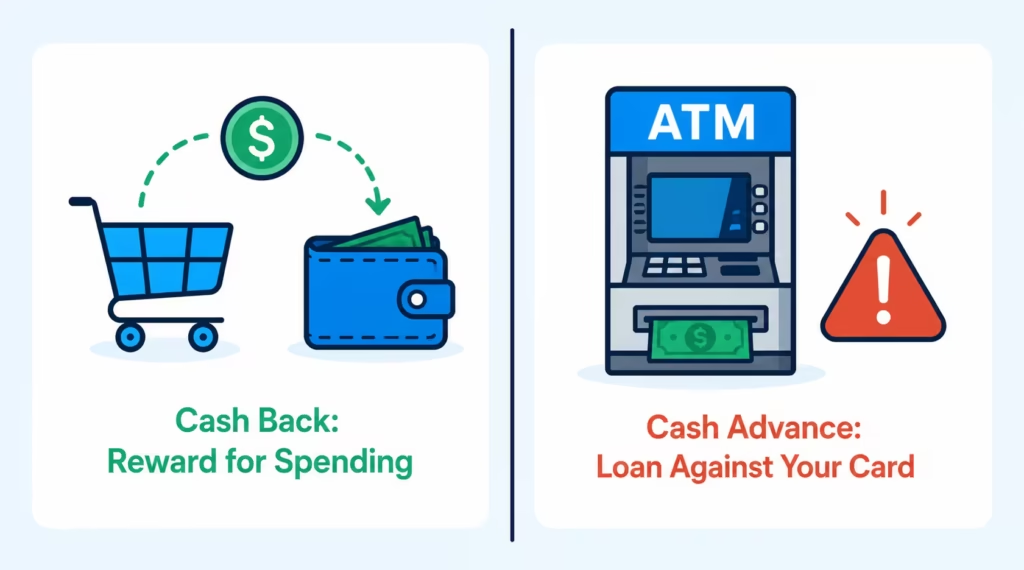
Cash back is a reward. You earn it by making regular purchases. It’s free money the card gives you.
A cash advance is a short-term loan against your card’s credit limit. You use your card at an ATM or teller to withdraw cash. That cash isn’t free. It comes with:
- A cash advance fee (usually 3% to 5% of the amount, or $10 minimum)
- A higher APR than regular purchases (often 25% or more)
- No grace period; interest starts building the moment you withdraw
So if you take a $500 cash advance, you might pay a $25 fee upfront, plus daily interest at 25% APR. Even if you pay it back within a month, the fee and interest can add up fast.
Cash back rewards you for spending. A cash advance charges you for borrowing. They’re opposite sides of the coin.
If you ever need cash from your credit card, treat it as a last resort. A personal loan, an emergency fund, or even a bank overdraft is almost always cheaper than a cash advance.
What Purchases Don’t Earn Cash Back
Not every swipe earns rewards. Card issuers exclude specific transactions from their cash back programs. Knowing these exclusions helps you avoid surprises.
Common eligible purchases include groceries, dining, gas, retail shopping, online orders, streaming, and most everyday spending.
Common exclusions include:
- Balance transfers: Moving debt from one card to another doesn’t earn rewards. The balance transfer exclusion applies even if the transfer counts toward your credit limit.
- Cash advances: As covered above, these aren’t purchases. They earn no cash back.
- Fees: Annual fees, late fees, and foreign transaction fees never earn rewards.
- Interest charges: Interest you pay on a balance isn’t a purchase. No rewards there either.
- Gambling transactions: Casino chips, lottery tickets, and online betting often don’t qualify.
- Money orders and wire transfers: These are treated like cash, not purchases.
- Cryptocurrency purchases: Many issuers classify crypto buys as cash advances.
Some issuers also exclude:
- Peer-to-peer payments (Venmo, PayPal, Zelle transactions to friends)
- Prepaid card reloads
- Gift card purchases at certain retailers
The fine print always wins. Before making a big purchase you expect to earn rewards on, check your card’s terms. If you’re unsure, call the number on the back of your card.
Is Cash Back Taxable
Good news. In most cases, cash back is not taxable income.
The IRS treats cash back as a rebate, not income. Since you’re essentially getting a discount on your spending, it doesn’t count as new money earned. A rebate reduces the cost of what you bought. It doesn’t add to your paycheck.
This IRS rebate treatment applies to:
- Rewards earned through everyday spending
- Cash back tied to a purchase requirement
- Sign-up bonuses that require you to spend a minimum amount
But there’s an important exception. If you earn a bonus without any spending requirement, that bonus can be taxable. For example, if a bank pays you $200 just for opening a card and doesn’t require any purchases, the IRS may treat that $200 as income.
In that case, the card issuer might send you a 1099-MISC form at tax time. If you receive a 1099-MISC for card rewards, report it as “other income” on your tax return. The IRS official tax guide on rebates and rewards covers the specifics if you want to check for your situation.
The rule of thumb is simple. If you had to spend to earn it, it’s a rebate. If it came free without any purchase, it might be income. When in doubt, ask a tax professional.
Is a Cash Back Card Worth It
The honest answer is: it depends on your habits.
A cash back card works well when you:
- Pay your balance in full each month
- Spend consistently on categories that match your card’s rewards
- Use the card for planned purchases, not impulse buys
It stops being worth it when you:
- Carry a balance month to month
- Chase categories and overspend just to earn rewards
- Pay an annual fee that eats up most of your rewards
The math matters. If your card earns $200 a year in cash back but has a $95 annual fee, your real benefit is $105. Compare that against a no-fee card with slightly lower rates. Sometimes the no-fee option wins.
Before applying, ask yourself:
- Will I pay in full each month?
- Do my top spending areas match this card’s bonus categories?
- Are the earned rewards higher than any fees I’ll pay?
If the answer to all three is yes, the card likely pays off.
Does Interest Cancel Out Your Cash Back
Yes. Interest almost always beats cash back rewards.
Here’s the math. The average credit card APR sits around 20% to 25% based on Federal Reserve data. Most cash back rates top out at 2% to 5%.
Say you spend $1,000 on a card that earns 2% cash back. You earn $20 in rewards. If you carry that $1,000 balance for a month at 22% APR, you pay about $18 in interest. In two months, interest costs you more than double your rewards.
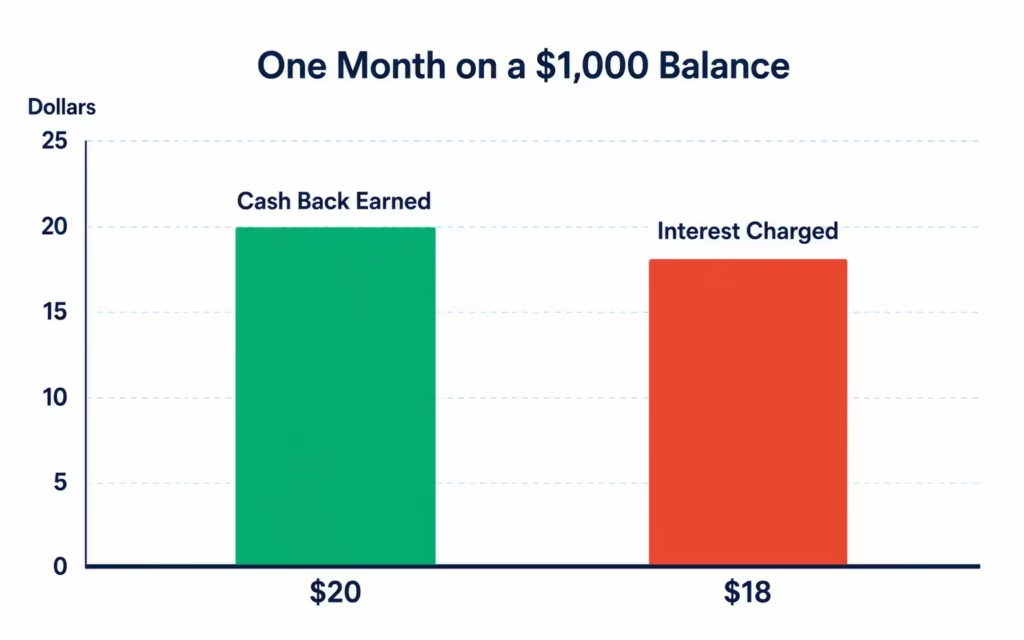
The lesson is clear. Pay your balance in full every month. If you don’t, the interest wipes out your rewards, and then some. A cash back card only saves you money when you never pay a cent of interest.
If you cannot consistently pay in full, a low-APR card or no-frills card is more beneficial than any rewards card.
Cash Back vs. Points or Miles
Cash back is the simplest form of rewards. One dollar earned equals one dollar to spend.
Points and miles can offer more value, but they take more work. A hotel point might be worth 0.5 cents one day and 1.5 cents the next, depending on the redemption. Airline miles fluctuate based on the route, season, and availability.
Points and miles work best if you:
- Travel often
- Enjoy researching redemption strategies
- Want premium experiences like business class flights
Cash back works best if you:
- Want maximum flexibility
- Prefer predictable value
- Don’t want to think about rewards after earning them
There’s no single winner. It comes down to what you value more: simplicity or optimization.
How to Choose the Right Cash Back Card for Your Spending
Picking a cash back card isn’t about grabbing the one with the highest advertised rate. It’s about matching the card to how you actually spend. A 5% grocery card is useless if you eat out most nights. A travel-heavy dining card wastes rewards if you rarely leave your kitchen.
Start by pulling your last three months of debit or credit card statements. Add up spending in these buckets:
- Groceries and household supplies
- Gas or public transit
- Dining and takeout
- Online shopping
- Streaming and subscriptions
- Travel and hotels
Whichever two or three buckets top your list should decide your card. If groceries and gas lead, a tiered card with 3% in both categories fits best. If your spending is spread evenly, a flat-rate 2% card usually earns more overall.
Next, weigh the annual fee against expected rewards. A card with a $95 fee needs to earn at least $95 more than a free card to break even. Do the math before applying.
Finally, check the welcome bonus. Many cards offer $200 or more after you spend a set amount in the first few months. If you can hit the threshold with normal spending, that bonus can double your first-year rewards.
Sarah, a 28-year-old marketing coordinator, tracked her spending for one month and found $420 in groceries and $180 in gas. Switching from a flat 1.5% card to a 3% grocery and gas tiered card added about $130 to her yearly rewards, with no change in her habits.
Common Mistakes That Reduce Your Cash Back Earnings
Even with the right card, small habits can shrink your rewards without you noticing. Avoiding these mistakes protects the money you’re already earning.
Forgetting to activate rotating categories. Cards like the Chase Freedom Flex and Discover it require quarterly activation. Miss the deadline, and your bonus rate drops to 1% for three months. Set a calendar reminder for the first week of January, April, July, and October.
Overspending to chase rewards. Spending an extra $100 to earn $5 in cash back is a $95 loss. Rewards only add value when they come from spending you’d do anyway.
Ignoring category caps. Many tiered and rotating cards limit the bonus rate to the first $1,500 or $6,000 spent per quarter or year. After the cap, the rate drops to 1%. If you hit the cap early, switch to a different card for that category until the next cycle.
Paying only the minimum balance. Interest charges wipe out rewards fast. A $1,000 balance carried at 22% APR costs about $220 a year in interest. Even a great 5% card can’t outpace that math.
Redeeming rewards for low-value options. Some issuers offer gift cards at a bonus rate but cut the value on Amazon purchases or travel bookings. Always compare redemption values. Statement credit and direct deposit almost always give you full dollar-for-dollar value.
Closing old cards too quickly. Closing a card can void unredeemed rewards. Cash out first, then close. Better yet, keep no-fee cards open to protect your credit history.
Frequently Asked Questions
Is cash back free money?
No, you have to spend money to earn it. It works as a small rebate on purchases you’re already making, not a bonus for doing nothing.
What is the downside to cash back?
Interest charges from carrying a balance almost always cancel out the rewards, since average APRs run 20% to 25% versus typical cash back rates of 2% to 5%. Rotating category cards also require quarterly activation, and missing it drops your rate to 1%.
What does 5% cashback mean?
It means you earn 5 cents back for every dollar spent in that category. A $200 purchase at a 5% rate earns $10 in cash back.
How much is $5 cash back on $50?
$5 back on a $50 purchase works out to a 10% cash back rate. That’s higher than nearly all standard cash back cards, which typically range from 1% to 5%.
What is 5% cashback on $100?
5% cash back on a $100 purchase equals $5 back. The formula is simply the purchase amount multiplied by the rewards rate.
Is 1% cash back good on a credit card?
1% is on the low end for cash back cards, since flat-rate cards commonly offer 1.5% to 2% with no annual fee. A 1% rate is worth it mainly if the card has no fee and you value simplicity over maximizing rewards.
Is it worth having a cash back credit card?
It’s worth it if you pay your full balance every month and your spending matches the card’s bonus categories. If you carry a balance or pay a high annual fee, interest or fees can erase most or all of the rewards.
Do I lose my cash back if I close my account?
Yes, closing your card can void any unredeemed cash back. Redeem your rewards balance before closing an account to avoid losing what you’ve earned.
Wrapping Up
Understanding cash back on a credit card comes down to a few key ideas. Rewards are earned as a percentage of eligible spending, paid out as statement credit, deposit, or check, and generally tax-free because the IRS treats them as rebates. Different card structures suit different habits, and the right choice depends on where and how you spend.
Based on the math, the most effective approach is to pay your balance in full every month. Interest at 20% or more easily wipes out any 2% reward.
If you know a friend or family member who’s about to apply for their first rewards card, share this guide. It could save them from picking a card that doesn’t fit their spending.