
You open your card app and see a number labeled “outstanding balance.” It looks bigger than you expected. It was different yesterday. Now you’re not sure what it means, or which number you’re supposed to pay. I’ve watched this confuse a lot of new cardholders, and the worry is real: pay the wrong number and you could get hit with interest you didn’t need to owe.
Your outstanding balance is the total amount you owe on your card at this exact moment, but in most cases you only need to pay the smaller statement balance to avoid interest.
Below, we explain what this number means, why it changes daily, how it compares to your other balances, and when and what to pay.
Key Takeaways
This guide explains what a credit card’s outstanding balance is, how it differs from the statement balance and minimum payment due, and which number to pay to avoid interest.
Core Facts:
- The outstanding balance is the live total owed on a card, including posted purchases, accrued interest, fees, cash advances, and balance transfers.
- The statement balance is a frozen snapshot taken on the billing cycle closing date, and paying it in full by the due date avoids purchase interest through the grace period.
- Pending transactions reduce available credit but do not add to the outstanding balance until they post, which is why the balance can seem to change unpredictably.
- Available credit equals the credit limit minus the outstanding balance minus pending charges.
- The minimum payment due is typically 1 to 3 percent of the statement balance or a flat amount such as $25, whichever is greater, and paying only the minimum leaves interest accruing on the rest.
- Credit bureaus report a balance snapshot from the statement closing date, so paying down the balance a few days before closing (rather than just before the due date) can lower reported credit utilization.
Best for:
- Cardholders confused about why their app shows a different balance than their printed statement.
- People deciding whether to pay their statement balance, full outstanding balance, or minimum due.
- Readers trying to understand why their credit score dropped despite paying their card in full each month.
What Is an Outstanding Balance on a Credit Card?
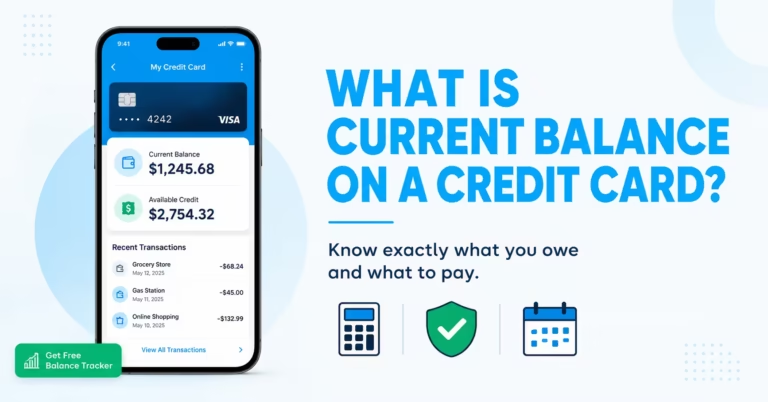
An outstanding balance is the full amount you owe on your credit card at the moment you check your account. It is a live number. It moves up when you spend and down when you pay.
Think of it this way. Say your card shows $500 owed on Monday. On Tuesday, you buy $50 of groceries. Once that charge posts, your balance reads $550. Pay $200 on Friday, and it drops to $350. Nothing mysterious happened. The number simply tracked your activity.
One thing trips people up here: the label. Many issuers call this same figure the current balance. So if one card app says “current balance” and another says “outstanding balance,” you are almost always looking at the same thing: the total outstanding amount on your credit card right now. The name changes. The math doesn’t.
What’s Included in Your Outstanding Balance
This number is not just your shopping. It is a running total of everything owed on the account, including:
- Purchases that have posted to your account
- Interest charges that have accrued on any carried balance
- Fees, such as an annual fee or a late payment fee
- Cash advances and their fees
- Balance transfers moved over from another card
Two details matter here. First, interest and fees count as soon as they are charged to the account, not just at the end of a billing cycle. Second, all of these items keep adding up throughout the cycle. Your balance doesn’t wait for your statement to grow.
Why Your Outstanding Balance Changes Daily (Posted vs. Pending)
This is the part that makes the number feel unpredictable. The key is understanding posted transactions versus pending transactions.
A posted transaction is finished. The merchant collected the money, and the charge is now part of what you owe. Posted charges raise your balance right away.
A pending transaction is still in process. The merchant has asked your issuer to hold the money, but the charge hasn’t settled yet. Pending charges usually do not add to your outstanding balance yet, but they do reduce your available credit.
Here’s a real-world example. Michael fills up his car, and the gas station places a $75 pending hold. His balance doesn’t move yet. Two days later, the hold settles at $62, the final amount of gas he actually bought. Now his balance rises by $62, and the pending hold disappears. If he checked his app during those two days, the numbers would have looked confusing for no real reason.
📌 Did You Know: Hotels and gas stations often place holds that are higher than your final charge. This is why your available credit can drop before your balance moves at all.
Does Your Outstanding Balance Include Interest and Fees?
Yes, once interest or a fee is charged to your account, it becomes part of your outstanding balance. Interest and fees are treated the same way as a purchase. As soon as they post, they add to the total you owe.
Timing matters here. Interest is not usually added daily. It typically posts at the end of your billing cycle, and only if you carried a balance from the previous cycle instead of paying it off in full. If you pay your statement balance in full by the due date, most issuers will not charge you interest at all. This is often called a grace period, and it is the reason some cardholders never see an interest charge on their account.
Fees work differently. A late fee, annual fee, or cash advance fee is added as soon as your issuer applies it, regardless of whether you carried a balance.
Here is an example: Say your statement balance was $500 and you only paid $300, leaving $200 unpaid. Your issuer charges interest on that $200 at the end of the next billing cycle. Once that interest posts, say it comes to $10, your outstanding balance reflects it immediately. Your new outstanding balance becomes $210, plus any new purchases you have made since then.
If you consistently pay your statement balance in full, your outstanding balance should rarely include interest at all.
Outstanding Balance vs. Statement Balance
This is the most important comparison in this article, and the one that decides whether you pay interest.
Your statement balance is a snapshot. At the end of each billing cycle (usually about 30 days), your issuer adds up everything you owed on the closing date and prints that figure on your billing statement. That number then stays frozen until the next cycle closes.
Your outstanding balance never freezes. It keeps moving with every new charge and payment, all cycle long.
Here’s how the two look side by side. Say your billing cycle closed on June 1 with a statement balance of $800. Your payment is due June 26. Between June 1 and June 10, you spend $150 on new purchases:
| What you check | What it shows on June 10 |
|---|---|
| Statement balance | $800 (frozen, due June 26) |
| Outstanding balance | $950 ($800 + $150 in new spending) |
Both numbers are correct. They just answer different questions.
The payoff: if you pay the full $800 statement balance by the due date, you owe no interest on those purchases. This is the grace period at work. The extra $150 belongs to the next cycle and will appear on your next statement.
Outstanding Balance vs. Available Balance (or Available Credit)
Your outstanding balance is what you owe. Your available credit is what you can still spend. They are two ends of the same credit limit, and the math is simple:
Credit limit − outstanding balance − pending charges = available credit
Say your card has a $3,000 credit limit, a $900 balance, and $100 in pending charges. Your available credit is $2,000.
The trap to avoid: judging your spending room by whether the card gets declined. A card that still works can hide a balance creeping toward the limit. Jennifer, a marketing coordinator, kept using her card all month because it never declined.
She didn’t notice her balance had climbed to $2,700 of her $3,000 limit until a rental car hold was refused. Her card worked fine for small purchases the whole time. The number to watch is the balance itself, not the swipe.
⚠️ Mistake to Avoid: Don’t use “the card wasn’t declined” as a spending green light. Check your balance against your credit limit before big purchases, especially travel bookings that add large holds.
Outstanding Balance vs. Minimum Payment Due
Your minimum payment due is the smallest amount your issuer will accept to keep your account in good standing for that cycle. It is usually a small percentage of your statement balance (often 1% to 3%) or a flat amount like $25, whichever is greater.
It is not a suggested payment plan. It is the floor, not the goal.
Here is why that matters. Interest on credit cards is expensive: Federal Reserve data puts the average rate on credit card plans at 20.94% as of May 2026. If you pay only the minimum, that rate applies to everything you didn’t pay.
On a $2,000 balance, a $40 minimum payment keeps you current, but roughly $34 of interest can land on next month’s bill. Pay the minimum month after month and a big share of each payment feeds interest instead of shrinking your debt.
The minimum due protects you from a late fee. It does nothing to protect you from interest.
Which Balance Should You Actually Pay?
Now the decision this whole article builds toward. For most cardholders, the answer is simple: pay the full statement balance by the due date. That single habit avoids all purchase interest while keeping your account in perfect standing.
Paying the entire outstanding balance is also fine, but it is optional, not required. It makes sense in two situations:
- You want a $0 balance right now, for peace of mind or before a trip.
- You want to lower your reported balance before your issuer sends data to the credit bureaus (more on that in the next section).
What you should not do is treat the outstanding balance as the amount you must pay. It includes brand-new charges that aren’t due yet. Paying it early costs you nothing, but it also buys you nothing extra in interest savings.
💡 Pro Tip: Set autopay to “statement balance” instead of “minimum due.” You’ll never miss a due date and never pay a cent of purchase interest, as long as the money is in your bank account.
What Happens Depending on Which Balance You Pay
Each choice has a clear, predictable result:
| You pay | What happens |
|---|---|
| Full statement balance | No interest on purchases. Account stays in good standing. |
| Full outstanding balance | No interest, plus a $0 (or near-$0) balance and lower reported utilization. |
| Minimum due only | No late fee, but interest accrues on the unpaid remainder at your card’s APR. |
| Less than the minimum | Late fee, possible penalty APR, and a missed-payment mark risk. |
Notice that the first two rows both avoid interest completely. The difference between them is timing and credit reporting, not cost.
How Outstanding Balance Affects Your Credit Utilization and Credit Score
This section talks about a frustrating part of personal finance: paying your card in full each month but seeing your credit score drop.
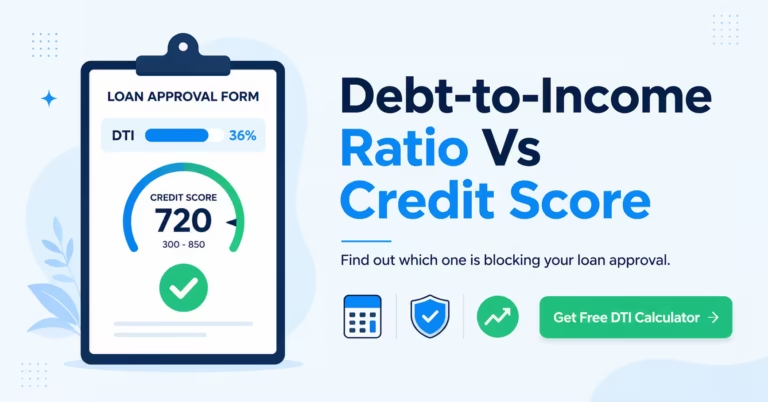
The mechanism is your credit utilization ratio. That is your balance divided by your credit limit, shown as a percentage. A $900 balance on a $3,000 limit is 30% utilization. Scoring models treat lower utilization as a sign of healthy credit use, and the Consumer Financial Protection Bureau advises keeping credit use at no more than 30 percent of your total limit.
Here is the catch. Your issuer doesn’t report whether you paid in full. It reports a balance snapshot, usually taken on your statement closing date. So the number the credit bureaus see is whatever you owed on that one day, not your good payment habits.
Watch how this plays out. Sarah, a graphic designer, charges about $2,400 a month on a card with a $3,000 limit. She pays every statement balance in full and has never owed interest. But her issuer reports her balance on the closing date, right when it peaks near $2,400. The bureaus see 80% utilization month after month, and her score sags even though her finances are perfect.
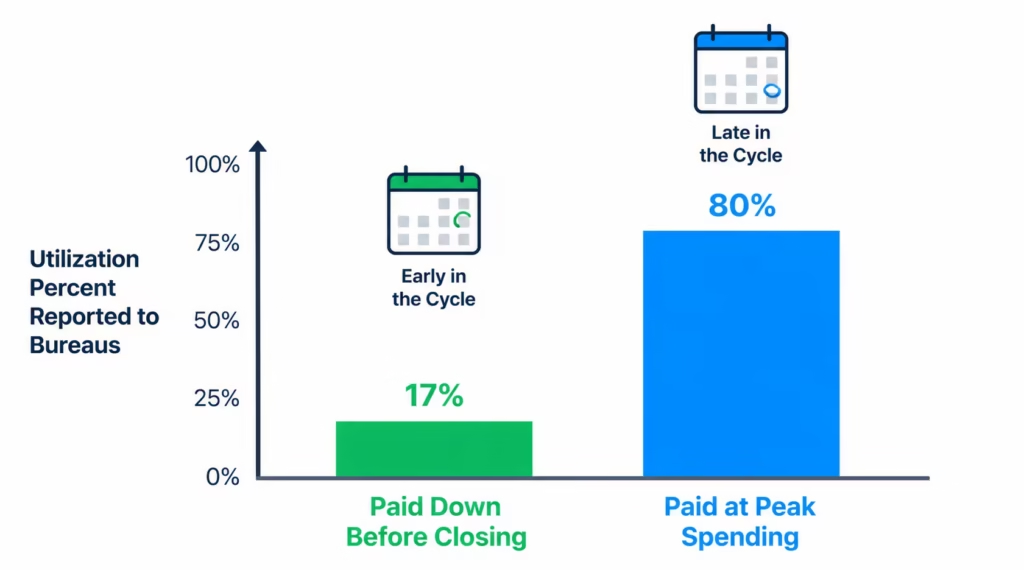
The fix takes one step: pay down most of the balance a few days before the statement closes, not just before the due date. A $2,400 balance paid down to $500 before closing reports as about 17% utilization instead of 80%. Same spending, same full payment, very different snapshot.
Where to Find Your Outstanding Balance
You can check this number in under a minute, in three places:
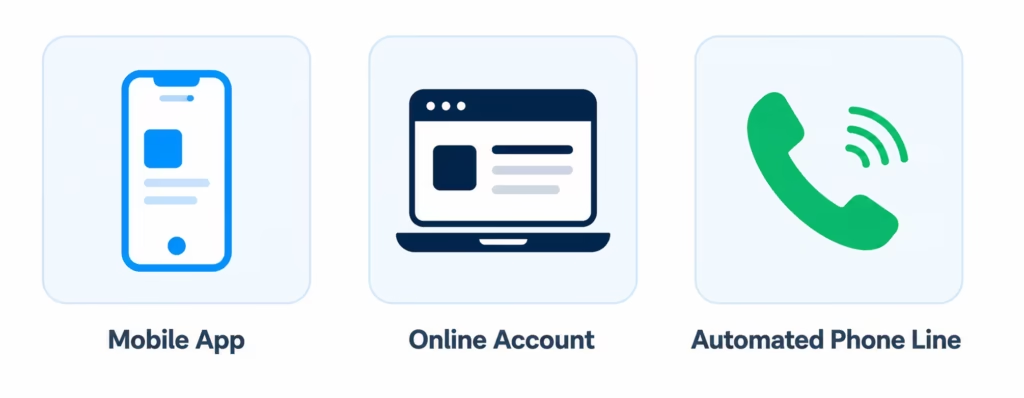
- Your issuer’s mobile app. Open it, and the balance is usually the biggest number on the home screen, often labeled “current balance” or “outstanding balance.”
- Your online account. Log in on the issuer’s website. The balance sits at the top of your account summary or dashboard.
- Your phone. Calling the number on the back of your card and using the automated system also works if the app is down.
One warning: your paper or PDF statement will not show this figure. A statement only displays the statement balance frozen on the closing date. For the live, real-time number, use the app or website.
What Does a $0 or Negative Outstanding Balance Mean?
A $0 outstanding balance means you currently owe nothing. There are no posted transactions sitting on your account. This usually happens right after you have paid off your full balance and have not made any new purchases since.
A negative outstanding balance means the opposite. Your card issuer actually owes you money. This is more common than it sounds and usually happens for one of a few reasons. You may have returned an item and received a refund after you had already paid off your balance.
You may have accidentally overpaid your bill. Or a statement credit from your issuer, such as a rewards redemption, may have been applied to your account.
A negative balance is not an error, and it is not something to worry about. Your issuer will usually apply that negative amount to your next purchase. This means you won’t owe anything until your spending goes over the credit on your account.
If you’d prefer to get that money back instead of using it for future purchases, you can often ask for a refund of the negative balance from your card issuer.
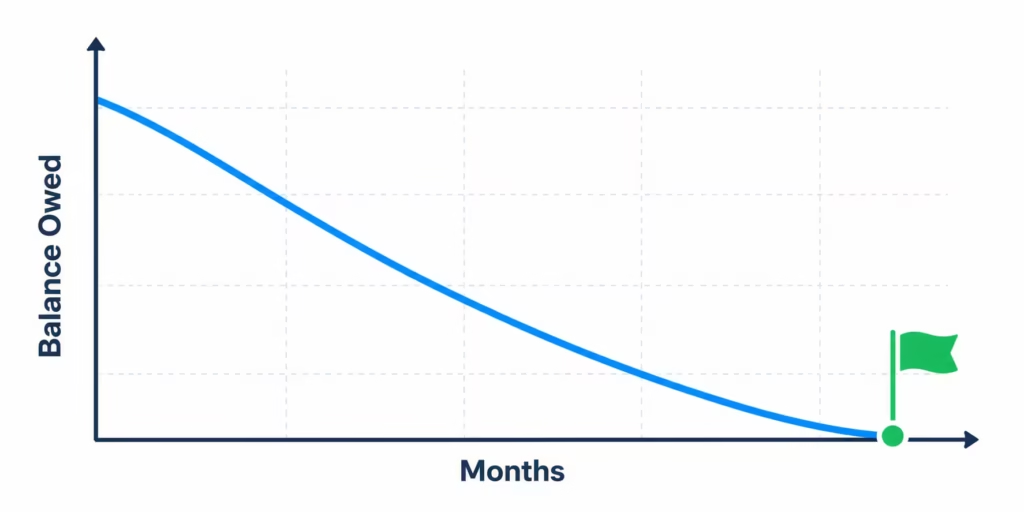
How to Reduce a Growing Outstanding Balance
If your balance is climbing faster than your payments, these four steps will turn it around:
- Pay more than the minimum every month. Even an extra $50 above the minimum goes straight to principal and cuts future interest.
- Target the highest-APR card first. If you carry balances on several cards, put every spare dollar toward the most expensive one while paying minimums on the rest.
- Pause new charges on the card you’re paying down. New spending on a card that’s already accruing interest starts costing you immediately, with no grace period.
- Set autopay for at least the statement balance going forward. This stops the cycle from repeating once the old balance is gone.
David, a warehouse supervisor, owed $4,100 across two cards. He stopped adding new charges, set autopay for the statement balance on his lower-APR card, and threw an extra $200 a month at the 26% APR card. The expensive balance was gone in about 14 months, and he paid far less interest than he would have making minimum payments on both.
What Happens If You Don’t Pay Your Outstanding Balance
Skipping payments sets off a chain that gets worse with time. Interest adds up on the unpaid balance. Since credit card interest compounds, next month’s interest is charged on a balance that includes this month’s interest. The debt grows on its own.
Miss even the minimum payment, and a late fee lands on top, typically up to $30 or more. Miss a payment by 30 days or more, and the issuer can report it to the credit bureaus, where a single late mark can drag your score down for years. Let it go long enough and the account can be charged off and sent to collections.
None of this happens from carrying a balance responsibly. It happens from paying nothing. Even the minimum payment, made on time, keeps the worst of it away while you work the balance down.
Frequently Asked Questions (FAQs)
Does outstanding balance mean I owe money?
Yes, your outstanding balance is the total amount you currently owe on your credit card. It includes purchases, interest, fees, cash advances, and balance transfers that have posted to your account.
Is outstanding balance the same as current balance?
Yes, most issuers use “current balance” and “outstanding balance” to describe the exact same number. Both refer to the live total you owe at the moment you check your account.
Should I pay outstanding balance or statement balance?
Pay your statement balance by the due date to avoid all purchase interest. Paying the full outstanding balance works too, but it’s optional since it includes new charges that aren’t due yet.
Is it bad to owe $1000 on a credit card?
It depends on your credit limit, not the dollar amount alone. A $1,000 balance on a $3,000 limit is 33% utilization, just above the 30% level the Consumer Financial Protection Bureau recommends staying under.
Is it bad to immediately pay off a credit card?
No, paying off your card immediately isn’t bad, but it’s also not necessary to avoid interest. As long as you pay the statement balance by the due date, you’ll owe zero interest whether you pay early or right at the deadline.
What’s the smartest way to pay off a credit card?
Pay more than the minimum each month and target your highest-APR card first while making minimum payments on the rest. One warehouse supervisor paid off a $4,100 balance across two cards in about 14 months this way, saving significant interest.
Do I need to pay my outstanding balance?
You’re only required to pay at least the minimum payment due to avoid a late fee and keep your account in good standing. To avoid interest entirely, pay the full statement balance rather than the full outstanding balance.
What happens if I only pay the minimum due?
Paying only the minimum keeps your account current but leaves interest accruing on the unpaid remainder at your card’s APR. On a $2,000 balance, a $40 minimum payment can still leave roughly $34 of interest landing on next month’s bill.
Wrapping Up
Your outstanding balance is the live total you owe, your statement balance is the frozen figure that decides interest, and your minimum due is only a floor. For most readers, paying the full statement balance by the due date delivers the best result: zero purchase interest and a healthy account.
If you carry debt, paying above the minimum and pausing new charges will shrink what you owe fastest.
If this helped you, share it with a friend or family member who just got their first card. Knowing which number to pay can save them money.