
You’re running a business, even a small one, and you’re still putting everything on your personal card. It feels a little messy, and you’re not sure if that’s a problem. Maybe you’ve wondered if a business credit card vs. a personal credit card choice really matters, or if it’s just marketing. Getting it wrong can hurt your credit, your taxes, and even your personal savings.
Business cards and personal cards work the same way on the surface, but they differ a lot in liability, legal protections, and credit reporting.
Below, I’ll walk you through each difference in plain terms. You’ll learn who qualifies, what’s at risk, and exactly which card to use for which expense.
Key Takeaways
This guide compares business credit cards and personal credit cards, covering eligibility, the personal guarantee, lost legal protections, credit reporting differences, and which expenses belong on each card type.
Core Facts:
- Freelancers, gig workers, and sole proprietors can qualify for a business credit card using their Social Security number, without an LLC or EIN.
- Nearly every small business credit card requires a personal guarantee, making the cardholder personally liable for the debt even if an LLC exists.
- Business cards are exempt from CARD Act protections, so issuers can raise rates with little or no notice and use double-cycle billing.
- Most major issuers don’t report routine business card balances to personal credit bureaus, but missed or late payments often do get reported.
- A charged-off business card account can remain on a personal credit report for up to seven years.
- Business card limits are typically higher than personal card limits because approval considers both business revenue and personal creditworthiness.
Best for:
- Freelancers and sole proprietors deciding whether to separate business and personal spending onto different cards.
- LLC owners who assume their business structure fully protects them from business card debt.
- Small business owners choosing which expenses to put on a business card versus a personal card for tax and bookkeeping purposes.
What Actually Separates a Business Card From a Personal Card
At first glance, the two cards look the same. Both let you buy now and pay later. Both charge interest if you carry a balance. But three real differences sit underneath.
Purpose. A personal card is meant for your own life: groceries, travel, streaming services. A business card is meant for costs that help your business earn money: ads, supplies, software, shipping. The card agreement for each product says so, and issuers take that seriously.
How approval works. A personal card is approved based on your income and your credit. A business card is approved based on your personal credit plus your business’s revenue. That’s a big reason limits tend to be higher, and we cover that in detail later.
Where the account gets reported. A personal card always shows up on your personal credit reports with Experian, Equifax, and TransUnion. A business card may report to business credit bureaus instead, which can help you build a separate business credit score over time. Some issuers still report to personal bureaus in certain cases, so it’s not a clean split.
There’s also a fourth difference, and it’s the one people miss most: the legal protections and who is on the hook for the debt are not the same. Those two topics are big enough to get their own sections below.
Who Can Actually Get a Business Credit Card
Many freelancers assume business cards are only for registered companies with offices and staff. That assumption costs them. The truth is much friendlier.
You can qualify for a business credit card for sole proprietor use with no LLC, no employees, and no fancy paperwork. If you earn money outside a regular job, you likely count as a business in the eyes of card issuers. That includes:
- Freelancers and gig workers with 1099 income
- Sole proprietors selling products or services
- Side-hustlers, even part-time ones
- Owners of LLCs and corporations

Most people are surprised to learn this: you can apply using your Social Security number, even if you don’t have an Employer Identification Number (EIN). An EIN is optional for sole proprietors.
If you want one, it’s free and takes about ten minutes on the IRS website’s EIN application page. Some owners like having one because it keeps their SSN off business paperwork, but it’s not required to apply.
Issuers will also ask about your business revenue. Don’t panic if the number is small or even close to zero. In a sole proprietorship, your total personal income is usually counted. This is because there’s no legal separation between you and your business.
📌 Did You Know: There is no minimum business size, revenue, or age requirement written into card applications. A freelance designer who earned $3,000 last year can apply the same way a $3 million company can.
How Approval Works Without a Business Credit History
A brand-new business has no credit history of its own. So how do issuers decide? They lean almost entirely on you.
When your business is young, the issuer pulls your personal credit report and scores the application mostly on that. Your business revenue gets considered, but it doesn’t need to be large. Plenty of people get approved with a few months of modest side income, as long as their personal credit is solid.
In practice, this means your approval odds in the early days track your personal credit profile more than anything about the business itself. A good personal score with a young business usually beats a weak personal score with a growing one.
The Personal Guarantee and What You’re Actually Liable For
This is the most important section in this article, so read it slowly.
A personal guarantee is a promise you sign when you open the card. It says: if the business can’t pay this debt, I will pay it myself. Nearly every small business credit card requires one, especially for new and small businesses. Cards with no personal guarantee exist, but they’re rare and usually demand strong business revenue or large bank balances.
Many owners assume a business card works like an LLC shield. They think the debt stays with the business no matter what. That’s wrong. The personal guarantee punches straight through that idea. Even if you have an LLC, the card agreement makes you personally responsible.
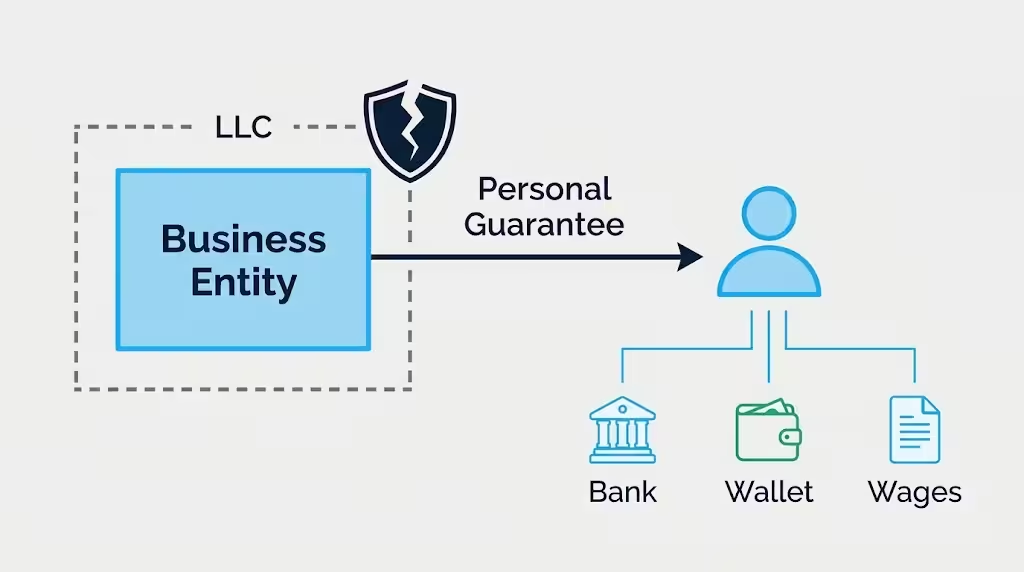
Here’s what that means in plain terms. Say your business owes $14,000 on the card and the money runs out. The issuer can come after your personal bank account, your personal assets, and your wages. The corporate veil your LLC gives you does not block a debt you personally guaranteed.
What Happens If the Business Can’t Pay the Balance
Let’s walk through the worst case, step by step.
First, the missed payments start getting reported. Many issuers report delinquent business accounts to the personal credit bureaus, even if they never reported your on-time payments there. So a card that stayed invisible while things went well can suddenly show up and drag down your personal credit score when things go badly.
Second, the debt becomes personally collectible. The issuer or a collections agency can pursue you, not just the business. That can mean collection calls, lawsuits, and judgments tied to you as an individual.
Third, recovery takes time. A charged-off account can sit on a credit report for up to seven years.
This is why the separation an LLC provides does not fully apply here. An LLC protects you from many business debts. It does not protect you from a debt you personally guaranteed in writing.
CARD Act Protections You Lose With a Business Card
On a personal card, federal law gives you a safety net. The CARD Act of 2009, which updated the Truth in Lending Act (TILA) and its rulebook, Regulation Z, forces issuers to treat you fairly in specific ways. Business-purpose credit is exempt from these rules, as the CFPB’s Regulation Z exemption guidance makes clear.
Here’s what you actually lose on a business card:
- Advance notice of rate increases. On a personal card, an issuer must give you 45 days of notice before raising your rate. On a business card, your rate can jump with little or no warning.
- Ban on double-cycle billing. Personal cards can’t charge interest based on last month’s balance, either. Business cards can, so you might pay interest on money you already paid off.
- Fee limits and rules. Caps on penalty fees and rules about how payments get applied don’t carry over the same way.
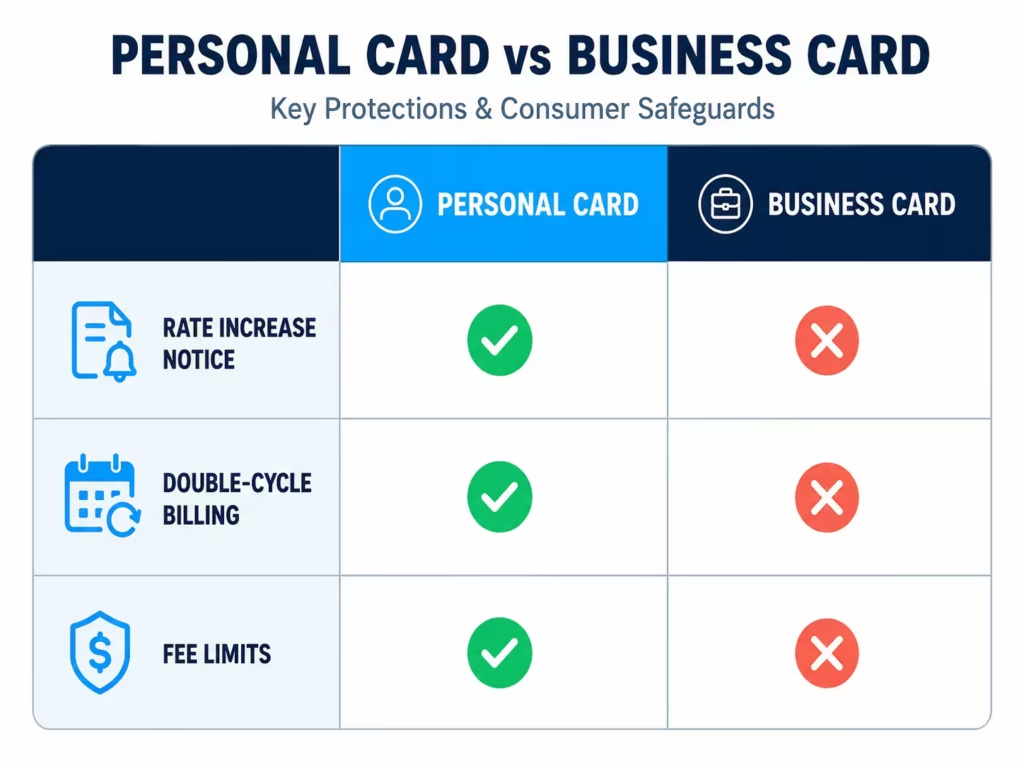
To be fair, some issuers voluntarily extend CARD Act-style protections to their business cards. It varies by issuer and by card. The key word is “voluntarily,” which means they can also change their minds.
The practical takeaway: read the card’s terms before you apply, because the law won’t protect you by default. Pay special attention to the sections on rate changes, penalty fees, and how payments are applied to balances.
⚠️ Mistake to Avoid: Never assume a business card has the same rate-hike and fee protections as your personal card. Marcus, a catering business owner in Austin, learned this when his business card’s APR jumped 6 points after one late payment, something his personal card legally couldn’t do without notice.
How a Business Card Affects Your Personal Credit
The relationship between a business card and your personal score is more tangled than most articles admit. Let’s untangle it.
The application. Yes, applying almost always triggers a hard inquiry on your personal credit report. That’s because the issuer is judging you personally, remember. One inquiry usually costs only a few points and fades within a year.
The balance. Whether your business card balance counts toward your personal credit utilization ratio depends on the issuer. Most major issuers don’t report routine business card activity to the personal bureaus.
In that case, a $9,000 business balance won’t inflate your personal utilization the way it would on a personal card. That’s actually a hidden benefit: big inventory purchases don’t squeeze your personal score.
The catch. The personal guarantee ties the account back to you in one important way. As covered above, late or missed payments often do get reported to personal bureaus, even at issuers that otherwise stay silent. So the account can only hurt your personal credit, not help it, at many issuers.
Because reporting practices differ so much, check the issuer’s policy before applying. A quick call or a look at their FAQ page usually answers it.
Building a Separate Business Credit Profile
Now the good news. A business card can help your business build its own credit identity, separate from yours.
Some issuers report your payment history to business credit bureaus like Dun & Bradstreet, where it feeds scores such as PAYDEX. There’s also the FICO Small Business Scoring Service, which lenders use for small business loans.
According to the Federal Reserve’s Small Business Credit Survey, credit cards are among the most common financing tools small firms use, which makes them a natural starting point for building that file.
Why does this matter? A strong business credit profile helps you get loans, better terms, and higher limits. This way, you won’t need to rely on your personal credit each time.
One reality check: reporting varies a lot by issuer. Some report to business bureaus only. Some report to both. A few report to neither while the account is in good standing. If building business credit is a goal, confirm the issuer reports to business bureaus before you apply.
Credit Limits: Why Business Cards Often Go Higher
Businesses spend more than people do. Card issuers know this, and their limits reflect it.
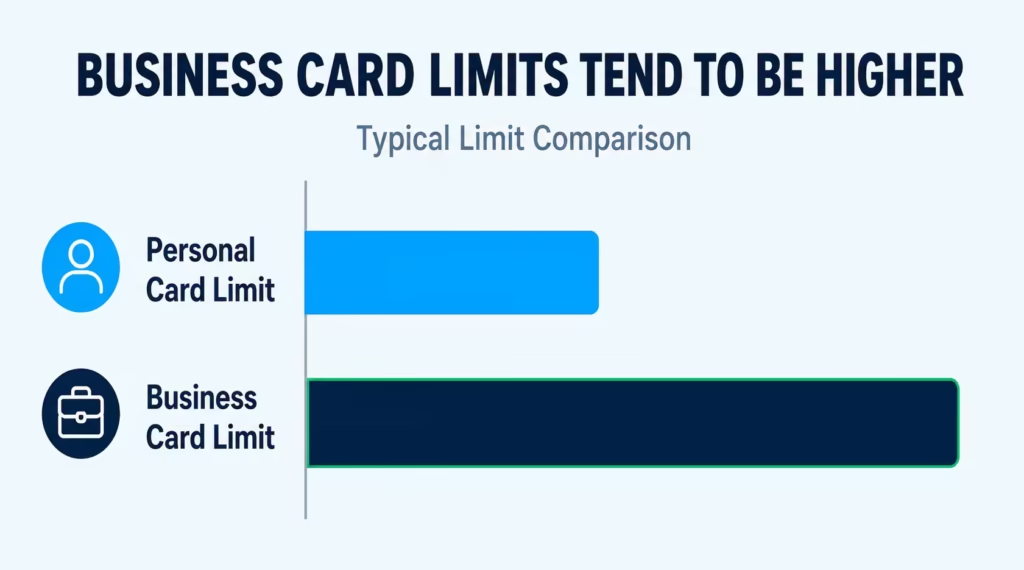
Personal card limits are based on your personal income. Business card limits are based on your business revenue plus your personal creditworthiness. Two income streams supporting one application generally mean more room to spend. A business card limit is often much higher than a personal card limit. Strong accounts can even reach five figures over time.
This matters in real life. Think about a $6,000 inventory order, a $4,500 equipment purchase, or $3,000 a month in ad spend. On a personal card, those charges might eat most of your limit and spike your utilization. On a business card with a bigger ceiling, the same spending fits comfortably and keeps utilization low.
There’s a bonus here. Some business charge cards come with no preset spending limit at all, adjusting to your payment history and revenue instead. For a growing business with lumpy expenses, that flexibility can be the difference between filling an order and turning it down.
Rewards and Benefits Built for Business Spending
Rewards are where the marketing gets loud, so let’s focus on what actually differs.
Reward categories. Personal cards tend to reward life spending: dining, travel, groceries, gas. Business cards reward business expense categories: office supplies, software subscriptions, shipping, advertising, and phone bills. If your highest monthly costs are Facebook ads and FedEx labels, a business card’s reward structure will simply fit better.
Business-specific perks. Many business cards include tools a personal card never offers: free employee cards, spending reports by category, year-end summaries, and direct connections to bookkeeping software like QuickBooks. These aren’t flashy, but they save real hours at tax time.
Intro APR offers. Personal cards are famous for long 0% intro periods, sometimes 15 to 21 months. Business cards usually offer shorter intro APR windows, and some offer none. If financing a big purchase interest-free is your main goal, compare this feature closely before choosing.
The pattern to remember: personal cards optimize for your life, business cards optimize for your operations. Neither is “better” in general. The right one is the one whose categories match where your money actually goes.
Which Expenses Actually Belong on Which Card
Here’s the simple rule of thumb you can use at the register, online checkout, or anywhere else:
If the cost exists to earn business income or run the business, it goes on the business card. If it’s for your personal life, it goes on the personal card.
Ad spend, inventory, software, client meals, shipping, business travel: business card. Groceries, your personal Netflix account, a family vacation: personal card. That’s 95% of decisions solved in one sentence.
Consistency matters more than perfection. One accidental grocery run on the business card won’t ruin anything. What causes real damage is habitual mixing, where every statement becomes a puzzle of personal and business charges.
Why does mixing hurt? Two reasons. First, it weakens your tax deduction eligibility position, because deductible expenses get buried in personal spending and become hard to prove. Second, it makes your books a mess, which means more accountant hours and more stress every spring.
💡 Pro Tip: Pick one “default” card for business and one for personal, and keep them physically separate. Put a small label or sticker on the business card so the right choice is automatic at checkout.
Handling Mixed-Use Purchases
Some items refuse to fit the rule. A laptop you use for client work during the day and movies at night. A phone that’s half business, half personal. A car, a home office, internet service.
For these, use a reasonable-use allocation approach. Buy the item on the card that matches its primary use. If the laptop is 70% business, put it on the business card and note the business-use percentage in your records. Only that portion is a business expense for tax purposes.
Documentation matters more for mixed-use items than for anything else. Keep the receipt, and jot down why the item is business-related and how you estimated the split. If the IRS ever asks, that one-line note is the difference between a smooth answer and a denied deduction.
Keep it simple. Don’t build a spreadsheet for every $60 purchase. Primary use decides the card, a quick note covers the rest, and your CPA can fine-tune the split at tax time.
Can You Use a Personal Card for Business (or a Business Card for Personal)?
Both directions come up constantly, so here are direct answers.
Personal card for business expenses: allowed, but costly. Nothing illegal stops you, and plenty of freelancers start this way. But you give up three things: clean expense separation, business credit building, and any business-specific protections or perks. You also create the tax headache described above. Using a personal credit card for business expenses is a fine temporary bridge, but it’s a poor long-term system.
Business card for personal expenses: don’t. This direction is worse. Most issuer card agreements say the card is for business. So, using it for personal expenses can break the terms. It also adds non-deductible charges to your books. For LLC owners, mixing finances can weaken the liability protection you set up.
The pattern is simple. One direction is merely inefficient. The other breaks rules and invites problems. Using each card for its intended purpose keeps your tax treatment, bookkeeping, and liability setup safe.
Employee Cards and Spending Controls
At some point, you’ll want someone else to buy things for the business. This is where business cards pull far ahead of personal ones.
Business card accounts commonly let you add employee cards under the main account. Each employee gets their own card, and all the spending rolls up into one statement you control. Even better, many issuers let you set employee spending controls per card: monthly limits, category restrictions, and instant alerts.
Compare that to the alternatives. Sharing your personal card number with an employee means they see your full account, your personal spending, and no spending limits at all. It’s a security risk and a tracking nightmare. Reimbursing employees from their own pockets works, but it’s slow and annoying for everyone.
A quick example. Dana runs a small cleaning company with two crew leads. She gave each an employee card with a $500 monthly limit, restricted to gas and supplies. Supply runs no longer wait on her, and every charge lands neatly in her monthly statement with the employee’s name attached.
If you ever plan to delegate spending, even to one person, this feature alone can justify the business card.
Tax and Bookkeeping Implications of Card Choice
Everything above points here, because this is where card choices turn into real money.
The IRS expects business expenses to be ordinary, necessary, and provable. When your business spending lives on its own card, your monthly statement becomes a clean record of potentially deductible costs. Your bookkeeping speeds up. Deductions become easier to prove. Tax prep is no longer an archaeology project.
When spending is mixed, the opposite happens. You or your accountant must sort every transaction line by line, months later, relying on memory. Some legitimate deductions get missed. Others get claimed without clean support, which is risky if questions ever come up. Consistent expense separation is the single simplest fix, and it costs nothing beyond a little discipline at checkout.
One honest note: this article is general education, not tax advice. Deductibility rules have nuance, and your situation may have quirks worth professional eyes. For specifics on what your business can deduct, review the IRS guide on deducting business expenses and talk with a CPA before filing.
Frequently Asked Questions (FAQs)
Can an LLC get a business credit card?
Yes, LLC owners can apply and often get higher limits than sole proprietors due to established business revenue. Most issuers still require a personal guarantee, so you remain personally liable for the debt even with LLC status.
Is it easier to get a business credit card than a personal credit card?
Approval works similarly, but business cards weigh your personal credit plus business revenue. Even a few months of modest side income can qualify you if your personal credit is solid, since issuers rely mostly on your personal profile for young businesses.
Do I need a business credit card for an LLC?
No, it’s not required, but skipping one means using personal credit for business costs. That weakens your tax deduction proof, blocks business credit building, and can undermine the liability protection your LLC is meant to provide.
Do business credit cards hurt your credit score?
Applying triggers a hard inquiry on your personal report, typically costing a few points that fade within a year. Most issuers don’t report routine business balances to personal bureaus, but missed payments often do get reported and can hurt your score.
What are the downsides of using a business credit card?
You lose CARD Act protections like 45-day rate hike notices and limits on double-cycle billing. You’re also personally liable through the personal guarantee, meaning missed payments can hit your personal credit and assets.
Can I use my personal credit card for business expenses?
Yes, it’s allowed but costly. You lose clean expense separation, business credit building, and business-specific perks, and it creates tax headaches by burying deductible expenses in personal spending.
Can I use my business credit card for personal expenses?
This isn’t recommended. Most card agreements restrict the card to business use, so personal charges can violate the terms, add non-deductible items to your books, and weaken LLC liability protection.
What happens if my business can’t pay off the credit card balance?
The issuer can pursue you personally for the debt, including your bank account, assets, and wages, because of the personal guarantee. A charged-off account can also stay on your credit report for up to seven years.
Does a business credit card help build business credit?
Some issuers report payment history to business bureaus like Dun & Bradstreet, feeding scores such as PAYDEX. Reporting practices vary, though, so confirm with the issuer before applying if building business credit is your goal.
What expenses should go on a business card versus a personal card?
Costs that help the business earn money, like ads, supplies, software, and shipping, belong on the business card. Personal life expenses like groceries or a family vacation should stay on your personal card.
Wrapping Up
Choosing between card types depends on: who qualifies (most business income earners), liability (you via personal guarantee), protections (less on business cards), and spending reports.
For readers earning 1099 or side income, use a dedicated business card for business costs. This helps keep your deductions, books, and credit safe. Use a personal card for everything else.
When weighing a business credit card vs. a personal credit card, purpose should decide. Know a freelancer still mixing expenses on one card? Share this with them before tax season does the teaching.