
You checked your credit card app and saw a charge you don’t remember making. Maybe it’s a random $1, a flat $100, or an amount bigger than what you actually paid. Your first thought is fraud. Your second thought is, “Wait, is this eating my credit limit?” Most of the time, that mystery line is a pre-authorization charge on a credit card, not a real bill.
Here’s the short answer: a pre-authorization is a temporary hold that sets money aside, and it usually drops off on its own within a few days.
We’ll walk you through how these holds work, why the amount often looks weird, how long they last, and exactly what to do if one gets stuck.
Key Takeaways
This guide explains what a pre-authorization charge is on a credit card, including why merchants place holds, how long different hold types last, their effect on available credit, and how to resolve a hold that will not clear.
Core Facts:
- A pre-authorization is a temporary hold a merchant places to confirm a card is valid and has enough available credit; no money actually moves until the merchant captures the charge.
- A hold does not lower your credit limit but reduces your available credit until it is captured or released.
- Gas station holds typically release in 1 to 3 days, hotel holds in 3 to 7 days after checkout, and rental car holds can take 7 to 15 days, sometimes up to 30.
- Pre-authorization holds do not affect your credit score because credit bureaus only receive data on posted, billed balances, not pending holds.
- A hold resolves in one of two ways: capture, where the merchant turns it into a real charge, or release, where the hold is voided and disappears.
- If a hold does not clear within its typical window, contact the merchant first to request a release, then the card issuer; a chargeback should not be filed for a pending hold.
Best for:
- Readers who see an unfamiliar pending charge on their credit card and want to know if it is fraud or a normal hold.
- Travelers booking hotels or rental cars who want to understand why held amounts are higher than their expected bill.
- Cardholders whose available credit is unexpectedly reduced and want to know when a stuck hold should be escalated.
What a Pre-Authorization Charge Is
A pre-authorization charge is a temporary hold that a merchant places on your credit card. It is not a real charge. No money has actually moved from your account to the merchant yet.
Think of it like putting a sticky note on a stack of cash. The cash is still yours. It’s just marked as “reserved” so nobody else can touch it until the merchant decides what the final bill will be.
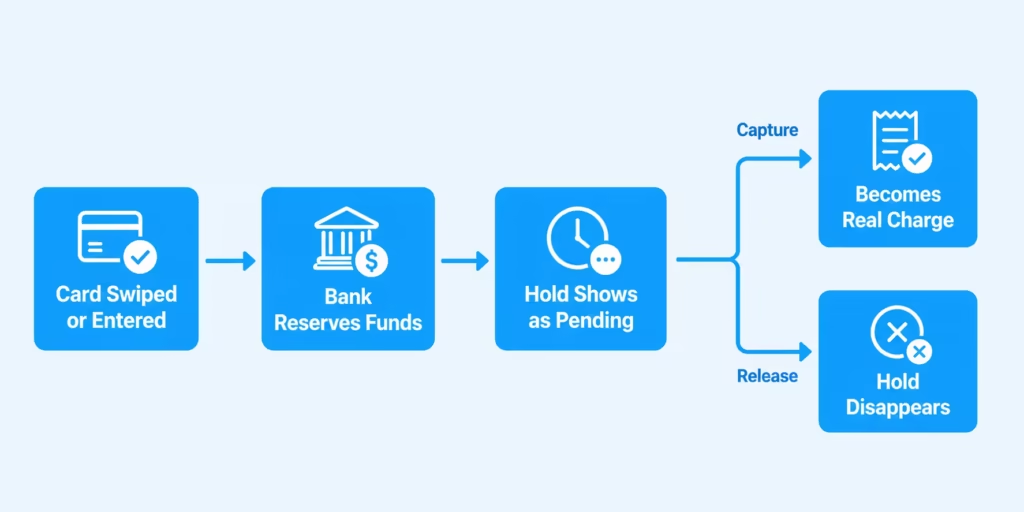
Here’s what actually happens in the background. When you swipe, tap, or type your card number, the merchant contacts your issuing bank. They ask, “Is this card valid, and does it have enough credit for this amount?” The bank checks, then sets that amount aside on your account. That reserved amount shows up as a pending transaction in your app.
Later, when the merchant knows the real total, they either:
- Turn the hold into a real charge (this is called capture), or
- Let the hold drop off (this is called release).
So the money is set aside, not moved. That is the key mental model. A hold is not a bill. A hold is a placeholder.
Why Merchants Use Pre-Authorization Holds
Merchants use these holds for two simple reasons.
First, they want to confirm the card is real and has enough available credit before they give you something valuable. A hotel doesn’t want to hand you a room key if your card is going to decline three days later. A rental car company doesn’t want to give you a car if the card is closed.
Second, they often don’t know the final amount yet. At a gas pump, the station has no idea how many gallons you’ll pump. At a hotel, staff doesn’t know if you’ll open a $15 minibar drink. So the merchant places a hold that covers a likely maximum, then adjusts it once the real total is clear.
Common Transactions That Trigger a Pre-Authorization Hold
Certain purchases almost always trigger a hold. If you just used your card at one of these places, that mystery amount probably matches.
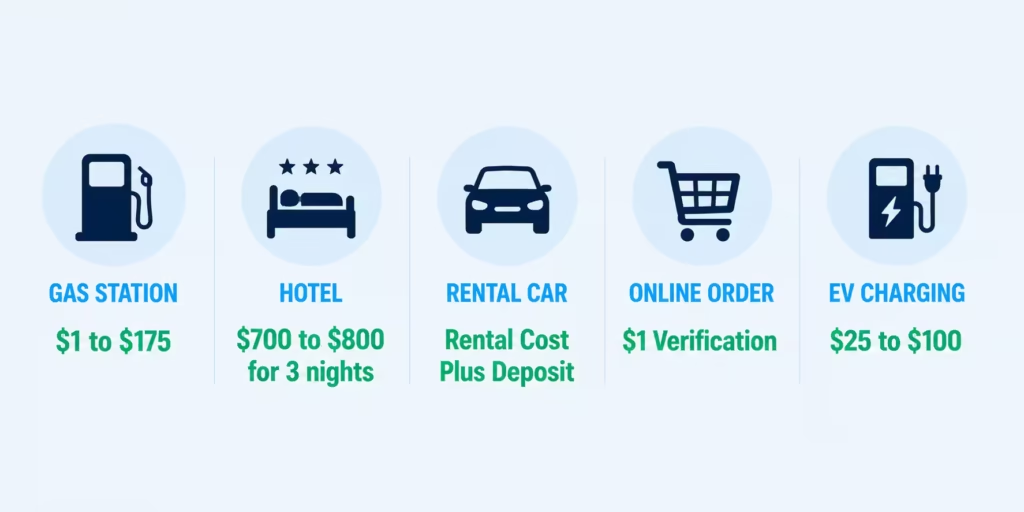
Gas stations. Pay-at-the-pump gas is one of the most common sources. Most stations place a hold between $1 and $175 before you even start pumping. The Federal Trade Commission notes that fuel merchants often block a preset amount because they don’t know your final gallon count. If you only pumped $32 in gas, you might still see a $100 hold for a day or two.
Hotels. Hotels place a hold that covers your room rate plus a buffer for incidentals like room service, the minibar, parking, or resort fees. A three-night stay at $180 per night might show a hold closer to $700 or $800.
Rental cars. Rental companies place a hold for the estimated rental cost plus a damage or security deposit. The FTC warns renters that most rental companies block more than the agreed-on rental cost, sometimes by several hundred dollars.
Online orders and free trials. New online stores and subscription services often run a $1 pre-auth to confirm the card works. Free trials do the same thing. The $1 usually disappears within a few days.
EV charging stations. Public EV chargers work like gas pumps. They don’t know how much energy your car will use. So, they put a flat hold on your card, usually between $25 and $100. Then, they adjust the amount once you unplug.
Why the Held Amount Differs From What You Expected to Pay
This is the confusion that sends most people searching for answers. You paid $34 for gas but see a $100 hold. You booked a $150 hotel room but see a $400 hold. Nothing is broken. Here’s the reason.
Merchants estimate high on purpose. They don’t want to run out of authorized funds partway through your stay or at your fuel pump. So they pick a number that comfortably covers the worst case.
Once the real bill is known, the merchant captures only the final amount. The difference between the original hold and the true charge is released back to your available credit. So a $100 gas hold that ends up being a $34 fill-up leaves you $34 short, not $100 short, once everything settles.
Hotels and rental car companies almost always round up as a buffer. It protects them if you add charges later. It’s not a mistake, and it’s not a double charge.
How a Pre-Authorization Hold Affects Your Available Credit
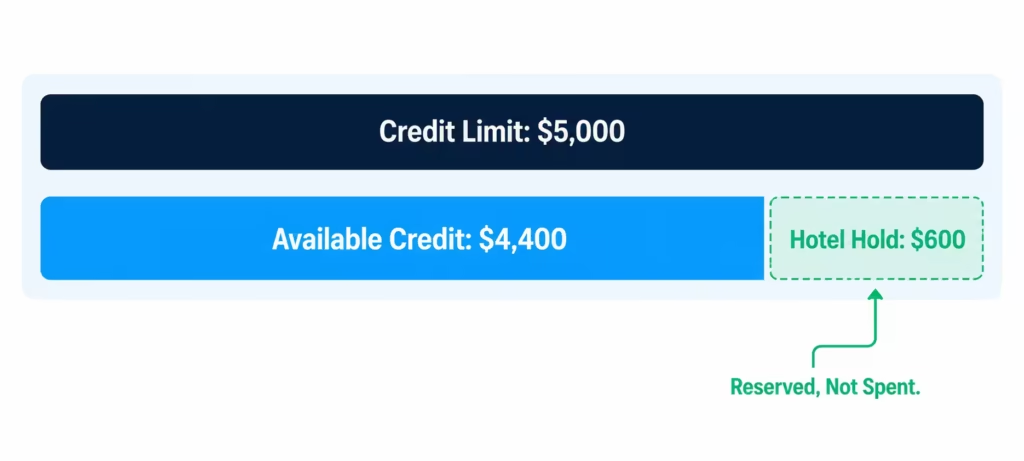
A hold does not lower your credit limit. Your limit stays the same. What changes is your available credit, which is the room you have left to spend right now.
If you have a $5,000 limit and a $600 hotel hold, your available credit is $4,400 until the hold clears or turns into a real charge. Your limit is still $5,000. Nothing has been reported to your bank as a bill yet.
This is why a purchase might get declined for no obvious reason. Say you have a $2,000 limit, a $1,500 rental car hold, and you try to buy a $600 laptop. The system sees only $500 of available credit, so it blocks the laptop purchase. The rental car hold hasn’t cost you a penny yet, but it’s blocking your spending power.
Two things worth remembering:
- The held amount is not owed. You will not see it on your statement as a balance due.
- The hold will not appear on your bill unless the merchant captures it.
If you’re planning a big trip with a hotel or car rental, keep this squeeze in mind. Leaving extra room on your card, or using a card with a higher limit for the deposit, prevents surprise declines mid-trip.
How Long Pre-Authorization Holds Typically Last
The honest answer is, it depends on the merchant, your bank, and the type of purchase. But here are realistic ranges you can plan around.
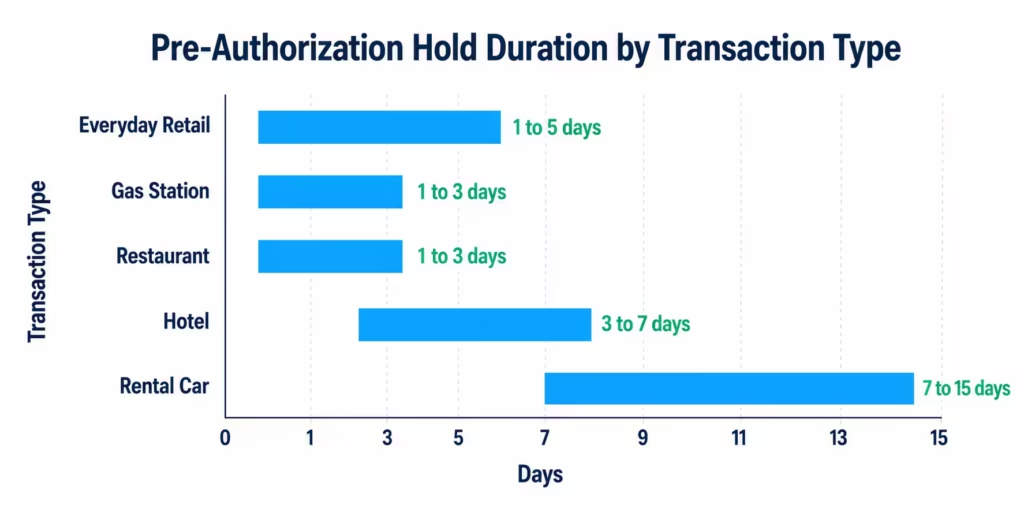
Everyday retail and online orders: 1 to 5 business days. Small $1 verification holds often fall off within 24 to 72 hours.
Gas station holds: Usually 1 to 3 days for the difference to be released, though some banks take up to 7 days.
Hotel holds: 3 to 7 days after checkout is common. Some banks release them in 24 hours. Others hold for up to two weeks.
Rental car holds: These take the longest. Holds can last from a few days to a week, but rental car deposits often extend to 7 to 15 days after returning the vehicle. Some may remain for up to 30 days on credit cards.
Restaurants (tip buffer): A restaurant may place a small hold above your bill to cover a possible tip. This usually clears within 1 to 3 days.
Three things affect how long a hold sticks around:
- The card network. Visa, Mastercard, American Express, and Discover each have their own authorization time limits.
- The merchant’s process. Some merchants batch and finalize transactions daily. Others take several days to submit final amounts.
- The day of the week. A hold placed on a Friday night might not process until Monday or Tuesday, because banks don’t finalize card transactions on weekends the same way they do on weekdays.
💡 Pro Tip: If you need the hold to clear faster, call the merchant and ask them to send a “release” or “void” to your card issuer directly. Waiting for it to expire on its own is slower than asking the source to cancel it.
Does a Pre-Authorization Charge Affect Your Credit Score?
Short answer: no. A pre-authorization hold does not affect your credit score.
Here’s why. Credit bureaus (Experian, Equifax, and TransUnion) only receive information about posted, billed balances, not temporary holds. Since a hold has not been captured or billed, there is no balance to report. The three main scoring models, FICO and VantageScore, rely on data from the bureaus. So, any holds don’t affect your official score.
There is one small wrinkle. Some banking apps and credit monitoring tools calculate your credit utilization ratio. This ratio shows the percentage of your available credit that you’re using. They do this in real time. A big hold can make it look, inside that app, as if your utilization spiked. But that number is only a snapshot. It is not what gets reported to bureaus, and it is not what your FICO score sees.
The important distinction is between a temporary hold and an actual reported balance. A hold is invisible to your credit score. A posted, unpaid balance at the end of your statement cycle is what actually shapes utilization on your report.
So if a $1,200 hotel hold is stressing you out, you can relax. It won’t ding your score.
How a Pre-Authorization Hold Resolves
Every hold ends one of two ways. Understanding both helps you spot each outcome on your own statement.
Capture. The merchant tells your bank, “Turn this hold into a real charge for this exact amount.” The pending line disappears, and a posted transaction shows up in its place, often for a different (usually lower) amount than the original hold. This is the normal path for a completed purchase.
Release. The merchant either voids the hold on purpose, or the hold expires because the merchant never captured it in time. The pending line quietly vanishes. No charge shows up. Your available credit returns to normal.
On your statement, a captured hold looks like any other transaction: a merchant name, a date, and a final dollar amount. A released or voided hold usually leaves no trace at all. Some banks may briefly show a “reversed” or “cancelled” line item that disappears within a few days.
The final number after capture is called the settlement amount. It is what the merchant actually collects and what appears on your bill.
What Happens if the Transaction Is Canceled
If you cancel a hotel booking, return a rental car early, or the merchant cancels an online order, the hold gets voided rather than refunded.
This is an important difference. A refund means money moved and is being sent back, which can take 3 to 10 business days. A void means money never moved in the first place. The hold just gets erased.
Voided holds can still take a few days to fully drop off your available credit, even though nothing was actually charged. That delay is on your bank’s side, not the merchant’s. You don’t need a refund because no money was ever taken.
How to Tell a Pre-Authorization Apart From a Real Charge on Your Statement
Learning to read your statement is the fastest way to calm your nerves the next time an odd charge shows up. Three quick signs tell you it’s a hold, not a real bill.
Look at the status label. Most banking apps mark transactions as either pending or posted. Pending means the transaction is a hold that hasn’t finalized. Posted means the money has actually moved and the transaction is on your bill. If it says pending, it is almost certainly a pre-auth.
Check the amount for round or oddly specific numbers. Real charges usually match your receipt to the penny. Holds often show tidy amounts like $1.00, $50.00, $100.00, or a flat hotel security deposit like $250.00. If the amount looks suspiciously clean, it is likely a pre-auth.
Match the merchant name to a recent visit. Card statements can show merchant names that differ from the storefront sign. For example, a hotel might appear under its parent chain, or a gas station may list its payment processor. Cross-reference the date and the merchant with your calendar. If it lines up with a hotel stay, a car rental, a gas fill-up, or a new online order, you have your answer.
Here’s a quick comparison to make it stick:
| Feature | Pre-Authorization Hold | Real (Posted) Charge |
|---|---|---|
| Status in app | Pending | Posted |
| Amount | Often round or estimated | Matches your receipt |
| Effect on available credit | Reduces it temporarily | Reduces it and adds to balance |
| Shows on your monthly bill | No | Yes |
| Can be voided by merchant | Yes | No (requires refund) |
Why It Can Look Like You Were Charged Twice
Here’s the confusion that sparks a lot of angry customer service calls. For a short window, the original hold and the final charge can both appear on your statement at the same time. You see a $100 gas hold and a $34 gas charge from the same station on the same day and think, “They charged me twice.”
They didn’t. The hold should drop off once the real charge posts, usually within 1 to 5 days. Your available credit will be reduced by only the final $34, not by $134.
This is not duplicate billing. It is just the two parts of the same transaction briefly showing up together. If both are still there after a week, then it is worth a phone call. Not before.
What to Do if a Pre-Authorization Hold Doesn’t Go Away
Most holds clear on their own. But sometimes one gets stuck. Here’s the exact path to follow when the normal window has passed.
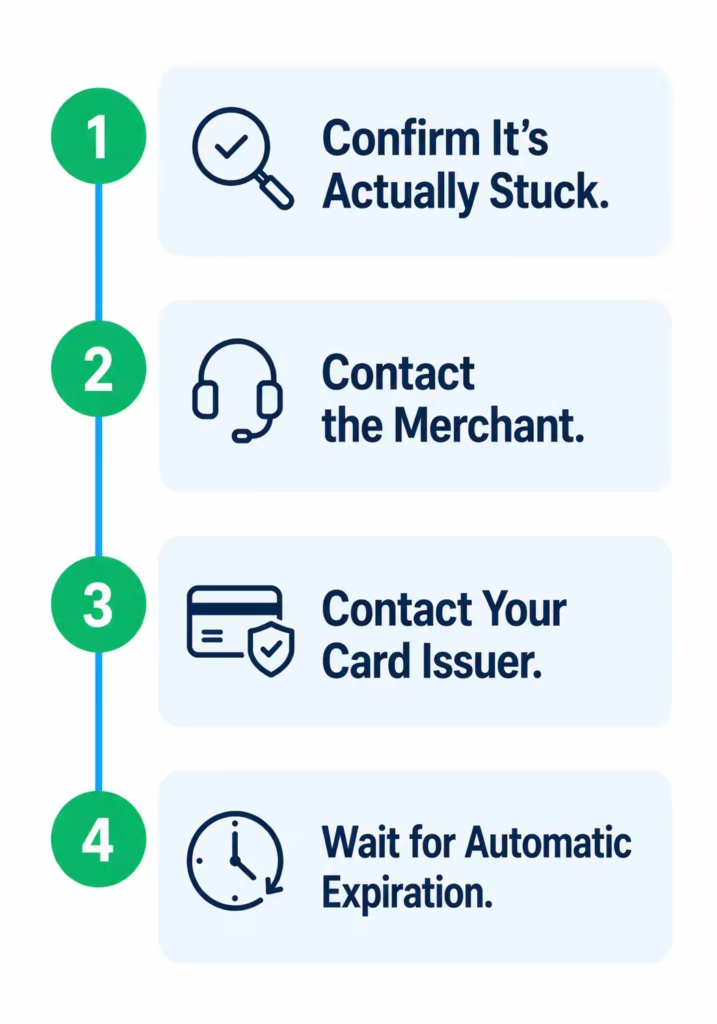
Step 1: Decide if it’s actually stuck. Use the timeframes from earlier as your guide. A gas hold sitting for 24 hours is normal. A hotel hold sitting for 4 days is normal. A gas hold sitting for 10 days is not normal. Don’t panic before your transaction type’s typical window has passed.
Step 2: Contact the merchant first. Call the business where the hold started (the hotel, the rental car agency, the gas station’s corporate line, the online store). Ask them to send an authorization release or a void to your card issuer. Merchants can usually do this in minutes if they choose to. Have your transaction date, the hold amount, and the last four digits of your card ready.
Step 3: Contact your card issuer. If the merchant refuses or says they already released it, call the customer service number on the back of your credit card. Tell them you have an authorization that hasn’t cleared past its expected window. They can force the release on their end in many cases, though some banks will ask you to wait until the authorization expires naturally.
Step 4: Wait for authorization expiration if needed. Every hold has a maximum life. Once that limit is reached, the bank must release it automatically. This is your safety net. Even a truly stuck hold will not sit forever.
⚠️ Mistake to Avoid: Don’t file a chargeback for a stuck pre-authorization. A chargeback is meant for real, posted charges. Filing one for a pending hold can confuse the process and delay the release. Ask for a void or an authorization release instead.
What to Do if the Final Charge Is Wrong or You Don’t Recognize the Hold
Sometimes the issue isn’t a stuck hold. It’s a captured charge that seems too high, or a hold from a merchant you don’t recognize at all. Here is how to sort out normal weirdness from something worth disputing.
First, compare the final captured charge to what you agreed to pay. Pull up the receipt, the hotel folio, the rental agreement, or the online order confirmation. Add any incidental charges (room service, minibar, fuel top-off, resort fee) to the base amount. Does the final number match? If yes, it’s just the pre-auth resolving. Nothing to fix.
Next, decide if a difference is normal or worth questioning.
Normal differences include:
- The final charge is lower than the hold (the leftover was released, no action needed).
- The final charge is a few dollars higher due to a minor incidental you may have forgotten (a bottle of water, a small resort fee, a state tax).
- Rounding on a gas or restaurant pre-auth that adjusts to the exact receipt total.
Worth questioning:
- The final charge is significantly higher than the receipt total with no explanation.
- You see a hold from a merchant you have never done business with.
- The hold appeared for a purchase you canceled and never received.
- The final charge shows up twice as posted transactions, not just one hold plus one final charge.
Finally, know when to dispute with the card issuer. If you truly do not recognize a hold, or the final charge is genuinely wrong and the merchant will not fix it, you have federal protection. The Fair Credit Billing Act (FCBA) gives you the right to dispute billing errors on credit cards, and the FTC provides the process for doing so. You generally have 60 days from the date the bill was sent to file a written dispute with your issuer.
The key difference to understand: a chargeback vs. an authorization dispute is not the same thing. A chargeback only applies once a charge has posted. A pending pre-auth isn’t a chargeable transaction. So, the best first step is to call the merchant or release the bank authorization. A chargeback filing isn’t needed yet.
If a charge is fraudulent, like if someone stole your card number, call your issuer right away. Ask them to freeze the card, cancel the pending holds, and send you a new card.
Frequently Asked Questions (FAQs)
What is a pre-authorization charge on a credit card?
A pre-authorization charge is a temporary hold a merchant places on your card to confirm it’s valid and has enough available credit. No money actually moves, and the hold typically drops off within a few days if never captured.
Why do I have a pre-authorization on my credit card?
You likely used your card at a gas pump, hotel, rental car counter, or online store that didn’t know the final amount yet. Merchants place these holds to confirm your card works and to reserve enough credit to cover the estimated total.
How do I cancel a pre-authorization on a credit card?
Call the merchant first and ask them to send a release or void to your card issuer, since they can often do this in minutes. If the merchant won’t help, call your card issuer directly and ask them to force the release.
Do pre-authorization charges get refunded?
No refund is needed because no money ever moved. If a transaction is canceled, the merchant voids the hold instead, though it can still take a few days for your available credit to fully update.
How long does a pre-authorization charge last?
It depends on the merchant type: gas station holds usually clear in 1 to 3 days, hotel holds in 3 to 7 days after checkout, and rental car holds can take 7 to 15 days, sometimes up to 30.
Does a pre-authorization charge affect my credit score?
No, pre-authorization holds don’t affect your credit score. Credit bureaus only receive data on posted, billed balances, so a temporary hold never reaches FICO or VantageScore calculations.
Can I get a refund for a pre-authorization payment?
You don’t need a refund since a hold never actually charges you money. Instead, the merchant voids the authorization, which removes the hold from your available credit within a few days.
What’s the difference between a pre-authorization hold and a real charge?
A pending transaction is a hold that hasn’t finalized, while a posted transaction means money has actually moved and appears on your bill. Holds also tend to show round numbers like $100, while real charges match your receipt exactly.
Can a merchant charge more than the original pre-authorization hold?
Usually not. Merchants estimate high on purpose to cover worst-case costs, so the final captured charge is typically equal to or lower than the original hold, with the difference released back to your available credit.
What should I do if my pre-authorization hold won’t go away?
First, confirm it’s actually stuck by checking typical timeframes, since a hotel hold sitting for 4 days is normal. If it’s genuinely overdue, call the merchant for a release, then your card issuer, and avoid filing a chargeback since that’s only for posted charges.
Wrapping Up
Pre-authorization holds are one of the most misunderstood parts of using a credit card. This guide explains what they are, why merchants use them, which transactions trigger them, their impact on credit, duration, how to identify them on statements, and what to do if issues arise.
The best approach is clear:
- Check the pending label.
- Match the merchant to a recent purchase.
- Give the hold its usual time before acting.
That single habit prevents almost every unnecessary panic call.
If a friend or family member just booked a hotel, rented a car, or noticed a strange pending charge, share this guide. They might be worried it’s fraud. It could save them a stressful phone call and a wasted dispute.