
You checked your credit score on a free app before heading to the dealership. It said 720. Then the finance manager slid a paper across the desk showing 680, and your stomach dropped. Did the app lie? Did your score drop overnight? Neither. Car lenders don’t use the same score you’ve been watching. They pull an industry-specific version called the FICO Auto Score, and it runs on a different scale with different rules.
The FICO Auto Score is a specialized credit score built by Fair Isaac Corporation that predicts how likely you are to miss a car payment.
Below, you’ll get the full breakdown: which version your lender probably uses, why your numbers don’t match, what counts as “good,” and how to rate shop without hurting your credit.
Key Takeaways
This guide explains what a FICO Auto Score is, how it differs from a base FICO score, its 250 to 900 range, common versions (2, 8, and 9), and how to rate shop without hurting your credit.
Core Facts:
- A FICO Auto Score is a specialized score built by Fair Isaac Corporation that predicts how likely a borrower is to miss a car payment, weighted more heavily toward auto loan payment history than a base FICO score.
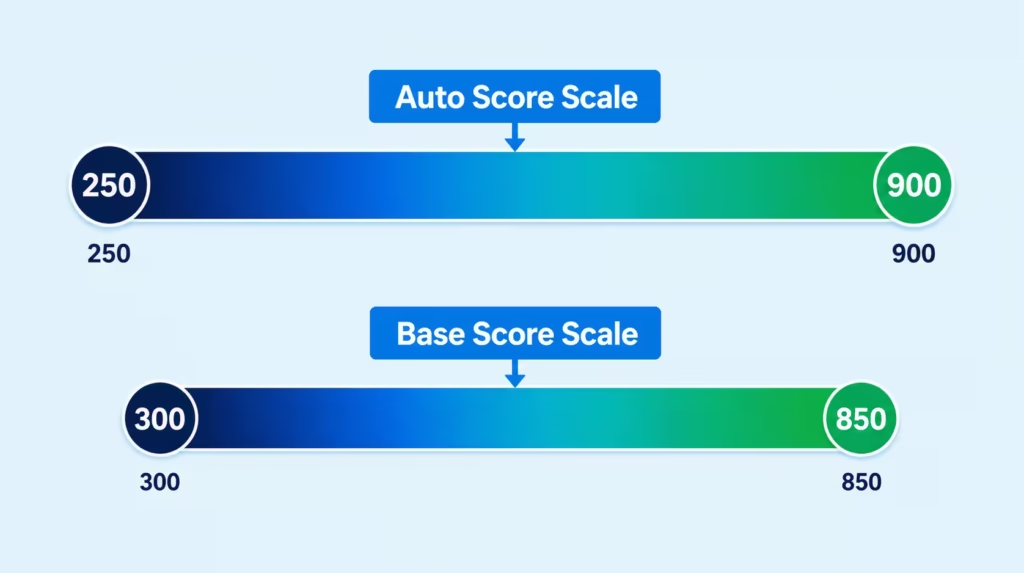
- The FICO Auto Score range is 250 to 900, compared to the base FICO Score range of 300 to 850, so the two numbers are not directly comparable.
- Score tiers on the auto scale are super prime (781 and above), prime (661 to 780), near prime (601 to 660), subprime (501 to 600), and deep subprime (500 and below).
- FICO Auto Score 8 is the most widely used version among lenders, while Score 9 gives less weight to unpaid medical collections and may factor in reported rental payment history.
- Multiple auto loan inquiries count as a single hard inquiry when made within a rate shopping window of 14 days for older FICO models or 45 days for newer models.
- Free apps like Credit Karma typically show VantageScore or base FICO 8, not the actual FICO Auto Score used by car lenders; myFICO offers paid access to the real auto score versions.
Best for:
- Readers preparing to apply for an auto loan or refinance who want to understand the score their lender will actually use.
- Anyone confused by a mismatch between their app-reported credit score and the number a dealership or lender showed them.
- Borrowers planning to rate shop across multiple lenders who want to avoid unnecessary hard inquiry damage to their credit.
What Is a FICO Auto Score
A FICO Auto Score is a credit score built specifically for auto lenders. It’s made by Fair Isaac Corporation, the same company behind the base FICO Score most people already know about. But this version is tuned for one job: predicting how likely you are to miss a car payment or default on an auto loan.
Think of it as an industry-specific score. Base FICO scores try to predict overall credit risk. The auto version zooms in on one type of debt. It looks more closely at your track record with car loans and less at things that don’t matter as much for vehicle financing.
There isn’t just one FICO Auto Score. FICO has released several versions over the years, and lenders pick which one they want to use.
That’s why two dealerships checking your credit on the same day can come back with two different numbers. The score also runs on a wider range than the base FICO you may already be tracking, which is why the number itself can look unfamiliar.
How FICO Auto Score Differs From Your Base FICO Score
The main difference comes down to weighting. Your base FICO score treats all your credit accounts pretty evenly. Auto loan payment history carries the same weight as your credit card history or a personal loan. The auto-specific credit scoring model doesn’t work that way. It gives your car loan track record more pull.
Here’s what that means in practice. Say you paid off a car loan on time for five years. On your base score, that helps a bit. On the auto version, it helps a lot. Now flip it around. Say you had a repossession three years ago, but you’ve been perfect with credit cards ever since.
Your base FICO score may have mostly healed. But when a lender pulls the auto version, that repo still stings hard. Auto lenders want to see how you handle car debt, so past auto trouble drags the score down more than it would on a general credit report.
The scale is different too. And so is the version most lenders pull. Both of these throw people off. Let’s break the scale down first.
FICO Auto Score Range Explained (250–900)
The FICO Auto Score range is 250 to 900. Your base FICO Score runs 300 to 850. That’s a 50-point gap on the top end and a 50-point gap on the bottom.
Higher is still better. A score of 800 on the auto scale is strong, just like 800 on the base scale is strong. The rule doesn’t flip. But the numbers don’t line up one-to-one.
⚠️ Mistake to Avoid: Don’t compare a FICO Auto Score directly to a base FICO score. A 780 on the auto scale is not the same tier as a 780 on the base scale. The math and the ceiling are different.
If your dealer says “your score is 790,” ask which scale that’s on. A 790 out of 900 is a very different picture than a 790 out of 850.
Why Your FICO Auto Score Doesn’t Match Your App Score
Your free credit app is not lying to you. It’s just showing a different score. Most free tools like Credit Karma show VantageScore, which is a totally separate scoring model built by the three credit bureaus. Bank apps and free Experian access usually show a base FICO Score 8. Neither of these is the FICO Auto Score.
Three things cause the mismatch:
Different scoring model. VantageScore and base FICO score you one way. The auto version scores you another way. The formulas weigh factors differently, so the same credit file produces different numbers.
Different scale. As covered above, one runs 300 to 850. The other runs 250 to 900. Even if the models agreed on your risk level, the number would still look different.
Different bureau data. Your app might pull data from TransUnion. The dealer might pull from Experian or Equifax. Not every account reports to every bureau, and update timing varies. So the underlying file itself can differ.
This is normal. It’s not an error, and it’s not a bait-and-switch from the lender. It just means the number you’ve been watching is a general reference, not the exact one the auto lender uses.
FICO Auto Score Versions Overview
FICO has released several auto score versions over time. Lenders can pick which one they use, and there’s no rule forcing them to use the newest one. Some stick with older versions because that’s what their loan approval software is built around. Others move to newer ones for better risk prediction.
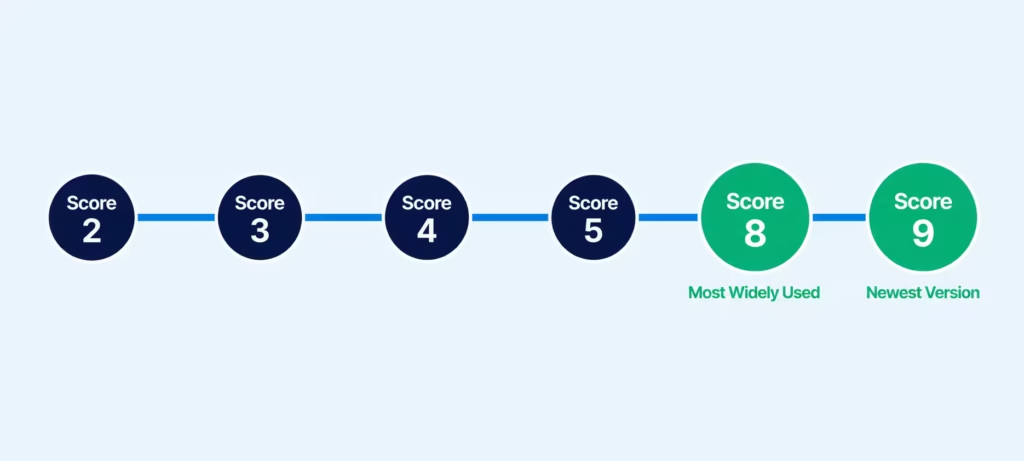
The versions in active use today are FICO Auto Score 2, 3, 4, 5, 8, and 9. You’ll almost never hear about 4 or 5 anymore. The three you actually need to know are 8, 9, and 2 (with 3 as a close cousin of 2).
Each version reads your credit file slightly differently. That’s why score version adoption matters for you as a borrower. The same file can produce a different number depending on which one the lender pulls.
What Is a FICO Auto Score 8
FICO Auto Score 8 is the most widely used auto score version among lenders today. When people talk about “the FICO Auto Score,” this is usually the one they mean.
It balances traditional credit data (payment history, amounts owed, length of credit history) with recent auto loan behavior. It also handles small collection accounts under $100 more gently than older versions did. If you’ve been to a dealership in the last several years and they pulled a FICO Auto Score, there’s a strong chance it was this one.
What Is a FICO Auto Score 2 (and Score 3)
FICO Auto Score 2 and FICO Auto Score 3 are older-generation versions. They’re still in active use, mostly by credit unions and regional banks that haven’t updated their scoring systems in a while. Score 2 is pulled from Experian data. Score 3 is closely related but based on Equifax data.
These older versions tend to weight recent overall credit activity more heavily. That can hurt you if you’ve opened a few new accounts lately. It can help you if your recent activity has been clean, but your older history has some rough patches.
What Is a FICO Auto Score 9
FICO Auto Score 9 is the newer version. It has two big changes from Score 8. First, it gives less weight to unpaid medical collections. That helps people whose only credit problem was a surprise hospital bill. Second, it may include rental payment history if your landlord reports it to a credit bureau.
Adoption of Score 9 is growing, but it’s still behind Score 8. Most lenders haven’t switched over yet.
Which Version Your Lender Is Likely Using
There’s no way to know for certain which version your lender will pull. But you can make a solid guess based on where you’re applying.
Large banks and dealership financing arms most commonly pull FICO Auto Score 8. Chase, Capital One Auto, Ally, and most captive lenders (the financing arms of Toyota, Ford, Honda, and so on) tend to use it.
Credit unions and regional banks are more likely to use FICO Auto Score 2 or another older version. They update their loan systems less often, so they stick with what works for them.
Here’s how a comparison of FICO Auto Score 2 vs 8 might play out. Say you have a thin credit file (not many accounts) but one paid-off car loan. Score 8 might reward that auto history more, giving you a higher number. Score 2 might focus more on your recent activity and general credit mix, giving you a lower one.
For FICO Auto Score 8 or 9, the difference matters most if you have medical collections on your report. Score 9 basically shrugs at unpaid medical bills. Score 8 does not. If you’ve had a medical debt hit your credit, Score 9 could be several points kinder. But since Score 8 still dominates, most lenders will see the harsher number.
Practical takeaway: you can’t force a lender to use a specific version. What you can do is check with a few different lender types (a big bank, a credit union, and your dealer) to see which one gives you the best offer.
💡 Pro Tip: If you’re a credit union member and your file has some older blemishes but clean recent activity, apply there first. Older versions like Auto Score 2 sometimes read recent behavior more favorably, and you may land a better rate than at a big bank.
What Is a Good FICO Auto Score
On the 250 to 900 auto scale, a rough tier breakdown looks like this:
| Tier | FICO Auto Score Range |
|---|---|
| Super prime | 781 and above |
| Prime | 661 to 780 |
| Near prime | 601 to 660 |
| Subprime | 501 to 600 |
| Deep subprime | 500 and below |
These tiers roughly match how auto lenders group borrowers for risk-based pricing, based on data from Experian’s State of the Automotive Finance Market Report: Q1 2026, which tracks auto financing trends across different credit-risk segments.
“Good” depends on the lender. One credit union might treat 690 as prime. A subprime specialty lender might treat 620 as their best tier because their whole book is subprime. So the number matters, but so does where you apply.
Score tier drives the rate offer directly. A super prime borrower and a subprime borrower buying the same car can pay thousands of dollars in interest apart over a five-year loan. That’s why the score isn’t just about yes/no approval. It’s about how much the loan actually costs you.
What Factors Impact Your FICO Auto Score Most
The general FICO scoring factors still apply. But the auto version tilts the weights.
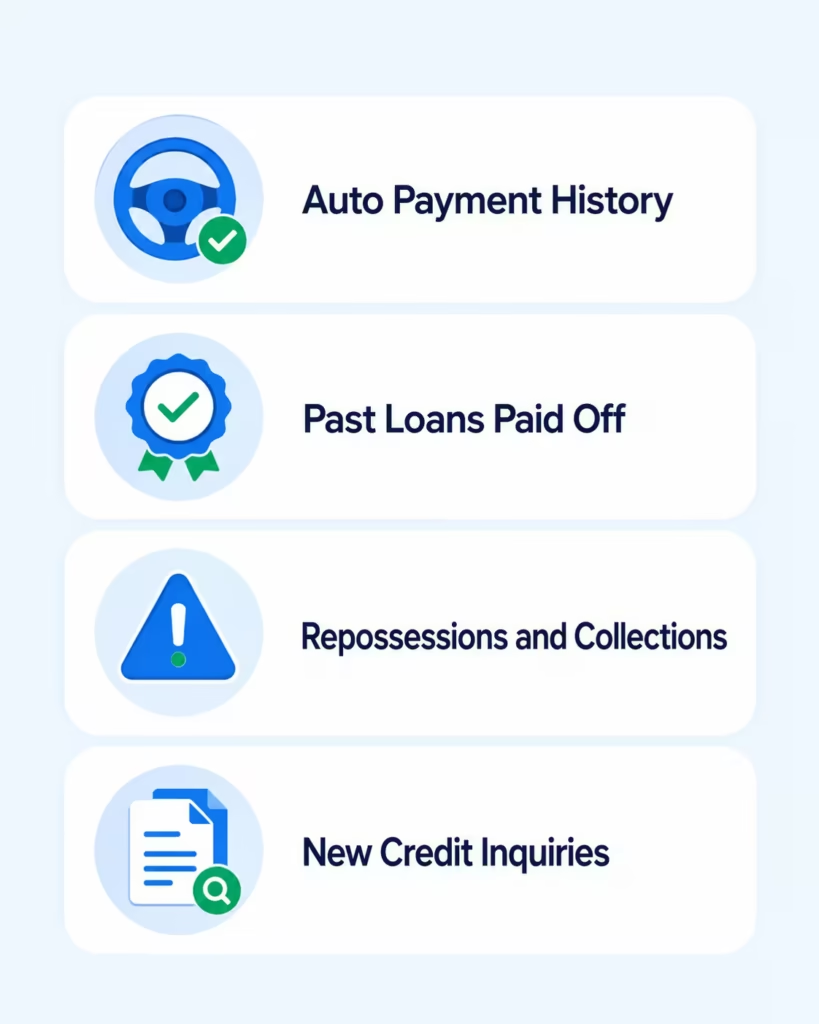
Auto loan payment history matters more here than on your base score. Every on-time car payment builds the score up. Every 30-day late payment on a car loan hurts more than a 30-day late payment on a credit card would.
Prior auto loans paid off successfully help a lot. If you’ve financed a car before and paid it off, that’s a strong signal. Lenders like seeing you’ve done this before without problems.
Repossessions, bankruptcies, and auto-related collections hurt disproportionately. A repossession is the worst possible mark on this score. It tells the lender exactly the risk they’re trying to predict actually happened to you. These stay on your report for seven years, and they weigh heavier on the auto score than the base one.
Recent credit inquiries and new account activity matter too. Opening five new credit cards in the last six months looks risky. So does maxing out a card right before applying. Credit utilization (how much of your available credit you’re using) still counts, though it’s not as central as payment history.
Not on this list on purpose: mortgage payment behavior. It matters some, but not nearly as much as it does on other specialty scores. The auto version cares about car debt above all else.
How to Check Your Actual FICO Auto Score
Most free apps don’t show your FICO Auto Score. Here’s the honest truth about your options.
Credit Karma, bank apps, and free Experian access show VantageScore or base FICO 8. Useful for tracking general trends. Not the exact number your lender will see.
myFICO offers paid access to actual FICO Auto Score versions across all three bureaus. This is the most direct way to see the real number before you apply. It costs money, and you can check current plans on myFICO to decide if it’s worth it for your situation. If you’re about to finance a car, one month of access can pay for itself in negotiating power.
Adverse action notices are another route. If a lender denies you or gives you worse terms than their best rate, they must legally send you a notice that includes the score they used, per the Fair Credit Reporting Act. It’s not helpful before applying, but it’s helpful after your first denial or first rate offer.
Realistic expectation: exact pre-application access is limited. You may not know the precise number the dealer will pull. What you can do is track your base FICO 8 as a rough guide, know it might be 20 to 40 points different on the auto scale, and prepare accordingly.
Rate Shopping and Hard Inquiries Without Hurting Your Score
You’ve probably heard that every credit check tanks your score. That’s mostly a myth when it comes to auto loans. FICO knows people shop around for car loans, and the scoring model is built to handle it.
Multiple auto loan inquiries within a short window count as a single hard inquiry for scoring purposes. This is called the rate shopping deduplication window. For newer FICO models, that window is 45 days. For older models, it’s 14 days.
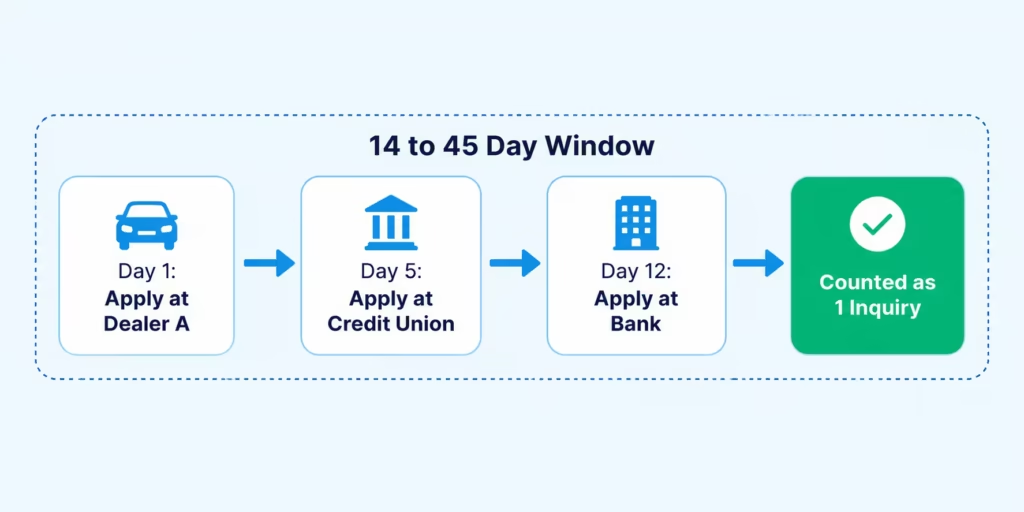
Practical guidance: pick two weeks and do all your auto financing applications inside it. Even under the older 14-day rule, you’re safe. You can walk into three dealerships, apply with your credit union, and get pre-approved by a bank, all within that window, and it counts as one inquiry for your score.
📌 Did You Know: The rate shopping window only applies to auto, mortgage, and student loan inquiries. Credit card and personal loan inquiries don’t get grouped this way. Each one counts separately, so shop those more carefully.
The savings from rate shopping can be huge. A one-point difference in APR on a $30,000 loan over five years is over $800 in interest. Getting three or four quotes almost always beats taking the first offer.
FICO Auto Score vs FICO Score
Here’s the side-by-side, quick and clean.
| Feature | FICO Auto Score | Base FICO Score |
|---|---|---|
| Purpose | Predicts car loan default risk | Predicts general credit risk |
| Score range | 250 to 900 | 300 to 850 |
| Heaviest weighted factor | Auto loan payment history | Overall payment history |
| Used by | Auto lenders, dealerships | Credit card issuers, personal loan lenders, general use |
| Common versions | 2, 8, 9 | 8, 9, 10 |
When each shows up: The auto score shows up when you finance or refinance a car. The base FICO score shows up in most other lending situations, including credit cards, personal loans, and some rentals. Mortgage lenders use their own separate FICO versions (2, 4, and 5, but for mortgages, not autos).
If you’re only going to track one score for general credit health, track the base FICO. If you’re actively car shopping in the next month, it’s worth knowing your auto version too.
What Is a FICO Credit Score Used For
In the auto lending world, this score does more than get you a yes or no. It shapes the whole deal.
Loan approval
The most basic use. A lender sets a minimum score to consider your application. Below that line, they decline. Above it, you move to underwriting.
Rate tier assignment
This is where the score really costs (or saves) you money. Auto lenders use risk-based pricing. Your score puts you into a rate tier, and each tier has its own APR range. Super prime borrowers might see rates of 5 to 6% right now. Subprime borrowers might see 15 to 20% or more on the same car. Over five years, that difference can easily top $10,000.
Underwriting decisions across lender types
Dealership financing arms, banks, and credit unions all use the score during their approval process. Each one has its own thresholds, but the score itself is a shared input.
Not the only factor
Lenders also look at your income, your debt-to-income ratio, your down payment, your job history, and the vehicle you’re buying. A high score doesn’t guarantee approval if your income can’t support the payment. A lower score can still get approved with a bigger down payment or a co-signer.
The bottom line: your FICO Auto Score doesn’t just open or close the door. It also sets the price of admission.
Frequently Asked Questions (FAQs)
What is a FICO Auto Score?
A FICO Auto Score is a specialized credit score built by Fair Isaac Corporation just for car lenders. It predicts how likely you are to miss a car payment and runs on a 250 to 900 scale instead of the standard 300 to 850.
What is the difference between a FICO Auto Score and a credit score?
A FICO Auto Score weighs your car loan payment history much more heavily than a base FICO score does. It also runs on a wider 250 to 900 scale, so the same credit file can produce two very different numbers.
What is a good FICO Auto Score?
A score of 781 or above is considered super prime, and 661 to 780 is prime. Anything from 601 to 660 falls into near prime, with scores below that landing in subprime territory.
Is FICO Auto higher than FICO?
Not necessarily higher, just on a different scale. Since the Auto Score tops out at 900 instead of 850, the raw number often looks higher even when your actual risk tier is similar.
How can I obtain my FICO Auto Score?
Free apps like Credit Karma only show VantageScore or base FICO 8, not the Auto Score. myFICO sells paid access to real FICO Auto Score versions across all three bureaus, or you can see the exact score used on an adverse action notice after a denial.
Can I get a free FICO Auto Score?
Not reliably. Free tools show VantageScore or base FICO 8 instead. The only guaranteed free look comes from an adverse action notice, which lenders must send if they deny you or offer worse than their best rate.
How do I improve my FICO Auto Score?
Making on-time payments on any existing car loan helps the most since auto payment history carries extra weight. Avoiding new credit inquiries and keeping old accounts free of late marks also protects the score over time.
What credit score do you need to buy a $30,000 car?
There’s no fixed minimum, since approval depends on your score tier alongside income, debt-to-income ratio, and down payment. Super prime borrowers (781+) typically get the best rates, while subprime borrowers can still get approved with a larger down payment or co-signer.
How does rate shopping affect my FICO Auto Score?
Multiple auto loan inquiries within a short window count as one hard inquiry. Newer FICO models use a 45-day window, while older models use 14 days, so shopping within that window protects your score.
What hurts a FICO Auto Score the most?
A repossession does the most damage since it directly confirms the default risk the score is trying to predict. It weighs more heavily on the auto score than on a base FICO score and stays on your report for seven years.
Wrapping Up
Walking into an auto loan application feeling blindsided by a mismatched score is a rough way to start a big financial decision. The FICO Auto Score is a specialized version built for car lenders, runs on a 250 to 900 scale, and comes in several versions, with Score 8 leading the pack.
Based on the risk-based pricing data covered above, the most effective approach is to rate shop within a 14-day window, ask which version each lender pulls, and use myFICO if you need the exact number before applying.
If you know someone about to sign auto loan paperwork, share this article with them. It could save them thousands of dollars in interest and hours of stress at the dealership.