
You need cash fast. Maybe a car repair came up, a landlord only takes cash, or a bill is due today, and your bank account is empty. A cash advance on a credit card looks like the quickest fix in your wallet, but the true cost is easy to misjudge, and one wrong assumption can turn a small emergency into a much bigger bill.
A cash advance is a short-term loan. You borrow cash using your card’s credit line. Then, the amount, plus fees and daily interest, gets added to your card balance.
Below, you will find exactly how it works, what it costs in real dollars, which surprise transactions trigger the same fees, and how to pay it off for the least money possible.
Key Takeaways
This guide explains what a credit card cash advance costs, including upfront fees, APR, credit score effects, transactions that trigger the fee, and cheaper alternatives to consider first.
Core Facts:
- A cash advance is a loan against your credit card’s credit line, with interest accruing the same day and no grace period, unlike regular purchases.
- Fees typically run 3% to 5% of the amount withdrawn, or a flat $10 minimum, whichever amount is greater.
- The average cash advance APR is 24.80%, often reaching close to 29.99%, well above typical purchase APRs on the same card.
- A $500 cash advance repaid within 30 days costs about $35.19 total once the fee and interest are combined.
- Cash advances are not reported as a negative item on credit reports, but they raise credit utilization, which can lower your score.
- Under the CARD Act payment rule, any payment above the minimum must go toward the balance with the highest APR first, usually the cash advance.
Best for:
- Readers facing a genuine emergency who need to understand the real cost before withdrawing cash from a credit card.
- Anyone who has used or plans to use money orders, wire transfers, crypto purchases, or convenience checks and wants to know if these count as cash advances.
- Readers comparing a cash advance against alternatives like a personal loan, 0% intro APR offer, or earned wage access app.
What Is a Cash Advance on a Credit Card?
A cash advance lets you borrow against your credit limit and receive actual cash. The money does not come from your checking account. It comes from your card’s available credit. Your issuer treats it as a loan, adds the amount to your card balance, and starts charging you for it right away.
This matters because a credit card cash advance is not free access to cash. It is one of the most expensive ways to borrow on a card. The fee hits on day one, the interest rate is usually higher than your purchase rate, and there is no interest-free window at all.
Think of it this way. Swiping your card for groceries is using credit. Pulling cash from that same card is taking out a small, pricey loan that starts the meter running the second the bills leave the ATM.
How a Cash Advance Differs From a Regular Purchase
Three things separate a cash withdrawal from a normal purchase, and each one costs you money.
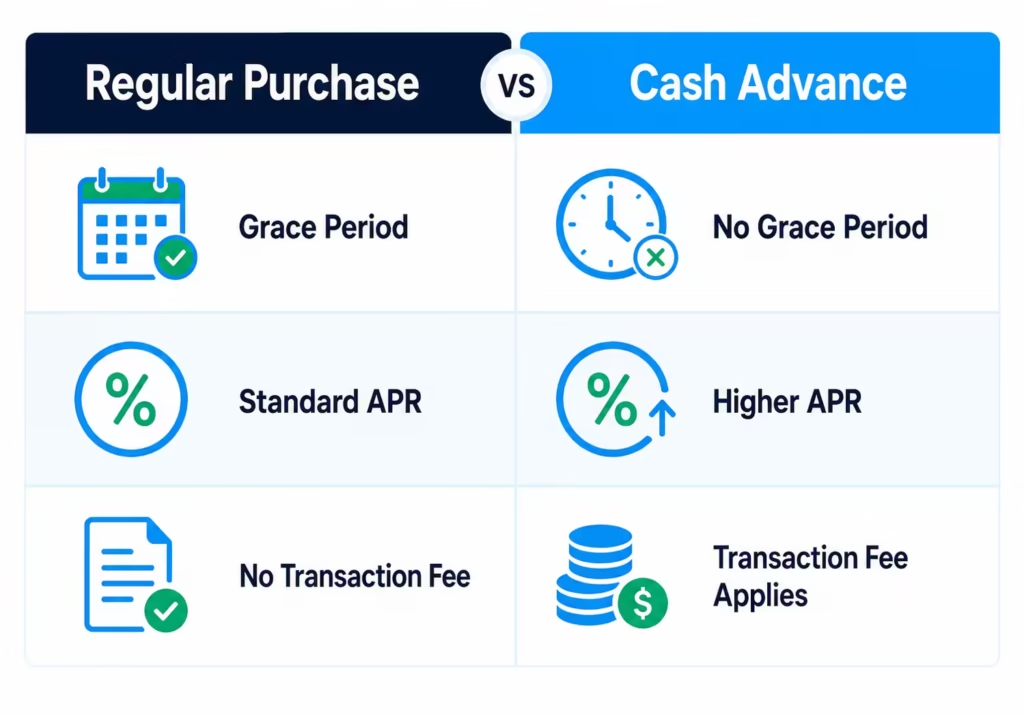
First, there is no grace period. Purchases usually get 21 to 25 days before interest starts, as long as you pay in full. Interest on a cash advance starts the same day you take the money.
Second, the APR is higher. A card that charges 22% on purchases may charge close to 30% on cash advances.
Third, a separate fee applies. Purchases carry no transaction fee. Every cash advance does, and you pay it even if you repay the money a week later.
How to Get a Cash Advance
There are three main ways to turn your credit line into cash.
ATM withdrawal. Insert your card, enter your PIN, and select the cash advance or credit option. The cash comes out like a debit withdrawal, but the charge lands on your card balance.
Bank teller withdrawal. Walk into any bank that handles your card’s network, such as Visa or Mastercard, and ask for a cash advance at the counter. Bring a photo ID. Tellers can often give you more than an ATM allows in a single day.
Convenience checks. Some issuers mail blank checks tied to your account. Writing one to yourself and cashing it counts as a cash advance, with the same fee and the same instant interest.
Do You Need a PIN?
Yes, for ATM withdrawals. A cash advance PIN is different from the one you may use for purchases, and many cardholders have never set one up.
To get one, log in to your online account or call the number on the back of your card and request a PIN. Some issuers send it by mail, which can take 7 to 10 business days, so do this before an emergency hits. If you need cash today and have no PIN, the bank teller window is your fallback. It requires only your card and a photo ID.
Cash Advance Limit vs. Your Total Credit Limit
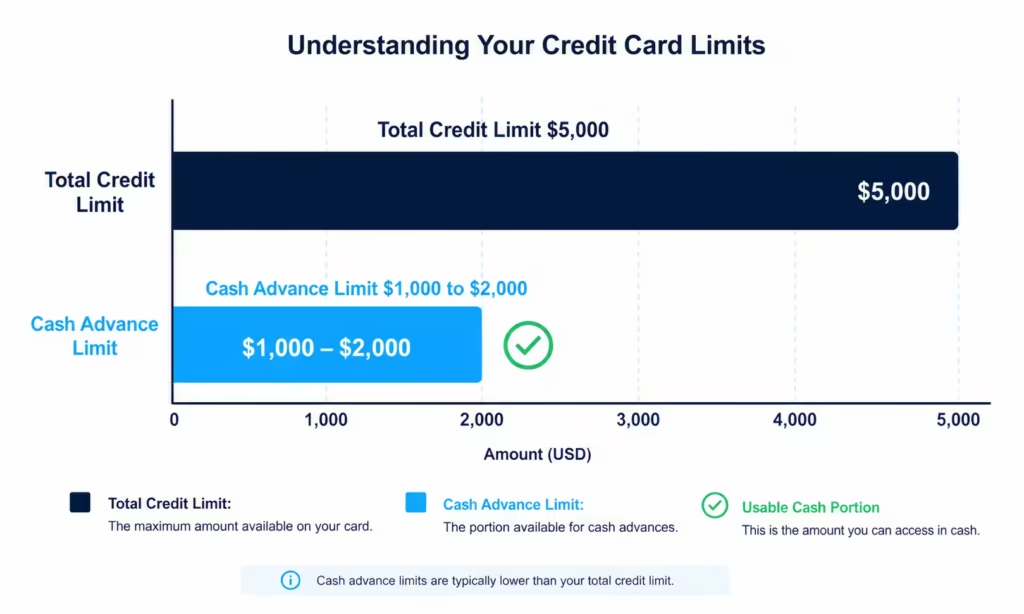
Your cash advance limit is a separate, smaller sub-limit carved out of your total credit limit. A card with a $5,000 credit line might allow only $1,000 to $2,000 in cash advances.
Existing balances shrink it further. If your cash advance limit is $1,500 and you already carry a $900 purchase balance, some issuers reduce your available cash room by that amount.
Picture this. Marcus, a delivery driver in Phoenix, saw a $5,000 limit and a $0 balance and assumed he could pull $4,000 for a transmission repair. The ATM declined him at $1,200 because that was his actual cash advance sub-limit. He lost an hour and had to rework his repair plan on the spot.
How to Find Your Cash Advance Limit
Three quick checks will give you the exact number. Look at your monthly statement, where most issuers list the cash advance limit near the credit limit line. Log in to your online account or app and check the account details or credit limit section. If neither is clear, call customer service and ask directly. Take this step before you are standing at an ATM in a hurry.
Daily ATM Withdrawal Caps
Even within your cash advance limit, ATMs usually cap how much you can pull per day, often a few hundred dollars. If you need more than the daily limit, a bank teller can help. Teller limits usually follow your full cash advance limit, not the ATM’s daily cap.
Cash Advance Fees
The fee works on a “whichever is greater” basis. Most issuers charge 3% to 5% of the amount you withdraw, or a flat minimum of about $10, whichever number is higher.
On a $500 withdrawal at 5%, the fee is $25. On a $150 withdrawal, 5% is only $7.50, so the $10 flat minimum kicks in instead. Experian confirms that 3% to 5% or a $10 minimum is the typical structure across issuers.
Two points surprise people. The fee posts to your balance no matter how fast you repay, so even a one-day advance is not free. And the fee itself becomes part of the balance that accrues interest.
Cash Advance APR and the Missing Grace Period
The upfront fee stings, but the interest rate usually does more damage over time. Figures from CreditCards.com’s cash advance survey put the average cash advance APR at 24.80%, and many cards sit closer to 29.99%. That is several points above the typical purchase APR on the same card.
Worse, there is no grace period. Interest starts accruing the moment the cash leaves the machine, and it compounds daily. Daily compounding means each day’s interest gets added to your balance, and the next day you pay interest on that slightly bigger number. It sounds small. On a large advance left unpaid for months, it snowballs.
📌 Did You Know: If you pay your full statement balance on time, a cash advance still builds interest daily until your payment is posted. There is no “paid in full” escape hatch like purchases have.
How Much Does a Cash Advance Actually Cost?
Percentages are abstract. Here is what a typical advance costs in real dollars, assuming a 5% fee and the 24.80% average APR, repaid after 30 days.
| Advance Amount | Upfront Fee (5%) | Interest (30 days at 24.8% APR) | Total Cost |
|---|---|---|---|
| $300 | $15.00 | ~$6.12 | ~$21.12 |
| $500 | $25.00 | ~$10.19 | ~$35.19 |
| $1,000 | $50.00 | ~$20.38 | ~$70.38 |
So $500 for a car repair costs about $535 all-in if repaid within a month. Stretch repayment to six months and the interest alone roughly triples. Time is the price lever that matters most.
How to Minimize the Cost If You Take One
If the advance is truly your best option, three moves keep the damage small.
Withdraw only what you need. Every extra dollar carries a fee and daily interest. Take $400 for a $400 problem, not $500 for cushion.
Repay as fast as possible. Because interest compounds daily, paying in 5 days versus 45 days on a $1,000 advance saves you roughly $27 in interest. Send a payment the day your paycheck lands, not on the due date.
Do the fee math on multiple withdrawals. A flat minimum fee means three separate $200 withdrawals can cost more in fees than one $600 withdrawal. One larger pull is usually cheaper than several small ones.
💡 Pro Tip: You can make a payment toward your card the same day you take the advance, before the statement even closes. Every day earlier cuts the daily interest charge.
Transactions That Count as a Cash Advance (Beyond ATM Withdrawals)
This is where people get burned without touching an ATM. Issuers code a wide range of cash-like transactions as cash advances, with the same fee and instant interest. The common triggers:
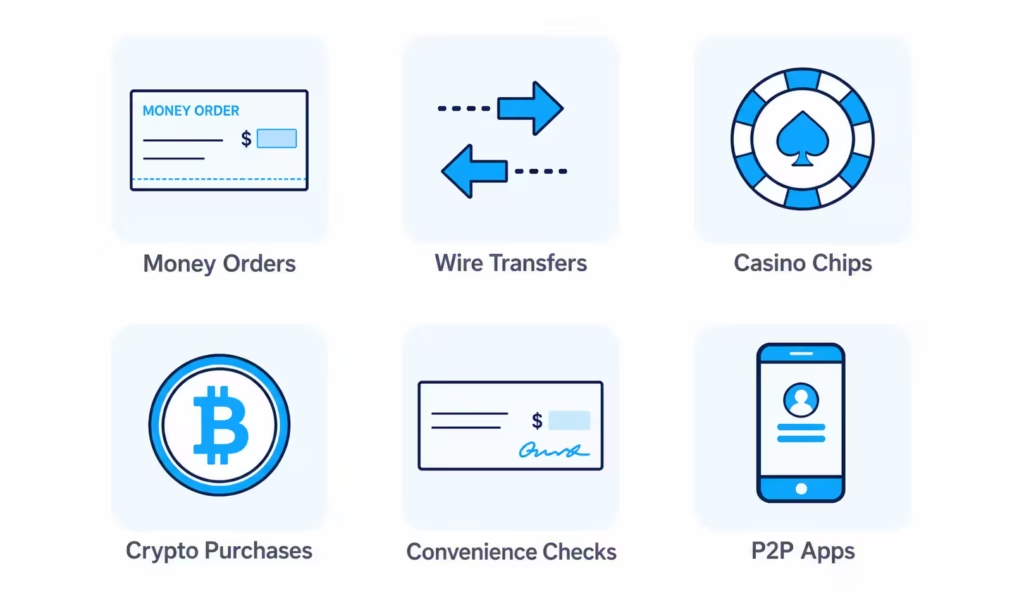
- Money orders bought with your card
- Wire transfers, including services like Western Union
- Casino gaming chips and racetrack wagers
- Cryptocurrency purchases made with a credit card
- Convenience checks written against your account
- Some peer-to-peer app “add cash” features, where loading a balance with your card is coded as cash
The pattern is simple. Anything that works like cash, or can be quickly turned into cash, is usually treated like cash. When in doubt, check your card’s terms before the transaction, because there is no way to undo the coding after the fact.
⚠️ Mistake to Avoid: Jennifer, a bookkeeper in Columbus, wrote a $900 convenience check to cover a security deposit, assuming it worked like a normal charge. The $45 fee and immediate 29.99% interest added over $60 to a bill she thought would cost nothing extra.
How a Cash Advance Affects Your Credit Score
Here is the direct answer. A cash advance is not reported to the credit bureaus as a negative item. There is no “cash advance” flag on your credit report, and the transaction itself does not ding your FICO score.
The real risk is indirect. An advance raises your balance, which raises your credit utilization, which can lower your score. It also raises your minimum payment, and a missed payment on that bigger bill is what causes serious damage.
Credit Utilization Impact
Utilization is the share of your credit limit you are using, and scoring models penalize high numbers, especially above roughly 30%.
Say you have a $5,000 limit and a $1,500 balance. Your utilization is 30%. Add a $1,000 cash advance, and your balance jumps to $2,500, pushing utilization to 50%. That spike alone can pull a score down until you pay the balance back down. The advance did not hurt your credit by existing. It hurt by inflating the ratio.
How Cash Advance Payments Get Applied to Your Bill
When you carry both a purchase balance and a cash advance balance, your payments split by a federal rule. Under the CARD Act payment rule, your issuer decides how to spread your minimum payment. However, any amount you pay over the minimum must go to the balance with the highest APR first. That is almost always your cash advance.
Here is what that looks like: You owe $800 in purchases at 22% APR and $400 in cash advances at 29.99% APR, with a $40 minimum. Pay $240 total, and the extra $200 goes straight to the cash advance, shrinking the expensive balance first.
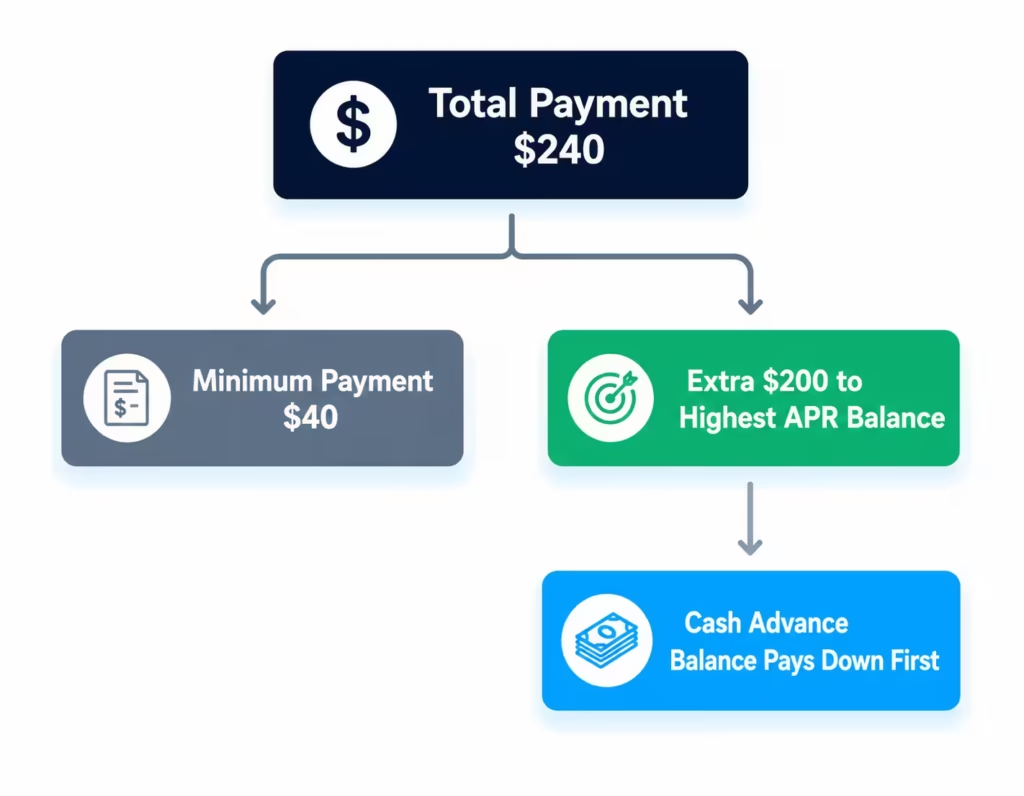
The upside is your priciest debt clears faster. The surprise is your purchase balance barely moves until the advance is gone, which confuses people who watch the wrong number.
What Happens If You Can’t Pay Back a Cash Advance
This is the scenario nobody plans for but plenty of people face. The car repair cost more than the estimate, or the paycheck you were counting on came up short. Here is exactly what happens next, and what to do about it.
First, the balance keeps growing. Interest does not pause because you are struggling. At a 29.99% APR, a $1,000 advance gains about $25 in interest every month it sits unpaid, and daily compounding pushes that number slightly higher each day.
Second, your minimum payment rises. Issuers calculate minimums as a percentage of your total balance plus fees and interest. A bigger cash advance balance means a bigger required payment, which is often the moment a tight budget breaks.
Third, a missed payment triggers the real damage. If you pay nothing for 30 days, the issuer reports the late payment to the credit bureaus, and a single late mark can drop a good credit score by 80 to 100 points. Miss 60 days and many issuers apply a penalty APR, which can push your rate near 30% on your entire balance, including purchases.
What to Do If You Fall Behind
Act before you miss a payment, not after. Three moves work far better than hoping the problem shrinks.
Call your issuer first. Most major card companies run hardship programs that can temporarily lower your APR, freeze fees, or split the balance into fixed payments. You only qualify if you ask, and asking before a missed payment protects your credit report.
Move the balance if you still qualify. A balance transfer card with a 0% intro APR stops the daily interest clock entirely. Transfer fees run 3% to 5%, which is far cheaper than months of 29.99% compounding.
Talk to a nonprofit credit counselor. Agencies certified through the National Foundation for Credit Counseling can set up a debt management plan that rolls card balances into one lower-rate monthly payment. The first session is usually free.
David, a warehouse supervisor in Memphis, took a $700 advance for a dental bill, then missed two payments when overtime dried up. His issuer’s hardship program dropped his rate to 10% for nine months, and he cleared the balance for about $40 in total interest instead of the $200-plus it was heading toward.
When a Cash Advance Makes Sense (and When It Doesn’t)
A cash advance is a reasonable last resort when all three are true: the need is a genuine emergency, no cheaper option is available in time, and you can repay within days or weeks.
It is the wrong call when the shortfall is recurring, the expense could wait, or a cheaper path exists. Using advances to plug a monthly budget gap means paying 25% to 30% interest on the same problem over and over.
Quick test before you withdraw: Can you name the exact dollar amount you need, and the exact date you will repay it? If either answer is fuzzy, pause and check the alternatives first.
Credit Card Cash Advance vs. Cash Advance Apps
Cash advance apps like EarnIn, Dave, and Brigit now compete with credit card cash withdrawals. They function in very different ways.
A credit card advance borrows against your credit line. An app advance borrows against your own paycheck. The app checks your earnings and work hours. Then, it gives you a portion of money you’ve already earned but haven’t received yet. This amount usually ranges from $50 to $750, based on the app and your history.
The cost structures barely resemble each other. A $300 credit card advance costs roughly $21 in the first month once the 5% fee and 24.80% APR stack up.
The same $300 from an app usually has no interest. You can also give a tip if you want. If you need the money quickly, there’s an instant-transfer fee of $2 to $9. Otherwise, it takes one to three days.
| Factor | Credit Card Cash Advance | Cash Advance App |
|---|---|---|
| Source of money | Your credit line | Your earned wages |
| Typical amount | Up to your cash advance limit | $50 to $750 |
| Interest | 25% to 30% APR, daily, from day one | Usually $0 |
| Upfront cost | 3% to 5% fee | $0, plus optional tip |
| Instant delivery | Immediate at ATM | $2 to $9 express fee, or 1 to 3 days free |
| Credit impact | Raises utilization, which can lower your score | No credit check, no bureau reporting |
The tradeoffs cut both ways. Apps cap how much you can pull, require a regular direct-deposit paycheck, and only work if you have earnings to borrow against. A credit card advance works for larger amounts and does not care when payday falls, but you pay heavily for that flexibility.
For a small gap of a few hundred dollars before payday, the app almost always wins on price. For a real emergency over $1,000 and no paycheck cushion, a card advance might be your only option. So, it’s crucial to consider the alternatives in the next section first.
Alternatives to a Cash Advance
Before paying $35 to $70 for quick cash, compare the realistic options.
| Option | Typical Cost for $1,000 Over 30 Days | Catch |
|---|---|---|
| Cash advance | ~$70 (fee + interest) | Instant, no approval needed |
| Personal loan | ~$10 to $30 interest (roughly 12% to 25% APR) | Takes 1 to 3 days, needs decent credit |
| 0% APR promo offer | $0 if you qualify | Approval and a transfer fee may apply |
| Earned wage access app | ~$1 to $5 fee | Advances only wages already earned |
| Asking the biller for more time | Often $0 | Requires a phone call before the due date |
For most readers who can wait 48 hours, a small personal loan or an employer paycheck advance can provide the same cash. Plus, it costs much less.
Cash Advance vs. Payday Loan
If the choice is only between these two, the cash advance is usually the less expensive option. Payday loans typically charge around $15 for every $100 borrowed on a two-week term, which the Consumer Financial Protection Bureau notes works out to an APR near 400%. A cash advance at 25% to 30% APR looks tame by comparison. Still, “cheaper than a payday loan” is a low bar, and both should sit near the bottom of your list.
Frequently Asked Questions (FAQs)
What is a cash advance on a credit card?
A cash advance is a short-term loan against your credit card’s limit that gives you actual cash. It gets added to your card balance immediately, with a fee and daily interest starting the same day, unlike regular purchases.
Does a cash advance hurt your credit score?
A cash advance isn’t reported as a negative item on its own, but it raises your balance and credit utilization, which can lower your score. A $1,000 advance on a $5,000 limit can push utilization from 30% to 50%.
Is a cash advance ever a good idea?
A cash advance can make sense when you have a genuine emergency, no cheaper option is available in time, and you can repay within days or weeks. It’s the wrong choice for recurring shortfalls or expenses that could wait.
How do you pay back a cash advance?
Under the CARD Act payment rule, any payment above your minimum must go toward the balance with the highest APR first, which is almost always the cash advance. This means your pricier cash advance debt clears before your purchase balance.
What happens if you pay a cash advance back immediately?
You still pay the upfront fee even if you repay within a day, since it posts to your balance regardless of timing. Interest also accrues daily starting the moment the cash advance is taken, so a fast repayment minimizes but doesn’t eliminate cost.
Why am I being charged a cash advance fee?
Cash advance fees apply because issuers treat cash withdrawals as a separate, riskier transaction than purchases. The fee is typically 3% to 5% of the amount withdrawn, or a flat $10 minimum, whichever is greater.
How much is a cash advance fee for $500?
A $500 cash advance at a typical 5% fee costs $25 upfront. Add about $10.19 in interest over 30 days at the average 24.80% APR, bringing the total cost to roughly $35.19.
Are cash advance fees charged even on small withdrawals?
Yes, because issuers use a flat minimum fee, usually around $10, whenever the percentage-based fee would be lower. A $150 withdrawal at 5% works out to $7.50, so the $10 minimum applies instead.
The Bottom Line
A cash advance on a credit card is fast cash with a real price tag: an upfront fee of 3% to 5%, a higher APR, and interest from day one with no grace period. Treat it as a last resort. Only borrow what you need. Repay within days. Daily compounding means that every extra week costs more.
Before you withdraw, compare a personal loan, a 0% offer, or an earned wage app against the numbers above.
Know someone staring down a surprise car repair or medical bill? Sharing this breakdown could save them from a $70 mistake they never saw coming.