
I’ve talked with many card users who spot the words “fixed APR” on a card offer and feel a mix of relief and confusion. It sounds safe. It sounds locked in. But then a notice arrives in the mail saying the rate is going up, and suddenly the label makes no sense. If you’re comparing card offers, reading your statement, or trying to figure out if “fixed APR” really protects you, that gap between the label and the reality is frustrating.
Here’s the short answer: a fixed APR is a rate that doesn’t move with a market index like the Prime Rate, but the issuer can still change it with proper notice.
In this guide, we’ll walk through how these rates really work, what the law says, where to find them, and how to decide if one is right for you.
Key Takeaways
This guide explains what a fixed APR is, how it differs from a variable APR, the Credit CARD Act rules that let issuers change it, the 45-day notice process, and where fixed-rate cards are still available.
Core Facts:
- A fixed APR does not move with a market index like the Prime Rate, but the issuer can still raise it later by following federal notice rules.
- Under Regulation Z, issuers generally cannot raise the APR on an existing balance during the first 12 months an account is open.
- If an issuer raises a fixed APR after year one, it must send written notice at least 45 days before the new rate takes effect.
- The new rate applies only to transactions made more than 14 days after the notice date, while the existing balance keeps the old rate.
- Cardholders can opt out of a rate increase, keep the old rate on their existing balance, and pay it off over five years or the standard minimum payment schedule, whichever is longer.
- Federal credit unions are capped at an 18% APR on most loans under an NCUA rule extended through September 10, 2027, and fixed-rate cards are mainly found there and at small community banks rather than large national issuers.
Best for:
- Readers comparing a fixed APR credit card offer against a variable one and deciding which fits their spending habits.
- Cardholders who received a rate-increase notice and want to understand their opt-out rights and timeline.
- People searching for a fixed-rate credit card who have only found variable-rate options at major banks.
What a Fixed APR Actually Means
A fixed APR on a credit card is an annual percentage rate that does not move up or down based on a market index. Most credit cards today use variable rates, which shift automatically when the Prime Rate changes. A fixed rate stays flat unless the card issuer takes a specific action to change it.
Think of it this way. A variable APR is tied to something outside the issuer’s control. A fixed APR is set by the issuer at the time you’re approved, and it stays at that level on its own.
There’s one big point to flag right away. “Fixed” does not mean “locked forever.” The word only means the rate is not linked to an index. Your card company can still raise a fixed rate later, as long as they follow the rules set by federal law. We’ll cover those rules in detail below, but keep this in mind so nothing catches you off guard.
Fixed APR on Other Credit Products
Fixed APR is not just a credit card term. It also shows up on mortgages, auto loans, and many student loans. On those products, “fixed” usually behaves more like the word suggests: the rate is set for the full loan term and truly stays put.
Credit cards are different. A fixed APR on a card is subject to the change rules under the Credit CARD Act of 2009, which we cover in the section below. So if you’ve had a fixed-rate mortgage before, don’t assume your credit card works the same way.
How Fixed APR Differs From Variable APR
The main difference is where the rate comes from and what makes it move.
A variable APR is built from two pieces: an index plus a margin. The index is almost always the U.S. Prime Rate, and the margin is a number the card issuer adds on top. So if the Prime Rate is 6.75% and your card’s margin is 14%, your variable APR is 20.75%. When the Federal Reserve moves rates, the Prime Rate shifts, and your APR shifts with it, automatically, with no action from the issuer. The Federal Reserve’s H.15 release tracks the current Prime Rate.
A fixed APR doesn’t work that way. It’s set at approval and stays at that number on its own. If the Fed raises rates tomorrow, your fixed APR doesn’t budge. The issuer would have to take a formal step to change it.
Here’s a simple example:
Say Michael and Jennifer both open a card in the same month at 19.99% APR. Michael’s card is variable. Jennifer’s is fixed. Six months later, the Federal Reserve raises rates by 0.50%. Michael’s APR jumps to 20.49% on his next statement. Jennifer’s APR stays at 19.99%. Neither one did anything. That’s the mechanical difference in action.
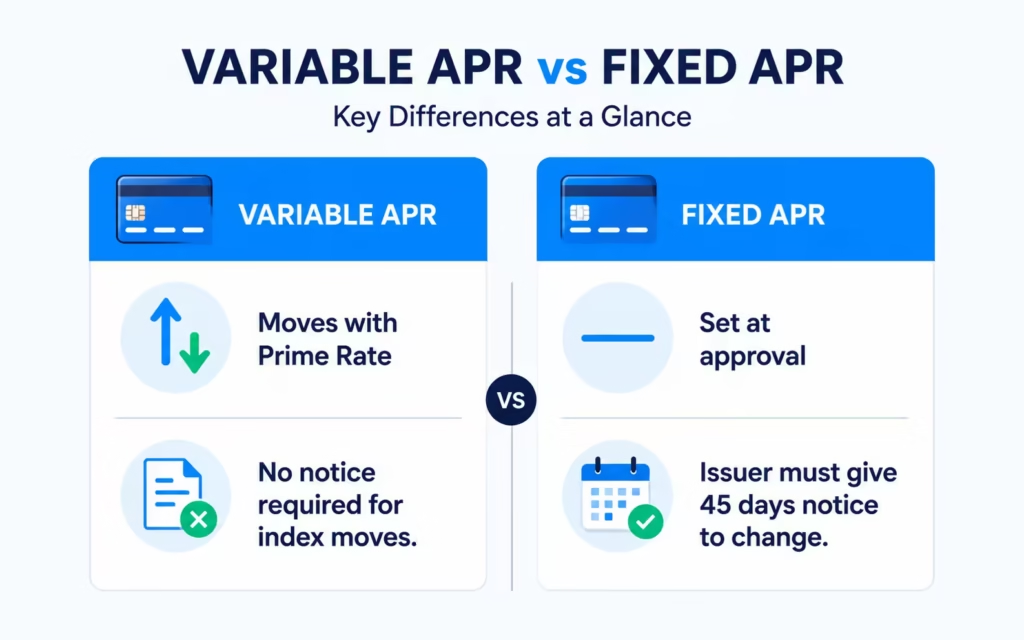
The practical effect is simple. Variable rate cards move on their own. Fixed rate cards only move when the issuer decides to change them, and they must follow legal steps to do so.
Can a Fixed APR Change? Understanding the CARD Act Rules
Yes, a fixed APR can change. This is the answer most readers don’t expect, and it’s the reason the word “fixed” causes so much confusion.
The rules come from the Credit CARD Act of 2009, which is carried out through Regulation Z (specifically Section 1026.55) under the Truth in Lending Act. The Consumer Financial Protection Bureau (CFPB) enforces these rules.
The key protection is this: during the first 12 months your account is open, the issuer generally cannot raise your APR on your existing balance. This holds for both fixed and variable rate cards, but it matters a lot for fixed cards because people often assume the rate is safe by default. As the CFPB explains in its guidance on rate increases, the issuer must generally give 45 days of advance notice before raising the rate on new purchases.
After that first year, the issuer has more room to change the rate. They must still follow strict notice rules. This change applies only to future transactions, not the balance you already owe, except for a few exceptions we cover below.
📌 Did You Know: The 12-month protection is not a “grace period.” Regulation Z has a strict rule. Even if your card says “fixed,” the issuer can’t raise the rate on your balance in the first year. There are only a few exceptions to this rule.
The 45-Day Notice Requirement
If your card issuer wants to raise your fixed APR, they must send you a written notice at least 45 days before the new rate kicks in. This is spelled out in Regulation Z § 1026.9.
Here’s how the timing actually works:
- The issuer mails or emails the notice.
- You have at least 45 days from that notice date before the new rate takes effect.
- The new rate only applies to transactions made more than 14 days after the notice was provided.
- Your existing balance and any charges made in that 14-day window stay at the old rate.
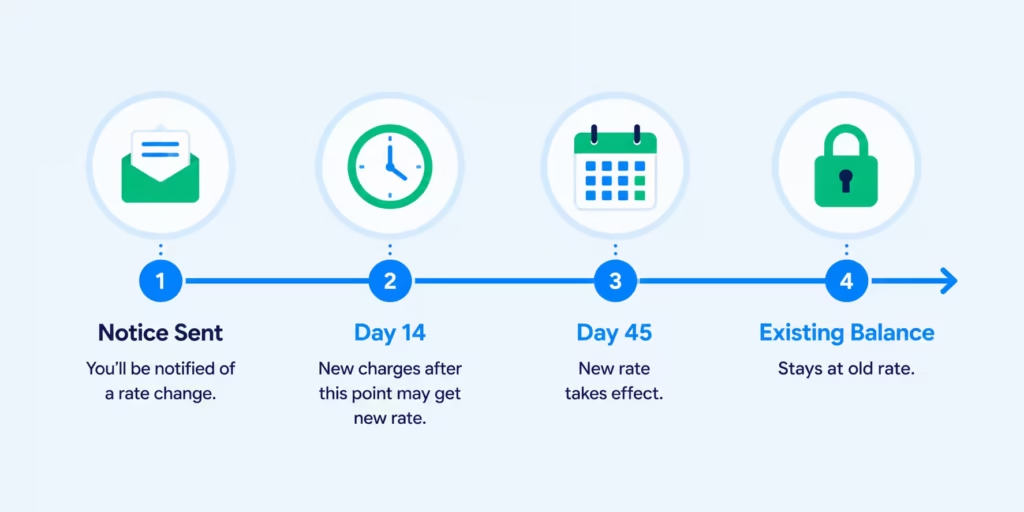
So a portion of your balance is “grandfathered” at the old rate. Only new purchases after that cutoff get the higher rate. This is a big deal because it gives you time to plan, pay down what you owe, or move balances to another card if needed.
Exceptions When Notice Isn’t Required
There are a few carve-outs to the 45-day rule. If one of these applies, your rate can jump without the normal notice.
- Promotional or introductory rate ends. If your card has a 0% intro APR or a special promo rate, that rate can expire without a 45-day notice. Under the CARD Act, promo rates must last at least six months, and the terms are laid out when you sign up.
- Payment more than 60 days late. If your account is more than 60 days past due, the issuer can apply a penalty APR to your existing balance right away. That penalty rate can only stay if you keep missing payments. If you make six months of on-time payments after the penalty rate kicks in, the issuer must return your balance to the old rate.
- Variable index moves. This doesn’t apply to a true fixed APR, but on a variable card, rate moves tied to the Prime Rate don’t need the 45-day notice.
- Servicemembers Civil Relief Act (SCRA). Active-duty service members get a related protections. The SCRA caps interest rates at 6% on debt taken on before active duty. It’s a different rule, but worth knowing if you or a family member serves.
What Happens When You Get a Rate-Increase Notice
Getting a rate-hike notice can feel alarming, especially on a card you thought was fixed. But you have real options. Here’s a clear action plan.
Step 1: Read the notice carefully. Look for the effective date of the new rate, the old and new APR figures, and instructions for how to opt out. The notice must state these things clearly.
Step 2: Decide whether to opt out. You have the right to reject the rate increase. If you opt out:
- You can no longer make new purchases on the card (in most cases the account is closed to new activity).
- You continue paying off your existing balance at the old, lower APR.
- The issuer usually gives you five years or the standard minimum payment schedule, whichever is longer, to pay it off.
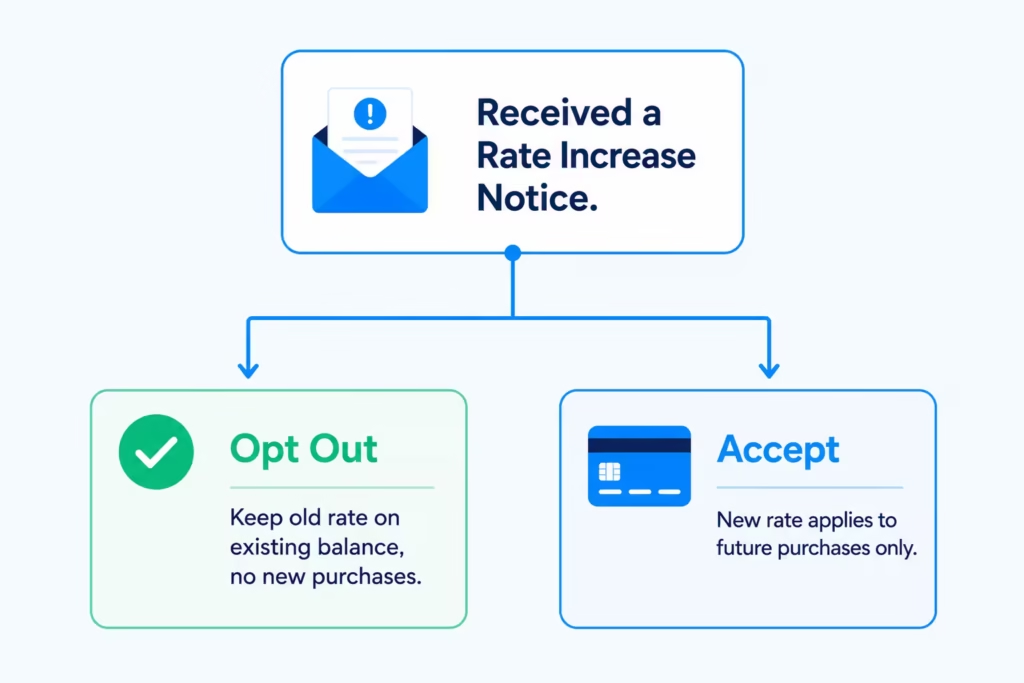
Step 3: Decide what to do if you accept the change. If you do nothing, the new rate kicks in automatically for transactions made more than 14 days after the notice. Your existing balance stays at the old rate. You keep using the card as normal, just at the higher rate on new charges.
Step 4: Compare your other options. Before you accept or reject, look at what else is out there. Can you move your balance to a 0% intro APR card? Can you find a lower-rate card at a credit union? Even a modest rate drop can save real money if you carry a balance.
Step 5: Contact your issuer to opt out (if that’s your choice). The notice will explain how, usually by phone or in writing. Do it before the effective date on the notice. If you miss that deadline, you lose the opt-out right.
⚠️ Mistake to Avoid: Ignoring the notice and hoping it goes away. If you don’t opt out by the deadline, the higher rate applies to your future purchases automatically. Read the letter the day it arrives and make a plan.
Why Fixed-Rate Credit Cards Are Rare Today
If you’ve searched for a fixed-rate card at Chase, Citi, Capital One, or another large bank and come up empty, you’re not doing anything wrong. Fixed-rate cards are genuinely hard to find at big issuers.
The main reason traces back to the CARD Act itself. Before 2009, big banks could raise fixed rates fairly easily, so offering a “fixed” APR carried little risk for them. After the CARD Act limited how and when rates could be changed, offering fixed rates became much riskier for large issuers. If they set a rate too low and market rates rose sharply, they were stuck.
Their response was to shift almost entirely to variable-rate cards tied to the Prime Rate. That way, if the Federal Reserve raises rates, the issuer’s income adjusts automatically without triggering the 45-day notice process or opt-out rights. Bankrate’s current rates data reflects this reality, with most major-issuer cards now variable.
So the shortage of fixed-rate cards at national banks isn’t a mystery or a search problem on your end. It’s a market reality shaped by federal law.
Where to Actually Find a Fixed-APR Credit Card
The realistic answer is credit unions and small community banks. That’s where most fixed-rate cards live today.
Credit unions follow different rules and focus on members, not shareholders. This lets them provide flat, predictable rates. They don’t face the same profit pressure that drives big banks to use variable pricing. Many community banks follow the same pattern for the same reasons.
Practical steps to find one:
- Check credit unions you already qualify for. Many people are eligible through an employer, a family member, a place of worship, or where they live, and don’t realize it.
- Search local credit unions in your zip code. The MyCreditUnion.gov locator from the National Credit Union Administration lets you find nearby federally insured credit unions.
- Look at membership-based credit unions with open eligibility. Some let you join by making a small donation to a partner nonprofit or by paying a low one-time membership fee.
- Ask community banks in your area. Some smaller banks still offer fixed-rate cards, though the terms vary.
Skip the big-name credit card comparison sites for this search. They usually feature variable-rate cards from national issuers because that’s where the affiliate revenue is.
What to Expect From Credit Union Fixed-Rate Cards
Setting expectations up front will save you disappointment. Credit union fixed-rate cards look different from big-bank variable cards in a few key ways.
- Lower rate ceilings. Federal credit unions are capped at an 18% APR on most loans under a National Credit Union Administration (NCUA) rule. The NCUA extended this 18% interest rate ceiling through September 10, 2027. Compared with average credit card APRs above 21%, that’s a real gap in your favor.
- Fewer rewards. Don’t expect big cash back programs, luxury travel perks, or huge sign-up bonuses. Some credit unions offer light rewards, but the focus is a lower rate, not points.
- Membership steps. You may need to open a small savings account, meet an eligibility test, or pay a modest membership fee. It’s usually simple, but it’s an extra step compared to applying at a big bank.
- Slower application feel. Approvals may take a bit longer, and the online experience may not match Chase or Amex. Trade off convenience for a lower, steadier rate.
Is a Fixed APR Cheaper Than a Variable APR?
Not automatically. This is one of the most common assumptions, and it’s worth correcting directly.
The type of rate (fixed vs. variable) is a separate question from the level of rate (high vs. low). A fixed APR can be higher than a variable APR, lower, or roughly the same. It depends on the issuer, market conditions when the card was priced, and the applicant’s credit profile.
Sometimes fixed rates carry a small “stability premium.” The issuer takes on more risk by locking in a rate, so they price that risk into the number. In other cases, especially at credit unions with lower operating costs, the fixed rate can be well below the market average.
The right way to compare is to look at the actual APR on the offer in front of you, not the label. Ask: what’s the rate today, and what’s the risk if market rates change? A 17.99% fixed rate at a credit union may beat a 21.99% variable rate at a big bank in almost every scenario. But a 24.99% fixed rate is not a bargain just because the label says “fixed.”
💡 Pro Tip: When comparing offers, write down both APRs side by side, then ask what happens if the Prime Rate rises 1% or 2% over the next year. Model the variable card at the higher number. If the fixed card still costs more, “fixed” isn’t buying you anything real.
Pros and Cons of a Fixed APR Credit Card
Here’s a balanced look, so you can weigh both sides before choosing.
Advantages of a Fixed APR
- Payment predictability. Your interest cost per month stays the same when the Federal Reserve changes rates. That makes budgeting easier, especially if you carry a balance.
- Protection during year one. For the first 12 months, the issuer generally can’t raise the rate on your balance. This is true for variable cards too, but combined with a fixed rate’s steadiness, it gives you a very stable first year.
- Cleaner comparison. You know exactly what you’ll owe on carried balances. No guessing about future Prime Rate moves.
- Fits people who dislike rate surprises. If you find variable rate news stressful, a fixed rate takes that anxiety off the table (mostly).
Drawbacks of a Fixed APR
- Limited availability. Mostly available at credit unions and smaller banks. If you want a fixed rate and a premium rewards card from a national issuer, you’ll usually have to pick one.
- Not automatically cheaper. The rate might be higher than a comparable variable card, depending on the issuer.
- Still not truly “locked.” The issuer can raise it after year one with 45 days’ notice. So “fixed” is more accurate than “permanent,” but less protective than the word sounds.
- Fewer rewards and perks. Credit union fixed-rate cards often skip big rewards programs to fund the lower steady rate.
How Fixed APR Appears in Your Card’s Terms and Disclosures
You can check your own card in about two minutes if you know where to look.
In the Schumer box (on the offer or account opening disclosure). Every credit card offer includes a small chart called the Schumer box. It lists APRs for purchases, balance transfers, cash advances, and any penalty APR. Look for the words:
- “Fixed” next to the APR number
- “Non-variable”
- No mention of an index like “Prime Rate + 14.99%.”
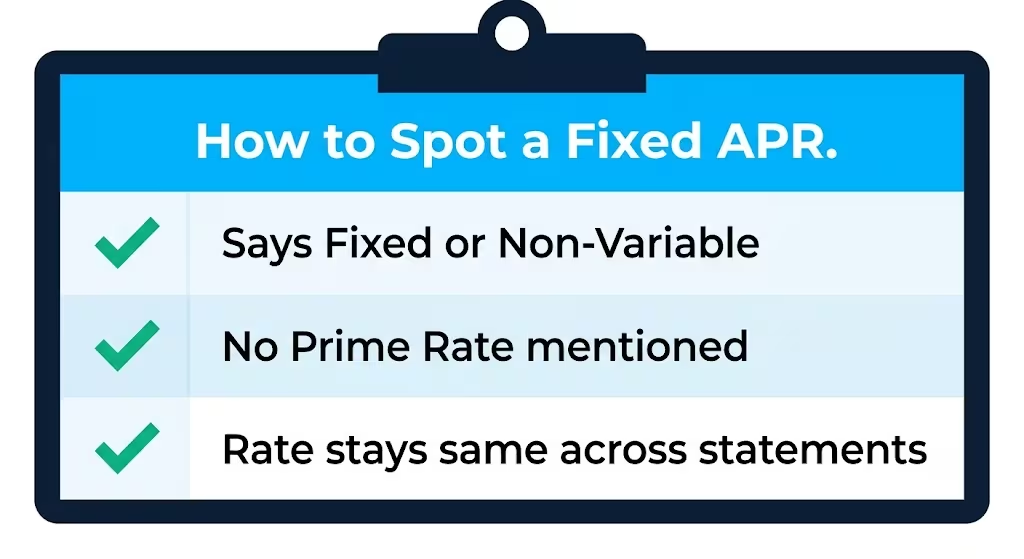
If you see an index-plus-margin format (like “Prime + 12.99%”), it’s a variable rate. If you see a plain number with no index reference, it’s fixed. Sometimes the disclosure spells it out clearly with a note like, “This APR will not vary based on the Prime Rate.”
On your monthly statement. Your statement includes an “Interest Charge Calculation” section, usually near the bottom. It lists the APRs applied to each balance type. It won’t always say “fixed” outright, but you can compare the APR over several months. If it stays the same while the Prime Rate moves, it’s fixed. If it changes when the Fed moves rates, it’s variable.
Watch for the term “APR floor rate.” Some cards, including a few that call themselves fixed, include a floor rate, which is a minimum the APR won’t drop below. This matters less on a fixed card than a variable one, but it’s worth noting so you’re not surprised.
Connect the dots to notices. If you ever get a letter from your issuer titled something like “Important Changes to Your Account,” check whether it mentions a rate change. That’s the 45-day notice we covered above. Cross-reference it with the APR listed in your original account opening disclosure to confirm the change.
How to Decide if a Fixed APR Credit Card Is Right for You
At this point, you’ve got the full picture. Now it comes down to a short self-check.
Do you value payment predictability over rewards and convenience?
If the answer is yes, a fixed rate card is worth pursuing. If you rarely carry a balance and mostly want travel points or cash back, variable-rate cards from national issuers will likely serve you better.
Are you comfortable with a credit union relationship?
Fixed-rate cards live at credit unions, so you’ll need to join one. If you’re open to that (small savings account, maybe a membership fee, slightly slower service), fixed becomes very doable. If you’d rather stick with a large national bank, fixed cards may not be a practical fit.
Do you understand that “fixed” reduces but doesn’t eliminate rate-change risk?
This is the last check. A fixed APR protects you from Prime Rate moves. It does not fully protect you from your issuer raising the rate with 45 days’ notice after year one. If you understand that and still want the extra steadiness a fixed rate offers, you’re making a well-informed choice.
The best choice for a user who values predictability is a fixed-rate card from a federal credit union. Since 2009, federal rules and market pricing have changed. The NCUA’s 18% ceiling and a stable rate often make this option cheaper over time than a mid-tier variable card. For someone who pays in full each month, the choice matters far less, because interest rarely applies.
Frequently Asked Questions (FAQs)
Is a fixed APR good?
A fixed APR can be good if you value stable payments and qualify for a low rate at a credit union. It won’t move with the Prime Rate, but a high fixed rate, like 24.99%, isn’t automatically a better deal than a lower variable one.
Is 24% APR good or bad?
A 24% APR is on the high end, since average credit card APRs run above 21%. Federal credit unions cap most rates at 18% through September 10, 2027, so a fixed rate near that ceiling beats 24% in most cases.
What is a good fixed APR rate?
A fixed rate close to a credit union’s 18% cap is considered strong, especially compared with variable rates that often exceed 21%. A rate like 17.99% at a credit union typically beats a 21.99% variable rate at a big bank.
Is it better to have a fixed or variable APR?
Neither is automatically better since the type of rate is separate from the level of rate. Compare the actual APR number on each offer, then check what happens if the Prime Rate rises 1-2% before deciding.
Can my fixed APR change without warning?
No, your issuer must send written notice at least 45 days before raising a fixed APR, and the increase only applies to new purchases made more than 14 days after that notice. Your existing balance stays at the old rate.
What happens if I opt out of a rate increase?
You keep your existing balance at the old, lower APR and pay it off over five years or your standard minimum payment schedule, whichever is longer. You can no longer make new purchases on that card once you opt out.
Why don’t big banks like Chase or Citi offer fixed-rate cards?
The Credit CARD Act of 2009 made fixed rates riskier for large issuers, since raising them requires 45 days’ notice and gives cardholders the right to opt out. Big banks shifted to variable rates tied to the Prime Rate, so their income adjusts automatically instead.
Where can I find a fixed-rate credit card?
Fixed-rate cards are mainly available through credit unions and small community banks, not major national issuers. Use the NCUA’s MyCreditUnion.gov locator to find federally insured credit unions near you, and check if you qualify through an employer, family member, or local membership option.
How can I tell if my card’s APR is fixed or variable?
Check the Schumer box on your card offer for the word “fixed” or “non-variable,” with no index like “Prime + 12.99%” listed. On your statement, an APR that stays the same while the Prime Rate moves confirms it’s fixed.
Is my APR protected from rate increases in the first year?
Yes, issuers generally cannot raise your APR on an existing balance during the first 12 months your account is open. This protection applies to both fixed and variable rate cards under Regulation Z.
The Bottom Line
We discussed a lot: what a fixed APR is, how it differs from a variable rate, and the CARD Act rules for changing it. We also talked about the 45-day notice process, where to find fixed-rate cards, the trade-offs with credit unions, and how to choose one that fits your habits.
For steady payments, focus on federal credit unions. Know the 12-month protection window. Also, read each rate notice as soon as it arrives. That combination gives you the real benefit a fixed APR is meant to offer: predictability, without surprises.
If you know someone frustrated by rising credit card rates or confused about “fixed” rates, share this guide with them. It could save them from a costly surprise and help them pick the right card the first time.