
You just checked your credit score, and now you’re staring at a three-digit number with no clue what it actually means. Is 672 “fair” or “good”? Will it get you approved for that new card, or the mortgage you’ve been eyeing?
The credit score ranges you see on your bank app or Credit Karma don’t always tell the full story, and that gap can cost you real money if you apply for the wrong product.
We’ll show you the exact tier your number falls into, what it qualifies you for, and how close you are to the next level. Keep reading for a clear, tier-by-tier breakdown and expert tips to move up fast.
Key Takeaways
This guide explains credit score ranges from 300 to 850 under FICO and VantageScore, including tier definitions, what each tier qualifies you for, and how to move up a tier.
Core Facts:
- FICO and VantageScore both run on a 300 to 850 scale but use different tier cutoffs, so the same score can carry two different labels.
- FICO tiers are Poor (300-579), Fair (580-669), Good (670-739), Very Good (740-799), and Excellent (800-850).
- The average FICO score in the U.S. was 713 as of late 2025, and only about 1.76% of consumers reach a perfect 850.
- Conventional mortgages require a minimum FICO score of 620, but the best rates typically require 740 or higher.
- Payment history makes up 35% of a FICO score, and a single 30-day late payment can drop a score by 60 to 100 points.
- Most lenders offer their best rates once a score crosses 760, meaning higher scores bring diminishing returns.
Best for:
- Readers who want to identify their current credit tier and understand what it qualifies them for.
- Anyone comparing FICO and VantageScore results that don’t match and want to know why.
- People preparing to apply for a credit card, mortgage, auto loan, or personal loan who want to know the score threshold that affects their rate.
FICO vs. VantageScore: Why Your Score Might Look Different
You checked your score in two places this week, and the numbers don’t match. One app says 665, another says 674. One labels you “fair,” the other says “good.” Nothing is wrong. You’re just looking at two different scoring models.
Both FICO Score 8 and VantageScore 3.0/4.0 run on the same credit score range, 300 to 850. That’s where the similarity ends. FICO is the model most lenders trust. Experian reports that FICO scores are used in over 90% of U.S. lending decisions. VantageScore was built by the three major credit bureaus (Equifax, Experian, and TransUnion) as a rival model. It shows up a lot in free score tools like Credit Karma.
The two models pull data from the same credit reports. But they weight things differently. They also draw their tier lines in different spots. That’s the key thing to notice.
Here’s how the FICO score ranges and VantageScore tiers stack up:
| Tier | FICO Score 8 | VantageScore 3.0/4.0 |
|---|---|---|
| Poor | 300–579 | 300–600 |
| Fair | 580–669 | 601–660 |
| Good | 670–739 | 661–780 |
| Very Good | 740–799 | (not a separate tier) |
| Excellent | 800–850 | 781–850 |
Why the Same Score Can Get Two Different Labels
Take a score of 665. Under FICO, that’s still “fair.” Under VantageScore, it’s already “good.” Same person, same credit habits, same week. But two different labels. That’s the nine-point structural gap between the models at play.
This matters when you apply for something. Lenders almost always pull a FICO score. So if your free app shows “good” under VantageScore but you’re really at 665 FICO, you may not qualify as you think. Before you apply for any card, loan, or mortgage, find out which model the lender uses. Ask them, or check the fine print on the pre-qualification page.
💡 Pro Tip: When you check your score for free, look for small text that says “FICO Score 8” or “VantageScore 3.0.” That one label tells you which chart to use before you shop for credit.
What Is a Poor Credit Score?
A poor credit score sits at the bottom of the scale. Under FICO, that means 300 to 579. Under VantageScore, it stretches slightly wider, from 300 to 600. If your number lands here, you’re in what most lenders call “subprime” territory.
What does that mean in real life? Most mainstream credit cards will decline you. Auto loans, if approved, come with sky-high interest rates, sometimes 20% APR or more. Renting an apartment gets harder. Some utility companies may even ask for a security deposit before turning on service.
This tier isn’t a personal judgment. It just reflects one thing lenders track: risk. A score in this range usually points to late payments, high balances, collection accounts, or a very thin credit file. The good news is that this tier moves the fastest with the right steps. Small changes to payment history and balances can lift a poor score into fair territory in a few months.
Creditworthiness at this level isn’t zero. Secured credit cards, credit-builder loans, and some subprime auto lenders will still work with you. They just cost more.
What Is a Fair Credit Score?
A fair credit score means you have some credit history, but there are still red flags. FICO puts this tier at 580 to 669. VantageScore trims it to 601 to 660. This is the tier where most people sit when they’re rebuilding, or when they’re still early in their credit journey.
What does fair unlock? A limited but real set of options:
- Store credit cards (Target, Kohl’s, Home Depot)
- Some starter rewards cards with modest limits
- FHA-backed mortgages, which accept scores as low as 580 with a 3.5% down payment, per HUD
- Auto loans, but at higher rates than prime borrowers get
- Personal loans from lenders that use risk-based pricing to offset the added risk
If your score is in the high 600s, you’re right on the edge of “good.” That’s a critical spot. Just 10 or 20 points more can drop your interest rate by a full percentage point on a car or personal loan. That’s real money over the life of the loan.
What credit score is considered good starts at 670 under FICO. If you’re at 655, you’re 15 points away. That gap is usually one billing cycle of paying down a card, or one late payment being aged out, from closing.
What Is a Good Credit Score?
A good credit score is the tier most lenders treat as “safe enough.” Under FICO, this range is 670 to 739. Under VantageScore, it’s much wider, running 661 to 780. There’s a shared overlap zone from 670 to 739 where both models agree you’re “good.”
Is 700 a good credit score? Yes. In fact, 700 puts you right in the middle of the good tier under FICO, and squarely inside VantageScore’s good range too. It’s a comfortable place to be.
The average FICO score in the U.S. sat at 713 as of late 2025, according to Experian’s five-year credit trends report. That means if you’re at 700 or above, you’re already at or near the national average.
What changes once you cross into good?
- Most mainstream credit cards will approve you
- Conventional mortgages become accessible (620 is the floor, but 670+ gives you real options)
- Auto loan rates drop noticeably
- Rental applications get easier
- You can start earning rewards cards with decent sign-up bonuses
Here’s the catch. “Good” gets you approved. It doesn’t always get you the best rate. Lenders reserve their lowest APRs for the tier above. So while good is a solid milestone, it’s not the finish line.
What Is a Very Good Credit Score?
Very good is where the real savings start. FICO defines this tier as 740 to 799. VantageScore doesn’t use “very good” as a separate label. It skips straight from good to excellent at 781. So if you’re using VantageScore, this tier gets folded in.
Under FICO, though, 740 is a magic number. That’s typically where lenders start showing you their best advertised rates. The interest rate impact at this tier is huge.
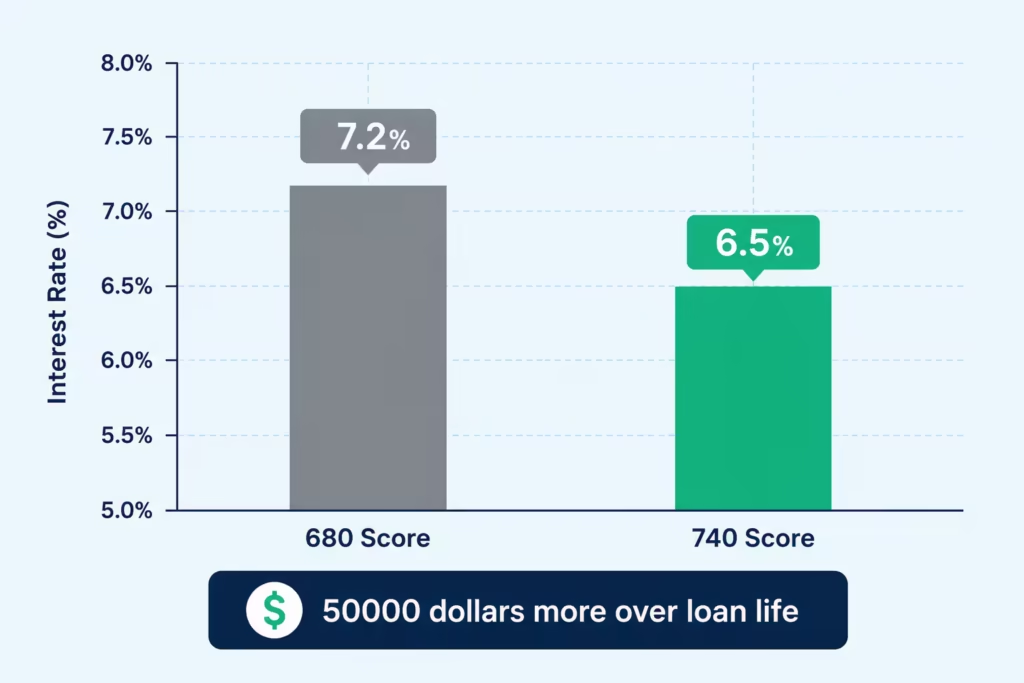
Consider a $300,000 30-year mortgage. A borrower at 680 might see a rate of 7.2%. Someone at 740 might see 6.5%. That difference costs the lower-score borrower about $140 more per month, or $50,000 more over the life of the loan. Same house, same loan amount. Different score, very different bill.
Very good also opens the door to:
- Premium travel and cash-back cards with strong bonuses
- Lower auto loan APRs (often under 6% for well-qualified buyers)
- Better terms on personal loans
- Higher credit limits with less scrutiny
If you’re at 720 or 730, you’re close. A few months of low card balances and on-time payments can push you into this tier.
What Is an Excellent Credit Score?
An excellent credit score puts you at the top of the scale. FICO calls this range 800 to 850. Some call it “exceptional.” VantageScore starts its excellent tier at 781 and runs to 850.
Here’s something most articles skip. You don’t actually need 800 to get the best rates on most products. That’s the “practical ceiling” concept. For most lenders, the best-rate tier kicks in around 760. Once you cross that line, going higher doesn’t unlock much more. A 780 and an 830 usually get the same mortgage rate, the same card offers, and the same auto loan APR.
So why aim for 800+? Two reasons. First, it gives you a safety cushion. If one late payment drops you 50 points, you’re still in “very good” territory. Second, some ultra-premium products (private banking, jumbo loans, some business credit) look for scores in the exceptional range.
Only about 1.76% of U.S. consumers have a perfect 850, per Experian research. So chasing that specific number isn’t worth stress. Getting to 760 is the real target.
📌 Did You Know: Most lenders round to the nearest 20-point tier when they set rates. So a 761 usually earns the same rate as a 780. Once you clear 760, extra points bring diminishing returns.
What Credit Score Do You Need for a Credit Card?
There’s no single answer. Card issuers set their own internal cutoffs, called lender overlays. Two people with the same score can get different results at two different banks. That’s not random. Each issuer looks at more than just the number.
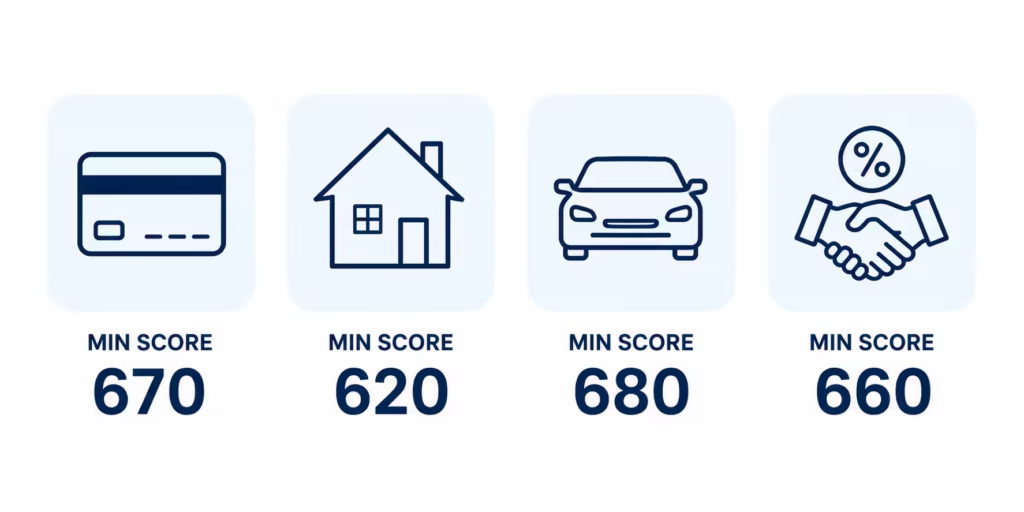
In general, though, most rewards cards want to see 670 or higher. Premium travel cards often push that to 740+. Secured and starter cards work with much lower scores, sometimes down to the 500s. Your approval odds get stronger the higher you climb.
Let’s break down three specific cards readers often ask about.
Costco Anywhere Visa Credit Score
The Costco Anywhere Visa by Citi is a co-branded card with strong cash-back on gas and dining. It’s popular, and it’s not easy to get. Reports from cardholder forums and issuer data suggest a FICO score of 700 or higher is the practical minimum. Your strongest approval odds sit at 720 and above.
You’ll also need an active Costco membership before you apply. Citi tends to look at your full credit profile, not just the score. So if you have recent late payments, even a 720 might not be enough.
Home Depot Credit Card Credit Score
The Home Depot Consumer Credit Card is a store card issued by Citi. Store cards usually have looser standards than travel or cash-back cards. For Home Depot, applicants with FICO scores around 640 or higher tend to get approved.
Some fair-credit borrowers (in the low 600s) also get approved, though usually with lower credit limits. This card is a solid stepping stone for someone in the fair tier who wants to build toward better cards.
Discover Card Credit Score
Discover offers a range of cards, from student and secured products to premium cash-back options. For its main rewards cards (like Discover it Cash Back), a FICO score of 700 or higher is the sweet spot for approval.
There are exceptions. Discover it Secured accepts applicants with poor or no credit. Discover it Student cards are aimed at students who may not have established credit yet. So if 700 feels out of reach, one of Discover’s starter products can get you in the door.
What Credit Score Do You Need for a Mortgage?
Buying a house is where credit score requirements get serious. The mortgage market has clear tiers based on the loan type. Here’s the honest breakdown.
For most conventional loans, the minimum FICO score is 620. That gets you approved. But it doesn’t get you the best rate. For the lowest advertised mortgage rates, you need 740 or higher. That’s a big gap in real dollars.
FHA loans are the go-to for lower scores. HUD allows scores down to 580 with a 3.5% down payment, and down to 500 with a 10% down payment, according to HUD’s official FHA guidelines. Individual lenders often set their own overlays above these floors.
VA loans (for veterans and service members) don’t have a set minimum from the VA itself. But most lenders want to see 620 or higher.
⚠️ Mistake to Avoid: Don’t confuse the “minimum to qualify” with the “minimum to get a good rate.” A 620 score gets you a conventional loan. But you could pay $200+ more per month than someone at 740. Always ask your lender what rate you’d get at your current score, and at 20 or 40 points higher.
Credit Score for a Conventional Loan
A conventional loan is any mortgage not backed by a government agency. Most are eligible to be sold to Fannie Mae or Freddie Mac, which sets the baseline rules. The Fannie Mae Selling Guide sets the minimum representative credit score at 620 for most fixed-rate loans, per Fannie Mae’s Selling Guide.
Individual lenders can add “overlays” on top. That means a bank might require 640 or 660 even though Fannie Mae’s floor is 620. This is why two lenders might quote you very different terms.
For the best conventional rates, aim for 740 or higher. That’s where private mortgage insurance (PMI) rates drop the most too, if you’re putting down less than 20%.
Credit Score for a USDA Loan
USDA loans are for buyers in eligible rural and some suburban areas. They allow no down payment, which makes them powerful for first-time buyers. Most USDA-approved lenders want to see a FICO score of 620 to 640.
Below 640, the process gets harder. Lenders have to run a manual underwrite, which means they look at your full financial picture instead of just running your file through automated approval. Some lenders won’t do manual underwrites at all. So while USDA officially has no set minimum, 640 is the practical target.
What Credit Score Do You Need for a HELOC?
A HELOC (home equity line of credit) lets you borrow against the equity you’ve built in your home. Because it’s a second lien behind your main mortgage, lenders take on extra risk. That’s why the score bar sits higher than for a first mortgage.
Most banks want to see a FICO score of 680 or higher for HELOC approval. Some lenders will go as low as 620, but expect a smaller credit line and a higher rate. For the best HELOC rates, you’ll usually need 700 to 740 or higher.
Here’s why the threshold is stricter. If a borrower defaults, the first mortgage lender gets paid first from any home sale. The HELOC lender is second in line. If home equity dropped in value (like it did in 2008), the HELOC lender might get nothing. Stricter score rules protect them from that risk.
HELOCs also use risk-based pricing heavily. So a 680 score might get you approved at 10% APR, while a 760 might get 8% on the same line. On a $50,000 HELOC, that two-point gap can mean $1,000+ more in yearly interest.
What Credit Score Do You Need for a Personal Loan?
Personal loans have the widest score range of any product. That’s because the lender pool is huge, from subprime online lenders to prime banks and credit unions. Your options change a lot based on where your score sits.
Subprime personal loan lenders will approve borrowers with scores in the 500s. But APR at that level can hit 30% or more. That turns a $10,000 loan into a $16,000 payback over three years.
Prime lenders sit at the other end. Discover Personal Loans, for example, sets a published minimum FICO score of 660. But the average approved borrower at Discover actually scores around 750. So the published minimum and the real approval bar are different things.
Your approval odds improve fast as you climb the tiers:
- 580 to 619: Subprime lenders only, APRs 20% and up
- 620 to 679: Prime lenders start becoming an option, APRs around 12-20%
- 680 to 739: Most prime lenders approve, APRs around 8-14%
- 740 and above: Best APRs, often under 8% for qualified borrowers
For most people, waiting until you cross 680 before applying can save thousands in interest.
How to Improve Your Credit Score
You know your tier. You know what the next one unlocks. Now let’s close that gap. Two factors move your score the fastest.
Payment history is the biggest single factor in FICO’s scoring formula. It makes up 35% of your score. One 30-day late payment can drop you 60 to 100 points. So step one is simple: pay every bill on time, every month. Set up autopay on at least the minimum for every card and loan. That protects your history even in a busy month.
Credit utilization is factor number two. This is the percent of your available credit that you’re actually using. If your card limit is $5,000 and your balance is $2,000, your utilization is 40%. Aim to keep utilization under 30%. For the best score impact, under 10% is even better.
Here’s a trick that works fast. Pay down your card balance before the statement closes, not just before the due date. The balance on your statement is what gets reported to the bureaus. So paying early lowers what the bureaus see, even if you don’t change how you use the card.
The third factor to watch is hard inquiries. Every time you apply for new credit, the lender pulls a hard inquiry. Each one can drop your score by 5 to 10 points, and they stay on your report for two years. If you’re planning a big application (like a mortgage), avoid opening new cards or loans for at least 6 months before you apply.
A quick action plan to move up one tier:
- Set up autopay on every account (protects payment history)
- Pay down cards to under 10% of the limit (drops utilization)
- Pause new credit applications for 6 months (no new hard pulls)
- Check your credit reports for errors at AnnualCreditReport.com and dispute anything wrong
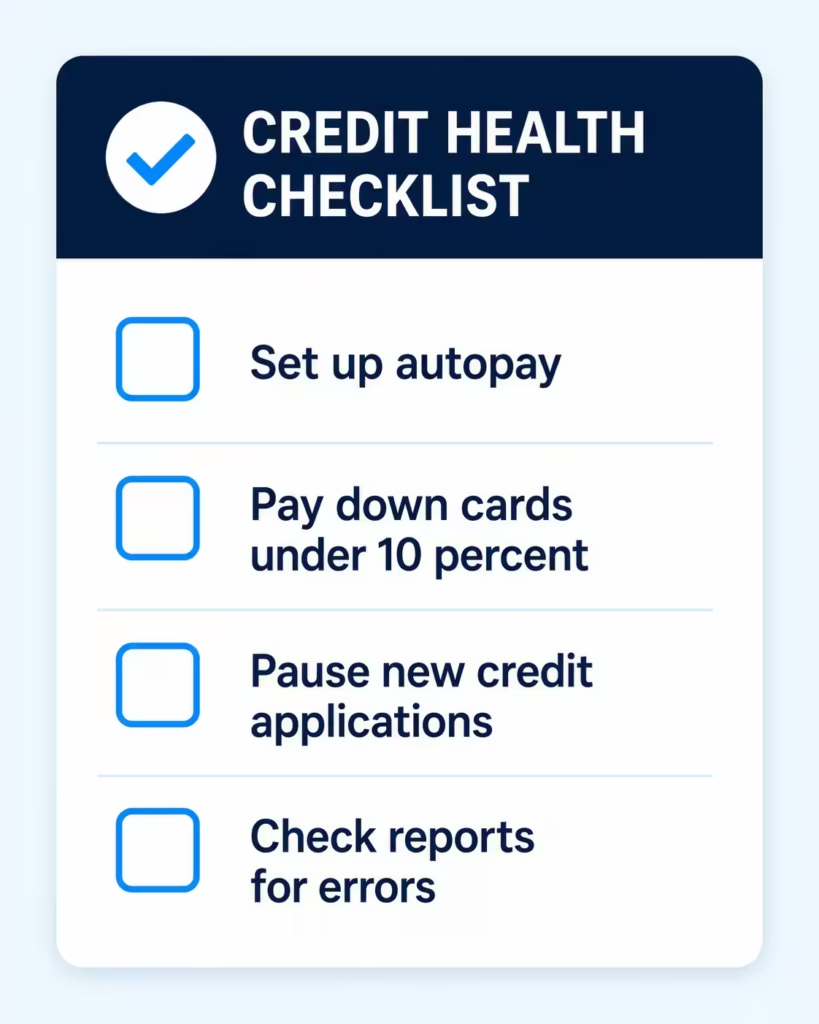
Most people who follow these four steps see a 20 to 50 point jump within 90 days. That’s often enough to move from fair to good, or from good to very good.
Frequently Asked Questions (FAQs)
Is a 450 credit score bad?
Yes, 450 falls in the poor tier under both FICO and VantageScore. At this level, most mainstream credit cards decline you, and auto loans often carry APRs of 20% or higher.
How rare is an 825 credit score?
An 825 sits in the excellent tier, which very few people reach. Only about 1.76% of U.S. consumers have a perfect 850, and scores above 800 are similarly uncommon.
Is a credit score 850 or 900 the max?
850 is the highest possible score under both FICO and VantageScore. Neither model uses a 900-point scale.
Does anyone actually have an 850 credit score?
Yes, but it’s rare. Experian research shows only about 1.76% of U.S. consumers hold a perfect 850 score.
What is the biggest killer of credit scores?
Late payments do the most damage, since payment history makes up 35% of your FICO score. A single 30-day late payment can drop your score by 60 to 100 points.
How fast can I add 100 points to my credit score?
Most people see gains of 20 to 50 points within 90 days by paying down balances and setting up autopay. Reaching a full 100-point jump usually takes longer and depends on your starting tier.
What credit score do I need to buy a $30,000 car?
A score of 680 or higher gets you into prime auto lender territory with APRs around 8-14%. Below 620, you’re limited to subprime lenders with rates of 20% or more.
What credit score is needed to buy a $400,000 house?
Conventional loans require a minimum FICO score of 620, but that won’t get you the best rate. For the lowest advertised mortgage rates on a loan this size, aim for 740 or higher.
How many Americans have a 700 credit score?
The average FICO score in the U.S. was 713 as of late 2025. A score of 700 puts you right around the national average.
Do you need an 800 credit score to get the best rates?
No, most lenders offer their best rates once you cross 760. Scores above that point bring diminishing returns on most cards, mortgages, and auto loans.
What’s the difference between a good and very good credit score?
Good is 670-739 under FICO, while very good is 740-799. Crossing into very good can save tens of thousands on a mortgage, since a 740 score might get 6.5% versus 7.2% at 680 on a $300,000 loan.
The Bottom Line
Credit score tiers matter because they shape what you’ll pay, what you’ll qualify for, and how lenders view you. We discussed the differences between FICO and VantageScore. We also explored each tier from poor to excellent. Finally, we matched scores to products like the Costco Visa, conventional and USDA mortgages, HELOCs, and personal loans.
The best move for most readers is to aim for a score of 740 before applying. That’s where the best rates begin. Small changes to payment history and utilization can close that gap in months.
If you know someone about to apply for a card, mortgage, or personal loan, share this guide with them. It could save them thousands in interest on their next big financial move.