
You saw “Pay with Affirm” at checkout and paused. Is it a credit card? A loan? Will it check your credit, and will that hurt your score? If you’re asking “what is Affirm and how does it work,” you’re asking the right questions before you commit to anything.
Affirm is a buy now, pay later (BNPL) company that gives you an installment loan to split a purchase into fixed payments. Some plans charge no interest at all, while others charge up to 36% APR.
Below, you’ll learn how the checkout process works, how the two plan types differ, what your rate depends on, how Affirm affects your credit in 2026, and when using it actually makes sense.
Key Takeaways
This guide explains what Affirm is and how it works, including its checkout process, Pay in 4 versus monthly plans, interest rate factors, and its 2026 credit bureau reporting rules.
Core Facts:
- Affirm is a point-of-sale installment loan, not a credit card, made or arranged through partner lenders such as Cross River Bank.
- Pay in 4 splits a purchase into four payments every two weeks at 0% APR, while monthly plans range from 0% to 36% APR.
- Checking eligibility for Pay in 4 uses a soft credit pull that does not affect your score, but some larger or longer-term financing can trigger a hard inquiry.
- As of 2025 and 2026, Affirm reports payment activity to Experian for plans issued on or after April 1, 2025, and to TransUnion for plans issued on or after May 1, 2025, but does not report to Equifax.
- Affirm charges no late fees, but payments 30 or more days past due can be reported to Experian and TransUnion as delinquencies.
- The Affirm Card is a Visa debit card that works almost anywhere Visa is accepted, unlike standard checkout Affirm, which is limited to partner retailers.
Best for:
- Shoppers deciding whether to use Affirm at checkout who want to understand the loan terms before committing.
- Anyone confused about whether Affirm will affect their credit score under the current 2026 reporting rules.
- Readers comparing Affirm’s Pay in 4 or monthly plans against paying with a credit card.
What Affirm Is
Affirm is a loan provider, not a card network and not a bank. When you choose it at checkout, you’re applying for a point-of-sale installment loan. That loan covers your purchase, and you repay it in a set number of fixed payments instead of paying the full price up front.
Affirm itself is not a bank. Its loans are made or arranged through partner lenders, including Cross River Bank, Member FDIC, and other regulated institutions, as stated in Affirm’s consumer disclosures.
The company behind the product, Affirm Holdings, is publicly traded and works with major national retailers. So while the mechanics may feel unfamiliar, you’re dealing with a large, established financial company.
The key mindset shift: Affirm is debt. It’s structured, transparent debt with no late fees, but it’s still money you owe. That framing matters for everything else in this guide.
Where You Can Use Affirm
You can use Affirm at the checkout of partner retailers, both online and in some stores. Well-known partners include Walmart, Amazon, Target, and Best Buy, along with travel sites like Expedia.
You can also access Affirm through its mobile app or browser extension at stores that support it. And the Affirm Card, covered in its own section below, extends this kind of financing to almost any merchant that takes Visa.
How the Affirm Checkout Process Works
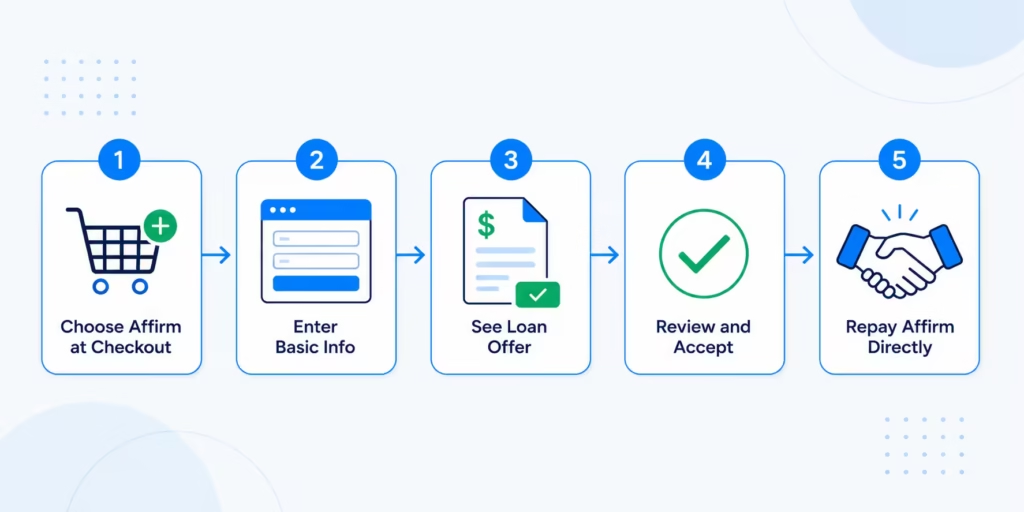
Using Affirm for the first time takes only a few minutes. Here’s what actually happens:
- Choose Affirm at checkout. Pick it the same way you’d pick a card or PayPal.
- Enter basic info. Affirm asks for your name, mobile number, date of birth, and a few other details to make a real-time decision.
- See your loan offer(s). Before you commit, Affirm shows you the exact terms: the number of payments, the amount of each payment, and the APR, if any.
- Review and accept. Nothing is final until you accept a specific plan.
- Affirm pays the merchant. The store gets paid up front, minus a fee, so your order processes like any other purchase.
- You repay Affirm directly. All future payments go to Affirm, not to the merchant.
One thing first-time users find reassuring: you see the full cost, in dollars, before you agree. There’s no fine-print surprise later, because the total you see is the total you pay.
Affirm’s Payment Options: Pay in 4 vs. Monthly Plans
Affirm’s plans fall into two categories: short-term Pay in 4 and longer monthly financing. Which one you see depends on the purchase amount and the merchant. Smaller carts usually get Pay in 4. Big-ticket items like furniture, electronics, or travel usually get monthly plan options.
Pay in 4
Pay in 4 splits your purchase into four equal payments, charged every two weeks. Per Affirm’s own terms, this option is always 0% APR. You pay no interest at all.
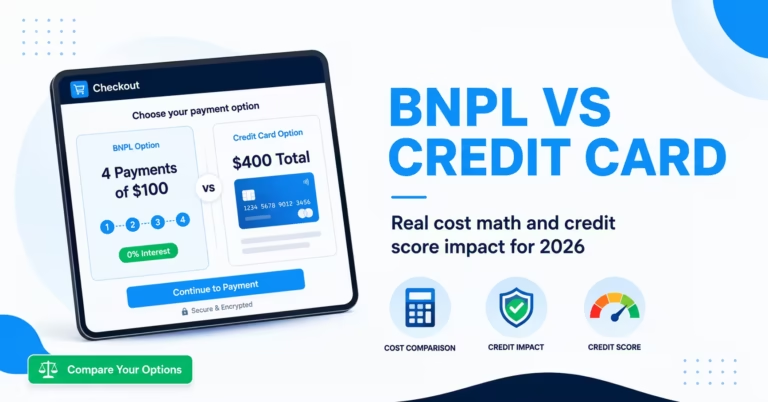
A down payment may be required, and it counts as your first payment. For example, on a $400 purchase, you might pay $100 at checkout, then $100 every two weeks until it’s done. You can make payments with a debit card, credit card, or bank account.
Monthly Payment Plans
Monthly plans run from a few months up to several years, depending on the merchant and lender. These are used for larger purchases, and they can carry interest. Rates range from 0% to 36% APR based on credit, per Affirm’s payment terms.
The upside is predictability. Your monthly payment is fixed and shown to you before you accept the loan. It never changes, and interest never compounds.
| Feature | Pay in 4 | Monthly Plans |
|---|---|---|
| Payment schedule | 4 payments, every 2 weeks | Monthly, over several months to years |
| Interest | Always 0% APR | 0% to 36% APR |
| Typical purchase size | Smaller purchases | Larger, big-ticket items |
| Down payment | Sometimes required (counts as first payment) | Sometimes required |
How Affirm Determines Your Interest Rate
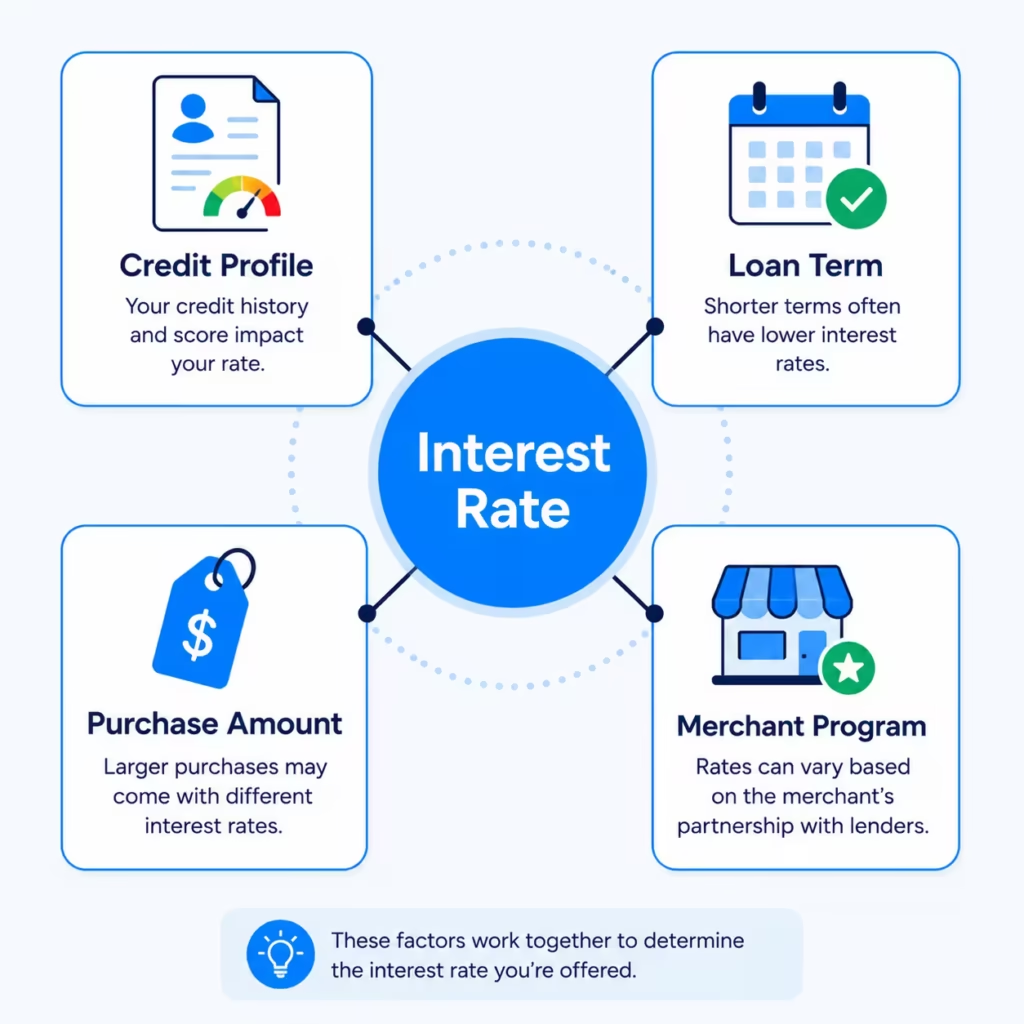
Ever wonder why a friend got 0% APR and you got 24% on a similar purchase? It’s not random. Four main factors shape your offer:
- Your credit profile. Stronger credit generally means lower rates.
- The loan term. Longer terms often come with higher rates.
- The purchase amount. Bigger loans can be priced differently than small ones.
- The merchant’s program. Many 0% APR offers are merchant-subsidized. The store pays Affirm a fee to offer you free financing because it boosts their sales. Merchants that don’t subsidize leave you with standard rates, per Affirm’s merchant documentation.
Also, don’t confuse “no fees” with “no interest.” Affirm charges no late fees, no prepayment penalties, and no hidden fees. But interest is a separate thing. A plan at 24% APR has real interest costs even though it has zero fees. Affirm uses simple interest, not compounding, so interest never snowballs on itself.
A Real Example: What a Payment Plan Actually Looks Like
Say you’re buying a $400 item. Here are two paths the same cart might offer:
| Pay in 4 | 12-Month Plan at 15% APR | |
|---|---|---|
| Payment | $100 every 2 weeks | About $36 per month |
| Total paid | $400 | About $433 |
| Interest cost | $0 | About $33 |
The monthly plan feels cheaper because each payment is small. But it costs you roughly $33 more for the same item. (These figures are an illustration using simple-interest math at 15% APR; your actual offer will vary.) The lesson: always compare the total cost, not just the payment size.
Does Affirm Affect Your Credit Score?
This is where most online content gets it wrong, and where policy has changed recently. The honest answer has three parts, because “appear on your credit report” and “change your credit score” are not the same thing. As of 2025 and 2026, Affirm’s reporting rules have expanded, so older articles saying “Affirm never reports” are out of date.
Soft Pull vs. Hard Inquiry
Checking your eligibility for Pay in 4 and most standard purchases uses a soft credit pull. A soft pull does not affect your score at all.
Some larger or longer-term financing may involve a hard inquiry, which can cause a small, temporary dip. If you apply for several Affirm loans in a short window, those effects can add up. Checking your own offers in the app first is a low-risk way to see where you stand.
Credit Bureau Reporting (2026 Update)
Affirm has expanded its credit reporting well beyond what it used to do. According to Affirm’s credit reporting policy, all payment activity on plans issued on or after April 1, 2025 is reported to Experian, including Pay in 4. Plans started on or after May 1, 2025 are also reported to TransUnion, per Affirm’s credit reporting overview. Experian confirmed the expansion in March 2025.
Two important nuances:
- Affirm does not currently report to Equifax.
- Appearing on a report is not the same as being scored. Some newly reported Pay in 4 data shows up on your file but isn’t yet factored into standard FICO or VantageScore models. Missed payments, however, are scored.
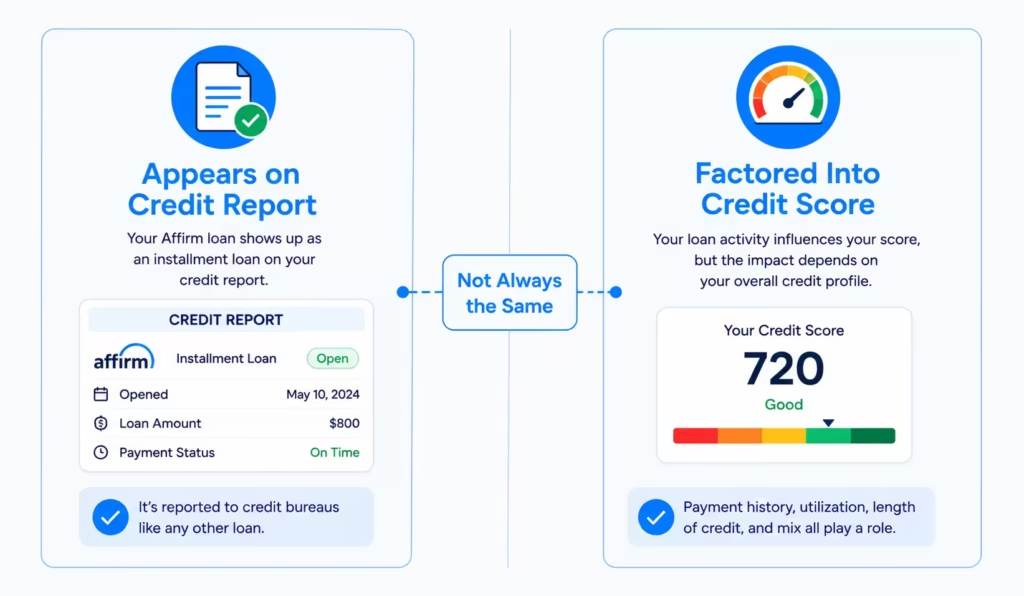
📌 Did You Know: An Affirm loan can show up on your Experian or TransUnion report without moving your FICO score at all. “Reported” and “scored” are two separate things, and most articles blur them together.
Because this policy is actively evolving, don’t assume “not reported” or “won’t affect my score.” Check the current terms before you borrow.
What Happens If You Miss a Payment
Affirm charges no late fees. But a missed payment is not consequence-free.
Payments that run 30 or more days past due can be reported to Experian and TransUnion as delinquencies. That kind of mark can meaningfully lower your score. Continued non-payment can eventually send the account to collections.
💡 Pro Tip: Turn on autopay in the Affirm app. Most missed payments happen because of an expired card or a forgotten due date, not because the borrower couldn’t pay. Autopay removes that risk.
Eligibility and How to Get Approved
To use Affirm, you generally need to:
- Be 18 or older (19 in Alabama, or if you’re a ward of the state in Nebraska)
- Have a U.S. mobile number in your own name
- Have a valid U.S. billing address
- Provide identifying information so Affirm can verify you
Approval happens in real time based on your information and a credit check. Affirm doesn’t publish a minimum credit score, and approval is never guaranteed. Also note that approval and rates can vary from purchase to purchase. Being approved once doesn’t lock in the same terms next time.
How to Apply
- Apply right at a partner merchant’s checkout, or pre-qualify in the Affirm app or at affirm.com before you shop.
- Enter your name, mobile number, date of birth, and address.
- Review the offer you’re shown, including the payment schedule and total cost.
- Accept only if the terms work for you. Pre-qualifying to check offers typically uses only a soft pull, so looking doesn’t hurt your score.
Once you complete your purchase, you will receive a confirmation email. You can then manage your account directly through the Affirm app or website. This portal allows you to view your upcoming payment schedule at any time.
You have the option to set up automatic payments to ensure you never miss a due date. If you prefer to change your payment method, you can easily update those details in your settings.
The Affirm Card
The Affirm Card is a Visa debit card, issued by Evolve Bank & Trust, that works almost anywhere Visa is accepted in the U.S. It’s not limited to Affirm’s partner stores.
Day-to-day, you can use it like a normal debit card and pay in full. Or, for eligible purchases, you can request a pay-over-time plan in the Affirm app, even up to 24 hours after you buy, per the Affirm Card help page. Affirm states the card has no card fees, no hidden fees, and no compounding interest.
Affirm Card vs. Standard Checkout Affirm
If you mostly shop at big partner retailers, standard checkout Affirm is all you need. If you want pay-over-time flexibility at any store, the Card is the better fit.
How Affirm Makes Money
If some loans charge 0% interest and there are no late fees, what’s the catch? There isn’t one, but the model is worth understanding. Affirm earns money two ways:
- Merchant fees. Retailers pay Affirm a merchant discount rate on each sale, because offering pay-over-time increases their conversion and order sizes.
- Interest. On non-0% plans, the interest you pay is revenue.
So on a 0% APR purchase, the merchant is effectively covering Affirm’s fee, not you. This also explains Affirm’s incentives: it profits when you get approved and repay on time, not when you incur penalty fees. That’s a healthier structure than products built around late fees.
Is Affirm Safe and Legitimate?
Yes, with one honest caveat. Affirm Holdings is a large, publicly traded company, and its loans are made or arranged through licensed, regulated partner lenders like Cross River Bank, per Affirm’s disclosures. It’s a regulated financial product, not a fly-by-night app.
On data security, you never hand your card number to unfamiliar sites. Affirm connects behind the scenes, and you manage everything inside your Affirm account.
The caveat: Affirm loans don’t carry all the protections of a credit card. Credit cards come with federal dispute and chargeback rights that installment loans don’t match in the same way. Affirm has its own refund and dispute process, covered next, but don’t assume it’s identical to your card’s protections.
Because these loans act as individual credit agreements, they sit outside the standard legal framework that governs credit cards. If an item arrives damaged or never shows up at all, you cannot simply instruct your bank to initiate a chargeback.
Instead, you must work directly through Affirm’s internal dispute channels to pause payments. This process can be slower and occasionally more frustrating than a traditional credit card dispute. Always check the retailer’s return policy carefully before you commit to a purchase.
Returns and Refunds on an Affirm Purchase
This trips people up, so here’s exactly how it works:
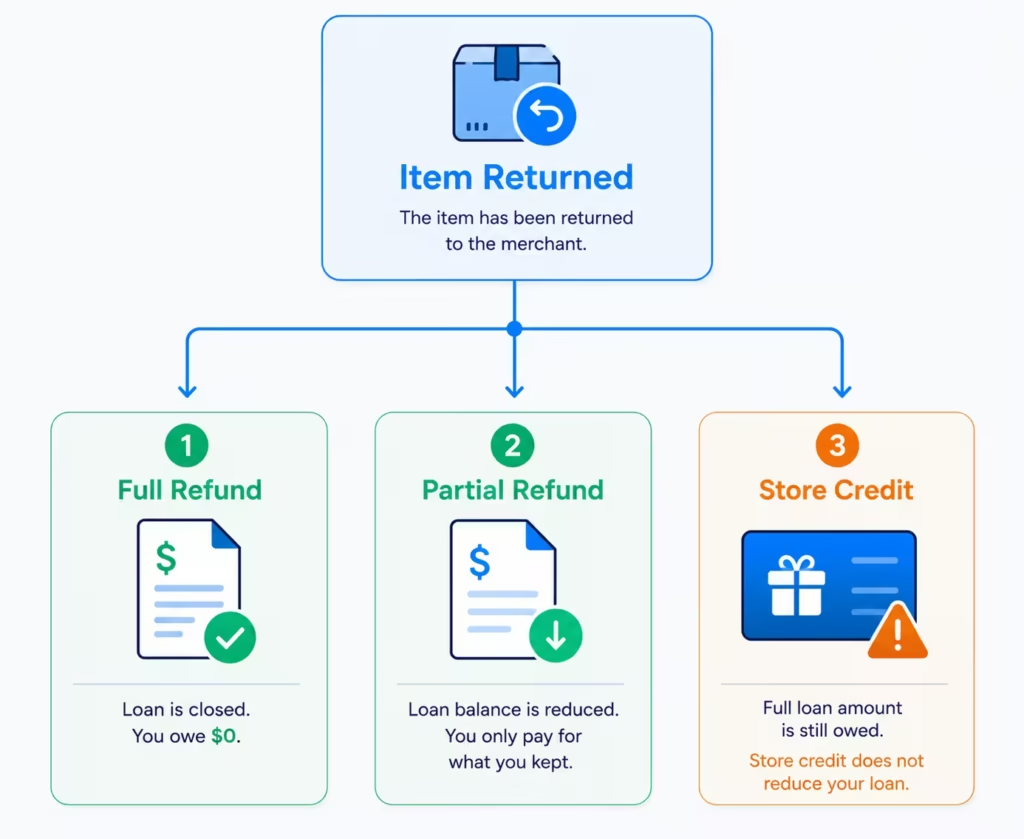
- Full refund: Contact the store first. Affirm can’t cancel a loan without the store’s confirmation. Once the store confirms, your loan balance is adjusted or the loan is closed out.
- Partial refund: Your remaining balance is reduced by the refunded amount.
- Store credit: This is the big one. If the store gives you store credit instead of a refund, you still owe the full original loan amount to Affirm, and your payment schedule doesn’t change.
- Timing: Refunds aren’t instant. Payments may still come due while a refund processes, so keep paying on schedule until your balance updates in the app.
⚠️ Mistake to Avoid: Don’t accept store credit on a financed purchase unless you’re sure you want it. You could end up paying Affirm for months while your money sits locked in a gift card balance.
Affirm vs. Paying with a Credit Card
Your most likely alternative is a credit card, so compare the two directly.
Where Affirm wins: Its simple interest never compounds, the payment schedule is fixed, and the total cost is shown up front. A genuine 0% APR offer beats almost any card, and Pay in 4 costs nothing. A card’s revolving balance, by contrast, can grow through compound interest, and minimum payments can stretch a small purchase into years of cost.
Where a credit card wins: Cards earn rewards, offer stronger purchase and fraud protections, and give you flexible payment timing. If you already have a 0% intro APR card, that may beat an interest-bearing Affirm plan.
Either way, remember that Affirm is still debt. A fixed schedule makes it predictable, not free.
Pros, Cons, and When Affirm Makes Sense
Pros:
- Transparent terms with the full cost shown before you accept
- No late fees, no prepayment penalties, no compounding interest
- Genuine 0% financing through Pay in 4 and merchant promotions
- Widely accepted at major retailers
Cons:
- Interest can reach 36% APR on some plans
- Missed payments are now reported to two bureaus and can hurt your score
- It’s easy to stack multiple loans and overextend
- Fewer protections than a credit card
A practical framework: Affirm makes sense for a large necessary purchase with a real 0% offer, or for Pay in 4 when you’ve planned the cash flow. Avoid it for impulse buys, for stacking several loans at once, or any time you’re unsure you can make every payment on schedule.
Think of Affirm as a tool, not extra spending money. You should always treat it like a serious financial commitment. Check your monthly budget before you click purchase.
If your bank account cannot easily handle the payments, skip the loan entirely. Being cautious will help you enjoy your purchase without any future stress or regret.
Frequently Asked Questions (FAQs)
Is Affirm a loan or credit?
Affirm is a loan, not a credit card. When you choose it at checkout, you take out a point-of-sale installment loan through a partner lender like Cross River Bank, then repay it in fixed payments.
Does Affirm charge a fee?
Affirm charges no late fees, prepayment penalties, or hidden fees. It can charge interest on monthly plans, up to 36% APR, but Pay in 4 is always 0% APR with no interest.
Does Affirm hurt your credit score?
It can, but only if you miss a payment. Payments 30 or more days late can be reported to Experian and TransUnion as delinquencies, which can meaningfully lower your score.
What is the downside of using Affirm?
Monthly plans can carry interest up to 36% APR, and missed payments now report to two credit bureaus. It’s also easy to stack multiple loans and overextend your budget without realizing it.
Is Affirm really worth it?
It’s worth it for a planned purchase with a genuine 0% offer or a Pay in 4 plan you’ve budgeted for. Avoid it for impulse buys or if you’re unsure you can make every payment on time.
Can I use Affirm with a 500 credit score?
Affirm doesn’t publish a minimum credit score, so approval isn’t guaranteed either way. Your credit profile is one of four factors that shape your rate, alongside loan term, purchase amount, and the merchant’s program.
Is buying with Affirm trustworthy?
Yes. Affirm Holdings is a large, publicly traded company, and its loans are made through licensed, regulated partner lenders like Cross River Bank.
Is it better to pay with a credit card or Affirm?
A genuine 0% Affirm offer or Pay in 4 usually beats a credit card since Affirm’s interest never compounds. A 0% intro APR credit card, or one with strong rewards and fraud protection, can beat an interest-bearing Affirm plan.
Who gets denied for Affirm?
Affirm can deny applicants who don’t meet basic requirements, such as being under 18, lacking a U.S. mobile number in their own name, or failing its real-time credit check. Approval and rate also vary by purchase, so being approved once doesn’t guarantee approval next time.
The Bottom Line
Affirm is a straightforward tool once you see it clearly: a fixed installment loan with no fees, shown in full before you commit. Pay in 4 is always interest-free; monthly plans range from 0% to 36% APR, and since 2025, your activity is reported to Experian and TransUnion.
Based on the factors above, a practical approach is to favor 0% offers, turn on autopay, and skip financing for anything you wouldn’t buy with cash.
Know someone hesitating at checkout right now? Share this guide with them so they can decide with the full picture.