
That “0% APR for 18 months” offer looks amazing on the front of the envelope. But what does it really mean once you sign up, and could it actually cost you more than a regular card if you handle it wrong? Many shoppers confuse promotional financing with “free money,” miss the fine print about when the clock starts, or overlook fees that can quietly eat into their savings.
The introductory APR is a limited-time promotional rate on a credit card, usually 0%, that applies to purchases, balance transfers, or both for a set number of months.
In this guide, we’ll walk you through exactly how it works, how to spot the risky offers, and how to build a payoff plan so the promo actually saves you money.
Key Takeaways
This guide explains what an introductory APR is, including how it differs from deferred interest, when the promotional clock starts, how to calculate a payoff plan, and what can end the promo early.
Core Facts:
- An introductory APR is a temporary rate, often 0% but sometimes 1.99% to 3.99%, offered on new purchases, balance transfers, or both for a limited time.
- Federal law under the Credit CARD Act requires any advertised promotional APR to last a minimum of six months, with most offers running 12 to 21 months.
- The promotional clock starts on the account opening date, not the date of first purchase, so delaying card use shortens the usable window.
- Deferred interest offers charge interest on the entire original balance retroactively if it is not paid in full by the deadline, unlike true 0% APR, which only charges interest on the remaining balance going forward.
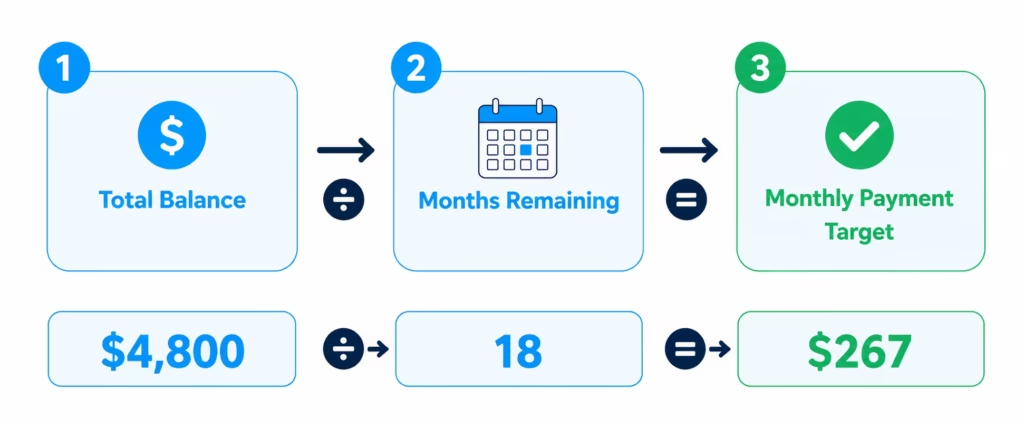
- A payoff plan can be calculated using the formula: total balance divided by months remaining equals the monthly payment target needed to clear the balance before the promo ends.
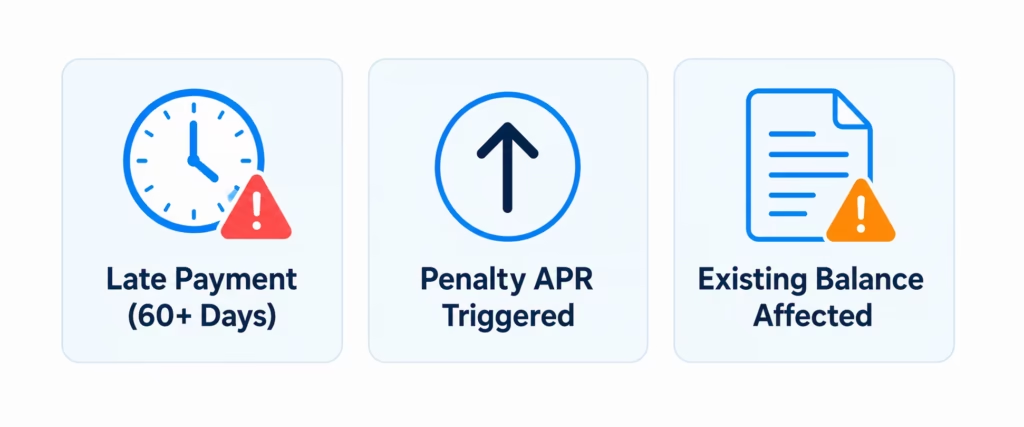
- A late payment of 60 or more days can trigger a penalty APR near 29.99% and may apply to the existing balance, not just new purchases.
Best for:
- Readers evaluating a new 0% APR credit card offer before applying.
- Cardholders currently in a promotional period who need to build a payoff plan before it ends.
- Anyone confused about the difference between a true 0% intro APR and a deferred interest offer.
What Is an Introductory APR
An introductory APR is a temporary interest rate that a credit card issuer offers for a limited time when you open a new account. It is often set at 0%, but some cards use a low rate like 1.99% or 3.99% instead. The key term is temporary. This rate is not the card’s regular price. It is a promotion designed to bring you in the door.
The offer can apply to different types of balances. Some cards give you a 0% rate on new purchases. Others offer it on balance transfers from another card. A few generous offers include both. What you do not get is a permanent free ride. Once the promotional window ends, the card switches to its standard APR, which is often much higher.
Think of it like a gym’s “first three months free” deal. The service is real, but so is the regular price that kicks in after. Knowing this upfront helps you plan around the deadline instead of being caught off guard.
How Introductory APR Works
During the promotional period, no interest is charged on the qualifying balance as long as you follow the card’s rules. That means if you carry a balance from month to month during the promo, you will not see interest charges pile up the way you would on a regular card. Only your minimum payment and any fees will apply.
A qualifying balance usually means the specific type of transaction the promo covers. If you have a 0% purchase APR, only new purchases you make on the card get the deal. If it’s a balance transfer promo, only the amount you moved over from another card qualifies. Cash advances rarely qualify, and they usually start charging interest right away at a higher rate.
When the Introductory Period Starts and Ends
The clock does not start when you make your first purchase. It starts on the date your account is opened. If your card has 15 months of 0% APR and you open it on August 9, 2026, your promo ends around November 9, 2027. This is true regardless of when you use the card. This is a detail many people miss, and it can shave weeks off your usable window if you wait to activate the card.
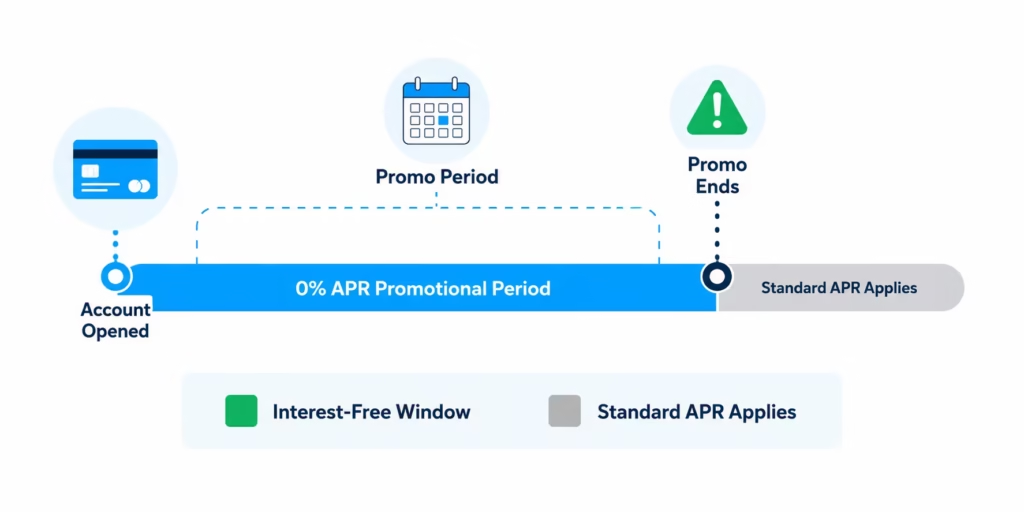
Some cards handle balance transfers a bit differently. The transfer must often be completed within a set window, usually 60 to 120 days from account opening, to qualify for the 0% rate. Miss that window, and the transfer gets charged at the standard rate instead.
How Long Intro APR Periods Typically Last
Most promotional periods run between 12 and 21 months on today’s market. Federal law sets a floor here. Under the Credit CARD Act, any advertised promotional APR must last at least six months. As Capital One notes, promotional APRs are required to last a minimum of six months by law.
Longer promos usually go to applicants with stronger credit. Shorter offers, sometimes just six to nine months, tend to show up on entry-level or store cards. Pick the length that fits your actual payoff timeline, not the flashiest headline.
Types of Introductory APR Offers
Not every 0% offer is the same product. Cards mix and match promotional structures, so read the offer details before you assume you know what you’re getting.
Purchase APR vs. Balance Transfer APR
A purchase intro APR applies only to new spending you put on the card. It’s great when you’re planning a large expense like new appliances, a medical bill, or a home repair and want time to pay it off without interest.
A balance transfer intro APR applies only to debt you move onto the card from another lender. It’s built for people trying to escape high interest on an existing card.
Here’s the catch: A single card may offer one, the other, or both. And even when a card offers both, the promotional lengths are often different. A card might give you 18 months on purchases but only 12 months on balance transfers. Check both timelines separately.
Deferred Interest Offers
Deferred interest offers look like 0% APR promos but work very differently. You’ll see them most often on store cards, medical financing, and furniture or electronics cards. The advertising will say something like “No interest if paid in full within 12 months.”
That word if is the whole game. If you pay the entire balance before the deadline, you owe no interest. If you don’t, the card charges you interest on the original full balance from day one, not just the leftover amount. This is called retroactive interest, and it can turn a small remaining balance into a costly bill.
Introductory APR vs. Deferred Interest: The Critical Difference
This is the single most important distinction in the entire topic. Confusing the two can cost hundreds of dollars.
The Consumer Financial Protection Bureau recommends a simple test called the “look for the if” rule. CFPB guidance explains that deferred interest offers use language like “No interest if paid in full within 12 months,” and that “if” means you could end up paying more than you expected.
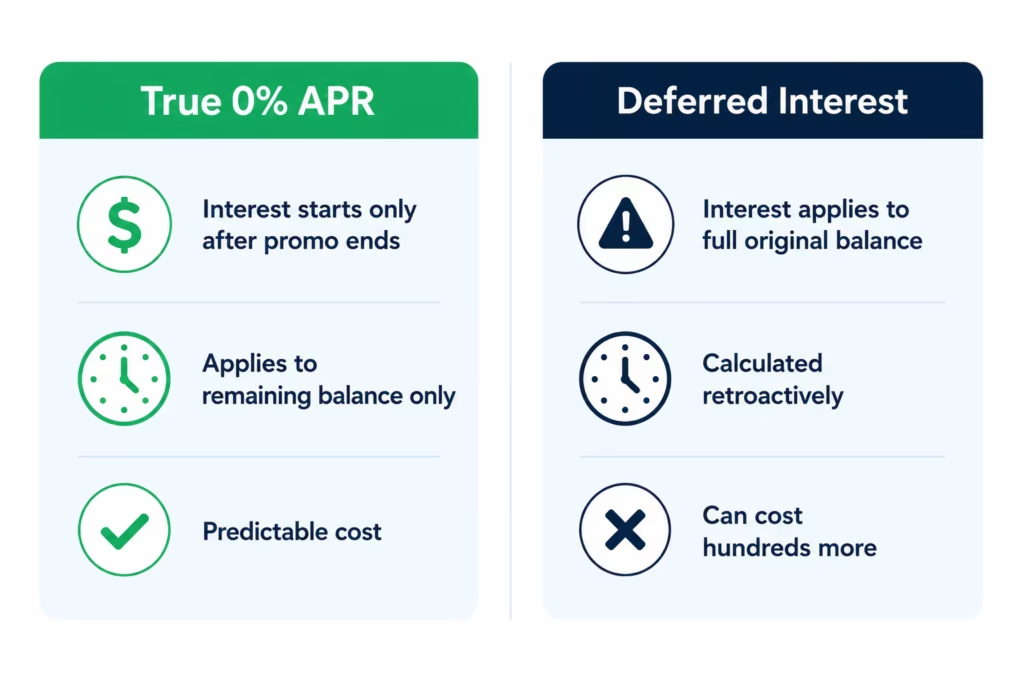
With a true 0% intro APR, interest applies only going forward after the promo ends. If you have $500 left when your promotional window closes, you start paying interest on that $500 at the standard rate. Everything you already paid stays paid.
With deferred interest, that same $500 remaining balance triggers interest on the entire original amount you charged, calculated back to the purchase date. So if you originally spent $3,000 and had a 26.99% rate lurking behind the promo, you would owe interest on the full $3,000 for the whole promotional period, not just on the $500 you have left.
⚠️ Mistake to Avoid: Assuming any “no interest” offer is a true 0% APR. If the ad says “if” or “deferred interest,” consider it a retroactive-interest offer. Make sure to pay the full balance before the deadline.
Worked Example: True 0% APR vs. Deferred Interest on the Same Balance
Let’s put a $3,000 purchase through both scenarios. Say you charge $3,000 on a card with a 12-month promo. You pay $200 a month for 12 months, so you’ve paid $2,400. That leaves $600 unpaid when the promo ends. The standard rate on the card is 24.99%.
True 0% APR scenario: The card starts charging 24.99% on the $600 leftover balance going forward. If you keep paying $200 a month, you’ll clear that $600 in about three more months and pay roughly $25 in total interest.
Deferred interest scenario: The card looks back at your original $3,000 charge and calculates 24.99% interest on the full amount for the 12 months you had it. That’s roughly $749 in retroactive interest added to your $600 balance. Suddenly your remaining bill is about $1,349, more than double what you’d owe under the true 0% offer.
| Detail | True 0% Intro APR | Deferred Interest |
|---|---|---|
| Starting balance | $3,000 | $3,000 |
| Payments made | $2,400 | $2,400 |
| Balance at promo end | $600 | $600 |
| Extra interest added | About $25 | About $749 |
| Total still owed | About $625 | About $1,349 |
Same purchase. Same payments. Very different outcomes. That is why reading the offer wording matters so much.
What Happens When the Introductory Period Ends
Once your promo ends, the card does not close, and your balance doesn’t disappear. Any unpaid amount simply starts earning interest at the card’s standard variable APR. This rate moves with the prime rate, which is tied to the Federal Reserve’s benchmark.
Standard credit card rates are steep. Bankrate reports the average credit card interest rate is around 19.57%, and cards for people with fair credit often run into the mid-to-high 20s. Your card’s specific standard APR is listed in the cardholder agreement and on your monthly statement.
New purchases you make after the promo ends also get charged at the standard rate. If you plan to keep using the card, expect regular interest charges to start showing up on your bill again. The promotional protection is gone.
How to Calculate a Payoff Plan Before Your Intro Period Ends
The safest way to use a 0% offer is to pay the balance off before the promo ends. Here’s the simple formula:
Total balance ÷ Number of months remaining = Monthly payment target
Say you transferred $4,800 to a card with an 18-month promo. Divide $4,800 by 18, and you get $267. That’s the minimum you need to pay each month to zero out the balance before interest kicks in.
Set that number as an automatic payment. Log into your card’s app or website, go to the payments section, and schedule a fixed monthly payment for that amount. Automation removes the risk of forgetting a month. It also protects you from another risk we’ll cover next, since a missed payment can end the promo early.
Build in a small buffer if you can. Paying $280 instead of $267 gives you a cushion if a month gets tight, and it clears the balance a little early. If your card has a purchase promo and a balance transfer promo at the same time, treat them as two separate payoff plans. Each plan has its own deadline.
💡 Pro Tip: Set your autopay to at least the calculated monthly target, not just the “minimum payment due.” The card’s minimum payment is almost always far too small to clear your balance before the promo ends.
The Real Cost of Balance Transfer Offers
A 0% balance transfer sounds free, but it rarely is. Almost every balance transfer offer charges an upfront fee that gets added to the transferred balance.
Balance Transfer Fees Explained
Balance transfer fees usually run between 3% and 5% of the amount you move. On a $5,000 transfer, that’s $150 at 3% or $250 at 5%. The fee is added to your new card’s balance right away, so your starting point is actually $5,150 or $5,250, not $5,000.
A promo is still worth it in most cases, but you have to do the math. Compare the fee to the interest you’d otherwise pay on your old card. If your current card charges 22% APR and you’d carry the balance for a year anyway, the interest saved will almost always beat a 3-5% one-time fee. But if you could realistically pay off the old card in two or three months at the regular rate, a transfer fee might not be worth it.
Also look for cards with a fee cap or an intro fee of 3% instead of 5%. Some cards run limited-time promos with lower transfer fees, especially for new customers. Those small differences can add up to real money on larger balances.
What Can End Your Intro APR Early
Your promotional rate isn’t guaranteed for the full period no matter what you do. There are specific actions that can cut it short.
Late Payments and Penalty APR
The biggest risk is a late payment. If you pay 60 or more days past due, the card issuer can revoke your promotional rate and switch you to what’s called a penalty APR. Penalty rates often sit at 29.99%, which is close to the legal maximum on many cards.
Once triggered, a penalty APR can apply not just to new purchases but potentially to your existing balance too. That means the debt you were paying off at 0% could suddenly start accruing interest at nearly 30%. Even a single 60-day miss can undo months of careful payoff work.
Autopay is the single best defense. Set at least the minimum payment on autopay so a busy month or a forgotten due date can’t trigger this. If you can, pay more than the minimum through a second scheduled payment.
Consumer Protections Under the CARD Act
The Credit CARD Act of 2009 built in some safeguards. Promotional APRs must last at least six months. Card issuers must give you at least 45 days’ notice before raising your APR for most reasons. If a penalty APR is added, the issuer must review your account after six months of on-time payments. They will consider restoring your original rate.
These rules won’t prevent you from losing the promo if you pay late. However, they do require card companies to be clear about the terms and offer a fair warning.
Who Typically Qualifies for Intro APR Offers
The best 0% promotional offers, especially the ones with 18 to 21 month windows, are aimed at applicants with good to excellent credit. That generally means a FICO score of 690 or higher, with the strongest offers reserved for scores above 740.
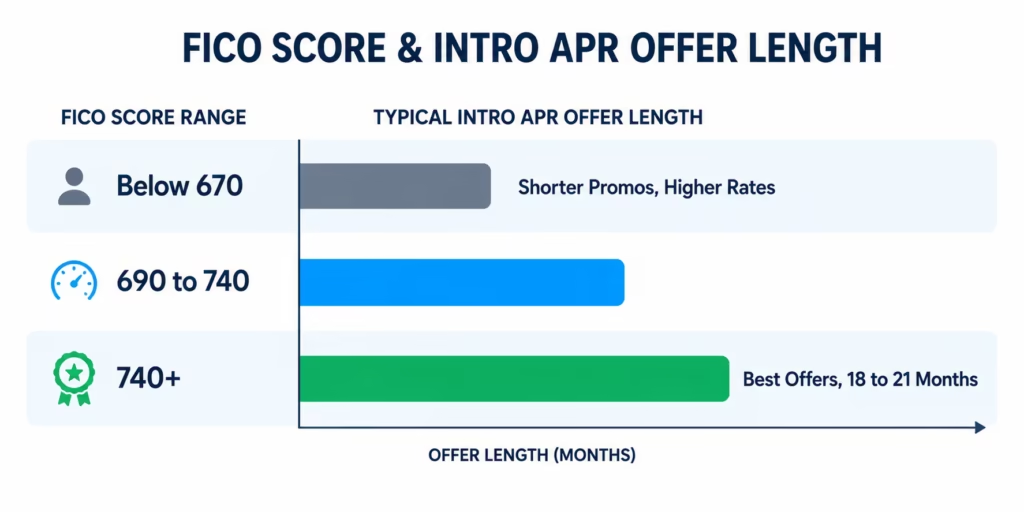
If your score is fair (below 670), you can still get promotional cards. However, they may have shorter time frames, higher standard APRs, or lower credit limits. Store cards are one exception since they often approve lower scores, but many of those are the deferred interest cards we covered earlier.
Every application also creates a hard inquiry on your credit report. A hard pull can knock a few points off your score for several months and stays on your report for two years.
Applying for several 0% cards in a short window can hurt your approval odds on later applications. Pick your target card carefully, check for pre-approval offers first when possible, and apply only when you’re ready to use the offer.
📌 Did You Know: Many issuers let you check if you pre-qualify for a card without a hard inquiry. Pre-qualification only uses a soft pull, so you can shop around and compare offers before any impact hits your credit score.
Frequently Asked Questions (FAQs)
Is 0% introductory APR good?
A 0% introductory APR is a strong deal if you pay off the balance before the promo ends. It lets you finance a purchase or transfer debt without interest for up to 21 months, but the standard APR (often near 20-25%) kicks in on any leftover balance.
Is 0% APR a trap?
It’s not a trap by itself, but deferred interest offers can feel like one. If a deal says “no interest if paid in full,” missing the deadline triggers retroactive interest on your entire original balance, not just what’s left.
How long does the introductory APR last?
Most introductory APR periods run between 12 and 21 months, depending on your credit. By law, under the Credit CARD Act, any advertised promotional APR must last at least six months.
What are the disadvantages of 0% APR cards?
The biggest downside is retroactive interest on deferred interest cards if you don’t pay in full by the deadline. Late payments can also trigger a penalty APR near 29.99%, and balance transfers usually carry a 3% to 5% upfront fee.
Is 24% APR on a credit card high?
Yes, 24% APR is on the higher end, though it’s close to average for people with fair credit. Bankrate reports the average credit card interest rate is around 19.57%, so 24% sits several points above that.
Is it better to have 0% intro APR or no annual fee?
A 0% intro APR typically saves more money if you’re carrying a balance, since avoiding 20%+ interest on hundreds or thousands of dollars outweighs a $50-$100 annual fee. A no-annual-fee card makes more sense if you plan to pay your balance in full each month anyway.
How much is 26.99 APR on $3000?
Using the article’s deferred interest example, 24.99% on a $3,000 balance held for 12 months adds up to roughly $749 in interest. At 26.99%, the amount would be slightly higher than that, since a higher rate applies to the same principal over the same period.
Does 0% APR hurt my credit score?
Opening a new 0% APR card triggers a hard inquiry, which can lower your score by a few points for several months. The account itself doesn’t hurt your score as long as you make at least the minimum payment on time.
What can end my 0% intro APR early?
Paying 60 or more days late can end your promotional rate early and trigger a penalty APR near 29.99%. This penalty rate can apply to your existing balance, not just new purchases, so a single late payment can undo months of interest-free progress.
How do balance transfer fees affect a 0% offer?
Balance transfer offers usually charge 3% to 5% of the transferred amount upfront, added directly to your new balance. On a $5,000 transfer, that’s $150 to $250 added immediately, so your real starting balance is higher than the amount you moved.
The Bottom Line
To grasp an introductory APR, focus on three key points:
- Know the promo length.
- Spot the difference between true 0% and deferred interest.
- Set a payoff plan to clear the balance before the promotion ends.
To make the most of deferred interest, divide your balance by the promo months. Set that amount for autopay. Treat the promo end date as a strict deadline. Used the right way, a promotional APR is one of the most powerful low-cost financing tools available.
If you know someone making a big purchase or dealing with high-interest debt, share this guide. It could save them hundreds in avoidable interest.