
You’ve probably seen “debt-to-income ratio” on a mortgage checklist and “credit utilization” on your credit app, and wondered if they mean the same thing. They don’t, and mixing them up can send you chasing the wrong fix before a big application. The confusion around debt-to-income ratio vs debt to credit ratio trips up a lot of people.
Here’s the short answer: your debt-to-income ratio compares your monthly debt payments to your income, while your debt-to-credit ratio (also called credit utilization) compares your card balances to your credit limits. Only the second one affects your credit score.
Below, you’ll find both formulas, step-by-step calculations, target numbers by loan type, and a clear plan for which ratio to fix first based on your goal.
At a Glance
This guide explains the difference between debt-to-income ratio and debt-to-credit ratio, including their formulas, what counts toward each, and which one to prioritize based on your goal.
Core Facts:
- Debt-to-income ratio (DTI) divides total monthly debt payments by gross monthly income and doesn’t directly affect your credit score, since income isn’t part of your credit report.
- Debt-to-credit ratio, also called credit utilization, divides total revolving balances by total revolving credit limits and factors into roughly 30% of a FICO Score and about 20% of VantageScore 4.0.
- DTI includes rent or mortgage, auto loans, student loans, minimum credit card payments, personal loans, and court-ordered payments, but excludes utilities, groceries, and subscriptions.
- Debt-to-credit ratio only includes revolving accounts like credit cards and some lines of credit, and excludes installment debt such as auto loans, student loans, and mortgages.
- Utilization can update as often as monthly because card issuers report each billing cycle, while DTI changes only when income or a debt obligation changes.
- Closing an unused credit card can spike utilization instantly by removing its credit limit, while a credit limit increase improves utilization with no effect on DTI.
Best for:
- Readers comparing debt-to-income ratio and debt-to-credit ratio before applying for a mortgage, auto loan, or other major financing.
- Anyone trying to raise a stalled credit score who needs to know which ratio to actually act on.
- People managing both a high DTI and high utilization who need a clear order of priorities to fix first.
What Is Debt-to-Income Ratio?
Your debt-to-income ratio, or DTI, shows how much of your monthly income goes toward paying debts. It’s the number lenders use to judge whether you can handle a new loan payment on top of what you already owe.
The formula is simple:
DTI = Total monthly debt payments ÷ Gross monthly income
“Gross monthly income” means your income before taxes and other deductions come out. If your pay stub shows $6,000 a month before taxes, that’s the number you use, not your take-home pay.
Monthly debt payments include things like your rent or mortgage, auto loan, student loans, minimum credit card payments, and personal loans. Everyday bills like utilities, groceries, and streaming subscriptions don’t count, because they’re not debts.
Lenders care about DTI because it answers a basic question: can this person realistically afford one more monthly payment? As the Consumer Financial Protection Bureau (CFPB) puts it, your DTI is all your monthly debt payments divided by your gross monthly income. A lower number tells a lender you have breathing room. A higher number raises the risk that a new payment could stretch you too thin.
Does Debt-to-Income Ratio Affect Your Credit Score?
No. Your DTI has zero direct effect on your credit score.
Here’s why: FICO and VantageScore build your score from your credit report, and your credit report doesn’t include your income. It shows your accounts, balances, limits, and payment history, but not what you earn. Since DTI needs your income to be calculated, scoring models can’t use it.
What DTI does affect is approval. It’s a lender’s tool, not a scoring factor. That’s why someone with a 780 credit score can still get turned down for a mortgage. Their score is fine. Their DTI told the lender the payment wouldn’t fit their budget.
The flip side is also true. A high DTI and a great credit score can absolutely exist at the same time. If you’ve been denied with a strong score, your credit report probably isn’t the problem. Your income-to-debt picture likely is.
What Is Debt-to-Credit Ratio (Credit Utilization)?
Your debt-to-credit ratio measures how much of your available revolving credit you’re using right now. You may know it by its more common name: credit utilization ratio.
The formula looks like this:
Debt-to-credit ratio = Total revolving balances ÷ Total revolving credit limits
Revolving credit means accounts you can borrow from, pay down, and borrow from again. Credit cards are the classic example. Personal lines of credit and home equity lines of credit (HELOCs) can count too, depending on how they’re reported.
Installment loans don’t belong in this calculation. Your auto loan, student loans, mortgage, and personal loans have fixed payments and a set end date. They affect your DTI, but they don’t factor into your utilization.
Does Debt-to-Credit Ratio Affect Your Credit Score?
Yes, and it carries real weight. Utilization is a core part of the “amounts owed” category in your credit score.
According to myFICO, amounts owed make up about 30% of your FICO Score, and credit utilization is one of the most important pieces of that category. VantageScore reports that credit utilization accounts for about 20% of its VantageScore 4.0 model.
Scoring models read high utilization as a warning sign. Someone using most of their available credit looks closer to overextension than someone using a small slice of it. That’s why paying down card balances is often the fastest way to move a stalled score, while paying off a car loan usually does very little for it.
Key Differences Between Debt-to-Income Ratio and Debt-to-Credit Ratio
These two ratios sound similar, but they measure completely different parts of your financial life. This comparison table shows them side by side:
| Factor | Debt-to-Income Ratio (DTI) | Debt-to-Credit Ratio (Utilization) |
|---|---|---|
| What it measures | Monthly debt payments vs. gross income | Revolving balances vs. credit limits |
| Debts included | Mortgage or rent, auto, student, personal loans, minimum card payments, child support or alimony | Revolving balances only (cards, lines of credit) |
| Debts excluded | Utilities, groceries, insurance, subscriptions | Installment loans, mortgages, auto loans |
| Affects credit score? | No | Yes (part of “amounts owed”) |
| Affects loan approval? | Yes, directly | Indirectly, through your credit score |
| Who uses it | Lenders during underwriting | FICO and VantageScore scoring models |
| How it improves | Pay off debts, lower payments, or raise income | Pay down card balances or raise credit limits |
Notice that the two ratios can move in opposite directions. You could pay off a personal loan and watch your DTI drop while your utilization doesn’t budge. You could also get a credit limit increase that improves your utilization overnight while your DTI stays exactly the same. Different levers, different results.
What Debts Count Toward Each Ratio
A lot of miscalculations happen right here. People assume every debt counts toward both ratios, and it doesn’t.
What counts toward DTI:
- Mortgage payment or rent (lenders often use your current rent or proposed housing payment)
- Auto loan payments
- Student loan payments
- Minimum credit card payments
- Personal loan payments
- Court-ordered payments like child support or alimony
What doesn’t count toward DTI:
- Utilities and phone bills
- Groceries and gas
- Insurance premiums
- Subscriptions and memberships
What counts toward debt-to-credit ratio:
- Credit card balances and their limits
- Lines of credit, including some HELOCs depending on how they’re reported
What doesn’t count toward debt-to-credit ratio:
- Auto loans
- Student loans
- Mortgages
- Personal loans
The pattern to remember: DTI counts almost every recurring debt payment you make. Utilization only cares about revolving accounts.
Common Mistakes People Make Confusing the Two Ratios
Because the names sound alike, people repeat the same handful of errors. Watch out for these:
- Paying off an installment loan to boost a credit score. Paying off your car improves your DTI, but it barely touches your utilization because auto loans aren’t revolving credit. If your score was the goal, that money would have worked harder on your card balances.
- Assuming a low DTI means a better credit score. DTI isn’t in your score at all. Someone with a 25% DTI can still have a weak score if their card utilization is high.
- Treating all debt as equal. A dollar of credit card debt and a dollar of auto loan debt behave differently in these formulas. The type of debt matters as much as the amount.
- Thinking one good ratio guarantees approval. Lenders look at your score, your DTI, your income history, and more. One strong number doesn’t cancel out a weak one elsewhere.
How to Calculate Your Debt-to-Income Ratio (Step-by-Step)
You can figure out your own DTI in a few minutes with a pen and paper.
Step 1: Add up your monthly debt payments. List your rent or mortgage, auto loan, student loans, personal loans, the minimum payment on each credit card, and any court-ordered payments. Use the required monthly payment, not the full balance.
Step 2: Find your gross monthly income. Take your annual pre-tax income and divide by 12. If you earn steady bonuses, commissions, or documented side income, lenders may count those too, as long as you can verify them.
Step 3: Divide and convert to a percentage. Divide your total monthly debts by your gross monthly income, then multiply by 100.
Example: $1,900 in monthly debts ÷ $5,500 in gross monthly income = 0.345, or a 34.5% DTI.
One more thing worth knowing: lenders sometimes split DTI into two versions. Front-end DTI looks at housing costs only. Back-end DTI includes housing plus all your other debts. When a lender quotes a single DTI number, they almost always mean the back-end figure.
Common errors to avoid:
- Don’t include groceries, utilities, or insurance.
- Don’t use take-home pay instead of gross income.
- Don’t use your full card balance when only the minimum payment counts.
How to Calculate Your Debt-to-Credit Ratio (Step-by-Step)
This one takes two quick passes: per card, then overall.
Step 1: List each card’s balance and limit. Pull your current balances and credit limits from your card apps or statements.
Step 2: Calculate each card’s utilization. Divide each balance by its limit. A card with a $1,500 balance and a $5,000 limit sits at 30%.
Step 3: Add everything up for your overall ratio. Sum all your balances, sum all your limits, then divide. Three cards with $3,300 in total balances and $11,000 in total limits give you 30% overall.
Both numbers matter. Scoring models look at your overall utilization and at individual cards. One maxed-out card can hurt even if your overall number looks fine.
Timing matters too. Card issuers usually report your balance to the credit bureaus around your statement closing date, not your payment due date. If you pay in full every month but your balance gets reported before you pay, your utilization can look higher than your actual habits suggest. Paying down balances before the statement date helps your reported number reflect your real behavior.
How Often Each Ratio Updates and When to Recheck It
The two ratios refresh on very different schedules.
Your utilization can change as often as monthly, because card issuers report new balances to the bureaus each billing cycle. Pay down a card this month, and your reported utilization can improve on the next cycle. That makes it the faster-moving of the two numbers.
Your DTI isn’t tracked or reported anywhere. It only exists when someone calculates it. It changes when your income changes or when a debt obligation starts or ends, like paying off a loan or taking on a new one.
Practical takeaway: recheck your utilization before any credit application, since it may have shifted since you last looked. Recalculate your DTI whenever your income changes or you add or remove a loan.
What’s a Good Debt-to-Income Ratio? (By Loan Type)
There’s no single magic number, because each loan program sets its own limits. Here’s how the main options stack up:
| Loan Type | Typical DTI Limit | Notes |
|---|---|---|
| General guideline | 36% or below | Widely treated as a healthy target |
| Conventional (Fannie Mae) | 36% manually underwritten; up to 45% with strong compensating factors; up to 50% through automated underwriting | Set by the Fannie Mae Selling Guide |
| FHA | 31% front-end / 43% back-end baseline; up to 50% back-end with compensating factors | Set by HUD Handbook 4000.1 |
| VA | 41% is the standard benchmark, not a hard cap | Decisions lean heavily on residual income |
The old 28/36 rule is still a useful mental shortcut: spend no more than 28% of gross income on housing and no more than 36% on total debt.
For conventional loans, the Fannie Mae Selling Guide sets a maximum of 36% for manually underwritten loans, with room to reach 45% when a borrower shows strong compensating factors like solid cash reserves or excellent credit. Loans run through Fannie Mae’s Desktop Underwriter system can go as high as 50%.
For FHA loans, HUD Handbook 4000.1 uses 31/43 as the baseline for manually underwritten loans and allows higher ratios, up to 50% on the back end, when compensating factors are present.
VA loans work differently. The VA Lender’s Handbook describes 41% as a benchmark rather than a strict cutoff. Above that level, approval leans on whether the borrower has enough residual income left over each month after debts and living costs.
One more update worth knowing: the CFPB’s General Qualified Mortgage final rule replaced the old flat 43% DTI cap for Qualified Mortgages with price-based thresholds. Lenders still check your ability to repay, so DTI absolutely still matters, but the 43% figure is no longer a universal federal ceiling. Individual loan programs and lenders set their own limits.
And a reminder: whatever your target, hitting it affects approval and terms, not your credit score.
What’s a Good Debt-to-Credit Ratio?
This ratio has simpler benchmarks, because it’s a scoring factor rather than a loan-program cutoff.
- Under 30% is the widely used ceiling. Stay below it and utilization generally isn’t dragging your score down.
- Under 10% is where people chasing top-tier scores often aim. Lower utilization tends to score better, all else equal.
- Per-card matters too. A single card at 80% can hurt even when your overall utilization is 15%. Scoring models notice concentrated balances.
- 0% isn’t the sweet spot. A small reported balance that’s paid in full each month shows active, responsible use. An all-zero report can score slightly lower than a low-but-active one.
Unlike DTI, there’s no FHA-versus-conventional split here. The same general thresholds apply to everyone, because the number feeds your credit score rather than a specific loan’s rulebook. Exact point impacts vary from person to person, so treat these as targets rather than guarantees.
Side-by-Side Example: Calculating Both Ratios for the Same Person
Seeing both numbers come from one financial picture makes the difference click. Meet Jordan, a fictional example built to show how this works.
Jordan’s finances:
- Gross monthly income: $5,500
- Rent: $1,400
- Auto loan: $350
- Student loan: $250
- Minimum credit card payments: $120 total
- Card A: $2,400 balance, $6,000 limit
- Card B: $900 balance, $3,000 limit
- Card C: $0 balance, $2,000 limit
Jordan’s DTI:
Total monthly debts: $1,400 + $350 + $250 + $120 = $2,120
$2,120 ÷ $5,500 = 0.385, so Jordan’s DTI is 38.5%
Jordan’s debt-to-credit ratio:
Per card: Card A sits at 40% ($2,400 ÷ $6,000), Card B at 30% ($900 ÷ $3,000), and Card C at 0%.
Overall: $3,300 in balances ÷ $11,000 in limits = 30%
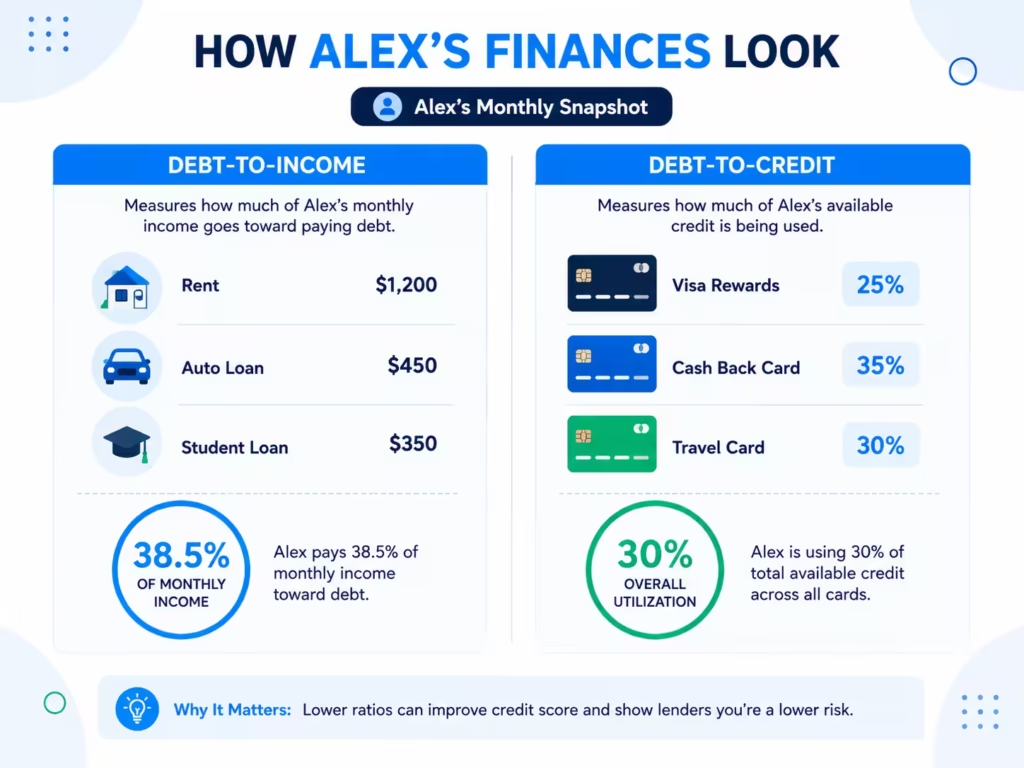
What these numbers mean: Jordan’s 38.5% DTI sits within range for many conventional and FHA loans, so approval odds on the income side look reasonable. The utilization story is weaker.
The overall 30% is right at the common ceiling, and Card A at 40% is exactly the concentrated-balance trap that scoring models notice. If Jordan put an extra $1,200 toward Card A, that card would drop to 20%, and the overall ratio would fall to about 19%, with no change to DTI at all.
Same person, same month, two very different pictures. That’s why you can’t treat these ratios as interchangeable.
Which Ratio Matters More for Your Situation
The honest answer: it depends on what you’re trying to do right now.
If you’re applying for a mortgage, auto loan, or other major financing, DTI usually matters most for approval. It’s the lender’s direct measure of whether the payment fits your income. But don’t ignore utilization, because it shapes the credit score the lender uses to set your rate and risk tier. You need both working for you.
If you’re trying to raise your credit score, debt-to-credit ratio is your lever. DTI is irrelevant to the score itself. Paying down card balances and paying attention to statement dates is where your effort belongs.
If you’re doing a general financial health check, both matter for different reasons. DTI tells you how much of your income is already spoken for. Utilization tells you how stretched your revolving credit looks to the scoring models. A healthy picture keeps both in good shape.
How Lenders Use Both Ratios Together
In real underwriting, these numbers rarely get judged alone. They answer two different questions at the same table.
Your credit score, which is partly built from your utilization, helps set your risk tier, your rate, and your terms. Your DTI, which sits outside your score entirely, tells the lender whether your income can carry the new payment and how large a loan you can qualify for.
That’s why mismatches happen. A strong score paired with a weak DTI can still end in a denial, because the payment doesn’t fit. A comfortable DTI paired with a score dragged down by maxed-out cards can mean worse rates or a smaller approval. Neither number rescues the other.
The practical move before any major application is to get both into solid territory, not just the one that’s easiest to fix.
Actions That Improve Both Ratios
Some moves pull double duty. If you want the most progress per dollar and per hour, start here.
- Pay down credit card balances. This lowers your utilization directly. It also shrinks your required minimum payments, which trims your DTI a bit at the same time.
- Increase your income. A raise, a new job, or documented side income raises the denominator of your DTI and improves the ratio without paying off a dime of debt. Lenders need proof of the income, so keep documentation.
- Pay off small debts completely. Eliminating a small loan removes an entire line from your DTI debt list. If it’s a card you pay it to zero and keep it open; you gain on both fronts.
- Avoid new debt before a big application. A new loan adds a payment to your DTI and often adds a hard inquiry to your credit report. Neither helps you in the months before a mortgage application.
Actions That Help One Ratio But Hurt the Other
Some popular moves fix one metric while quietly damaging the other. These are the traps worth knowing before you act.
Closing an old, unused credit card. This does nothing for your DTI, because there’s no payment attached to an empty card. But it removes that card’s limit from your available credit, so your utilization can spike overnight. Closing a card with a $5,000 limit while carrying $3,000 in balances across $10,000 in total limits jumps you from 30% to 60% utilization instantly.
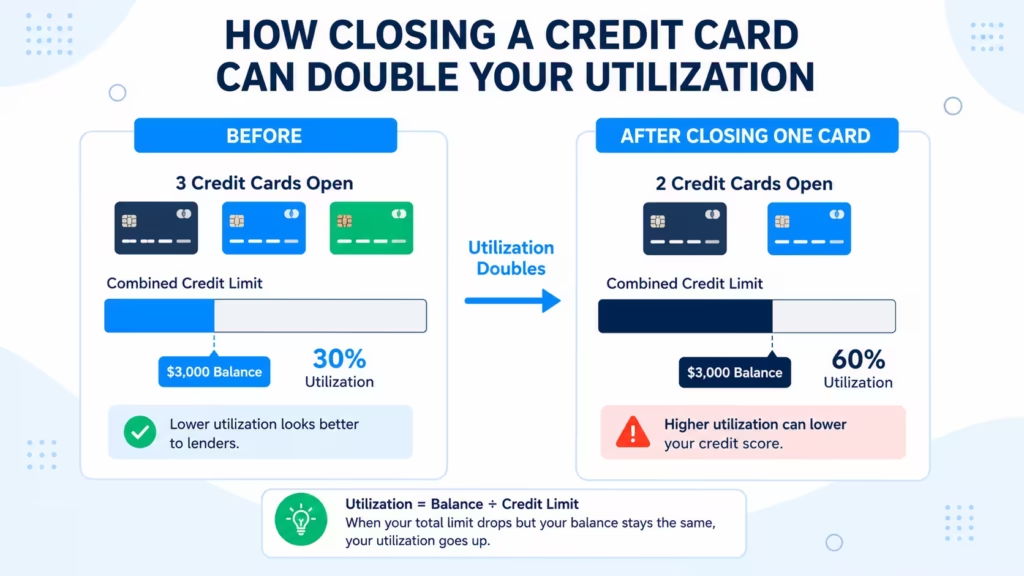
Requesting a credit limit increase. This helps utilization right away by growing your total available credit, with no effect on DTI. One caution: some issuers run a hard inquiry for the request, which can cause a small, temporary score dip. Ask whether it’s a soft or hard pull before you proceed.
Consolidating card debt into a personal loan. Moving revolving balances to an installment loan can drop your utilization toward 0%, which your score may reward. But your total monthly debt payments often stay similar, so your DTI may barely improve, and the new loan adds a hard inquiry and a new account to your report.
Opening a 0% balance transfer card. The new limit can improve your utilization math, and the promotional rate can save real interest. The trade-offs: a hard inquiry, a new account lowering your average account age, and a new minimum payment that shows up in DTI. This move works best with a firm payoff plan before the promotional rate expires.
⚠️ Mistake to Avoid: Don’t close old credit cards right before applying for a mortgage to “clean up” your finances. It can’t help your DTI, but the lost available credit can raise your utilization and lower the score your lender is about to pull.
How to Prioritize When Both Ratios Need Work
When both numbers look rough, the order you attack them matters.
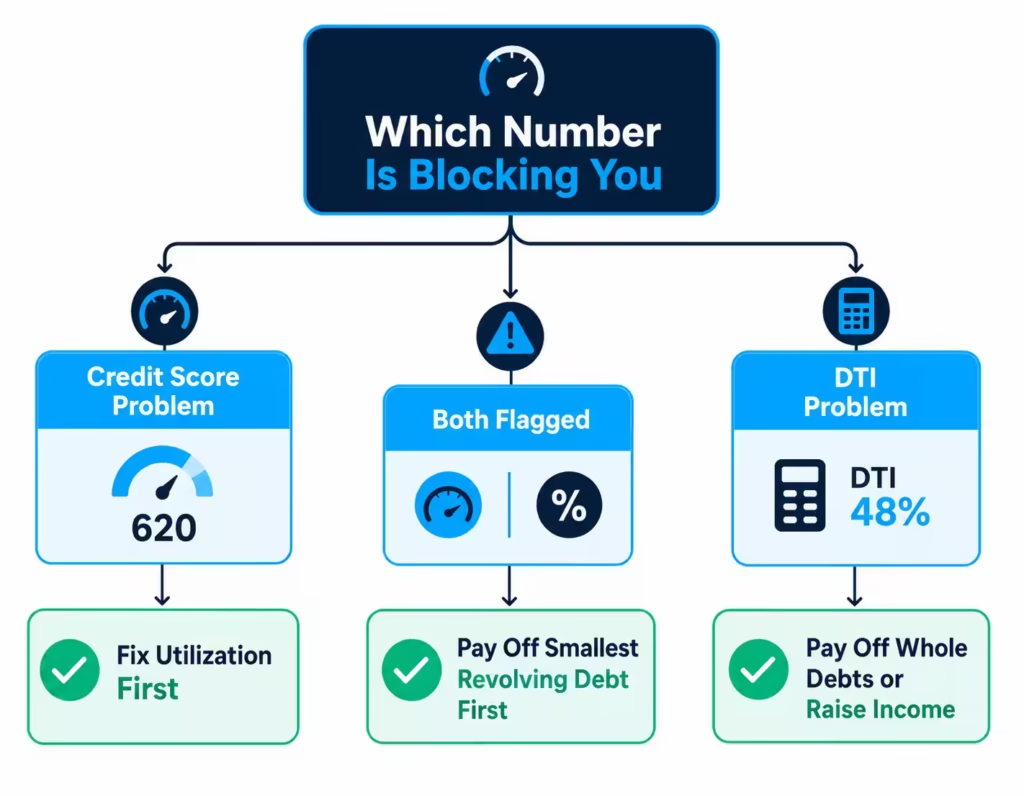
If your credit score is the thing blocking approval, start with utilization. It’s the fastest-moving metric you control. Paying down card balances can show up in your score within one or two billing cycles.
If a lender told you directly that DTI is the problem, focus on eliminating whole debts or raising documented income. Removing an entire monthly payment moves DTI far more than chipping away at balances.
If both are flagged, look for the smallest debt you can pay off entirely. If that debt happens to be a revolving account, a single payoff improves both ratios at once.
As a general rule, fix utilization first when an application is time-sensitive, because it responds the quickest. Then work on DTI, which usually takes longer because it depends on bigger structural changes like paying off a loan or earning more.
Frequently Asked Questions (FAQs)
Is debt-to-income ratio more important than credit score?
Neither ratio replaces the other. Your credit score, shaped partly by credit utilization, sets your interest rate and risk tier, while your debt-to-income ratio determines whether a lender believes you can afford the payment at all.
Is 43% DTI too high?
Not automatically. The 43% figure was once a hard cap for Qualified Mortgages, but the CFPB replaced it with price-based thresholds, and programs like FHA, VA, and conventional loans each set their own limits, some allowing 45-50% with strong compensating factors.
How can I lower my debt-to-income ratio quickly?
Pay off a small debt completely rather than chipping away at several balances, since removing an entire monthly payment cuts your DTI faster than partial payments. Increasing documented income, like a raise or side job, also lowers your ratio without touching debt.
How can I get a loan if my debt-to-income ratio is too high?
Lenders may still approve you with compensating factors like strong credit, large cash reserves, or a bigger down payment. VA loans in particular focus on residual income left over after expenses rather than a strict DTI ceiling.
How can I raise my credit score fast?
Paying down credit card balances is the quickest lever, since utilization can update within one to two billing cycles after a payment. Focus on your highest-utilization card first, since a single balance over 30% can drag your score even if your overall utilization looks fine.
What’s a good debt-to-credit ratio?
Keep your overall utilization under 30%, and aim for under 10% if you’re chasing a top-tier score. Watch individual cards too, since one card at 80% utilization can hurt your score even when your combined ratio across all cards looks healthy.
Do closing a credit card and increasing my credit limit affect DTI or utilization differently?
Closing a card removes its credit limit from your total, which can spike your utilization overnight with no effect on DTI. A credit limit increase does the opposite, improving your utilization instantly while leaving your DTI completely unchanged.
Should I pay off my car loan or credit card first to improve my credit score?
Pay down the credit card. Auto loans are installment debt and don’t factor into your utilization ratio at all, so paying one off helps your DTI but does almost nothing for your credit score.
Does checking my debt-to-income ratio or credit utilization hurt my credit score?
No. Calculating your own DTI or utilization is just math you do yourself using your existing balances, limits, and income, so it never triggers a credit inquiry or shows up on your credit report.
Wrapping Up
Debt-to-income ratio and debt-to-credit ratio measure different things: one compares your debt payments to your income for lender approval, and the other compares your card balances to your limits for your credit score. Only utilization touches your score, but both shape whether you get approved and on what terms.
A simple way to proceed is to calculate both numbers today. Then, compare them to the targets above. After that, invest your next dollar where it will best improve the ratio that matters for your goal.
If this cleared things up for you, share it with a friend who’s preparing for a loan application. It could save them from fixing the wrong number.