
You’ve been checking your credit score for months. It looks strong. Then a lender says your debt-to-income ratio is the problem, and you’re not even sure what that means or how it’s different from the score you’ve been tracking. That confusion gets expensive fast, especially when a denial or a smaller loan offer lands right before a big purchase.
The short answer: they’re two separate metrics with different inputs, and lenders weigh them differently depending on the loan type.
In this guide, I’ll walk you through how each one works, how to spot which is actually holding you back, and what to fix first.
Key Takeaways
This guide explains the difference between debt-to-income ratio and credit score, including how each is calculated, which loan types weight them differently, and how to diagnose which one is blocking your approval.
Core Facts:
- Debt-to-income ratio (DTI) compares total monthly debt payments to gross monthly income and does not factor into your credit score, since credit bureaus never receive income data.
- DTI is calculated as total monthly debt payments divided by gross monthly income, multiplied by 100; a DTI of 36% or lower is generally considered healthy.
- For mortgages, Fannie Mae’s maximum total DTI for a conventional loan is 36%, though it can go up to 45% or 50% with strong compensating factors.
- FHA loan guidelines typically use a 31% front-end and 43% back-end DTI, though compensating factors can allow it to stretch as high as 56.99%.
- Credit card issuers weight credit score heavily and rarely calculate DTI formally, while mortgage lenders rely on DTI to decide approval and use score mainly to set the rate.
- Paying off an installment loan can temporarily lower a credit score by 5 to 25 points due to reduced credit mix and shortened account history, even though it improves DTI immediately.
Best for:
- Readers preparing for a mortgage or auto loan application who want to know whether DTI or credit score is limiting their approval odds.
- People who were denied credit or offered worse rates and want to interpret the specific reason cited in their denial letter.
- Anyone with limited time before an application who needs to know which metric, DTI or credit score, to prioritize fixing first.
Core Differences Between DTI and Credit Score
DTI and credit score often get lumped together, but they measure two very different things. Mixing them up is the reason people with a 780 score still get denied, and why some people with a 620 score still get approved.
Your debt-to-income ratio is a cash-flow number. It compares your total monthly debt payments to your gross monthly income (your pay before taxes). Lenders use it to answer one question: after your current bills, can you afford one more monthly payment? DTI does not care about your history. It cares about right now.
Your credit score is a behavior number. It checks your payment history, your credit usage, how long your accounts have been open, your credit mix, and any recent inquiries. It answers a different question: based on how you’ve handled credit before, how likely are you to pay this back?
Here’s the part most people miss. Income is never part of your credit score. Not your salary, not your job title, not your bank balance. The three credit bureaus (Experian, Equifax, and TransUnion) don’t receive your paycheck data. So a six-figure earner and a minimum-wage worker with the same payment history can have the same FICO Score.
And debt itself doesn’t hit both metrics the same way. A $500 minimum credit card payment adds $500 to your DTI numerator, no matter what your balance is. But that same card affects your score through the balance-to-limit ratio, not the payment amount.
| Feature | Debt-to-Income Ratio | Credit Score |
|---|---|---|
| What it measures | Monthly debt vs. gross income | Credit behavior over time |
| Uses your income? | Yes | No |
| Changes in real time? | Yes, instantly | No, gradually |
| Shown on credit report? | No | Yes |
| Main use | Loan affordability | Loan risk |
Does DTI Affect Your Credit Score Directly?
No. Your DTI is not a credit report line item, and no scoring model (FICO or VantageScore) uses income data.
There is one indirect link, though, and it trips people up. Credit card balances feed into your credit utilization ratio, which is a major score factor. Those same balances also drive up the minimum payments used in your DTI. So a maxed-out card can hurt both numbers at once, but through completely different mechanisms.
Don’t confuse credit utilization with DTI. Utilization is balance divided by credit limit, and it lives inside the credit score. DTI is monthly payments divided by monthly income, and it lives entirely outside the score.
How to Calculate Your Own DTI
You probably know your credit score to the point. You probably have never calculated your DTI. Let’s fix that in about two minutes.
The formula is simple:
Total monthly debt payments ÷ Gross monthly income × 100 = DTI %
Gross monthly income means your income before taxes, retirement contributions, and insurance premiums come out. If you’re salaried at $84,000 a year, your gross monthly income is $7,000. If you’re paid hourly or you have variable income, lenders typically average your last two years.
Here’s a real example. Meet David, a 34-year-old operations manager at a logistics company in Ohio. His gross monthly income is $7,200. His monthly debt looks like this:
- Rent: $1,650
- Car loan payment: $410
- Student loan payment: $285
- Credit card minimum payments (two cards): $95
- Personal loan payment: $180
Total monthly debt payments: $2,620
$2,620 ÷ $7,200 = 0.363, or 36.3% DTI
That puts David right at the edge of the “comfortable” zone for most lenders. If he took on a $500 car lease tomorrow, his DTI would jump to about 43%, and his mortgage approval odds would drop with it.
Front-End vs. Back-End DTI
Lenders actually calculate two DTIs, not one. Knowing both keeps you from being blindsided at underwriting.
Front-end DTI only counts your housing costs. That’s your mortgage payment (principal, interest, taxes, and insurance) or your rent, divided by your gross monthly income. Some lenders also fold in HOA dues.
Back-end DTI counts everything. Housing plus every other required monthly debt payment, divided by your gross monthly income.
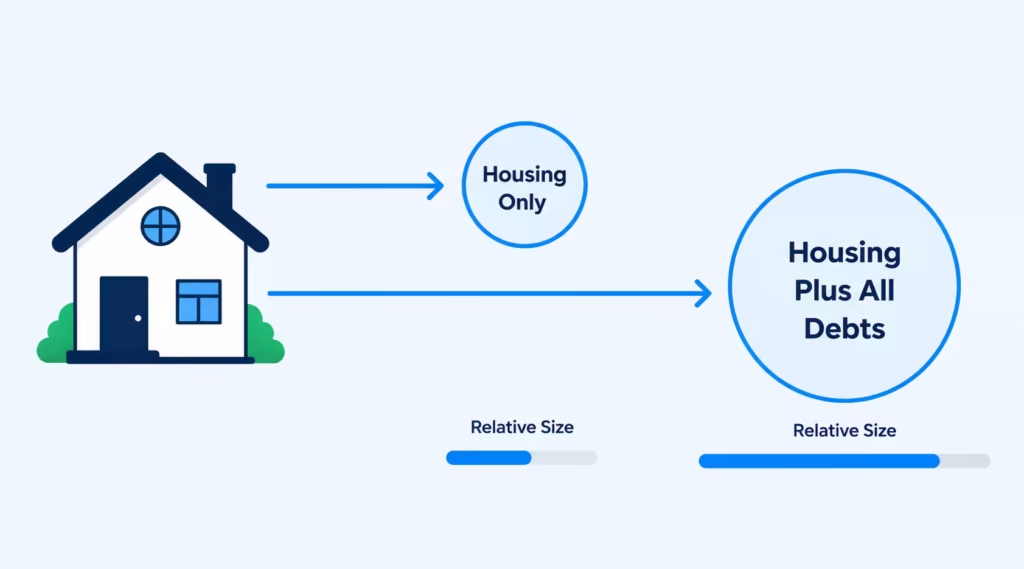
When a mortgage lender quotes “your DTI,” they almost always mean back-end DTI. That’s the number that shows up on approval decisions. Front-end is more of an internal check, especially for FHA loan files, where housing costs alone shouldn’t gobble up too much of the pie.
What Counts as Debt in the DTI Calculation
This is where first-time calculators get it wrong. DTI is not “everything I spend each month.” It’s a narrow list of required debt obligations.
Included in DTI:
- Rent or mortgage payment (including taxes, insurance, HOA)
- Auto loan or lease payments
- Student loan payments (even if in deferment, lenders often use 0.5% to 1% of the balance)
- Credit card minimum payments
- Personal loan payments
- Alimony or child support you pay
Not included in DTI:
- Utilities (electric, gas, water)
- Cell phone bills
- Groceries
- Health, auto, or renter’s insurance
- Streaming subscriptions
- Retirement contributions
- Taxes withheld from your paycheck
💡 Pro Tip: If you’re a co-signer on someone else’s loan, that monthly payment still counts against your DTI, even if the other person always pays on time. Lenders see the legal obligation, not who writes the check.
Good DTI and Credit Score Benchmarks
Now that you can calculate your DTI, you need to know what “good” looks like for both numbers.
For DTI, the benchmarks lenders lean on are:
- 36% or lower: Considered healthy. This is the traditional 36% DTI rule, tied back to older Fannie Mae guidance. You have room to add a new loan payment.
- 37% to 43%: Workable, but you’re in the “prove it” zone. Lenders will want compensating factors.
- 43%: The traditional ceiling for a Qualified Mortgage. The Consumer Financial Protection Bureau dropped the strict 43% cap from the General QM definition. Instead, it now uses a price-based test. Still, many lenders treat 43% as a soft ceiling in practice.
- 44% to 50%: Possible for conventional loans with strong credit and reserves, but the offers get tighter.
- Above 50%: High-risk. Most doors close, and the ones that stay open have steep rates.
For credit score, here are the standard FICO tiers:
- 800 and above: Exceptional
- 740 to 799: Very Good
- 670 to 739: Good
- 580 to 669: Fair
- 579 and below: Poor
For context, the average U.S. FICO Score dropped to 714 in the Spring 2026 report, a small dip from the year before. That means a score in the mid-700s already puts you above average, though “good enough” still depends on the loan type you’re chasing.
Keep in mind that “good” shifts by product. A 680 score plus a 32% DTI might sail through an auto loan and stall on a jumbo mortgage. The loan-type section further down breaks that out.
The Four DTI and Credit Score Combinations: What Each Signals to Lenders
Your DTI and score work as a pair. Any lender’s automated underwriting system reads them together, and each combination sends a different signal. Find yourself in one of these four quadrants.
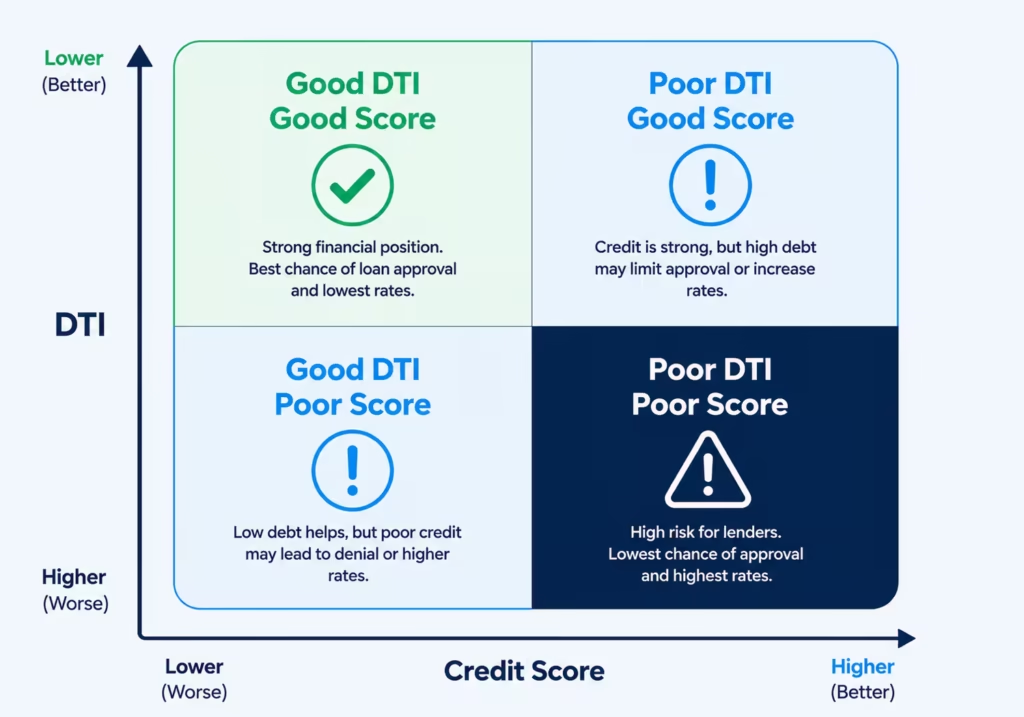
Quadrant 1: Good DTI (under 36%) + Good Score (720+)
This is the strongest position. To an underwriter, you look like a low-risk borrower with room to take on the new payment. You’ll probably qualify for the best rates. You’ll also get low down payment options on conventional products and quick approvals. Action item: shop rates aggressively. Lenders will compete for you.
Quadrant 2: Good DTI (under 36%) + Poor Score (under 670)
Your current debt load is manageable, but your history has bumps. Lenders read this as, “They can afford the payment, but have they missed one before?” You may still get approved, especially on FHA loans, but rates run higher, and you might need a larger down payment. Action item: focus your fix effort on the credit score. The affordability side is already in your favor.
Quadrant 3: Poor DTI (above 43%) + Good Score (720+)
This is the classic “high income, high debt” trap. You’ve been perfectly on time with every payment, but you’re stretched thin. Underwriters worry about capacity, not character. This shows up often with high earners carrying big student loans, a luxury car lease, and a couple of credit cards. Action item: pay down or pay off debts to lower monthly payments. Score work is not the bottleneck.
Quadrant 4: Poor DTI (above 43%) + Poor Score (under 670)
The toughest combination. Lenders see both affordability risk and repayment risk. Approvals are rare on conventional products, and when they happen, rates are steep. FHA and some credit union options may still be open, but you’ll want a real plan. Action item: work both metrics, but the DTI usually moves faster with focused payoff and can free up breathing room while credit score recovers.
Diagnosing Which Metric Is Actually Your Problem
Here’s the simplest test. Look at what happened last time you applied for credit.
If you were denied despite a strong score (above 700), the culprit is almost always DTI. A denial letter often lists reasons like “insufficient income for debt obligations” or “excessive obligations in relation to income.” Both point straight at DTI.
If you were offered worse rates or a smaller loan despite low debt, the credit score history is likely dragging you down. Codes like “delinquency history,” “recent inquiries,” or “length of credit history too short” point at the score.
If you were pre-qualified but then declined during underwriting, one of two things happened: your DTI moved after they pulled updated data, or a hard inquiry/new account tanked your score between pre-qual and application.
Read your denial letter, or ask the loan officer for the specific factors. Federal law requires lenders to tell you why. That short document is a free diagnostic tool.
How DTI vs. Credit Score Weighting Shifts by Loan Type
The mistake here is assuming both metrics matter equally for every loan. They don’t. Some lenders live and die by DTI. Others barely calculate it.
Mortgages: DTI is the star
For an FHA loan, the standard guideline is a 31% front-end DTI and 43% back-end DTI, though borrowers with compensating factors can stretch as high as 56.99%.
Fannie Mae’s maximum total DTI for a conventional loan is 36%. It can go up to 45%, or even 50% in some cases. This increase requires strong compensating factors and an approve/eligible finding from Desktop Underwriter. Credit score still sets your rate, but DTI decides whether you get through the door at all.
Auto loans: A blend, with score in the lead for rate
DTI matters for approval on larger loan amounts, but the score is the biggest lever on your interest rate. A 740 score borrower with a 41% DTI usually gets a better rate than a 640 score borrower with a 30% DTI.
Personal loans: Both matter, but score often opens the door
Online lenders like SoFi and LightStream pull both, but their marketing rates almost always require top-tier credit. DTI comes up when the loan amount is large relative to your stated income.
Credit cards: Score dominates; DTI is barely a whisper
Card issuers usually ask for stated income at application. They rarely verify it, and they don’t formally calculate DTI the way a mortgage underwriter does. This is why someone with a 780 score and a 52% DTI can still get approved for a premium travel card while getting denied for a mortgage.
⚠️ Mistake to Avoid: Don’t shop mortgage lenders using credit card approval odds as a proxy. A card issuer’s yes tells you almost nothing about how a mortgage underwriter will read your file.
Can a High Credit Score Offset a High DTI?
Sometimes, but only up to a point. Lenders call this the compensating factors framework.
If your DTI is on the high side, a score above 720 can help. Cash reserves should cover six months or more of housing payments. A low loan-to-value ratio helps, too; this means a bigger down payment. Also, stable long-term employment is key. Finally, having a history of paying similar or larger housing payments on time matters.
But there’s a ceiling. Once your DTI crosses about 50%, even a perfect credit score usually can’t save the file on a conventional loan. The math stops making sense to the automated underwriting system. FHA loans can flex further, but they’ll typically require multiple compensating factors, not just one.
Compensating factors are not a guarantee. They’re leverage in a manual underwrite. Some lenders use them aggressively; others barely at all. If your DTI is elevated, ask the loan officer directly which compensating factors their investor accepts.
Why Paying Off Debt Can Sometimes Lower Your Credit Score
This one confuses almost everyone. You do the “right thing,” pay off a loan, and your score drops by 10 to 25 points the following month. What happened?
Two mechanisms drive this.
First, credit mix. FICO likes to see both revolving accounts (credit cards) and installment accounts (car loans, personal loans, student loans, mortgages). When you pay off and close your only installment loan, your mix narrows, and the score dips slightly.
Second, credit history length. Your score partly rewards long-standing accounts. When an old installment loan closes, it stays on your report for up to 10 years, but its ongoing influence eventually fades. If it was one of your oldest accounts, closing it can shorten your average account age over time.
Here’s the practical reality. The dip is usually small, often 5 to 25 points, and it’s temporary. Meanwhile, the DTI benefit is real, immediate, and often larger in dollar terms than any rate improvement a few extra score points would earn you.
Take Jennifer, a 39-year-old marketing director. She paid off a $6,200 personal loan three months before applying for a mortgage. Her FICO dipped 14 points from 758 to 744. Both scores were in the same “very good” tier, so her mortgage rate didn’t change. But dropping that $215 monthly payment cut her back-end DTI from 44% to 41%, which is what actually got her the approval.
Hesitate if you’re 30 to 60 days from a big application. If you’re close to a scoring tier, like 738 near the 740 breakpoint, wait to pay off your debt until after closing. Otherwise, pay off the debt.
Which to Prioritize When You’re Short on Time
Time and money are limited. Here’s how to point both at the metric that will actually move your approval odds.
If your DTI is above 43%, prioritize DTI. No amount of score work will fix a DTI that’s blocking approval by itself. Focus here first.
If your DTI is comfortably below 36% but your score is under 680, prioritize the score. Affordability isn’t the issue; risk perception is.
If both are borderline, work them at the same time using payments that hit both. Paying down credit card balances lowers utilization (score) and lowers minimum payments (DTI) in one move.
How to Lower DTI Fast
The DTI formula only cares about monthly payments and gross income. That gives you three levers.
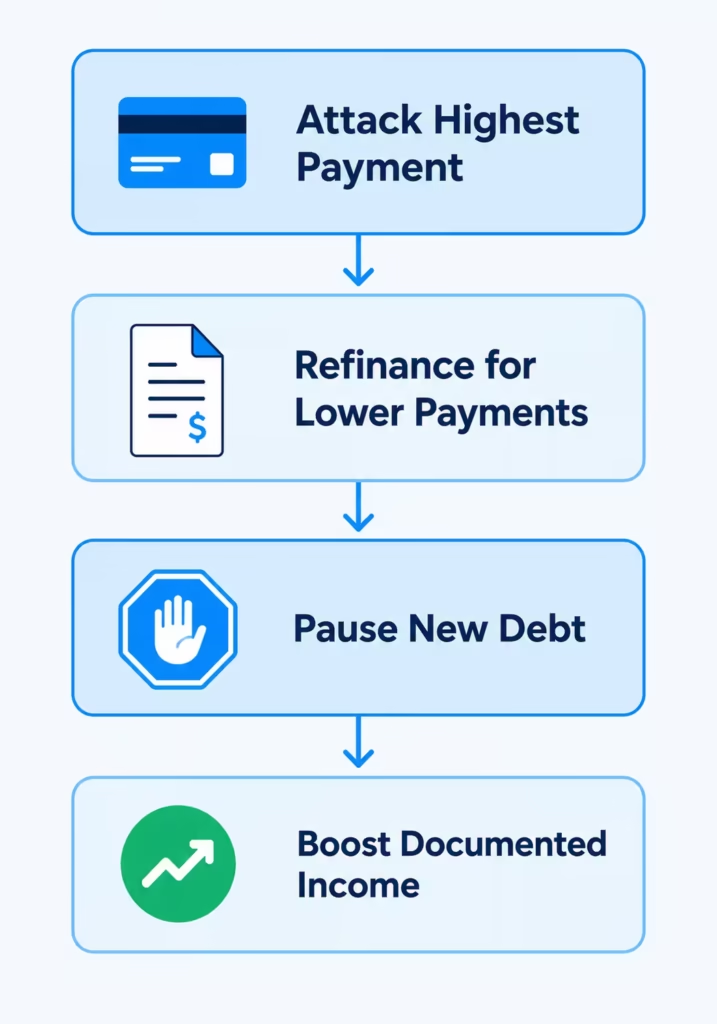
- Attack the highest monthly payment, not the highest balance. A $6,000 balance on a card with a $120 minimum payment matters less than a $4,500 car loan with a $410 payment. Pay off the car, and DTI drops immediately.
- Refinance to lower monthly payments. A student loan refinance that stretches the term can shave your monthly payment, which helps DTI even if total interest goes up.
- Pause new debt entirely. Every new hard inquiry that turns into a new account (a store card, a “buy now, pay later” plan, a car lease) adds to the DTI numerator on the spot.
- Boost documented gross income. Side income counts if it’s on your last two years of tax returns. A raise counts if it’s documented in a new offer letter or a pay stub.
How to Improve Credit Score Fast
Score moves take longer than DTI moves, but you can nudge things in 30 to 60 days with focused work.
- Pay revolving balances down before the statement date, not the due date. Card issuers report the statement balance to bureaus. Paying before that date drops the reported utilization for that month.
- Get overall utilization under 30%, and ideally under 10%. Utilization is a top-three FICO factor.
- Don’t open new accounts. Every hard inquiry can dock a few points, and new accounts shorten your average account age.
- Don’t close old cards. Closing them shrinks total available credit, which spikes utilization.
- Ask for a credit limit increase on cards you already have. More available credit at the same balance means lower utilization. Just make sure they do a soft pull, not a hard pull.
DTI Reflects Today, Credit Score Reflects Your History
One of the biggest mindset shifts in this whole topic: these two numbers live on different clocks.
Your DTI is a live snapshot. Every time you apply for a loan, the lender recalculates it using your current debts and your current income. Pay off a card today, and the DTI on your application tomorrow reflects it. Sign a new car lease today, and DTI spikes by tomorrow.
Your credit score is a trailing record. It’s built from months and years of behavior. A single on-time payment doesn’t jump it 40 points. A single missed payment doesn’t destroy it forever, but it lingers on your report for up to seven years.
Here’s what that means in practice:
If you pay off a $5,000 credit card balance in full, your DTI improves the moment that balance’s minimum payment leaves your monthly obligations. Your credit score improvement from lower utilization shows up on your next statement cycle, typically 30 to 45 days later.
Flip it the other way. If you co-sign a car loan for a family member next weekend, your DTI takes the hit the next time a lender pulls your data. That new tradeline may not fully show up in your score for a month or two, but the DTI damage is immediate.
📌 Did You Know: DTI has no memory. If you pay off a $30,000 personal loan today and take out a new $30,000 personal loan next month, your DTI is essentially back where it started. But your credit score remembers both transactions for years.
The practical takeaway: if a mortgage application is close, DTI is the metric where last-minute action pays off fastest. Score work should have started months earlier.
Common Myths About DTI and Credit Score
A few beliefs keep costing readers real money. Let’s put them down.
Myth: A high income guarantees a low DTI
Not true. DTI is a ratio, and high earners often carry the debt to match. A $250,000-a-year software director with a leased Range Rover, a private student loan payoff plan, and two mortgages can easily run a 48% DTI. Income helps only if debt payments stay proportionally lower.
Myth: Lenders only care about the credit score
Card issuers behave this way. Mortgage and large personal loan underwriters do not. For a home loan, DTI is often the more important number, and a stellar score won’t rescue a 55% DTI.
Myth: Checking your DTI or credit score yourself hurts your score
False. Calculating your own DTI has zero impact because it’s not tied to your credit file. Checking your credit score using Credit Karma, your bank app, or AnnualCreditReport.com is a soft inquiry. Soft inquiries don’t impact your score at all.
Myth: A good score means automatic approval regardless of debt load
This is the single most costly myth in this article. A 780 score with a 52% DTI will still get you a mortgage denial from most lenders. Approval is about the whole file, not one bright number.
Myth: Paying off a collection removes it from your credit report
Paying is worth doing, but the collection typically stays on your report for up to seven years from the original delinquency date. Some newer FICO models weight paid collections less harshly, but they don’t disappear on payment.
Frequently Asked Questions (FAQs)
Is 38% a good debt-to-income ratio?
A 38% DTI falls in the “workable” zone between 37% and 43%. You’re not denied outright, but lenders will want compensating factors like strong credit or cash reserves before approving.
What is considered a healthy DTI?
Most lenders consider a DTI of 36% or lower healthy. This gives you room to take on a new loan payment without straining your budget.
Can you get a mortgage with a 50% debt-to-income ratio?
It’s difficult but not impossible. Above 50% DTI, most conventional loan doors close, though FHA loans can sometimes flex higher with multiple compensating factors like strong credit and cash reserves.
How can I lower my debt-to-income ratio quickly?
Pay off the loan with the highest monthly payment, not the highest balance, since DTI only counts payments. Refinancing to stretch loan terms and pausing new debt also drop your DTI fast.
Can you have an 850 credit score with debt?
Yes. Credit scores measure payment behavior, not whether you’re debt-free, so carrying balances you pay on time doesn’t block a top score. What matters is keeping utilization low and never missing payments.
Why did I get denied for a loan despite having a good credit score?
A strong score above 700 combined with a denial usually points to your DTI, not your credit history. Denial letters often cite “excessive obligations in relation to income,” which is a DTI problem, not a score problem.
Does paying off debt hurt my credit score?
Sometimes, yes, by 5 to 25 points temporarily. Closing your only installment loan reduces your credit mix and may lower your average account age. However, the decrease is usually minor and improves over time.
How can I lower my debt-to-income ratio?
Focus on your highest monthly payment first. A $410 car payment impacts your DTI more than a larger balance with a small minimum due.
What’s the difference between front-end and back-end DTI?
Front-end DTI only counts housing costs like your mortgage or rent divided by gross income. Back-end DTI adds every other required debt payment on top and is the number mortgage lenders typically mean when they quote “your DTI.”
Wrapping Up
Debt-to-income ratio and credit score answer two different questions for a lender, and knowing which is dragging your file down is the whole game. Score reflects how you’ve handled debt. DTI reflects whether today’s income can absorb another payment.
For readers getting ready for a mortgage soon, start by calculating your DTI. Then, check your score. Focus on the number that is farthest from the target thresholds we discussed.
If you know someone applying for a mortgage or auto loan soon, share this with them. It might make the difference between getting approved or facing another hard inquiry for a rejected application.