
You saw the pink Klarna button at checkout, and now you’re pausing. What is Klarna, exactly, and how does it work once you click it? It’s smart to ask before you split a purchase into payments.
Klarna is a buy now, pay later service that pays the store for you right away, then lets you repay Klarna over time, often with no interest.
Below is how each payment plan works. You’ll see if there’s a credit check, the actual fees, what to do if you miss a payment, and how to tell if Klarna suits your budget.
At a Glance
This guide explains what Klarna is and how it works, including its Pay in 4, Pay in 30, and monthly financing plans, credit check differences, fees, and what happens if a payment is missed.
Core Facts:
- Klarna pays the store in full at checkout, and the shopper then repays Klarna on a set schedule instead of paying the retailer directly.
- Pay in 4 splits a purchase into four interest-free payments over about six weeks, with the first payment collected at shipping and the rest every two weeks.
- Pay in 30 defers the full payment for 30 days after shipping with no interest, requiring one full payment rather than installments.
- Monthly financing (Pay over time) runs from 3 to 24 months with interest rates ranging from 0.00% to 35.99% APR and involves a credit check at application.
- Pay in 4 and Pay in 30 use a soft credit check that does not affect a credit score, while Pay over time involves a fuller credit check and is reported to TransUnion and Experian.
- A missed Pay in 4 payment can trigger a late fee of up to $7, capped at 25% of the total order value, and an unpaid balance can restrict new purchases and eventually be sent to collections.
Best for:
- Shoppers making a one-off purchase they could already afford, who want to spread out payment without paying interest.
- First-time Klarna users who want to understand credit check and fee differences before checkout.
- Anyone comparing Klarna’s short-term plans against a traditional credit card before deciding which to use.
How Klarna Works at Checkout
The idea behind Klarna is simple. When you choose Klarna at checkout, Klarna pays the store the full price right away. The store ships your order as if you had paid in full. You then owe Klarna, not the store, and you repay that amount on a set schedule.
Here’s the flow, step by step:
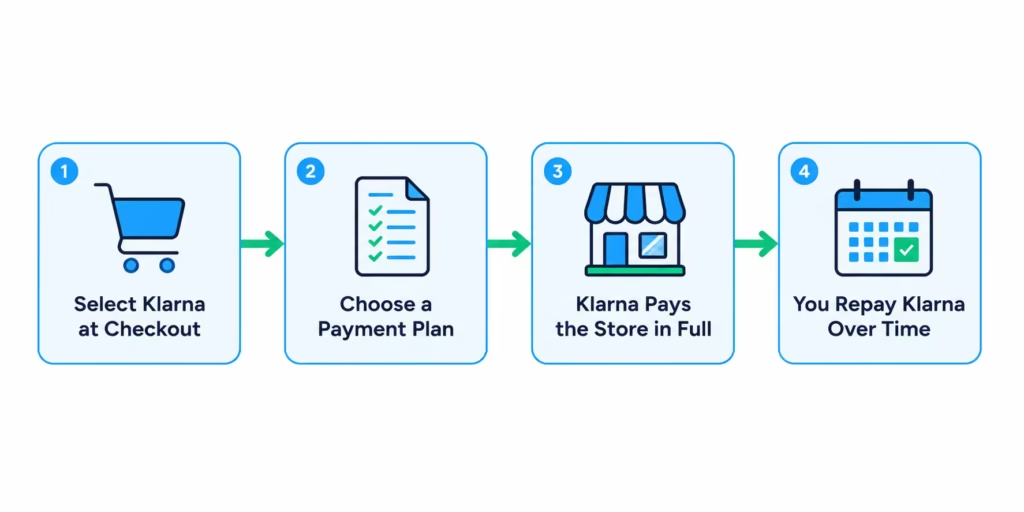
- You pick Klarna as your payment method. You’ll see it at a partner store’s checkout, in the Klarna app, or through the Klarna browser extension.
- You choose a payment plan. Depending on the store and the order size, you might see “Pay in 4,” “Pay in 30 days,” or monthly financing. The terms are shown before you confirm.
- Klarna pays the store in full. The merchant gets its money upfront and takes on no wait. Klarna takes on the credit risk instead.
- You repay Klarna. Payments are charged automatically to the card or bank account you linked, on the schedule you agreed to.
This setup is called point-of-sale financing or checkout financing. It matters because it explains who you owe. If something goes wrong with the order itself, you deal with the store. If something goes wrong with a payment, you deal with Klarna.
What Klarna Is, in Plain Terms
Klarna is a Swedish fintech company, founded in Stockholm in 2005. It has been a licensed bank in Europe since 2017. The Swedish Financial Supervisory Authority supervises it. Now, it trades on the New York Stock Exchange with the ticker KLAR.
According to Klarna’s investor relations page, it has over 119 million active users worldwide and works with more than one million retailers, including Nike, Sephora, Macy’s, and Expedia. In the US, Klarna’s credit products are offered through a partner bank, WebBank. Klarna isn’t one single product. It’s a family of payment options, and the next section breaks them down.
Klarna’s Payment Plan Options
Many shoppers assume Klarna is just “split it into 4.” That’s only one of several plans. The plan you’re offered can vary by store and by order amount, and the plans differ in timing, interest, and credit checks. Knowing which one you’re looking at is the single most important step before you click confirm.
Pay in 4
Pay in 4 is Klarna’s best-known plan. It splits your purchase into four equal, interest-free payments:
- Your first payment is collected when your order ships.
- The next three payments are charged automatically every 2 weeks.
- You pay no interest and no fees when you pay on time.
The whole plan runs about six weeks. It works well for mid-size purchases you know you can cover from your next few paychecks. One catch to note: Pay in 4 is available nationwide except in Hawaii, US territories other than Puerto Rico, and for APO/FPO/DPO addresses, per Klarna’s Pay in 4 page.
Pay in 30
Pay in 30 isn’t an installment plan at all. It’s a deferred payment. You pay nothing upfront. When the store ships your order, a 30-day window starts. You then pay the full amount in one payment any time within those 30 days. There’s no interest and no fee when you pay on time, per Klarna’s Pay in 30 page.
This plan is handy when you want to try something before your money leaves your account, like clothes you’re not sure you’ll keep. Just know the full amount comes due at once, so it’s only comfortable if you can cover the full price within the month.
Monthly Financing
Monthly financing, which Klarna calls “Pay over time,” is a different animal. It’s a real loan, and it can cost you money:
- Repayment terms run from 3 to 24 months.
- Interest rates range from 0.00% to 35.99% APR, depending on your credit and the offer.
- The loan is issued by WebBank in partnership with Klarna.
- You can pay it off early with no penalty.
These details come from Klarna’s Pay over time page, which also notes that a credit check is performed when you apply. Monthly financing is meant for larger purchases, and the rate you see can be anywhere in that wide APR range. Always read the actual rate shown at checkout, because some offers are interest-free and others are not.
⚠️ Mistake to Avoid: Don’t assume every Klarna offer at checkout is interest-free. If you see monthly payments over many months, check the APR in the plan details before you accept. The interest-free plans are Pay in 4 and Pay in 30.
Comparing the Plans at a Glance
| Pay in 4 | Pay in 30 | Pay over time | |
|---|---|---|---|
| Payment structure | 4 equal payments | 1 full payment | Monthly installments |
| Timing | First at shipping, then every 2 weeks | Within 30 days of shipping | 3–24 months |
| Interest | None | None | 0.00%–35.99% APR |
| Credit check | Soft check | Soft check may apply | Credit check performed |
| Best for | Mid-size buys you can cover in 6 weeks | Items you might return | Larger purchases |
Does Klarna Check Your Credit?
Yes, but the type of check depends on the plan, and that’s the key distinction.
For Pay in 4, Klarna performs a soft credit check. For Pay in 30, a soft check may be used to assess eligibility. Soft checks don’t affect your credit score and aren’t visible to other lenders. Klarna states this plainly on its Pay in 4 and Pay in 30 product pages.
For Pay over time, Klarna states that a credit check will be performed when you apply. The product page doesn’t call this check soft. Also, long-term financing applications usually require a more detailed credit review. If protecting your score matters to you, read the terms shown during the application before you submit it.
Two more points worth knowing. First, approval isn’t guaranteed for any plan, and the plan and amount you’re approved for can vary by purchase. Second, a soft check means trying Klarna’s short-term plans won’t leave a mark that other lenders can see. That’s a meaningful difference from applying for a new credit card.
Does Using Klarna Affect Your Credit Score?
This is a separate question from the credit check, and the answer again depends on the plan.
Klarna’s own credit reporting help page spells out what’s shared with the bureaus, TransUnion and Experian:
- Reported: Pay over time loans, including on-time payments, late payments, and defaults.
- Not reported: Pay in 4, Pay in 30, pay-in-full purchases, and Klarna Card activity.
There’s an important nuance on the reported loans. Klarna says the Pay over time data it shares currently doesn’t impact your score and is only visible to you, not to other lenders. In plain terms, your Klarna payment history is being recorded with the bureaus, but it isn’t feeding into your score yet.
That landscape is shifting. In 2025, FICO announced new scoring models, FICO Score 10 BNPL and FICO Score 10T BNPL, designed to fold buy now, pay later data into credit scores.
As lenders adopt these models, BNPL payment history may start counting for or against you. One rule is clear: if a debt stays unpaid long enough to go to collections, that account can appear on your credit report, regardless of the plan you used.
How to Sign Up and Use Klarna
There are two main ways in: directly at a store’s checkout, or through Klarna’s own app and browser extension. Either way, the basic requirements are the same. Per Klarna’s eligibility terms, you need to:
- Be at least 18 years old (or the legal age in your state)
- Be a US resident
- Have a valid card or bank account
- Be able to receive verification codes by text
- Provide accurate personal details; a Social Security number may be required for credit-based products
Using Klarna at Online Checkout
This is the most common path, and it takes about a minute:
- Shop at a partner store and head to checkout.
- Select Klarna as your payment method.
- Enter your basic details and link a debit card, credit card, or bank account.
- Pick the plan offered, review the schedule and any APR, and confirm.
Payments then run on autopay, so you don’t have to remember due dates. You can track everything in the Klarna app.
Using Klarna In Person or Anywhere Else
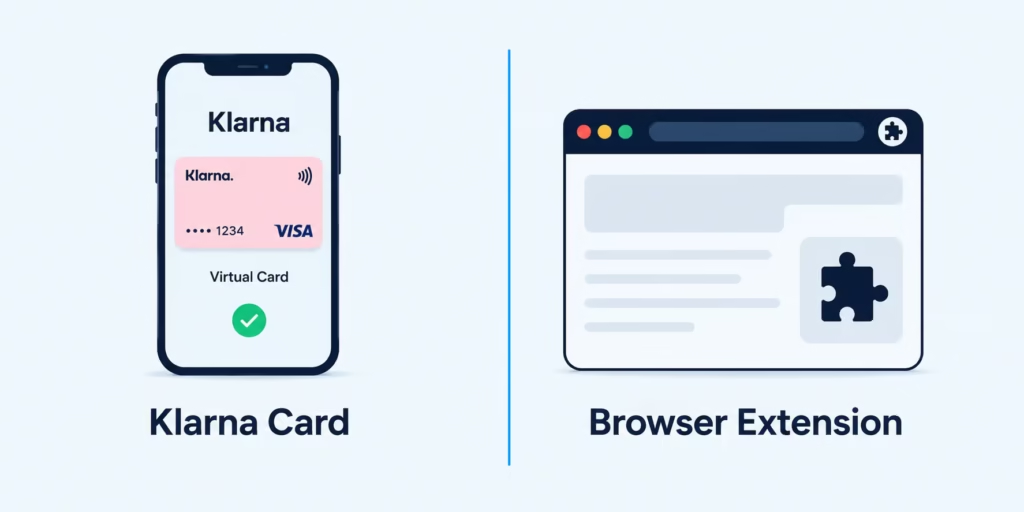
What if a store doesn’t offer Klarna at checkout? You still have options:
- The Klarna Card. This is a Visa card issued by WebBank that lets you pay over time in four interest-free payments anywhere Visa is accepted, online or in-store, as described by WebBank’s announcement.
- The Klarna app. The app lets you shop and pay flexibly at stores beyond Klarna’s partner list.
- The browser extension. It surfaces Klarna payment options when you shop online at stores that don’t natively offer it.
- Apple Pay and Google Pay. Klarna can be used as a pay-over-time option within these wallets at supported checkouts.
💡 Pro Tip: If you’re eyeing a specific store, search for it in the Klarna app first. The app shows which payment options are available there before you fill your cart.
Klarna’s Fees Explained
“Interest-free” is real, but it’s not the whole story. Here’s what can cost you money:
- On-time payments: Pay in 4 and Pay in 30 cost nothing extra when you pay as scheduled. No interest, no fees.
- Late fees on Pay in 4: If a payment fails and the retry also fails, a late fee of up to $7.00 is added to your next payment. Total late fees can never exceed 25% of your order value, per Klarna’s Pay in 4 terms.
- Late fees on Pay in 30: Fees can apply here too, so pay within the 30-day window.
- Interest on Pay over time: Anywhere from 0.00% to 35.99% APR, depending on the offer, plus possible late fees as laid out in your credit agreement.
- Account restrictions: An unpaid balance can freeze your ability to make new Klarna purchases until it’s resolved.
The pattern is simple: the short plans only cost you money if you pay late, while monthly financing can cost you money even if you pay perfectly on time. That’s why the APR line in a financing offer deserves a hard look.
What Happens If You Miss a Payment
Missing a payment isn’t the end of the world, but there is a real escalation path. Knowing it upfront takes the panic out of the “what if.”
The Immediate Consequences
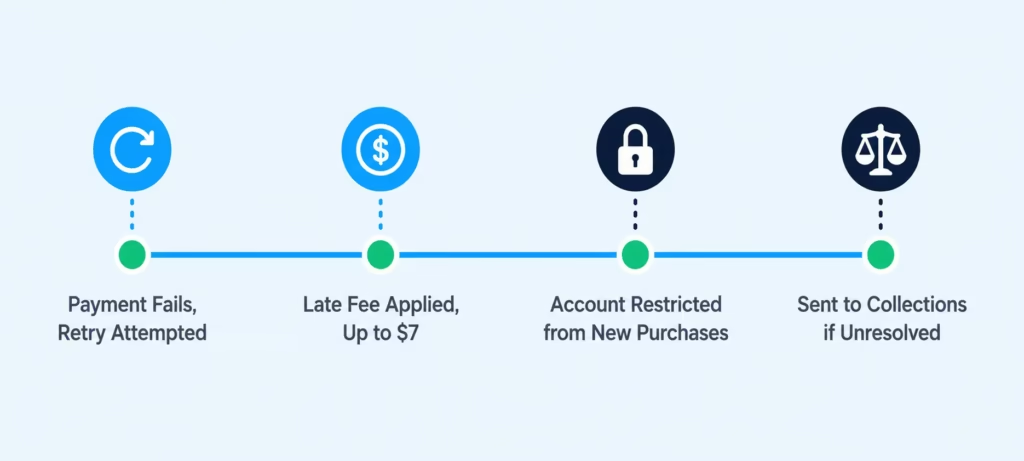
When a scheduled payment fails, Klarna emails you and tries to collect the payment one more time, according to Klarna’s missed-payment help page. If the second attempt fails, the missed amount will be added to your next payment. A late fee may apply, up to $7 for Pay in 4, or capped at 25% of the total order value.
While a balance sits unpaid, Klarna can restrict you from making new purchases. One genuinely useful feature: you can extend a payment’s due date once per order from the app. Select the order, tap “Manage payments,” then “Extend due date.” Note that this option isn’t available on Pay over time loans.
Escalation to Collections
If a balance stays unpaid, it can be sent to a collections agency, and Klarna says this can restrict your future use of the service. This is the stage where the consequences get heavier.
A collection account can appear on your credit report and hurt your score, and unpaid debts that drag on can eventually lead to legal action. Klarna doesn’t specify how many days before a balance goes to collections. So, treat any missed payment as urgent. Don’t assume you have a set grace period.
If You Can’t Pay: Klarna’s Customer Recovery Programme
If you’re struggling, act early. Klarna’s financial hardship support page walks you through it: log in to the app, select the unpaid purchase, choose “Report a problem,” and describe your situation in the Financial support section.
Klarna has introduced a Customer Recovery Programme, as stated in a press release. This programme reaches out to customers with overdue payments. If a customer pays half of their balance, Klarna will waive the other half, helping to avoid collections.
That program was announced with specific terms for the UK market, so the exact offer available to US customers can differ. The practical point stands everywhere: contact Klarna before the debt escalates, because the options are better early than late.
Returns and Refunds with Klarna
Returns trip people up because two companies are involved. The rule of thumb: the store handles the return, Klarna handles the money.
- Start the return with the store, following its normal return policy. Don’t just stop paying.
- Report the return in the Klarna app. Go to the Payments tab, select the order, and enter your tracking details and the return date. The moment you report it, your payments are paused, per Klarna’s return help page.
- The store registers the return and updates your balance. Klarna then adjusts or cancels your remaining payment schedule. If you already paid more than you owe, Klarna refunds the overpayment.
Keep your proof of return and any emails with the store. If the store hasn’t registered your return after 21 days, Klarna can support you better if you’ve submitted those tracking details. And if a payment gets charged while all this is in motion, don’t panic. Report your return in the app with your evidence. Klarna will then investigate to decide if the plan changes or if the original schedule stays.
⚠️ Mistake to Avoid: Never skip a scheduled payment just because you’ve shipped a return back. Until the store registers the return and Klarna updates the plan, missed payments can still trigger late fees. Pause the plan through the app instead.
Is Klarna Safe and Legitimate?
Klarna is a legitimate, established financial company, not a fly-by-night app. It’s a licensed bank in Europe under the supervision of the Swedish Financial Supervisory Authority; it’s publicly traded on the New York Stock Exchange, and it reports serving 30 million customers a year in the US alone, according to its company information. In the US, its credit products run through WebBank, an FDIC-regulated bank.
On data security, Klarna says it uses encryption and around-the-clock fraud monitoring, per its about page. Linking a card to Klarna carries roughly the same risk profile as linking one to any major payment service.
The bigger real-world risk is imitation. Scam sites and phishing messages sometimes dress up as Klarna. Protect yourself with a few habits:
- Only enter payment details through the official app, klarna.com, or a real retailer’s checkout.
- Be skeptical of texts or emails demanding urgent payment through a link. Open the app directly instead.
- Real Klarna reminders point you to your account; they don’t ask for passwords or full card numbers by message.
Current Regulatory Oversight of Klarna and BNPL
If you’ve noticed that answers about BNPL protections seem inconsistent, you’re not imagining it. The rules are still being written, and they vary by country.
In the US, the Consumer Financial Protection Bureau issued an interpretive rule in 2024 that would have treated BNPL lenders more like credit card issuers, with stronger dispute and refund rights.
In May 2025, the CFPB withdrew that rule and said it would not reissue it or prioritize enforcement based on it. Today, BNPL plans lack the same federal protections as credit cards. This makes the return and dispute habits from earlier even more important.
Meanwhile, Klarna is moving toward becoming a US bank itself. In July 2026, Klarna applied to Utah regulators and the FDIC to charter Klarna Bank USA, an FDIC-insured industrial bank
If approved, that would bring its US operations under direct US banking supervision. Add in FICO’s new BNPL-aware scoring models, and the direction is clear: this industry is being pulled toward credit-card-style treatment. For you today, the takeaway is to read the current terms for each purchase, because the rules of the game are actively evolving.
📌 Did You Know: Klarna shares your Pay over Time payment history with TransUnion and Experian. Right now, only you can see that data, and it doesn’t affect your score. As new FICO models roll out, that could change.
Klarna vs. a Credit Card: Key Differences
If you already have a credit card, you might wonder why you’d bother with Klarna. They’re built for different jobs.
| Klarna (Pay in 4 / Pay in 30) | Credit card | |
|---|---|---|
| Approval | Soft check, instant decision at checkout | Hard inquiry, fuller application |
| Interest | None when paid on time | Interest on any carried balance |
| Credit building | Short plans aren’t reported, so no boost | On-time payments build your history |
| Payment structure | Fixed schedule, no revolving debt | Revolving line with minimum payments |
| Where you can use it | Partner stores, or anywhere via app/card | Nearly everywhere |
| Fees | Late fees up to $7 per missed payment (Pay in 4) | Late fees plus interest that compounds |
The clearest difference is debt shape. A credit card lets a balance linger and grow. Pay in 4 has an end date six weeks out, which makes overspending harder to hide from yourself. The trade-off is that Klarna’s short plans do nothing to build your credit history, while a card paid on time does.
Is Klarna a Responsible Choice for You?
Klarna is a tool, and like most tools, it fits some hands better than others.
It tends to fit well when:
- You’re making a one-off purchase you could pay for today, and you just want smoother cash flow.
- You’re confident you can cover each payment from income you already expect.
- You want to avoid credit card interest on a specific buy.
- You’re considering Pay in 30 to try items before your money leaves your account.
It may be a poor fit when:
- You’re already juggling several BNPL plans across different apps. These services don’t talk to each other, and it’s easy to lose track of the total.
- Your budget is tight enough that a failed autopay is a real possibility.
- You tend to lose track of due dates, even with autopay and reminders.
One habit matters more than any other: keep a single list of every active payment plan you have, across every provider, with amounts and dates. Klarna shows you your Klarna obligations. Nobody shows you the combined picture except you. If the combined total would strain your next few paychecks, that’s your signal to hold off.
Frequently Asked Questions (FAQs)
Is it a good idea to use Klarna?
It’s a good fit for a one-off purchase you could already afford today and just want to spread out. It’s a poor fit if you’re already juggling other buy now, pay later plans, since missed payments can trigger late fees and account restrictions.
Is it safe to link my bank account or debit card to Klarna?
Yes, Klarna is a licensed bank in Europe supervised by the Swedish Financial Supervisory Authority and uses encryption plus fraud monitoring. The bigger risk is scam texts or emails impersonating Klarna, so only enter payment details through the official app or website.
Is it hard to get approved for Klarna?
Approval isn’t guaranteed for any plan, and the amount you’re approved for can vary by purchase. Pay in 4 and Pay in 30 use a quick soft credit check, while Pay over time involves a fuller credit review.
How badly does Klarna affect your credit score?
Pay in 4 and Pay in 30 aren’t reported to credit bureaus, so on-time payments don’t affect your score. Pay over time loans are reported to TransUnion and Experian, but Klarna says this data currently doesn’t impact your score yet.
Is it safe to give Klarna your Social Security number?
Klarna may ask for your Social Security number specifically for credit-based products like Pay over time, not for the short-term interest-free plans. This is standard practice for lenders running a credit check, similar to applying for any financing.
What are the disadvantages of Klarna?
Pay over time can carry interest up to 35.99% APR, and Pay in 4 and Pay in 30 don’t build your credit history since they aren’t reported to bureaus. Missed payments can also add late fees up to $7 and freeze your account from new purchases.
Is Klarna better than a credit card?
Klarna’s short-term plans have a fixed end date around six weeks out and charge no interest when paid on time, making overspending harder to hide. Credit cards let a balance revolve longer and build your credit history, which Klarna’s short plans don’t do.
Is it good to pay off your Klarna early?
Yes, Klarna allows early payoff on Pay over time loans with no prepayment penalty. Paying early can reduce the total interest owed since APRs range from 0.00% to 35.99% depending on your offer.
How many months does Klarna give you to pay?
It depends on the plan you choose. Pay in 4 spans about six weeks; Pay in 30 gives you a single 30-day window, and monthly financing (Pay over time) stretches from 3 to 24 months.
The Bottom Line
Klarna pays the store upfront, then collects from you on a fixed schedule. Pay in 4 and Pay in 30 are interest-free with soft credit checks, while monthly financing is a real loan with an APR that can reach 35.99%. On-time short-term payments won’t show on your credit report. But missed payments can lead to late fees, account restrictions, and even collections.
A practical approach: pick the interest-free plans, turn on every reminder, and track all your BNPL plans in one place before adding another.
If this guide cleared things up for you, share it with a friend who’s hovering over that pink button for the first time.