
You found out your credit score is holding you back. Maybe a lender turned you down, a landlord asked for a bigger deposit, or a car dealer quoted you a painful interest rate. Now you’re seeing ads for credit repair services and wondering what they actually do, whether they’re legit, and whether you should pay for one.
Credit repair is the process of finding and correcting inaccurate, incomplete, or unverifiable negative information on your credit reports, usually by filing disputes with the credit bureaus. It can be done for free on your own or through a paid company.
This guide walks you through the process step by step. It covers costs, timelines, scam awareness, and whether hiring help is right for you.
At a Glance
This guide explains what credit repair services do, including the dispute process, typical costs, legal protections under CROA, and how to tell a legitimate company from a scam.
Core Facts:
- Credit repair is the process of disputing inaccurate, incomplete, outdated, or unverifiable negative items on credit reports, usually filed with the credit bureaus.
- It cannot remove accurate negative information such as real late payments, legitimate collections, or actual charge-offs, regardless of what a company claims.
- Credit bureaus generally must investigate a dispute within 30 days under the Fair Credit Reporting Act, and unverified items must be deleted.
- Typical pricing includes a setup fee of $70 to $200 plus a monthly fee of $50 to $100, with a five-month engagement totaling around $544.
- The Credit Repair Organizations Act bans advance fees, requires a written contract, and gives consumers a three-business-day right to cancel.
- In 2023, the CFPB imposed a $2.7 billion judgment against Lexington Law and CreditRepair.com over illegal advance fees and deceptive marketing.
Best for:
- People whose credit reports contain errors spread across multiple bureaus or accounts.
- Individuals cleaning up identity theft who need extra paperwork and follow-up support.
- Anyone deciding between paying for credit repair and disputing errors themselves for free.
What Is Credit Repair?
Credit repair is the process of reviewing your credit reports and challenging negative items that are wrong, incomplete, outdated, or can’t be verified. The goal is simple: your credit report should only contain information that’s accurate.
It’s just as important to know what credit repair is not. It is not a way to erase accurate debt. It is not a service that directly raises your credit score. And no company can legally remove a legitimate late payment or a real collection account just because you paid them a fee. When inaccurate items get removed, it usually happens because the creditor failed to verify them during a dispute, not because anyone has special power over the bureaus.
A few different types of providers work in this space. For-profit credit repair organizations sell dispute services, usually for a monthly fee. Nonprofit credit counselors can help you review your reports as part of broader financial guidance. And you always have the option to do the same work yourself at no cost, since the right to dispute errors belongs to you under federal law.
Credit repair is legal, but it’s regulated. The industry follows a federal law known as the Credit Repair Organizations Act. We’ll discuss it in detail later in this article.
What Services Credit Repair Companies Typically Offer
When you pay a credit repair company, you’re paying for a bundle of fairly mechanical tasks:
- A review of your credit reports from all three bureaus: Equifax, Experian, and TransUnion
- Identification of items that look inaccurate, duplicated, outdated, or unverifiable
- Preparation and filing of dispute letters with the bureaus and, in some cases, directly with creditors or collectors
- Goodwill letters asking a creditor to remove a reported late payment as a courtesy
- Debt validation requests, which ask a collector to prove a debt is actually yours
- Follow-up on disputes that were denied or ignored
- Ongoing credit monitoring while your account is active
Notice what’s missing from that list: nothing on it requires special access or legal authority that you don’t already have. That’s a key point that comes up again in the DIY section.
How the Credit Repair Process Works
Whether you hire a company or do it yourself, the underlying process is the same. Here’s what happens after you sign up with a provider.
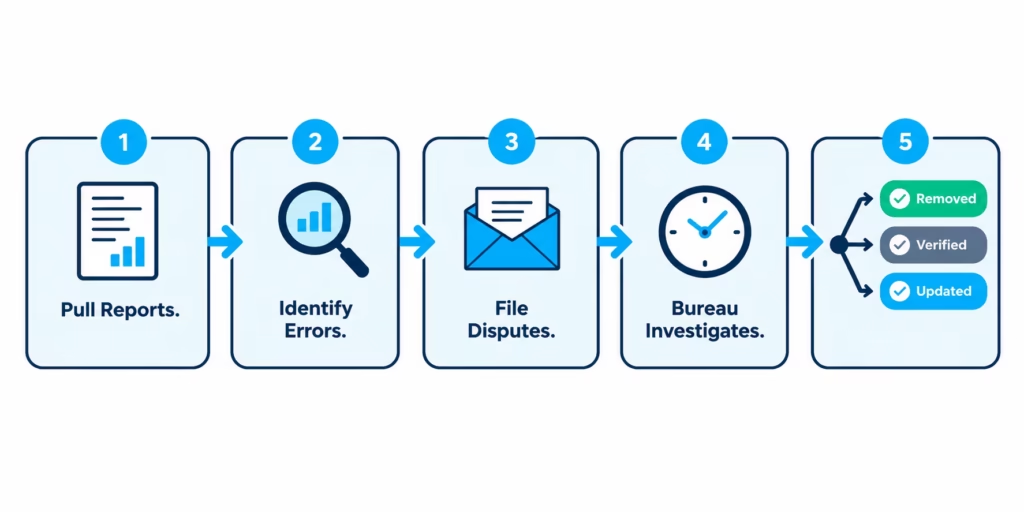
Step 1: Pull your reports. The company collects your credit reports from Equifax, Experian, and TransUnion. The three reports often contain different information, so reviewing only one can miss errors.
Step 2: Identify disputable items. The company flags accounts or entries that look inaccurate, incomplete, duplicated, or too old to stay on the report.
Step 3: File disputes. Dispute letters go out to the bureaus reporting the item, and sometimes to the creditor or collector that furnished it. Each letter identifies the item and explains why it’s being challenged.
Step 4: The bureaus investigate. Under the Fair Credit Reporting Act (FCRA), the bureaus generally must investigate a dispute within 30 days. They contact the company that reported the information and ask it to verify the item. You can read the full text of these requirements in the Fair Credit Reporting Act.
Step 5: Get an outcome. One of three things happens. The item gets corrected or removed because it couldn’t be verified. The furnisher verifies it as accurate, and it stays. Or the item gets updated but not deleted, for example, when a balance is corrected but the account remains.
If the first dispute fails, that’s not necessarily the end. A company can choose to re-dispute with new documents. It might also escalate the issue to the furnisher directly or send a goodwill letter for items that are correct but outdated. Bureaus can refuse to investigate disputes they see as frivolous. So, repeating the same dispute without new information has its limits.
How Credit Repair Companies Remove Negative Items
The whole mechanism comes down to one rule: the bureaus must be able to verify what they report. If a creditor can’t or won’t verify an item within the investigation window, the bureau must delete it.
A few things follow from that rule. First, documentation matters a lot. A dispute backed by bank statements, identity theft reports, or court records is far stronger than a generic letter.
Second, accurate items that the creditor promptly verifies will stay on the report, no matter how many letters get sent. Third, there’s a real difference between an item being deleted and an item being updated. A paid collection, for example, may be updated to “paid and closed,” which is better for some scoring models but is not the same as removal.
📌 Did You Know: Many successful removals occur not because the item was proven wrong. Instead, it’s often due to the furnisher not responding to the bureau’s verification request within 30 days.
Is Credit Repair Legal and Legitimate?
Yes. Credit repair is legal at the federal level and in every state, but companies that provide these services must follow federal and state consumer-protection laws. The Credit Repair Organizations Act (CROA), enacted in 1996, prohibits deceptive claims, restricts advance payments, and requires certain disclosures and written contracts for covered credit repair organizations.
But a legal industry and a trustworthy company are not the same thing. Enforcement actions show why. In 2023, the CFPB imposed a $2.7 billion judgment against Lexington Law and CreditRepair.com as part of a settlement over illegal advance fees and deceptive marketing practices. The Federal Trade Commission has also taken enforcement action against credit repair operators over unlawful practices.
So the honest answer is: credit repair services are legal and regulated, but individual companies can still violate the law. That is why checking a provider’s fees, contract terms, cancellation rights, and claims is so important before signing up.
What CROA Protects You From (Rules Companies Must Follow)
CROA gives you specific, enforceable rights. The full statute is available through the FTC’s legal library, but the core protections are these:
- No advance fees. A credit repair organization cannot charge you until the promised services have been fully performed. Most legitimate companies bill monthly after completing work. They avoid collecting large payments upfront.
- A written contract. Before any work starts, you must receive a written contract describing the services, the total cost, the timeline, and your rights.
- A three-business-day right to cancel. You can cancel the contract for any reason within three business days of signing, at no cost to you.
- No false claims. Companies can’t mislead about their capabilities. They also can’t encourage you to make false statements to the bureaus or to create a new credit identity.
If a company violates these rules, it isn’t just acting shady. It’s breaking federal law, and that distinction gives you real recourse.
Does Credit Repair Actually Work?
It works for a specific kind of problem and does nothing for another. Credit repair helps remove or fix items on your report. This happens when entries are inaccurate, incomplete, duplicated, outdated, or unverifiable. It cannot remove accurate negative information, no matter what any advertisement implies.
Realistic outcomes look mixed by design. In a typical engagement, some items are removed or corrected. Others are verified and stay. Some are updated instead of being deleted. A company telling you every negative item will disappear is describing an outcome the law doesn’t allow it to promise.
Score results also vary widely. Someone whose report contains several flat-out errors may see meaningful movement once those errors are corrected. Someone whose report is full of accurate late payments may see little or no change from disputes alone. Anyone selling you a guaranteed point increase is selling you something they can’t deliver.
⚠️ Mistake to Avoid: Don’t pay for credit repair before checking whether your negative items are actually disputable. If your report is accurate, a dispute service has nothing to work with.
What Credit Repair Can and Cannot Fix
Before spending a dollar, sort your own negative items into two groups.
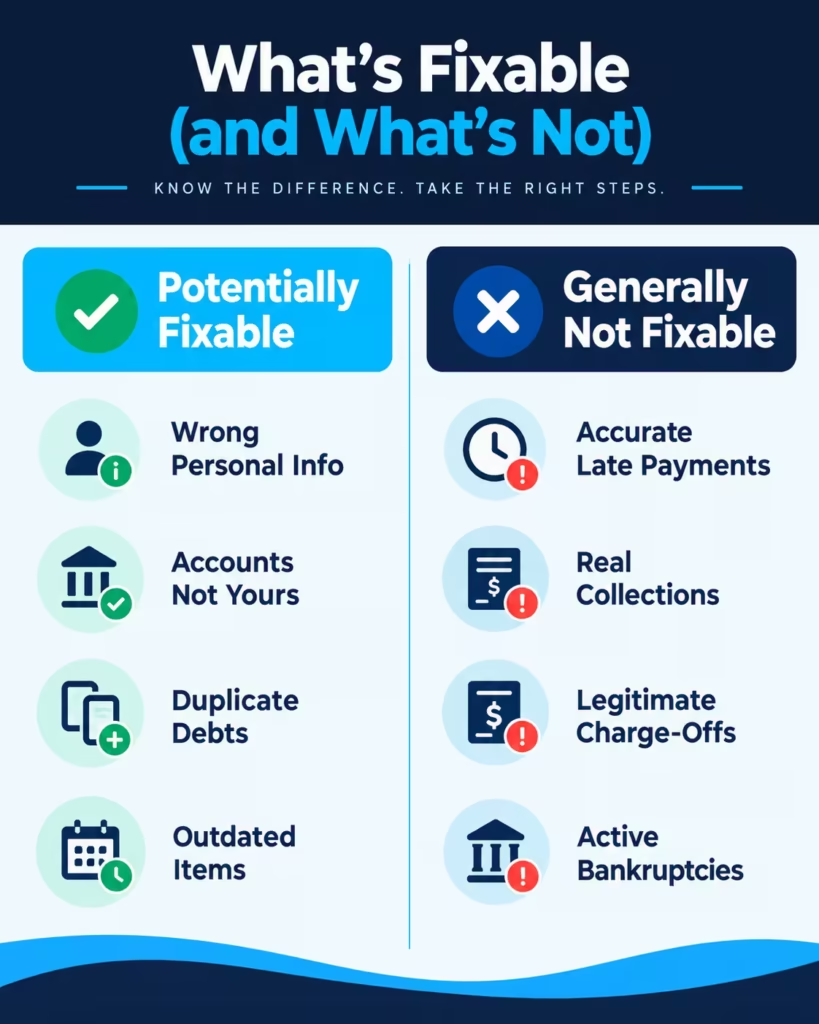
Potentially fixable through disputes:
- Personal information that’s wrong, like a misspelled name or an old address reported as current
- Accounts that don’t belong to you, including signs of identity theft or mixed files
- The same debt listed multiple times by different collectors
- Negative items older than the legal reporting window, which is generally seven years for most items
- Collections that the collector cannot validate or verify
Generally not fixable through disputes:
- Late payments that actually happened and are reported correctly
- Legitimate collection accounts you owe
- Real charge-offs
- Bankruptcies and other items still within their legal reporting period
If most of your items fall in the second group, credit repair is the wrong tool, and your money is better spent on counseling or debt management. That distinction gets a full breakdown in the DIY section below.
How Much Does Credit Repair Cost?
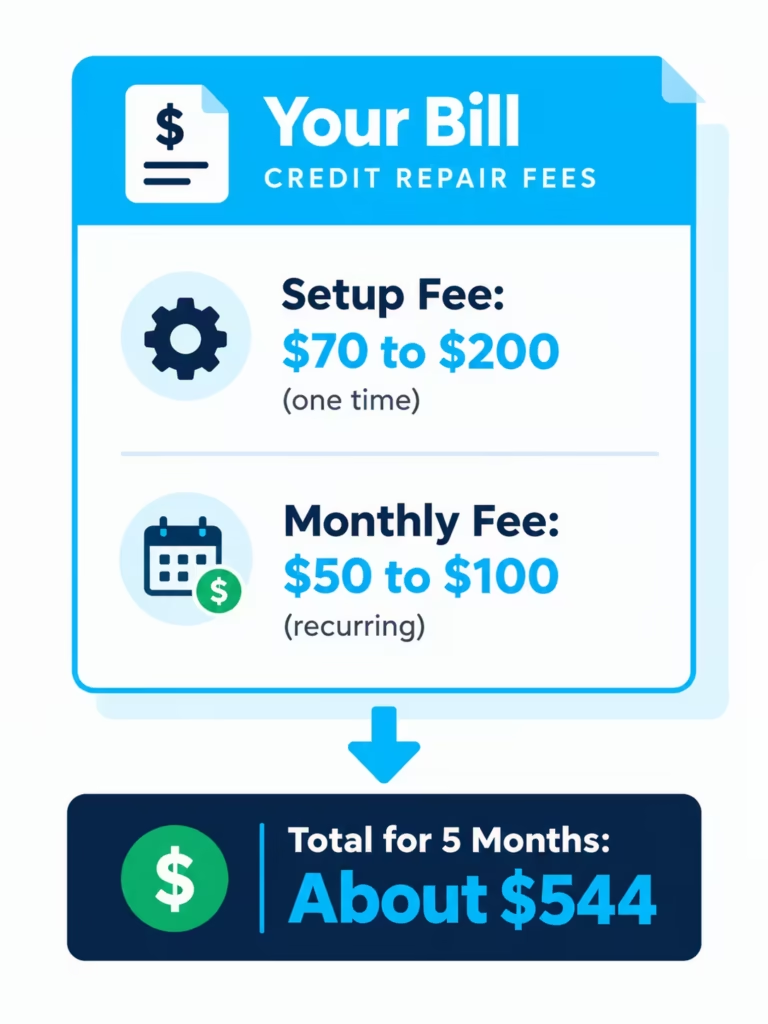
Most credit repair companies use a two-part pricing model. There’s usually an initial setup or “first work” fee, typically in the range of $70 to $200, followed by a monthly subscription that commonly runs $50 to $100. Higher-priced tiers often lead to more disputes each cycle. They also include creditor-level help and extras like credit monitoring and identity theft tools.
Remember the CROA rule from earlier: companies cannot charge you before the work is performed. Legitimate providers follow that rule for billing. So, be cautious of anyone asking for a big payment upfront.
Total Realistic Cost Over a Full Engagement
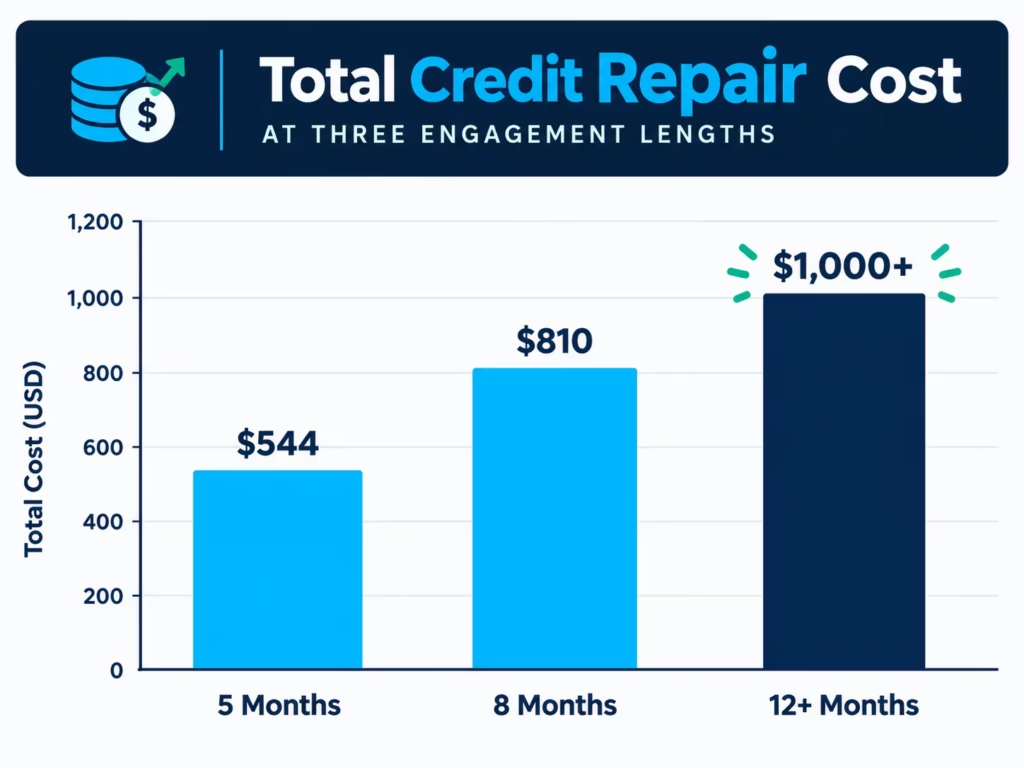
The monthly teaser rate hides the number that actually matters: the total you’ll spend before the work is done. The math is straightforward. With a $99 setup fee and an $89 monthly fee over a five-month engagement, you’re looking at roughly $544. Stretch that to eight months, and you’re near $810. Complex reports with multiple bureaus and re-disputes can push engagements past a year, which puts the total well above $1,000.
Compare that to the DIY route, which costs nothing beyond postage and your time. The comparison isn’t “free versus expensive.” It’s “free versus several hundred dollars for convenience,” and whether that’s worth paying depends on how complex your report is and how much time you have.
How Long Does Credit Repair Take?
A single dispute cycle runs about 30 to 45 days, since the bureaus generally have 30 days to investigate and then report results back. But most reports need more than one cycle. Items get verified and disputed again. New documents are submitted, and each bureau resolves issues at its own pace.
For full engagement, expect a timeframe of several months to a year. This depends on the number of negative items, how many bureaus report them, and your creditors’ responsiveness. Someone with three errors on one bureau’s report may be done in 60 days. Someone cleaning up after identity theft across all three bureaus should plan for the longer end.
This is exactly why “guaranteed results in 30 days” claims are a red flag. No company controls how fast the bureau investigates or how quickly a furnisher replies. So, no company can truly promise quick results.
DIY Credit Repair vs. Hiring a Credit Repair Company
Here’s the fact the industry’s ads don’t lead with: you have the exact same legal dispute rights that any credit repair company has. You can pull your reports for free at AnnualCreditReport.com, identify errors, and send your own dispute letters to the bureaus and furnishers at no cost. There is no paid-only door into the dispute system.
So what does a company actually add? Time savings, mostly. A good provider knows how to handle disputes. They know which documents help a case and when to escalate to a furnisher. They also track deadlines across all three bureaus. Persistence has value too, since follow-up is where many DIY efforts stall. Some people also use credit repair software to organize the DIY process, which splits the difference.
DIY tends to make the most sense when you have a small number of clear errors, a tight budget, and the patience to track letters and deadlines. Paid help is useful when your report is complex. It’s also needed if the items cover all three bureaus, you’re fixing identity theft, or you have a tight deadline, like a mortgage application. You can’t afford to miss any follow-ups.
Either way, set the right expectation: you’re paying for effort and organization, not for special access or guaranteed results.
Credit Repair vs. Credit Counseling vs. Debt Settlement
These three services get confused constantly, and hiring the wrong one wastes money while your real problem goes untreated. Match the service to the problem:
| Service | What it does | When it’s the right fit |
|---|---|---|
| Credit repair | Disputes inaccurate or unverifiable items on your credit reports | Your reports contain errors |
| Credit counseling | Budgeting help and debt management plans, often through nonprofits | Your debt is real but hard to manage |
| Debt settlement | Negotiates to pay less than you owe, usually after you stop paying creditors | You’re deep in delinquent debt and understand the credit damage and risks involved |
If your problem is errors, you need disputes. If your problem is that the debts are real and unaffordable, a nonprofit credit counseling agency is usually the better first call.
Debt settlement is a last-resort option. It can seriously impact your credit. So, make sure to research it thoroughly before considering it.
How to Tell If a Credit Repair Company Is Legitimate
The good news is that most scam signals map directly to specific CROA violations, which makes them easy to spot once you know the rules.
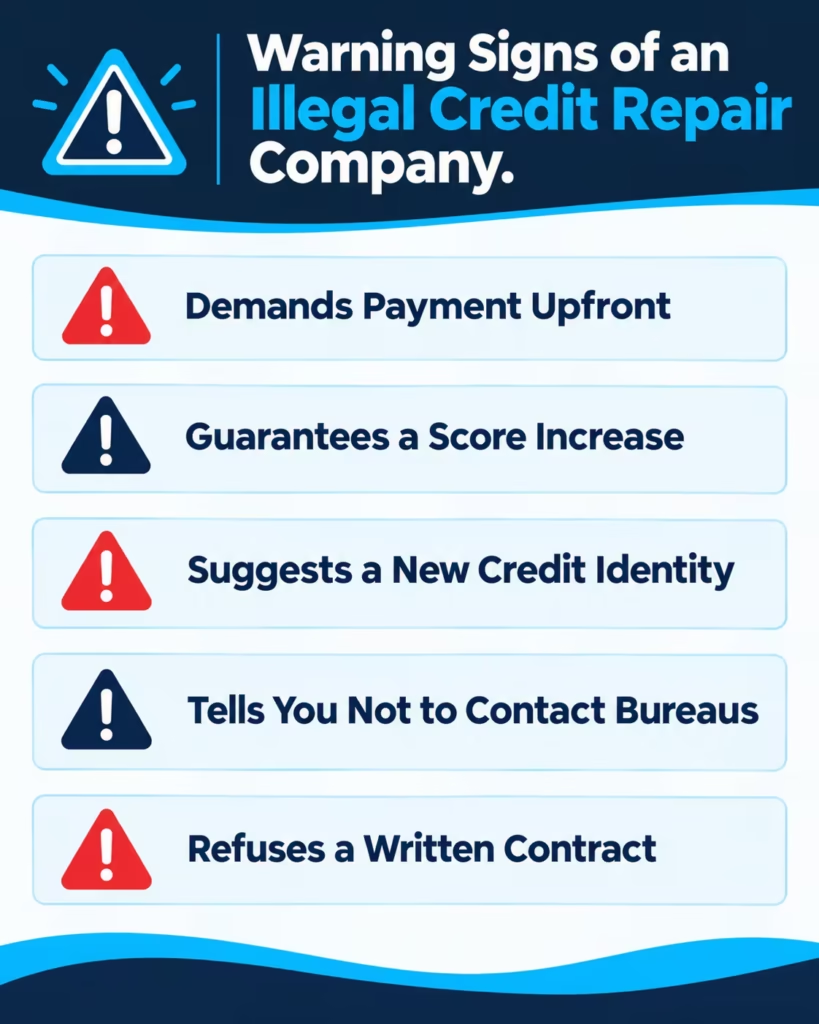
Red flags, and the law each one breaks:
- Demanding payment before any work is done. Illegal under CROA’s advance-fee ban. This is the single clearest warning sign.
- Guaranteeing a specific score increase or promising to remove accurate items. A false-claims violation, and factually impossible on top of it.
- Suggesting you create a “new credit identity” using a CPN or EIN, or telling you to dispute accurate debts as fraud. This is worse than a scam. It can expose you to prosecution for fraud, not just lost fees.
- Telling you not to contact the credit bureaus directly. You have a legal right to deal with the bureaus yourself, and anyone discouraging that right is hiding something.
- Refusing to give you a written contract or explain your three-day cancellation right. Both are required disclosures.
Green flags to look for:
- Transparent pricing with monthly billing after work is performed
- A written contract with clear service descriptions and cancellation terms
- A track record you can verify independently
On verification: check the company’s complaint history in the CFPB’s consumer complaint database, look up its BBB profile, and search the FTC’s enforcement actions for its name. Ten minutes of checking tells you more than any sales page.
Which Credit Repair Companies Are Considered Legitimate
Rather than trusting any ranking, including this type of article, judge companies on traits you can verify. Look closely at established providers. They have years of experience, clear pricing, and only bill after the work is done. Also, they maintain clean complaint histories.
One caution: “legitimate” only means the company follows the law. It does not mean the company will get results in your case, because no one can promise how a furnisher will respond to a dispute. Even with a reputable provider, the same rules apply: accurate, verified items stay.
💡 Pro Tip: Check a company’s CFPB complaint history before its marketing claims. A pattern of billing or cancellation complaints tells you more than a polished website ever will.
What “Most Aggressive Credit Repair Company” Means and the Trade-offs
In industry marketing, “aggressive” usually means a high volume of disputes, rapid re-disputing after denials, and challenges sent to bureaus and furnishers simultaneously. Persistence can genuinely help, since some items only get removed on the second or third round with better documentation.
The trade-offs are real, though. Bureaus may refuse to investigate disputes they consider frivolous. So, filing many claims without real issues can hurt your case. Aggressive marketing also tends to correlate with the red flags above, especially implied guarantees. Evaluate aggressiveness alongside the legitimacy checks, never instead of them. An aggressive company that bills upfront is still just a company breaking the law.
Does the VA Offer Credit Repair Services?
No. The Department of Veterans Affairs doesn’t provide credit repair services. If a company claims to be affiliated with the VA, be cautious.
What the VA does offer is free financial help that can address the same underlying problems. The Veterans Benefits Banking Program (VBBP) connects veterans with free financial and credit counseling through counselors affiliated with the NFCC and AFCPE.
Veterans in the Veteran Readiness and Employment program can also access counseling services, and Military OneSource provides free financial counseling to service members and their families. VA home loan benefits can help rebuild credit. VA loans have more flexible credit standards than many conventional options.
If you’re a veteran, start with those free resources before paying anyone a monthly fee.
Should You Use a Credit Repair Service?
The decision hinges on four factors: the type of negative items you have, your budget, your DIY skills and time, and your deadline.
Paying for help tends to make sense when:
- Your report has errors spread across multiple bureaus and accounts
- You’re cleaning up identity theft, which involves more paperwork and follow-up than a standard dispute
- You have a time-sensitive goal, like a mortgage application, and can’t risk missed deadlines
- You simply won’t do the tracking and follow-up yourself, and you know it
It usually doesn’t make sense when:
- Most of your negative items are accurate. Disputes can’t remove them, so you’d be paying for nothing
- You have one or two simple errors. That’s a free afternoon of DIY work
- Money is tight. Several hundred dollars in fees is real money that could go toward the debts themselves
Whatever you choose, remember this: no company can guarantee results. If a company claims it can, pay attention. It says a lot about them.
Frequently Asked Questions (FAQs)
What is credit repair services?
Credit repair services identify and fix inaccurate, incomplete, or unverifiable negative items on your credit reports. They do this by filing disputes with the credit bureaus. Companies charge a monthly fee for this, though you can legally do the same disputes yourself for free.
What is the average cost for credit repair?
Most companies charge a setup fee of $70 to $200 plus a monthly fee of $50 to $100. A typical five-month engagement runs around $544 total, and complex cases stretching past a year can exceed $1,000.
Is it worth paying someone to fix your credit?
It’s important if your report has mistakes from several bureaus. It’s also crucial when fixing identity theft or facing a tight deadline, like for a mortgage application. It’s usually not worth it if your negative items are accurate or you only have one or two simple errors.
Does credit repair service actually work?
It only applies to inaccurate, incomplete, duplicated, outdated, or unverifiable items. It does not work for accurate negative information. Results vary widely: some items get removed, some stay after verification, and some get updated instead of deleted.
Is credit repair a high-risk business?
The industry is legal and regulated by the Credit Repair Organizations Act. However, some companies have faced significant enforcement actions. In 2023, the CFPB imposed a $2.7 billion judgment against Lexington Law and CreditRepair.com over illegal advance fees and deceptive marketing.
What are the risks of using a credit repair company?
The main risks are illegal upfront fees, false guarantees of specific score increases, and schemes involving a fake “new credit identity” using a CPN or EIN. The identity fraud risk is the most serious, since it can expose you to prosecution, not just lost fees.
What is the most aggressive credit repair company?
“Aggressive” typically describes companies using high dispute volume and rapid re-disputing rather than one specific named company. This method can speed up results, but it may lead to disputes being seen as frivolous. So, it should never replace verifying a company’s basic legitimacy.
Can you trust credit repair companies?
Trust varies by company, not industry. Legitimate providers follow CROA rules about fees, contracts, and cancellation rights. Before signing, check the company’s CFPB complaint history and BBB profile. A clean legal record speaks louder than marketing claims.
How is credit repair different from credit counseling or debt settlement?
Credit repair disputes wrong items on your report. Credit counseling helps you manage actual debts through budgeting. Debt settlement negotiates to pay less than what you owe. Matching the service to your actual problem matters, since real debt cannot be removed through disputes.
The Bottom Line
Credit repair services exist to do one job: challenge inaccurate or unverifiable items on your credit reports. It’s a legal, regulated industry. However, companies vary from careful to criminal. CROA’s rules on advance fees, contracts, and cancellation rights are your best tools for screening. Paid help runs roughly $50 to $100 a month plus setup, works over months rather than weeks, and buys you convenience rather than special power.
Based on the factors above, a practical approach is to pull your free reports first, sort your negative items into disputable and accurate, then decide whether the DIY route or a vetted company fits your situation.
Know someone weighing a credit repair company right now? Share this guide with them before they sign anything. It could save them hundreds of dollars or steer them away from a scam.