
Buying a car is exciting. Getting the loan part right is stressful. You may worry that checking your rate will hurt your credit score. You may also wonder if the dealer you like even accepts this lender. That uncertainty is exactly why so many shoppers pause before they figure out how Capital One Auto Finance works.
Capital One lets you pre-qualify online with a soft credit check, then finalize the loan at a dealer in its financing network.
Below, we’ll walk through each step in plain language: pre-qualifying, shopping, dealer rules, vehicle limits, paperwork, refinancing, and life after you sign.
Key Takeaways
This guide explains how Capital One auto finance works, including online pre-qualification with a soft credit check, using the Auto Navigator shopping tool, vehicle and applicant eligibility rules, and how refinancing and loan management work after signing.
Core Facts:
- Pre-qualifying with Capital One uses a soft credit inquiry, so checking your estimated rate and terms does not affect your credit score.
- A hard credit inquiry only occurs when you submit a formal credit application at the dealership, and it can stay on your report for two years.
- Capital One only finances vehicles bought through its participating dealer network, which includes over 15,000 dealers, and does not finance private-party sales or unlisted brokers.
- Eligible vehicles must generally be within the last 10 model years and have fewer than 120,000 miles, with certain discontinued brands and vehicle types excluded.
- Refinancing requires a payoff amount between $7,500 and $75,000, the vehicle must be 10 years old or newer, and Capital One will not refinance an existing Capital One auto loan.
- Loan terms typically range from 36 to 72 months, and a longer term can lower the monthly payment while increasing total interest paid over the life of the loan.
Best for:
- Car buyers who want to understand the pre-qualification process before visiting a dealership.
- Shoppers deciding between CarMax, Carvana, or Tesla who need to know which platforms work with Capital One financing.
- Current borrowers evaluating whether refinancing their auto loan could lower their rate or payment.
How Capital One Auto Financing Works
Capital One Auto Finance is a direct lender. That means it lends you the money itself. It is not just a middleman that hands your file to someone else. It is also not a car dealer. Capital One does not own, buy, or sell the cars you browse.
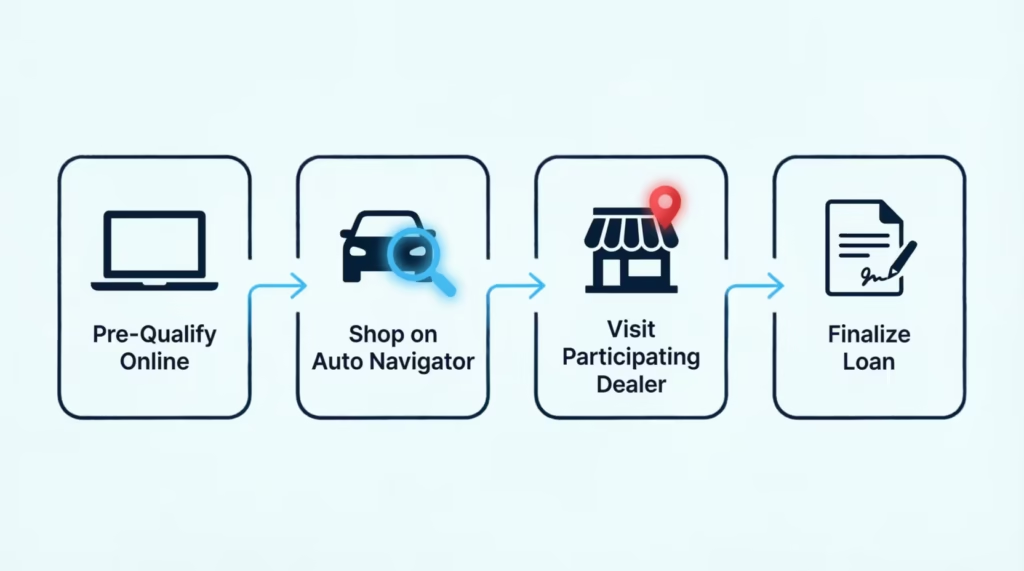
The process has four main stages. First, you pre-qualify online and see estimated terms. Second, you shop for cars using the Auto Navigator tool. Third, you visit a participating dealer with your offer. Fourth, you sign the final paperwork at that dealership.
One important detail shapes the whole Capital One auto loan process. The loan and the car purchase are two separate deals. You buy the car from the dealer. You borrow the money from the lender. The dealer helps connect the two at signing.
Most of these loans use a fixed APR. A fixed rate means your interest rate never changes. Your payment stays the same every month for the life of the loan. That makes budgeting much simpler than a rate that moves up and down.
Rates matter more than many buyers expect. Experian data show the average new car loan rate sits near 6.39%, while used car loans average about 11.43%. A small rate difference can change your total cost by thousands of dollars.
How Prequalification Works
Most people start here. Prequalification is a quick online check. It gives you an estimate of what you could borrow, at what rate, and for how long. It takes just a few minutes.
Follow these steps to complete it:
- Go to the Capital One Auto Navigator pre-qualification page and create an account or sign in.
- Enter your personal details. This includes your name, date of birth, address, and Social Security number.
- Add your income and job information. Then enter your monthly housing payment.
- Choose whether you want financing for a purchase or a refinance.
- Submit the form and review your estimated terms.
Please meet a few basic rules to pre-qualify. You must be at least 18 years old. You need a valid street address in the contiguous United States, and an APO or FPO address works too. You also need a minimum monthly income of at least $1,500.
There are limits on existing accounts as well. Your current Capital One accounts must be in good standing. That means not past due, not over limit, and not charged off. You also cannot hold three or more open Capital One auto accounts. Your total Capital One auto balances cannot top $100,000.
Your offer does not last forever. A Capital One pre-qualification expires 30 days after the request. You can always submit a new one after that. Keep in mind the new terms may differ from the old ones.
This step uses a soft credit pull. That is the part that worries most shoppers, so it deserves its own answer.
Does Prequalifying With Capital One Hurt Your Credit?
No. Checking your rate this way does not lower your score. The online request triggers a soft inquiry only. Soft inquiries show up on your report for you alone. Lenders reviewing your file later do not see them. They also carry zero score impact.
The hard credit inquiry comes much later. It happens when you sign a real credit application at the dealership. At that point, the dealer may send your application to several lenders. Each lender that pulls your report creates a hard inquiry. Those can stay visible on your credit report for two years.
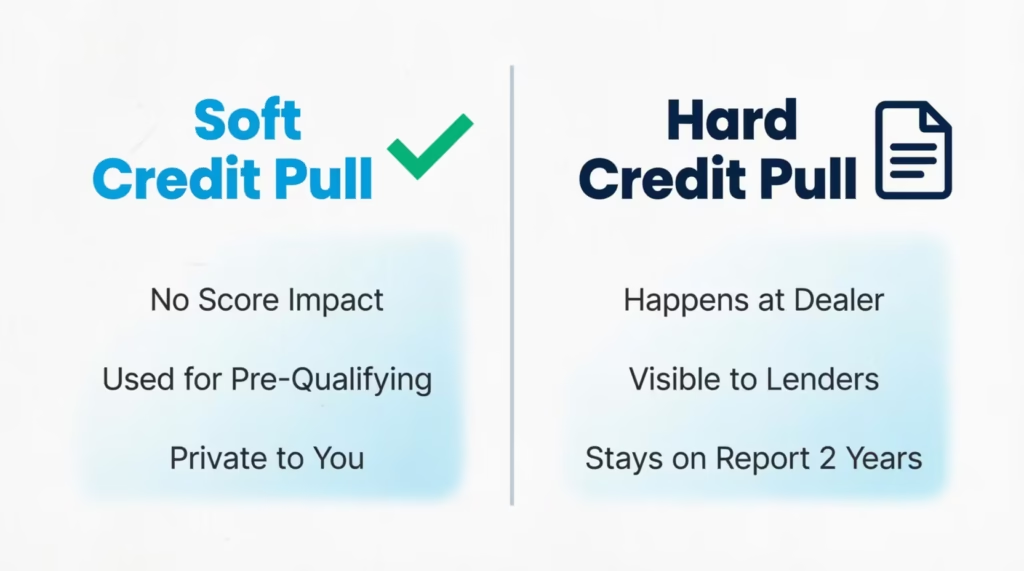
So think of it as two different actions. Checking your rate is research. Applying for the loan is a commitment. Only the second one leaves a hard mark.
📌 Did You Know: Multiple auto loan inquiries made close together usually count as just one. Credit scoring models generally group them if they fall within 14 to 45 days of each other, the CFPB explains. That means you can compare real offers without stacking up damage.
How Capital One Auto Finance Pre-Approval Works
People use “pre-approval” and “pre-qualification” as if they mean the same thing. They do not. Knowing the gap protects you from a bad surprise at the dealership.
In Capital One’s own system, the online step is called pre-qualification. It is an estimate based on what you typed in plus a soft review of your credit. Nothing is verified yet. In the wider lending world, a true pre-approval usually means the lender has pulled your credit hard and checked more details. The terms are firmer, but not always final either.
So what actually gets locked in when you pre-qualify? You get an estimated monthly payment, an estimated APR, and an estimated loan term. Those numbers are real offers based on real credit data. They are not random guesses. But they are still conditional.
Several things can change your final terms:
- You give the dealer different information than you entered online.
- You update your details by phone with Capital One or another lender.
- You pick a different car than the one you pre-qualified against.
- Your credit changes after you pre-qualify.
- You choose to finance with a different lender instead.
The loan-to-value ratio matters too. That compares the loan size to the car’s value. A larger down payment lowers that ratio. A lower ratio can help your rate.
Term choices can shift as well. The online tool shows common term lengths in round monthly steps. The dealer may offer other options. Not everyone qualifies for every term.
⚠️ Mistake to Avoid: Do not treat your online estimate as a signed contract. Your terms are not final until you finish the credit application at the dealer and everything checks out.
How Auto Navigator Works
Auto Navigator is the shopping tool. It is an online marketplace that Capital One owns and runs. It pulls listings from more than 15,000 dealers across the country, though Alaska and Hawaii are not included.
The tool does three useful things. First, it lets you browse real cars that are for sale right now. Second, it shows your estimated payment on each specific car. Third, it saves your offer so you can bring it to the dealer.
That second feature is the real value. You are not guessing. You see a car listed at $24,500 and the tool shows what your payment on that exact car could look like. You can adjust the down payment or term and watch the number move.
Some listings show a “Dealer Partner” badge. That badge means the dealer pays Capital One. It does not mean the car is a better deal. Compare prices on your own either way.
Capital One has also partnered with other lenders to widen your options. For each car, the tool shows pre-qualified terms from one participating lender you qualify with. If several lenders approve you, the one displayed depends on that dealership’s preference. You may have other offers available that are not on screen. It is fair to ask about them.
Two limits are worth knowing. Car details come from dealers and outside sources, not from Capital One. Prices, mileage, and photos can be off. Some photos are stock images. Cars also sell fast, so call the dealer to confirm the car is still there before you drive over.
Once you pick a car, you carry your offer to the dealership. The dealer submits the actual application. You may be asked for more information to confirm your identity or your details. Only then does the loan agreement become real.
Where You Can Use Capital One Auto Financing
This is where many shoppers get tripped up. Capital One does not finance every car purchase. It only finances vehicles bought through dealers in its financing network.
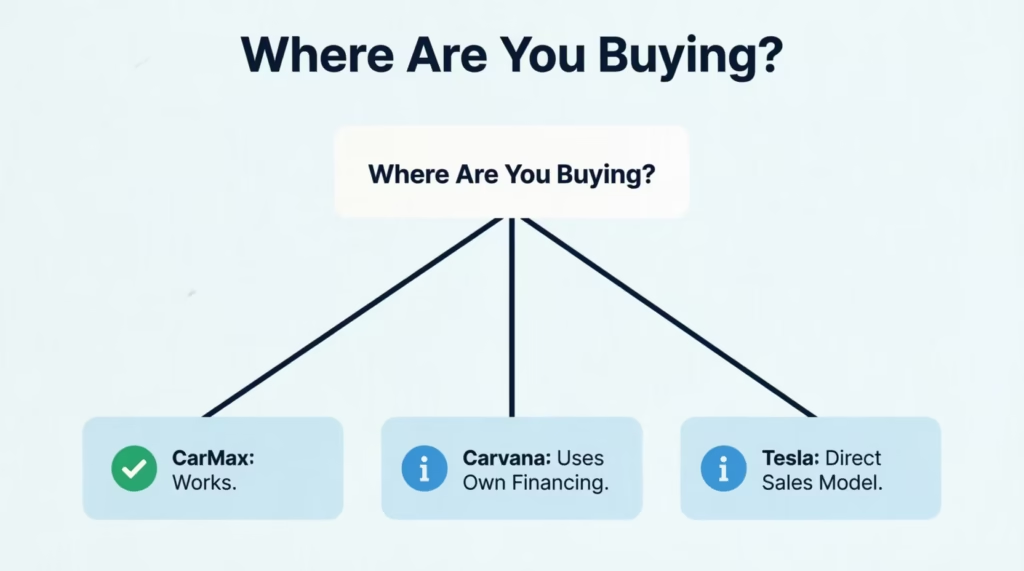
That rule is strict. Capital One does not finance cars bought from dealers outside the network. It also does not finance purchases from auto brokers or private party sellers. So a great deal from a neighbor selling their sedan will not work here.
Checking is easy. Search for the dealer in Auto Navigator. If the dealership appears there, it provides Capital One financing. Some dealers offer this financing but do not list their inventory in the tool, so you can also just call and ask. The network changes too. Dealers can be added or removed at any time without notice, so confirm before you go.
Here is how three popular options stack up.
Does Capital One Auto Finance Work With CarMax?
Yes. CarMax locations show up as participating dealers in Auto Navigator. Many buyers have used this pairing without trouble.
The process is the same as at any other dealer in the network. You pre-qualify online. You find a CarMax car you like. You bring your offer in. CarMax submits the credit application, and the loan gets finalized there. CarMax also works with several other lenders, so compare what they offer against your Capital One terms.
Does Capital One Auto Finance Work With Carvana?
Not through Capital One’s own dealer network. Carvana is not part of it. Carvana runs its own financing program instead.
That said, Carvana does allow outside financing in some cases. Buyers can arrange money through a bank or credit union and complete a verification process with Carvana. Rates can differ a lot between the two paths. One shopper found roughly 10% through a bank pre-approval while Carvana’s own quote landed near 20% on similar cars. So if you plan to buy from Carvana, ask them directly which outside lenders they accept and what documents they need.
Does Capital One Auto Finance Work With Tesla?
Generally no. Tesla sells straight to the customer. There is no third-party dealership in the middle.
Capital One’s financing is built around its dealer network. A direct sale model falls outside that structure. Tesla arranges financing through its own lending partners at checkout. If you want a Tesla, compare Tesla’s financing offers against a bank or credit union pre-approval. Used Teslas sold by a franchise dealer in the network are a different story, so it is worth a search in Auto Navigator.
Vehicle Eligibility Requirements
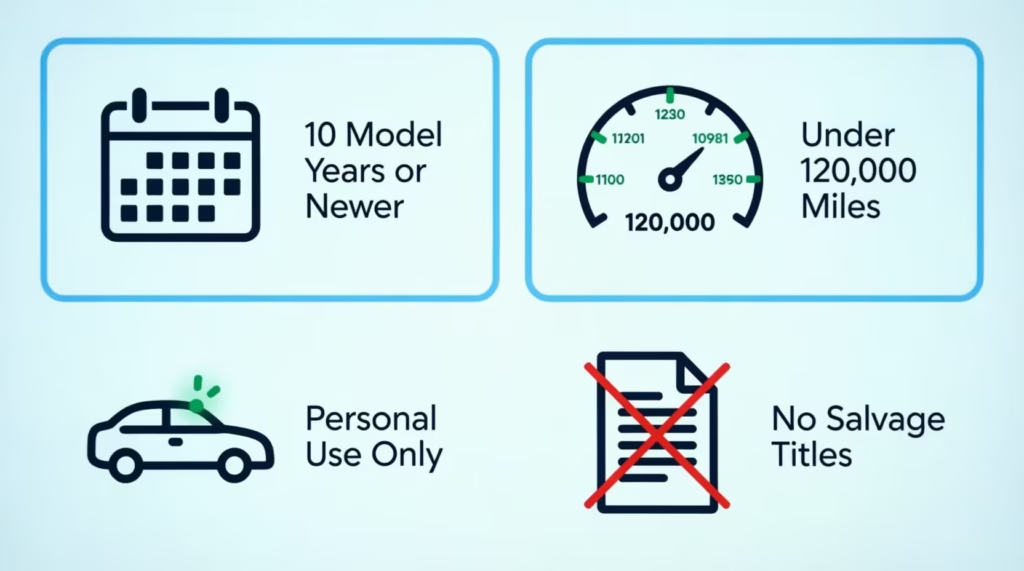
Your credit is only half the picture. The car has to qualify too. Plenty of applications stall because the vehicle breaks a rule the buyer never knew about.
| Requirement | The rule |
|---|---|
| Vehicle age | Model year within the last 10 years |
| Mileage | Fewer than 120,000 miles |
| Vehicle types allowed | New or used cars, light trucks, minivans, SUVs |
| Use | Built and used for personal use only |
| Minimum amount financed | $4,000 for new and used vehicles |
| Seller | Must be a dealer that provides Capital One financing |
There is a little flexibility. In some cases, an older model year or a higher mileage car may still qualify. Do not count on it, but do not assume you are blocked either.
Certain brands are off the table. Capital One does not finance Oldsmobile, Daewoo, Saab, Suzuki, or Isuzu vehicles. These makes are no longer sold new in the US market, which makes their values harder to predict.
Several vehicle categories are also excluded:
- Commercial vehicles, including cars used for ride-share work
- Lease buyouts
- Motorcycles, ATVs, and recreational vehicles
- Camper vans and motor homes
- Cars with a history of chronic malfunctions
- Manufacturer or dealer buybacks under state lemon laws
- Branded title and salvage title vehicles
- Any vehicle with no VIN or no title issued
The personal use rule catches people off guard. If a vehicle looks commercial based on the model or the details you provide, it can be ruled ineligible. A driver planning to buy a cargo van for a delivery business needs a commercial loan instead.
Applicant Eligibility and Documentation Requirements
Gathering your information first makes everything faster. The online step asks for a set of basics. The dealer step usually asks for proof.
Have these details ready before you start:
- Your full legal name, date of birth, and current address
- Your Social Security number or tax ID number
- Your gross monthly income and how you earn it
- Your employer name and how long you have worked there
- Your monthly rent or mortgage payment
Income rules vary a bit by product. Pre-qualification requires at least $1,500 in monthly income. For some loans, the requirement can be $1,500 or $1,800, depending on your credit profile.
If you are already a Capital One customer, some fields may fill in automatically. That saves time, but check every line. Old addresses and outdated income figures are common. You are responsible for confirming the information is right before you submit.
At the dealership, expect a few requests. Most dealers ask for a valid driver’s license, proof of insurance, and proof of address such as a utility bill. Some ask for recent pay stubs.
One thing surprises many first-time buyers. When you sign that credit application at the dealer, the dealer may send it to several lenders at once. This is called application routing. The dealer is shopping your file to find an approval, and sometimes to earn more on the financing.
Each lender that pulls your credit adds a hard inquiry. You can ask the finance manager which lenders received your application. You can also ask them to submit it only to Capital One if you already have an offer you like.
How Does Capital One Verify Employment?
Verification is mostly document-based. During the application, you provide your employer, job title, income, and time on the job. The lender compares that to what your credit file and other data show.
If the numbers line up, you may never be asked for anything else. If something looks off, or if your income is hard to confirm, expect a request for proof. Common requests include recent pay stubs, a W-2, or bank statements showing deposits. In some cases, a lender may call your employer’s HR line to confirm you work there.
Self-employed buyers face a longer path. Tax returns from the last two years and business bank statements are the usual asks. Gig workers and 1099 earners should prepare the same.
This step directly affects your final rate. Your pre-qualified APR assumed the income you reported was accurate. If verified income comes in lower, the offer can change or fall through. So report your gross income honestly, and be ready to prove it.
Michael, a warehouse supervisor who earns $4,200 a month plus overtime, pre-qualified using $5,100 because he counted a busy season. His verified base pay came in lower. His approved loan amount dropped by about $3,800, and he had to add cash at signing. Reporting steady, provable income avoids that scramble.
How Capital One Auto Loan Terms Are Structured
Understanding the structure lets you judge whether an offer is fair. Three pieces do the work: the rate, the term, and the amount financed.
The rate is normally a fixed APR. It stays locked for the whole loan. Your APR depends on several things. Your credit history matters most. So does the total amount financed, your down payment, the loan term length you pick, the loan-to-value ratio, and the car itself. Older, higher mileage cars usually carry higher rates.
Terms are shown in common monthly steps online. Typical choices run from 36 months up to 72 months, and longer terms exist at some dealers. Not every borrower qualifies for every term.
The amount financed is simple math:
Vehicle price + taxes and fees + optional products − down payment − trade-in value = amount financed
Optional products are where budgets quietly break. Extended warranties, gap coverage, and paint protection all get rolled into the loan. Add $2,800 of add-ons, and you now pay interest on all of it for years. Ask for the price of the car alone first. Then decide on extras separately.
Trade-in equity works in your favor. If your old car is worth $6,000 and you owe $2,000, you have $4,000 of equity. That acts like a down payment. Negative equity works the opposite way and gets added to the new loan.
How Monthly Payments Are Calculated
Your payment comes from three inputs: the principal, the rate, and the term. Principal is the amount financed. Lenders use a standard amortization formula, but the logic is easy to follow.
Each month, interest is charged on your remaining balance. The rest of your payment cuts the principal. Early on, more of the money goes to interest. Later, more goes to principal. That is why paying extra in year one saves the most.
Take a $25,000 loan at 7% APR for 60 months. The payment lands near $495. Total interest comes to roughly $4,700. Stretch the same loan to 72 months, and the payment drops to about $426. But total interest climbs to roughly $5,700. The lower payment costs you about $1,000 more.
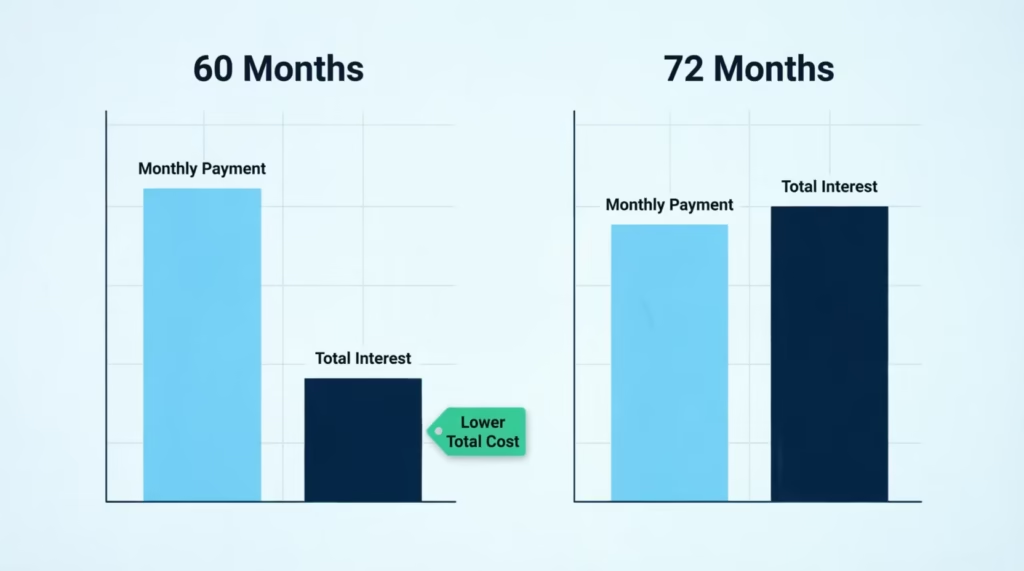
| Loan setup | Monthly payment | Total interest |
|---|---|---|
| $25,000 at 7% for 60 months | About $495 | About $4,700 |
| $25,000 at 7% for 72 months | About $426 | About $5,700 |
Always check the final numbers against the loan agreement before you sign. Look at four lines: the amount financed, the APR, the term in months, and the total of payments. That last line shows the true cost. If any number does not match what you agreed to, stop and ask. Once you sign, the contract governs.
💡 Pro Tip: Negotiate the car price and the financing as two separate conversations. Dealers can lower the sticker price while quietly stretching the term, which leaves you paying more overall.
How Capital One Auto Refinance Works
Refinancing replaces your current car loan with a new one. Your old lender gets paid off. You start making payments to the new lender instead. Nothing about the car itself changes.
People refinance for two reasons. Some want a lower rate, which cuts total interest. Others want a smaller monthly payment, usually by extending the term. You can sometimes get both, but not always.
The process runs in three steps. You can begin on the Capital One auto refinance page:
- Pre-qualify online. Share details about yourself, your car, and your current loan. This uses a soft credit inquiry, so your score is safe. Decisions typically arrive within 30 seconds.
- Pick your offer and eSign. Choose the terms you want and confirm any details requested. The hard credit check waits until your information is verified.
- Finalize. Capital One pays off your old lender and helps transfer the title. You then manage the loan in your Capital One account or mobile app.
The cost side is friendly. There is no application fee. There are no prepayment penalties, so you can pay extra or pay it off early for free. States do charge a title transfer fee. Capital One pays that fee for you and adds it to your final loan amount.
Now the honest warning. A longer term lowers your payment but can raise your total interest. Say you owe $18,000 with 42 months left at 11%. Refinancing to 7% over 60 months might drop your payment by about $130. Yet you would pay interest for 18 extra months. Compare total interest, not just the monthly number. Refinancing to a shorter or equal term at a lower rate is where the real savings live.
Two more details matter. You must keep comprehensive and collision insurance for the whole loan term, with a deductible of $1,000 or less. Also check your gap policy. Refinancing can cancel it, and you may be owed a refund.
Refinance Eligibility Requirements
Refinance rules differ from purchase rules. Review them before you apply.
| Requirement | The rule |
|---|---|
| Vehicle age | 10 years old or newer |
| Loan amount | Minimum $7,500, maximum $75,000 |
| Current lender | Cannot be Capital One Auto Finance |
| Ownership | At least one applicant must be on the original loan and be a registered owner on the title |
| Payment status | Must be current on the existing car loan and any mortgage |
| Vehicle use | Personal use only |
Your current lender must also meet standards. It needs to report your loan to a major credit bureau, or be FDIC or NCUA insured, or be both BBB accredited and registered with the state as a lender or auto dealer. Most banks, credit unions, and large finance companies clear this easily.
The Capital One rule catches many people. You cannot refinance an existing Capital One auto loan with Capital One. That includes loans from its subsidiaries. If you want a better rate on a loan you already have there, you must go to a different lender.
The payoff amount limits can also bite. If your verified payoff comes in above $75,000, you may need to pay down the balance in cash before the refinance can close. Call your current lender for an exact payoff quote before applying, since it includes interest through the payoff date.
Excluded vehicles overlap with purchase rules. Discontinued makes like Suzuki and Isuzu do not qualify. Neither do commercial or ride-share vehicles, motorcycles, RVs, ATVs, boats, camper vans, motor homes, lease buyouts, salvage or branded titles, or lemon buybacks.
Managing Your Loan After You’re Approved
Signing is not the finish line. A few servicing details are worth knowing now, not during a crisis.
Start by setting up your online account. You can manage the loan on the Capital One website or in the mobile app. From there, you can view your balance, see your due date, make payments, and set up autopay. Autopay is the simplest protection against a missed payment.
Payment options usually include automatic bank drafts, one-time online payments, phone payments, and mail. Extra payments are allowed with no penalty. If you send extra money, tell the servicer to apply it to principal. Otherwise it may sit as a prepaid future payment and save you nothing in interest.
If you spot an error on your loan documents, act fast. Contact the dealer and the lender the same week. Bring your copy of the signed contract and the pre-qualified offer. Written records win these conversations, so save every document and email.
Total loss is the scenario nobody plans for. If your car is totaled or stolen, contact your insurance company first. Then have the insurer contact Capital One directly with the full claim details.
The insurance payout goes to the lender to settle the loan balance. If the payout is less than what you owe, you still owe the difference. Gap coverage exists for exactly that gap, which is why many buyers consider it. Capital One does not sell gap coverage itself.
How Capital One Reports to Credit Bureaus
Your loan is reported to the three major credit reporting agencies: Equifax, Experian, and TransUnion. Reporting happens monthly.
What gets reported includes your payment history, meaning whether each payment arrived on time or late. Accounts that reach 30 or more days past due are reported as delinquent every month. Account status also gets reported when it applies, such as a repossession, a loan paid in full, or a balance settled for less than the full amount.
Timelines are long. Late payment details can stay on a credit report for up to seven years. Some statuses, like bankruptcy, can remain for up to ten years.
One fact deserves emphasis. Negative history is not erased by later good behavior. Catching up, paying off the loan, or settling it does not delete past late payments. If a late mark is accurate, no one can legally remove it, and any company promising otherwise is a scam risk.
You do have real dispute rights. The Fair Credit Reporting Act lets you dispute information you believe is wrong or incomplete. File directly with Capital One Auto or with the bureaus.
Include specifics such as payment dates and account status, plus proof like bank statements. Capital One investigates and responds within 30 days. If a change is needed, bureaus typically update reports within one to two billing cycles.
Title Transfer and Payoff
Title work is administrative, but it protects your ownership. Handle it promptly.
After a refinance, the lienholder on the title must change. The old lender’s lien is released, and the new lender is recorded. Capital One helps manage this transfer and pays the state fee for you, adding it to your loan. Respond quickly to any document request from the state or the lender. Delays can hold up your title for months and create problems if you try to sell the car.
Refinancing does not change who owns the car. Registered owners on the title stay the same. At least one applicant must already be a registered owner. Adding or removing an owner is a separate state process that may require paperwork from everyone listed.
When the loan is paid off, the lender releases its lien. Depending on your state, you will either receive a paper title showing no lienholder or an electronic release sent to your DMV. Expect a few weeks. Confirm the release actually happened rather than assuming it did. Then store the clear title somewhere safe. You will need it the day you sell or trade the car.
Frequently Asked Questions (FAQs)
Can I pay off a Capital One auto loan early?
Yes, Capital One does not charge a prepayment penalty on auto loans. You can pay extra toward your loan at any time, but tell the servicer to apply it to principal so it actually reduces your interest.
How many miles will Capital One finance a car?
Capital One generally requires vehicles to have fewer than 120,000 miles. The vehicle must also be within the last 10 model years, though some flexibility exists on a case-by-case basis.
How many months will Capital One finance a car?
Typical terms run from 36 months up to 72 months, shown in common steps through Auto Navigator. Some dealers may offer longer terms, though not every borrower qualifies for every length.
How much is a $25,000 car loan for 72 months?
At 7% APR, a $25,000 loan over 72 months runs about $426 a month. Total interest paid over the full term comes to roughly $5,700.
Is a 60 or 72 month car loan better?
A 60-month term costs less in total interest but has a higher monthly payment. On a $25,000 loan at 7% APR, 60 months costs about $1,000 less in total interest than stretching to 72 months.
What’s a good APR for a car loan?
Experian data shows average new car loan rates near 6.39% and used car loan rates near 11.43%. Your own rate depends on your credit history, down payment, loan term, and the vehicle’s age and mileage.
What disqualifies you from an auto loan with Capital One?
Excluded vehicles include salvage or branded titles, lemon law buybacks, commercial or ride-share vehicles, motorcycles, RVs, and discontinued brands like Suzuki and Isuzu. Vehicles older than 10 model years or with 120,000+ miles are usually ineligible too.
Does Capital One approve you instantly for an auto loan?
Refinance decisions typically arrive within about 30 seconds of submitting your prequalification. New purchase prequalification is also fast, though the loan isn’t finalized until the dealer submits the actual credit application.
Is Capital One auto pre-approval guaranteed?
No, your online terms are conditional estimates, not a guaranteed contract. Your final rate and amount can change if your credit shifts, you pick a different car, or verified income doesn’t match what you reported.
Can I use Capital One financing at any dealership?
No, Capital One only finances vehicles purchased through dealers in its participating network, which includes over 15,000 dealers nationwide. You can search Auto Navigator or call the dealer directly to confirm they offer Capital One financing before you shop.
Wrapping Up
Financing a car gets much easier once the sequence makes sense: pre-qualify with a soft pull, shop within the dealer network, confirm the vehicle and paperwork rules, then verify every number in the contract before signing.
Based on the eligibility limits and rate spreads covered above, the most effective approach is to pre-qualify first and walk in with terms in hand. That single step turns a Capital One auto finance offer into real negotiating power instead of a hopeful guess.
If you know someone about to walk into a dealership without a rate in hand, share this guide with them. It could save them hundreds of dollars and a lot of stress.