
If you run vehicles for work, you’ve probably asked yourself whether a fuel card or a credit card is the smarter way to pay at the pump. It’s a fair question, and the confusion is real. The term “fuel card” actually covers two very different products, and picking the wrong one can mean missed savings or surprise interest charges.
The short answer: a fuel card gives businesses tighter control and deeper reporting on fuel spending, while a credit card offers flexibility and cash back rewards. The best choice depends on your fleet size, drivers, and spending habits.
Below, you’ll find a full breakdown of costs, controls, credit impact, and approval requirements, plus a simple framework to help you decide with confidence.
At a Glance
This guide compares fuel cards and credit cards for business fuel spending, covering spending controls, expense reporting depth, a worked cost example, interest risk, acceptance networks, approval requirements, and credit impact.
Core Facts:
- Fleet fuel cards restrict purchases to fuel (and sometimes maintenance items) at the point of sale, while credit cards allow any purchase type with no restriction until the statement is reviewed afterward.
- In a worked example using 500 gallons per month at $4.15 per gallon, a 6-cent fuel card rebate saves about $30 monthly ($360 per year), while 3% credit card cash back saves about $62.25 monthly ($747 per year).
- Fleet fuel cards function as charge cards with no interest charged, since the balance is due in full each billing cycle, though late payment fees can still apply.
- Carrying a $2,000 balance at 22% APR for one year costs roughly $240 in interest, which can erase an entire year of credit card cash back rewards.
- Fleet fuel cards are often more accessible to newer or credit-thin businesses than business credit cards, though some programs require a security deposit or personal guarantee.
- Many fuel card programs run a credit check at approval, but whether the account reports to credit bureaus afterward varies by provider, making fuel cards generally unreliable for building business credit.
Best for:
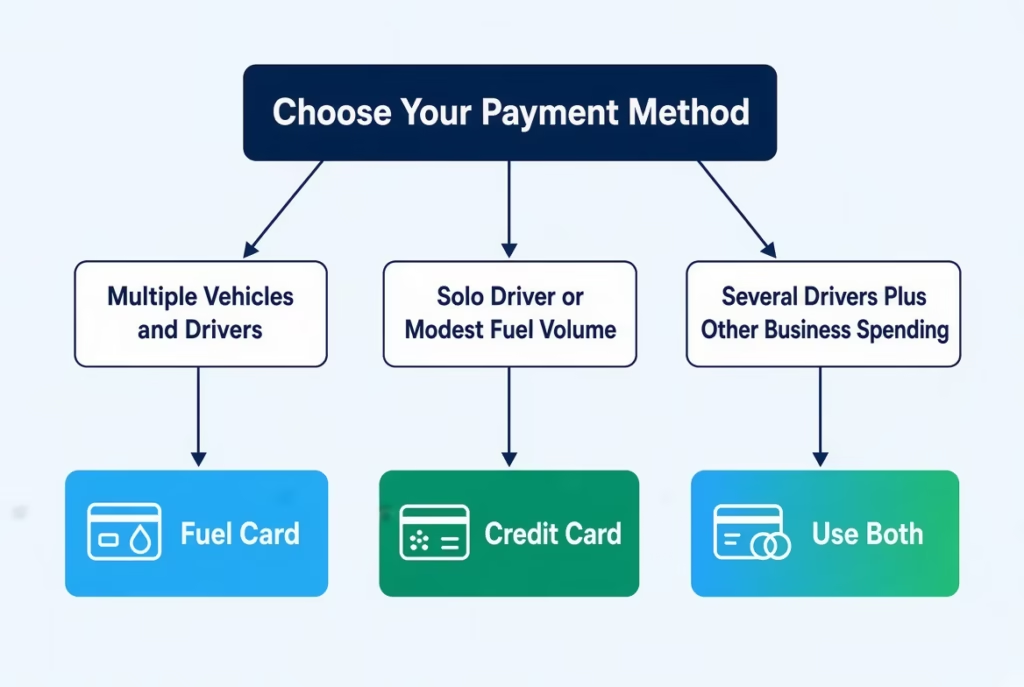
- Businesses running multiple vehicles and drivers that need purchase restrictions, driver-level reporting, or IFTA fuel tax data.
- Solo drivers or individual consumers comparing a branded gas station card against a general rewards credit card.
- Businesses with several drivers and significant non-fuel spending who are deciding whether to run a fuel card and credit card together.
What Is a Fuel Card?
A fuel card is a payment card that can only be used for fuel and, in some programs, vehicle-related purchases like oil changes or tires. Most fuel cards work like charge cards, meaning you pay the balance in full each billing cycle rather than carrying it over with interest.
Here’s where most people get tripped up: two very different products are sold under the “fuel card” name. Knowing which one you’re looking at changes everything about this comparison.
Fleet and Universal Fuel Cards
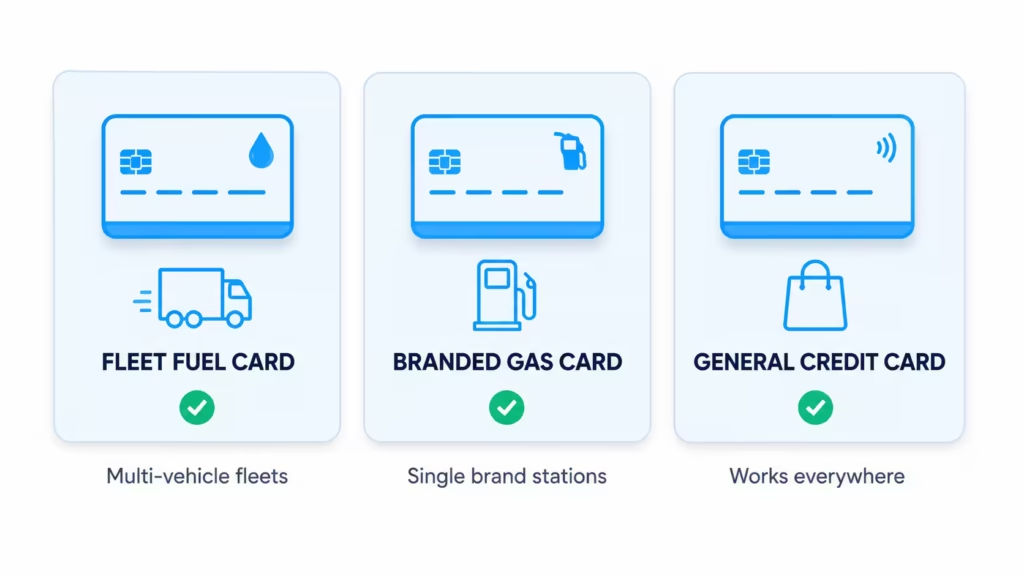
Fleet fuel cards are built for businesses that run multiple vehicles and drivers. Specialized fleet-card providers, not traditional banks, issue them. Well-known names include WEX, Fuelman, Comdata, and the Voyager fleet card network.
These cards work across a network of gas stations and truck stops. Their real value is control. A manager can restrict what each card buys, set spending caps, and see exactly who bought what, where, and when. Fleet cards are designed for companies with service trucks, delivery vans, or sales vehicles, not for personal use.
Branded Retail Gas Cards
Branded gas cards are a different animal. Think of the cards you see advertised at Shell, BP, or ExxonMobil stations. These are issued by a single fuel brand or its bank partner, and they function much more like a store credit card.
They come with a revolving balance and their own APR, and they’re typically usable only (or mostly) at that brand’s stations.
For example, the Exxon Mobil Smart Card+ offers 10 cents off per gallon on regular fuel grades, but it’s tied to Exxon and Mobil stations. These cards are marketed to individual drivers, not fleets. If you searched for a “fuel card” hoping for fleet controls, a branded retail card won’t give you that.
What Is a Gas Rewards Credit Card?
A gas rewards credit card is a regular credit card. It gives cash back or points for gas purchases. You can also earn rewards on other spending, like groceries and dining.
Unlike a branded gas station rewards card, a general gas rewards card works anywhere credit cards are accepted. You’re not locked into one fuel brand. Business versions of these cards, like standard business credit cards, let you issue employee cards. You can also earn rewards on various company expenses.
Reward structures vary. Some cards pay a flat percentage on everything. Others pay a higher rate on gas as a bonus category, sometimes with quarterly or annual caps on how much spending earns the boosted rate. That cap detail matters, and we’ll come back to it in the cost section.
Fuel Card vs. Credit Card: Core Differences at a Glance
Before the deep dives, here’s the big picture on the difference between a fuel card and a credit card:
| Factor | Fleet Fuel Card | Branded Gas Card | Gas Rewards Credit Card |
|---|---|---|---|
| Primary purpose | Fuel and vehicle expenses only | Fuel at one brand | General spending, gas rewards |
| Payment structure | Charge card, paid in full | Revolving credit with APR | Revolving credit with APR |
| Purchase restrictions | Strong, set at point of sale | Limited to one brand’s stations | None |
| Reporting detail | Driver, vehicle, gallons, odometer | Basic | Basic (merchant and total) |
| Typical user | Businesses with vehicles | Individual drivers | Consumers and businesses |
| Acceptance | Fuel card network only | One fuel brand | Virtually everywhere |
A charge card structure means no interest accrues, but the full bill comes due each cycle. A revolving card lets you carry a balance, which is flexible but expensive if you don’t pay it off. The sections below break down what these differences mean in practice.
Spending Control and Fraud Prevention
This is where fleet fuel cards earn their keep for business owners.
A fleet card’s purchase restrictions work at the point of sale, not after the fact. The card simply won’t process a transaction that falls outside its rules. A manager can set limits on a card based on the program. They can restrict it to fuel only, allow maintenance items, or cap the dollar amount or gallons per transaction. They can also limit purchases by time of day or day of the week.
At the pump, drivers typically must enter a PIN or employee ID, and many programs trigger an odometer prompt before fuel starts flowing. That odometer entry does double duty: it discourages misuse and feeds fuel-efficiency data into your reports. WEX, for instance, describes real-time alerts and per-transaction controls as core features of its fleet cards.
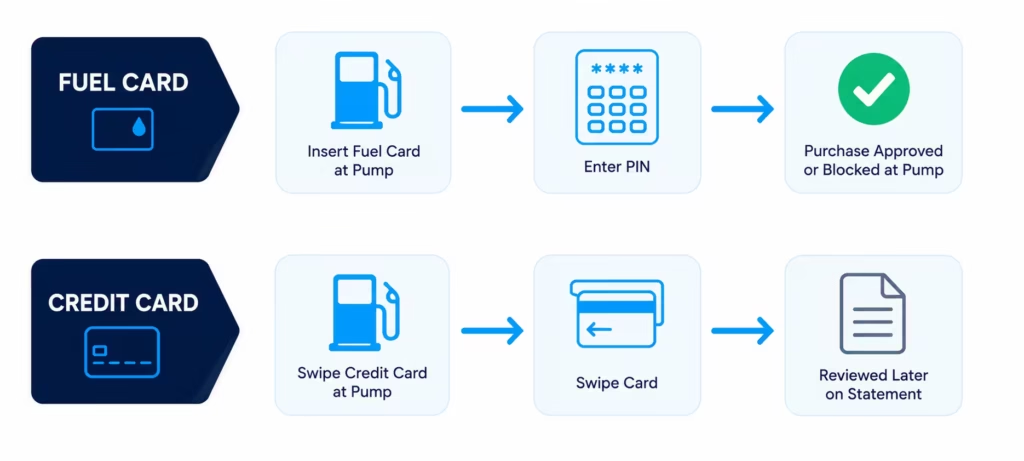
A credit card has no purchase-category restriction at the point of sale. If a driver hands the card to a cashier, it can buy diesel, cigarettes, snacks, or a car wash. Your only line of defense is reviewing the statement afterward, when the money is already spent. A line item like “Shell #4521, $86.40” tells you nothing about what was actually purchased.
⚠️ Mistake to Avoid: Don’t assume an employee card on your business credit card gives you fuel controls. It gives you a credit limit, not purchase restrictions. Those are two different things.
For a business dealing with card misuse, fraud prevention at the pump beats fraud detection on the statement every time.
Expense Tracking and Reporting Depth
Ask any bookkeeper what a credit card statement gives them, and the answer is short: merchant name, date, and total. That’s it. If a driver fills up twice in one day, you see two charges with no way to tell how many gallons were pumped or which vehicle was filled.
Fleet fuel card reporting goes much deeper.
A typical transaction record shows:
- The driver
- The vehicle
- Gallons purchased
- Price per gallon
- Odometer reading
- Station location
- Fuel type (often included)
This driver-level reporting turns a pile of receipts into clean data your accounting software can actually use.
The monthly difference is real. With a credit card, someone has to chase down receipts and manually match them to statement lines. A fuel card organizes data for you. Many programs connect directly to bookkeeping and fleet management tools.
IFTA and Fuel Tax Reporting
For businesses with trucks crossing state lines, this subsection alone can justify a fuel card. The International Fuel Tax Agreement requires carriers to file quarterly fuel tax returns reporting miles driven and fuel purchased in each jurisdiction. As the Washington State Department of Licensing notes, an IFTA return is due every three months even if there were no miles to report.
Many fleet card programs automatically generate fuel purchase data for IFTA filings. This data is organized by jurisdiction. A credit card statement can’t. You’d be reconstructing it by hand from receipts at filing time. If your vehicles only operate locally, IFTA doesn’t apply to you, so weigh this feature accordingly.
Beyond tax reporting, these cards offer helpful security features. You can set specific limits for each driver. For example, you might restrict purchases to fuel only. Some cards prevent spending above a certain dollar amount per day.
If a card is ever lost or stolen, you can deactivate it instantly through an online portal. This keeps your business funds safe and prevents unauthorized use at the pump.
Real Cost Comparison: Per-Gallon Rebates vs. Percentage Cash Back
This is the section most readers came for, so let’s do the math.
Fuel cards typically save money through a per-gallon rebate: a set number of cents off each gallon, sometimes tiered by monthly volume. Fuelman, for example, advertises 8 cents off per gallon on diesel and unleaded at the 40,000-plus locations in its discount network, with plans that carry monthly account fees.
Credit cards pay a percentage back on what you spend. A card offering 3% cash back on gas sounds generous, but the real value depends on the pump price and any spending caps.
Here’s a worked example. Assume your business uses 500 gallons per month. The national average gas price is about $4.15 per gallon as of early September 2026, according to AAA. That’s roughly $2,075 in monthly fuel spending.
- Fuel card at 6 cents off per gallon: 500 × $0.06 = $30 per month, or about $360 per year
- Credit card at 3% cash back: $2,075 × 0.03 = $62.25 per month, or about $747 per year
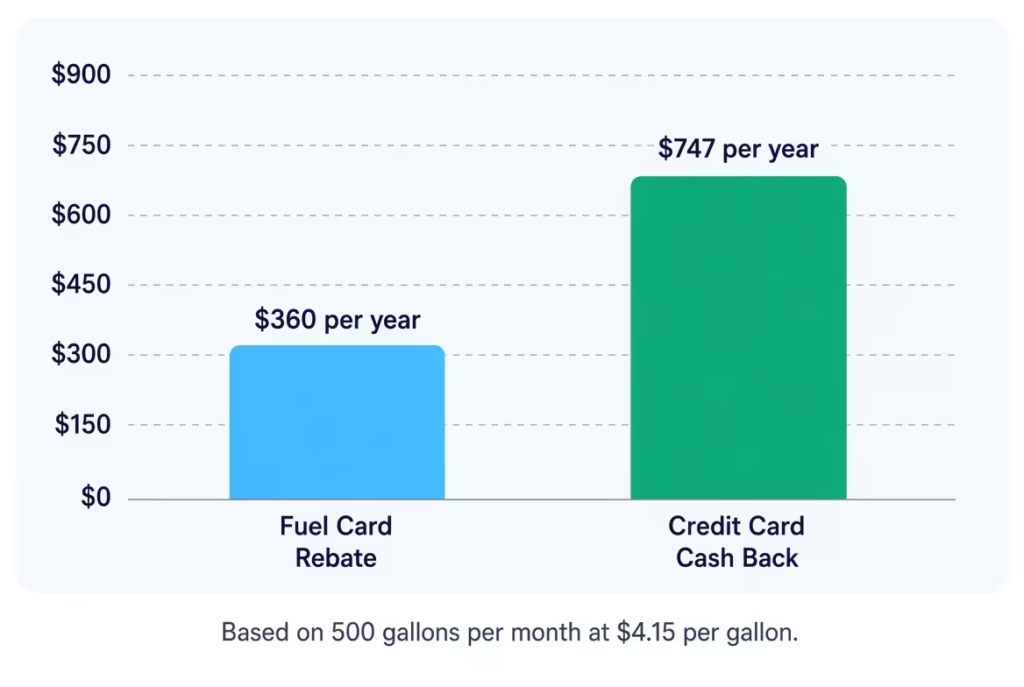
At that volume and price, the credit card wins on raw rewards. But the math shifts at higher volumes. Some credit cards cap bonus-category earnings, say at $6,000 or $7,000 of gas spending per year, after which the rate drops to 1%. A fuel card rebate usually applies to every gallon with no cap. Fleets burning 2,000 or more gallons a month often find the uncapped per-gallon rebate pulls ahead.
Don’t forget the fees on both sides. Some fuel card programs charge monthly account fees that eat into rebates. Some rewards credit cards charge annual fees. Run your own numbers with your actual gallons and pump price before deciding.
💡 Pro Tip: Calculate your break-even point. Divide any monthly fuel card fee by the per-gallon rebate. If you buy 300 gallons a month and the card costs $10 a month with a 6-cent rebate, you save $18 and net $8. That’s thin. Higher volume changes the picture fast.
Interest Charges, Fees, and Debt Risk
Here’s a risk that quietly wipes out rewards: carrying a revolving balance.
Fleet fuel cards are charge cards. There’s no interest because there’s no carried balance, though late payment penalties and fees can apply if you miss the due date. Branded retail gas cards are a different story. They work like any store credit card, and their APRs tend to run high. Consumer Reports found one major brand’s gas card charging an APR well above the national average for credit cards.
General credit cards aren’t cheap to carry either. The average commercial bank credit card interest rate was 20.94% across all accounts in May 2026, and 22.15% on accounts actually assessed interest, according to Federal Reserve data.
What does that mean in dollars? Carry a $2,000 fuel balance at 22% for a year, and you’ll pay roughly $240 in interest. That erases the entire $747 annual cashback from our earlier example if balances keep rolling month to month. Interest doesn’t care about your rewards rate.
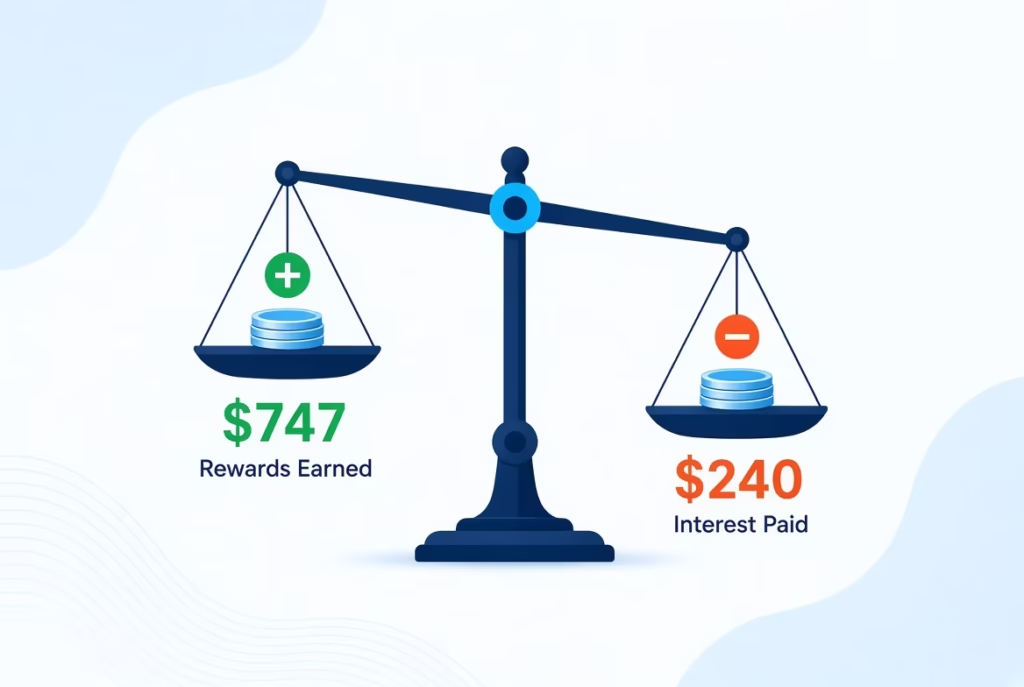
The practical takeaway: cash back rewards and rebates only net out positively when the bill is paid in full. If cash flow is tight and you expect to carry balances, a business credit card APR can turn your “savings” into extra cost.
Where Each Can Be Used: Acceptance Networks
A card that saves 10 cents a gallon is worthless if no station on your route takes it.
Fleet fuel cards work only within their own fleet card network, and network sizes vary widely. Some regional programs cover a few thousand locations. Universal-style networks cover far more. Fuelman, for instance, cites 40,000-plus discount network locations. Before committing to any fuel card, pull up its station locator and check it against your actual routes, especially if your drivers run regular lanes through rural areas.
Branded gas cards are the most restrictive: they work mostly at one fuel brand’s stations. That’s fine for a solo driver with a favorite brand nearby, but it’s a poor fit for vehicles covering wide territory.
Credit cards have no acceptance problem. Virtually every gas station and truck stop in the country takes major credit cards. If your operation is spread out or unpredictable, that flexibility has real value.
⚠️ Mistake to Avoid: Don’t sign up for a fuel card based on its rebate alone. A strong discount at stations your drivers never visit is worth exactly zero. Check network coverage first, rebate second.
Approval Requirements and Qualifying
Worried about qualifying? The two products have meaningfully different bars.
Fleet fuel cards are often more accessible to newer or credit-thin businesses than business credit cards. Some programs will approve businesses with little credit history. However, they might need a security deposit or a personal guarantee. Also, initial spending limits can be low. Underwriting criteria differ by provider and may not be public. So, be careful with any specific approval claims.
A business credit card typically involves a credit check, a review of business credit history, and frequently a personal guarantee from the owner. Newer businesses may qualify but start with lower limits, which can pinch if fuel is a major expense.
Does a Fuel Card Affect Your Credit or Require a Credit Check?
This is one of the most common points of confusion, so let’s be direct.
Many fleet fuel card programs do run a credit check at approval, on the business, the owner, or both. But approval is only half the story. Whether the account reports to credit bureaus afterward varies by provider and by program, and many fuel card providers don’t clearly disclose their reporting practices.
A business credit card, by contrast, generally reports to business credit bureaus and sometimes consumer bureaus as well. That makes it a genuine credit-building tool when managed well.
A fuel card is not generally a reliable way to build credit, so don’t choose one expecting it to strengthen your credit profile. If credit building matters to you, ask any provider directly whether they report, and to which bureaus, before applying.
Using a Fuel Card and Credit Card Together
The fuel card vs. credit card question doesn’t have to be either-or. For many small businesses, the smartest answer is both.
A common combined setup looks like this: the fuel card handles all fuel spending, where its controls and driver-level reporting do the heavy lifting. The business credit card handles everything else: supplies, travel, software, parts. Each tool does the job it’s actually good at.
This split maximizes both control and reward value. Fuel spend gets locked down and documented. General spending earns flexible cash back rewards without category caps eating the value. Expense tracking also stays clean, since each statement has a clear purpose.
One caution: running both means two statements, two due dates, and two integrations to reconcile. For a two-truck operation, that extra admin may outweigh the benefit. For a ten-vehicle fleet with an office manager, it’s usually worth it.
To manage this well, set up automated payments for both accounts. This ensures you never miss a deadline. You should also connect both card feeds to your accounting software. This keeps your records unified in one place. By making these systems work together, you avoid the headache of manual bookkeeping. Your spending stays organized while you focus on growing your business.
Which Should You Choose? A Decision Framework
Every section above feeds into this final call. Match your situation to the right tool:
Choose a fuel card alone if:
- You run multiple vehicles with employees driving them
- You’ve had (or fear) card misuse and want purchase restrictions at the pump
- You need IFTA reporting or gallon-level detail for fleet management
- Your routes sit inside a strong fuel card network
Choose a credit card alone if:
- You’re a solo driver or consumer comparing against a branded gas card
- Your monthly fuel volume is modest, so percentage cashback beats a per-gallon rebate
- You pay in full every month and value acceptance everywhere
- You want to build business credit through bureau reporting
Use both if:
- You have several drivers and also significant non-fuel business spending
- You want fuel locked down and general expenses earning rewards
For the individual driver segment, skip the fleet products entirely. Check how much you save per gallon with a branded gas card. Compare that to the rate you get with your rewards card. Use the math method from the cost section to find the difference. Factor in the branded card’s high APR risk if you ever carry a balance.
Switching From One to the Other
Decided to make a change? Handle the transition cleanly:
- Order the new cards before canceling anything, and overlap both briefly.
- Train drivers on the new card’s rules, PINs, and odometer prompts before day one.
- Update your expense software integrations so transactions flow into the right categories.
- Cancel the old card only after the final statement reconciles completely.
A rushed switch creates the exact bookkeeping mess you were trying to escape.
Frequently Asked Questions (FAQs)
Is it cheaper to use a fuel card?
It depends on your volume. At 500 gallons a month and $4.15 a gallon, a 6-cent fuel card rebate saves about $30 monthly, while 3% credit card cash back saves about $62. Fuel cards pull ahead only at higher volumes, since credit card rewards often cap out.
Is it better to use a fuel card or credit card?
Choose a fuel card if you manage multiple drivers and want purchase controls plus fuel-specific reporting. Choose a credit card if you’re a solo driver, spend a modest amount monthly, and want rewards that work anywhere.
What is the point of having a fuel card?
A fuel card restricts purchases to fuel (and sometimes maintenance) at the pump itself, not after the fact. It also tracks driver, vehicle, gallons, and odometer data automatically for cleaner bookkeeping.
What are the disadvantages of using fuel cards?
Fuel cards only work within their own station network, so coverage can be limited on certain routes. They also generally don’t build business credit, and some programs charge monthly account fees that cut into rebates.
Is gas a good thing to put on a credit card?
Gas is a good credit card expense only if you pay the statement in full each month. Carrying a $2,000 balance at 22% APR for a year costs about $240 in interest, which can erase an entire year’s cash back rewards.
Do fuel cards charge interest?
No. Fleet fuel cards work as charge cards, meaning the full balance is due every billing cycle with no interest charged. Late fees can still apply if you miss the due date, though.
Does a fuel card affect your credit score?
Many fuel card programs run a credit check at approval, but whether the account reports to credit bureaus afterward varies by provider. Unlike a business credit card, a fuel card generally isn’t a reliable way to build credit.
Wrapping Up
The fuel card vs. credit card decision comes down to what you need most: control and fuel-specific reporting, or flexibility and percentage rewards. Fleet fuel cards limit pump purchases and offer detailed transaction data. In contrast, credit cards can be used anywhere and provide cash back on all spending. For many small fleets, using both together covers every base.
A practical approach is to run your own numbers first: gallons per month, pump price, and any fees, then match the result to your fleet size and routes.
Know a business owner still handing out a shared credit card for gas? Share this guide with them. It might save their next expense report.