
Thinking about tapping your home’s equity for a renovation, tuition, or paying off high-interest debt? It’s a big decision, and it’s easy to feel lost. A lot of what you’ll find online mixes a home equity line of credit (HELOC) up with other products, which makes it hard to know what you’d actually be signing up for.
A HELOC is a revolving line of credit secured by your home. It lets you borrow against your equity, repay, and borrow again during a set draw period.
Below, you’ll learn how a HELOC works, how much you can borrow, what it costs, the real risks, and how it stacks up against other options so you can decide if it fits your plans.
At a Glance
This guide explains how a home equity line of credit works, including the draw and repayment periods, how much you can borrow using CLTV math, current interest rates, tax deductibility rules, and the real risks of using your home as collateral.
Core Facts:
- A HELOC is a revolving line of credit secured by your home, letting you borrow, repay, and borrow again during a set draw period, unlike a home equity loan, which pays out a single lump sum.
- Most HELOCs carry a variable rate tied to the prime rate; as of early September 2026, the prime rate was 6.75%, and the national average HELOC rate was about 7.29%.
- Lenders calculate your borrowing limit using combined loan-to-value (CLTV), commonly capped around 85%; on a $400,000 home with a $240,000 mortgage balance, that yields roughly $100,000 in available credit.
- Many lenders require a FICO score of at least 680 and a debt-to-income ratio of 43% or less, though requirements vary by lender.
- On a $50,000 balance at 8%, an interest-only draw-period payment of about $333 a month can rise to roughly $478 (15-year repayment) or $607 (10-year repayment) once repayment begins.
- HELOC interest is tax-deductible only when funds are used to buy, build, or substantially improve the home securing the loan, and only if you itemize deductions.
- Because the home is collateral, missed payments can lead to foreclosure, and federal rules allow lenders to freeze or reduce the credit line if home values drop significantly.
Best for:
- Homeowners facing ongoing or uncertain costs, such as a phased renovation or a standby emergency fund, who want to pay interest only on what they actually draw.
- Homeowners with a low first-mortgage rate who want to avoid giving it up, which a cash-out refinance would require.
- Homeowners who want to compare a HELOC against a home equity loan or cash-out refinance before deciding which financing option fits their timeline and need for payment certainty.
What a Home Equity Line of Credit Is
A HELOC is a revolving line of credit secured by the equity in your home. Equity is the gap between what your home is worth and what you still owe on your mortgage.
Here’s the part that trips people up: a HELOC is not a lump-sum loan. It works more like a credit card with a set credit limit. During the draw period, you can borrow money, pay it back, and borrow again, as often as you need, up to your limit.
Because your home secures the line, most HELOCs sit in a second-lien position. That means the lender’s claim on your home comes after your main mortgage lender’s claim. This is why you may hear a HELOC called a “second mortgage.”
Banks, credit unions, and online lenders all issue HELOCs. Terms vary a lot from one lender to the next, so shopping around matters.
One thing makes this product very different from a credit card or personal loan: your house is the collateral. If you don’t repay, the lender can foreclose. That single fact should shape every decision you make about how much to draw.
How a HELOC Works
A HELOC runs in two phases, and your payment looks very different in each one.
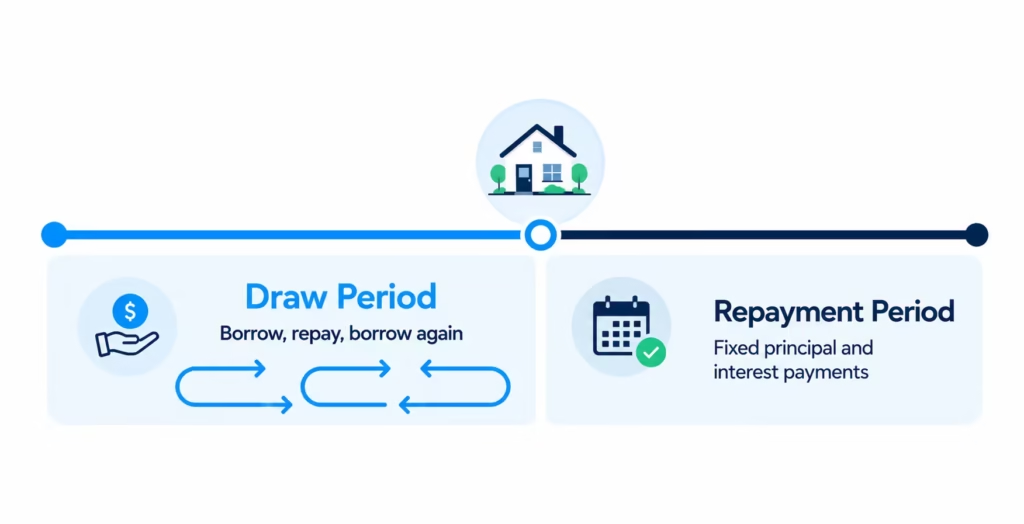
The draw period. This first phase commonly lasts 10 years, though terms vary by lender. You can pull money out as needed, up to your credit limit. During this phase, many lenders let you make interest-only payments on what you’ve borrowed. Some require a small amount of principal too.
The repayment period. When the draw period ends, you can’t borrow anymore. The line converts to a fully amortizing loan, often over 10 to 20 years. Your payment now covers principal plus interest.
Most HELOCs carry a variable interest rate tied to the prime rate. When the prime rate moves, your rate and your monthly payment move with it.
The prime rate stood at 6.75% as of early September 2026, and Bankrate’s national survey put the average HELOC rate at about 7.29% around the same time. Some lenders offer a fixed-rate conversion option, which lets you lock part of your balance at a fixed rate. That can add some predictability if rates make you nervous.
What Happens When the Draw Period Ends
This is where many borrowers get a nasty surprise. If you’ve been making interest-only payments for years, your payment can jump sharply when repayment starts.
Here’s a concrete example. Say you owe $50,000 at an 8% rate. During the draw period, an interest-only payment runs about $333 a month.
When the line shifts to a 15-year repayment schedule at the same rate, the payment climbs to roughly $478 a month. That’s about 44% more. With a 10-year repayment term, the payment jumps to about $607, an 82% increase. And if rates have risen by then, the new payment would be higher still.
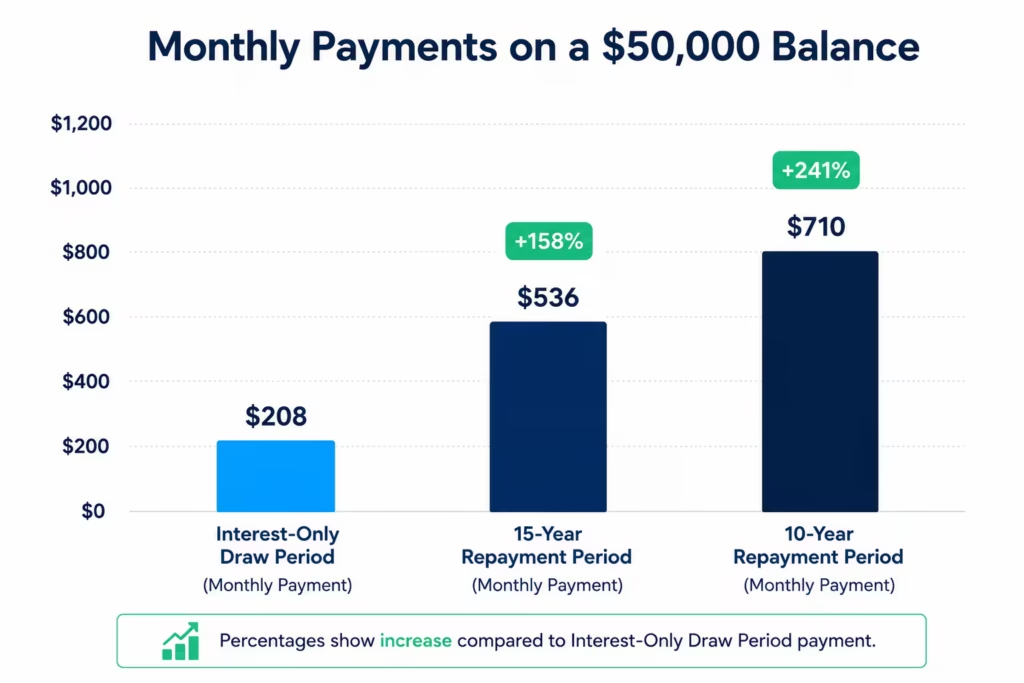
If the new payment won’t fit your budget, you have options. You can refinance into a new HELOC or home equity loan. You can also ask your lender to change the terms. Another option is to pay down the balance quickly before the draw period ends. The key is to plan for this shift years ahead, not the month it happens.
⚠️ Mistake to Avoid: Don’t assume your low interest-only payment is the “real” payment. Run the repayment-period numbers before you borrow, not after.
How HELOCs Compare to Similar Financing Options
A lot of confusion around HELOCs comes from mixing them up with two close cousins: the home equity loan and the cash-out refinance.
All three options let you tap home equity. But they differ in three main ways:
- How you get the money: lump sum or revolving line.
- How the rate works: fixed or variable.
- How payments are structured.
Keep those three differences in mind as you read the two comparisons below.
HELOC vs. Home Equity Loan
A home equity loan hands you one lump sum up front, usually at a fixed rate with a fixed monthly payment. A HELOC gives you a revolving line you draw from as needed, usually at a variable rate.
Which one fits depends on your situation:
- One-time, known cost (a contractor’s fixed bid, a single tuition bill): a home equity loan often fits better. You get a fixed payment you can plan around.
- Ongoing or uncertain costs (a phased remodel, a standby emergency cushion): a HELOC often fits better. You pay interest only on what you actually use.
As of September 2026, Bankrate’s survey showed average rates of 7.29% for HELOCs and 8.13% for home equity loans. However, your offer may vary based on your credit, equity, and lender.
HELOC vs. Cash-Out Refinance
A cash-out refinance replaces your entire first mortgage with a new, bigger one. You pocket the difference in cash. A HELOC sits alongside your existing mortgage as a second lien and leaves your first loan untouched.
That distinction matters a lot right now. If you locked in a low first-mortgage rate a few years back, a cash-out refi would force you to give it up and re-borrow at today’s higher rates. A HELOC lets you keep that low rate and borrow only what you need.
Cash-out refinances usually have higher closing costs. This happens because you’re refinancing the entire mortgage balance instead of just a smaller second line. The trade-off: a cash-out refi gives you one fixed payment on a single loan, which some borrowers find simpler to manage.
The choice between these options depends on your specific financial goals. HELOCs often come with variable interest rates that can change over time. This means your payments might go up or down based on market conditions. In contrast, fixed-rate home equity loans provide predictable monthly costs from start to finish. You should weigh these factors carefully before deciding which path fits your budget best.
How Much You Can Borrow With a HELOC
Lenders don’t let you borrow your home’s full value. They use a measure called combined loan-to-value (CLTV). CLTV adds your current mortgage balance and your requested credit line, then divides by your home’s appraised value.
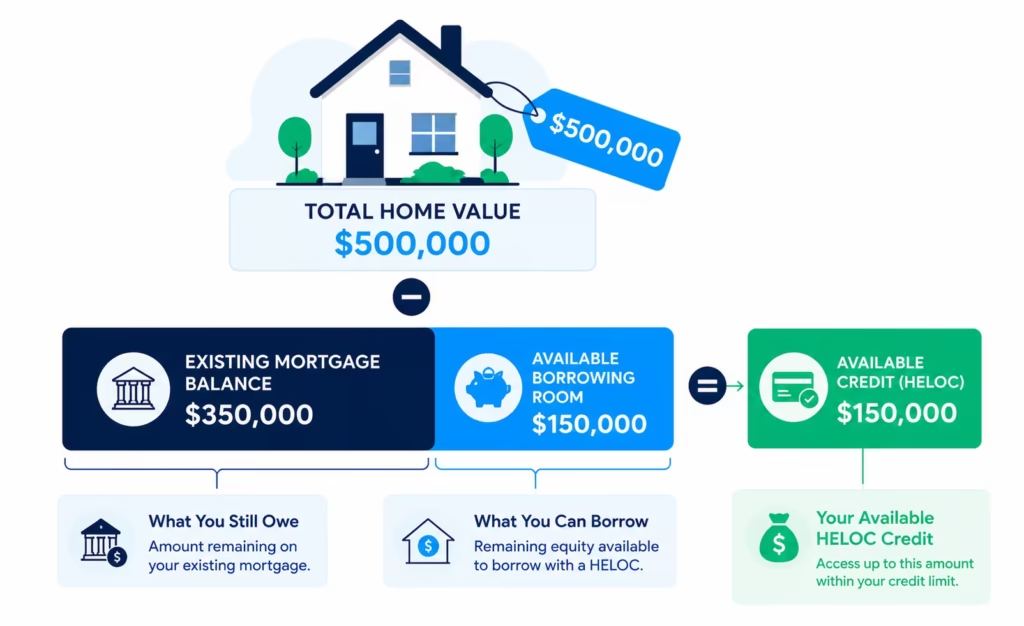
Many lenders cap CLTV at around 85%, though limits vary by lender and by your credit profile.
Here’s the math with real numbers:
- Home value: $400,000
- Current mortgage balance: $240,000
- Maximum CLTV at 85%: $400,000 × 0.85 = $340,000 in total allowed debt
- Available HELOC credit limit: $340,000 − $240,000 = $100,000
Why the cushion? Lenders want equity left in the home so they’re protected if values fall and they ever need to foreclose. That 15% buffer is their safety margin, not a random hurdle.
Also note: your approved credit limit isn’t a spending target. It’s a ceiling. The right draw amount is whatever your plan actually requires, and your budget can repay.
HELOC Qualification Requirements
Want to gauge your approval odds before you apply? Lenders generally look at four things.
Credit score. Many lenders look for a FICO score of at least 680, while some accept scores closer to 620, according to Experian. Higher scores usually unlock lower rates and higher credit limits.
Debt-to-income ratio (DTI). Your DTI compares your total monthly debt payments to your gross monthly income. Many lenders want to see 43% or less, though some allow higher ratios for strong applicants.
Equity. Most lenders require you to keep at least 15% to 20% equity in the home after the new line is added. That’s the CLTV limit from the last section working as an approval gate.
Income and employment. Expect to verify income with pay stubs, W-2s, or tax returns. Self-employed borrowers may need two years of returns.
Requirements vary meaningfully from lender to lender. If one lender’s terms look tight, another may offer more room, so compare at least a few before committing.
HELOC Interest Rates
Most HELOC rates are variable, built from two parts: the prime rate plus a margin set by the lender. The prime rate sat at 6.75% in early September 2026, following the Federal Reserve’s decision to hold its target range at 3.50% to 3.75%. If your margin is 1%, your rate would be 7.75%, and it would rise or fall whenever the prime rate changes.
As a snapshot, Bankrate’s national survey put the average HELOC rate near 7.29% in early September 2026, close to multi-year lows. Treat that as a reference point, not a promise. Rates move, and your personal offer depends on your credit score, CLTV, line size, and lender.
Three features are worth asking any lender about:
- Fixed-rate lock: Some lenders let you convert part of your balance to a fixed rate, sometimes more than once.
- Rate caps: Many HELOCs carry a lifetime ceiling that limits how high your rate can go.
- Rate floors: Some lines have a floor, so your rate won’t drop a set level below even if prime falls.
HELOC Costs Beyond the Interest Rate
Comparing lenders on rate alone can cost you. The CFPB notes that HELOCs can come with several fees, and the mix varies by lender:
- Closing costs: Often 2% to 5% of the credit line when charged. On a $50,000 line, that’s roughly $1,000 to $2,500. Some lenders waive closing costs entirely, sometimes in exchange for a higher rate or an early closure fee.
- Appraisal or valuation fee: Often $300 to $600 for a full appraisal, though some lenders use cheaper automated valuations.
- Annual or membership fee: Commonly $50 to $100 per year at lenders that charge one.
- Inactivity fee: Some lenders charge a fee if you open the line and never use it.
- Early closure fee: Often $200 to $500 if you close the line within the first two or three years.
💡 Pro Tip: Ask every lender for a full fee sheet, not just the APR. A no-closing-cost HELOC with an annual fee and early closure penalty can cost more over five years than a line with upfront fees and nothing else.
The HELOC Application and Approval Process
From funding application, a HELOC commonly takes two to six weeks, depending on the lender, the appraisal, and how fast you supply documents. If you need money by a fixed date, like a tuition deadline or a contractor’s start date, apply early.
The process typically follows these steps:
- Application: You share income, employment, and property details, and the lender pulls your credit.
- Documentation: Expect requests for pay stubs, W-2s or tax returns, mortgage statements, and homeowners insurance.
- Appraisal or valuation: The lender confirms your home’s value, which sets your CLTV and credit limit.
- Underwriting: The lender verifies everything and issues a decision.
- Closing: You sign the final paperwork, often with a notary or online.
One protection worth knowing: federal law gives you a right of rescission under the Truth in Lending Act. For a HELOC secured by your primary home, you have three business days after closing to cancel the deal for any reason, without penalty. The line can’t fund until that window passes, so build those extra days into your timeline.
Risks of Taking Out a HELOC
This section deserves your full attention, because the risks here are different in kind from other borrowing.
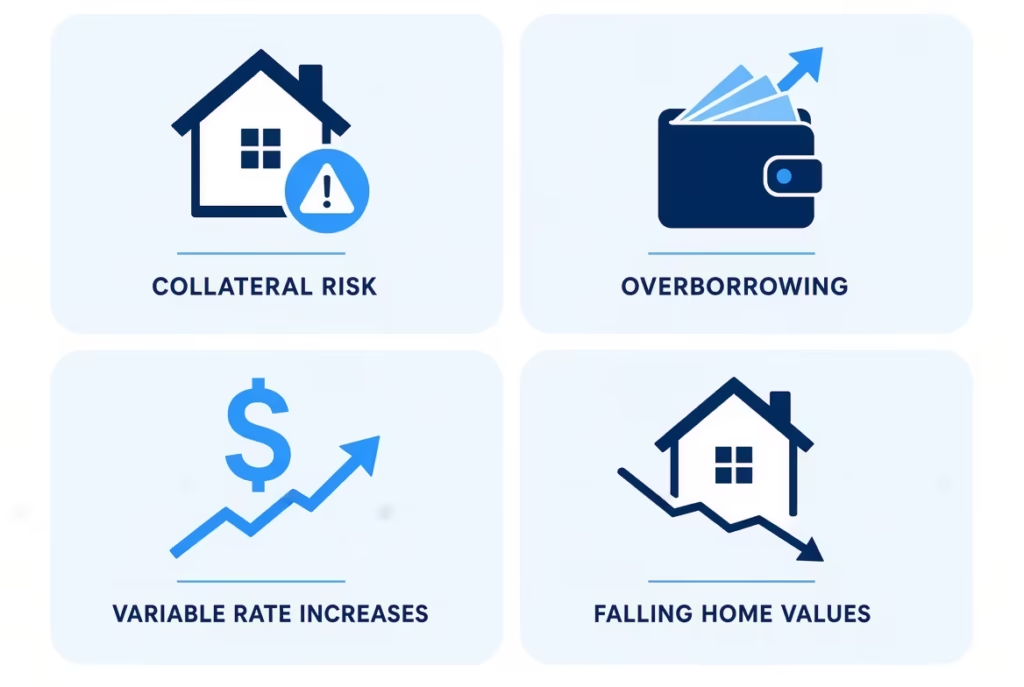
Your home is on the line. A HELOC is secured debt. Miss enough payments and the lender can foreclose, even if you’re current on your first mortgage. Never treat the line like a credit card in your head. It isn’t one.
Overborrowing is easy. A large available limit can feel like cash on hand. Borrowing for depreciating purchases or daily spending against your home’s equity can quietly erode your biggest asset.
Variable rates cut both ways. If the prime rate rises, your payment rises. A few points of rate increase on a large balance can add hundreds of dollars a month.
Home values can fall. If prices drop, you could owe more than the home is worth, which limits your ability to sell or refinance.
📌 Did You Know: Some HELOC agreements let lenders demand the full balance if you default. Also, foreclosure can happen on a second lien, even if the first mortgage is fine.
What Happens If You Sell Your Home or Its Value Drops
If you sell, the HELOC doesn’t transfer or linger. The balance must be paid off at closing from your sale proceeds, along with your first mortgage.
If your combined mortgage and HELOC balances exceed the sale price, you face negative equity. In that case, you’d need to bring cash to closing or negotiate with the lender, since the sale alone won’t clear the debt.
There’s another scenario that surprises people. If your home’s value drops significantly while the line is open, federal rules allow the lender to freeze or reduce your credit line. That means funds you were counting on for a mid-project draw may not be there. Keeping your total borrowing well under your limit, and your limit well under your equity, gives you a buffer against this.
Is HELOC Interest Tax-Deductible
Sometimes. Under current law, interest on a HELOC is deductible only when you use the funds to buy, build, or substantially improve the home that secures the loan. This standard comes from the Tax Cuts and Jobs Act, and per IRS Publication 936, it applies to total qualified mortgage debt of up to $750,000 ($375,000 if married filing separately).
What counts in practice:
- Qualifying: A kitchen remodel, a new roof, a room addition, replacing the HVAC system.
- Not qualifying: Paying off credit cards, covering tuition, a vacation, or buying a car, even though the loan is secured by your home.
Two more catches. You must itemize deductions to claim it, so if you take the standard deduction, the interest isn’t deductible at all. And you’ll generally document the interest using IRS Form 1098, which your lender sends each year.
This is general information, not tax advice. The “substantially improve” line has gray areas, so a tax professional can confirm how the rules apply to your specific project and filing situation.
Is a HELOC the Right Choice for Your Situation
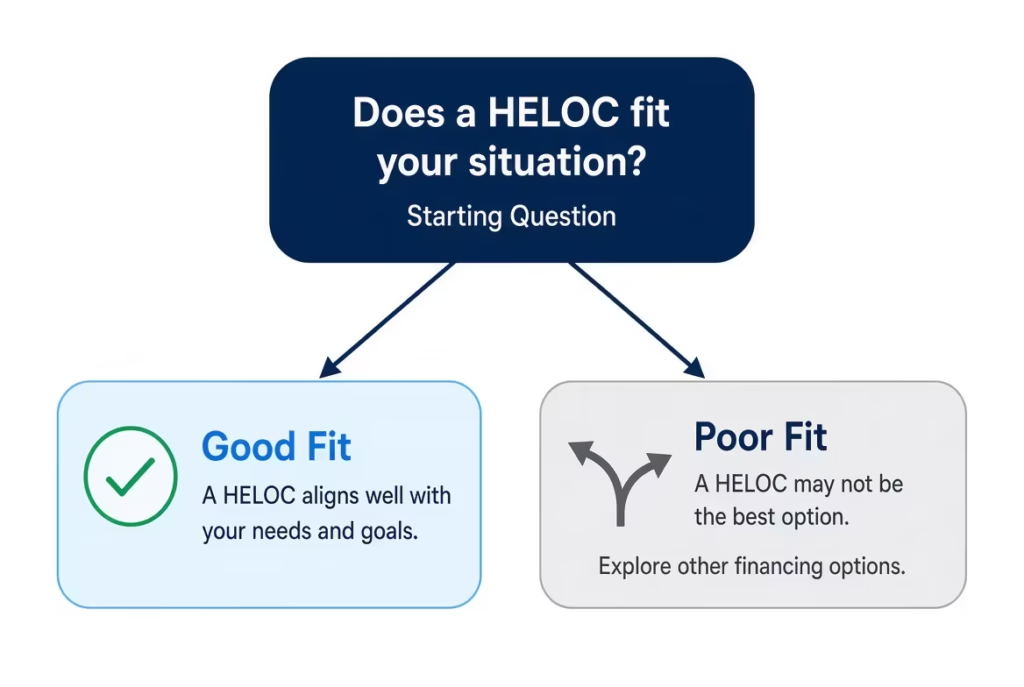
Pull it all together with a simple framework. A HELOC tends to be a strong fit when:
- Your costs are ongoing or uncertain, so flexibility has real value
- You have steady income and the discipline not to treat the line as spare cash
- You have a solid equity cushion, and your local market looks stable
- Your first-mortgage rate is low enough that replacing it would be costly
It can be a bad match if your income is unstable. You might want payment certainty, so a fixed-rate product could be better. Also, if your equity cushion is thin, even a small price drop could leave you underwater.
Common Uses for a HELOC
Home renovations and improvements. The most common use, and the one that may qualify for the interest deduction. Phased projects fit the draw-as-you-go structure well.
Debt consolidation. Swapping 20%+ credit card rates for a rate near 7% can save real money. But you’re turning unsecured debt into debt secured by your home. If you run the cards back up afterward, you’re worse off than before.
Education expenses. A HELOC can bridge tuition gaps, though federal student loans often carry protections a HELOC doesn’t, so compare first.
Emergency standby line. Some homeowners open a line and never draw on it, keeping it as a backstop. Watch for annual and inactivity fees if you go this route.
Investment opportunities. Some people use their home equity to fund business ventures or stocks. This is a very risky strategy. You are putting your roof at risk to chase higher returns. If the investment fails, you could lose your home along with your money. Only take this risk if you have an ironclad plan and plenty of extra cash.
Alternatives to a HELOC
If the sections above point you away from a HELOC, you still have paths forward:
- Home equity loan: A fixed lump sum with fixed payments. Better for one-time costs when you want predictability.
- Cash-out refinance: Replaces your first mortgage. Worth considering if current rates beat your existing rate and you want one simple payment.
- Personal loan: Unsecured, so your home isn’t collateral. Rates are higher (around 12% on average in recent Bankrate data), but it can make sense for smaller amounts or thinner equity.
- 0% intro APR credit card: For smaller, short-term expenses you can repay within the promo window. Miss the payoff date and the math flips fast.
Each option has its own trade-offs in cost, risk, and structure. The right choice depends on your amount, timeline, and how much rate certainty you need.
Start by listing your top financial goals. Compare the total interest costs for each loan type. Read the fine print carefully, especially regarding fees and variable rates. You might also talk to a trusted financial planner. They can help you see how these choices fit into your long-term budget. Taking these extra steps helps you protect your property and your wallet.
Frequently Asked Questions (FAQs)
What is the cheapest way to borrow against home equity?
Among home equity options, a HELOC typically carries the lowest average rate, around 7.29%, compared to about 8.13% for a home equity loan. Personal loans run higher still, averaging around 12%, since they’re unsecured.
Is a HELOC better than a home equity loan?
A HELOC fits ongoing or uncertain costs better, since you only pay interest on what you actually draw. A home equity loan fits one-time, known costs better, since it gives you a fixed payment you can plan around from day one.
Is HELOC interest tax deductible?
Only if you use the funds to buy, build, or substantially improve the home securing the loan, and only if you itemize deductions. Paying off credit cards, tuition, or a vacation with HELOC funds does not qualify, even though the loan is secured by your home.
How is a $50,000 home equity loan different from a $50,000 HELOC?
A $50,000 home equity loan pays out as one lump sum with a fixed rate and fixed monthly payment from the start. A $50,000 HELOC gives you a revolving credit limit you draw from as needed, usually at a variable rate, so your payment depends on how much you’ve actually borrowed.
What credit score is needed for a HELOC?
Many lenders look for a FICO score of at least 680, while some accept scores closer to 620. A higher score usually unlocks a lower rate and a higher credit limit.
What is a better option than a HELOC?
A home equity loan suits one-time costs better if you want a fixed payment, while a cash-out refinance can work if today’s rates beat your current mortgage rate. A personal loan or a 0% intro APR credit card can fit smaller, shorter-term expenses without putting your home up as collateral.
What fees come with a HELOC beyond the interest rate?
Closing costs often run 2% to 5% of the credit line, and an appraisal typically costs $300 to $600. Some lenders also charge an annual fee of $50 to $100, an inactivity fee if you never draw on the line, or an early closure fee of $200 to $500 within the first two or three years.
Can a lender freeze or reduce your HELOC credit line?
Yes, federal rules allow a lender to freeze or reduce your credit line if your home’s value drops significantly while the line is open. This means funds you were counting on for a future draw may not be available, so keeping your borrowing well under your approved limit helps guard against this.
What is the monthly payment on a $50,000 home equity line of credit?
During the draw period at an 8% rate, an interest-only payment on $50,000 runs about $333 a month. Once repayment begins, that payment can rise to roughly $478 on a 15-year term or $607 on a 10-year term.
Wrapping Up
A HELOC gives you flexible access to your home’s equity, with a draw period for borrowing and a repayment period for paying it back. The trade-offs are real: variable rates, fees beyond the headline APR, and the fact that your home secures the debt.
For many readers, a smart way to proceed is to calculate CLTV. Then, stress-test the repayment amount. Also, compare fee sheets from at least three lenders before applying.
Know a homeowner weighing a remodel, tuition bill, or debt payoff? Share this guide with them. A clear picture of how this product works could save them from a costly surprise.