
You’re at checkout, about to buy something, and you spot the Afterpay button. It sounds simple: split your purchase into four payments. But you probably have real questions before you tap it. When does the first payment hit? Is there a credit check? What happens if a payment fails?
Afterpay is a buy now, pay later service that splits an eligible purchase into four equal, interest-free payments over six weeks, with the first payment due right at checkout.
Below is how the payment schedule works: what it costs, how it affects your credit, and what to expect if issues arise. This way, you can choose confidently before using your card.
At a Glance
This guide explains what Afterpay is and how its Pay in 4 service works, including the exact payment schedule, credit check details, late fee structure, and what happens if a payment is missed.
Core Facts:
- Afterpay is a buy now, pay later service operated by Afterpay US Services, LLC, owned by Block, Inc., that splits an eligible purchase into four equal payments over six weeks.
- The first payment, 25% of the total, is due immediately at checkout, with the remaining three payments charged automatically every two weeks.
- Pay in 4 has no interest when payments are made on time, and the merchant pays Afterpay a fee rather than the customer.
- Afterpay does not perform a hard credit check for Pay in 4 and does not report on-time payments to Experian, Equifax, or TransUnion.
- A missed payment triggers a paused account and a grace period of about 10 days before a late fee is applied, capped at 25% of the order value.
- Afterpay also offers a separate Pay Monthly product for purchases roughly between $400 and $4,000 that does charge interest and requires a credit check.
Best for:
- Shoppers deciding whether to use Afterpay for an upcoming purchase who want to know the exact payment schedule and costs before checkout.
- People concerned about credit score impact who want to understand when Afterpay does or does not involve a credit check.
- Anyone who wants to understand what happens step by step if a payment fails or is missed.
What Afterpay Is
Afterpay is a buy now, pay later (BNPL) service. It is not a credit card, and it doesn’t work like a traditional loan with a revolving balance. Instead, it splits one specific purchase into a fixed payment plan.
In the US, the service is operated by Afterpay US Services, LLC, which is owned by Block, Inc. That’s the same company behind Cash App and Square. So this isn’t a pop-up startup or a store gimmick. It’s a large, regulated financial company.
The core product is called Pay in 4. It breaks an eligible purchase into four equal payments spread over six weeks. If you pay on time, you pay zero interest. The reason it can be genuinely free for you is simple: the merchant pays Afterpay a fee for offering it, not you.
Afterpay also offers a longer-term option called Pay Monthly for bigger purchases. That one works differently and can charge interest. We’ll break down the difference later, because mixing up the two is one of the most common mistakes shoppers make.
How to Use Afterpay (Online, In-Store, and Signing Up)
The basic flow is the same everywhere: you shop as normal, then choose Afterpay as your payment method at checkout. The details differ a bit depending on whether you’re buying online or in a physical store.
Using Afterpay for Online Purchases
Online is the most common way people use Afterpay. The steps look like this:
- Shop at a retailer that offers Afterpay and add items to your cart.
- At checkout, select Afterpay as your payment method.
- Log in to your Afterpay account, or create one if it’s your first time.
- Link a debit or credit card. This is the card your payments will be charged to.
- Review the payment schedule and confirm.
The approval decision happens right at the point of sale, usually in seconds. You’ll see your four-payment schedule before you commit to anything. You can find participating stores and the full process on Afterpay’s how it works page.
Using Afterpay In-Store With the Afterpay Card
Yes, you can use Afterpay in physical stores too. It works through the Afterpay Card, which is a virtual card that lives in your phone’s digital wallet.
To set it up, open the Afterpay app, go to the In-store tab, and follow the prompts to add the Afterpay Card to your Apple Wallet or Google Wallet. Once it’s there, you tap to pay at the register just like any other contactless payment. The purchase is then split into four payments over six weeks, same as online.
The app also shows you which nearby stores accept it, so check that list before you head out.
Creating an Account vs. Returning Customer Login
First-time users need to create an account. You’ll need to be at least 18 years old, a US resident, and willing to share basic info like your name, email, phone number, and a payment card. The approval decision is instant and happens while you’re standing at checkout.
Returning customers skip all of that. You just log in, confirm the purchase, and go. One thing to know: “instant approval” doesn’t mean guaranteed approval. Each purchase is assessed on its own, which we’ll explain in the spending limits section.
How Afterpay Pay in 4 Actually Works
This is the part most people get wrong, so let’s be exact.
Pay in 4 splits your total into four equal payments of 25% each. The first payment is due immediately at the time of purchase. Not in two weeks. Right now, before the order even ships. The remaining three payments are automatically charged to your linked debit or credit card every two weeks. That means the full plan runs six weeks from start to finish.
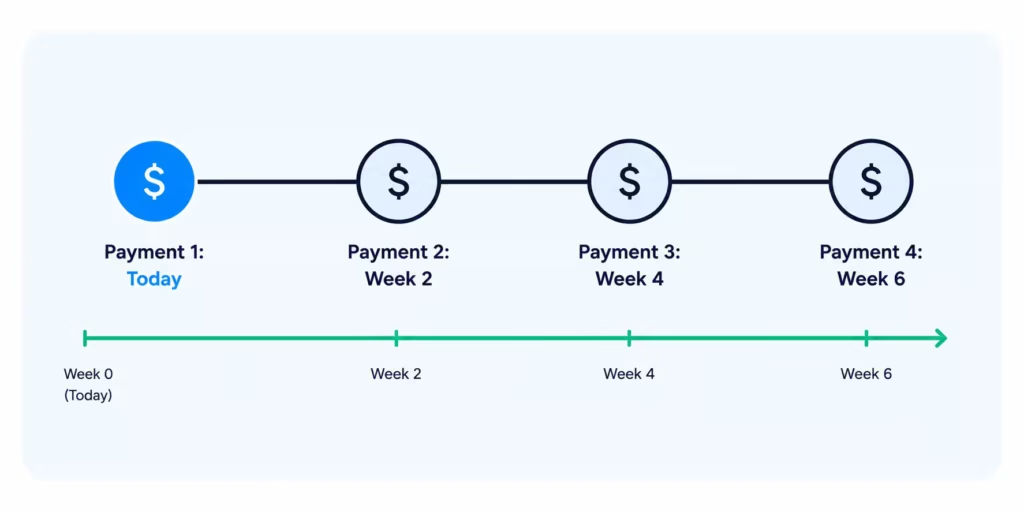
Taxes and shipping are part of the total that gets split. So if your cart is $180 but taxes and shipping push it to $200, the $200 is what gets divided by four.
“Interest-free” has one condition: paying on time. There’s no interest ever on Pay in 4, but missed payments can trigger late fees. More on that shortly.
Example Payment Schedule (Real Numbers)
Say you buy a $200 jacket on September 1, including taxes and shipping. Here’s what your plan looks like:
| Payment | Due date | Amount |
|---|---|---|
| 1 | September 1 (at checkout) | $50 |
| 2 | September 15 | $50 |
| 3 | September 29 | $50 |
| 4 | October 13 | $50 |
| Total | $200 |
Pay everything on time and your total cost is exactly $200. Not a cent more. That’s the whole appeal, and it’s also why the first surprise for many new users is that immediate $50 charge. Budget for it before you tap confirm.
⚠️ Mistake to Avoid: Don’t assume “pay later” means the first payment comes later. Afterpay charges 25% the moment you buy. If your linked card can’t cover it, the purchase won’t go through, or worse, it could overdraft your account.
Does Afterpay Affect Your Credit Score?
This is the biggest fear most first-time users have, so here’s the plain answer: for standard Pay in 4, using Afterpay does not build or hurt your credit score under normal use.
Afterpay doesn’t perform a hard credit check for Pay in 4. Plus, your on-time payments aren’t reported to the major credit bureaus: Experian, Equifax, and TransUnion. Most BNPL plans like this don’t involve the hard credit inquiries that traditional financing requires.
That cuts both ways. On-time Afterpay payments won’t help you build credit either. If building a credit history is your goal, this isn’t the tool for that.
Does Afterpay Do a Credit Check When You Sign Up?
Sometimes, yes, but it’s a soft credit check, not a hard one. According to Afterpay’s own help center, the company may run a soft credit check, and that check does not impact your credit score.
A soft check lets Afterpay see basic credit information, but it doesn’t show up to other lenders and has zero effect on your score. You could check your own credit report a hundred times the same way with no impact.
Note that the Pay Monthly product involves its own credit check process, which is separate from Pay in 4.
When Afterpay Can Actually Hurt Your Credit
There is one real risk path, and it’s worth knowing about. If you stop paying entirely and the debt goes unpaid long enough, Afterpay can send the account to a collections agency. A collections account can then be reported to the credit bureaus independently, and that can genuinely damage your score.
This is rare, and it only happens after extended non-payment. But it’s the reason you should treat Afterpay as a real financial obligation, not free money. The protection works like this: pay on time, and your credit is untouched. Ignore the debt for months and collections becomes a possibility.
What Happens If You Miss an Afterpay Payment
Life happens. Payday shifts, a card gets declined, an account runs low. Here’s the actual sequence of events when a payment fails, step by step:
- The charge fails. Afterpay tries to charge your linked card on the due date, and it doesn’t go through.
- You get notified. Afterpay alerts you that the payment was missed, so it won’t be a silent surprise.
- Your account is paused. Per Afterpay’s help center, a missed payment immediately pauses your account. You can’t make new Afterpay purchases until it’s resolved, and your spending limit may drop.
- The grace period runs. According to Afterpay’s responsible spending page, a late fee may be charged only after a grace period, usually around 10 days, passes without payment.
- The late fee is applied. If you still haven’t paid after the grace period, the fee lands on your account.
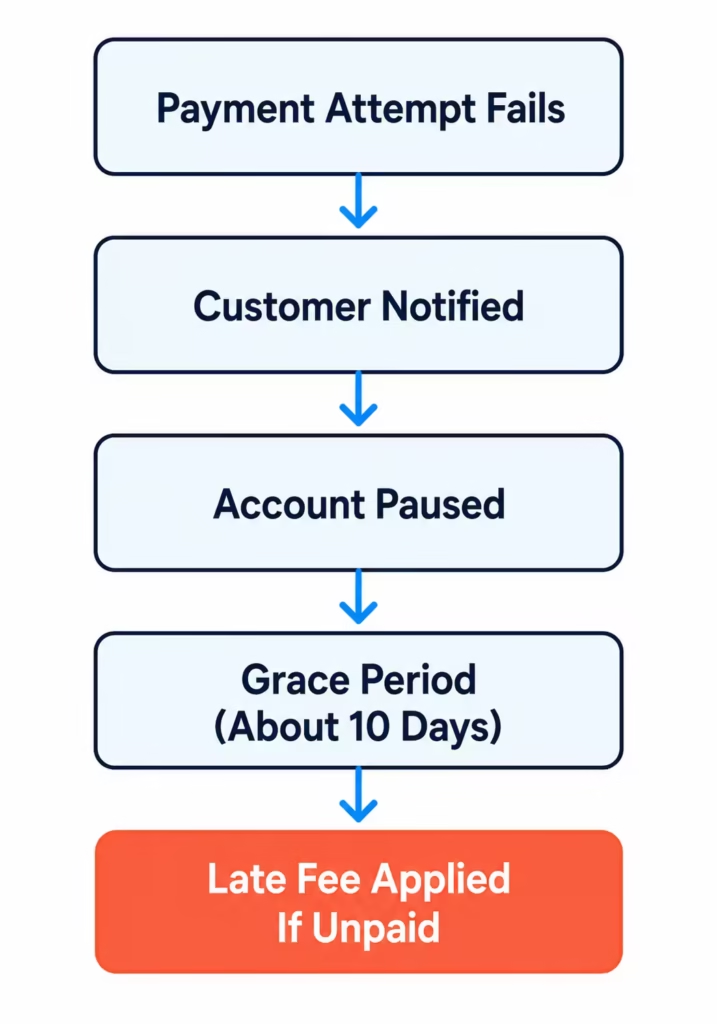
The smartest move is acting before the due date, not after. The Afterpay app lets you reschedule a payment in advance, which can help you avoid the fee entirely. If you know a charge will bounce, open the app and move the date before it’s due.
Late Fees: How Much They Cost and How They’re Capped
Late fees on Pay in 4 are capped at 25% of the original order value, so they can’t spiral without limit. Fees apply per order, tied to the missed installment, not as some recurring account-wide penalty.
A few practical points:
- The cap is tied to your order size. A $100 order means late fees can never exceed $25 on that order.
- If it’s your first miss, it’s worth contacting Afterpay support. Some users are able to get a first late fee waived, though this isn’t guaranteed and is handled case by case.
- Paying the overdue amount and any fee gets your account unpaused, but your spending limit may stay lower for a while.
💡 Pro Tip: Rescheduling a payment in the app before it’s due costs nothing. Waiting until after it fails can cost you a fee and a paused account. If money is tight on the due date, reschedule early, not late.
How Afterpay Spending Limits and Approval Work
There’s no single Afterpay spending limit that applies to everyone. Limits are individualized, and Afterpay doesn’t publish the full formula behind them.
What is clear from how the system behaves: new customers typically start with lower limits. As you complete orders on time, your limit can grow. Think of it as earning trust with the platform.
Two terms worth knowing:
- Spend limit is the overall cap on your account.
- Available to spend is what’s left right now, after your open orders are counted.
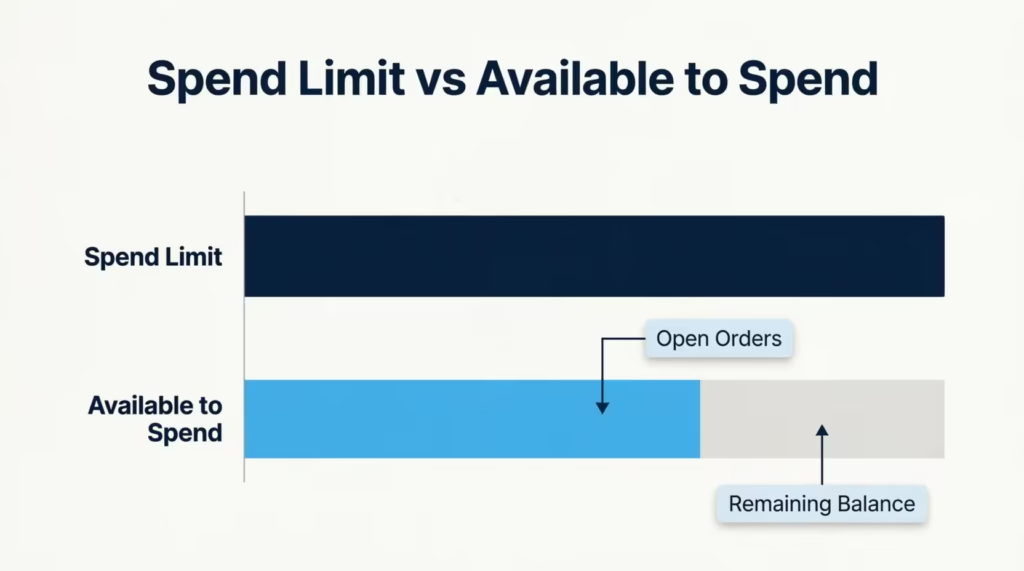
One more key point: every purchase is assessed separately at checkout. Having a limit doesn’t guarantee any single purchase is approved. Merchants can set their own minimums, so some stores need a minimum cart total. This is often around $35, but it can vary. Afterpay will only show up at checkout if you meet that amount.
Why a Purchase Might Get Declined or Limited
Getting declined is common and usually not personal. The most frequent reasons:
- You’re new. No payment history yet, so the system starts you small.
- Open orders are eating your capacity. Existing plans count against what’s available to spend.
- An unpaid late fee or overdue payment is sitting on your account.
- The merchant’s own limits are stricter than Afterpay’s.
- The timing or size of the purchase doesn’t pass that specific checkout assessment.
If you’re declined, the fix is usually boring: pay down open orders, clear any overdue amounts, and try again with a smaller purchase.
Managing Multiple Afterpay Orders at Once
Afterpay lets you run several payment plans at the same time. That’s convenient, but it’s also where people get into trouble. Each order’s payments reduce your available spending. It’s easy to lose track of your total when three plans charge your card in different weeks.
Open the app regularly and check the total you owe across all active plans, not just the next payment due. If the combined biweekly charges would strain your budget, that’s a signal to hold off on the next purchase until a plan or two is finished.
Afterpay Pay in 4 vs. Pay Monthly: What’s the Real Difference
This is where a lot of confusion (and panic) comes from. You may have read somewhere that “Afterpay charges interest.” That’s only true for one of its two products.
The details above come straight from Afterpay’s Pay Monthly page, which confirms that Pay Monthly loans are subject to credit check and approval and aren’t available in all states.
How do you know which one you’re being offered? Look at the checkout screen. Pay in 4 always shows four payments over six weeks. Pay Monthly shows monthly payments with an APR disclosed. If you see an APR listed, you’re looking at Pay Monthly.
For standard Pay in 4, there are no signup fees, no service fees, and no interest. Late fees are the only cost risk, and only if you miss payments.
How Returns and Refunds Work With Afterpay
Good news: returning something bought with Afterpay is straightforward, but it runs through the store, not Afterpay.
The merchant’s own return policy applies. Afterpay doesn’t decide whether you can return an item; the store does. Once the merchant accepts your return and processes the refund, they tell Afterpay. Then, Afterpay updates your payment plan.
The refund is applied in a specific order:
- It goes toward your remaining installments first, reducing or eliminating what you still owe.
- If you’ve paid more than the adjusted total (for example, if you paid two out of four installments and then returned the item), the difference is refunded to your original payment method.
Timing depends on two things: how fast the merchant processes the return, and then how fast the refund settles. Expect it to take several business days after the store confirms the return. Keep making scheduled payments in the meantime if any come due, since a refund in progress doesn’t pause your plan.
Is Afterpay a Loan, and Who Is Financially Responsible
Yes, Pay in 4 is a form of credit, even if it doesn’t feel like one. When you check out with Afterpay, you’re entering a payment agreement, and Afterpay operates under state lending licenses (in California, for example, it operates under a lending license). This is a regulated financial product, not a marketing gimmick.
You, the customer, are financially responsible for all four payments, regardless of how casual the branding feels. If you don’t pay, the earlier consequences kick in: fees, a paused account, and eventually collections for long-term non-payment.
How it compares to things you already know:
- Versus a credit card: No revolving balance and no interest accrual on Pay in 4. You can’t carry the debt month to month.
- Versus layaway: You get the item immediately. With old-school layaway, the store held your item until you finished paying.
Is Afterpay Safe and Legitimate to Use
Afterpay is a legitimate, regulated financial service. It’s operated in the US by Afterpay US Services, LLC, owned by Block, Inc., and it’s offered by thousands of major mainstream retailers. Payment data is handled under PCI DSS standards, the same security standard used across the card payments industry.
The bigger real-world risk isn’t Afterpay itself. It’s scammers exploiting its popularity. Phishing texts and emails posing as Afterpay (“your payment failed, click here”) are common. Protect yourself:
- Only log in through the official app or afterpay.com, never through a link in a text or email.
- Afterpay won’t ask for your password or full card number by text.
- When in doubt, open the app directly and check your account there.
One final distinction worth making: safe and suitable are different things. Afterpay is safe to use in the technical sense. Whether it suits your budget depends on whether you can comfortably make all four payments on time. That’s a judgment only you can make.
Frequently Asked Questions (FAQs)
What is the downside of Afterpay?
The main downsides are late fees, which can reach 25% of your order, and a paused account if you miss a payment. Running several plans at once can also strain your budget since each order’s payments count against what you have available to spend.
Can you be denied for Afterpay?
Yes, each purchase is assessed separately, so approval isn’t guaranteed even with a good spend limit. Common reasons include being a first-time user, having open orders, unpaid late fees, or the merchant’s own stricter minimums.
Can I borrow cash from Afterpay?
No. Afterpay splits payment for a specific retail purchase into four installments; it doesn’t provide cash loans or funds you can withdraw. The service only works through participating merchants at checkout.
Do I need money in my account to use Afterpay?
Yes. Your first payment, 25% of the total, is charged immediately at checkout, not later. If your linked card can’t cover that amount, the purchase won’t go through and could trigger an overdraft.
How do you get approved for Afterpay?
You need to be at least 18, a US resident, and provide basic details plus a payment card when creating your account. The approval decision happens instantly at checkout, though each purchase is still assessed individually.
What’s the highest limit Afterpay will give you?
Afterpay doesn’t publish a universal maximum, since spend limits are set individually and grow over time with on-time payment history. New customers typically start with a lower limit that increases gradually as trust builds with the platform.
Why did I only get approved for a small amount on Afterpay?
New customers usually start with a lower limit since there’s no payment history yet to assess. Your limit typically grows the more you complete orders on time.
Is it better to have a credit card or Afterpay?
It depends on what you need: Afterpay’s Pay in 4 has no revolving balance or interest, but on-time payments don’t build credit history as a credit card can. A credit card suits ongoing borrowing and credit building, while Afterpay suits a single fixed purchase paid off in six weeks.
What does the dollar amount in my Afterpay account, like $600, actually mean?
That number is your available spending limit, an estimate of what you can put toward a new Pay in 4 purchase right now. It reflects your overall spend limit minus any open orders, unpaid late fees, or other factors Afterpay weighs.
The Bottom Line
Afterpay’s Pay in 4 splits a purchase into four equal payments over six weeks, with 25% due at checkout and no interest when you pay on time. It uses soft credit checks at most, doesn’t report on-time payments to the bureaus, and caps late fees at 25% of your order. The real risks are manageable: missed payments, overstacked plans, and mistaking it for the interest-charging Pay Monthly option.
A practical approach for many shoppers: start with one small purchase, pay it off on schedule, and let your limit grow from there.
Know someone hovering over that Afterpay button for the first time? Share this guide with them so they understand exactly what they’re agreeing to before they tap confirm.