
I get why charge cards feel confusing. You hear the term thrown around next to “credit card,” but the rules aren’t the same, and one wrong assumption about paying the balance in full or “no preset limit” can cost you real money. If you’re weighing whether a charge card fits how you actually spend and pay, that uncertainty is worth clearing up first.
A charge card lets you make purchases now. You must pay the full balance by the due date. It usually doesn’t have a fixed credit limit.
Below, we’ll walk through how it works step by step, what happens if you miss a payment, how it compares to a credit card, the fees to watch for, and who it fits best.
Key Takeaways
This guide explains what a charge card is, how full monthly payments and flexible spending power work, plus fees, credit effects, drawbacks, and who the product fits.
Core Facts:
- Charge cards generally require the full statement balance by the due date instead of allowing a minimum payment and revolving balance.
- Most charge cards have no traditional preset credit limit, but spending power changes based on purchases, payments, credit history, and other factors.
- Statements generally cover a billing cycle of about 30 days, with payment due about 21 to 25 days after the cycle closes.
- Charge cards can have annual fees, late-payment charges, foreign transaction fees, and optional Pay Over Time costs that may include interest.
- Charge cards generally are not included in revolving credit utilization, but payment history, account age, inquiries, and credit mix still affect credit.
Best for:
- People who consistently pay existing card balances in full and want flexible spending power.
- Business owners, consultants, and frequent travelers with variable monthly spending and predictable income.
- Rewards-focused users who can use card benefits enough to justify annual fees and avoid carrying balances.
What Is a Charge Card?
A charge card is a type of payment card that lets you make purchases on credit, with one important condition. You must pay the full balance by the statement due date each month. It works like a short-term line of credit, not a long-term borrowing tool.
Two features set it apart from a regular credit card. First, there’s the full-payment rule. You can’t roll a balance from one month to the next as you do with a normal credit card. Second, most charge cards do not come with a traditional preset credit limit. Your spending power is flexible, and the issuer adjusts it based on how you use the card.
A charge card is still a credit account. It is not a debit card, and it is not a prepaid card. A debit card pulls money straight from your checking account. A prepaid card only lets you spend money you loaded onto it. A charge card, on the other hand, gives you a short window of credit that must be settled in full each cycle.
This is also different from revolving credit. Revolving credit lets you carry unpaid balances forward month after month, with interest added. A traditional charge card means the opposite setup. Charges are cleared each cycle, so there’s no long-term balance building up.
How Does a Charge Card Work?
Using a charge card feels a lot like using any other credit card at checkout. You swipe, tap, or enter your card number online. The issuer approves the purchase, pays the merchant, and adds the amount to your account. The difference shows up when the bill arrives.
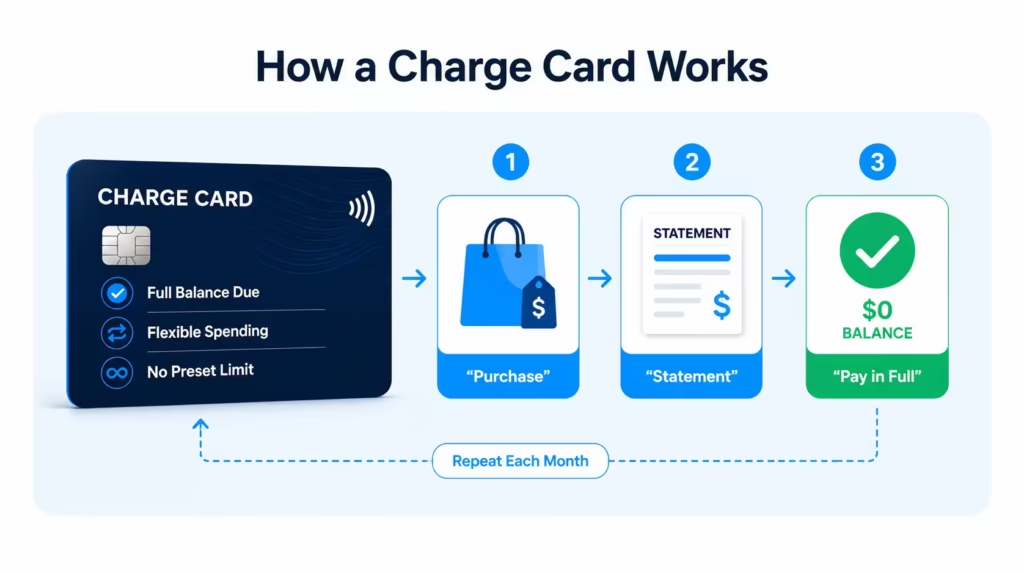
Say you use the card for a $1,200 laptop on the 5th of the month. Then you spend $300 on groceries and $250 on gas over the next two weeks. All three purchases sit on your account during the billing cycle. When the cycle closes, the issuer sends you a statement showing a total balance of $1,750.
The statement balance is the full amount you owe. Unlike a regular credit card, there’s no small “minimum payment” option that keeps you in good standing. The whole $1,750 is due by the payment due date printed on the statement, which is usually about 21 to 25 days after the cycle closes.
Once you pay in full, your account resets. New purchases start fresh in the next cycle. This tight loop is why charge cards are often described as short-term credit, not borrowing tools.
How the Monthly Payment Works
The billing cycle is the engine behind every charge card payment. Every purchase you make during that window, usually about 30 days, gets grouped into one statement. The statement tells you the exact amount owed.
The statement balance is not something you can slice up. Full payment is generally expected by the payment due date. There’s no built-in option to pay 5% or 10% and let the rest ride.
Compare that with a credit card. A credit card lets you pay a small minimum, sometimes just $25 or 2% of your balance, and carry the rest forward with interest. A charge card doesn’t work that way. You either pay in full or fall behind, which triggers real consequences.
What Happens If You Don’t Pay a Charge Card in Full?
Missing the full-payment requirement is not a small slip. Charge cards are built around the idea that the full statement clears every month. When that doesn’t happen, several things can go wrong at once.
The first hit is usually a late payment fee. The exact amount depends on your card agreement. Fees are typically capped by federal rules, but they can still be sharp. On top of that, some issuers may charge a penalty rate or add additional charges tied to unpaid balances.
Next comes account restriction. The issuer can freeze your ability to make new purchases until the account is brought current. In more serious cases, repeated missed payments can push the account into default.
That’s when the balance may be turned over to collections, which is a serious ding on your credit file. Your payment history shows up on your credit report, and missed payments stay there for up to seven years, per guidance from the Consumer Financial Protection Bureau.
The exact rules always trace back to your issuer’s cardholder agreement. Some card products now include optional features that soften this a bit. American Express, for example, offers a Pay Over Time feature on certain charge cards.
That lets eligible cardholders move some purchases into a monthly-payment plan with interest charges applied. Those features come with their own terms and are separate from the traditional full-payment rule.
⚠️ Mistake to Avoid: Treating a charge card like an interest-free credit line for large purchases. If you can’t pay the full statement, the traditional charge-card model is not built to help you spread the cost. Fees, restrictions, and credit damage can pile up fast.
What Does “No Preset Spending Limit” Mean?
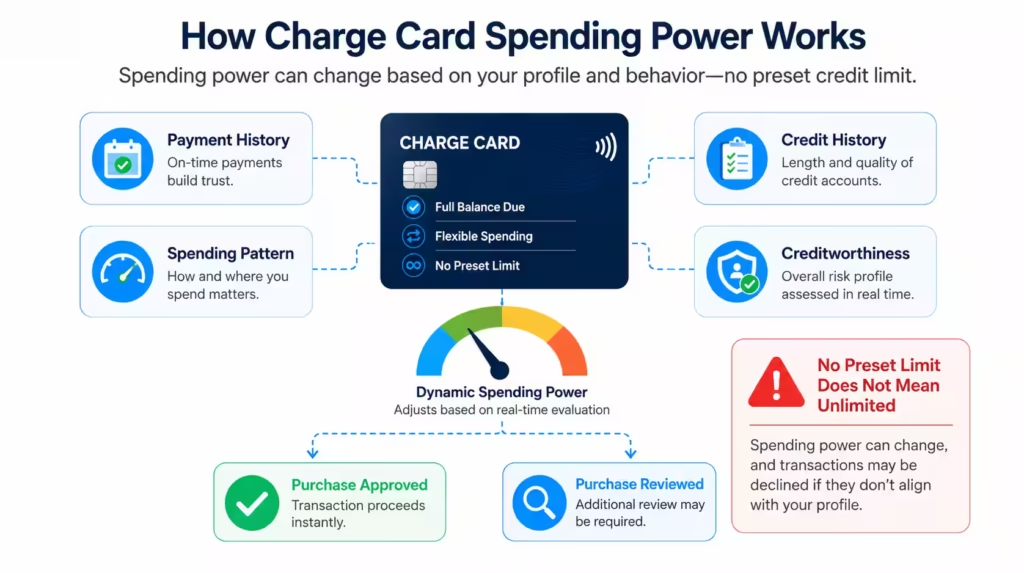
“No preset spending limit” is one of the most misread phrases in personal finance. It does not mean you can spend any amount you want. It means there’s no single, fixed number set in advance, like the $10,000 credit limit you might see on a normal credit card.
Instead, your spending power is dynamic. The issuer looks at several factors in real time to decide whether to approve a purchase. As American Express explains in its own guidance, the amount you can spend adapts based on factors such as your purchase, payment, and credit history.
Here’s a realistic example: Sarah, a marketing director at a small consulting firm, has used her charge card for about a year. She usually spends $2,500 to $4,000 a month and always pays in full. When she tries to book a $9,500 business trip, the charge goes through without a hitch.
Her friend Michael, who just opened the same card and has only made two on-time payments so far, tries a $7,000 furniture purchase. His transaction gets held for review.
Why the difference? Sarah has a track record. Michael doesn’t yet. The issuer uses factors like payment history, spending patterns, income data on file, and overall creditworthiness to decide what to approve. These same factors can also cause your spending capacity to grow or shrink over time.
That’s why a purchase can still be declined even without a hard preset spending limit. Big or unusual charges may trigger extra review. Some issuers offer a “Check Spending Power” tool that lets you see if a specific amount is likely to be approved before you swipe.
Are Charge Cards Really Unlimited?
No. “No preset limit” is not the same as “unlimited.” Your buying power is a moving target, not a blank check.
Large purchases may still need approval. If you plan to charge something well outside your usual pattern, like a $20,000 medical bill or a $15,000 travel package, the issuer may pause the transaction. You might need to contact the card company or use a pre-approval tool first.
Your ability to spend is always tied to your ability to repay. That’s the core rule behind flexible spending power. If the issuer notices a gap between your charges and what you can pay off, your limit might drop suddenly.
💡 Pro Tip: Before making a purchase that’s much larger than your usual spending, use your issuer’s spending power tool or call customer service. This can save you from a declined transaction at the register or checkout screen.
Charge Card vs. Credit Card: What’s the Difference?
The charge card vs credit card comparison comes down to how the balance is handled and how spending power is set. Both let you buy now and pay later, but the rules around repayment, interest, and credit limits look very different.
The table below breaks down the key differences at a glance.
| Feature | Charge Card | Credit Card |
|---|---|---|
| Payment requirement | Full balance due each month | Minimum payment allowed |
| Carry a balance? | Generally no (traditional model) | Yes, month to month |
| Spending limit | No preset limit (flexible) | Fixed credit limit |
| Interest charges | Usually none on the traditional balance | Applies to unpaid balances |
| Minimum payment | Not a standard feature | Standard feature |
| Credit utilization | Generally not counted | Directly counted |
| Product availability | Fewer options | Very common |
Why do these differences matter? Because they change how the card fits into your monthly cash flow.
A credit card gives you the option to spread out large purchases over months. That flexibility comes with a cost. Interest on carried balances can climb quickly. As of the second quarter of 2025, Federal Reserve data puts the average interest rate on credit card accounts assessed interest at over 22%.
A charge card takes away that option. In return, it offers flexible spending power and no long-term interest on the standard balance. It forces discipline. You spend, then you settle up. There’s no “I’ll pay it off later” cushion built into the product.
Credit utilization is another key split. On a credit card, the ratio of your balance to your credit limit is a major scoring factor. On a charge card, there’s no preset limit to divide against, so most scoring models treat it differently. More on that below.
What Fees and Costs Can a Charge Card Have?
Skip the assumption that no revolving APR means no cost. Charge cards often come with fees, and some of those fees are not small. Reading the card agreement is the only way to know exactly what you’re signing up for.
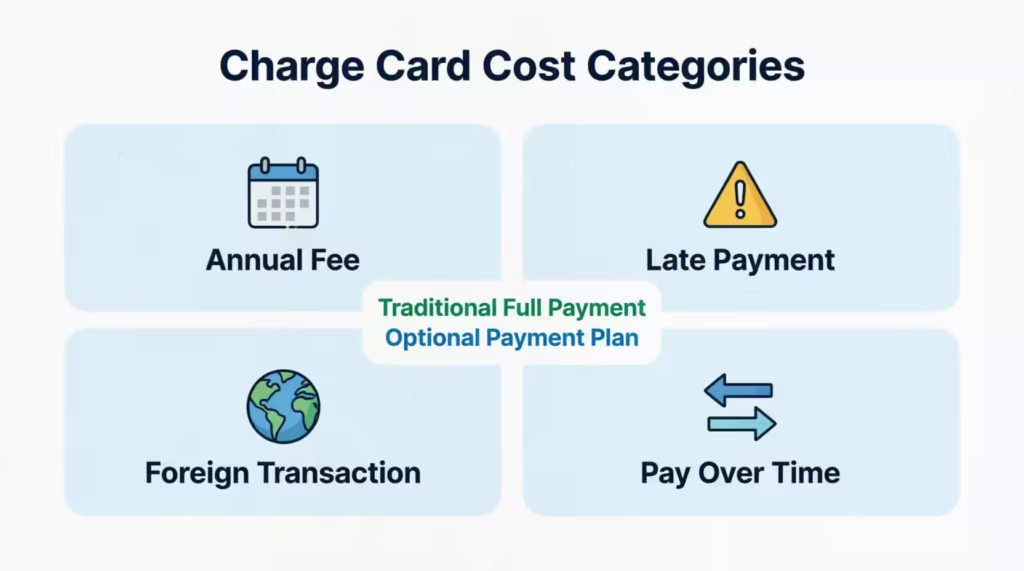
The most common cost is the annual fee, also called a membership fee. Premium charge cards have annual fees that start at about $150 for basic cards. For top-tier options, like the American Express Platinum Card, fees can exceed $700. That fee is often the trade-off for premium rewards, travel credits, and lounge access.
Late-payment charges are the next big line item. If you miss the due date, the fee kicks in. The Consumer Financial Protection Bureau points out that credit card late fees are regulated by federal rules, but charge card late fees vary by issuer and product.
Other fees to check for:
- Foreign transaction fees, usually 2.7% to 3% on purchases made outside the U.S., though many premium charge cards waive this.
- Returned payment fees if your bank rejects your payment.
- Additional cardholder fees for authorized users.
- Fees tied to optional Pay Over Time or installment features, which may include interest charges.
Some card products now blend traditional charge-card rules with optional pay-over-time plans. Those plans let you move eligible purchases into monthly payments, but they usually add interest. That interest sits outside the traditional charge-card model. Always treat it as a separate cost.
Do Charge Cards Charge Interest?
Traditional charge cards do not use a revolving purchase APR the way credit cards do. When you pay the statement in full by the due date, there are no interest charges on that balance. This is one of the main reasons people choose charge cards for high, predictable monthly spending.
The annual percentage rate on a traditional charge card is often listed as “N/A” for purchases, because the product is not designed to carry a balance. If you don’t pay in full, though, the issuer doesn’t just tack on regular interest. Instead, you may face late fees, penalty rules, or account restrictions.
The wrinkle is Pay Over Time. Features like Amex’s Pay Over Time, Plan It, or similar issuer programs let eligible charges shift into a payment plan. Those plans can carry their own interest rate or fixed monthly fee. It’s a separate financial arrangement layered on top of the charge card.
Product terms always control the final answer. Two charge cards from the same issuer can have different rules. Check the specific card agreement before you assume anything.
How Do Charge Cards Affect Your Credit?
Charge cards do affect your credit. Just not in every way a regular credit card does. The most important distinction is around credit utilization ratio, but other scoring factors still apply.
Here’s the short version. When you apply, the issuer usually runs a hard inquiry, which can drop your score by a few points for a short time.
After you open the account, your payment history on that card is sent to the major credit bureaus: Experian, Equifax, and TransUnion. On-time payments help. Missed payments hurt.
Now for utilization. On a regular credit card, your balance is divided by your credit limit to produce a utilization percentage, and that percentage is a major input to your FICO Score.
Charge cards generally are not factored into your credit utilization rates because they don’t have a preset credit limit to compare against. FICO’s own guidance treats charge accounts differently from revolving accounts for utilization purposes.
That doesn’t mean charge cards are invisible to your credit. They still affect:
- Payment history, which is the biggest single factor in most scoring models.
- Account age, since the length of your credit history matters.
- New credit and inquiries, especially in the months right after you apply.
- Total number of accounts and mix of credit types on your credit report.
So the honest answer is not “charge cards don’t affect your credit.” It’s closer to “charge cards affect your credit through the usual factors, but generally not through utilization.” The distinction matters, especially if you’re planning a big financial move like applying for a mortgage.
📌 Did You Know: Some scoring models handle charge accounts a little differently than others. Newer VantageScore models and older FICO models may not treat charge card balances identically. If you’re monitoring your credit, expect small variations depending on which score you’re viewing.
What Are the Benefits of a Charge Card?
Charge cards are not a fit for everyone, but they do come with real strengths. The advantages line up best with certain financial habits and lifestyles.
Flexible spending power is the headline benefit. There’s no fixed credit limit blocking large or unusual purchases. If your monthly spending shifts due to business travel, seasonal projects, or big purchases, that flexibility can be very helpful.
A freelance designer named Jennifer spends $2,000 one month and $12,000 the next during client project sprints. She would face limits with a $6,000 credit card. A charge card adapts to that swing more easily.
The full-payment structure builds in useful discipline. Because you can’t roll a balance forward, there’s no slow build-up of interest debt. This tends to work well for people who already pay the balance in full each month and want the product to reinforce that habit.
Rewards are another draw. Premium charge cards often carry strong rewards programs. Points on travel, dining, and everyday spending. Statement credits for streaming or transit. Airport lounge access. Concierge services. Cardholders who spend heavily and pay in full can extract significant value from these perks.
There’s also a cost angle. When you clear the balance each cycle, you generally avoid the revolving purchase APR that regular credit cards apply to carried balances. Your payment history benefits too, since on-time full payments feed into your credit profile.
Who this fits:
- People with steady, predictable income who always pay in full.
- Business owners and frequent travelers who need flexible spending capacity.
- Rewards-focused users who spend enough to offset annual fees.
- Anyone who wants a built-in nudge to avoid carrying credit card debt.
What Are the Drawbacks of a Charge Card?
The same features that make charge cards attractive to some users make them a poor match for others. It’s worth being honest about the trade-offs before applying.
Less payment flexibility is the biggest one. If your cash flow ever dips, there’s no built-in “pay the minimum this month” safety valve. You either come up with the full amount or deal with fees, restrictions, and credit damage. That structure demands consistent monthly cash flow.
The annual fee on many charge cards is another consideration. Premium products can charge $150, $250, $500, or even more per year. Those fees are only worth it if you actually use the benefits and rewards. If you carry the card for the flexible spending power alone, the math often doesn’t work.
Product availability is limited. Compared to the thousands of credit card options in the U.S., charge cards are a small slice of the market. American Express is the dominant issuer, with a few other players offering niche or business-focused products. If you want to compare a dozen options, you’ll have fewer choices.
Approval standards can be stricter. Because the issuer takes on more risk without a fixed limit, they usually look for stronger credit profiles, steady income, and a clear payment track record. First-time credit users often find charge cards harder to qualify for than starter credit cards.
Finally, if you truly need to spread payments across months, revolving credit through a traditional credit card is a better structural match. A card with a moderate APR beats a charge card that forces you into late fees or a paid pay-over-time plan every cycle.
Who Is a Charge Card Best For?
A charge card fits best when your financial habits already match the product’s rules. It doesn’t reshape bad habits. It rewards steady ones.
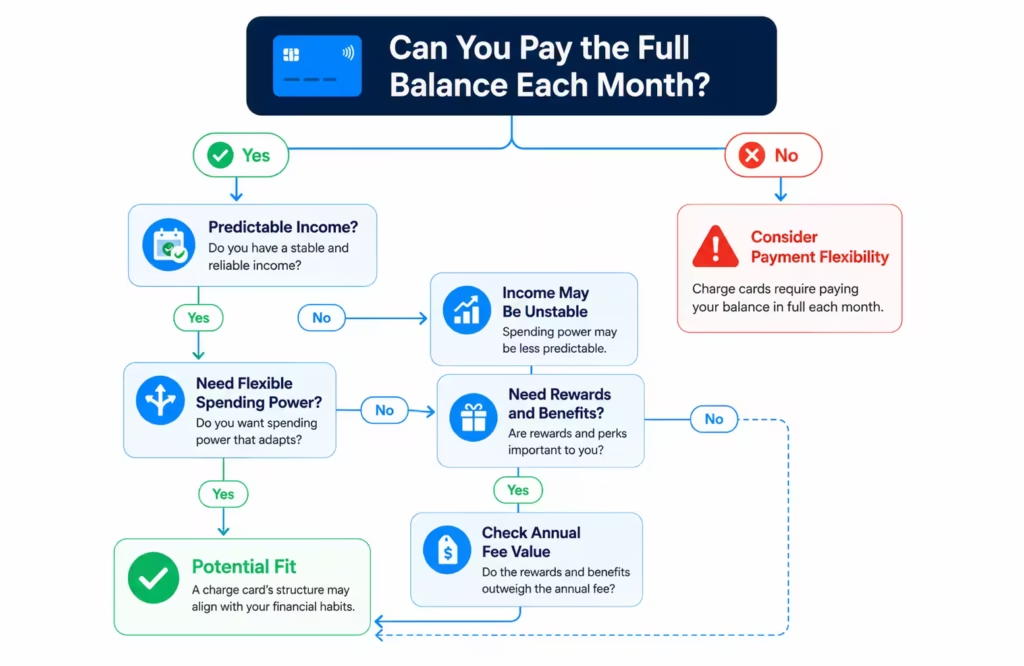
You’re likely a good fit if:
- You pay your balance in full every month on your existing credit cards. The full-payment rule feels normal, not scary.
- Your income is predictable and reliable, so you can absorb an unexpected big purchase without stress.
- You value flexible purchasing power, especially for large or variable monthly spending. Business owners, consultants, and frequent travelers often fall into this bucket.
- You want strong rewards and premium perks and spend enough to justify the annual fee.
- You use the card as a payment tool, not a borrowing tool.
You should probably think twice if:
- Your income fluctuates, or your emergency savings are thin. Missing a full payment can create real problems fast.
- You rely on payment flexibility to smooth out monthly cash flow. A regular credit card with a reasonable APR is a better match.
- You’re new to credit and still building a charge card account track record. Starting with a credit-builder card often makes more sense.
- The spending power feature tempts you to spend beyond what you can repay. That’s the exact behavior charge cards punish hardest.
Take David, an operations manager at a manufacturing company. He earns a steady salary, always pays his credit cards in full, and travels for work about ten days a month. A charge card with strong travel rewards fits his life well.
Compare that to his coworker Rachel, whose commission-based pay swings by $3,000 or more each month. She’d probably do better with a low-APR credit card that lets her manage timing.
The best product is the one that matches how you already handle money, not the one that forces you to change everything about your habits overnight.
Frequently Asked Questions (FAQs)
What is the purpose of a charge card?
A charge card is designed for purchases that are paid in full by the due date rather than carried month to month. It can be useful for people with predictable income who want flexible spending power, rewards, and a payment structure that discourages long-term debt.
Do charge cards exist anymore?
Yes. Charge cards still exist, although they represent a much smaller part of the U.S. card market than traditional credit cards. American Express remains the dominant issuer, while a few other companies offer niche or business-focused charge-card products.
What’s the difference between a charge card and a credit card?
A charge card generally requires the full statement balance to be paid each month, while a credit card lets you make a minimum payment and carry the remaining balance. Charge cards also typically have flexible spending power instead of a traditional preset credit limit.
What are the disadvantages of a charge card?
The biggest disadvantages are limited payment flexibility, potentially high annual fees, fewer product choices, and stricter approval standards. Missing a required payment can also result in fees, account restrictions, and credit damage.
Why would anyone use a charge card instead of a credit card?
A charge card can make sense for someone who pays balances in full and needs flexible spending power for variable expenses. Rewards, travel benefits, and the lack of a traditional revolving balance can also appeal to high-spending users.
Do charge cards hurt credit?
A charge card does not automatically hurt your credit, but missed payments can damage your payment history, and applying can create a hard inquiry. Charge cards generally are not included in revolving credit utilization because they lack a preset credit limit.
Do charge cards still build credit?
Yes. Charge-card payment history is reported to major credit bureaus, so consistent on-time payments can contribute positively to your credit profile. The account can also affect factors such as account age, new credit, inquiries, and credit mix.
Are charge cards bad for credit?
No, a charge card is not inherently bad for credit. Paying on time can support your credit profile, while missed payments can hurt it, and charge cards generally affect credit differently from revolving cards because they lack a preset limit.
Are Amex cards still charge cards?
Some American Express products use the traditional charge-card model, while others combine charge-card features with optional Pay Over Time arrangements. Because terms vary by product, the specific card agreement determines whether purchases must be paid in full or can qualify for monthly payments.
Is it worth having a charge card?
A charge card can be worthwhile if you consistently pay in full, have predictable income, and can use rewards or benefits enough to justify the annual fee. If you need to spread payments across several months, a traditional credit card may be a better fit.
Wrapping Up
A charge card is a specific tool with a specific job. It lets you spend flexibly with no fixed limit, but it expects the full balance every single month. That trade-off shapes everything else, from fees and rewards to how the card shows up on your credit report.
Choose a charge card only if you pay balances in full and want flexible spending. This fits the payment structure and cash flow needs discussed. For readers who need month-to-month flexibility, a traditional credit card will usually deliver a better fit.
If you know someone weighing whether a charge card matches their spending style, share this guide with them. It could save them from choosing the wrong product and paying for the mistake in fees or credit damage.