
You keep seeing the term “credit card churning” pop up on Reddit threads, travel blogs, or in that one coworker’s story about a free trip to Tokyo. It sounds exciting, maybe a bit shady, and definitely confusing. You’re not sure if it’s smart, risky, or somewhere in between. That’s a fair worry, since credit card churning touches your credit score, your wallet, and your peace of mind.
In short, credit card churning means opening new cards to earn sign-up bonuses, then closing or downgrading them once the reward hits.
Below, you’ll get a plain, expert breakdown of how it works, what it does to your credit, the issuer rules that limit it, and who it actually fits.
Key Takeaways
This guide explains what credit card churning is, including the six-step process of opening and closing cards for bonuses, major issuer restrictions, the specific credit score impact, and how to judge whether it fits your situation.
Core Facts:
- Credit card churning means applying for new credit cards mainly to earn the welcome bonus, then keeping, downgrading, or closing the card once that bonus posts.
- Credit card churning is not illegal, though issuers can refuse applications, claw back bonuses, or close accounts if they determine the activity violates their terms.
- A single hard inquiry typically lowers a FICO score by less than 5 points and affects scoring for about 12 months, though it stays on the report for 24 months.
- Careful churners typically see a temporary score dip of 5 to 15 points that recovers within about 9 to 12 months as inquiries age and utilization stays low.
- Chase denies most new card applications if an applicant has opened five or more personal credit cards from any issuer in the past 24 months, a policy known as the 5/24 rule.
- American Express limits most welcome bonuses to once per lifetime per card and caps new Amex approvals at two within any 90 days.
Best for:
- Readers with a stable credit score of 740 or higher who pay their balances in full every month and want to understand if churning fits their financial profile.
- People with no major loan applications, such as a mortgage or auto loan, planned within the next 12 to 18 months.
- Beginners who have encountered the term “credit card churning” and want a clear, factual explanation before deciding whether to research specific cards or strategies.
What Credit Card Churning Actually Means
Credit card churning is the practice of applying for new credit cards mainly to earn the welcome offer, then moving on to the next card once that bonus posts. The goal is not the card itself. The goal is the big pile of points, miles, or cash back tied to the sign-up bonus.
The term comes from the idea of “churning” through cards quickly, the same way a farmer churns butter. You cycle through offers instead of settling into one card for the long haul. Some people also call it credit card flipping or, less accurately, credit card hacking. On travel forums, you’ll hear it grouped under “travel hacking” too.
What churners chase is simple. A card might offer 60,000 to 100,000 points after you spend a set amount in the first few months. Those points and miles can be worth $600 to $2,000 in travel value. Cash back cards work the same way, just with fewer zeros. The welcome offer is the whole prize.
Churning vs. Just Having Rewards Cards
Having a rewards card is not churning. Millions of people carry a Chase Sapphire or an Amex Gold for years and use them for daily spending. That’s normal rewards use.
Churning is different in three ways. First, you plan to close, downgrade, or “park” the card once the bonus lands. Second, you apply on a fast schedule, sometimes several cards a year. Third, the card’s long-term perks are almost beside the point. If a card had zero ongoing benefits but a huge sign-up bonus, a churner would still open it.
How the Churning Cycle Works
The process looks like a loop. Once you know the six steps, the whole idea clicks.
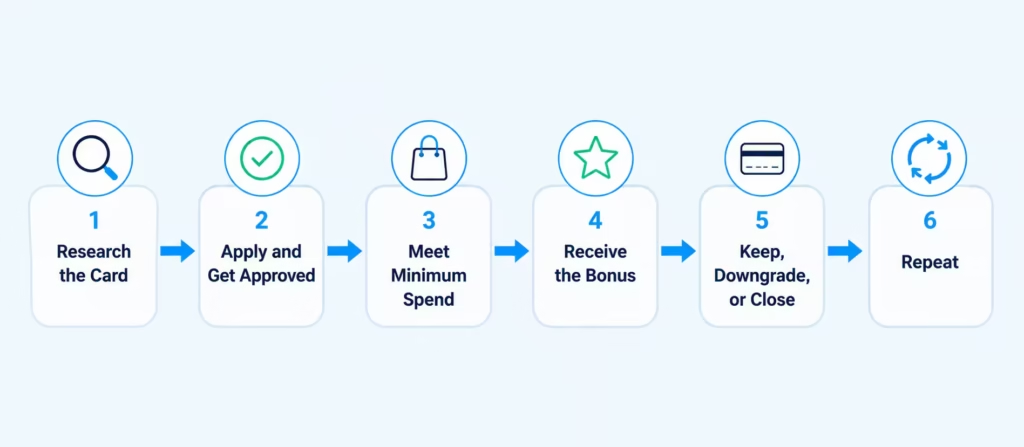
Step 1: Research the card. You pick a card with a strong welcome offer that fits your spending. A common target is a card offering 75,000 points after $4,000 in spend over three months. You check the annual fee, the minimum spend, and whether you can meet it without buying things you don’t need. Sites like NerdWallet, The Points Guy, and Doctor of Credit are common research spots.
Step 2: Apply and get approved. You submit the application. The bank runs a hard inquiry on one of your credit reports. If approved, the card arrives in a week or so.
Step 3: Meet the minimum spend requirement. This is where the bonus is earned. Say the card wants $4,000 in three months. You put groceries, gas, bills, and any big planned buys on the card. You pay the balance off each month to avoid interest.
Step 4: Receive the bonus. Once you hit the minimum spend requirement, the bonus posts to your account. It usually shows up one to two billing cycles after you cross the spend line.
Step 5: Decide to keep, downgrade, or close. Before the annual fee hits at month 12, you make a choice. You can keep the card if it earns its fee back. You can downgrade to a no-fee version to protect your average age of accounts. Or you can close it if it no longer serves you.
Step 6: Repeat. With one card done, you research the next offer that fits your rules and your credit health. Serious churners space applications by 90 days or more to keep their profile clean.
Here’s a quick credit card churning example:
Michael, a 34-year-old marketing manager, opens a travel card with an 80,000-point welcome offer after $4,000 in three months. He shifts his regular spending to the new card, hits the target in month two, and earns the bonus worth about $1,200 in flights. At month 11, he downgrades to a no-fee version, then applies for a different card three months later.
💡 Pro Tip: Line up your card application with a known big expense, like car insurance renewal, a home repair, or holiday shopping. It helps you hit the minimum spend without spending money you wouldn’t have spent anyway.
Is Credit Card Churning Illegal or Against the Rules?
Credit card churning is not illegal. No law says you can’t apply for many cards or close them after earning a bonus. You have the legal right to apply for credit and to close accounts when you choose.
That said, “not illegal” is not the same as “no consequences.” Churning lives in a gray zone. Banks can and do refuse applications, claw back bonuses, or close accounts if they decide you’re gaming the system.
There’s also a big line between churning and fraud. Fraud means lying on an application, faking income, or using tricks like manufactured spending in ways that break card terms. Buying gift cards or money orders just to meet a spend target can trip fraud alerts and get accounts shut down. Real churning stays within the terms and conditions of normal spending. It’s the difference between playing a game aggressively and cheating.
Why Issuers Still Discourage It
Banks make money when you carry a balance, pay interest, or use the card for years. A churner does none of that. You pay in full, earn the bonus, and often leave. So issuers have quietly built rules to slow churning down. They don’t ban it outright, but they make it harder to keep repeating.
Issuer Rules That Limit Credit Card Churning
Every major bank now has some version of an anti-churning rule. The exact numbers change from time to time, so you should always confirm on the issuer’s site before applying. Below are the rules churners talk about most.
| Issuer | Common Rule Name | What It Does |
|---|---|---|
| Chase | 5/24 Rule | Denies most new card apps if you’ve opened 5+ cards from any bank in 24 months |
| American Express | Once-per-lifetime | Blocks welcome bonus if you’ve had that exact card before |
| American Express | 2/90 Rule | Limits new Amex approvals to 2 in 90 days |
| Bank of America | 2/3/4 Rule | Caps new BoA cards at 2 in 2 months, 3 in 12 months, 4 in 24 months |
| Citi | 48-Month Rule | Blocks the bonus on many cards if you earned one on the same card in 48 months |
Chase’s 5/24 Rule
The Chase 5/24 rule is the most famous churning limit. If you’ve opened five or more personal credit cards from any bank in the past 24 months, Chase will likely deny your application for most of its rewards cards. Chase counts cards from every issuer, not just its own. Business cards from most banks don’t count, but new personal cards do.
Because of this, many churners start with Chase cards before opening anything else. Once you’re “over 5/24,” Chase becomes off-limits for years. As Forbes has reported on the 5/24 rule, it’s an unofficial guideline, but it’s applied consistently in practice.
American Express Restrictions
American Express takes a different path. Its once-per-lifetime rule means you can usually earn the welcome bonus on a specific card only once, ever. Open the Amex Gold today, close it in two years, reopen it later, and you still won’t get the bonus again.
Amex also uses a 2/90 rule, which limits you to two new Amex credit cards in any 90 days. Some targeted offers waive the lifetime language, so it pays to read the fine print of every offer before you click apply.
Other Major Issuer Restrictions
Bank of America uses a 2/3/4 rule. You can get no more than 2 BoA cards in 2 months, 3 in 12 months, and 4 in 24 months. Citi’s 48-month rule blocks the bonus on many cards if you earned or closed the same card family within the last 48 months.
Capital One tends to approve one personal card every six months for most people. Discover typically allows only one active Discover card and limits the welcome bonus to once per lifetime per product.
The takeaway is simple. Every big issuer now has some version of a churn brake. Track your opens and closes in a simple spreadsheet, or you’ll get denied without knowing why.
How Churning Affects Your Credit Score
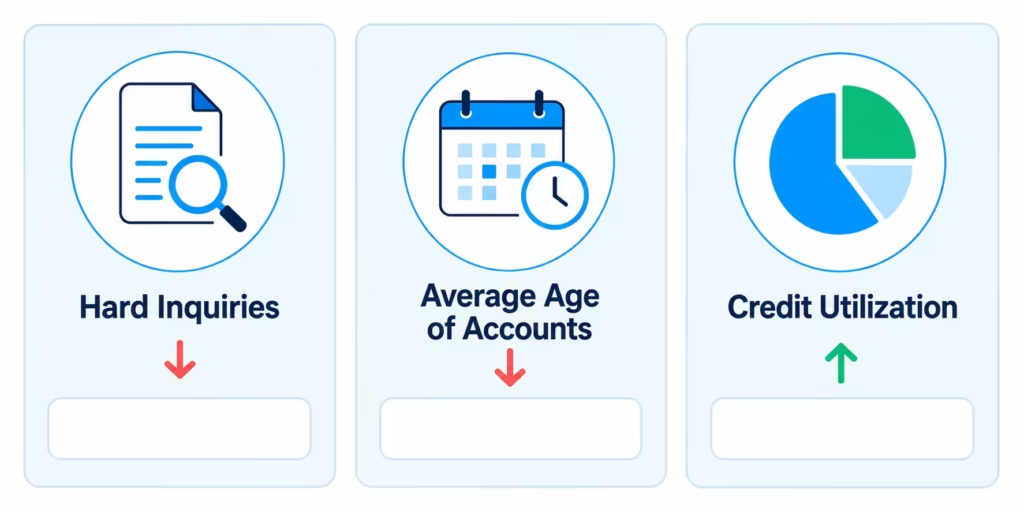
The credit score question is the one most people care about. The honest answer is that churning does move your score, but not always by as much as you’d think. The effect comes from three separate factors that pull in different directions.
Hard Inquiries From Applications
Every new card application creates a hard inquiry on your credit report. A single hard inquiry usually drops your FICO score by less than five points and only affects scoring for about 12 months, though it stays on the report for 24 months.
If you apply for one card, the dip is small and fades fast. Apply for three cards in a month, and the total dip can reach 10 to 15 points. Space out your applications by 90 days and the damage stays minor.
Average Age of Accounts
Your average age of accounts is the mean age of every open credit line on your report. Opening a brand-new card drags this average down. Closing an old card doesn’t help either, since closed accounts eventually stop counting toward age after ten years.
If you have three cards averaging six years old and you open a new one, your average drops to about four and a half years. Not huge, but real. This factor is why churners keep at least one or two of their oldest cards open, even if they don’t use them much.
Credit Utilization Ratio
Your credit utilization ratio is how much of your total credit limit you’re using. Lower is better. Under 30% is fine. Under 10% is best.
Churning often helps here. Each new card adds to your total available credit. If you had a $10,000 limit across two cards and add a card with an $8,000 limit, your total climbs to $18,000. Your usage percentage drops even if your spending stays the same. That can boost your score.
Overall Impact and How Long It Lasts
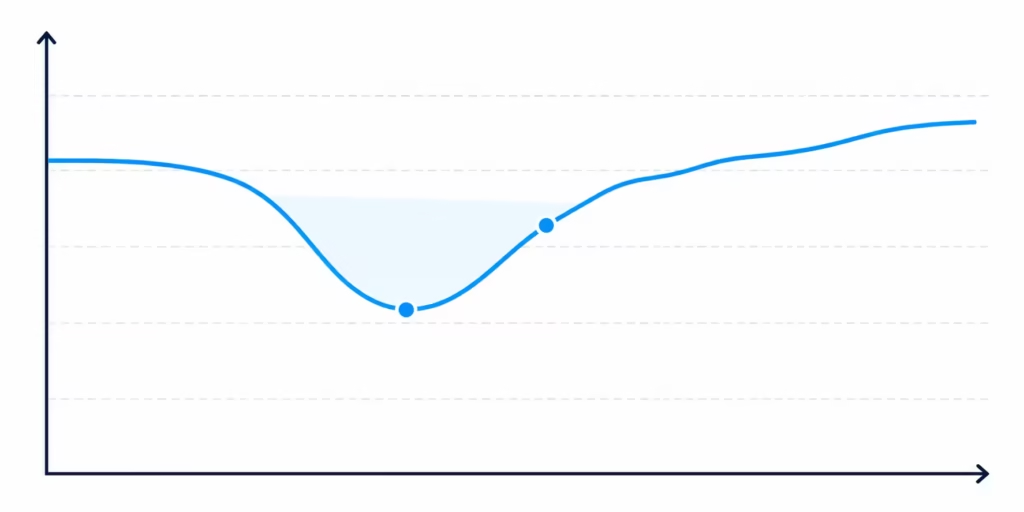
Put the three factors together and most careful churners see a temporary dip of 5 to 15 points on their FICO score. The inquiry piece fades within 12 months. The average age piece slowly repairs itself as accounts get older. The utilization piece often stays positive the whole time.
Sarah, a 29-year-old software engineer with a 780 score, opened three cards over six months. Her score dipped to 762 at the low point, then climbed back to 785 within nine months as inquiries aged and utilization stayed low. That pattern is typical for someone with a strong file who pays on time.
Risks Beyond Your Credit Score
The credit score is only part of the picture. Some of the biggest churning risks have nothing to do with FICO.
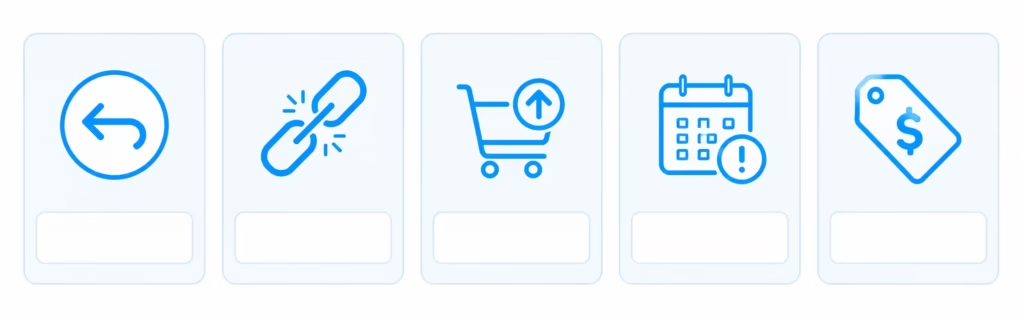
Bonus clawbacks. If a bank decides you opened the card only for the bonus, they can pull it back. Amex is famous for this. If they flag your account as “gaming,” you may see the bonus vanish from your account weeks after it posted. That decision is final, and there’s rarely an appeal.
Account closure. Issuers can close your accounts at any time, for any reason, with no notice. Chase has a widely reported “shutdown” pattern where they close every account tied to a customer at once. If you have $5,000 in unused points on a co-branded card, they can disappear the moment the account closes.
Overspending. The number one hidden risk. To hit a $4,000 minimum spend, some people buy things they don’t need. If you spend an extra $1,000 chasing a $600 bonus, you lose $400 and gain a headache. Any interest charge from carrying a balance wipes the bonus out even faster.
Missed payments. Juggling five or six cards means five or six due dates. One missed payment can drop your score by 60 to 100 points and stay on your report for seven years. That single mistake dwarfs any churning gain.
Annual fees. Many high-bonus cards carry annual fees of $95 to $695. If you forget to downgrade or close before the fee renews, that cost eats into your reward. Track every fee date. Set a calendar alert 30 days before each renewal.
Who Should (and Shouldn’t) Consider Credit Card Churning
Churning is not a hobby for everyone. It rewards a specific type of person and punishes another.
Good fit indicators:
- Your credit score is 740 or higher and stable.
- You pay every card in full every single month, without exception.
- You already have at least 2 to 3 years of clean credit history.
- You have no major loans coming up in the next 12 to 18 months.
- You enjoy tracking spreadsheets, deadlines, and fine print.
- You have room in your budget to hit spend targets with normal purchases.
Poor fit indicators:
- Your credit file is thin, with fewer than three accounts or under two years of history.
- You’ve carried a credit card balance in the past year.
- You’re planning to buy a home, refinance, or take an auto loan soon.
- You tend to buy more when you have available credit.
- You forget bill due dates or dislike managing multiple accounts.
Jennifer, a 42-year-old operations director, has an 810 score, zero debt, and pays her cards in full. She’s a strong fit. David, a 27-year-old teacher planning to buy a home next year, has a 720 score and one late payment two years ago. He’s a poor fit and should wait.
Potential Benefits of Credit Card Churning
For the right person, the upside is real. That’s why the strategy exists in the first place.
The biggest benefit is scale. A single card earning back 2% on spending returns modest rewards each year. Adding two or three welcome bonuses on top can push your yearly rewards to $1,500 or $3,000 in value. That’s the same as a small raise, tax-free.
Churning also gives you access to varied perks. One card might offer airport lounge access. Another might cover Global Entry. A third might give hotel elite status. By rotating cards, you sample benefits without paying to keep them all long-term.
The strategy also shines when you have a big planned expense. Sarah wanted to take her family to Hawaii for a milestone anniversary. Over 10 months, she and her husband opened two travel cards and earned enough points and miles to cover four round-trip flights and five hotel nights. The trip’s cash cost would have been $6,200. They paid $340 in taxes and fees.
That kind of rewards optimization is why churners tolerate the work. Done carefully, the bonus math beats almost every cashback card on the market.
Common Mistakes First-Time Churners Make
Even a strong credit profile can’t protect you from sloppy habits. Most first-time churners lose money not because the strategy fails, but because small errors add up fast. Knowing these traps in advance saves you the tuition most beginners pay.
Applying for too many cards at once
New churners often see three attractive offers and apply for all of them in the same week. That stacks three hard inquiries on the same report and drops the score by 10 to 15 points at once. It also raises fraud flags at the issuer. A better rhythm is one card every 90 days for the first year.
Forgetting the annual fee date
A $550 annual fee can turn a $900 bonus into a $350 win overnight. Many banks charge the fee on the card’s anniversary, not the calendar year. Mark day 335 on your calendar. That gives you a 30-day window to decide whether to keep, downgrade, or close before the charge hits.
Chasing bonuses without tracking spend
Michael, a 31-year-old sales rep, opened a card with a $4,000 spend requirement. He assumed his usual spending would cover it. On day 85, he checked his account and had spent only $2,900. He rushed to buy $1,100 in items he didn’t need, then carried a balance the next month. The interest and unused purchases wiped out the whole bonus.
Closing old cards too fast
Your average age of accounts takes a hit every time you close a long-held card. Instead of closing that five-year-old no-fee card, keep it open and put one small charge on it every few months. It costs nothing and protects your credit history length.
Ignore 2/90, 5/24, and 48-month timers
Beginners often apply for the “best” card without checking issuer rules. A denied application still creates a hard inquiry. Keep a simple spreadsheet with each card’s open date, close date, and the issuer’s rule window. Ten minutes of tracking prevents wasted applications.
📌 Did You Know: Chase’s shutdown reviews often trigger not from the number of cards, but from a sudden pattern of large minimum-spend purchases followed by inactivity. Steady, natural spending on each card lowers your shutdown risk more than any other single habit.
Tools and Habits That Make Churning Sustainable
The people who keep churning for years all share the same trait. They treat it like a system, not a hobby. A few free tools and steady habits do most of the heavy lifting.
A tracking spreadsheet. The single most valuable tool. List each card with its open date, welcome offer, minimum spend, deadline, annual fee date, and current status. Google Sheets works fine. Update it the day you apply and the day the bonus posts. Without it, you’ll lose track by card number four.
A free credit monitoring service. Sign up for Experian’s free credit monitoring or a similar service from your bank. Check your score once a month, not every day. You want to spot big changes, not obsess over normal swings of a few points.
Autopay on every card. Set every card to autopay the statement balance in full. One missed payment can undo two years of careful churning. Autopay removes the risk without removing the reward.
Calendar alerts for each key date. Add three alerts per card: 60 days after opening (spend check), day 335 (annual fee decision), and one week before each statement date (utilization check). These three reminders prevent the three most common losses.
A dedicated churning email address. Banks send offer emails, bonus confirmations, and fee reminders. A separate Gmail address keeps that noise out of your main inbox and gives you a clean paper trail if a bonus is ever disputed.
Steady, natural spending. The goal is to move your normal expenses to the new card, not invent new ones. Groceries, gas, streaming subscriptions, utility bills, and insurance premiums all count. If the minimum spend requires anything beyond your normal budget, the card is the wrong fit for that month.
A cool-down rule. After every three approvals, take a six-month break from applications. This lets your credit report age, drops old inquiries out of the scoring window, and keeps your profile looking healthy to the next issuer.
Frequently Asked Questions (FAQs)
Is credit card churning illegal?
No, credit card churning is not illegal. Banks can still refuse applications, claw back bonuses, or close your accounts if they decide you’re gaming the system, so “legal” doesn’t mean risk-free.
Is credit card churning bad for your credit score?
Churning typically causes a temporary dip of 5 to 15 points from hard inquiries and a lower average account age. Utilization often improves at the same time, so most disciplined churners recover their score within 9 to 12 months.
Is credit card churning worth it?
For someone with a 740+ credit score, no carried balances, and no major loans planned soon, churning can generate $1,500 to $3,000 a year in reward value. For people with thin credit files or upcoming mortgage plans, the risk usually outweighs the payoff.
How much money can you make credit card churning?
A single welcome bonus is often worth $600 to $2,000 in travel value, and stacking two or three bonuses a year can add up to $1,500 to $3,000 in rewards. One example in the article covered a $6,200 family trip for just $340 in taxes and fees.
Is credit card churning a bad idea for beginners?
Beginners often lose money by applying for too many cards at once, missing annual fee deadlines, or overspending to hit minimum spend requirements. Starting with one card every 90 days and tracking dates on a spreadsheet avoids most first-time mistakes.
What is the Chase 5/24 rule?
Chase denies most new card applications if you’ve opened five or more personal credit cards from any bank in the past 24 months. This rule counts cards from every issuer, not just Chase, so many churners apply for Chase cards first before their count climbs.
How long does a hard inquiry affect your credit score?
A single hard inquiry usually drops your FICO score by less than 5 points and only affects your score for about 12 months, though it stays visible on your report for 24 months. Applying for three cards in one month can push the combined dip to 10 to 15 points.
Final Thoughts
Now you know what credit card churning really is, how the cycle runs, and how it moves your credit score up or down. The article discussed important issuer rules, such as Chase’s 5/24 rule and Amex’s once-per-lifetime clause. It also explained the three credit factors that influence each other and highlighted important non-score risks.
The best match is a disciplined saver. They have a score of 740 or higher, no debt, and no large loans coming up. For most others, sticking with one or two great rewards cards will bring more peace of mind than chasing bonuses.
If you know a friend who’s curious about travel hacking or wondering whether to try their first bonus, share this guide with them. It could save them a costly denial or a wrecked credit score.