

Seeing the word “derogatory” next to an account on your credit report is scary. Most people who spot a derogatory mark on a credit report have the same questions right away. What does it mean? How bad is it? Can it be fixed? The worst part is not knowing if you’re looking at a real problem, a simple mistake, or something in between.
Here is the short answer: it is a negative record showing that an account was not paid as agreed, and lenders see it as a warning sign when you apply for credit.
The good news is that you have real options. Below, you’ll find out exactly what each type of mark means, how long it stays, how much it can hurt your score, and the specific steps to dispute it, negotiate it, or wait it out.
Key Takeaways
This guide explains what a derogatory mark on a credit report is, including the main types, how long each stays, how much it can lower your score, and how to dispute or resolve one.
Core Facts:
- A derogatory mark is a negative entry showing a debt was not paid as agreed, and it is reported by creditors or pulled from public court records rather than added by the bureaus themselves.
- Most derogatory marks stay on a credit report for up to seven years, while Chapter 7 bankruptcy can stay up to ten years and Chapter 13 up to seven years.
- The seven-year clock starts from the date of first delinquency, the original missed payment, and this date cannot be reset by paying, settling, or selling the debt to a collector.
- A single 30-day late payment can cost 20 to 80 points, while a charge-off, collection, or foreclosure can cost 100 or more, and bankruptcy can cost 130 to 240 points.
- Paying off a derogatory mark updates the account status but does not remove the entry from the report unless a written pay-for-delete agreement is reached.
- Inaccurate marks can be disputed with each credit bureau, and the bureau generally has 30 days (up to 45 with added evidence) to investigate before verifying, correcting, or deleting the item.
Best for:
- Readers who just noticed a derogatory mark on their credit report and want to understand what it means before taking action.
- People deciding whether to dispute an inaccurate mark, negotiate an accurate one, or simply wait for it to age off.
- Anyone comparing goodwill letters, pay-for-delete negotiation, and natural aging-off as strategies for an accurate negative mark.
What Is a Derogatory Mark on a Credit Report?
A derogatory mark is a negative entry on your credit report. It shows that you failed to pay a credit obligation the way you agreed to. That could mean a missed payment, an account sent to collections, a repossession, or a bankruptcy. The meaning of a derogatory mark is simple: it tells future lenders that something went wrong with this account.
So what does derogatory mean on a credit report in practice? It is a risk signal. Lenders use your report to guess how likely you are to pay them back. A derogatory item tells them there is a real chance you might not. That is why a single mark can lead to higher interest rates, bigger deposits, or flat-out denials.
These marks are not added by the credit bureaus themselves. Your creditors and lenders, known as “furnishers,” send account data to the three major credit reporting agencies: Experian, Equifax, and TransUnion.
The bureaus then place that data in your file. The Fair Credit Reporting Act (FCRA) is a federal law. It sets rules for how long a negative item can stay on your credit report. It also outlines your rights to challenge that item.
One thing worth knowing: a derogatory mark is not the same as a hard inquiry. A hard inquiry happens when you apply for credit, and it is a normal part of borrowing. A derogatory mark only appears when something has actually gone wrong with an account.
How a Derogatory Mark Ends Up on Your Report
There are two paths a mark can take to land on your report.
The first and most common path is through your creditor. When you fall behind on a payment, the lender reports the late status to the bureaus. If the account gets worse, they keep reporting updates. A charge-off, a collection, or a repossession all travel this same route, from the furnisher’s records into your credit file.
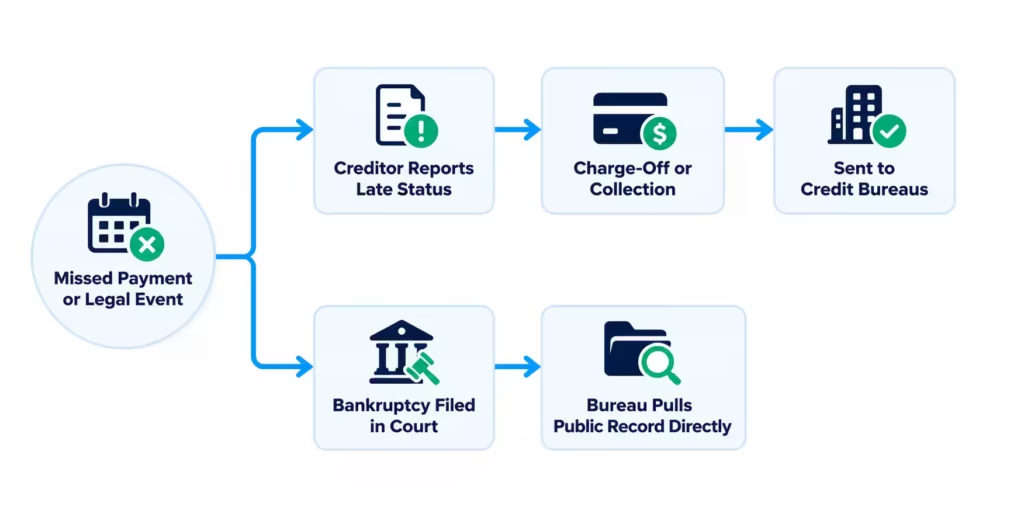
The second path is public records. Some derogatory events, like bankruptcies, are picked up by the bureaus directly from court records. Your lender does not have to report these. The bureaus find them on their own and add them to your file.
Types of Derogatory Marks You Might See
Not every negative mark is the same. Each type has its own cause, its own level of severity, and its own timeline. Below are the major categories you might see on your report, explained in plain language so you can spot which one applies to you.
Late Payments
This is the most common type of derogatory mark, and often the first one people ever see.
A payment is reported late once it is 30 or more days past due. If you miss a due date but pay within a couple of weeks, it usually will not show up on your credit report at all. Your lender might charge a late fee, but the credit bureaus will never hear about it.
Once you cross that 30-day line, the late payment is reported. And the longer the account stays unpaid, the worse it gets. Lenders report delinquency in stages: 30 days, 60 days, 90 days, and 120 days past due. Each step up signals more risk and does more damage to your score. A single 30-day late payment is a minor derogatory event. A 120-day late mark is a serious one.
Charge-Offs
A charge-off confuses a lot of people, because the name sounds like the debt was canceled. It was not.
A charge-off is an accounting term. When an account has gone unpaid for a long stretch, usually around 120 to 180 days, the lender gives up on collecting it through normal means. They “charge it off” their books as a loss for tax purposes. That is all it means.
The key point: you still legally owe the money. A charge-off does not forgive the debt. The lender can still try to collect it, and in many cases they will sell it to a collection agency. So a report might show a credit card with a $0 balance marked as a charge-off, and a separate collection entry for the same debt. Both can appear at the same time, and both are derogatory.
Collection Accounts
A collection account appears when your unpaid debt is sold or handed over to a third-party debt collector.
This often happens right after a charge-off. The original lender sells the debt, sometimes for pennies on the dollar, and the collection agency takes over. Now the collector reports the account to the bureaus under their own name. That is why the same debt can show up twice: once as a charge-off from the original lender, and once as a collection from the agency.
A collection is considered a major derogatory event. One important protection to know is that the seven-year reporting clock for a collection starts from the date you first fell behind with the original lender. It does not begin when the collector bought the debt. A collector cannot restart that clock just by purchasing the account.
Repossession and Foreclosure
These two marks involve loans tied to a physical asset.
A repossession happens when you stop paying a secured loan, like a car loan, and the lender takes the property back. If the car is sold for less than what you owed, you can still be on the hook for the difference, called a deficiency balance.
A foreclosure is the same idea applied to a home. When mortgage payments stop, the lender takes legal action to take the property back and sell it.
Both are major derogatory marks, and both are reported even if you voluntarily hand the asset back. A “voluntary surrender” of a car still shows up as a repossession on your credit report.
Bankruptcy and Public Records
Bankruptcy is the most severe type of derogatory mark, and it stays on your report the longest.
There are two common forms for consumers. Chapter 7 bankruptcy wipes out most unsecured debts and stays on your report for up to 10 years. Chapter 13 bankruptcy involves a court-approved repayment plan and stays on your report for up to 7 years.
Bankruptcies reach your report through court records, not through a lender. The same used to be true for civil judgments and tax liens. However, since 2018, the three bureaus have removed tax liens and civil judgments from credit reports because those records often lacked enough identifying information to be accurate. If you see an old judgment or lien on your report today, it is worth checking carefully, because it may not belong there at all.
Do Hard Inquiries Count as Derogatory Marks?
No. This is a common mix-up, so it is worth clearing up.
A hard inquiry shows up when you apply for new credit, and the lender checks your report. It is a record of an application, not a record of something going wrong. It is not classified as derogatory by the bureaus or by scoring models.
The impact is also very different. A hard inquiry usually costs fewer than five points and stops affecting your FICO Score after 12 months. It falls off your report after two years. A true derogatory mark, by contrast, can cost 100 points or more and stay for seven years. The two get confused because some credit apps list inquiries and negative items on the same screen, but they are very different things.
How Long Does a Derogatory Mark Stay on Your Credit Report?
Most negative marks can stay on your credit report for up to seven years. The FCRA sets this limit, and the credit reporting companies must follow it. Data from the Consumer Financial Protection Bureau confirms that most negative information can be reported for seven years, while bankruptcies can stay for up to ten.
Here is the type-by-type breakdown readers usually need:
| Type of Mark | How Long It Stays |
|---|---|
| Late payment | 7 years from the missed payment |
| Charge-off | 7 years from first delinquency |
| Collection account | 7 years from first delinquency with the original lender |
| Repossession | 7 years |
| Foreclosure | 7 years |
| Chapter 13 bankruptcy | 7 years from filing date |
| Chapter 7 bankruptcy | 10 years from filing date |
Two things about this table matter more than any single number.
First, the clock does not reset. Paying off a collection does not restart the seven years. Selling the debt to a new collector does not restart it either. The countdown runs from a fixed point in the past, and nothing a collector does can legally move it.
Second, the mark falls off automatically. You do not have to request removal once the time is up. If a mark is still showing after its legal window has closed, that is an error you can dispute.
What Is the “Date of First Delinquency”?
This date is the anchor for the entire seven-year clock, and it is one of the most misunderstood parts of credit reporting.
The date of first delinquency is the date you first missed a payment and never brought the account current again. It is not the date of the charge-off. It is not the date the debt was sold to a collector. It is the original missed payment that started the slide.
Say you missed a credit card payment in March 2021 and never caught up. The account was charged off in September 2021 and sold to a collector in January 2022. All of those events, the late marks, the charge-off, and the collection age off your report based on that March 2021 date. That means they should all disappear around March 2028.
This is also why “re-aging” is illegal. Re-aging is when a collector reports a newer delinquency date to keep the debt on your report longer. The FCRA forbids it. If a mark on your report seems too old to still be there, compare it against your own records. A wrong date could mean the item is being reported illegally and can be disputed off.
How Much Does a Derogatory Mark Lower Your Credit Score?
There is no single number, because the drop depends on your starting point and the type of mark. But there are reliable ranges.
Payment history is the biggest piece of your credit score. It makes up about 35% of a FICO Score, which is why even one late payment can do real damage. VantageScore weighs payment behavior similarly, so the pattern holds across both major models.
So how many points does a derogatory mark take off? A FICO simulation gives a useful picture. It compared two consumers: one with a 607 score and past credit problems, and one with a 793 score and a clean history.
After a single 30-day late payment, the lower-score profile dropped to roughly 570 to 590. The higher-score profile fell all the way to 710 to 730, a loss of around 60 to 80 points. After a 90-day late payment, the clean profile fell to about 660 to 680, a drop of more than 110 points, according to FICO’s published credit action simulations.
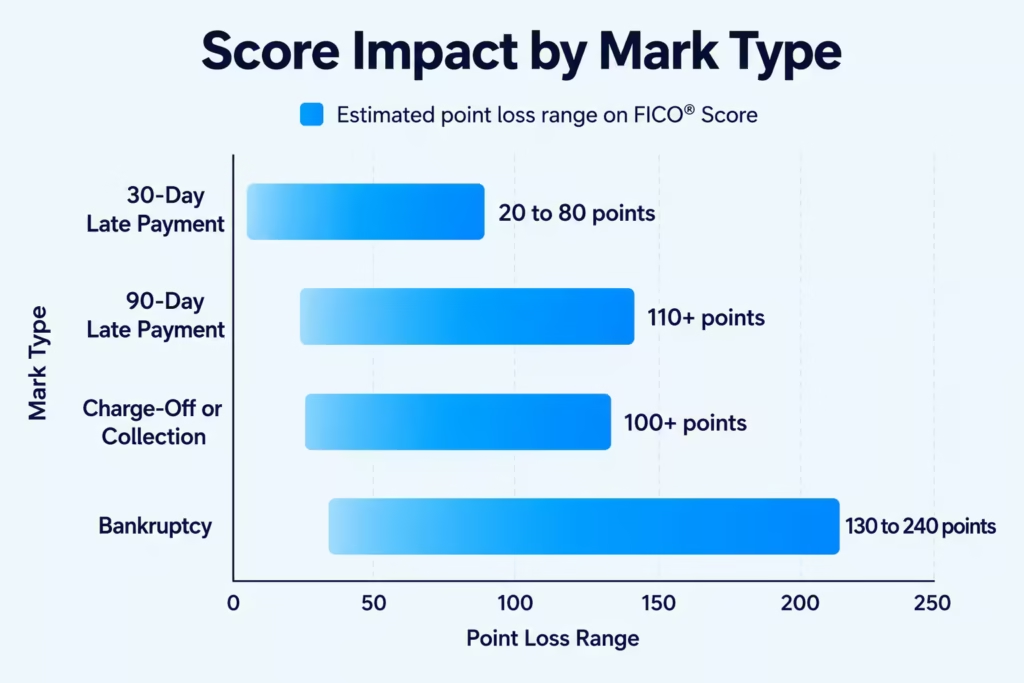
The pattern generalizes like this: a single 30-day late payment can cost anywhere from about 20 to 80 points. More severe events, like a charge-off, collection, or foreclosure, can cost 100 points or more. A bankruptcy can knock 130 to 240 points off, depending on where the score started.
One reassuring fact: the damage fades with time, even while the mark is still visible. A collection from six years ago hurts far less than one from six months ago. Scoring models care most about recent behavior.
What Affects How Much a Mark Hurts Your Score
Four variables decide how hard a mark hits you.
Your starting score matters most. The higher your score, the farther it falls. This feels unfair, but there is a logic to it: a clean file has no history of risk, so the first sign of trouble changes the picture dramatically. A file that already shows missed payments has that risk baked in, so one more mark changes less.
The severity of the mark matters too. A 30-day late payment is minor. A 90-day late payment is worse. A charge-off, repossession, or bankruptcy is worse still.
Recency plays a big role. Fresh marks hurt the most. As months pass with no new problems, the sting fades.
Finally, it matters whether you already have other derogatory marks. The first negative item does the most damage. Additional marks still hurt, but each new one tends to cost fewer points than the last.
Derogatory vs. Delinquent vs. “Key Derogatory Account”: What’s the Difference?
Credit apps and lenders use these words loosely, which creates real confusion. Here is what each one actually means.
“Delinquent” simply means late. An account becomes delinquent the day after a missed due date. But delinquency is private at first. It only becomes a derogatory item on your credit report once the lender reports it to the bureaus, which happens at the 30-day mark. So every derogatory mark started as a delinquency, but not every delinquency becomes a derogatory mark. Catch up within 29 days, and the bureaus never find out.
“Derogatory” is the report-wide label. It describes any negative entry: late payments, collections, charge-offs, repossessions, bankruptcies. When an app says “you have a derogatory mark,” it is using this broad sense.
“Key derogatory account” is a narrower, issuer-specific term. Some lenders and scoring tools use it to highlight the account that harms your profile the most. This could be an account with a major negative status, like a charge-off. That is the “key derogatory account meaning in practice: not a separate category of mark, just a spotlight on the worst one.
The same account can wear different labels on different platforms. One app might call it “derogatory,” another says “major delinquency,” and a lender’s denial letter calls it a “key derogatory.” It is the same underlying account. Focus on the account status itself, not the wording each tool happens to use.
Does Paying Off a Derogatory Mark Remove It?
No. This is the most expensive misconception in credit repair, so here it is plainly: paying a derogatory debt does not remove the mark from your report.
What actually changes when you pay is the account status. A collection might update from “unpaid” to “paid collection.” A charge-off might show a $0 balance. Those updates are worth having, since some lenders and newer scoring models look more kindly on paid collections than unpaid ones. But the mark itself stays on your report until the seven-year clock runs out.
The reason is the date of first delinquency. As covered above, the reporting clock is anchored to the date you first fell behind. Payment does not move that date. Settlement does not move it. Nothing legal moves it. The entry simply continues reporting, with an updated status, until it ages off.
There is one real exception: a pay-for-delete arrangement, where a collector agrees to remove the entry entirely in exchange for payment. It is not guaranteed and not always honored, but it exists. The details are covered in the options section below.
⚠️ Mistake to Avoid: Do not rush to pay an old collection believing it will erase the mark or instantly fix your score. Paying without a written deletion agreement usually just updates the status to “paid,” and the mark stays for the rest of its seven years. Decide on your strategy first, then pay.
How to Check If a Derogatory Mark Is Accurate
Before you dispute, pay, or negotiate anything, confirm the mark is actually correct. Errors are more common than most people think, and a wrong mark is a removable mark.
Start by pulling your full reports from all three bureaus, not just one. A mark might appear on your Experian report but not TransUnion, or show different dates at each bureau. You can get free weekly reports from all three at AnnualCreditReport.com, the only site authorized by federal law for this.
Once you have the reports, check each derogatory item against your own records:
Account ownership. Do you recognize the account? A mark from an account you never opened could mean a mixed file, where someone else’s data landed on your report, or identity theft.
The dates. Does the date of first delinquency match your records? A date that looks too recent could signal illegal re-aging.
The balance. Is the amount right? Collectors sometimes tack on fees, and errors inflate balances.
Duplicate reporting. Is the same debt listed twice, once by the original lender and once by a collector, with inconsistent details between them?
Payment status. If you settled or paid the debt, does the report reflect that?
Common errors are:
- Mixed files from people with similar names.
- Debts reported after they should have aged off.
- Accounts marked unpaid even after they were settled.
If anything looks wrong, the next section is your playbook.
How to Dispute an Inaccurate Derogatory Mark
If a mark is wrong, federal law is on your side. The FCRA gives you the right to dispute any inaccurate or unverifiable item, and the bureaus must investigate. Here is how to do it well.
Step 1: Gather your evidence. Gather items that back up your case. This includes bank statements with payments, settlement letters, payoff confirmations, or identity theft reports. A dispute with documents beats a dispute with only a claim.
Step 2: File the dispute with each bureau reporting the error. You can file online, by mail, or by phone with Experian, Equifax, and TransUnion. Online is fastest. Mail is slower but creates a paper trail, which is why many consumer attorneys prefer it. If you mail, send copies of your evidence, never originals, and use certified mail so you can prove delivery.
Step 3: Say exactly what is wrong. Vague disputes get vague results. Instead of “this is not mine,” write: “This collection does not belong to me. I never held an account with this lender. I have attached my bank statements for the period in question.” Name the account, name the error, name the fix you want.
Step 4: Dispute with the furnisher too. You can also send a dispute directly to the creditor or collector reporting the item. They have their own investigation duty under the FCRA, and hitting both ends raises the odds of a correction.
Warning: Bureaus may dismiss a dispute as “frivolous” if it lacks support or appears to be a template from a credit repair mill. Avoid this by being specific, including documents, and only disputing items that are genuinely wrong. Disputing accurate marks hoping they slip through is a waste of your time.
What Happens After You File a Dispute (The 30-Day Process)
Once a bureau receives your dispute, the clock starts. The bureau generally has 30 days to investigate, per the Consumer Financial Protection Bureau’s dispute guidance. That window can stretch to 45 days if you submit extra information mid-investigation.
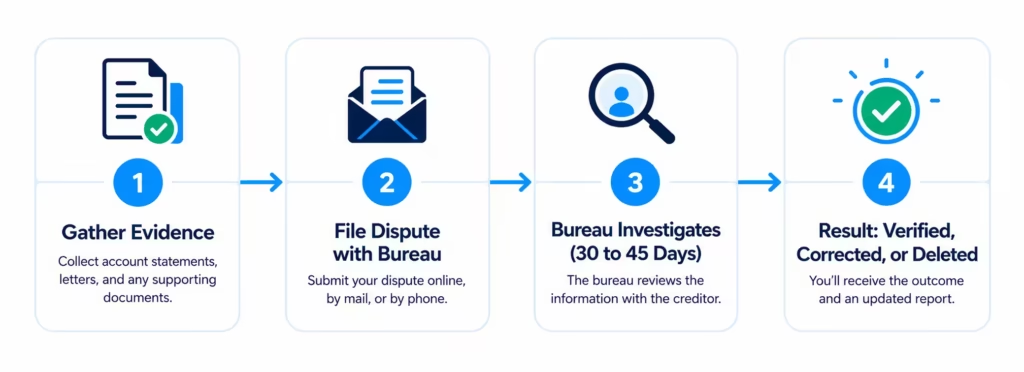
During the investigation, the bureau forwards your dispute and evidence to the furnisher. The furnisher must review its own records and report back. Three outcomes are possible:
The item is verified as accurate, and it stays. The item is corrected, and the wrong details are fixed. Or the furnisher cannot verify it, and the item must be deleted.
That last outcome matters more than people realize. If a collector has sloppy records, and many do, a failure to verify means removal, even for a debt that was real.
When the investigation ends, the bureau must send you the written results and a free updated copy of your report if anything changed. If your dispute is denied but you have more evidence, you can escalate.
You can file a complaint with the CFPB, add a brief statement to your file, or talk to a consumer rights attorney. FCRA cases often come with fee-shifting, which means many attorneys take them without charging you upfront.
Your Options When a Derogatory Mark Is Accurate
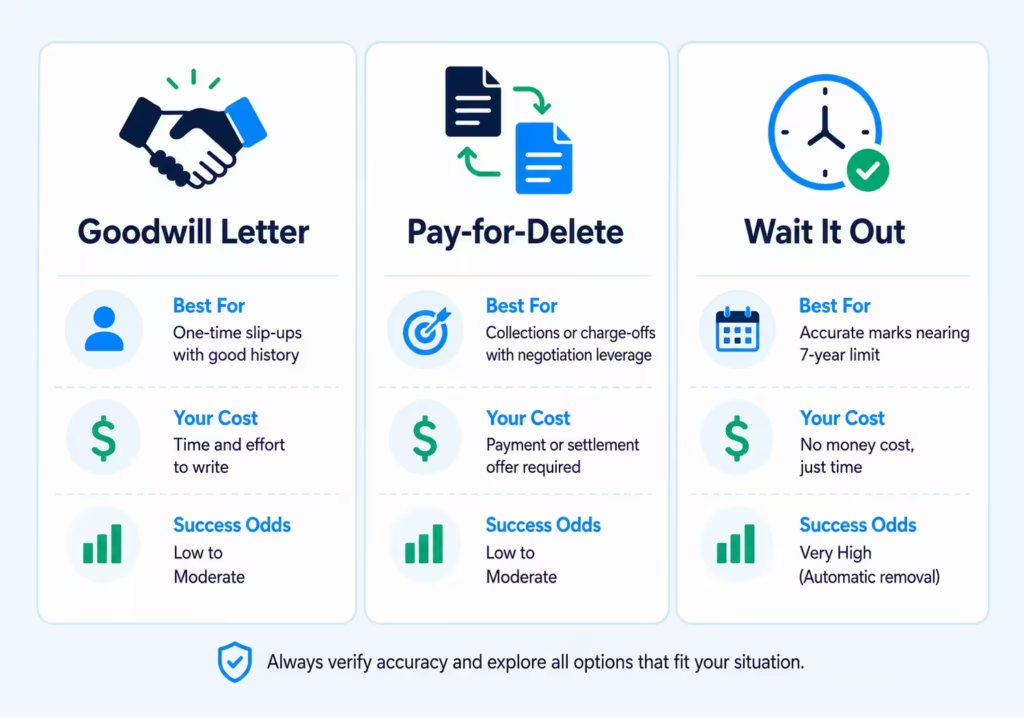
A mark that is accurate cannot be disputed off. The bureaus will verify it, and it will stay. But accurate does not mean hopeless. There are three legitimate paths, and the right one depends on your situation.
A quick note on expectations: none of these is guaranteed, and no one can legally promise to remove accurate, current information. Any company selling “guaranteed removal” of true marks is selling a scam.
Goodwill Letters
A goodwill letter is a written request asking a creditor to remove a negative mark as a gesture of goodwill. It works best in one specific situation: an otherwise clean history with a single isolated slip.
Consider a typical scenario. Michael, a project manager at a manufacturing company, had eight years of perfect payments on his auto loan. Then a family emergency and a bank account switch collided, and one payment posted 35 days late. A mark like that, sitting alone on an otherwise spotless record, is the ideal goodwill candidate.
The letter should be short and honest. Acknowledge the late payment. Explain briefly what happened. Point to your long track record. Note that you have kept the account current ever since. Then ask for a goodwill adjustment to your credit reports.
Understand what this is: not a legal right, but a favor. The creditor has every right to say no, and large banks often do. But some lenders grant these requests, especially for long-term customers, and the only cost of asking is a stamp.
Pay-for-Delete Negotiation
Pay-for-delete applies to unpaid collections and charge-offs. The idea is simple: you pay the debt, either fully or through a settlement. In return, the collector will delete the tradeline from your reports instead of just marking it as paid.
A few ground rules. First, this is a negotiation, not a right. The FCRA doesn’t make furnishers delete accurate information. Many big collection agencies also refuse to do this as a policy. Second, get the agreement in writing before you pay a cent.
A phone promise is worthless once the money changes hands, and with a paid debt, the collector has no reason left to help you. Third, if they agree, the letter should state clearly that the account will be deleted from all three bureaus, not just “updated” or “settled.”
Even if it works, remember this: pay-for-delete takes away the collector’s tradeline. However, the original creditor’s charge-off might still show on your report until it ages off.
💡 Pro Tip: Start negotiations lower than you can afford. Collectors often settle for 40% to 60% of the balance, and the deletion request costs you nothing extra to include. Make payment and deletion a single package deal in the written agreement.
Letting It Age Off Naturally
Sometimes the smartest move is no move at all. If a mark is five or six years into its seven-year window, the damage is already mostly done and mostly healed. Scoring models weigh recent behavior far more heavily than old history, so an aging mark is shrinking in impact every month.
Take Jennifer, an operations manager who found a collection from six years ago while preparing a mortgage application. Paying it would not remove it, and re-engaging with the collector carried its own risks. Since the entry was months from aging off on its own, waiting was the rational play, and her loan officer agreed.
Waiting it out is most effective when two things are true: the mark is close to its reporting deadline, and you are also building positive credit during that time. Making on-time payments, keeping credit utilization low, and avoiding new negative marks will boost your score more in the next year than negotiating an old, fading entry.
How a Derogatory Mark Can Affect You Beyond Your Score
Your credit score is only the beginning. A derogatory mark ripples into several parts of everyday life.
Loans and credit cards are the most obvious. A fresh major derogatory mark makes approval for a mortgage or auto loan harder, and when approval does come, it comes with a higher interest rate.
On a 30-year mortgage, even a one-point rate difference can cost tens of thousands of dollars over the life of the loan. Lenders also look beyond the score itself. Many mortgage underwriters check the actual report. A recent unpaid collection can lead to extra scrutiny. It may also require resolving the issue before closing.
Renting gets harder too. Many landlords and property managers check credit. A bad mark can lead to a bigger security deposit, a need for a co-signer, or a denied application. This is especially common with larger property management companies that screen by rigid criteria.
Employment is affected in narrower ways than most people fear, but it is affected. Some employers, mostly in finance, government, and roles handling money, review a version of your credit report as part of background checks.
They see the report, not your score, and they need your written permission first. A few states restrict or ban the practice. But where it is used, a pattern of derogatory marks can cost a candidate the job.
Insurance and utilities can sting as well. In many states, insurers set premiums based on credit scores. Also, utility companies might ask for deposits from customers with poor credit history.
How to Prevent Future Derogatory Marks
Once you have dealt with the mark in front of you, the final step is making sure the next one never appears. Three habits do most of the work.
Set up autopay and payment reminders. The most common derogatory mark is a simple late payment, and most late payments are not caused by an inability to pay. They are caused by forgetting. Autopay for at least the minimum due on every account removes the risk entirely. For accounts you prefer to pay manually, set calendar reminders a few days before each due date.
Check your credit reports regularly. Errors, mixed files, and fraudulent accounts are easiest to fix when caught early. Free weekly reports are available at AnnualCreditReport.com, so a quick review every few months costs nothing. Many banks and credit card apps also offer free monitoring that alerts you when something new hits your file.
Contact the creditor before you fall behind. This is the step people skip, and it is the most powerful one. Lenders would rather work with you than charge off your account. If you lose a job, face a medical bill, or see a tight month coming, call before the due date passes.
Many creditors provide hardship programs, deferred payments, or modified terms. Most won’t report late payments if you have an approved plan. A two-minute phone call in week one can prevent a seven-year mark in month two.
📌 Did You Know: A payment that is 29 days late does not appear on your credit report at all. Only payments 30 or more days past due get reported. If you realize you missed a due date, paying within that window can cost you a late fee but saves your credit report entirely.
Frequently Asked Questions (FAQs)
How long do derogatory marks stay on your credit report?
Most derogatory marks stay for 7 years from the date of first delinquency. Bankruptcies stay longer: Chapter 7 for up to 10 years, Chapter 13 for up to 7 years.
Can a derogatory mark be removed from your credit report?
Yes, if it’s inaccurate, you can dispute it with the bureaus and have it deleted within 30 to 45 days. If it’s accurate, removal isn’t guaranteed, but goodwill letters or pay-for-delete agreements sometimes work.
Should I pay off a derogatory mark?
Paying it won’t erase the mark, but it updates the status to “paid” and can help with newer scoring models. Get any deletion promise in writing before you pay, since a verbal agreement isn’t enforceable.
What happens if I pay off a derogatory debt?
The account status changes, such as from “unpaid collection” to “paid collection,” but the entry itself stays on your report until the seven-year clock runs out. Only a written pay-for-delete agreement removes the tradeline entirely.
Can you buy a house with a derogatory mark?
Yes, but it can be harder to get approved and you may face a higher interest rate. Mortgage underwriters often review the full report, and a recent unpaid collection may need to be resolved before closing.
Does removing derogatory marks improve credit?
Yes, removing a verified-inaccurate mark can raise your score, especially if it was a recent, severe item like a collection or charge-off. The exact gain depends on your starting score and how many other negative marks remain.
What is the date of first delinquency?
It’s the date you first missed a payment and never caught up, and it anchors the entire seven-year reporting clock. Charge-off dates, collection sale dates, and settlement dates don’t reset this clock.
Is a hard inquiry the same as a derogatory mark?
No, a hard inquiry just records that you applied for credit and isn’t classified as derogatory. It costs fewer than 5 points, stops affecting your score after 12 months, and falls off after 2 years, unlike a derogatory mark’s 7-year impact.
How long does it take to remove derogatory marks from a credit report?
A dispute investigation generally takes 30 days, extendable to 45 days if you submit more evidence. If the furnisher can’t verify the item, the bureau must delete it once the investigation closes.
How many points will my credit score go up when a derogatory mark is removed?
It varies, but FICO simulations show a single 30-day late payment can cost 20 to 80 points, while a charge-off or collection can cost 100 or more. Removing the mark typically restores a similar amount, though recovery depends on your overall credit file.
Wrapping Up
A derogatory mark is a negative record of an account that was not paid as agreed, and the main types range from late payments to collections, repossessions, and bankruptcy. Most stay for seven years; the clock never resets, and paying a debt updates the status without erasing the history.
For most readers, start by verifying the mark. If you find anything wrong, dispute it under your FCRA rights. For accurate marks, try goodwill, negotiation, or patience.
If you know someone who just spotted a derogatory mark on a credit report and is panicking, share this guide with them. It could save them money and months of stress.