
If you just missed a credit card payment or noticed a scary rate-increase notice in your inbox, we know that sinking feeling. A penalty APR can turn a manageable balance into a fast-growing debt in a single billing cycle, and most cardholders only learn about it after it hits
A penalty APR is a much higher interest rate a card issuer applies when you break your cardholder agreement, most often by paying late.
In this guide, we’ll walk you through exactly what triggers it, how long it lasts, what it really costs in dollars, and the step-by-step actions you can take to prevent or reverse it.
At a Glance
This guide explains what a penalty APR is, including the two-tier trigger system, the 45-day notice and 14-day rule, how long the higher rate lasts, and the real dollar cost on a revolving balance.
Core Facts:
- A penalty APR is a raised interest rate, often in the high 20s up to around 29.99%, that replaces the standard rate when a cardholder breaks the account agreement.
- A single missed payment can trigger a penalty rate on new purchases only, while existing balances stay protected at the standard rate under 60 days delinquent.
- Once an account is more than 60 days past due, the issuer can apply the penalty rate to the entire outstanding balance, not just new purchases.
- Issuers must generally give 45 days advance notice before a penalty rate takes effect, and purchases made 14 or more days after that notice can be charged the new rate.
- A penalty rate typically lasts at least six months, and issuers must review the account for a rate reduction after six consecutive on-time minimum payments.
- Business credit cards are not covered by the CARD Act, so issuers can raise rates on the full balance without the 45-day notice or six-payment review required for consumer cards.
Best for:
- Cardholders who just missed a payment or received a penalty rate notice and need to understand their timeline to act.
- People trying to understand the difference between how a penalty APR affects new purchases versus an existing balance.
- Small business owners who want to understand why their business card carries fewer legal protections than a personal card.
What Is a Penalty APR
A penalty APR is a raised interest rate that a credit card issuer charges when a cardholder violates the terms of the cardholder agreement. It replaces the regular purchase or cash advance rate for a set period. Some issuers also call it a “default rate” or “default APR,” but the meaning is the same.
The rate itself is steep. Most issuers set the penalty APR in the high 20s to around 29.99%. For context, the average credit card interest rate on accounts assessed interest was 22.15% in May 2026, according to Federal Reserve G.19 data. A penalty rate often sits 7 to 10 percentage points above that.
You will find the exact penalty rate for your card in two places. First, the Schumer box, which is the boxed rate chart on your credit card application or offer. Second, the cardholder agreement, usually in the section labeled “penalty rates” or “when penalty APR applies.” Both must list the rate, what triggers it, and how long it stays in effect.
Not every card has one. Many major issuers have removed penalty rates from their consumer cards in recent years, but plenty still use them, and business cards use them widely.
Penalty APR vs. Standard APR
Your standard APR is the regular rate you pay for purchases or cash advances. A penalty APR does not add to that rate. It replaces it for as long as the penalty is active.
The gap between the two is usually large. If your standard purchase APR is 21% and your penalty rate is 29.99%, that is close to a 9-point jump. On a revolving balance, that difference adds up fast.
One key point: not every card carries a penalty rate. Some issuers dropped them, so always check the Schumer box before you assume your card has one.
What Triggers a Penalty APR: Missing a Single Payment
The first trigger tier is a single late payment. If you miss your due date by even one day, most issuers can move you to the penalty interest rate credit card terms spelled out in your agreement.
At this stage, the raised rate usually applies to future purchases only. Your existing balance stays at the standard rate, at least for now. That is a key protection built into federal rules.
Here is how it plays out in practice:
Sarah, a marketing coordinator at a Boston design studio, forgot her $45 minimum payment by 6 days. Her issuer sent a notice that her purchase rate on new charges would jump from 20.99% to 29.99%. Her existing $3,200 balance kept the old rate, but every new swipe would carry the higher one.
The takeaway is simple. One missed payment is enough to trigger a rate hike on new spending. You do not need to be weeks behind. That is why what triggers penalty APR is so often just a small slip, not a major default.
⚠️ Mistake to Avoid: Assuming a 1-day late payment is harmless because your issuer “usually” waives fees. The fee waiver and the penalty APR are two different things. The rate hike can still be triggered even if the late fee is refunded.
What Triggers a Penalty APR: 60 or More Days Delinquent
The second trigger tier is far more serious. Once your account is more than 60 days past due, the issuer gains much broader power over your interest rate.
In plain terms, 60 days delinquent means you have missed two straight minimum payments. At that point, the issuer can apply the penalty APR vs regular APR difference to your entire outstanding balance, not just new purchases.
This is the “delinquency exception” written into the CARD Act and spelled out under Regulation Z §1026.55(b)(4). Outside this exception, issuers cannot reprice an existing balance. Once you cross 60 days, that shield is gone.
The dollar impact is huge. If you carry a $6,000 balance at 21% and it gets repriced to 29.99%, your annual interest cost jumps by about $540. That is money added to a balance you are already struggling to pay down.
This is the single most important distinction in this topic. A single late payment hurts new spending. A 60-day delinquency hurts everything you already owe.
Other Triggers Beyond Late Payments
Late payments get the most attention, but they are not the only path to a penalty rate. A few other actions can trigger it, depending on your cardholder agreement.
A returned payment is one of the most common. If you schedule a payment and your bank rejects it for insufficient funds, most issuers treat that the same as a missed payment. The clock starts, and a rate hike may follow.
Going over your credit limit can also count as a terms violation. Many issuers no longer allow over-limit transactions by default, but if you have opted in, exceeding the limit can trigger the higher rate.
Other, less common triggers include bounced convenience checks and violating specific promotional terms, like breaking the rules of a 0% intro offer.
The pattern is simple. Anything that counts as a breach of your cardholder agreement can open the door to a penalty rate. Read your agreement’s “penalty rates” section to see exactly what your issuer includes.
Penalty APR vs. Late Fees and Over-Limit Fees
It is easy to mix up the penalty rate with the flat fees that often show up beside it. They are not the same thing.
A late fee is a one-time dollar charge for missing a payment. Under CFPB rules, this fee is capped, and many issuers charge around $30 to $41 for a first violation. The CFPB has moved to lower typical late fees under Regulation Z §1026.52, though enforcement details continue to evolve.
An over-limit fee is a separate flat charge for spending past your credit line. You must opt in for issuers to charge it.
A penalty APR is different. It is not a one-time fee. It is a raised interest rate that keeps costing you money every day the balance sits there. All three can apply at the same time, which is why one missed payment can hurt in multiple ways.
The 45-Day Notice and 14-Day Rule
Federal law does not let issuers raise your rate overnight. In most cases, they must give you 45 days of advance notice before a penalty rate takes effect. This rule comes from the CARD Act.
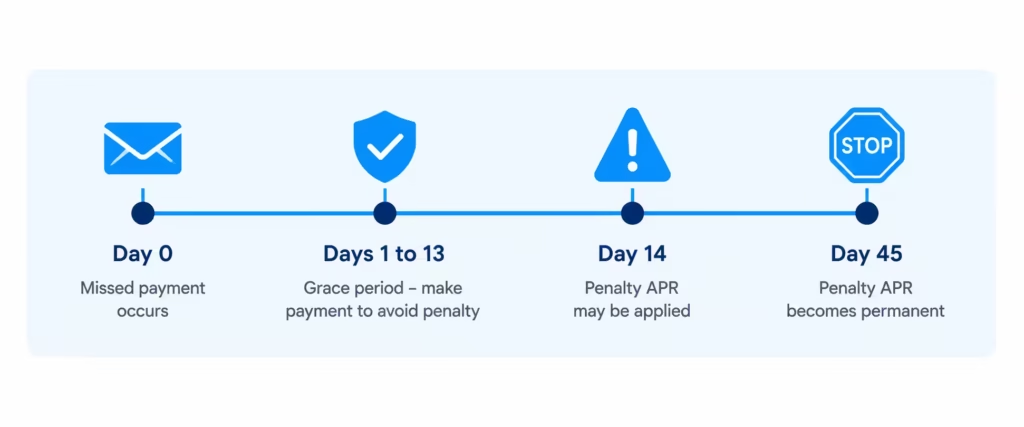
Inside that 45-day window, timing matters. Any purchase made 14 or more days after the notice date can be charged at the new penalty rate. Purchases made in the first 13 days are generally protected at the old rate.
Here is a simple timeline to picture it:
| Day | What Happens |
|---|---|
| Day 0 | Issuer mails the 45-day notice |
| Days 1–13 | Existing balance and new purchases stay at old rate |
| Day 14+ | New purchases can be charged the penalty rate |
| Day 45 | Penalty rate officially takes effect on qualifying purchases |
The practical move is straightforward. Once you get the notice, stop using the card. Every swipe after day 13 becomes a candidate for the higher rate.
One exception matters. If your account is already more than 60 days delinquent, the 45-day notice protections do not shield your existing balance. The issuer can reprice everything you already owe under the delinquency exception.
💡 Pro Tip: Set the notice aside and mark day 13 on your calendar. Even if you cannot pay the full balance right away, freezing new spending in that window keeps your existing balance vs future purchases problem as small as possible.
Does It Apply to Your Current Balance or Only Future Purchases
This is the question most cardholders get wrong, and the answer depends on one thing: whether you are 60+ days late.
If you are less than 60 days late, your existing balance is generally shielded. The penalty rate only applies to new purchases made after the 14-day window. What you already owe keeps the old rate until you pay it off.
If you are more than 60 days late, that protection disappears. The issuer can apply the penalty rate to your entire outstanding balance, including debt from months or years ago. This is where the real financial damage happens.
Understanding the notice mechanics is what separates a manageable rate hike from a costly one.
How Long a Penalty APR Lasts
There is no fixed end date built into most cardholder agreements, but there is a federal rule that protects you. A penalty rate typically lasts at least six months, and the CARD Act limits how long it can stay in place on your existing balance.
Under Regulation Z, if the penalty rate was applied to your existing balance, the issuer must review your account after 6 consecutive on-time minimum payments. If you meet that test, they must reduce the rate back down on that balance.
Six on-time payments is the magic number. Miss one, and the clock restarts. Make all six in a row, and the issuer is required to evaluate a rate reduction on the pre-penalty balance.
For new purchases made after the penalty took effect, the rules are more flexible for the issuer. They may keep those charges at the penalty rate longer, and there is no strict federal timeline forcing them to lower it. That is another reason to freeze card use once you get a notice.
The bottom line on how long penalty APR lasts: expect at least six months, plan for six on-time payments in a row, and act to reduce it as soon as you qualify.
How to Request a Lower Rate After Improving Payment History
Waiting for the automatic review is fine, but a phone call can speed things up. Once you hit that six-payment mark, the issuer must respond to a rate reduction request on the existing balance.
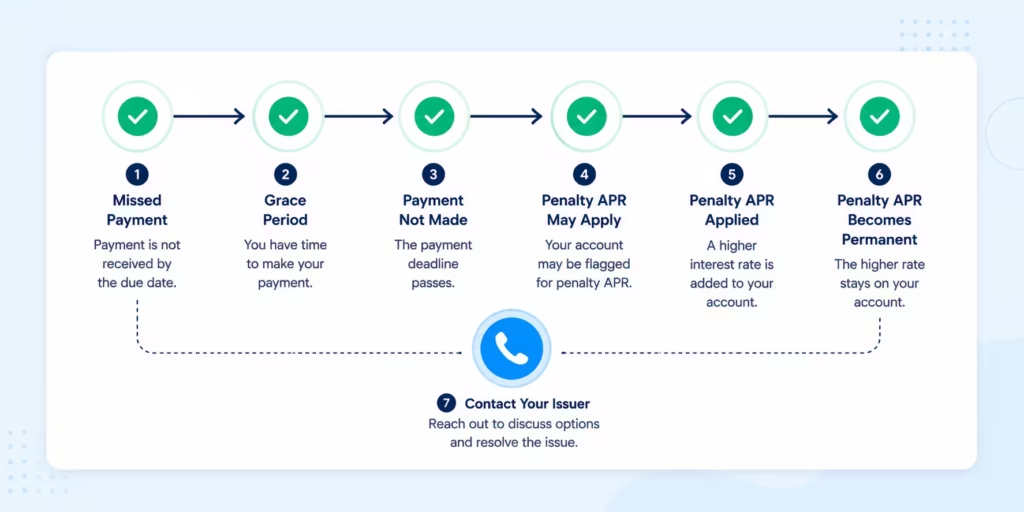
Follow these steps:
- Confirm you have made 6 consecutive on-time minimum payments. Pull up your statements and check the payment dates.
- Call the number on the back of your card. Ask to speak with the account management or retention team.
- State the request clearly. Say, “I would like to request a rate reduction on my account under the CARD Act’s six-payment review.”
- Ask for a written confirmation of the new rate and its effective date.
- If the agent says no, ask for the specific reason and request a supervisor review.
Being polite but firm helps. Agents deal with hundreds of calls a day, and a clear, informed request stands out.
How Much a Penalty APR Actually Costs
Percentages feel abstract, so it helps to see the dollars. Consider David, a project manager who carries a $5,000 revolving balance on a card with a 21% standard rate. His card’s average penalty APR is 29.99%.
At the standard 21% APR, David’s monthly interest is about $87.50, or roughly $1,050 a year if he only makes minimum payments and the balance holds steady.
At the 29.99% penalty rate, that same $5,000 balance costs about $124.96 in monthly interest, or around $1,499.50 a year. That is nearly $450 more in a single year, on the same balance, without buying anything new.
| Balance | Standard APR (21%) | Penalty APR (29.99%) | Extra Cost per Year |
|---|---|---|---|
| $2,000 | $420 | $600 | $180 |
| $5,000 | $1,050 | $1,499 | $449 |
| $10,000 | $2,100 | $2,999 | $899 |
The pain gets worse when you look at payoff time. Making only minimum payments at the penalty rate can add months or even years to your payoff timeline. Every dollar of interest is a dollar not going toward the principal.
That is why the penalty rate is often described as a debt trap. It is not just a higher number on a statement. It is real money leaving your pocket every single month.
Does a Penalty APR Hurt Your Credit Score
This is one of the most misunderstood parts of the topic, so let’s be clear. The penalty rate itself is not reported to credit bureaus. Your APR does not appear on your credit report at all.
What does hurt your score is the late payment that triggered the rate hike. Once a payment is 30 or more days past due, the issuer reports it to Equifax, Experian, and TransUnion. That single late mark can drop a FICO score by 60 to 110 points, depending on your starting score and credit history.
So two things are happening at once, and they are separate:
- The rate hike costs you money on your balance
- The late payment record hurts your credit score
You can end up with one problem, the other, or both. If you pay before day 30, you may face the penalty rate but avoid the credit bureau reporting hit. If you go 30+ days late, both hit you at once.
The score damage from a single 30-day late payment can linger on your credit report for up to seven years, though the impact fades over time as you build a strong recent payment history.
Penalty APR on Business Credit Cards
Here is a gap most cardholders never learn about until it hurts them. Business credit cards are not covered by the CARD Act. That means the consumer vs business protections you get on a personal card mostly do not apply.
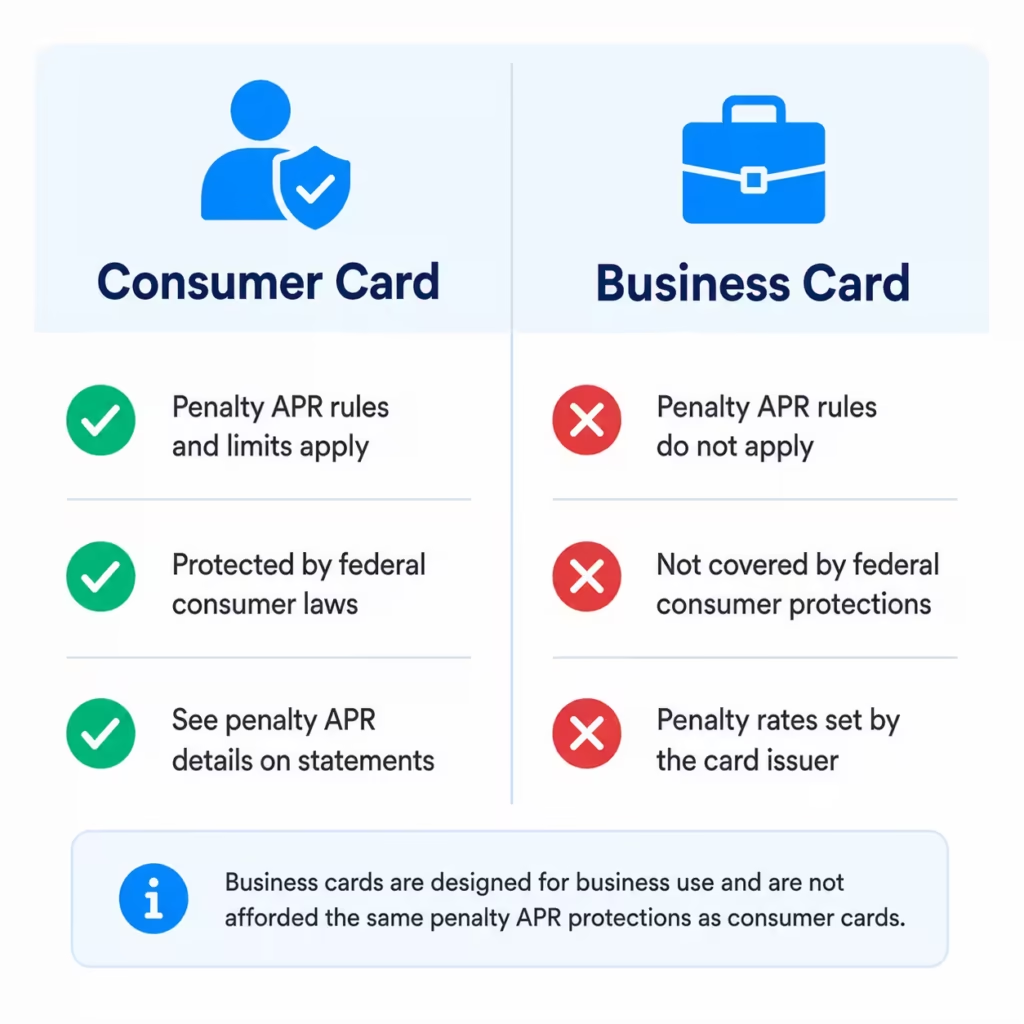
On a business credit card, the issuer can raise your rate without the same 45-day notice. They can apply a penalty rate to your entire balance without needing you to be 60 days late. They are not required to review your rate after six on-time payments.
This matters most for small business owners and freelancers. Michael, who runs a 4-person consulting firm in Denver, missed one payment on his business card by 8 days. His issuer moved his entire $12,000 balance to a 29.99% rate the next cycle, no 45-day notice required. On a consumer card, that would not have been allowed.
The practical takeaway is simple. Treat your business card with more caution, not less. Set up automatic payments, keep a payment buffer in your business checking account, and read the penalty rate section of your agreement before you sign.
How to Avoid Triggering a Penalty APR
Prevention is far cheaper than recovery. A few small habits can make it nearly impossible to trigger a penalty rate in the first place.
Set up autopay for at least the minimum payment. This single step blocks the most common trigger. Even if you plan to pay in full each month, having a backup autopay for the minimum protects you if you forget or travel.
Add multiple payment reminders. Most issuer apps let you set alerts by email, text, or push notification. A common setup is one reminder 7 days before the due date and a second one 2 days before.
Watch your credit utilization. Staying well under your credit limit removes the risk of an over-limit trigger. A good rule is to keep balances below 70% of the limit, and ideally under 30% for score reasons.
Keep enough cash in your checking account to cover the minimum payment. Returned payments count as a violation, and low balances are the top reason payments bounce.
Do a quick monthly review. Log in once a month, confirm the payment posted, and check for any notices. Two minutes of habit can prevent months of higher rates.
What to Do If You Just Received a Penalty APR Notice
If a rate-increase notice just landed in your mailbox, take a breath. You have options, and the next 14 days matter most.
Step 1: Bring the account current immediately. If you are behind, pay at least the past-due amount today. This can stop the 60-day clock from running toward the more damaging trigger.
Step 2: Stop using the card. Any purchase made 14 or more days after the notice date can be charged at the new rate. Freeze the card in your issuer’s app if it helps you resist the temptation.
Step 3: Call the issuer. Ask if they will reverse the rate hike this one time as a courtesy. Long-standing customers with otherwise clean payment histories sometimes get a one-time waiver. Ask for the retention or account management team specifically.
Step 4: If they will not reverse it, ask for the exact date the penalty rate ends and what conditions apply. Get the answer in writing through the app’s secure message center.
Step 5: Start tracking toward the six-payment mark. Set a calendar reminder for the sixth payment date. That is when you can formally request a rate reduction.
Step 6: If you have strong credit elsewhere, consider a balance transfer card with a 0% intro APR. Moving the balance can save hundreds while you rebuild. Just be sure you can pay it off before the intro period ends.
Acting inside the 14-day window is the single most important move. Every day you wait costs money, and every purchase in the wrong window locks in the higher rate.
Frequently Asked Questions (FAQs)
What does penalty APR mean?
A penalty APR is a raised interest rate a credit card issuer charges when you break your cardholder agreement, most often by paying late. It replaces your standard rate and often sits in the high 20s, up to around 29.99%.
What triggers a penalty APR?
A single payment missed by even one day can trigger a penalty APR on new purchases. Other triggers include a returned payment, going over your credit limit, or violating promotional terms like a 0% intro offer.
Is penalty APR permanent?
No, penalty APR is not permanent for your existing balance. Federal rules require issuers to review your rate after six consecutive on-time minimum payments, though new purchases made after the penalty took effect can stay at the higher rate longer.
How long does a penalty APR last?
A penalty APR typically lasts at least six months. If it applied to your existing balance, the issuer must review your account after six consecutive on-time minimum payments and reduce the rate if you qualify.
How to get rid of penalty APR?
Make six consecutive on-time minimum payments, then call your issuer to request a rate reduction under the CARD Act’s six-payment review. Ask for the retention team and request written confirmation of the new rate.
Do all credit cards have a penalty APR?
No, not every card has one. Many major issuers have dropped penalty rates from consumer cards, though plenty still use them, and business cards use them widely, so check your Schumer box.
How much is 26.99 APR on $3,000?
At 26.99% APR, a $3,000 balance costs roughly $67 a month in interest, or about $810 a year, if the balance holds steady and only minimum payments are made. Actual cost varies with your payment amount and balance changes.
Does a penalty APR hurt your credit score?
The penalty APR itself is not reported to credit bureaus and doesn’t appear on your credit report. What hurts your score is the late payment that triggered it, which can drop a FICO score by 60 to 110 points once it’s 30 or more days past due.
Do business credit cards have penalty APR?
Yes, and often with fewer protections than consumer cards. Business cards aren’t covered by the CARD Act, so issuers can raise rates on the entire balance without the 45-day notice or six-payment review requirement.
What is the 45-day notice rule for penalty APR?
Issuers must generally give 45 days of advance notice before a penalty rate takes effect. Purchases made 14 or more days after the notice date can be charged the new penalty rate, while the first 13 days are usually protected at the old rate.
Do business credit cards have penalty APR?
Yes, and often with fewer protections. Business cards are not covered by the CARD Act, so issuers can raise rates without the 45-day notice or the six-payment review that consumer cards get. Small business owners should treat their card terms with extra care.
The Bottom Line
A penalty APR is one of the most expensive surprises a credit card can hand you, but it is also one of the most preventable. We covered what triggers it, how the 45-day notice and 14-day window work, how long the higher rate lasts, and the real dollar cost on a normal balance. We also walked through prevention steps and the exact actions to take if a notice arrives.
Based on the CARD Act’s six-payment review rule, the most effective approach is to combine autopay with a fast recovery plan.
If you know a friend or family member juggling credit card debt, share this guide with them. It could save them hundreds of dollars and months of stress.