
You already have one Citi card. Maybe two. Now you’re eyeing another one, and a question pops up: how many Citi cards can I have before Citi says no? It’s a fair worry. Apply too soon, and you could burn a hard inquiry on a denial.
Here’s the short answer: Citi does not set a fixed cap on the number of cards you can hold. What it limits instead is how often you can apply, how much total credit it will extend to you, and how often you can earn a welcome bonus.
Below, you’ll learn exactly how those rules work, how to time your next application, and what to do if you hit a wall.
At a Glance
This guide explains how many Citi credit cards you can hold, covering the 8/65 application spacing rule, total credit exposure limits, welcome bonus eligibility windows, and steps to fix a low approval or denial.
Core Facts:
- Citi has no published cap on the total number of cards one person can hold; some cardholders report holding four or more at once.
- The 8/65 rule limits applications to one every 8 days and no more than two within any 65-day period; applications outside those windows are typically denied automatically.
- Total credit exposure, the combined credit limit Citi extends across all your accounts, is the main factor behind denials or low limits, not card count.
- Welcome bonus eligibility follows a separate brand-based restriction, with most Citi cards now carrying a 48-month window and some legacy cards using a 24-month window.
- Credit line reallocation lets you shift part of an existing card’s limit to a new card by phone, without increasing your total exposure.
- FICO’s scoring model weighs payment history, amounts owed, credit history length, credit mix, and new credit, with no direct penalty tied to how many cards you hold.
Best for:
- Cardholders planning to apply for another Citi card who want to avoid a wasted hard inquiry from bad timing.
- People who were denied or approved with a low limit despite a strong credit score and want to understand why.
- Readers deciding whether to close an old Citi card, who need to know it doesn’t reset welcome bonus eligibility.
Does Citi Limit the Total Number of Credit Cards You Can Have?
No. Citi has no published rule that caps the number of credit cards one person can hold. There is no “maximum of three cards” or “maximum of five cards” policy. Some cardholders report holding four, five, or more Citi cards at once.
This surprises people because some retailers do impose hard limits. Certain store-card issuers cap you at one or two accounts, period. Citi works differently. It cares less about how many cards you carry and more about how much credit it has already trusted you with.
One useful distinction: personal and business Citi cards are separate product categories. Holding personal cards doesn’t prevent you from also holding a Citi business card, and vice versa. Each has its own application track.
So if “card count” isn’t the real gatekeeper, what is? Two things: your total credit exposure with Citi, and Citi’s application-frequency rules. Both are covered next.
How to Check How Many Citi Cards You Currently Have
Before you plan your next application, confirm what you actually hold. Don’t guess from memory. An old card you forgot about still counts toward your total credit exposure.
Two quick ways to check:
- Log in to your Citi account. Your online dashboard and the Citi Mobile App list every open Citi credit account under your name.
- Pull your credit reports. Visit AnnualCreditReport.com, the only site authorized by federal law to provide your free credit reports. It shows every open account across all issuers, which is helpful if you’re not sure an old card was ever closed.
What Citi Actually Limits Instead: Total Credit Exposure

Here’s the concept that reframes the whole question. Citi doesn’t count your cards. It counts your credit.
Total credit exposure is the combined amount of credit Citi is willing to extend to you across all your Citi accounts. Think of it as one big pool. Every credit limit you already hold draws from that pool.
Citi does not publish a formula for this. Based on how approvals generally work, the pool size reflects your income, your credit profile, and your history with Citi. Someone with a high income and a long, clean Citi relationship typically gets a bigger pool than a newer customer.
Why does this matter for you? Because it explains a frustrating scenario: you apply for a new Citi card with a strong credit score, and you still get denied or approved with a tiny limit.
The problem often isn’t your creditworthiness in general. It’s that your existing Citi limits already use up most of what Citi is willing to lend you. A credit limit denial in this situation is about exposure, not about card count.
Signs You’ve Hit Your Citi Credit Exposure Limit
Watch for these signals:
- You get an “application pending” message instead of an instant approval. This often means a human needs to review whether Citi can extend you more credit.
- You’re approved, but with a low starting limit. If your new card arrives with a $1,000 or $2,000 limit while your other cards carry much higher limits, your exposure pool is likely close to full.
- You’re denied despite a strong score and income. When the rest of your profile looks good, existing Citi limits are a common culprit.
The good news: a low limit on a new card isn’t always permanent. There’s a fix called credit line reallocation, covered later in this article.
The Citi 8/65 Application Rule Explained
If there’s one rule to memorize before applying for another Citi card, it’s this one. The Citi 8/65 rule is an application-frequency limit:
- You can submit no more than one Citi card application in any 8 days.
- You can submit no more than two Citi card applications in any 65 days.
Apply outside those windows, and the excess application is typically denied automatically. You’d take a hard inquiry for nothing.
Why does this rule exist? From a risk standpoint, rapid-fire applications signal possible financial distress. Issuers use spacing rules to slow that down. The deeper reason matters less than the practical one: the rule is strict, and Citi enforces it.
One important clarification: the 8/65 rule governs whether you can apply. It’s separate from welcome-bonus eligibility rules, which govern whether you earn a bonus. You could be fully eligible to apply under 8/65 and still not qualify for the new card’s bonus. Don’t conflate the two.
Worked Example: Counting the 8/65 Rule Window
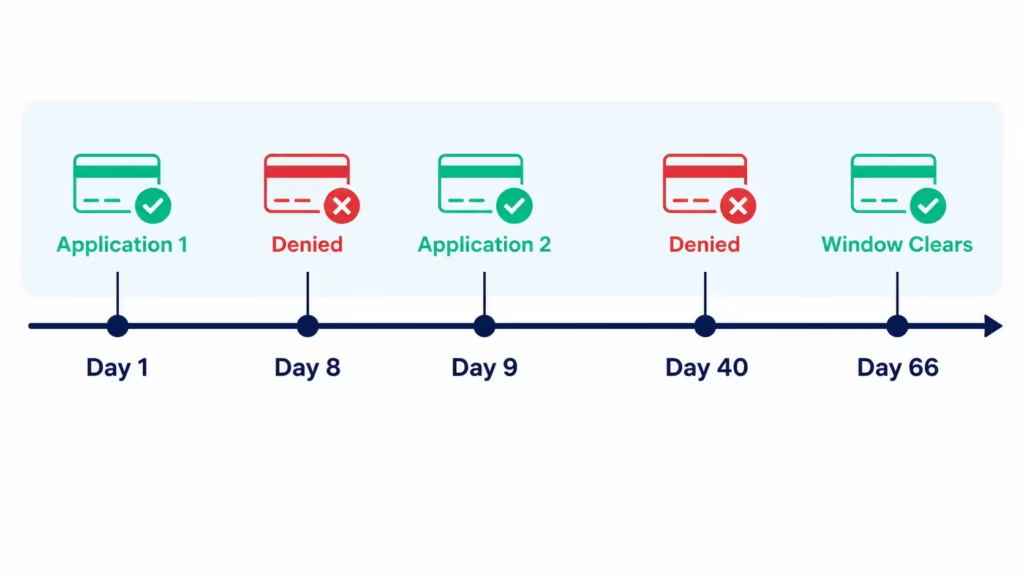
The rule trips people up because the two windows run at the same time. Here’s a simple timeline.
- Day 1: You apply for the Citi Custom Cash. That’s application #1.
- Day 8 or earlier: You apply for the Double Cash. Denied. The 8-day window hasn’t passed.
- Day 9: You apply for the Double Cash. Allowed. That’s application #2.
- Day 40: You apply for a third card. Denied. You now have two applications inside the 65-day window, even though the 8-day rule is satisfied.
- Day 66: The 65-day window has cleared your Day 1 application. You can apply again.
Notice that the 65-day count includes the same applications the 8-day rule tracks. It’s not two separate counters. It’s one rolling count, checked against two limits.
Do Business and Personal Citi Cards Count Together Under 8/65?
This is a common point of confusion, and the honest answer is: it depends on which limit you’re asking about.
Citi’s business card applications have their own spacing restriction, commonly described as one business card application per 90-day period. Some application limits are tracked separately for personal and business products, while other limits can combine across both. Citi has not published a single, detailed public document that maps every combination.
Because these figures can change, treat the commonly reported numbers as planning guidelines rather than guarantees. If the timing matters to you, confirm current terms directly with Citi before you apply.
Welcome Bonus Restrictions: The 48-Month Same-Brand Rule
Here’s the rule that quietly costs people hundreds of dollars. Getting approved for a card does not guarantee you its welcome bonus.
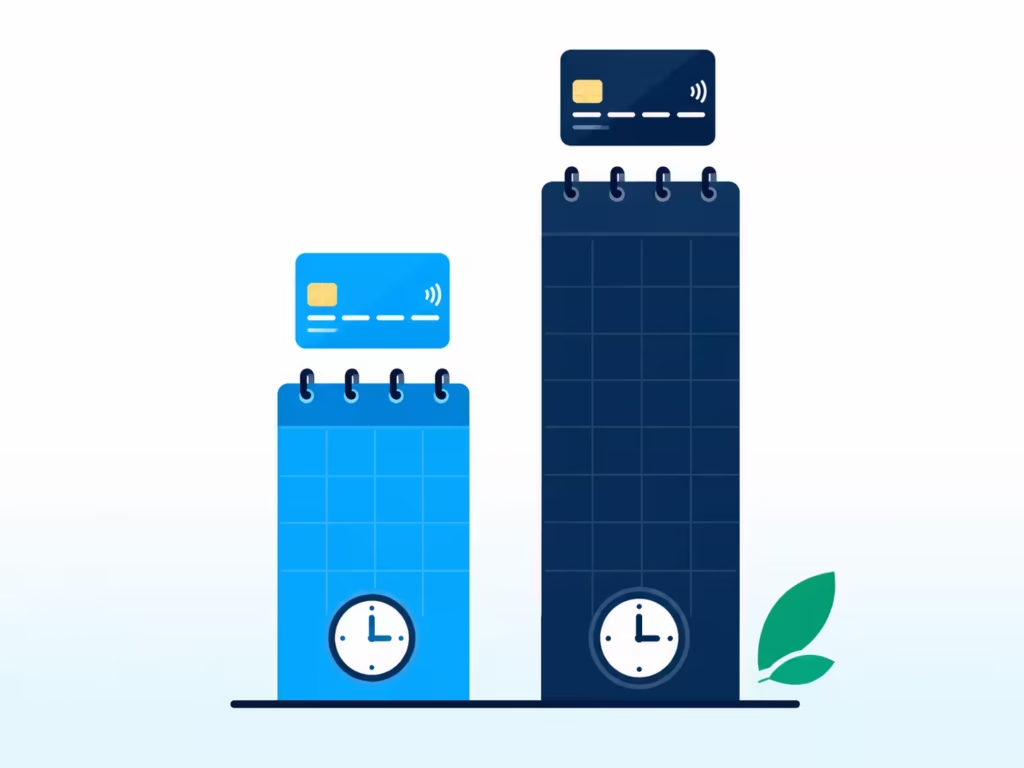
Citi restricts new-account bonuses by card “brand,” meaning the product family. The classic version of this rule, widely reported since 2016, is one bonus per brand within 24 months. Earned a Strata Premier bonus 18 months ago? A new Strata Premier application likely pays no bonus, even if you’re approved.
Two key clarifications:
- This is separate from 8/65. You can be approved and still be ineligible for the bonus. Approval and bonus eligibility are two different gates.
- Personal and business versions are usually treated as separate brands. Holding a personal AAdvantage card generally doesn’t block the bonus on the business version.
Now, an important update. In recent years, Citi has moved many of its cards to a longer window. As Bankrate’s issuer-by-issuer breakdown reports, most Citi cards now carry a 48-month bonus restriction. So the safest habit is this: read the exact bonus language on the application page for the specific card you want. The terms on that page are the ones that govern your application.
The 24-Month Legacy Language on Some Cards
Some Citi cards have carried longer restrictions for a while, including the Costco Anywhere Visa Card by Citi and its business version. As noted above, Citi has since extended 48-month language to many more products, including most AAdvantage and Strata cards.
How do you know which window applies to your card? Look at the offer’s terms and conditions. The restriction is spelled out in the bonus disclaimer, usually in a sentence like “bonus not available if you received a bonus for this product in the past 48 months.” If the language says 48 months, that’s your number. If it says 24, that’s your number. When in doubt, the longer window is the safer assumption.
How Closing or Product-Changing a Card Affects Bonus Eligibility
A natural follow-up: if you close the card, does the clock reset? Generally, no.
The restriction window is tied to when you received a bonus (or opened or closed an account in that family, depending on the card’s terms). It is not tied to whether the account is currently open. Closing your old Premier today does not make you bonus-eligible for a new Premier tomorrow.
Product changes can also affect timing. Converting a card to a different product within the same brand family may still count as activity in that family.
⚠️ Mistake to Avoid: Don’t close a card assuming it clears you for an immediate new bonus. The clock keeps running based on your account history, and you could end up with no old card and no new bonus.
Does Having Many Citi Cards Hurt Your Credit Score?
Separate question, separate answer. Citi’s internal rules are about approvals. Your credit score is a different system, and holding multiple cards isn’t automatically bad for it.
FICO’s published scoring factors break down as follows: payment history (35%), amounts owed (30%), length of credit history (15%), credit mix (10%), and new credit (10%). Notice what’s missing: “number of cards.” There’s no penalty for card count itself.
Here’s what actually happens when you add a Citi card:
- Short term: Each application triggers a hard inquiry, which can shave a few points temporarily. A new account also lowers the average age of your accounts.
- Long term: More total available credit can lower your credit utilization if you keep balances low. Lower utilization supports the 30% “amounts owed” category. That can help your score over time.
So the real answer to “will applying for another Citi card hurt my credit score?” is: briefly and modestly, with a possible long-term benefit if you manage balances well. The bigger risks in this article are a wasted inquiry from bad timing, not the card count itself.
What Happens If Your Citi Card Application Is Denied
A denial stings, but it’s information. By law, you’ll receive an adverse action notice explaining the main reasons. In multiple-card scenarios, the common causes are:
- You’ve hit your total credit exposure limit with Citi
- You violated the 8/65 application window
- Recent inquiries from Citi or other issuers raise flags
- Your income doesn’t support more credit relative to existing obligations (a debt-to-income concern)
Read that letter carefully. It tells you which lever to pull. If the issue is 8/65 timing, the fix is patience. If it’s exposure, the fix may be reallocation (next section).
How long should you wait before reapplying? There’s no official magic number. A practical approach is to wait at least long enough to clear the 8/65 windows, address the stated denial reason, and let recent inquiries age. Rushing back in usually just produces another denial.
What “Application Pending” Means and What to Do About It
Pending is not a denial. It usually means Citi needs to verify something or manually review your file. Exposure questions are a frequent trigger.
Your move: call Citi’s reconsideration line. The number widely listed in NerdWallet’s reconsideration guide is 1-800-695-5171. You can also check your status on Citi’s application status page.
Before you call, have these ready:
- Your income figures
- Your history with Citi (how long you’ve held existing cards)
- A clear reason for wanting the new card
Many pending applications convert to approvals after a short conversation. Don’t assume the worst and walk away.
How to Get a Higher Credit Limit on a New Card via Reallocation
Approved, but the limit is disappointing? This is where credit line reallocation comes in.
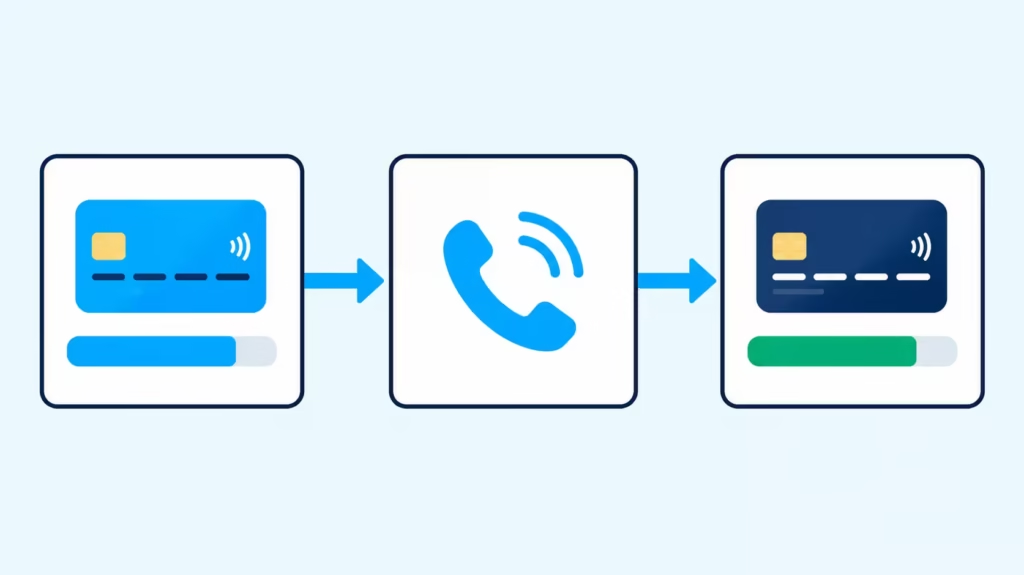
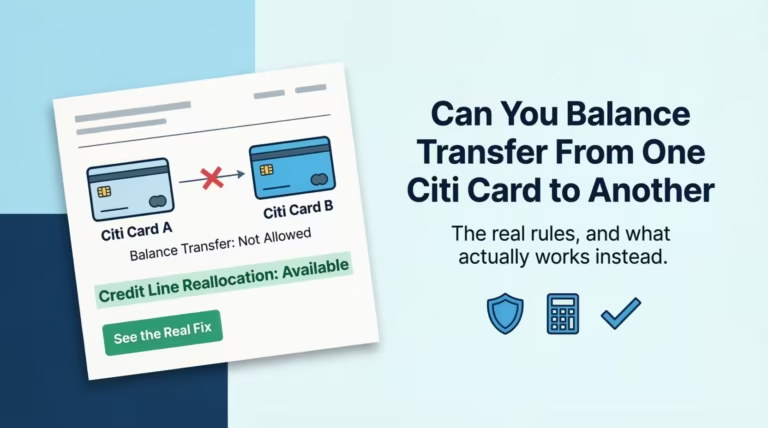
Reallocation means moving part of your credit limit from one Citi card to another. Your total exposure stays the same. You’re just shifting the distribution. If your old, rarely used card holds a $15,000 limit and your new card got $2,000, moving $5,000 over can make the new card actually useful.
As The Points Guy’s reallocation guide explains, this is done by phone with Citi customer service, and it’s different from a credit limit increase. Nothing new is being lent to you.
One honest caveat: user reports on Citi’s willingness to reallocate are mixed. Some cardholders succeed easily; others are told no. It’s worth asking, since the request itself costs nothing.
💡 Pro Tip: Reallocation makes the most sense when you have an older card with a large limit you barely use and a new card you plan to use actively. Move limit toward the card that earns you the most value.
Factors That Determine How Many Citi Cards You Can Realistically Get Approved For
Citi doesn’t publish an approval formula. But the practical answer to “how many cards can I realistically get” comes down to five variables:
- Income and ability to repay. Higher stated income supports a larger exposure pool.
- Credit score and report standing. A clean history expands what Citi will offer you.
- Existing Citi relationship and exposure. Long, positive history with Citi tends to grow your pool over time.
- Recent application activity. Both the 8/65 rule and your broader inquiry count matter.
- Payment history on current Citi accounts. Late payments shrink trust fast.
No single factor decides your outcome. A person with a moderate income but a decade of perfect Citi history may hold more cards than a high earner with a thin file. Self-assess honestly against these five points before your next application.
Strategic Tips for Applying for Multiple Citi Cards Over Time
Everything above boils down to a playbook. Here’s how to put it into action:
- Respect the 8/65 spacing. Mark application dates on a calendar. One per 8 days, two per 65 days, no exceptions.
- Track bonus windows by brand. Before applying, check the card’s terms for the 24- or 48-month restriction and your own bonus history in that family.
- Apply for the highest-value card first. If your exposure is limited, spend it on the card with the best bonus or the category you’ll use most.
- Check your current lineup first. Log in to your Citi account or pull your reports so you’re planning from facts, not memory.
- Use the reconsideration line proactively. A pending status is an invitation to make your case, not a rejection.
- Consider reallocation over new applications. If you need more usable credit, moving existing limits is often smarter than adding another hard inquiry.
Play it this way, and the question stops being “how many Citi cards can I have” and becomes “which Citi card should I get next, and when.”
Frequently Asked Questions (FAQs)
Can I have two Citi credit cards on one account?
Each Citi card you hold is its own account, so cards aren’t grouped under one account number. Citi tracks your combined credit limits across all your accounts as total credit exposure instead.
Does having two credit cards hurt credit score?
No, card count itself isn’t a scoring factor in FICO’s formula. A new application causes a small, temporary dip from the hard inquiry, but more available credit can actually lower your utilization and help your score long term.
Will 3 credit cards hurt my credit score?
Not on their own. FICO scores weigh payment history, amounts owed, credit history length, credit mix, and new credit, with no direct penalty for how many cards you hold.
What happens if I apply for a Citi card too soon after my last one?
Citi’s 8/65 rule blocks it. You’re limited to one application every 8 days and two within any 65 days, and an application outside those windows is typically denied automatically, costing you a wasted hard inquiry.
Does closing a Citi card reset my welcome bonus eligibility?
No. The bonus restriction window, now 48 months on most Citi cards, is tied to your account history and when you earned the bonus, not whether the account is still open.
What should I do if my Citi application shows as pending?
Pending usually means Citi needs to manually review your file, often due to credit exposure questions. Call the reconsideration line at 1-800-695-5171 with your income and Citi account history ready, since many pending applications convert to approvals after a short call.
How can I get a higher limit if my new Citi card approval is low?
Ask Citi about credit line reallocation, which shifts part of an existing card’s limit to the new one by phone. Your total exposure stays the same, but moving unused limit from an old card can make the new one more useful right away.
Do business and personal Citi cards share the same application limits?
It depends on which rule. Business card applications generally follow a separate 90-day spacing rule, and some limits track personal and business separately while others combine, so Citi’s exact terms should be confirmed before applying.
What’s the main reason a Citi application gets denied with a strong credit score?
The most common cause is hitting your total credit exposure limit with Citi, meaning your existing card limits already use up most of what Citi is willing to lend. Other causes include 8/65 rule violations and recent inquiries from any issuer.
Wrapping Up
Citi sets no fixed limit on how many cards you can hold. The real gates are your total credit exposure, the 8/65 application rule, and per-brand bonus windows of 24 to 48 months depending on the card.
A practical approach is to space your applications, read each card’s bonus terms before applying, and use reallocation or the reconsideration line when a result disappoints you. For many readers, that combination removes most of the guesswork.
Know someone sitting on a Citi card and wondering about their next move? Share this guide with them before they apply.