
I get why this question comes up so often. You’re carrying a balance on one Citi card, and you just spotted a shiny 0% offer on another Citi card sitting in your wallet. It feels like it should be a simple move, right? Two cards, same bank, just shift the debt over.
Here’s the short answer: No, Citi does not allow balance transfers between two Citi-issued cards.
Don’t close this tab yet, though. There’s a different Citi tool that might solve part of your problem, plus a real path to a lower rate if that’s what you actually need. I’ll walk you through all of it below.
Key Takeaways
This guide explains whether you can balance transfer from one Citi card to another, covering the same-issuer restriction, the credit line reallocation alternative, its eligibility factors, and the actual path to lowering interest on existing debt.
Core Facts:
- Citi does not allow balance transfers between two Citi-issued cards, regardless of which specific Citi cards or co-branded cards are involved.
- Attempting a same-Citi transfer results in a blocked or declined request, with no fee charged and no hard inquiry pulled since no transfer occurs.
- Credit line reallocation moves unused credit limit between two of your own Citi cards, but the balance and its interest rate stay on the original card.
- Reallocation eligibility typically requires accounts at least six months old, good standing, available unused credit on the donor card, and matching card types (personal-to-personal or business-to-business).
- Reallocation usually involves a hard credit inquiry, which according to myFICO typically lowers a FICO score by less than five points and stops affecting the score after 12 months.
- Lowering interest on existing Citi debt requires transferring the balance to a 0% intro APR card at a different bank, which typically carries a 3% to 5% balance transfer fee.
Best for:
- Readers trying to determine whether moving debt between two Citi cards is possible before contacting customer service.
- Cardholders who want to shift available credit between Citi accounts to lower utilization or prepare a card for closure.
- Readers seeking a genuine path to reduce interest on existing Citi card debt through a different issuer’s promotional offer.
Can You Transfer a Balance From One Citi Card to Another?
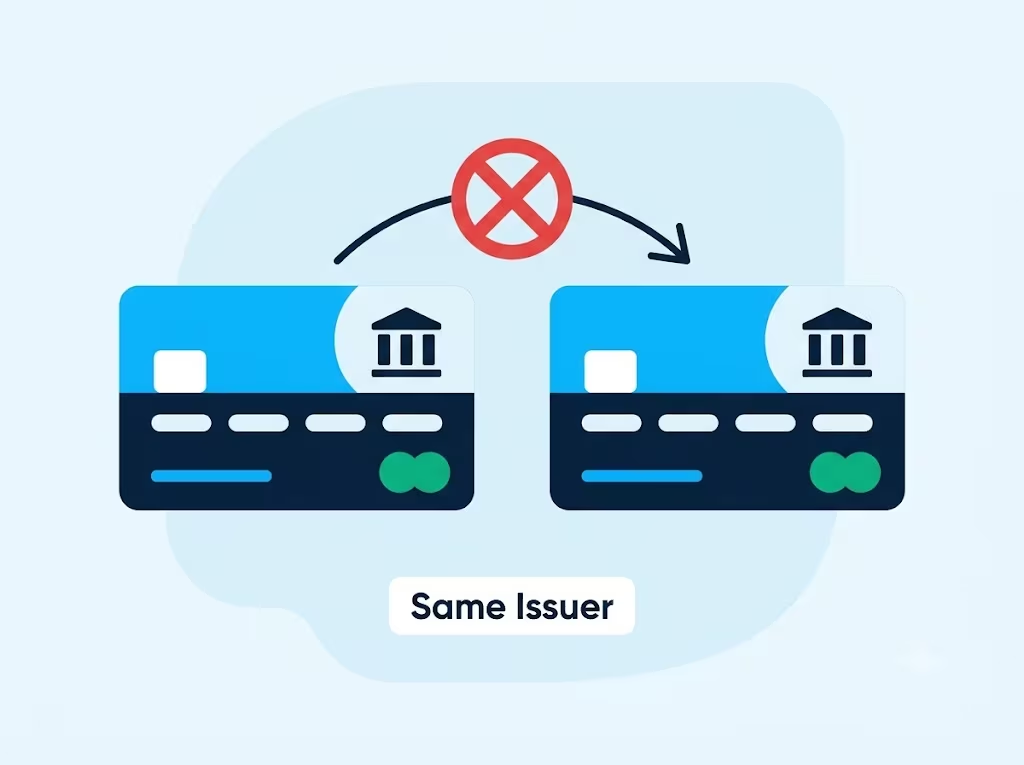
No. You cannot move a balance from one Citi card to another Citi card. This rule applies across the board, no matter which two Citi cards you hold.
If you have a Citi Double Cash, a Citi Simplicity, a Citi Rewards+, a Citi Custom Cash, or any co-branded Citi card like the AAdvantage or the Costco Anywhere Visa, they all fall under the same restriction. The Citi balance transfer program is designed to move debt from other banks onto a Citi card, not from one Citi account onto another.
The core reason is simple: Citi already owns that debt. Moving it from your left pocket to your right pocket doesn’t add anything to the bank’s books, so the program isn’t built to accept it. The full logic is covered in the next two subsections.
Why Balance Transfers Only Work Between Different Lenders
A balance transfer is really a marketing tool disguised as customer service. Banks offer low or 0% intro rates because they want to pull debt away from a competitor. If Chase or Amex has your $6,000 balance, Citi will happily take it. That’s a new asset for Citi and a lost customer for the other bank.
Now flip that around. If you owe Citi $6,000 on Card A, moving it to Card B doesn’t help them. They’d just give you a lower interest rate on money they were already earning full APR on. No bank rewrites its own loans at a loss on purpose.
This isn’t just Citi. Chase, Bank of America, Capital One, Discover, and Wells Fargo all have the same rule. It’s a standard industry practice, not a Citi quirk.
What Counts as “the Same Issuer” With Citi
The rule covers every card where Citibank, N.A. is the actual lender. That includes:
- Citi-branded personal cards (Double Cash, Simplicity, Rewards+, Custom Cash, Diamond Preferred, Strata Premier)
- Citi co-branded cards (Citi / AAdvantage cards, Costco Anywhere Visa by Citi, Citi Shell, Citi Home Depot Consumer Card, Citi Best Buy)
- Citi business cards
If the back of the card lists Citibank, N.A. as the issuer, it’s the same issuer for balance transfer purposes. Do not assume that a co-branded card counts as separate just because it carries an airline or retail logo. The underwriter is still Citi.
📌 Did You Know: The name printed on the front of your card (American Airlines, Costco, Home Depot) is just the brand partner. Flip the card over. If it says “Citibank, N.A.” near the bottom, Citi is the lender, and the same-issuer rule applies.
What Happens If You Try to Submit a Same-Citi Transfer Anyway
Say you go online, log in, and try to submit a balance transfer request using a Citi account number as the source. What happens?
The request will be blocked or declined during processing. Usually, the Citi web form or mobile app won’t allow you to enter another Citi account as the source. This happens because the system checks the account number against Citi’s own records. If you call and ask over the phone, the representative will tell you the transfer cannot be completed.
Here’s the good news: there is no penalty for asking. You won’t be charged a balance transfer fee, because no transfer actually happens. Your credit score is not touched, because no hard inquiry gets pulled just for asking about a transfer on an existing card. Your account stays in good standing.
This is a built-in restriction inside Citi’s system, not a bug or a glitch. Trying it isn’t the end of the world, but it also won’t work, so save yourself the phone call and read the next section instead.
Credit Line Reallocation: The Real Citi Tool for Moving Something Between Your Own Cards
Here’s where a lot of readers get confused, so read this section carefully.
Citi does have a tool that lets you shift something between two of your own Citi cards. It’s called credit line reallocation (or sometimes “credit limit transfer”). But there’s a critical difference from a balance transfer:
- A balance transfer moves debt from one account to another.
- A credit line reallocation moves available credit limit from one account to another. The debt stays where it is.
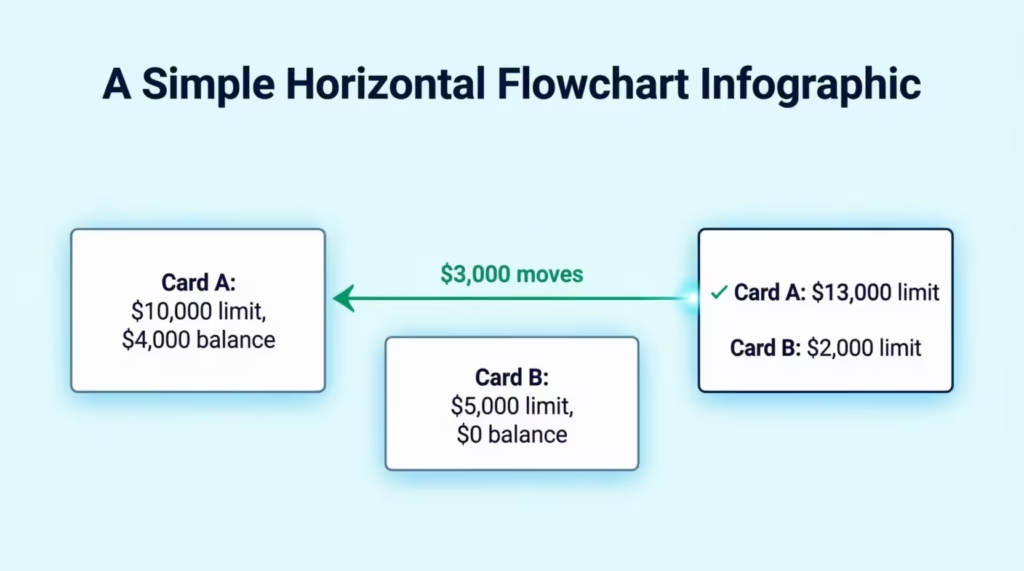
Let me make that concrete. Say your Citi Double Cash has a $10,000 credit limit and a $4,000 balance. Your Citi Simplicity has a $5,000 limit and a $0 balance. You could ask Citi to move $3,000 of that unused limit off the Simplicity and onto the Double Cash. After the move, your Double Cash would have a $13,000 limit (with the same $4,000 balance still sitting there), and your Simplicity would have a $2,000 limit.
So what’s the point? A reallocation can still help you in a few real ways:
- Lower your credit utilization ratio on one card. Your $4,000 balance against a $13,000 limit is a 31% utilization, versus 40% against $10,000. Utilization on individual cards affects your FICO credit score.
- Free up room to charge a big purchase on the card with more limit.
- Prepare a card for closure by draining its limit before you shut it down (some people do this before canceling a card they don’t want anymore).
What it does not do is give you a lower interest rate. Your $4,000 balance still sits on the Double Cash and still accrues interest at whatever APR that card charges. Reallocation is a credit-limit tool, not a debt-payoff tool.
One important note: Citi is famously restrictive about this. Reports from cardholders on the myFICO Forums and The Points Guy suggest Citi often turns down these requests or requires escalation to the right department. So while the tool exists, don’t count on getting a “yes” the first time.
Eligibility Requirements for Citi Credit Line Reallocation
Citi has never published a public rulebook for reallocations, but a few common conditions tend to come up:
- Account age. Both cards usually need to be at least six months old. Some agents cite six months since the last credit-line change, too.
- Good standing. Both accounts must be current, with no missed payments in recent history.
- Available credit to move. The “donor” card needs unused limit. You can’t reallocate credit that’s already tied up in a balance.
- Card type. Reallocation is generally only allowed between two personal Citi cards, or two business Citi cards. Personal-to-business shifts are not supported.
- Willingness to accept a hard pull. Citi typically runs a hard credit inquiry when reviewing the request (more on that below).
Balance Transfer vs. Credit Line Reallocation: Key Differences
Here’s a quick side-by-side to lock in the distinction:
| Feature | Balance Transfer | Credit Line Reallocation |
|---|---|---|
| What moves | Debt (your outstanding balance) | Available credit limit (unused portion) |
| Effect on debt | Debt shifts to new card; old card balance drops | Debt stays put; no effect on balance |
| Allowed within Citi? | No (must be between different issuers) | Yes, but often hard to get approved |
| Typical fee | 3% to 5% of the amount transferred | No fee |
| Helps you get a lower APR? | Yes, if you use a 0% intro offer | No, APR on your existing balance does not change |
| Helps you free up a card’s limit? | Indirectly (by clearing the balance) | Yes, directly |
| Credit score impact | Soft pull for existing cards, hard pull for new cards | Usually involves a hard inquiry at Citi |
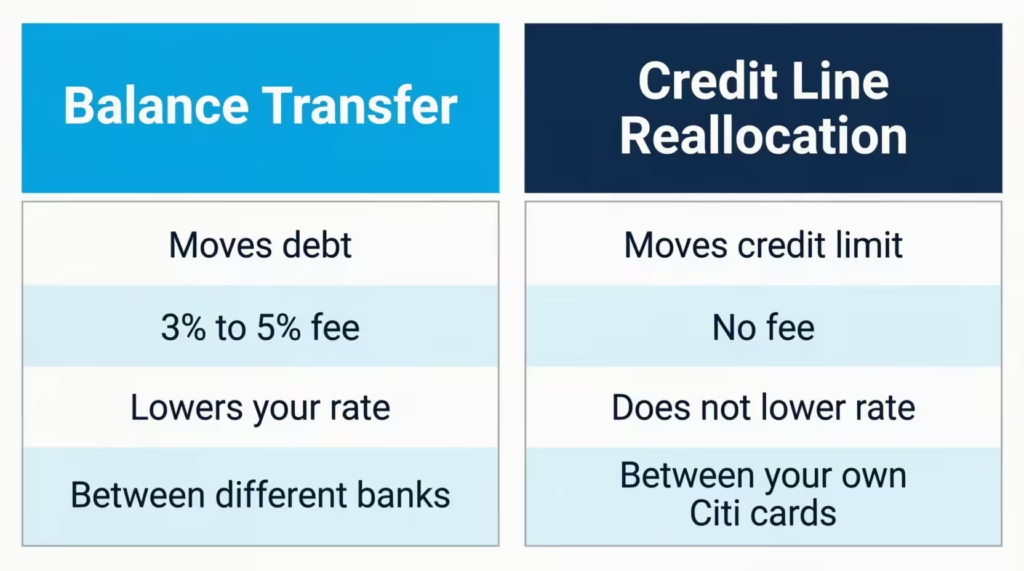
If you’re trying to pay less interest, you need a balance transfer to a different bank’s card. If you’re trying to shift available credit between your own Citi cards, reallocation is the tool. Two different problems, two different solutions.
How to Request a Citi Credit Line Reallocation
Reallocation is not a self-serve option in the Citi app or website, so don’t waste time hunting for a button. You have to talk to a person.
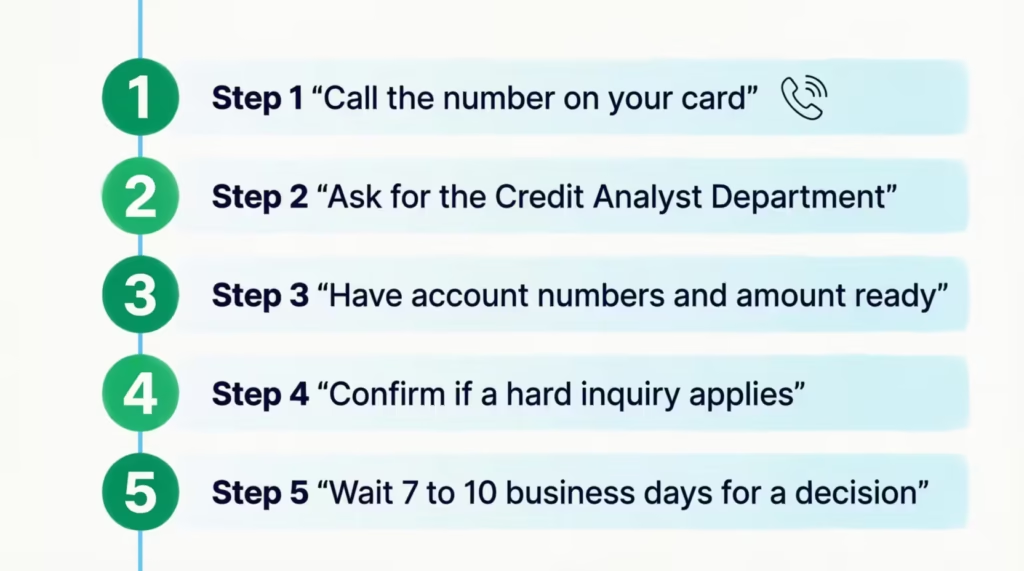
Step 1: Call the number on the back of one of your Citi cards. Any Citi personal card works. If you prefer written contact, log in to the Citi website or the Citi Mobile App and send a secure message from the “Message Center” instead.
Step 2: Ask to be transferred to the Credit Analyst Department. Front-line reps typically don’t have authority to reallocate credit. Politely say something like: “I’d like to reallocate credit limit from my Card A to my Card B. Could you connect me with a credit analyst who can review that request?”
Step 3: Have this ready before you call:
- Full account numbers or the last four digits of both Citi cards
- The exact dollar amount you want to move
- Which card is the “donor” (giving up credit) and which is the “receiver” (gaining credit)
- Your current income (they may re-verify, especially if it’s been a while)
Step 4: Confirm whether a hard inquiry applies. Ask the analyst directly: “Will this request involve a hard credit pull?” Citi almost always says yes, but confirm before you agree to proceed.
Step 5: Wait for the decision. Some cardholders get an answer on the call. Others get a decision in 7 to 10 business days. If denied, ask for the specific reason, since sometimes another attempt through a different agent works.
💡 Pro Tip: If the first agent says reallocation “isn’t a thing at Citi,” politely thank them and hang up. Call back later, and ask specifically for a “Credit Analyst” or “Credit Bureau” specialist. Front-line staff sometimes give wrong answers on niche requests. Persistence matters here.
Does Requesting a Credit Line Reallocation Affect Your Credit Score?
Yes, usually. This is the part many people miss.
When Citi reviews a reallocation, they usually treat it as a fresh underwriting decision. This means they do a hard inquiry on your credit report. Citi’s own consumer guidance on credit limit increases notes that formal requests may involve a hard inquiry, and reallocations tend to follow the same process.
So what does a hard inquiry actually do to your score? According to myFICO, one additional hard inquiry usually lowers a FICO score by less than five points for most people. The impact is temporary: hard inquiries stop factoring into your FICO score after 12 months, and drop off your credit report entirely after two years.
Compare that to a regular balance transfer to a new card from another bank. That path involves applying for a new credit card, which means a hard inquiry PLUS a new account on your file (which shortens your average account age). So the score impact from a full new-card application is usually a bit larger and lasts a bit longer than a reallocation.
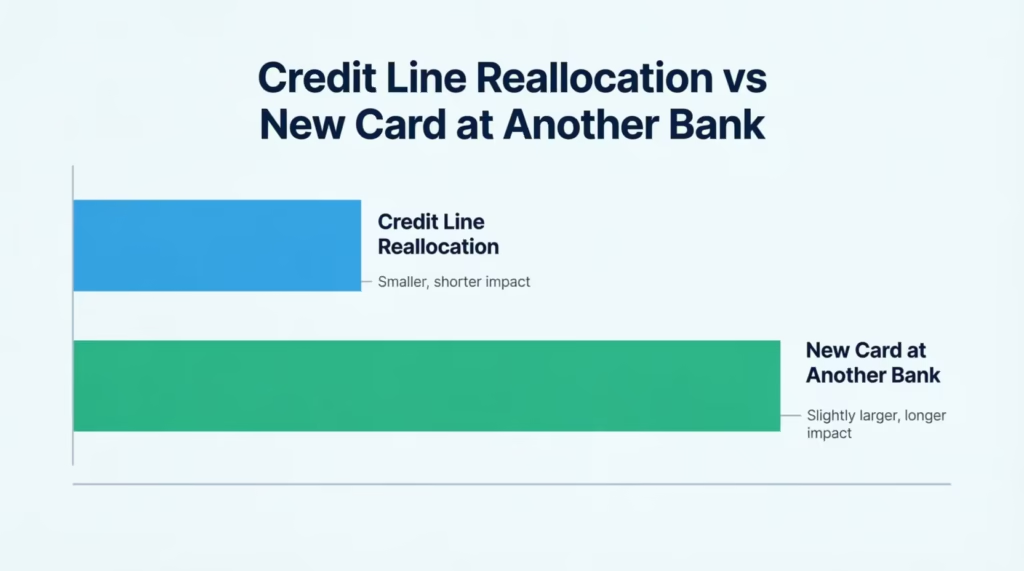
Neither one is catastrophic. If your FICO is above 720, a single hard inquiry is a rounding error. If you’re in the 640-680 range and about to apply for a mortgage or auto loan in the next few months, that’s when you want to pause and think twice.
⚠️ Mistake to Avoid: Don’t stack multiple credit requests in the same week. Requesting a reallocation, applying for a new balance transfer card, and asking for a credit limit increase on a third card within seven days can lead to three hard inquiries. This can cause a drop in your credit score. Space these out by at least 30 to 45 days if you can.
When Reallocation Makes Sense, and When It Doesn’t Solve Your Problem
Before you pick up the phone, take 30 seconds and answer this: What am I actually trying to solve?
Reallocation is the right tool if you want to:
- Lower the utilization ratio on one card (say, to help a score before applying for a mortgage)
- Move unused credit off a card you’re about to close, so you don’t lose the limit entirely
- Give one Citi card enough headroom to handle a large planned purchase
Reallocation will NOT help if you want to:
- Pay less interest on debt you already carry
- Consolidate high-interest Citi debt onto a 0% promo card
- Actually reduce the total balance you owe
The trap is thinking “I have unused credit on Card B and a balance on Card A, so I’ll just shift the debt over.” That’s not what reallocation does. The balance and its interest rate stay exactly where they are. All you’ve done is rearrange available room on your credit lines, which is fine for score management but useless for debt payoff.
If your real goal is paying less interest, keep reading. The next section is for you.
How to Actually Lower Your Rate on Existing Citi Debt
If you asked about a same-Citi transfer to lower interest, here’s the truth: move that debt to a card from a different issuer.
The mechanics are straightforward:
- Look for a 0% intro APR balance transfer card at another bank. Chase, Wells Fargo, U.S. Bank, Discover, and Bank of America all run competitive promos, often 0% for 15 to 21 months. Independent roundups like Bankrate’s balance transfer card list get updated regularly.
- Apply for the card. This triggers a hard inquiry and, if approved, a new account.
- Request a balance transfer from your Citi card to the new card during the application or shortly after opening. Most issuers give you 45 to 60 days to lock in the intro rate.
- Pay a balance transfer fee. Expect 3% to 5% of the amount transferred, per the issuer’s terms. On a $5,000 balance, that’s $150 to $250.
- Pay down the balance during the 0% window. Divide the balance by the number of intro months so you clear it before the promo ends and the regular APR kicks in.
Do the math before you jump. A 3% fee on $5,000 costs $150 up front, but saves you far more if you were paying 22% APR on that same balance for a year. That’s the trade-off to weigh.
Credit Impact of Applying for a New Card at Another Issuer
Opening a new balance transfer card at a different bank does two things to your credit file:
- Adds one hard inquiry. As covered above, expect a small, temporary dip of a few points.
- Adds a new account. This lowers your average age of accounts, which is a small piece of the FICO formula (about 15%).
The good news: the new card also adds to your total available credit, which usually lowers your overall utilization ratio. That effect often more than makes up for the inquiry and the shorter account-age average within a few months.
For most people carrying a real balance, the interest savings from a 0% intro APR dwarf the temporary score dip. If your credit is already strong (720+), you’ll typically recover within 3 to 6 months. If your credit is fragile or you’re mid-application on a mortgage, hold off until that big loan closes first.
Frequently Asked Questions
Can you transfer a balance from one Citi card to another Citi card?
No. Citi does not permit balance transfers between two accounts it already issues, regardless of the card type. The rule covers all Citi personal cards, Citi business cards, and Citi co-branded cards.
Why can’t I transfer my balance to another card with the same bank?
Because your debt already belongs to that bank. Balance transfer offers exist to pull debt away from competitors, not to rewrite loans within the same institution at a lower rate.
Can I move my credit limit from one Citi card to another instead?
Yes, sometimes. It’s called credit line reallocation, and it moves unused credit (not debt) between two of your own Citi accounts. Citi is stricter about approving these than some other banks, so expect to talk with a credit analyst and possibly accept a hard inquiry.
What happens if I try a same-issuer balance transfer?
The request will be declined during processing. You will not be charged a fee, your account won’t be penalized, and your credit score won’t be pulled just for asking. Nothing bad happens; it just won’t go through.
What are my options if I can’t transfer my Citi balance within Citi?
Two solid paths. First, apply for a 0% intro APR balance transfer card at a different bank and move the debt there. Second, if a lower rate isn’t the goal, ask Citi about credit line reallocation to shift available credit between your Citi cards.
Final Thoughts
Moving debt from one Citi card to another isn’t allowed, and no amount of calling around will change that. You can either reallocate your credit between Citi accounts or transfer your balance to another bank. If your main goal is to lower interest rates, look for a genuine 0% intro APR offer.
For many readers with a balance, switching to a non-Citi promotional card offers the best savings. It directly reduces the interest you would keep paying. If you know a friend or family member wrestling with the same Citi-to-Citi confusion, share this guide with them. It could save them a wasted phone call and hundreds in interest.