
If you’ve ever stood at an ATM with only your Discover card in your wallet, you’ve probably wondered whether it would actually work. It’s a fair question. Many cardholders assume their credit card is for purchases only.
The good news: Yes, your Discover card works at ATMs. But what happens when you use it is very different from a debit card withdrawal, and the costs can add up fast if you go in unprepared.
In this guide, we’ll walk through exactly how it works, what it costs, and smarter ways to get cash when you need it.
Key Takeaways
This guide explains how to use a Discover credit card at an ATM, covering how cash advances work, what they cost in fees and interest, how to set up a PIN, and when a cheaper fee-free alternative at checkout makes more sense.
Core Facts:
- Using a Discover card at an ATM is a cash advance drawn against your credit line, not a bank withdrawal, and interest begins accruing from the transaction date with no grace period.
- Before using a Discover card at an ATM, you must set up a separate cash advance PIN through your online account, mobile app, or by calling the number on the back of the card; Discover typically mails the PIN to your address on file, which can take several days.
- Discover charges a cash advance fee equal to the greater of $10 or 5% of the withdrawal amount, meaning a $1,000 withdrawal carries a $50 fee that posts to your account immediately.
- Your Discover cash advance limit is a separate, lower cap than your total credit limit, and individual ATMs set their own daily withdrawal maximums on top of that; the lower of the two limits controls how much cash you can access.
- Discover cardholders can receive up to $120 in cash at checkout at more than 70 participating retailers every 24 hours with no cash advance fee, at the standard purchase APR, and with a possible grace period if the prior statement balance was paid in full.
- When a Discover account carries both a purchase balance and a cash advance balance, payments are applied to the lower-interest purchase balance first, allowing the higher-rate cash advance to continue accruing interest until the purchase balance is cleared.
Best for:
- Discover cardholders who need more than $120 in cash immediately and have no debit card available, understand the fee structure, and can repay the balance before the next statement closes.
- Anyone considering a Discover ATM withdrawal who wants to compare the true cost against the checkout cash-back alternative before deciding which method to use.
- Cardholders who have never set up an ATM PIN and want to prepare for potential emergencies before they arise.
Yes, You Can Use Your Discover Card at an ATM
Your Discover card can be used at an ATM to get cash. But before you head to the nearest machine, it helps to understand what type of transaction you’re actually making. This is not a debit withdrawal. It’s a completely different type of transaction, and that difference is important for your bill.
Three things need to be in place before this works. You need a PIN set up on your Discover account specifically for ATM access. You need an ATM that’s on the Discover or PULSE network. And you need available cash advance credit on your account. If any of those three are missing, the transaction won’t go through.
This guide goes over each step, the transaction costs, and your options if you want to avoid fees.
What’s Actually Happening When You Use Your Discover Card at an ATM
When you insert your Discover card at an ATM and take out cash, that transaction is called a cash advance. It’s not a withdrawal from a bank account. It’s a short-term loan drawn directly from your credit line.
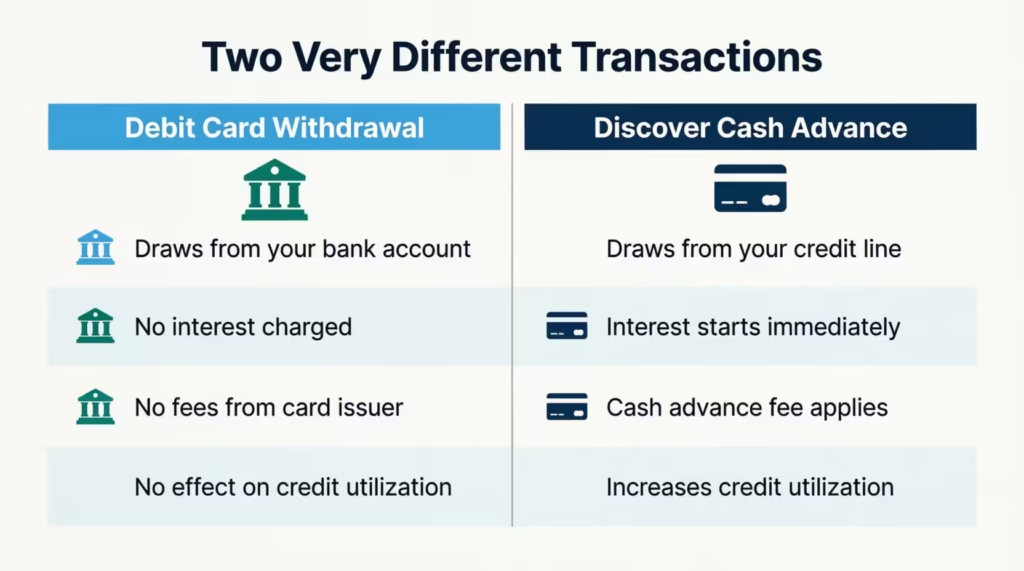
The cash adds to your Discover balance like a purchase. However, it’s tracked separately because of different terms. Cash advances come with their own fee, a higher interest rate than regular purchases, and no grace period. That last part is important. With regular purchases, you can avoid interest entirely by paying your balance in full each month. With a cash advance, interest starts the moment the money leaves the ATM.
You Need a PIN Before You Can Use Your Discover Card at an ATM
This is the step that catches a lot of people off guard. Discover credit cards don’t come with an ATM-ready PIN the way a debit card does. You have to set one up separately before the ATM will process your transaction.
There are three ways to do it:
Online: Log in to your Discover account at Discover.com. Go to “Account Services,” then look for “PIN Settings.” From there, select “Create/Reset PIN” and follow the prompts.
Mobile app: Open the Discover app, tap the menu icon, and choose “Card Details.” Look for the cash advance or PIN section to set up or update your PIN.
By phone: Call the number printed on the back of your Discover card. A representative can help you set up or reset your PIN over the phone.
One thing to be aware of: once you complete the setup online or by phone, Discover typically mails your PIN to your address on file. That can take several days. If you’re planning on needing ATM access in an emergency, set your PIN up well in advance. Don’t wait until you’re already in a pinch.
After you receive your PIN, test it at an ATM before any large or time-sensitive withdrawal. Entering the wrong PIN too many times can lock your card and create a much bigger headache than the original cash need.
💡 Pro Tip: Set up your Discover ATM PIN now, even if you don’t think you’ll need it soon. Having it ready means you won’t be stuck without access to cash in a real emergency.
How to Withdraw Cash From Your Discover Card at an ATM
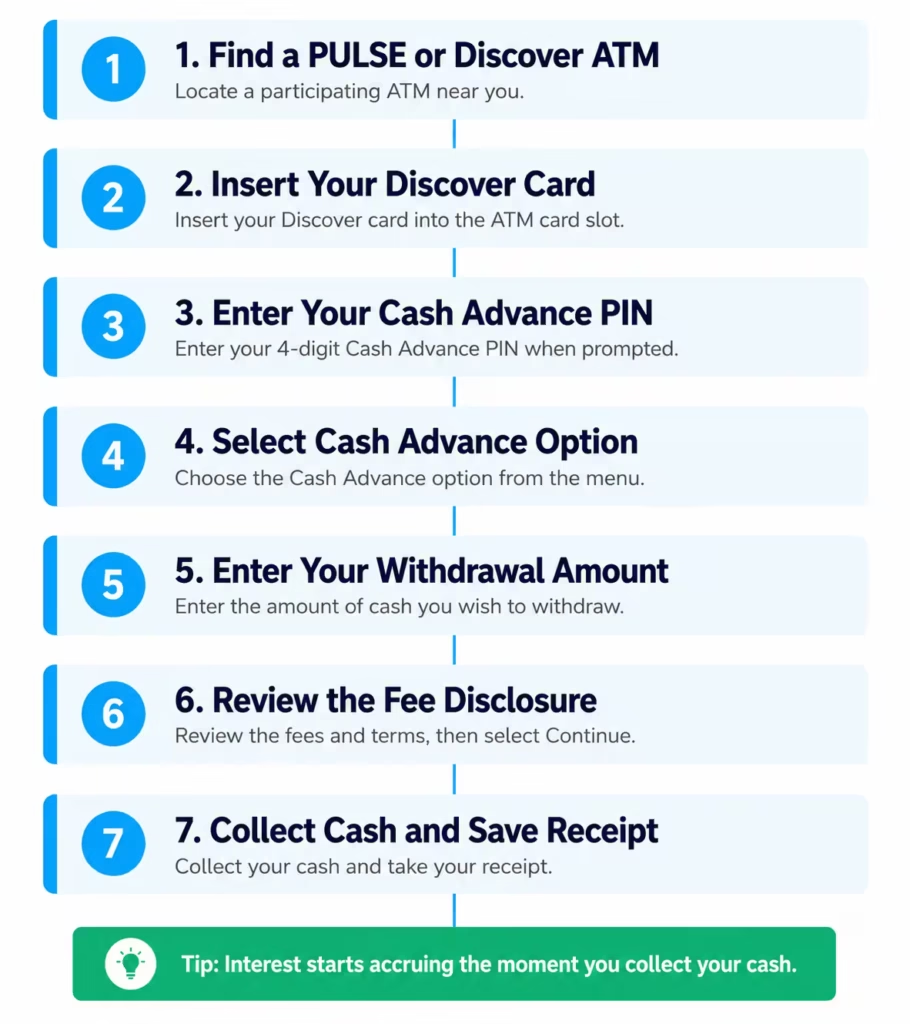
Once your PIN is set up and you’ve located a compatible ATM, the process is straightforward. Follow these steps:
Step 1: Find a compatible ATM. Look for a machine that displays the Discover or PULSE network logo. More on how to locate one in the section below.
Step 2: Insert your Discover card. Use the card slot just as you would with a debit card.
Step 3: Enter your cash advance PIN. This is the PIN you set up through your Discover account, not any other code or security number.
Step 4: Select the right option on screen. Look for “Cash Advance” or “Withdrawal from Credit Account.” The exact wording differs by ATM, but it usually stands out from the “Checking” or “Savings” choices you’d find with a debit card.
Step 5: Enter your withdrawal amount. Keep this within your available cash advance limit. If you’re not sure of your limit, check your Discover account before leaving home.
Step 6: Review the fee disclosure on screen. Most ATMs show the surcharge they plan to charge before you confirm the transaction. This is your chance to see the full cost and decide whether to proceed. You can cancel at this point without any charge.
Step 7: Confirm and collect your cash. Take your cash and your receipt. The receipt shows the amount, the date, and any fees charged. Save it. Interest starts accruing from this date, so you’ll want a record for tracking repayment.
How to Find an ATM That Accepts Your Discover Card
Not every ATM accepts Discover cards. The easiest way to find one near you is to use Discover’s ATM locator, available on the Discover website and within the Discover mobile app. It shows compatible machines based on your location.
You can also check the ATM itself. Look for stickers on the machine that display the Discover logo or the PULSE network logo. If you see either of those, your card should work there.
Most ATMs from major banks and large networks accept Discover through the PULSE network. This network is widely accepted in the U.S., so take 30 seconds to double-check before you go out of your way.
How Much Can You Withdraw? Understanding Your Discover Cash Advance Limit
Your cash advance limit is not the same as your overall credit limit. It’s a separate, lower limit that Discover sets specifically for cash transactions. For many cardholders, the cash advance limit is significantly smaller than the total credit line. If your credit limit is $5,000, your cash advance limit might be $1,000 or $1,500. The exact amount depends on your account.
To find your personal cash advance limit, check any of these sources:
- Online account: Sign into Discover.com, go to “Account Services,” then “Cash Advance.” Your limit appears next to the fee schedule.
- Mobile app: Tap the menu, choose “Card Details,” and look under “Cash Advance.” The limit appears at the top of that screen.
- Monthly statement: Look for the “Cash Advance Limit” line in the Account Summary section.
- Phone: Call the number on the back of your card, verify your identity, and ask a representative to confirm your limit.
Check this before you go to an ATM. It’s frustrating to request a withdrawal and get declined because you went over your cash advance limit.
Also, keep in mind that the cash advance balance counts toward your overall credit limit. If you withdraw $500, that $500 reduces your available credit for purchases as well.
The Two Separate Withdrawal Limits That Can Affect Your Transaction
Two different limits apply to every Discover ATM withdrawal, and the lower of the two is the one that controls how much cash you can actually get.
The first is your Discover cash advance limit, which is the account-level cap set by Discover. That’s the one described above.
The second is the ATM operator’s own daily withdrawal cap. This is a separate limit set by the machine or network, not by Discover. Even if your Discover cash advance limit is $1,500, a specific ATM might only dispense up to $300 or $500 per transaction. Some machines have daily caps that are lower than what Discover allows.
Both limits apply at the same time. If the ATM’s cap is $300 and your Discover cash advance limit is $1,500, you can only get $300 from that machine on that visit. Knowing this ahead of time prevents a frustrating surprise at the ATM screen.
What It Costs to Use Your Discover Card at an ATM
This is where most people get caught off guard. An ATM withdrawal with a Discover card triggers multiple charges, not just one.
Cash advance fee: Discover charges a fee every time you take a cash advance. The fee is the greater of $10 or 5% of the withdrawal amount. So if you withdraw $100, the fee is $10 (because 5% of $100 is also $5, which is less than $10). If you withdraw $300, the fee is $15 (5% of $300). For amounts over $200, the 5% rate takes over and keeps climbing. This fee posts to your account immediately when the transaction clears.
ATM surcharge: On top of Discover’s fee, the ATM operator typically charges its own fee for using the machine. This appears on the ATM screen before you confirm the transaction. It’s a separate charge from Discover’s fee and goes directly to the ATM owner.
Interest charges: Interest begins accruing the moment your cash advance posts. There is no grace period, meaning you cannot avoid interest by paying your balance before the due date, the way you can with purchases. The interest rate on cash advances is also higher than the standard purchase APR on your Discover card.
One more thing worth knowing: if the transaction is later disputed, the cash advance fee is still non-refundable. It stays on your account regardless of the outcome.
Always review your cardholder agreement for your specific fee amount and interest rate, as exact terms vary by card product.
The Cash Advance APR and Why Interest Starts Immediately
Cash advances carry a higher interest rate than regular credit card purchases. Your exact rate varies based on your Discover card and credit profile. However, cash advance APRs are usually higher than the standard purchase APR for the same account.
The bigger issue for most people isn’t just the rate itself. It’s when interest starts. With regular purchases, Discover gives you a grace period. If you pay your statement balance in full by the due date, no interest charges apply. Cash advances don’t work that way. Interest begins accruing from the transaction date, not from the statement closing date or the due date.
Interest also compounds daily. Each day the balance sits unpaid, more interest is added to the total. The longer it takes to repay, the higher the final cost.
Another important detail: interest is charged on the cash advance fee as well as on the cash itself. If Discover charges you a $15 fee on a $300 withdrawal, your balance is $315 from day one, and interest accrues on the full $315.
Check your cardholder agreement or your Discover online account. This will show the exact cash advance APR for your card.
A Real-Dollar Example: What a $200 Discover ATM Withdrawal Actually Costs
Numbers make this real. Consider a $200 ATM withdrawal.
Discover’s cash advance fee on $200 is $10 (the greater of $10 or 5%, and 5% of $200 is $10 exactly). An ATM surcharge of $3.50 is common. That brings your balance to $213.50 on day one, before a single cent of interest accrues.
If the cash advance APR on your account is around 26.99% (a typical range for Discover cash advances), the daily interest rate works out to about 0.074%. On a $213.50 balance, that’s roughly $0.16 per day in interest. Over 30 days, you’d add approximately $4.70 in interest charges.
Total cost for a $200 withdrawal held 30 days: roughly $18.20 above the $200 you actually received. That’s just one month. If the balance carries longer, interest keeps compounding on an already-higher balance.
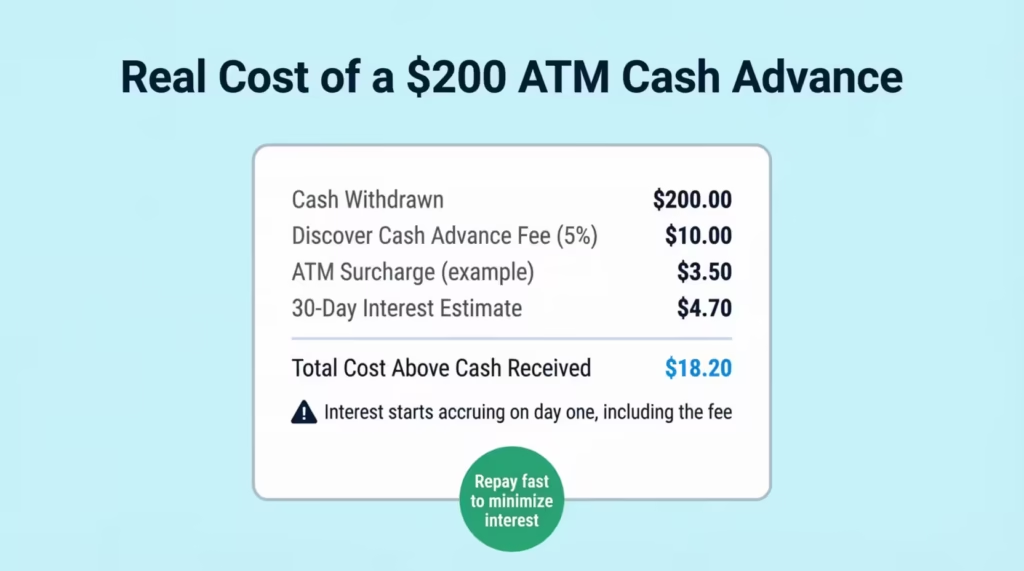
Always check the exact APR and fees in your cardholder agreement first. Rates and fees can change depending on the card product.
⚠️ Mistake to Avoid: Don’t assume paying the minimum payment will quickly eliminate a cash advance balance. Minimum payments may barely cover the monthly interest, leaving the principal balance nearly untouched for months.
How a Discover Card Cash Advance Affects Your Credit Score
Taking a cash advance doesn’t trigger a hard inquiry on your credit report. So the act of withdrawing cash at the ATM doesn’t directly knock points off your score.
What affects your score is the balance that results from the withdrawal. Credit utilization is one of the largest factors in most credit scores. It measures how much of your available credit you’re currently using.
A $500 cash advance on a card with a $2,500 credit limit pushes your utilization up by 20 percentage points immediately. If your score was close to the 30% utilization limit that credit bureaus flag, that one transaction could push you over.
The impact is most significant when the cash advance balance is still on your card when the statement closes. That’s the balance that gets reported to the credit bureaus each month. Repaying the cash advance before your statement closing date prevents the higher balance from appearing in your credit file at all.
The most effective way to protect your credit score: repay the cash advance as fast as possible, ideally before the next statement closes.
The Payment Allocation Problem Most Cardholders Don’t Know About
This one catches a lot of people by surprise. When your Discover account carries both a regular purchase balance and a cash advance balance at the same time, your payments don’t automatically go where you’d expect.
Payments are applied to lower-interest balances first. This means that if you have $400 in regular purchases at your standard APR and a $300 cash advance at a higher APR, your payment will first apply to the $400 purchase balance. It won’t affect the $300 cash advance until the purchase is paid off.
The result: the higher-interest cash advance balance sits there accruing daily interest while you pay down the lower-rate purchases. Your total payment reduces your balance, but the most expensive part of it lingers longest.
To work around this, send a separate additional payment specifically targeted at the cash advance balance. Contact Discover or check your online account for how to direct a payment to a specific balance. Doing this shortens the time the high-rate balance sits on your account and reduces the total interest you’ll pay.
The Fee-Free Alternative: Getting Cash With Your Discover Card at Checkout
Most Discover cardholders have never heard of this feature, but it’s worth knowing. Discover lets you get up to $120 in cash at checkout at more than 70 participating retailers every 24 hours, with no cash advance fee.
The list of participating stores includes grocery and convenience retailers such as Aldi, Dollar General, Safeway, and Piggly Wiggly. Discover maintains a full, current list of participating locations on its website. Individual stores may also set their own limits below $120, so it’s worth checking with your local store.
The process works just like getting cash back on a debit card. Make a purchase at checkout, and when prompted on the merchant terminal, choose how much cash you’d like. The cash amount gets added to your transaction total.
What makes this genuinely different from an ATM cash advance:
- No cash advance fee. That $10 or 5% charge doesn’t apply.
- Standard purchase APR. The cash you receive is treated as a purchase, not a cash advance. That means the lower purchase APR applies.
- Possible grace period. If you paid your previous statement balance in full before the due date, the grace period applies to this transaction. Pay the new balance in full by the due date, and no interest accrues at all.
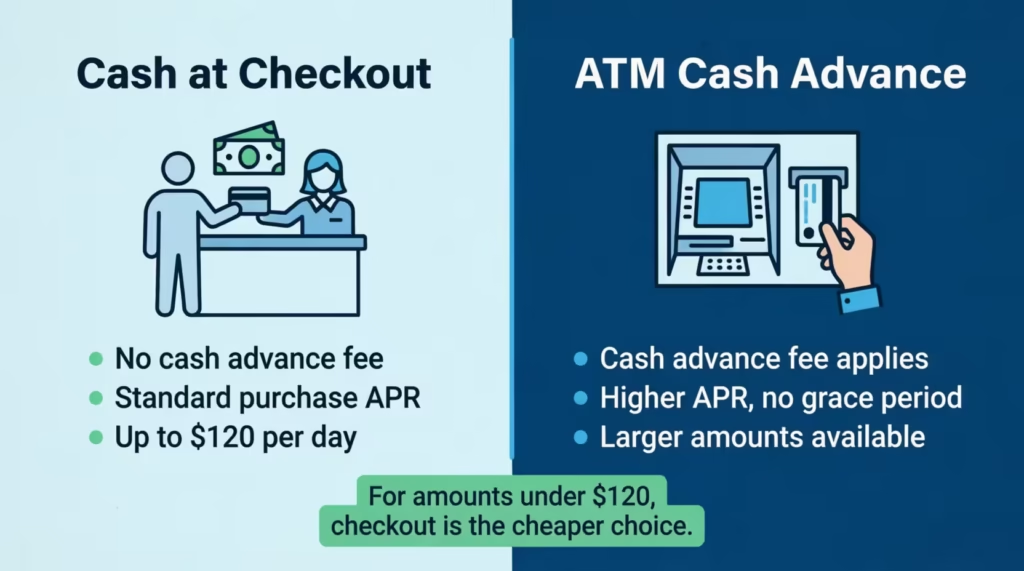
The main limitation is the $120 daily cap. That won’t work if you need a larger amount of cash. But for routine cash needs, this is a meaningfully cheaper option than an ATM withdrawal.
Other Ways to Get Cash Using Your Discover Card
Beyond ATMs and checkout, a few other methods give you access to cash from your Discover credit line.
Bank teller: You can walk into a bank branch that accepts Discover and request a cash advance at the counter. You’ll need your Discover card and a valid photo ID. Call the branch first to check if they handle Discover cash advances for non-customers. Not every branch does this. This method avoids the ATM surcharge, but Discover’s cash advance fee and the higher APR still apply.
Online direct deposit: Through your Discover account online, you can transfer a cash advance directly to a linked checking account. Log in to Discover.com. Then, go to the cash advance section under Account Services. Enter your bank routing and account number, and specify the amount. The funds typically arrive within 1 to 3 business days. The same cash advance fee and APR apply, but this avoids both the ATM surcharge and the need to travel anywhere.
Convenience checks: Discover occasionally mails convenience checks to cardholders. These checks are linked directly to your credit line and work like regular checks. You can write one to yourself and deposit it or cash it. The transaction counts as a cash advance. This means the higher APR starts right away, and Discover charges a cash advance fee for each check used.
None of these alternatives offers better fee terms than the checkout method described in the previous section. The key difference is timing and access. If you need cash right now and the amount exceeds $120, the ATM or bank teller route is your fastest option.
When Using Your Discover Card at an ATM Makes Sense, and When It Doesn’t
With all of this information in hand, the decision usually comes down to urgency, amount, and repayment timing.
Situations where an ATM cash advance is a reasonable choice:
- You’re in a true emergency and have no other access to cash
- The amount you need exceeds $120, so the checkout option doesn’t apply
- Your debit card isn’t available or isn’t working
- You’re confident you can repay the full balance within a few days
Situations where a better option exists:
- You need $120 or less and are near a participating Discover checkout retailer: use cash at checkout
- You can wait 1 to 3 business days: use the online direct deposit method to avoid the ATM surcharge
- You’re near a bank branch that accepts Discover: the teller option skips the ATM fee
When to avoid a cash advance entirely:
If you can’t repay the full cash advance balance before your next statement closes, the cost of carrying it grows quickly. A cash advance is one of the costliest short-term loans. This is due to the upfront fee, higher APR, and daily compounding interest. If the need isn’t urgent, consider options like a small personal loan or borrowing from a trusted source first.
For small, everyday cash needs under $120, the checkout feature is the clear winner: no fee, standard purchase APR, and a possible grace period if your prior balance was paid in full. Use the ATM when checkout isn’t possible, and go in knowing the full cost so you can pay it back quickly.
Frequently Asked Questions (FAQs)
How much is the cash advance fee on a $1,000 Discover withdrawal?
Discover charges the greater of $10 or 5% of the withdrawal amount, so a $1,000 cash advance triggers a $50 fee that posts to your account immediately. That $50 is added to your balance on day one, before any interest begins accruing.
How much cash can I withdraw from a Discover card at an ATM?
Your Discover cash advance limit is a separate, lower cap than your total credit limit, and the ATM itself sets its own daily maximum on top of that. The lower of the two limits is the most you can get in a single visit, so check both before you go.
How much interest is charged on a Discover credit card cash advance?
Cash advances carry a higher APR than regular purchases, and interest starts accruing from the transaction date with no grace period. Because interest compounds daily, even a short repayment delay adds a meaningful cost to the original fee.
Can I use my Discover card at a Bank of America ATM?
Discover cards work at ATMs displaying the Discover or PULSE network logo, which includes machines operated by many major banks. Use the ATM locator in the Discover app or check the machine for the PULSE logo to confirm compatibility before attempting the transaction.
Is a PIN the same as a CVV on a Discover card?
No. Your PIN is a 4-digit code you set up through your Discover account specifically for ATM cash advances, while your CVV is the 3-digit security code printed on the back of your card used for online and phone purchases. They serve completely different purposes.
What are the ways to get a cash advance on a Discover card?
Beyond ATMs, you can request a cash advance at a bank teller counter with your card and a photo ID, transfer funds directly to a linked checking account through Discover’s online portal, or write a convenience check if Discover has mailed you one. All methods carry the same cash advance fee and a higher APR.
What is the best way to get cash from a Discover card?
Discover’s cash at checkout feature is the cheapest option, offering up to $120 per day with no cash advance fee at over 70 retailers, including Aldi and Dollar General.
Can you withdraw $5,000 in cash from a Discover card?
A $5,000 withdrawal is unlikely; your Discover cash advance limit is typically a fraction of your total credit line, and ATMs impose daily caps of £300 to £500. Both limits apply simultaneously, so the lower amount controls your total access.
Can I get cash back on a Discover card without paying a cash advance fee?
Discover lets you get up to $120 cash at checkout every 24 hours with no fee at participating retailers, and it’s treated as a purchase with standard APR and potential grace period.
Does using a Discover card at an ATM hurt your credit score?
The cash advance itself does not trigger a hard inquiry, so it does not directly reduce your score. However, the resulting balance increases your credit utilization, which is one of the largest factors in most credit scores, and that impact is reported to credit bureaus when your statement closes.
Bottom Line
Discover cards do work at ATMs, but the transaction works very differently from a debit card withdrawal. The short version: it’s a cash advance against your credit line, it costs money upfront, and interest starts the same day you take the cash. Before using your Discover card at an ATM, set up your PIN in advance, check your cash advance limit, and review the fees in your cardholder agreement.
For amounts under $120, Discover’s cash at checkout feature at participating retailers is a far cheaper option with no cash advance fee.
Use ATM cash advances only in real emergencies. Pay back the balance quickly for the best results.
If this guide helped you, share it with a fellow Discover cardholder who might not know about the checkout option.