
You’ve probably heard the phrase “joint credit card” thrown around, especially when talking about merging finances with a partner or helping a family member build credit. The problem is that the term often gets confused with authorized-user cards. Choosing the wrong one can make you legally responsible for someone else’s spending.
A joint credit card is a single credit card account owned equally by two people who are both fully responsible for the full balance.
This guide walks you through how these cards work, how they differ from other shared-credit setups, who still offers them, and how to pick the right option for your situation.
At a Glance
This guide explains what a joint credit card is, how it differs from an authorized user or cosigner, which banks still offer them, and what happens during divorce, death, or account closure.
Core Facts:
- A joint credit card is a single account with two named owners who share the same credit limit and are both fully responsible for the entire balance, regardless of who made the charges.
- Unlike a joint owner, an authorized user has no legal obligation to pay the debt, requires no credit check to be added, and can be removed at any time by the primary cardholder.
- Both applicants on a joint credit card typically undergo individual credit checks, and a strong-credit applicant does not offset a co-applicant’s poor credit history.
- Capital One, American Express, and Chase do not offer joint credit cards, while U.S. Bank, PNC Bank, some smaller banks, credit unions, and Apple Card Family still offer joint or shared-liability options.
- Removing one owner from a joint account generally requires closing the account entirely, which can reduce average account age and raise credit utilization for both people.
- A divorce decree does not release either person from a joint credit card debt, since the Cardmember Agreement with the issuer remains a separate contract from any court order.
Best for:
- Couples or family members deciding between a joint credit card and an authorized user arrangement before applying.
- Anyone trying to identify which banks currently offer true joint credit card accounts.
- People navigating how a joint account is affected by divorce, separation, or the death of a co-owner.
What Is a Joint Credit Card?
A joint credit card is a single credit card account with two named owners. Both people share the same credit limit, and both are equally responsible for paying the entire balance, no matter who made the charges. Both names appear on the account, and the account activity shows up on both people’s credit reports.
This is not the same as one person “letting” another use their card, and it’s not the same as adding someone to your account so they can swipe it at the grocery store. In casual talk, people often say “our shared card” when they really mean an authorized-user setup. A true joint credit card is a legal arrangement where both parties are co-owners, and both had to apply and qualify.
The Consumer Financial Protection Bureau (CFPB) explains it directly: when you have a joint credit card account, each account holder is responsible for the full amount of the balance, and the card company can collect from either person. That shared, full liability is the core feature that sets joint cards apart from every other shared-credit option.
How a Joint Account Works Day-to-Day
In daily use, a joint credit card feels a lot like any other card, with a few key differences.
- Both co-cardholders get their own physical card, and either can make purchases or payments.
- Either person can log in online, view transactions, change the mailing address, request a credit limit change, or contact customer service.
- One monthly statement covers both people’s spending, with one due date and one balance.
- The account activity, including credit utilization, payment history, and account age, is reported the same way on both credit files.
- A missed or late payment hurts both credit scores at once. On-time payments and low balances help both scores at the same time.
Because both owners have equal control, there’s no “primary” cardholder who can override the other. That means transparency is built in, which many couples want, but it also means there’s no way to hide a purchase from your co-owner.
Joint Credit Card vs. Authorized User vs. Cosigner
This is where most confusion happens. Three arrangements let you share a credit card in some way, but the legal responsibility is very different for each one.
Joint owner (co-cardholder). Both people apply, both go through a credit check, both names go on the account, and both are legally responsible for the full balance. Either can use the card, manage the account, and be pursued by the issuer for unpaid debt. Removing one owner usually means closing the account.
Authorized user. The primary cardholder adds a second person to their existing account. The authorized user gets a card with their name on it and can make purchases, but they have no legal obligation to pay the bill. No credit check is required to add them, and the primary cardholder can remove them at any time. Per the CFPB, being an authorized user generally does not make you responsible for the debt.
Cosigner. A cosigner promises to pay if the primary borrower defaults. They usually don’t get their own card or day-to-day account access. This option is now rare on credit cards. As Bankrate reports, most major credit issuers no longer allow co-signers, though it may still be available at smaller banks or credit unions.
Here’s a side-by-side view:
| Feature | Joint Owner | Authorized User | Cosigner |
|---|---|---|---|
| Credit check required | Yes, for both | No | Yes, for the cosigner |
| Name on account | Yes | Yes (on card) | Sometimes |
| Legal responsibility for debt | Full, shared equally | None (generally) | Full, if primary defaults |
| Can use the card | Yes | Yes | Usually no |
| Can manage the account | Yes | Limited or none | No |
| Easy to remove | No, often requires closing | Yes | No |
| Widely offered today | Rare | Very common | Rare |
Most large card issuers now steer people toward the authorized-user setup instead of joint accounts. It’s easier for them to manage, simpler for you to relax, and offers many daily benefits of sharing a card without the legal issues of joint ownership.
Joint Credit Card vs. Cosigner
A cosigner isn’t really a co-owner in the way a joint account holder is. The cosigner’s job is to guarantee repayment if the primary borrower falls behind. They rarely get their own card; they don’t manage the account, and their access is often limited to being contacted when payments are missed.
That’s a big contrast with a joint owner, who has full account privileges from day one. If the goal is equal access and equal control, a cosigner arrangement doesn’t fit. If the goal is to help someone qualify who couldn’t get approved alone, a cosigner might work. However, most major issuers no longer offer this option for credit cards. You’re more likely to find it at smaller regional banks or credit unions.
How Approval Works When Two People Apply Together
A common myth is that a strong credit profile “cancels out” a weak one when two people apply for a joint credit card. That’s not how it works in practice.
Here’s what usually happens during a joint credit card application:
- Both applicants go through a credit check. According to Capital One, when two people apply for a joint credit card, the issuer may run credit inquiries on both potential cardholders. That means two hard inquiries, not one, in most cases, and each inquiry can temporarily lower a credit score.
- Both applicants generally need to independently qualify. Issuers look at each person’s credit history, debts, and payment record. If one applicant has serious credit problems, the whole application can be denied, even if the other applicant has excellent credit.
- Combined income can help, but rules vary. Some issuers consider household income or combined income when deciding on a credit limit. Others focus on each applicant’s individual income. There’s no guarantee that combining incomes will get you a bigger limit, so don’t assume it will.
- A strong-credit applicant doesn’t erase a weak-credit history. Adding a partner with excellent credit to your application doesn’t hide your late payments or high balances. Both credit files are reviewed, and both influence the outcome.
Before you apply, both people should check their own credit reports for accuracy. Applying and getting denied still leaves the hard inquiries on both credit reports, which can be a real cost if you weren’t going to qualify anyway.
⚠️ Mistake to Avoid: Assuming a joint application means only one credit check. In most cases, both people get a hard inquiry, so both scores can dip. If you’re not sure you’ll qualify, ask the issuer how they handle joint applications before you apply.
How a Joint Credit Card Affects Both People’s Credit
A joint credit card shows up the same on both people’s credit reports. This is true for all three major credit bureaus: Experian, Equifax, and TransUnion. Everything the account does, good or bad, flows to both credit files the same way.
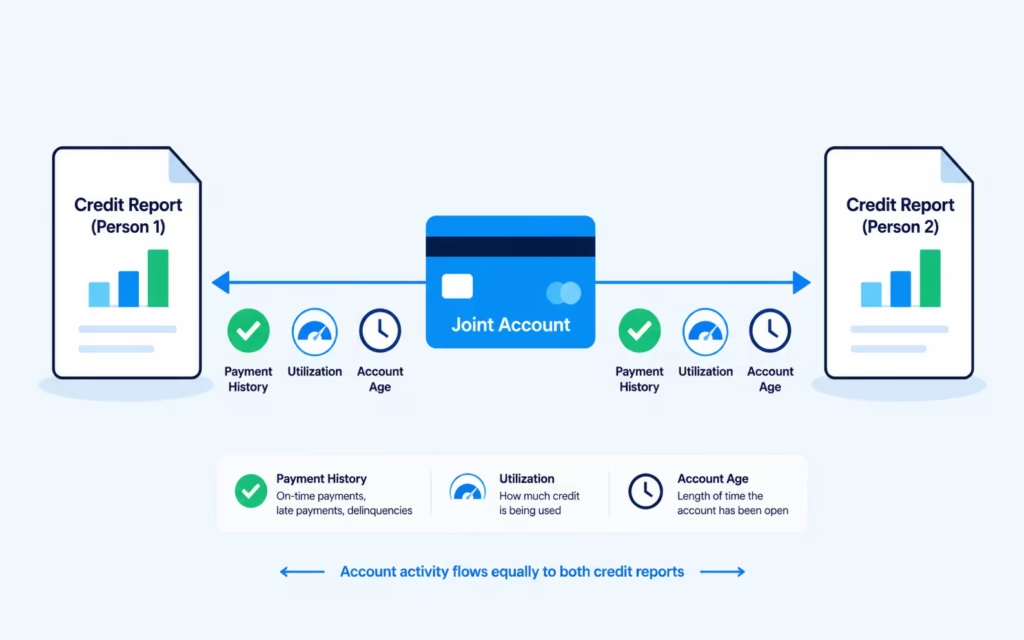
That includes:
- Payment history. Every on-time payment helps both scores. Every late payment hurts both.
- Credit utilization. If the card’s balance is 80% of the credit limit, that high utilization pulls down both people’s scores. If it stays low, both benefit.
- Account age. As the account gets older, it can help both people’s average account age, which is one factor in a FICO Score.
- Balance and total debt. The full balance shows up on both credit reports. This can impact debt-to-income ratios if either person applies for more credit.
This is the mechanism behind the shared liability risk. If your co-owner runs up a big balance you didn’t approve of, or misses a payment, your credit score can drop even though you did nothing wrong. On the flip side, if you both use the card responsibly, both of you can build credit together at the same pace.
Because the reporting is identical, there’s no way to shield your credit from your co-owner’s behavior while the account is open. To protect both scores, watch the account closely. Agree on spending limits beforehand and pay the balance in full each month.
Benefits of a Joint Credit Card
A joint credit card can make real sense for the right pair of people. The main benefits include:
- Simpler household budgeting. One statement, one due date, and one balance simplify shared spending, like groceries, utilities, travel, or family costs.
- Shared credit-building. When both owners use the card responsibly, both credit files can benefit from the same positive payment history and account age. That’s useful when one partner has a thinner credit file and wants to build a track record.
- Full transparency. Both people can see every purchase. Some couples find this helps with accountability and honest money conversations.
- Equal control. Neither person can be locked out of the account the way an authorized user can. Both have full rights to manage payments, dispute charges, and speak with the issuer.
- Potentially stronger qualifying power. Some issuers might look favorably on combined income or a strong co-applicant. However, this can vary and isn’t guaranteed.
These benefits mostly assume trust, aligned spending habits, and a stable relationship between the two owners. When those are in place, a shared card can be a straightforward way to run a joint financial life.
Risks and Downsides of a Joint Credit Card
The same features that make joint cards useful also create real risk. Before opening one, weigh these downsides carefully:
- Full liability for the entire balance. You’re on the hook for every charge, even ones you didn’t make. If your co-owner spends heavily and can’t pay, the issuer can collect from you.
- Shared credit damage. A missed payment or a maxed-out card by your co-owner drops your credit score too. You have no way to opt out while the account is open.
- Hard to unwind. As covered later, removing one owner usually means closing the account. That’s a big deal if the account is old and helps your credit history.
- Relationship strain. Financial disagreements are a common source of conflict. A shared card can make every purchase visible, which some people find helpful, and others find suffocating.
- Requires strong trust. A joint card only works when both people are honest about spending, aligned on goals, and reliable about payments. Even one bad month can hurt both of you.
- Fewer choices. Because so few issuers still offer these accounts, you may have to compromise on rewards, APR, or benefits to get one at all.
If any of these risks seem real for you, consider an authorized-user setup. Two individual cards paid from a joint checking account might also work better. You keep the shared spending workflow without the shared legal exposure.
Which Banks Offer Joint Credit Cards
Truly joint credit cards, where both people are co-owners from the start, are hard to find at major U.S. issuers today. Availability changes, and the last few years have seen issuers pull back further from this option.
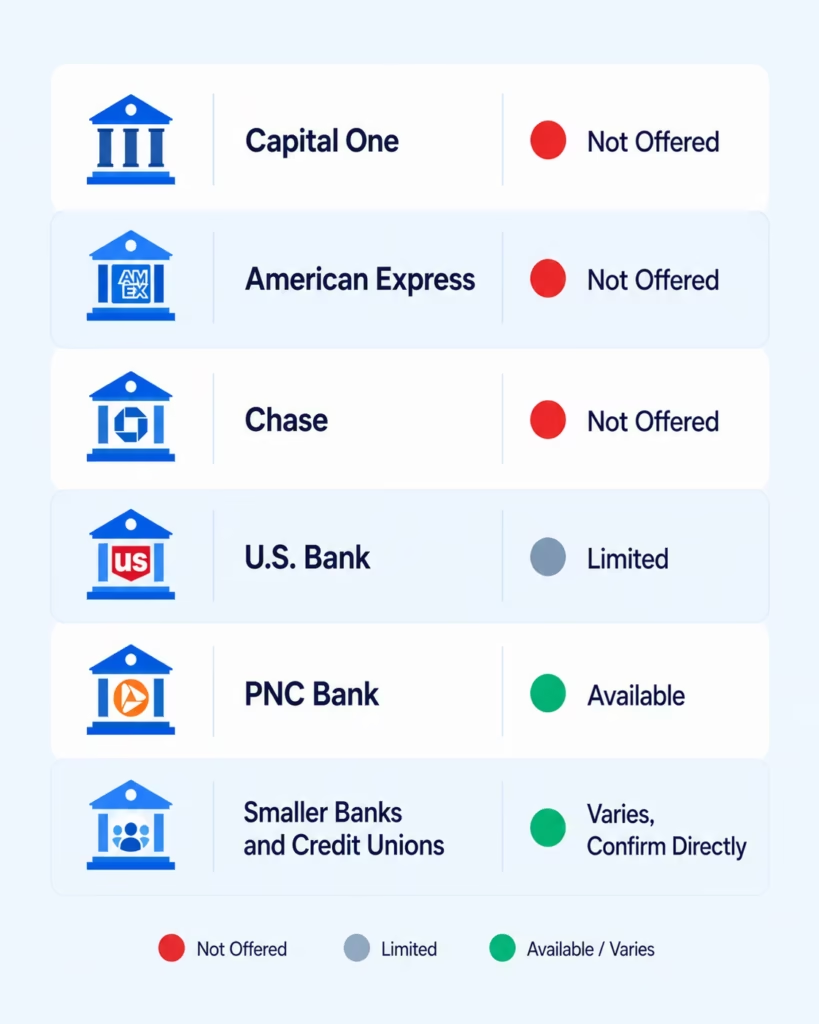
Here’s what the current picture looks like, based on issuer statements:
- Capital One: Does not offer joint credit cards. The bank confirms this directly, stating that Capital One doesn’t offer joint credit cards, and pointing customers to authorized-user or account-manager options instead.
- American Express: Does not offer joint credit card accounts. Amex notes that American Express doesn’t currently offer joint credit card accounts, but supports Additional Card Members as an alternative.
- Chase: Does not appear to offer new joint credit card applications. Chase describes the joint account holder concept, but notes that many lenders don’t offer joint account holders on their credit cards, and focuses its shared-card guidance on authorized users.
- Citi: Its shared credit card page advises applicants to see if an issuer has joint cards before applying. Also, its product materials emphasize authorized users rather than joint applications.
- U.S. Bank: Historically did not accept new joint credit card applications but did allow adding a joint owner to an existing account by phone. Cardholder reports in 2025 indicate U.S. Bank and its subsidiary Elan Financial Services removed even that option. Confirm directly with the bank before assuming this feature is available.
- Smaller banks and credit unions: Some regional banks and local credit unions may still allow joint applications on credit cards. Availability varies widely, so contact the institution directly to ask.
- Apple Card: Not a traditional joint account, but Apple Card Family lets you share a card with a co-owner and add up to four participants. Apple confirms that you can invite up to five members of your Family Sharing group to join and one of those five can be an account co-owner. A co-owner must be at least 18 and in your Family Sharing group. Total account members, including the original owner, is six.
Because availability can shift with little notice, always confirm the current policy directly with the issuer before applying. A published article, including this one, may be out of date the day after a bank changes its rules.
📌 Did You Know: Even at issuers that once accepted joint credit card applications, “joint” often meant adding a co-owner to an existing account rather than applying together for a brand-new card. The two paths aren’t the same, and you’ll want to ask the issuer which one they actually support.
Why Joint Credit Cards Have Become Rare
There are a few practical reasons joint credit cards have quietly disappeared from most major issuers.
Shared-liability accounts are harder for banks to manage. When two owners disagree, dispute charges against each other, or split up, the issuer often gets pulled into a mess it wasn’t designed to handle. Closing or restructuring the account is more complicated than closing a single-owner card.
The authorized-user model allows issuers to offer many customer benefits, like a second card, shared spending, and credit-building reporting. It does this with much less legal complexity. Only the primary cardholder is on the hook, and adding or removing an authorized user is quick. That simplicity is why most issuers now default to this model.
Fewer joint options are available now. The options that do exist are often at smaller institutions or come through workarounds like Apple Card Family.
Exiting a Joint Credit Card Account
Getting out of a joint credit card is harder than getting in. This is one of the most important things to understand before you open one.
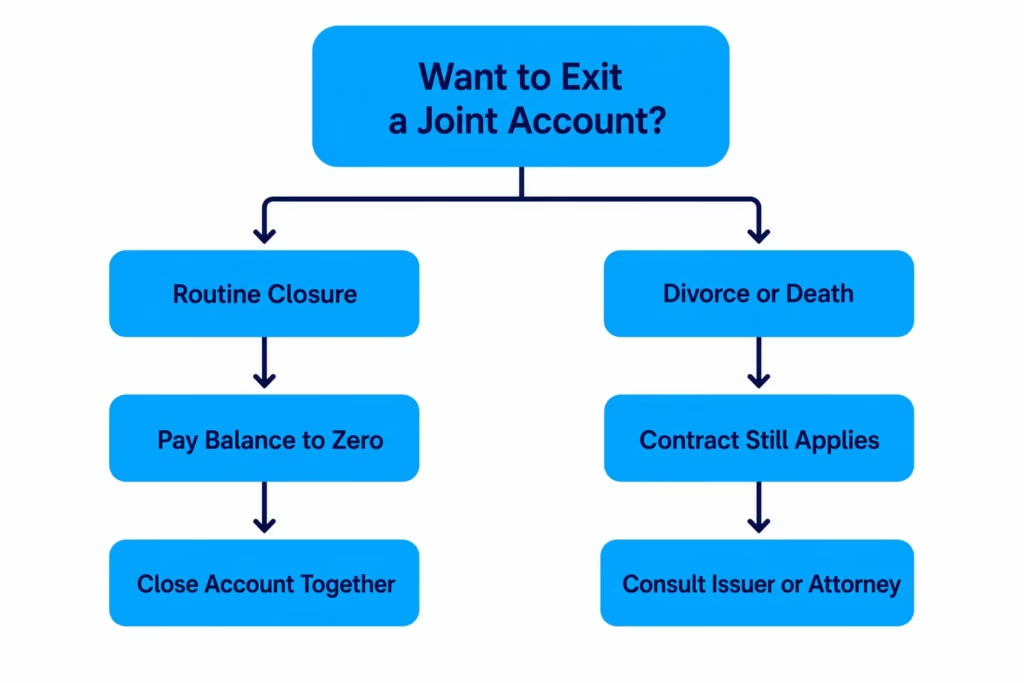
The general rule at most issuers: removing one owner from a joint credit card account requires closing the account entirely. There’s no simple “take my name off” option. If both owners want to end their shared setup, the usual path is to pay the balance down to zero, then close the account together. From there, one or both people can apply for individual cards separately.
Account closure has real credit consequences for both people:
- Loss of account age. If the card was your oldest account, closing it can lower your average age of accounts and slightly hurt your score over time.
- Higher utilization ratio. Closing the card removes its credit limit from your total available credit. If you carry balances on other cards, your overall utilization can jump, which can lower your score.
- Loss of positive history over time. Closed accounts in good standing stay on your credit report for up to 10 years. This means you keep the history for a while. However, the account will eventually drop off.
One practical option is for one person to open a new individual card first, before closing the joint account. That way, they have credit available in their own name and aren’t left without a card during the transition.
U.S. Bank spells out its own policy plainly: if you want an account in your name only, you’ll need to close the account and apply for a new one, with an exception if the co-owner is deceased. Other issuers work similarly. Ask the specific bank before you assume anything.
What Happens in a Divorce or Separation
Divorce doesn’t automatically clean up your joint credit card. This is one of the most misunderstood pieces of shared-credit financial planning.
The CFPB is direct on this point: a divorce decree or property settlement may assign a debt to a specific spouse, but it doesn’t change the fact that a creditor can still collect from anyone whose name appears as a borrower on the loan or debt. Your Cardmember Agreement with the issuer is a separate contract, and the divorce court can’t rewrite it for you.
That means:
- If your ex-spouse is ordered by the court to pay the joint credit card balance, and they don’t pay, the card company can still come after you.
- Sending the issuer a copy of your divorce decree doesn’t end your responsibility on a joint account.
- You’re generally only released from a joint debt if the creditor formally releases you or if the debt is refinanced into one person’s name only.
Practical steps to protect your credit during a separation:
- Pay the joint card balance down to zero as quickly as possible.
- Stop making new charges to the joint card once you decide to separate.
- Consider closing the joint account together once the balance is paid off.
- Open individual cards in each person’s name so both of you have credit available.
- Monitor your credit report at each of the three bureaus for any activity on the old joint account.
If the debt is large or the split is contested, talk to a family law attorney about how to allocate the balance and get it out of both people’s names.
What Happens if a Joint Cardholder Dies or Becomes Incapacitated
This is one of the specific scenarios where a joint credit card can actually work better than an authorized-user setup.
When one joint owner dies, the surviving joint owner typically retains full access and responsibility for the account. The card doesn’t get frozen or closed the way it often does for an authorized user, whose access can end as soon as the primary cardholder passes away. For older couples where one partner handles most bill-paying, this continuity can matter a lot.
The surviving owner is still on the hook for any balance owed on the card, because that’s how joint liability works. But at least the account keeps functioning, so recurring bills tied to the card don’t suddenly bounce.
If a co-owner becomes incapacitated rather than deceased, the other joint owner can still access and manage the account. An authorized user often can’t access it, because their access relies on the primary cardholder’s authority.
Some couples prefer joint credit cards over the authorized-user option. This survivor-continuity benefit is a key reason for that choice. If it matters to you, ask any issuer you’re considering how they handle death and incapacity on a joint account, and put those answers in writing.
Alternatives to a Joint Credit Card
Given how rare joint credit cards have become, most people who want to share a card end up using one of these alternatives instead:
- Add an authorized user. This is by far the most common option. The primary cardholder is responsible for the debt. The authorized user gets their own card. If the issuer reports their activity to the bureaus, they can build credit. Most major issuers do this. No credit check is needed to add or remove someone. This is a good fit for parents helping a teen or young adult build credit, or for couples where one person is comfortable being the sole account owner.
- Two individual cards funded from a joint bank account. Each person applies for their own credit card in their own name. Both cards get paid each month from a shared joint checking account. This means you have your own legal responsibility and credit exposure. You can also remove or close either card without it affecting the other. It’s often the cleanest setup for couples who want shared bill-paying without shared legal risk.
- Cosigning (where still available). A cosigner promises to pay if the primary borrower defaults, but usually doesn’t get card access. Most major issuers no longer offer this option on credit cards, though some smaller banks or credit unions still do. It’s a narrower fit, mostly used when one applicant can’t qualify alone.
- Apple Card Family. For people already in the Apple ecosystem, adding a co-owner to an Apple Card creates a shared account with equal responsibility. It’s not a typical joint credit card. Still, it works like one for two co-owners. You can also add participants who won’t share liability.
Each option has different rules on liability, credit reporting, and ease of exit. Match the option to your goal, not the other way around.
Choosing the Right Option for Your Situation
The right sharing setup depends less on the product and more on the relationship, the goal, and the level of risk you’re both comfortable taking on. Use these situation-based starting points as a guide, and confirm current issuer policies before you apply.
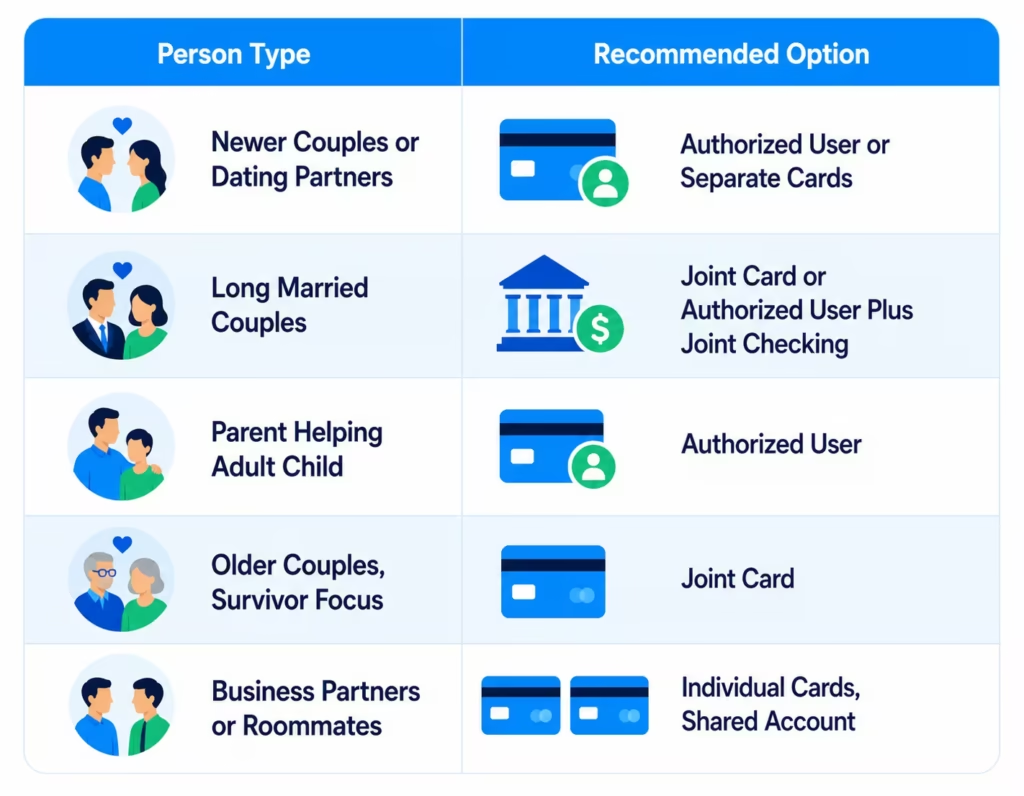
- Newer couples or dating partners: An authorized-user setup or two separate cards with a shared payment plan usually works best. It offers daily flexibility without tying you to shared legal duties while the relationship develops.
- Long-married couples merging finances: A joint credit card (where available) works if trust is high and financial habits are aligned. If your preferred bank doesn’t offer a true joint card, you can set up an authorized user on the higher earner’s card. Then, open a joint checking account for payments. This gives you most of the same benefits.
- A parent helping an adult child build credit: An authorized user is almost always the right call. There’s no credit check. The parent stays in control of the debt. Plus, the child can build a positive credit history if the issuer reports to the bureaus. It’s easy to remove the child later.
- Older couples focused on survivor continuity: A joint credit card can be a strong fit because the surviving owner keeps full account access. If you can’t get a joint card from your bank, ask how they manage authorized-user access after someone dies. Also, think about adding a power of attorney to your financial plans.
- Business partners or roommates: A joint credit card often doesn’t work well. Relationships can end suddenly, and it’s tough to untangle shared liability. Individual cards paid from a shared account are cleaner.
Before you decide, walk through these questions together:
- Does the issuer we want even offer joint credit cards, and if so, is it a new application or only an add-on to an existing account?
- How much do we trust each other with unrestricted spending on a shared credit line?
- What happens to the account if our relationship changes, one of us loses income, or one of us dies?
- Do we need equal legal ownership, or is one of us fine being the sole account holder while the other has authorized access?
- Are we prepared for the possibility that closing this account may temporarily lower both of our credit scores?
The right answers vary, but going through the questions before you apply prevents most of the regret that shows up later.
💡 Pro Tip: Combine an authorized-user setup with a joint checking account. The card owner stays legally responsible, both people can spend and see purchases, and monthly payments come out of shared funds. This mimics most of the practical benefits of a joint card, with none of the removal headaches.
Frequently Asked Questions (FAQs)
Can I put two names on a credit card?
Yes, a joint credit card puts two names on one account, and both people share the same credit limit and are equally responsible for the full balance. This differs from an authorized user, whose name appears on the card but who isn’t legally responsible for payments.
Can a married couple get a joint credit card?
Yes, married couples can apply for a joint credit card, though only a few issuers, like some smaller banks and credit unions, still offer true joint accounts. Most major banks, including Capital One and Amex, no longer offer this option to anyone, married or not.
Can you get a joint credit card if you’re not married?
Yes, joint credit cards aren’t limited to married couples. Any two people, including parents and adult children or long-term partners, can apply together at an issuer that still offers the option.
Are there any truly joint credit cards?
Yes, but they’re rare at major issuers. Capital One, American Express, and Chase don’t offer them, while some smaller banks, credit unions, and Apple Card Family offer joint or shared-liability options.
Is it better to have a joint credit card or an authorized user?
An authorized user setup is usually simpler and lower-risk, since only the primary cardholder is legally responsible for the debt. A joint card gives both people equal control and liability, which works best when trust and financial habits are already aligned.
Does adding my wife to my credit card affect my credit score?
Adding your wife as an authorized user typically doesn’t affect your credit score, since you remain the only person legally responsible for the account. Her credit can benefit if the issuer reports authorized-user activity to the credit bureaus.
Does a joint credit card build credit for both people?
Yes, both owners’ credit files receive the same account activity, including payment history and account age. Responsible use, like on-time payments and low balances, builds credit for both people at the same pace.
Can my wife and I each have a credit card for the same account?
Yes, both joint owners get their own physical card tied to the same account and credit limit. Either person can make purchases, view transactions, or manage the account without needing the other’s approval.
Can you remove your name from a joint credit card?
Generally no, not without closing the entire account. Most issuers require the account to be paid off and closed if one owner wants out, after which either person can apply for an individual card.
Do both people need good credit to get approved for a joint credit card?
Yes, in most cases both applicants undergo a credit check and need to qualify individually. A strong-credit applicant doesn’t cancel out a co-applicant’s poor credit history, and either person’s issues can lead to a denial.
The Bottom Line
A joint credit card allows two people to share one credit line. They both have equal ownership and responsibility. This can make shared spending easier and help them build credit together. It also has real risks. You could be fully responsible for a co-owner’s charges. Plus, it’s hard to remove one name without closing the account.
Many major issuers have stopped offering joint credit cards. Instead, people may find an authorized-user setup, two individual cards linked to a joint checking account, or options like Apple Card Family more helpful. Consider your goals, your relationship, and your issuer’s current rules before choosing.
If this guide helped clear up the differences, share it with a partner, family member, or friend who’s thinking about merging credit. A few minutes of reading now can prevent months of untangling later.