
You checked your credit score app and saw a term you didn’t fully understand. Now you’re wondering what a debt-to-credit ratio is and whether yours is hurting your score. That confusion is normal, and it can cost you points if you guess wrong.
Here is the short answer: it is the share of your available revolving credit that you are currently using, shown as a percentage.
Below, you’ll find the exact formula, a worked example, the difference between per-card and total numbers, and the one timing trick most people never learn. By the end, you’ll know your number and what to do about it.
Key Takeaways
This guide explains what a debt-to-credit ratio is, including the exact formula, worked examples, what counts as revolving debt, and the statement-closing-date timing trick for lowering your reported usage.
Core Facts:
- Debt-to-credit ratio equals total balances divided by total credit limits multiplied by 100, and it is the same metric as credit utilization ratio.
- Only revolving accounts count toward this ratio, including credit cards, personal lines of credit, and HELOCs; mortgages, auto loans, student loans, and personal loans are excluded.
- Utilization falls under the “amounts owed” category, which makes up about 30% of a FICO Score, second only to payment history at 35%.
- A ratio under 10% is considered excellent, 10% to 29% is acceptable, and 30% or higher starts working against your score.
- Card issuers typically report your balance to credit bureaus once per month on your statement closing date, not your payment due date.
- Paying your full balance by the due date does not guarantee 0% reported utilization, since the balance snapshot was already taken at the earlier statement closing date.
Best for:
- Readers who want to calculate their own debt-to-credit ratio using their actual card balances and limits.
- People confused about why their utilization still shows high after paying their card in full.
- Anyone trying to distinguish debt-to-credit ratio from debt-to-income ratio before applying for credit or a loan.
What Is a Debt-to-Credit Ratio?
A debt-to-credit ratio compares how much you owe on revolving credit to how much you’re allowed to borrow. Revolving credit means accounts like credit cards and lines of credit, where you can borrow, repay, and borrow again up to a set credit limit.
So if you owe $1,000 on a card with a $4,000 limit, you’re using one quarter of what you could use. That share is your ratio. Lenders and scoring models read it as a quick signal of how stretched your finances are. A low share suggests you use credit lightly. A high share suggests you may be leaning on it too hard.
You may also see this called the balance-to-limit ratio. Same idea, different label. The name changes from site to site, but the math never does.
Is Debt-to-Credit Ratio the Same as Credit Utilization?
Yes. Debt-to-credit ratio and credit utilization ratio are two names for the exact same metric. Some apps and articles also say “credit-utilization rate” or “debt-to-credit rate.” If you spot any of those terms on your credit report or in a scoring app, they all mean the same thing: your revolving balances divided by your revolving limits.
This matters because many people think they need to track two separate things. They don’t. One number, several names.
Keeping this number small helps your credit score. Many experts suggest you keep your balance below thirty percent of your limit. Using less than that shows you handle money well. It tells lenders that you are not relying too much on borrowed cash. Staying under this mark is a simple way to build trust with banks.
How to Calculate Your Debt-to-Credit Ratio
The formula has three quick steps:
- Add up your current credit card and line of credit balances.
- Add up the credit limits on those same accounts.
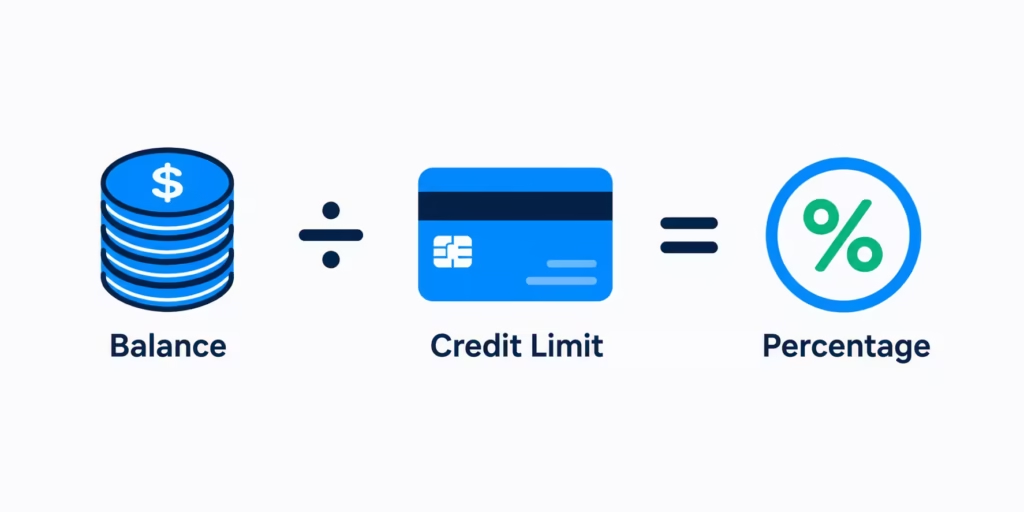
- Divide total balances by total limits, then multiply by 100 to get a percentage.
In short: balance ÷ credit limit × 100.
You can find both numbers in seconds. Open your card issuer’s app or website and check your account dashboard. The balance and limit sit right at the top of most screens.
Your paper or PDF statement works too. To double-check what lenders see, pull your free credit reports at AnnualCreditReport.com, the only site federally authorized to provide them.
Example Calculation
Single card: David carries a $2,500 balance on a card with a $5,000 limit. His math is $2,500 ÷ $5,000 × 100. That gives him a 50% ratio on that card.
Multiple cards: Sarah has three cards. Her balances are $900, $600, and $0. Her limits are $3,000, $2,000, and $5,000. First, sum the balances: $900 + $600 + $0 = $1,500.
Then sum the limits: $3,000 + $2,000 + $5,000 = $10,000. Finally, divide: $1,500 ÷ $10,000 × 100 = 15%. Her total ratio is 15%, even though one of her cards sits at 30% on its own.
💡 Pro Tip: Run this math once a month using your statement balances, not your real-time balance. The statement figure is the one that usually reaches the credit bureaus.
What Counts as Debt in This Ratio?
Only revolving credit counts. That means:
- Included: credit card balances, personal lines of credit, and home equity lines of credit (HELOCs)
- Not included: mortgages, auto loans, student loans, and personal loans
The reason comes down to how the accounts work. A revolving account stays open and reusable. You pay it down, and the credit limit frees up again.
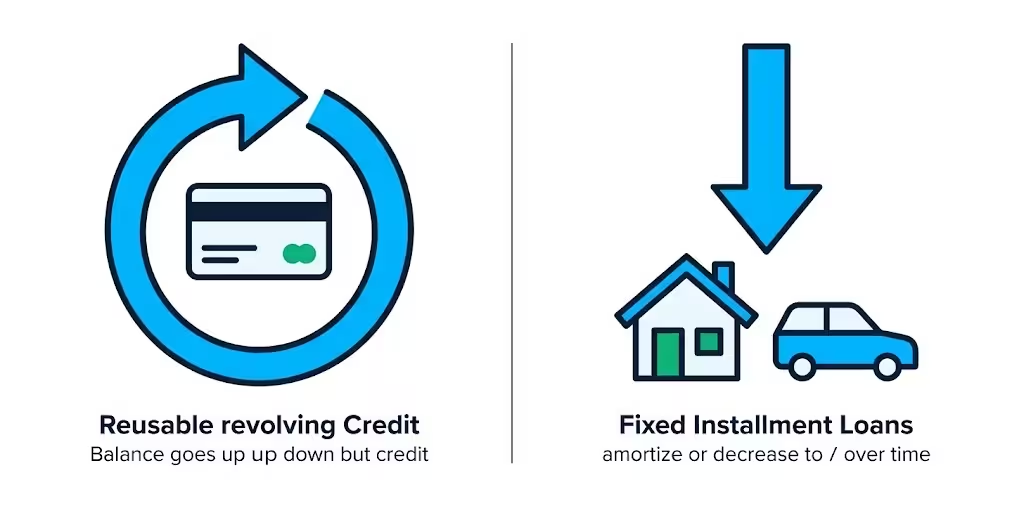
An installment loan works differently. You borrow one fixed amount and repay it on a set schedule until it hits zero. Because that structure is fixed, scoring models treat it separately, and it stays out of this calculation.
This trips people up often. Someone with a $22,000 auto loan might feel their ratio should be sky-high. It isn’t. That loan never enters the formula at all.
Per-Card Ratio vs. Overall Ratio
Your ratio exists at two levels, and both matter.
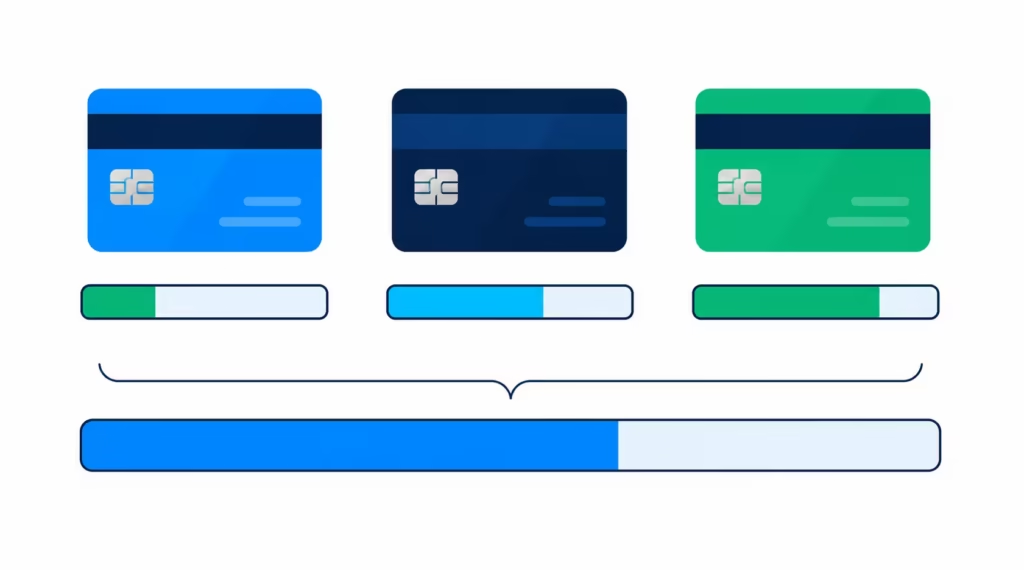
The per-card ratio is one card’s balance divided by that card’s own limit. The overall ratio is all balances combined divided by all limits combined. Scoring models look at both, though the overall figure usually carries more weight.
Here’s why the per-card number still matters:
Michael has three cards with a combined limit of $12,000 and combined balances of $2,400. His overall utilization is a healthy 20%. But one card, a store card with a $1,000 limit, is maxed out at $1,000. That single 100% per-card ratio can drag his score down even though his total looks fine. High usage on even one account signals stress to the scoring formula.
How Multiple Cards Affect Your Total Ratio
To get your total ratio, sum every balance across all your cards, sum every credit limit, then divide the first total by the second. Don’t average the per-card percentages. That gives you the wrong answer.
One caution: a single card with a tiny limit can skew your overall number fast. A $300 balance on a $500-limit card is 60% by itself. If that card is a big chunk of your total available credit, your combined ratio jumps even when your other cards sit near zero.
Keep your balances low on every single card to avoid these problems. Your goal is to stay well below 30% for each specific account. This simple strategy protects your credit score from sudden drops. It also shows lenders that you manage all your credit lines responsibly. Consistency is the best way to keep your entire profile looking strong.
Debt-to-Credit Ratio vs. Debt-to-Income Ratio
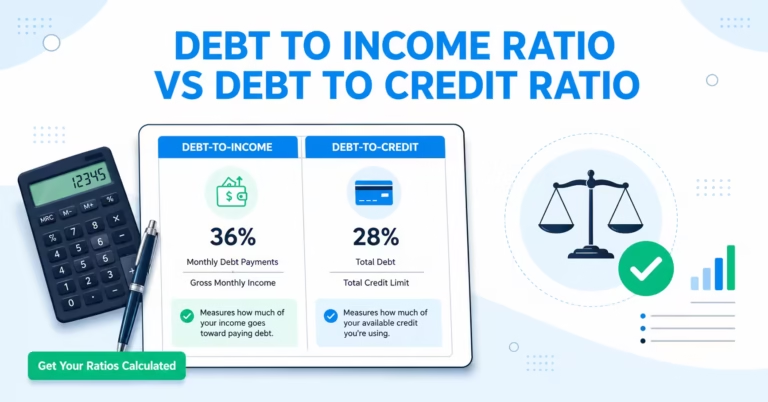
These two terms sound alike, and mixing them up is the most common mistake in this whole topic. They measure completely different things.
| Debt-to-Credit Ratio | Debt-to-Income Ratio | |
|---|---|---|
| What it compares | Revolving balances vs. credit limits | Monthly debt payments vs. monthly income |
| Main use | Credit score calculations | Loan approval decisions (mortgages, auto loans) |
| Direct effect on credit score | Yes, large effect | No direct effect |
Debt-to-income ratio, or DTI, shows lenders whether you can afford a new payment each month. It never appears in your credit score formula. Debt-to-credit ratio does, and it’s one of the biggest pieces. If a mortgage article tells you to fix your DTI, that’s a separate project from fixing your utilization.
Why Debt-to-Credit Ratio Matters for Your Credit Score
This number deserves your attention because of its weight in the scoring formula. Utilization sits inside the “amounts owed” category, which makes up about 30% of a FICO Score. Only payment history, at 35%, carries more weight.
That ranking has a practical upside. Payment history takes years to build. Utilization can change within a single billing cycle. Among the major credit score factors, this is the one you can move the fastest.
VantageScore, the other big scoring model, groups things a bit differently. It treats utilization as part of its own highly influential category rather than a fixed 30% slice. Either way, the conclusion holds: both models punish heavy use of your limits and reward light use.
Keeping your balances low helps you see results quickly. You do not need to wait years for your score to reflect these changes. When your statement closes, the bank reports your new, lower balance to the credit bureaus. Your score usually updates a few weeks later. This makes utilization one of the best tools for improving your credit when you are in a hurry.
What Is a Good Debt-to-Credit Ratio?
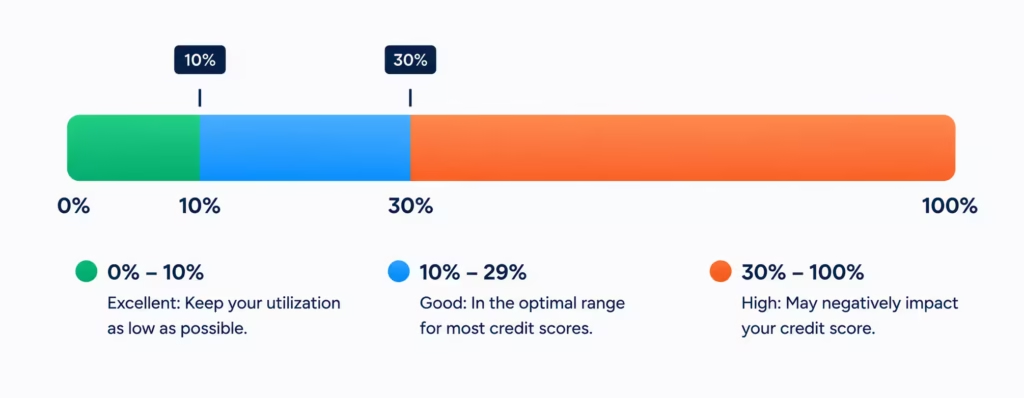
You’ve probably heard the 30% rule. Here’s the right way to read it: 30% is a ceiling, not a target. Staying under it helps you avoid the steepest score penalties, but it isn’t where top scores live.
The strongest benchmark sits much lower. People with the highest credit scores tend to keep utilization in the single digits, often under 10%. A good debt-to-credit ratio, then, looks like this:
- Under 10%: excellent territory, linked to the strongest scores
- 10% to 29%: acceptable, no major penalty
- Around 30%: the danger line, not the goal
One more nuance: 0% isn’t ideal either. A small reported balance shows the account is active and being managed, which reads better than a card that looks unused.
You might wonder how to keep your usage low while still using your cards. The simplest method is to pay off your balance before the statement closing date. This ensures that the amount reported to bureaus is small.
If you struggle to track your spending, try setting up automatic payments. This keeps your usage predictable and prevents accidental spikes. Consistently reporting a low balance is a powerful way to nudge your score into the excellent range.
What Is a Bad Debt-to-Credit Ratio?
Anything consistently above 30% starts working against you. The higher it climbs from there, the more points you stand to lose.
The most damaging case is a maxed-out card, meaning a ratio at or near 100%. To a lender or a scoring model, that pattern says you depend on borrowed money to get through the month. It reads as risk, and scores respond accordingly.
A bad debt-to-credit ratio of 50% to 100% can lower your score. This happens even if you pay on time. The scoring formula focuses on how much of your limit you use, not just your payment history.
The good news: this factor resets every reporting cycle. So, paying down balances can boost your score faster than most other fixes.
📌 Did You Know: Utilization has no memory in current scoring models. Last month’s 80% stops hurting you as soon as a lower balance gets reported.
You can use this to your advantage. Try to pay off your credit card balance before the statement closing date. This ensures that the bank reports a lower number to the credit bureaus. Many people see a score increase within a single month once they lower their usage. It is one of the quickest ways to improve your financial standing.
When Your Balance Is Reported and Why Timing Matters
This is the piece almost nobody explains, and it solves a huge source of confusion.
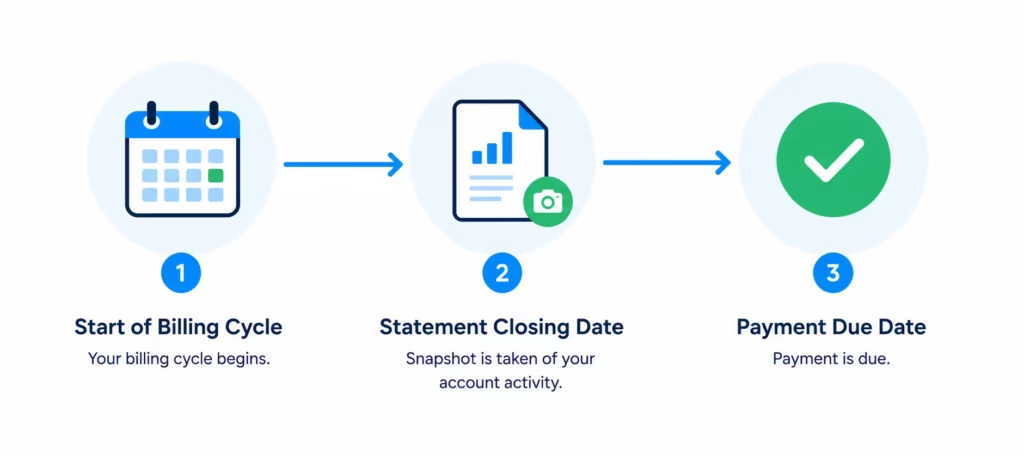
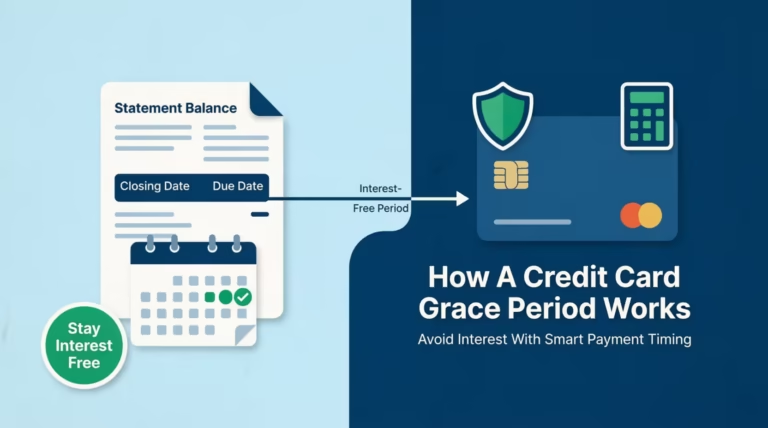
Card issuers don’t report your balance to the credit bureaus (Experian, Equifax, and TransUnion) every day. Most report once a month, and the snapshot usually happens on your statement closing date, not your payment due date. Those are two different dates, often about three weeks apart.
The reported balance is the number that feeds your ratio. Your real-time spending, and whatever you pay after the snapshot, doesn’t show up until the next cycle.
The practical move: if you want a lower reported utilization, pay down your balance before the statement closing date. The snapshot then catches the smaller number, and your ratio drops on the very next report.
Why Paying in Full Doesn’t Always Show 0% Utilization
Many people pay their full balance by the due date, then feel frustrated when their app still shows high usage. The timing explains it. The balance was already reported at statement close, days or weeks before that payment posted. Paying the bill on time protects your payment history, but it can’t rewrite a snapshot that already happened.
⚠️ Mistake to Avoid: Don’t wait for the due date if a lower reported ratio is your goal. Pay early, before the statement closes, so the bureaus see the smaller balance.
Frequently Asked Questions (FAQs)
What is a good debt-to-credit ratio?
A good ratio stays under 30% of your credit limit, with excellent scores typically seen under 10%. A small reported balance is better than 0%, since it shows the account is active and being managed responsibly.
Is a 30% debt-to-credit ratio good?
30% is the danger line, not a target to aim for. It’s the ceiling that helps you avoid steep score penalties, but the strongest scores come from usage in the single digits, ideally under 10%.
What counts as debt in a debt-to-credit ratio?
Only revolving credit counts, including credit card balances, personal lines of credit, and HELOCs. Installment loans like mortgages, auto loans, student loans, and personal loans are excluded entirely.
How is debt-to-credit ratio different from debt-to-income ratio?
Debt-to-credit ratio compares your revolving balances to your credit limits and directly affects your credit score. Debt-to-income ratio compares monthly debt payments to income and is used for loan approvals, with no direct effect on your credit score.
What is a bad debt-to-credit ratio?
Anything consistently above 30% starts hurting your score, with 50% to 100% causing real damage even if you pay on time. A maxed-out card near 100% utilization signals to lenders that you’re relying heavily on borrowed money.
Why does paying my credit card in full still show high utilization?
Card issuers report your balance on the statement closing date, not the payment due date, often about three weeks apart. If you pay in full by the due date, that payment posts after the snapshot already reported a higher balance.
How does one maxed-out card affect my overall utilization?
A single high-usage card can drag down your score even if your combined ratio across all cards looks healthy. For example, a $1,000 balance on a $1,000-limit store card creates a 100% per-card ratio that signals financial stress on its own.
How much does utilization affect my credit score?
Utilization falls under the “amounts owed” category, which makes up about 30% of a FICO Score, second only to payment history at 35%. Because issuers report balances monthly, this factor can change your score faster than almost any other.
When should I pay my credit card to lower my reported utilization?
Pay down your balance before your statement closing date, not the due date. The bureaus only see the balance reported at that snapshot, so an early payment ensures a lower number gets reported.
Wrapping Up
A debt-to-credit ratio is simply your revolving balances divided by your revolving limits, and it ranks among the most powerful levers in your credit score. Keep the overall number under 30%, aim for single digits if you can, watch each card on its own, and time payments before the statement closing date.
For many readers, paying early gives quick results. It alters the exact numbers that bureaus get.
If you know someone confused about why “paying on time” isn’t raising their score, share this article with them. The timing fix inside could be exactly what they’re missing.