
You may have spotted “cell phone protection” listed as a perk on your credit card, or read that some cards cover phone damage. If you’re paying your carrier $10 to $17 a month for insurance, it’s fair to wonder if that card benefit can replace it. Many cardholders don’t even know they have this coverage, or don’t know it needs to be activated.
Cell phone protection is a credit card benefit. It helps you cover repair or replacement costs if your phone gets damaged or stolen. Typically, you can claim up to $500 to $800. To qualify, you must pay your monthly wireless bill with that card.
Below, you’ll learn how the benefit works, what it does and doesn’t cover, how the deductibles and claim caps stack up, and how to decide if it’s enough protection for you on its own.
Key Takeaways
This guide explains how credit card cell phone protection works, including the activation requirement, coverage limits, common exclusions, and how it compares to paid carrier insurance plans.
Core Facts:
- Cell phone protection reimburses repair or replacement costs, typically $500 to $800 per claim, when your phone is damaged or stolen.
- Coverage activates only after you pay your full monthly wireless bill with the eligible card, usually starting the first day of the following calendar month.
- Common deductibles range from $25 to $50 per claim, and most cards allow up to two claims per 12-month period.
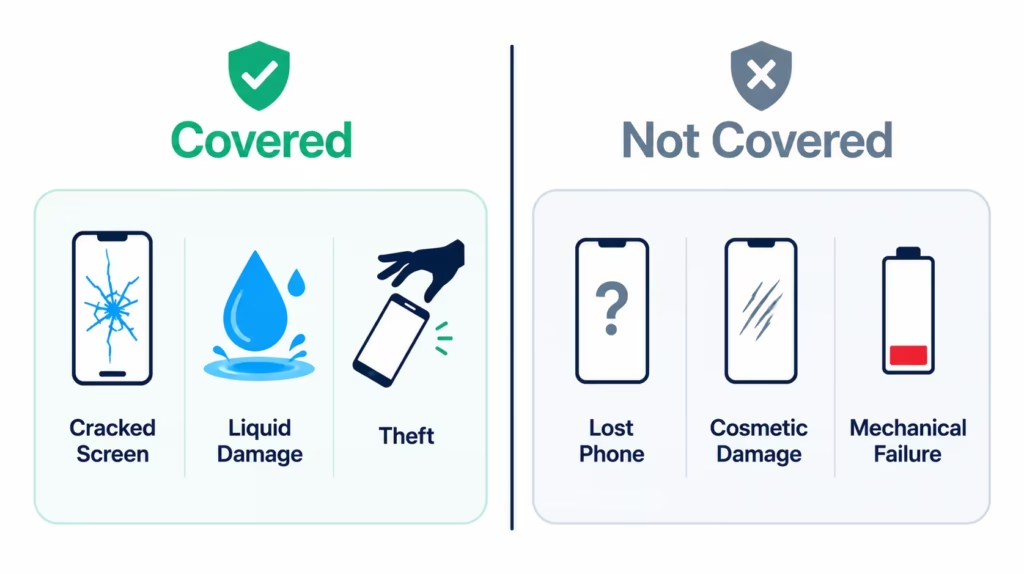
- Lost phones, cosmetic damage, and mechanical or electronic failure are excluded from coverage on nearly every card program.
- This benefit is almost always secondary coverage, meaning it pays only after carrier insurance or homeowners/renters policies are used first.
- Examples of published limits include Chase Freedom Flex ($800 per claim), Wells Fargo Autograph ($600 per claim), and Capital One Venture X ($800 per claim).
Best for:
- Cardholders who already pay their full wireless bill with an eligible credit card each month.
- People deciding whether to cancel paid carrier phone insurance in favor of an existing card benefit.
- Anyone filing or preparing to file a cell phone damage or theft claim who needs to understand documentation and exclusion rules.
What Is Cell Phone Protection on a Credit Card?
Cell phone protection on a credit card is an insurance-style benefit. If a phone linked to your wireless plan is damaged or stolen, the card can reimburse you for repairs or replacement, up to a certain dollar limit per claim.
A few things are worth knowing up front:
- It usually costs nothing extra. On cards that include it, the benefit comes with the card. There’s no monthly premium, which is the big difference from carrier insurance.
- A third party actually provides the coverage. Your bank doesn’t pay the claims. Issuers partner with an insurance underwriter. For example, American Express lists New Hampshire Insurance Company, part of AIG, as the underwriter for its cell phone protection. All the rules live in a document called the Guide to Benefits, which defines exactly what counts as an eligible cellular wireless telephone and what events are covered.
- Terms vary a lot from card to card. Even two cards from the same bank can have different limits, deductibles, and exclusions, or one may have the benefit and the other may not.
How to Check if Your Card Has This Benefit
Before anything else, confirm your specific card carries the benefit:
- Open your card’s online benefits page or the benefits section of the issuer’s mobile app and look for “cell phone protection” or “cellular telephone protection.”
- Find the Guide to Benefits for your card. It’s usually a PDF linked from the benefits page, and it spells out the limits, deductible, and exclusions.
- Call the number on the back of your card and ask directly.
Don’t assume based on the issuer’s name alone. Within a single bank, some card products include the benefit and others don’t.
How Does Credit Card Cell Phone Protection Work?
This is the part that trips people up most, because the benefit isn’t automatic. Coverage depends on one specific action.
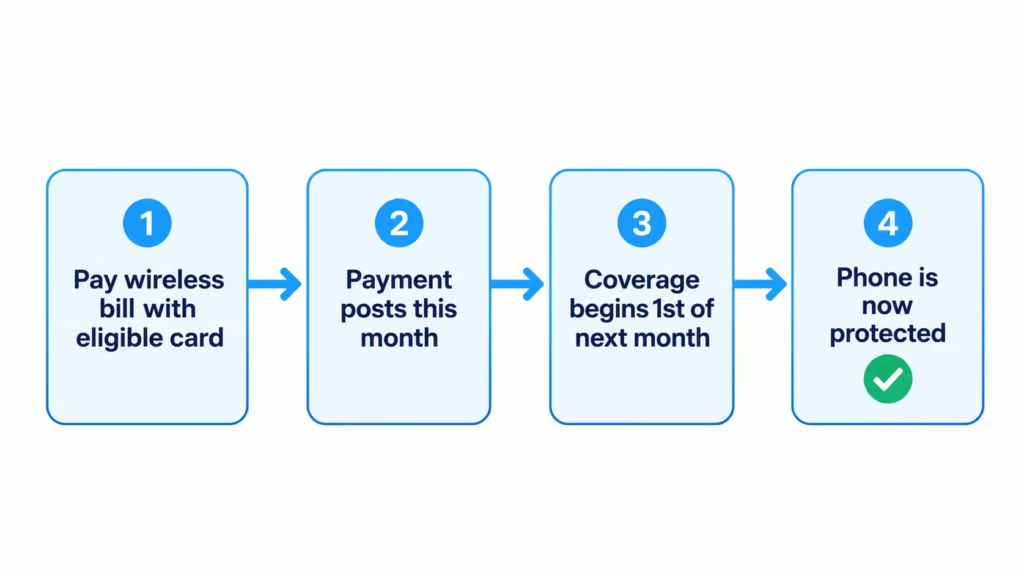
The core requirement is paying your full monthly wireless bill with the eligible card. Not part of the bill. Not a different card some months. The entire bill, on that card, each billing cycle.
Timing matters too. On most cards, coverage begins the first day of the calendar month after you pay the bill with the card. Say you switch your wireless autopay to an eligible card and the first payment posts in March. Coverage typically starts April 1. If your phone breaks in late March, you’re likely not covered yet, and that’s one of the most common ways claims get denied.
A few more mechanics worth understanding:
- Coverage ties to the phone number or line listed on the wireless bill you paid, not to a specific device’s serial number.
- If you stop paying the bill with the card, coverage lapses. It can resume once you start paying with it again, following the same timing rule.
- You don’t need to have bought the phone with the card. On most programs, the monthly bill payment is what activates coverage.
Which Phones and Lines Are Eligible
As a general pattern, the eligible lines are the ones listed on the monthly billing statement you paid with the card. On a shared or family plan, if you pay the entire bill with one eligible card, the lines on that bill can typically all qualify.
That said, this detail genuinely varies by issuer, so check your card’s Guide to Benefits before assuming every line on your plan is covered. If a family member’s line sits on a separate bill paid from a different account, that line is almost certainly not covered.
Which Credit Cards Cover Cell Phone Damage?
The benefit usually appears on mid-tier to premium cashback and travel cards. It’s common with banks and membership-based issuers like Chase, American Express, Capital One, Wells Fargo, and USAA. Card network tiers, like Visa Signature and Mastercard World Elite, sometimes include this. However, it’s always up to the individual card product, not the issuer or network.
To set expectations on dollar figures, here’s how a few well-known cards structure the benefit, based on each issuer’s published terms:
- Chase Freedom Flex: up to $800 per claim, with a $1,000 cap per 12-month period, per Chase’s benefits guide. Note that some cardholders have reported this benefit is scheduled to end on the card in September 2026, which is a good reminder that perks can change.
- Wells Fargo Autograph: up to $600 per claim against damage or theft, subject to a $25 deductible, per Wells Fargo. The Autograph Journey card raises that to $1,000.
- Capital One Venture X: reimbursement up to $800 when the phone is stolen or damaged, and the bill is paid with the card, per Capital One.
- The Platinum Card from American Express: the lesser of repair or replacement cost, up to $800 per claim, limited to two claims per 12-month period, per Amex.
These are examples, not a ranked list. The right move is always to check your own card’s Guide to Benefits, because that’s the document a claims administrator will apply to your claim.
USAA Credit Card Cell Phone Protection
USAA’s version is a concrete example of how one issuer sets up the benefit. Per USAA’s credit card benefits page, if your eligible phone is stolen or damaged, you can be reimbursed up to $500 when you pay your monthly cell phone bill using your USAA Bank credit card.
USAA’s Cellular Telephone Protection is available on eligible USAA Visa Signature cards and the USAA Cashback Rewards Plus American Express Card. This benefit has a $50 deductible. You can make up to two claims each year.
This means you could get about $1,000 in coverage annually. The same activation rule applies: pay the monthly wireless bill with the eligible USAA card. Coverage is secondary to other insurance. USAA’s terms do not cover accessories, rented or borrowed phones, prepaid phones, cosmetic damage, or lost phones.
What’s Covered Under Credit Card Cell Phone Protection?
Covered events fall into a few clear categories:
- Accidental damage. A cracked screen from a drop, a phone knocked off a counter, and in most cases, water damage all qualify. If the damage was an accident and it affects the phone’s function, it generally fits.
- Theft. If the phone is stolen and you can document it, typically with a police report, that’s a covered theft claim. A phone snatched from your hand or taken from a bag you were watching fits here.
- Involuntary and accidental parting. Some issuers, including Capital One on the Venture X, include this narrower category. It covers situations where you’re away from your phone against your will. These cases aren’t classic theft, but they are still verifiable.
Coverage pays for repair or replacement, whichever costs less, up to the per-claim limit. One detail people miss: reimbursement is based on the value of the phone you had, not the price of a newer model. If your two-year-old phone is stolen, you get its current value, not the cost of this year’s flagship.
What’s Not Covered? Common Exclusions to Know
Exclusions are where claims fall apart, so read this section against your own habits. Common exclusions across issuers include:
- Lost phones. Simple loss, with no evidence of what happened, is excluded on nearly every card program.
- Cosmetic damage. Scratches, dents, and scuffs that don’t affect how the phone works don’t qualify.
- Mechanical or electronic failure. A battery that stops holding a charge or a phone that dies on its own, with no physical damage, isn’t covered. That’s a warranty issue, not an insurance one.
- Phones used for business or bought for resale on consumer cards.
- Rented, leased, borrowed, or prepaid phones.
- Accessories, other than items like a standard battery or antenna.
- Phones lost while in the care of a common carrier, like a postal or delivery service or an airline, unless hand-carried.
Lost vs. Stolen vs. “Mysterious Disappearance”
This distinction causes more denied claims than almost any other. Theft means you can describe what happened: someone took the phone, and there’s evidence, often a police report, backing that up. “Lost” or “mysterious disappearance” means you can’t explain where the phone went. It fell out of a pocket, or it was there, and then it wasn’t.
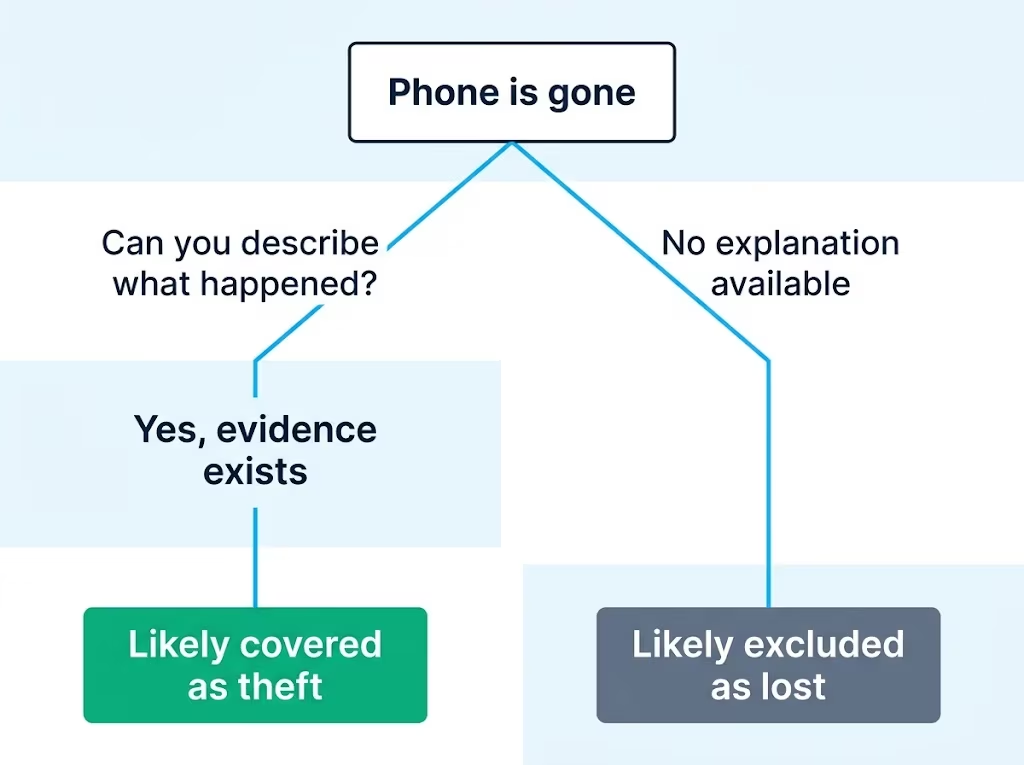
The reason issuers exclude loss isn’t arbitrary. There’s no way to verify a misplaced phone wasn’t simply misplaced, which makes the claim impossible to substantiate. The key point: if you can detail a specific event, like someone grabbing your phone, your claim is much stronger than saying, “I don’t know where it went.”
Common Reasons Claims Get Denied
- Filing for a lost phone with no explanation of what happened
- Not paying the wireless bill with the eligible card in the prior billing cycle
- Missing documentation, like no police report for a theft or no proof of the bill payment
- Filing after the claim deadline in the Guide to Benefits
- Claiming for an ineligible phone, such as a business-use, prepaid, or borrowed device
⚠️ Mistake to Avoid: Switching your wireless autopay to an eligible card and assuming you’re covered the same day. Coverage typically starts the first day of the following calendar month, so a phone broken in the gap weeks is likely on you.
Deductibles, Coverage Limits, and Claim Caps
“Covered” doesn’t mean “fully covered.” Three numbers shape how much money you’d actually get back:
- Deductible: commonly $25 to $50 per claim, though the range across programs runs wider.
- Per-claim cap: typically $500 to $800, with some cards at $600 and a few at $1,000.
- Annual claim limit: usually two claims per 12-month period. Some business cards allow three.
The per-claim cap and the claim limit compound. Two claims at a $500 cap means no more than $1,000 of coverage in a year, minus deductibles.
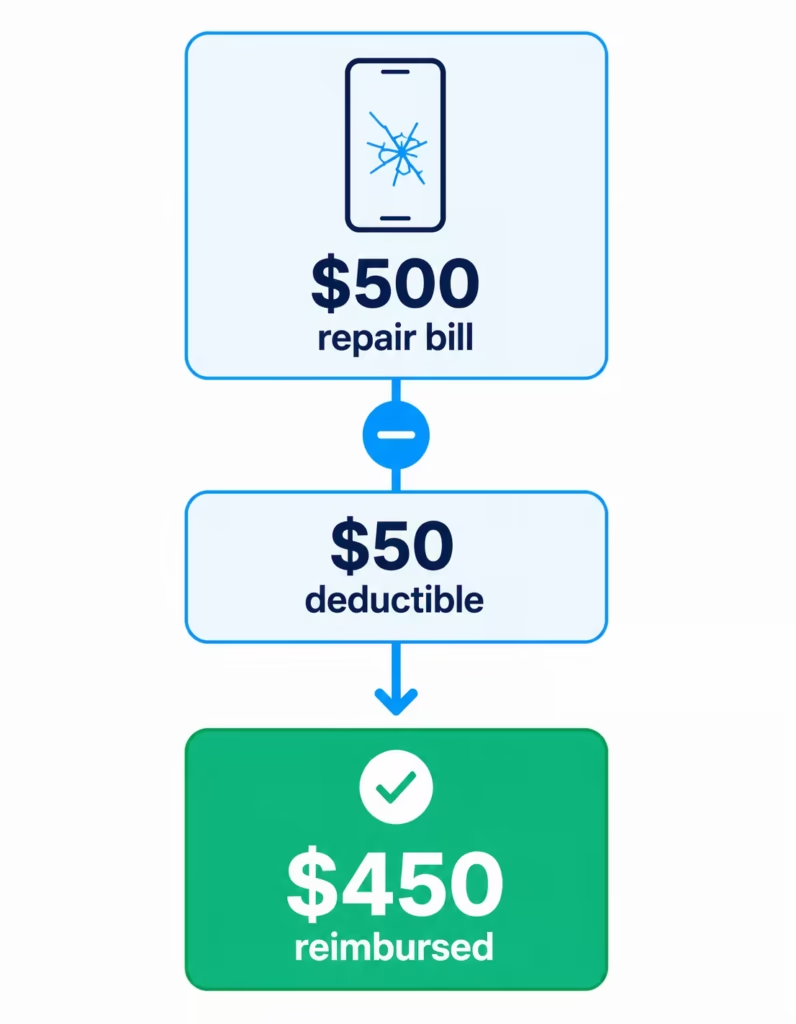
A quick worked example: say your repair bill is $500 and your card has a $50 deductible and a $500 per-claim cap. You’d be reimbursed $450. Now say your $1,200 phone is stolen and the per-claim cap is $600. Even before the deductible, $600 is the ceiling, so the rest comes out of your pocket. And remember, reimbursement won’t exceed the phone’s actual current value.
Is Credit Card Cell Phone Protection Primary or Secondary Coverage?
Credit card cell phone protection is almost always secondary coverage. It pays only after other insurance is used first. This includes carrier plans, renters or homeowners policies, and any manufacturer warranties that apply.
In practice, the order of operations looks like this:
- Something happens to your phone.
- If you hold another policy that applies, you file with that policy first.
- That policy pays out, or denies the claim, up to its terms.
- You submit any remaining shortfall to the card’s claims administrator, and the card benefit can cover the gap up to its own limits.
If you have no other insurance, the card benefit effectively becomes your only protection and applies more directly. This structure is key for deciding whether to keep or cancel later: if you keep carrier insurance and the card benefit, you might rarely use the card coverage. This is because the carrier plan usually comes first.
How to File a Cell Phone Protection Claim
If something happens, the process generally runs like this:
- Act quickly. Most benefit guides set a claim filing deadline, so report the incident as soon as you can.
- Contact the benefits administrator, not the general customer service line. The right number is in your Guide to Benefits and often on your card’s benefits page.
- Prove eligibility. You’ll need the wireless bill statement showing you paid with the eligible card for the required billing cycle.
- For theft, provide a police report. For damage, expect to submit a description and photos of the damage plus a repair estimate.
- Factor in the deductible. It’s subtracted from your reimbursement, or paid as part of the settlement, depending on the program.
Documentation Checklist Before You File
Gather these before you call, and the claim will go much smoother:
- A copy of the wireless bill showing payment from the eligible card
- A police report, for theft or robbery claims
- The purchase receipt or other proof of the phone’s value
- A repair estimate or invoice, for damage claims
- Your card account number and the claim reference number from the administrator
💡 Pro Tip: Screenshot or save each monthly wireless bill showing the card payment as it posts. If you ever file a claim months later, you won’t have to dig through old statements to prove you were eligible.
Credit Card Cell Phone Protection vs. Carrier or Manufacturer Insurance
The two options differ most on cost, scope, and how often you can claim.
Cost. Card protection comes with the card at no extra charge. Carrier plans charge monthly: AT&T’s Protect Advantage runs $16 to $25 per month per line, and T-Mobile’s Protection 360 ranges from $7 to $26 per device per month depending on the phone. AppleCare+ sits in a similar monthly range. That’s roughly $120 to $300 a year for coverage your card may already provide a version of.
Scope. Carrier and manufacturer plans usually cover more. Many include lost phones, and they often cover mechanical failure and offer perks like same-day screen repair. Card protection typically excludes lost phones and wear-related failures.
Claim frequency. Card benefits usually allow two claims per 12-month period. Some carrier plans, like AT&T’s, advertise unlimited claims, which matters if your household is rough on phones.
Interaction. Because card coverage is secondary, keeping both means the carrier plan applies first. Paying for both gives you overlapping coverage where the card side may never pay out.
Do You Need Cell Phone Protection If Your Credit Card Already Covers It?
This is the real decision, and it comes down to a few honest questions about your situation.
Credit card protection alone is likely enough if:
- Your phone costs a moderate amount to replace, so a $500 to $800 cap with a $25 to $50 deductible covers most of the risk
- You’re careful with devices and your realistic risk is a drop or theft, not losing the phone
- You already pay the full wireless bill on the eligible card every month, reliably
Keeping or adding other insurance may be worth it if:
- Your device costs $1,200 or more to replace, so a per-claim cap would leave you hundreds short
- Your biggest risk is losing the phone, which card protection rarely covers
- You expect to claim more than twice a year across your household
One caution before you cancel anything: card benefits aren’t guaranteed forever. Issuers change or remove perks, and Chase Freedom Flex cardholders have been notified of exactly that kind of change for 2026. Re-check your Guide to Benefits periodically, and definitely before you drop other coverage.
Frequently Asked Questions (FAQs)
Is it worth getting a cell phone protection plan?
It’s often unnecessary if your card already includes the benefit and your phone costs $500 to $800 to replace. If your device costs $1,200 or more, or you’re prone to losing phones outright, a paid plan still fills real gaps that card coverage leaves open.
What does credit card cell phone protection cover?
It reimburses repair or replacement costs for accidental damage, like a cracked screen, and theft you can document, typically with a police report. Coverage pays up to $500 to $800 per claim, based on your phone’s current value, not the price of a new model.
Which credit card is best for cell phone protection?
Capital One Venture X and Chase Freedom Flex both offer up to $800 per claim, while Wells Fargo Autograph Journey goes up to $1,000. Chase Freedom Flex’s benefit is reportedly ending in September 2026, so check current terms before choosing a card for this perk.
When should you cancel cell phone insurance?
Canceling makes sense once you’re reliably paying your full wireless bill with an eligible card and your phone’s replacement cost fits within its per-claim cap. Keep other coverage if you expect to lose a phone outright, since card protection rarely covers simple loss.
Do I need protection on my cell phone?
Some protection is worth having, since repairs and replacements can cost hundreds of dollars out of pocket. Many cardholders already have this covered for free through an eligible credit card, as long as they pay their wireless bill with it monthly.
Is credit card cell phone protection primary or secondary coverage?
It’s almost always secondary, meaning it pays only after carrier insurance, homeowners or renters policies, or manufacturer warranties are used first. If you carry no other insurance, the card benefit becomes your main protection and applies directly to the claim.
How much does it cost to cancel a cell phone contract?
Carrier cancellation fees aren’t addressed here, but for comparison, carrier phone insurance itself runs $7 to $26 per device monthly, or $120 to $300 a year, on plans like T-Mobile’s Protection 360 and AT&T’s Protect Advantage.
What’s a common reason cell phone protection claims get denied?
Filing for a “lost” phone with no explanation is one of the most frequent denial reasons, since issuers can’t verify a misplaced device wasn’t simply misplaced. Missing documentation, like a police report for theft, or filing after the claim deadline also sinks otherwise valid claims.
How much does carrier phone insurance cost compared to card protection?
Carrier plans like AT&T’s Protect Advantage run $16 to $25 per month per line, while T-Mobile’s Protection 360 ranges from $7 to $26 monthly depending on the device. Credit card protection costs nothing extra beyond paying your wireless bill with the eligible card each month.
Wrapping Up
Cell phone protection on a credit card is a real, no-extra-cost benefit that reimburses damage or theft, usually up to $500 to $800 per claim, once you pay your monthly wireless bill with the eligible card.
The trade-offs are clear: lost phones often aren’t covered. Deductibles and yearly claim limits reduce payouts. Plus, this coverage is secondary to other insurance.
Check your card’s terms in the Guide to Benefits. Ensure you meet the bill payment requirement. Then, compare your phone’s replacement cost with what a carrier would charge. If this helped you sort out your coverage, share it with a friend or family member who’s still paying for phone insurance they might not need.