
You’ve seen “travel insurance included” on your card’s list of perks. Now you’re planning a real trip, and you’re not sure what credit card travel insurance actually covers. That pause is smart. A claim that fails because of the wrong card, a missing receipt, or an uncovered reason can cost you thousands of dollars.
Most premium travel cards offer useful protection, but only when you use that card. They have strict rules and dollar limits. Often, this coverage isn’t enough for international medical emergencies.
Below, you’ll learn exactly how this coverage works, which benefits your card likely includes, how to check your own card’s limits, and how to decide whether you need a standalone policy on top.
At a Glance
This guide explains how credit card travel insurance works, including coverage types, activation rules, common exclusions, claim filing steps, and how to decide whether a standalone policy is needed.
Core Facts:
- Credit card travel insurance is a free bundled benefit, while standalone travel insurance policies typically cost 4% to 10% of the prepaid, nonrefundable trip cost.
- Coverage generally requires charging the trip, or the required portion of it, to the specific card offering the benefit, and split payments across multiple cards only protect the charges on the covered card.
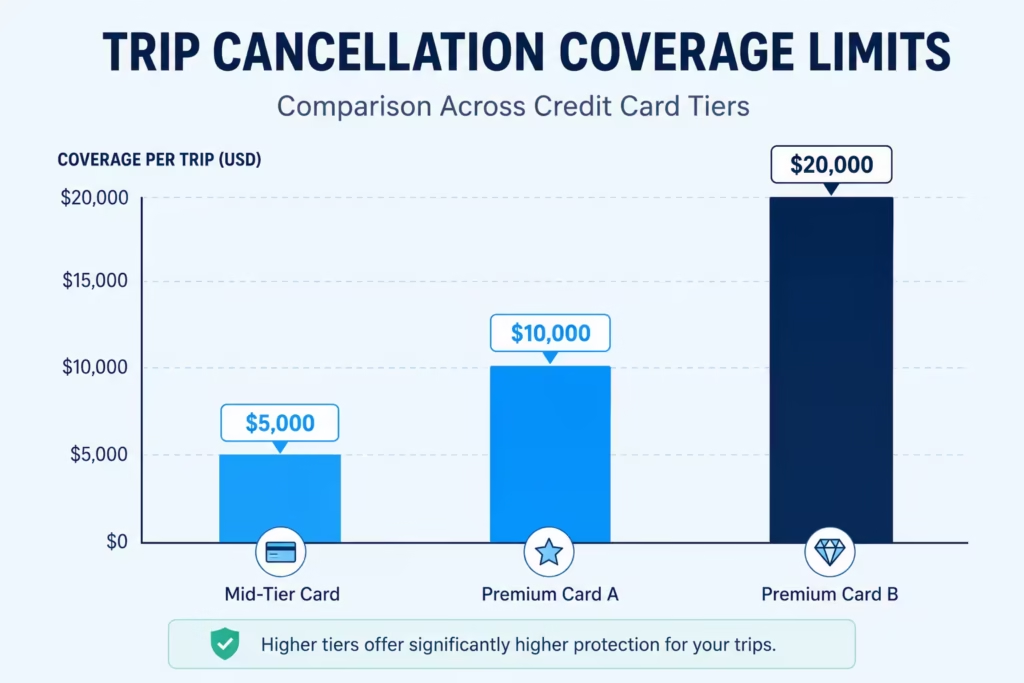
- Trip cancellation and interruption limits vary widely by card, ranging from around $1,500 per person on mid-tier cards up to $10,000 per person and $20,000 per trip on premium cards like the Chase Sapphire Reserve and American Express Platinum.
- Medical evacuation costs can range from about $10,000 to $250,000 depending on distance and medical needs, and most credit cards offer little or no coverage for this expense.
- No standard credit card benefit includes Cancel For Any Reason coverage, and pre-existing medical conditions are typically excluded through a lookback period applied before the trip was booked.
- Claim filing deadlines commonly fall between 20 and 60 days depending on the card and claim type, and missing or insufficient documentation is the most common reason claims are denied.
Best for:
- Travelers deciding whether their existing credit card coverage is sufficient for an upcoming trip or whether to buy supplemental insurance.
- Cardholders who want to understand exactly how to activate their coverage and avoid mistakes like split-card payments that leave part of a trip unprotected.
- International travelers assessing medical and evacuation risk before relying on credit card coverage alone.
What Credit Card Travel Insurance Is and How It Works
Credit card travel insurance is a free benefit that comes bundled with many rewards and travel cards. You never signed up for a separate policy. Instead, your card issuer pays an insurance company, often called a benefits administrator, to provide coverage on your behalf.
That setup creates a few important differences from a standalone travel insurance policy:
- Cost: Card coverage costs nothing extra. A standalone policy usually runs about 4% to 10% of your prepaid, nonrefundable trip cost, Squaremouth data shows.
- Scope: Card benefits tend to be narrower. They often cover trip cancellation, delays, bags, and rental cars, but medical coverage is thin or missing on many cards.
- Flexibility: A standalone policy lets you pick limits and add options. Card coverage comes as-is.
One more thing matters a lot here. This isn’t one uniform product. Benefits and limits vary widely by card, by issuer, and even between card tiers under the same brand. The Capital One Venture X caps trip cancellation at $2,000 per person for common carrier costs.
In contrast, the Chase Sapphire Reserve and the American Express Platinum Card cover up to $10,000 per trip. “My card has travel insurance” isn’t a yes-or-no fact. It’s the start of a question you need to answer for your specific card.
How to Activate Your Coverage
This is where costly mistakes happen, because coverage doesn’t apply automatically just because you own the card. The payment method is the trigger.
Here’s how credit card travel insurance works in practice:
- Charge the trip to the right card. The trip, or the relevant part of it, generally must be paid with the specific card that offers the benefit.
- Know your card’s payment rule. Some cards require you to pay the full fare. Others cover you if you charge “any portion” of the trip to the card. The American Express Platinum Card, for example, states that its trip cancellation and interruption insurance applies to round-trip purchases made entirely with the eligible card, per Amex’s published terms. Your card’s rule may differ, so check it.
- Points bookings can still count. When you book award travel with points and charge the taxes and fees to your covered card, coverage often still applies. This is common with Chase Sapphire cards, but confirm it in your own card’s guide.
- Split payments split protection. If you book flights on one card and the hotel on another to maximize points, only the charges on the covered card are protected. The hotel booked elsewhere isn’t.
- The account holder usually must be traveling. The cardholder usually needs to be on the trip to receive most benefits. However, trip cancellation and interruption coverage may also apply to immediate family members who are travelling with you.
⚠️ Mistake to Avoid: Booking different legs of one trip on different cards and assuming the whole itinerary is protected. Only the purchases charged to the covered card qualify.
Trip Cancellation and Interruption Coverage
This is the most-used and most-misunderstood benefit, so it deserves a close look.
Cancellation coverage reimburses you when a covered event forces you to cancel before departure. Interruption coverage kicks in when a covered event cuts your trip short, and it can also cover extra transportation costs to get you home.
Typical covered reasons include:
- Serious illness or injury to you, a traveling companion, or a close family member
- Death in the family
- Severe weather that stops your common carrier
- Jury duty or a subpoena you can’t postpone
- Military orders
Also important is what usually doesn’t qualify: changing your mind, general travel worries, or unnamed work conflicts in your card’s terms.
The caps vary a lot by card. Some mid-tier cards limit trip cancellation insurance to around $1,500 per person. Premium cards go much higher.
Chase Sapphire Reserve materials describe up to $10,000 per person and $20,000 per trip for cancellation and interruption, and Amex’s Platinum terms describe the same $10,000-per-trip figure with a $20,000 limit per card per 12-month period. Check your per-person coverage limit before you assume you’re protected.
Two rules apply almost everywhere. Only prepaid, nonrefundable expenses get reimbursed, so try for an airline or hotel refund first. The coverage window is important. Cancellation protection usually starts from your first trip deposit and lasts until you depart. Interruption coverage kicks in after you’ve left and covers the rest of your trip.
What Counts as a “Covered Reason”
A covered reason is a specific event named in your card’s policy that qualifies you for reimbursement. If your reason isn’t on the list, the claim gets denied, even if canceling felt completely reasonable to you.
Across major issuers, commonly covered reasons include:
- Sickness, injury, or death of the traveler, a companion, or an immediate family member
- Severe weather or a natural disaster affecting your departure point or destination
- Jury duty or a court subpoena
- Unannounced strikes that stop your carrier
- Your home being made uninhabitable by fire, flood, or burglary
- Terrorist incidents at your destination, on some policies
Lists vary by card, sometimes a lot. Verify your specific card’s covered reasons before you rely on them. Also, keep in mind two common gaps: “I changed my plans” is never covered, and pre-existing medical conditions are usually excluded. The exclusions section below covers both in more detail.
Trip Delay Coverage
Trip delay reimbursement is the benefit you’ll probably use the most. Weather delays and missed connections happen more often than full cancellations.
Most policies say a qualifying delay lasts a certain number of hours or requires an overnight stay. The delay must be caused by a common carrier, like an airline, train line, or cruise line. Deciding to leave the airport on your own doesn’t count.
When a delay qualifies, you can claim reasonable expenses like:
- Meals
- A hotel room for the night
- Toiletries and other essentials
- Ground transportation
Real figures show how much thresholds differ. Chase’s guide notes that Sapphire Preferred requires a delay of more than 12 hours, while Sapphire Reserve triggers after just 6 hours.
Both reimburse up to $500 per covered traveler. Capital One’s Venture X also offers up to $500 per person after a six-hour delay or an unexpected overnight stay.
Keep the difference between interruption and delay clear in your mind: a delay ends when your travel resumes. Interruption means the trip itself is cut short.
Baggage Delay and Loss Coverage
Baggage coverage is the benefit most likely to come up on an otherwise normal trip.
Baggage delay reimburses you for essential items you buy while your bags are in transit, once a delay threshold is met, commonly six hours or more. Think clothes, toiletries, and basics to get you through until your luggage arrives.
Lost, damaged, or stolen baggage coverage reimburses the value of your belongings up to a cap. Two limits apply here: a per-item cap and a total per-claim cap. Don’t pack high-value items like cash, jewellery, cameras, or business equipment in a checked bag. These items often have low limits or are excluded completely.
The filing order trips people up. Credit card baggage coverage is typically secondary to what the carrier owes you. First, file with the airline. Keep the airline’s claim reference number and written confirmation. Then, file with your card’s benefits administrator for any costs the airline didn’t cover. Skip the airline step and your card claim can be denied on paperwork grounds alone.
Emergency Medical and Dental Coverage
This section is the most critical in the article. The gap between what people think and what cards really offer is the largest here.
When a card includes emergency medical and dental coverage, it usually reimburses some treatment costs while you travel. This could cover things like an emergency room visit or urgent dental work, but only up to a modest limit.
The hard truth: many popular travel cards, including some premium ones, offer little or no emergency medical coverage. It is not a universal benefit the way trip cancellation is. Some cards skip it entirely.
Even where coverage exists, caps are often in the low thousands of dollars. A single hospital stay abroad can blow past that in days. And your domestic health insurance may not fill the gap, since many U.S. plans provide limited or no coverage outside the country.
The U.S. State Department is blunt about this: the U.S. government does not pay medical costs for Americans traveling abroad, and it urges travelers to confirm whether their health plan covers them overseas at all.
So is credit card travel insurance enough for international medical risk? Usually not. This is the single area where relying on your card alone is most likely to cause serious financial harm.
Medical Evacuation: The Biggest Coverage Gap
Medical evacuation coverage pays for emergency transport to adequate care or back home. It’s the largest single financial risk of traveling uninsured, and it’s the one most articles mention only in passing.
Real numbers explain why. UnitedHealthcare states that evacuation costs range from about $10,000 to $250,000. This depends on distance and medical needs. The State Department has also warned that air ambulance evacuations can cost hundreds of thousands of dollars.
Most credit cards offer little medical evacuation coverage. When they do, the limits often fall short of the actual cost of a long-distance evacuation.
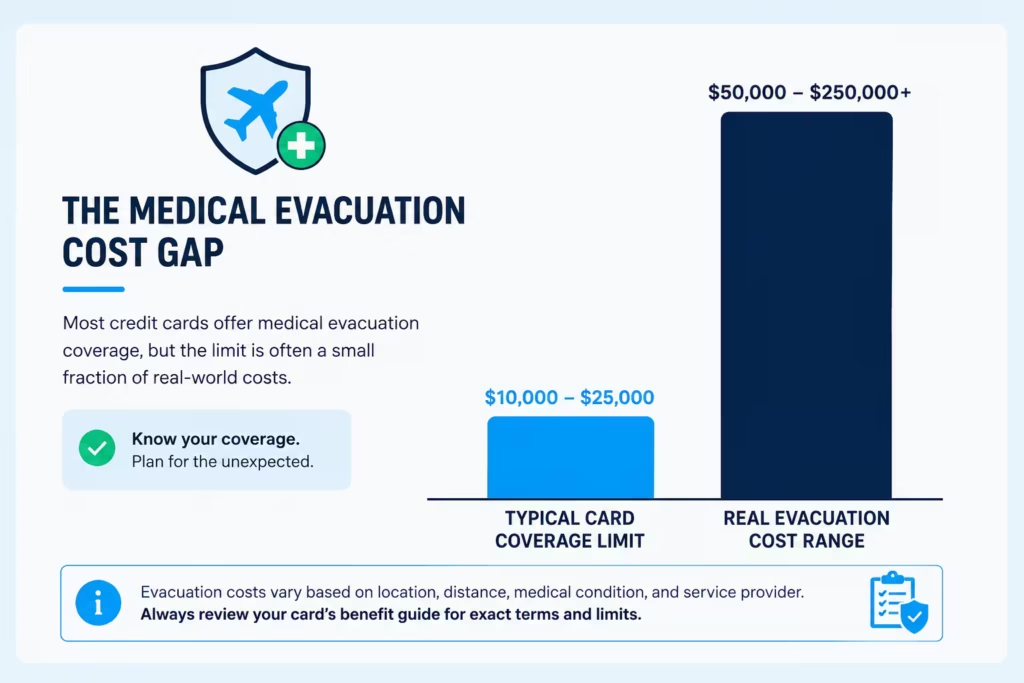
For international trips, especially to remote places or countries with few medical facilities, this gap often decides if a standalone policy is worth it.
📌 Did You Know: A medical evacuation from abroad can cost more than your whole trip, multiple times over. Many credit cards either don’t cover it or set limits far below the actual cost.
Rental Car Coverage (Collision Damage Waiver)
The rental car benefit, usually called a Collision Damage Waiver (CDW), covers damage to or theft of the rental vehicle itself. Some cards also cover towing and loss-of-use charges the rental company bills you while the car is being repaired.
To activate it, you usually need to do two things: decline the rental company’s CDW or LDW at the counter, and pay for the full rental with your covered card.
Now, the distinction that causes real trouble: primary vs secondary coverage.
With primary coverage, the card benefit pays first. Your personal auto insurance isn’t involved at all, so there’s no claim on your own policy and no risk of a premium increase from the rental accident.
With secondary coverage, the card pays only after your personal auto insurance has paid. That means filing a claim with your own insurer first, paying your deductible, and potentially seeing your rates go up. The card then covers what’s left, such as the deductible and fees your insurer didn’t pay.
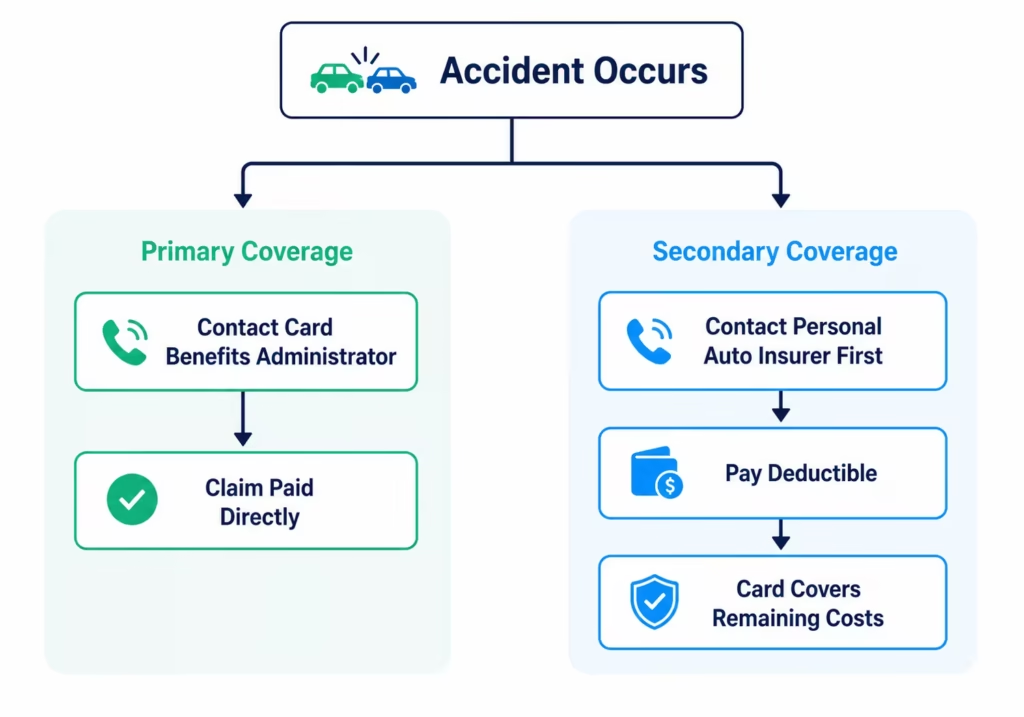
What this looks like in practice: at the counter, you decline the CDW either way. After an accident with secondary coverage, you call your own auto insurer first. After an accident with primary coverage, you go straight to the card’s benefits administrator. Even with primary coverage, the rental company might charge your card for damage right away. You’ll get reimbursed later after they process the claim.
Common exclusions catch people off guard:
- Exotic, antique, or high-value vehicles, and often large vans and trucks
- Rentals in certain countries, which vary by card
- Rental periods beyond a cap, commonly 15 consecutive days
- Injuries and liability. The CDW covers the vehicle only, not harm to people or other property
Your personal auto policy or a standalone rental policy handles liability. The card benefit does not.
What’s Excluded From Credit Card Travel Insurance
Exclusions cut across every benefit type, and they cause denials even when the paperwork is perfect. The big ones:
- Pre-existing condition exclusion. If a medical issue existed before you booked, claims tied to it are typically denied. Policies often use a “lookback period,” meaning they check whether the condition was treated, diagnosed, or changed in the months before you bought the trip.
- High-risk activities. Scuba diving at certain depths, mountaineering, skydiving, and similar activities often don’t qualify for medical and accident benefits.
- Excluded destinations. Sanctioned countries and sometimes specific high-risk regions aren’t covered. If a government travel warning applies, check your policy before you go.
- Excluded vehicles. As covered above, exotic cars, antiques, and oversized vehicles often fall outside rental coverage.
- Cancel For Any Reason (CFAR). No standard credit card benefit includes CFAR. If you want the freedom to cancel for a reason not on the list, only a standalone policy with a CFAR upgrade provides it.
- Known events. Insurance covers unforeseen problems. If a storm was already named or a strike was already announced when you booked, claims tied to it can be denied. The “foreseeability” rule is why buying early matters.
⚠️ Mistake to Avoid: Assuming a claim will be honored because the situation felt like an emergency. If the cause traces back to a pre-existing condition, a known event, or an excluded activity, expect a denial.
How to Find Out Exactly What Your Card Covers
Generic knowledge can only take you so far. Here’s how to pin down your own card’s terms in about ten minutes:
- Find your Guide to Benefits. This document is the authoritative source for your card’s credit card travel insurance coverage. Search your issuer’s website for your card name plus “guide to benefits,” or look in the benefits section of your online account. Chase publishes its Sapphire benefit guides publicly, and other issuers provide them on request or in your account portal.
- Check five things in it. For each benefit, note the coverage type, the dollar caps (per person, per trip, and per year), the covered reasons list, the exclusions, and the claim deadlines.
- Call the benefits administrator. If anything is ambiguous, call the number in the guide before you travel. The administrator, not the card’s customer service line, interprets the policy. Ask your question, note the date and who you spoke with, and get answers in writing by email when you can.
- Don’t assume tiers match. The same issuer’s cards can differ sharply. A no-fee card and a premium card under one brand may share a name but not coverage levels. Always verify the exact card product you hold.
How to File a Claim
Filing well is what turns a benefit on paper into money in your account. The general sequence:
- Report the incident promptly. Contact the benefits administrator as soon as you can after the loss. Deadlines to notify them are often short.
- Seek refunds from the provider first. Ask the airline, hotel, or rental company for reimbursement before filing with the card. Card coverage is often secondary, and skipping this step causes denials. “Reasonable efforts” means actually requesting the refund and keeping proof that you did, including written confirmation that the fare was nonrefundable.
- Gather your claim documentation. What you need depends on the claim type:
- Cancellation or interruption: Booking receipts for prepaid, nonrefundable costs, proof of the reason (like a doctor’s note with a diagnosis), and evidence of payment with the covered card.
- Medical: itemized invoices and a letter from the treating physician.
- Baggage: the airline’s claim reference number, written delay or loss confirmation, and receipts for items you bought.
- Submit within the window. Filing deadlines commonly fall between 20 and 60 days depending on the card and claim type. Mark the deadline the day the incident happens.
- Keep everything. Save every receipt, email, and reference number until the claim is fully paid.
Why Claims Get Denied (and How to Avoid It)
A large share of denials trace back to paperwork problems, not to the loss being uncovered. The most common causes:
- Missing or insufficient documentation. The single biggest cause. No physician’s note, no airline confirmation, no receipt, no payment.
- Filing late. Deadlines are firm.
- A reason that isn’t covered. Canceling for a cause not on your card’s list fails no matter how well you document it.
- Skipping the provider first. Not asking the airline or hotel for a refund before filing.
- Misreading the policy. Assuming coverage that was never there.
If you believe a claim was wrongly denied, request the denial reason in writing and compare it line by line against your policy language. Escalate to a supervisor at the benefits administrator if the denial doesn’t match the written terms. Where warranted, you can file a complaint with your state insurance regulator, since the benefit is an insurance product. That step is a real escalation path, not a guarantee of reversal.
Deciding If You Need Supplemental Travel Insurance
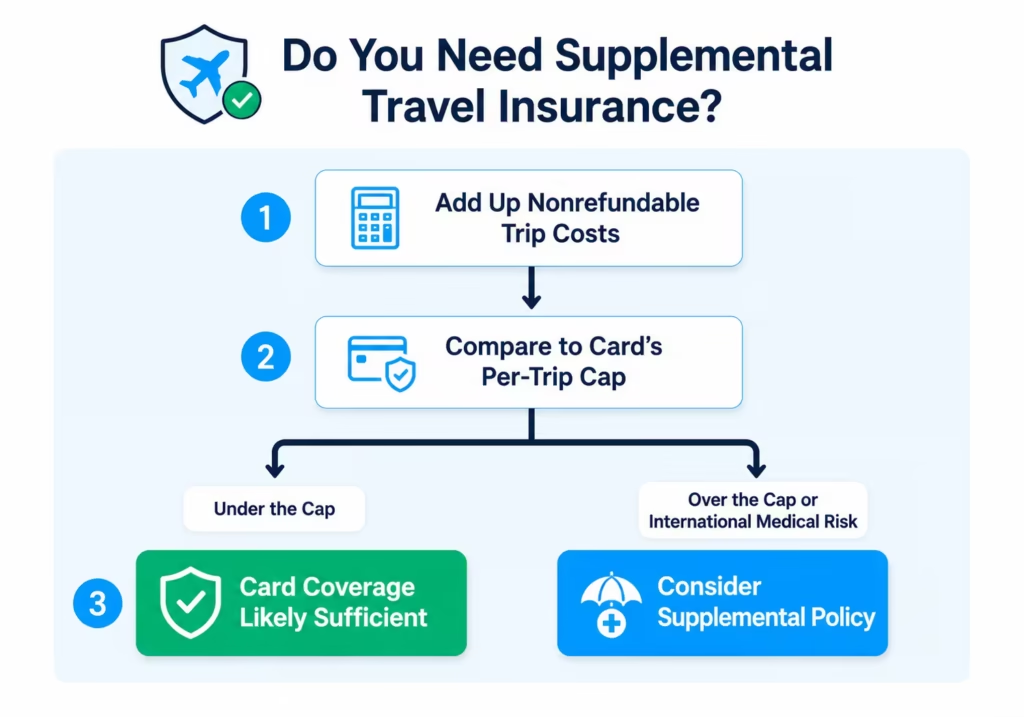
Here’s the payoff: a simple framework to decide whether your card is enough for this trip.
Step 1: Add up your exposure. Total your prepaid, nonrefundable trip costs: flights, hotels, tours, cruises, and anything else you can’t get back.
Step 2: Compare against your card’s cap. If your nonrefundable total sits comfortably under your card’s per-trip cancellation limit, the card likely covers the financial risk of canceling. A $3,000 trip on a card with a $10,000 cap? Fine. A $15,000 safari on a card capped at $2,000 per person? You have a real gap.
Step 3: Weigh the gaps money can’t cap. Ask three questions. Are you traveling internationally, where medical and evacuation risk is real? Does anyone on the trip have a health condition that could trigger the pre-existing condition exclusion? Do you genuinely need the flexibility to cancel for any reason? A “yes” to any of these points toward supplemental coverage.
When card coverage is usually enough: domestic trips, budget trips within your limits, and trips where your health insurance is valid.
When it typically isn’t: expensive trips beyond the cap, international travel with evacuation risk, travelers with pre-existing conditions, and anyone who needs cancellation flexibility.
On cost, comprehensive standalone policies generally run 4% to 10% of your prepaid trip cost, and the CDC’s Yellow Book notes that policies with broader cancellation flexibility can cost more. On a $5,000 trip, expect roughly $200 to $500 for solid standalone coverage.
Finally, this isn’t either/or. Card coverage and a standalone policy work in layers: your card handles what it covers first, and the standalone policy fills the gaps. For a big international trip, that combination is often the smartest play.
When Cancel For Any Reason Coverage Matters
CFAR is worth naming directly because so many travelers assume it exists on their card. It doesn’t. No standard credit card benefit includes Cancel For Any Reason coverage.
Bought as an upgrade to a standalone policy, CFAR typically reimburses 50% to 75% of your nonrefundable costs when you cancel for any reason at all. It usually must be purchased within a set window after your first trip payment, and it adds meaningfully to the policy price.
Who actually needs it? Travelers who are genuinely unsure about their plans include those caring for a health-vulnerable relative, people with unpredictable work schedules, or anyone booking an expensive trip that they might have to cancel for a reason not covered by the policy. If your reason for canceling would be “something came up,” CFAR is the only product that pays.
💡 Pro Tip: If you buy CFAR, purchase it right after your initial trip deposit. Most policies require you to add it within 10 to 21 days of that first payment, and the option disappears after the window closes.
Frequently Asked Questions (FAQs)
Do I get free travel insurance with my credit card?
Yes, many travel rewards cards include it at no extra cost beyond your annual fee. It’s not automatic in every situation, though, since you generally must pay for your trip with that specific card to trigger coverage.
What credit cards give you free travel insurance?
Cards like the Chase Sapphire Reserve, Chase Sapphire Preferred, and American Express Platinum include built-in travel insurance benefits. Coverage caps differ sharply between them, ranging from around $1,500 per person on mid-tier cards up to $10,000 per trip on premium ones.
How do I know if my credit card includes travel insurance?
Check your card’s Guide to Benefits document, available through your issuer’s website or your online account portal. It lists your exact coverage types, dollar caps, covered reasons, and claim deadlines.
Which credit card gives the best travel insurance?
The Chase Sapphire Reserve and American Express Platinum Card offer some of the highest caps, up to $10,000 per trip for cancellation and interruption. No card offers Cancel For Any Reason coverage or strong medical evacuation protection, so “best” still has real limits.
Which bank gives free travel insurance?
Chase, American Express, and Capital One all offer travel insurance on select cards, with benefits built into the card rather than sold separately. The Capital One Venture X, for example, caps trip cancellation at $2,000 per person, well below Chase and Amex’s premium tiers.
Do I need to do anything to activate my credit card’s travel insurance?
Yes, you must charge the trip, or the required portion of it, to the specific card offering the benefit. Booking one leg on a different card, even to earn more points, leaves that portion unprotected.
Does credit card travel insurance cover pre-existing medical conditions?
No, most credit card policies exclude claims tied to a pre-existing condition using a “lookback period” before your trip was booked. If your condition was treated or diagnosed shortly before booking, related claims are typically denied.
What is the difference between primary and secondary rental car coverage?
Primary coverage pays out directly without involving your personal auto insurer, so your rates stay untouched. Secondary coverage only pays after your personal insurance has paid first, meaning you file a claim, cover your deductible, and risk a premium increase.
Is credit card travel insurance enough for international medical emergencies?
Usually not. Many cards offer thin or no emergency medical coverage, and medical evacuation alone can cost $10,000 to $250,000 depending on distance and needs, far beyond typical card limits.
The Bottom Line
Your card gives great travel benefits, but there are rules. Use the right card, stay within limits, follow eligible reasons, and send complete documents on time.
The medical and evacuation gap is the biggest reason to think twice before relying on a card alone for international trips. A practical approach is to total your nonrefundable costs, check your Guide to Benefits, and fill only the gaps that matter.
For many readers, credit card travel insurance covers the basics. For bigger or riskier trips, a standalone policy adds extra protection. If someone you know is planning a trip and assumes their card “covers everything,” share this guide with them before they book.